

By: Dr.s Robert and Jill Malone
Audio Version:
The history of scientific revolutions reveals why established institutions resist change and why those who recognize emerging technologies early often gain the greatest advantage. In his groundbreaking book, The Structure of Scientific Revolutions, Thomas Kuhn explained why paradigm shifts are so difficult to recognize while they are happening, and why the scientific establishment so often resists the very discoveries that will transform the future.
To Begin:
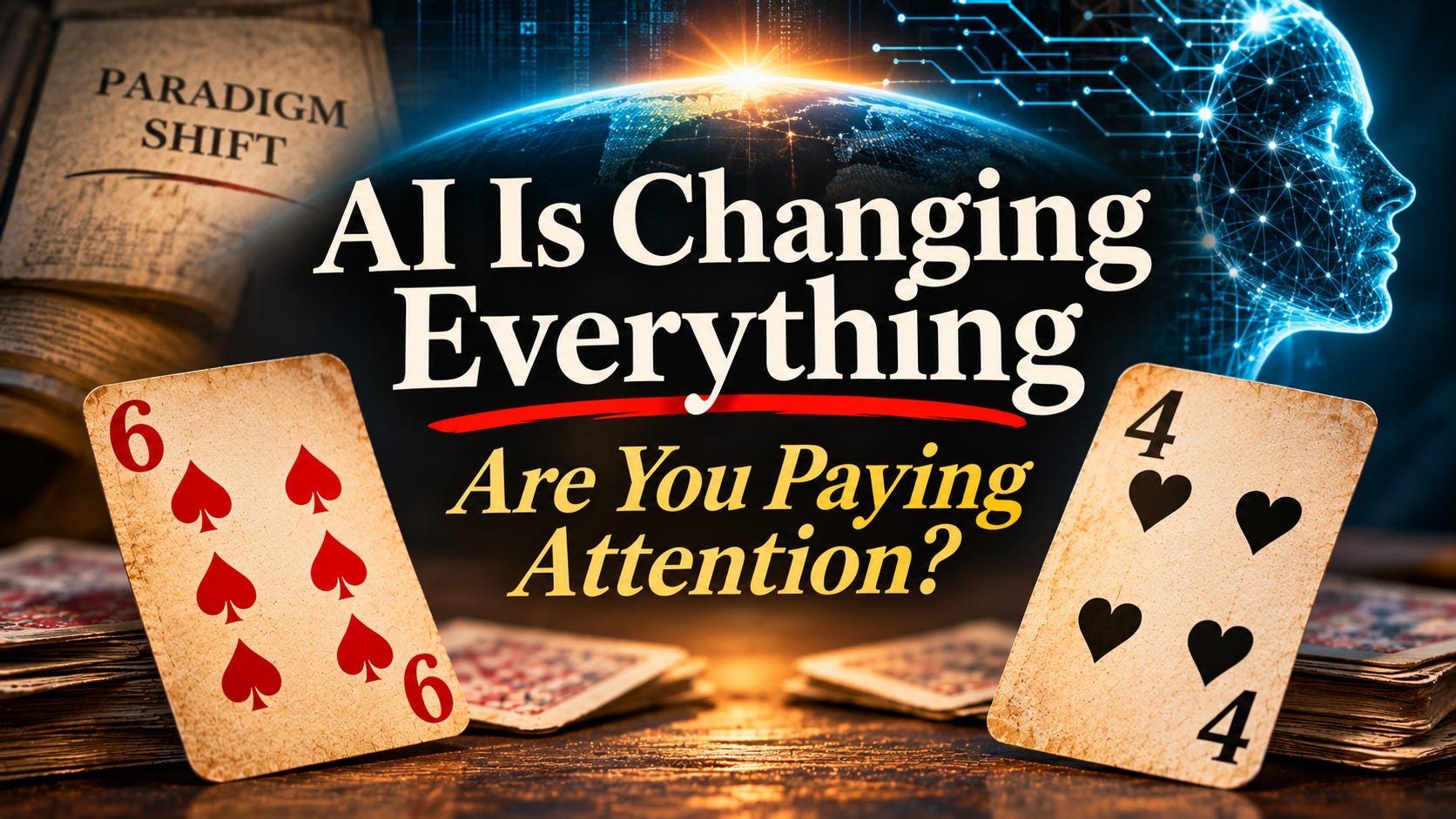
In 1949, Harvard psychologists Jerome Bruner and Leo Postman flashed playing cards at twenty-eight Harvard and Radcliffe students. Each card appeared briefly, and students identified what they saw. Most cards were ordinary. A few were deliberately wrong, such as a red six of spades or a black four of hearts.
Students confidently misidentified the trick cards. A red six of spades became a six of hearts. They fitted what they saw into familiar categories and missed the contradiction.
With longer exposures, some sensed something was wrong but struggled to explain it. Others never resolved the mismatch.
We believe much of the country is looking at artificial intelligence the same way. People see a more powerful search engine, a convenient writing assistant, or another technological innovation designed to make everyday tasks easier. What they fail to recognize is something far more profound: AI is fundamentally changing how we acquire knowledge, solve problems, conduct scientific research, and make decisions. The rules themselves are being rewritten, and most people have yet to grasp the implications.
What did Thomas Kuhn actually say about how science changes?
Physicist and historian Thomas Kuhn described the card experiment in his 1962 book The Structure of Scientific Revolutions, which popularized the phrase: “paradigm shift.” The slogan has since been worn thin by business consultants because the idea behind it is so powerful. Kuhn built on the work of Polish physician and microbiologist Ludwik Fleck, who argued in 1935 that scientists belong to “thought collectives” sharing assumptions about reality and proof.
For Kuhn, a paradigm is the framework a scientific community works within. It determines which questions matter and what constitutes a satisfactory answer. Scientists ordinarily solve puzzles inside that framework, a process Kuhn called “normal science.”
Eventually, results emerge that do not fit the established scientific framework. At first, scientists dismiss them as experimental errors or flawed methodology. But resistance often goes much deeper. Scientists who challenge the prevailing paradigm may face ridicule, rejection by scientific journals, denial of research funding, and professional isolation.
This was Robert Malone’s experience when he developed the foundational concepts behind mRNA and DNA vaccination and the use of RNA as a drug. Throughout the 1990s and 2000s, he was unable to secure substantial funding for his academic research. Yet decades later, other scientists and institutions received billions of dollars to advance technologies built upon those early discoveries. Meanwhile, the prestigious awards, professional recognition, and accolades largely went to others whose work followed from those original breakthroughs.
The scientific establishment has invested careers, reputations, and institutional resources in the existing framework. Those working at the cutting edge may be celebrated, but those at the bleeding edge, challenging the foundations of accepted science, can become threats to the establishment itself. As anomalies accumulate, the old framework eventually becomes harder to defend. Yet change rarely comes through one decisive experiment. Younger scientists may embrace the new paradigm while older colleagues remain committed to the old one. As a line attributed to physicist Max Planck puts it, science advances one funeral at a time.
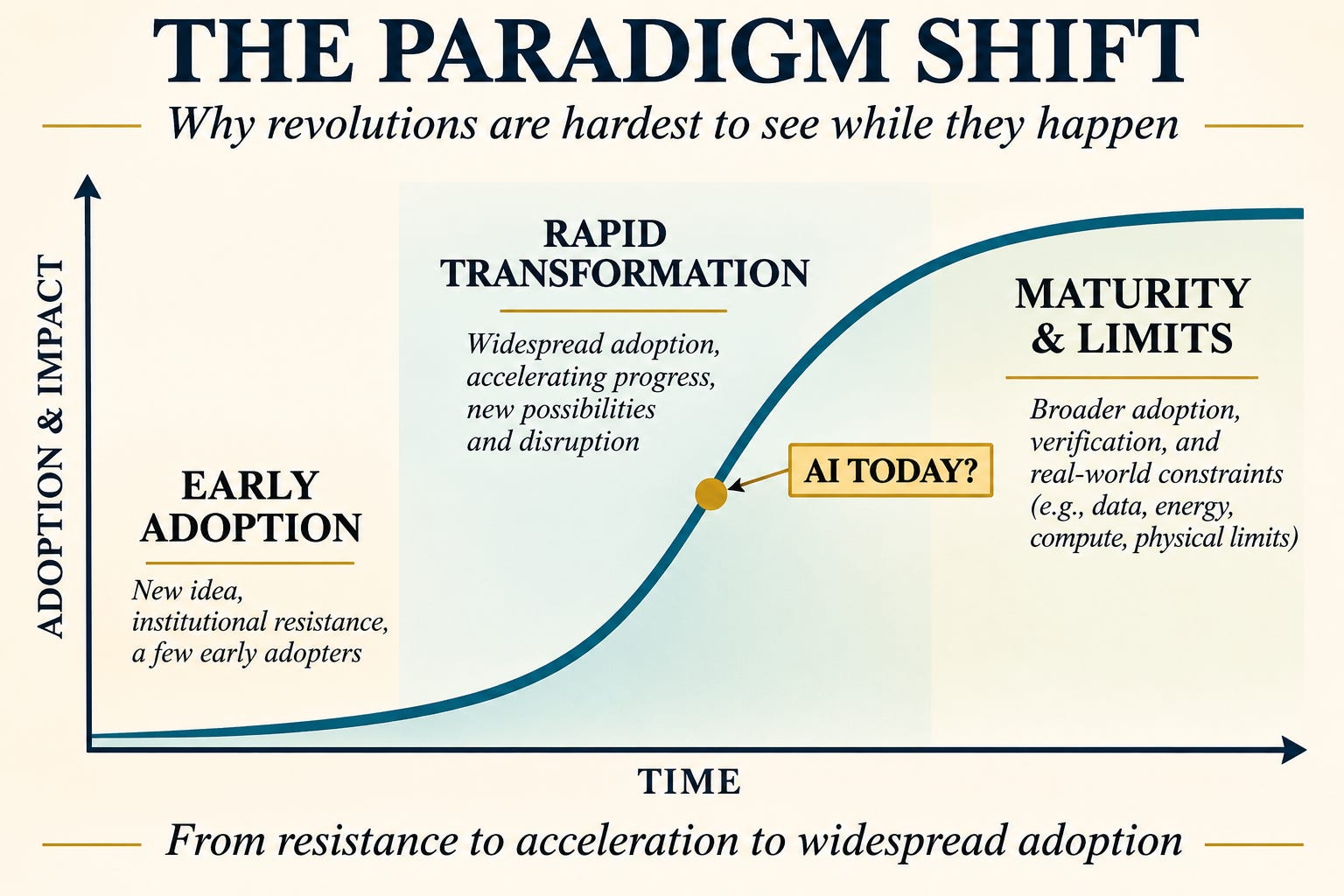
A new paradigm also opens problems previously considered insoluble or not worth asking. Progress accelerates as researchers tackle that backlog. Eventually, difficult new anomalies emerge and progress slows. We believe frontier AI is now in the period of rapid advance.
Why is a revolution so hard to see from the inside?
Kuhn argued that people interpret unfamiliar results through familiar categories, much like students confronted with an impossible playing card. Textbooks later present scientific revolutions as orderly progress, obscuring how disruptive and controversial they were at the time.
We are witnessing something similar with artificial intelligence. The rapid development of AI, particularly large language models (LLMs) such as ChatGPT, is challenging long-held assumptions about human intelligence, reasoning, creativity, and the nature of knowledge itself. Yet scientists and technologists remain deeply divided over what these systems actually represent.
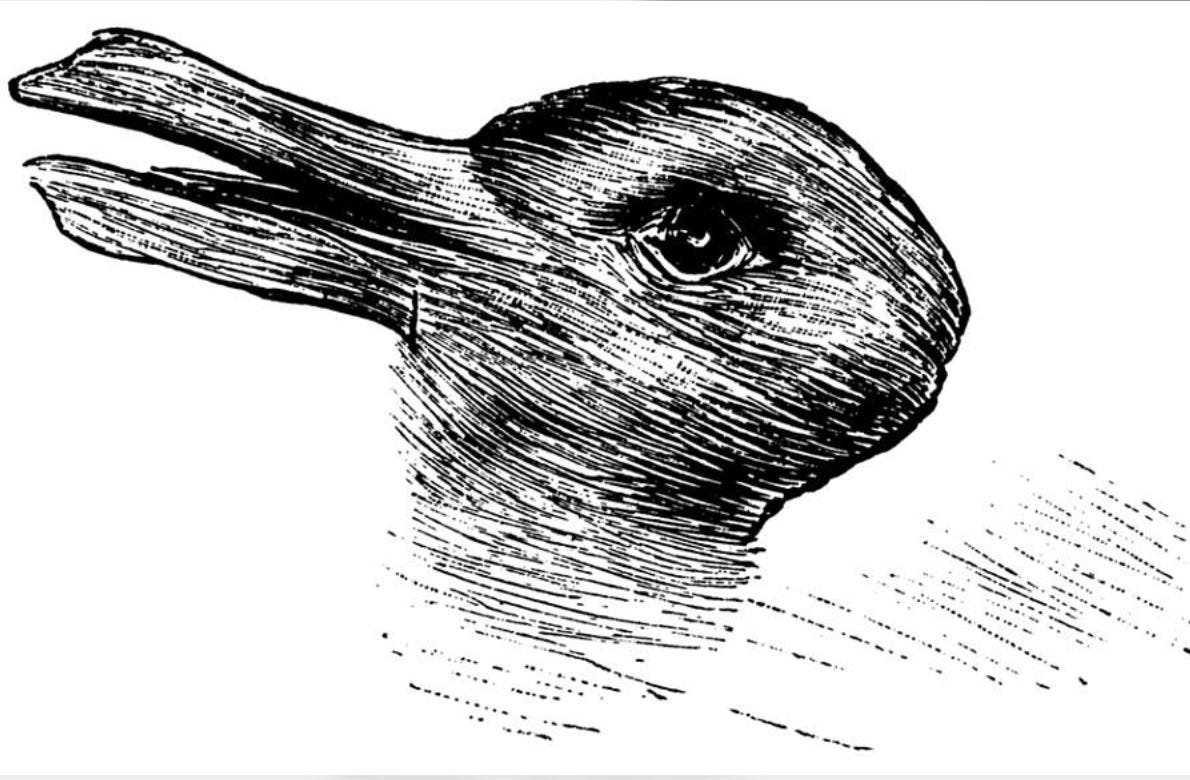
Some dismiss large language models as “stochastic parrots,” systems that assemble plausible language without genuine understanding. Others see the beginnings of an entirely new form of intelligence. Both camps observe the same remarkable capabilities but interpret them through fundamentally different frameworks, much like viewers who see either a duck or a rabbit in the same drawing.
Technology adoption often follows an S-curve: slow at first, then rapid, then leveling off.
An influential early study came from Iowa farm country. In 1943, sociologists Bryce Ryan and Neal Gross described how farmers in Scranton and Grand Junction adopted hybrid seed corn. It offered roughly 20 percent higher yields and better drought performance, yet some farmers adopted it a decade before their neighbors. Salesmen introduced the seed, but neighbors’ successful harvests often persuaded farmers to try it.
During the steep climb, it is hard to distinguish lasting change from hype. By the time a technology seems obvious, much of the advantage of early adoption may already be gone.
What counts as a solved problem now?
Critics argue that AI is merely a better tool, and a better microscope does not overturn a scientific paradigm. Kuhn’s more useful question is whether the standard for a legitimate answer has changed. In biology and medicine, that standard is shifting.
Proteins are chains of amino acids that fold into three-dimensional structures. Their shapes are central to their biological functions. For decades, predicting those shapes from amino-acid sequences was extraordinarily difficult. In 1987 and 1988, when one of us (Robert) was writing his first patent disclosures on RNA as a drug at the Salk Institute, determining a single protein structure by X-ray crystallography could require years of laboratory work.
In 2020, Google DeepMind’s AlphaFold demonstrated remarkably accurate predictions of many protein structures, work recognized in the 2024 Nobel Prize in Chemistry. AlphaFold predicts structures without fully explaining the physical pathway by which a protein folds.
Traditionally, scientists sought mechanisms that could explain and predict results. Increasingly, due to the use of AI, useful predictions arrive before a complete mechanistic explanation. When researchers accept those predictions as valuable answers, the standards of scientific practice change. That is part of what makes AI potentially revolutionary.
In June 2025, Nature Medicine published results from a Phase 2a trial of rentosertib, a candidate treatment for idiopathic pulmonary fibrosis. Insilico Medicine used AI to help identify the drug target and design the molecule. In the 71-patient trial, lung-function results favored rentosertib over placebo. Larger trials are still needed to establish safety and effectiveness.
The existing research system has problems of its own. Many published findings in medicine and psychology have proved difficult to reproduce. Peer review struggles with the volume of research, sometimes misses fraud, and is now grappling with AI-generated findings. Journals and academic institutions are imposing restrictions on AI use, sometimes treating the technology as a threat rather than a scientific tool. Bringing a discovery to patients can still take more than a decade. AI offers ways to overcome some of these barriers, but the institutions controlling scientific publication and recognition may be among the slowest to adapt. As would be expected, using Kuhn’s model of scientific revolutions.
Who gains when a technology revolution takes off?
Kuhn studied science, but economists extended similar ideas to technological change. In 1982, Giovanni Dosi described “technological paradigms” and their paths of improvement. In 2002, Carlota Perez examined five major technological revolutions, from the Industrial Revolution to information technology.
Perez identified two broad phases. During installation, early adopters and investors capture disproportionate gains. Speculation can produce bubbles and crashes, as in the dot-com boom. During deployment, technology spreads through the economy, institutions adapt, and benefits become more widely available.
Sociologist Robert Merton described a related dynamic in 1968: calling it the “Matthew effect.” Early recognition attracts funding, talent, and opportunities, producing further success. Initial advantages reinforce themselves.
AI may accelerate that process. Using the tools that AI provides teaches you to use them more effectively. Better use generates better results and more experience.
Regulation can reinforce the early leaders. Restrictions on open-weight AI models, which people can download and run independently, risk entrenching the largest technology companies. Perez’s framework helps explain why established firms might favor regulatory barriers that discourage new competitors. The major AI corporations have also amplified public and legislative concerns about AI safety while advocating regulations that smaller competitors may struggle to meet. Whether motivated by genuine safety concerns, commercial self-interest, or both, the result is the same: regulations that protect the dominant corporations, limit competition, and concentrate control over AI in fewer hands.
Does the early lead last?
Kuhn observed that early believers sometimes embrace a new paradigm before the evidence fully supports it. Many proposed revolutions fail. But we believe AI is different because measurable advances are already transforming entire fields, and these changes are happening within years rather than generations.
History also shows that being first does not guarantee lasting success. Early adopters often enjoy substantial advantages, but those advantages shrink as new technologies become cheaper and more widely available. Iowa farmers who adopted hybrid corn early enjoyed better yields for years, but eventually their neighbors could buy the same seed and enjoy the same benefits.
The lesson for AI is simple: Being first is not enough. What matters is what you do with that early advantage. Those who use AI to build businesses, develop valuable skills, solve problems, and create lasting assets will be better positioned than those who simply experiment with the technology. Once AI becomes commonplace, merely knowing how to use it will no longer provide a competitive advantage.
Where does the curve flatten?
Every technological revolution eventually encounters limits, and AI is no exception. One of its biggest challenges is verifying that its answers are correct. AI can generate information, predictions, and proposed solutions far faster than humans can check them. For example, AI might identify thousands of promising new drugs in a matter of hours, but scientists must still test those drugs in laboratories, animals, and human clinical trials to determine whether they are safe and effective. That process can take years, regardless of how quickly AI identifies a promising candidate.
The physical world imposes other limits. AI can accelerate scientific discoveries, but it cannot make a laboratory animal age faster or a patient recover sooner.
AI also requires enormous amounts of electricity, powerful computers, and vast quantities of information to train its systems. The most advanced AI models depend on massive data centers that are expensive to build and operate. Meanwhile, disputes over copyrighted training materials, along with government regulations and resistance from established institutions, may slow progress.
AI is advancing at an extraordinary pace, but that growth cannot continue indefinitely. Nobody knows when it will slow, what the ultimate limitations will be, or how much the world will change before that happens.
What can you do while the curve is still steep?
Start using AI on real problems now. Your practical experience will accumulate, and it becomes harder to catch up as others learn. Begin with something you already do: financial records, correspondence, or researching a medical question before an appointment.
Make what you learn durable. Document useful methods, teach family members or staff, and preserve the solutions that work.
Keep control of your own data. As AI becomes cheaper and available to everyone, the real advantage may lie in the information you possess. Your business records, research, customer information, and accumulated knowledge can make AI far more useful to you. Organize that information, keep secure copies, and avoid becoming dependent on AI companies that control access to your data. The tools may eventually be available to everyone, but your own information and experience are uniquely yours.
Verify the output. AI systems can be confidently wrong. The ability to recognize errors, test claims, and exercise judgment will become increasingly important.
Keep AI accessible to everyone. Government regulations should not make AI so expensive or difficult to use that only the largest corporations can afford it. Open-weight AI models, which people can download and run independently, help preserve competition and individual freedom. Regulations that impose costly licensing requirements or restrict access could put these tools beyond the reach of ordinary Americans, small businesses, and independent researchers. AI should not become another technology controlled by a handful of powerful corporations working hand in hand with government regulators. At the same time, independent testing remains essential to ensure that AI-generated results are accurate and reliable.
We believe historians will judge this century’s educated mind partly by how well it understood AI, just as calculus became a foundation of technical literacy in the twentieth century.
During the twentieth century, an understanding of calculus and the ability to apply it became hallmarks of a technical education. Engineers and scientists were expected to know how to use calculus to solve problems, even if they could not explain every mathematical principle underlying it.
History offers a warning about falling behind. Following the development of calculus by Isaac Newton and Gottfried Leibniz, British mathematicians remained committed to Newton’s methods and notation, while their European counterparts adopted Leibniz’s more flexible approach. Continental mathematicians subsequently made major advances, while British mathematics became increasingly isolated.
We believe something similar may happen with artificial intelligence. The ability to understand, evaluate, and effectively apply AI tools may become as fundamental to technical education in the twenty-first century as calculus was in the twentieth. Those who master these tools will be better equipped to solve problems, conduct research, and develop new technologies. Those who dismiss them risk being left behind, not because they lack intelligence or education, but because the tools and methods of their professions have changed.
Help us change the paradigm. Share this article!
If AI really is changing everything, shouldn’t more people understand what’s happening before the “AI revolution” passes them by?
Please share this article with friends, family, colleagues, and especially those who still think AI is just a fancy search engine.
Post it on X, Facebook, LinkedIn, or Substack. Restack it, email it, or republish it with attribution and a link to Malone.News.
Back to the red six of spades card experiment
Few of Bruner and Postman’s students recognized the red six of spades immediately. Those who eventually did were the ones who noticed something was wrong, questioned their assumptions, and looked again.
We believe we are living through a similar moment in history. Artificial intelligence is challenging fundamental assumptions about knowledge, intelligence, scientific discovery, and human capability. Yet many people continue to interpret what they are witnessing through the familiar framework of the past.
The question is no longer whether AI will change our world. It already is. The question is whether we will recognize the transformation unfolding before us, learn to use these new tools, and help shape what comes next, or remain committed to the old ways until the revolution has passed us by.
The red six of spades is right in front of us. Are we willing to see it?
The AI revolution is here. But independent journalism still requires actual humans, working long hours, and asking difficult questions.
If you value the research, analysis, and independent thinking we bring to Malone.News, please consider upgrading your free subscription to a paid one.
Your paid subscription helps keep this work independent, free from corporate sponsors, government funding, and the fashionable opinions of the establishment.
The robots aren’t paying our bills yet. Perhaps you could help?
Thank you for reading, questioning, and supporting Malone.News. We couldn’t do this without you.
References
Berkeley, George. The Analyst. London, 1734.
Bruner, Jerome S., and Leo Postman. “On the Perception of Incongruity: A Paradigm.” Journal of Personality 18 (1949): 206–223.
Dosi, Giovanni. “Technological Paradigms and Technological Trajectories.” Research Policy 11 (1982): 147–162.
Fleck, Ludwik. Genesis and Development of a Scientific Fact. 1935. Reprint, Chicago: University of Chicago Press, 1979.
Horner, John M., and San K. Tung. “Playing Cards with Thomas Kuhn: A Critical Reexamination of the Bruner and Postman (1949) Experiment.” Review of General Psychology (June 2011). doi:10.1037/a0023597.
Jumper, John, et al. “Highly Accurate Protein Structure Prediction with AlphaFold.” Nature 596 (2021): 583–589.
Kuhn, Thomas S. The Structure of Scientific Revolutions. Chicago: University of Chicago Press, 1962.
Lieberman, Marvin B., and David B. Montgomery. “First-Mover Advantages.” Strategic Management Journal 9 (1988): 41–58.
Meier, Chris, Nigel Markey, and Casper van Langen. “How Successful Are AI-Discovered Drugs in Clinical Trials?” Boston Consulting Group, 2024.
Merton, Robert K. “The Matthew Effect in Science.” Science 159 (1968): 56–63.
Perez, Carlota. Technological Revolutions and Financial Capital: The Dynamics of Bubbles and Golden Ages. Cheltenham: Edward Elgar, 2002.
Ryan, Bryce, and Neal C. Gross. “The Diffusion of Hybrid Seed Corn in Two Iowa Communities.” Rural Sociology 8 (1943): 15–24.
Xu, Zuojun, et al. “A Generative AI-Discovered TNIK Inhibitor for Idiopathic Pulmonary Fibrosis: A Randomized Phase 2a Trial.” Nature Medicine (June 2025).
AI is certainly creating a technology revolution. The question becomes who will control the use and direction of AI? I see firewalls being built to exclude knowledge resources from being accessed. I see corporations using AI to replace human interface. You now have to ask AI for permission to talk to a human to resolve a problem that does not fit the basic programed conflicts. I see AI in medicine to be directed towards maintaining the allopathic medicine model which runs on chemical and now RNA intervention to treat disease states, rather than use AI to eliminate the root causes of ill health that is grounded in lifestyle issues and manipulated food sources. As a research tool it has value if input is not limited. I believe if all Hippa data was accessible for AI analysis, we would quickly learn what the root causes of disease states are which includes the chronic consumption of prescription drugs that were marketed with false research data. The mega push to find RNA injections as the new treatment module for disease states speaks volumes that we are facing great risks if AI is controlled and manipulated. My thoughts on the issue.
Thank you both, for this has been my own general experience in medical and science research. I'm now retired from it, but this is a better way than I could have ever explained it to colleagues and others.
This stack constantly reinforces my own views and beliefs. THANK YOU So Much for all your work!🕊️🙏🌞