

America’s Digital Fortress Is Finally Being Built
President Trump’s new Cyber Strategy doesn’t just play defense — it goes on offense. Here’s why that matters.
For decades, America’s approach to cybersecurity was roughly equivalent to installing a screen door on a submarine. We built bureaucracies, published strategies, held hearings, and watched as China, Russia, Iran, and an entire criminal underworld walked through our digital defenses like they owned the place. Salt Typhoon. SolarWinds. Colonial Pipeline. The Office of Personnel Management breach. The list of humiliations is long, and the response from Washington was — in almost every case — a shrug, a task force, and another 400-page report nobody read.
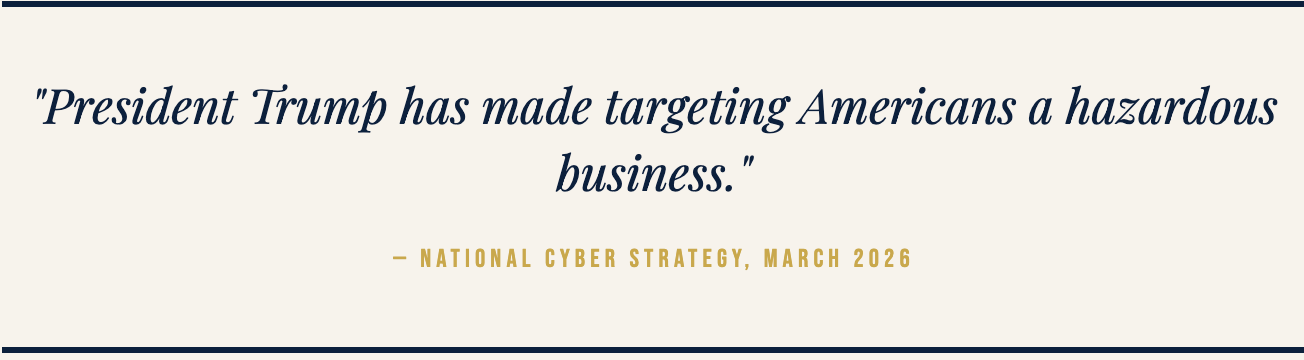
That era is over. The Trump Administration’s National Cyber Strategy for America, released this month, represents the most direct, assertive, and frankly honest cyber policy document to come out of the White House in a generation. It doesn’t traffic in the usual Beltway euphemisms. It doesn’t pretend the problem is primarily one of “awareness” or “information sharing.” It names adversaries, acknowledges hard truths, and most importantly — commits to going on offense

.That single sentence should send a chill down the spine of every hacker working for the People’s Liberation Army and every ransomware gang operating out of Eastern Europe. It means what it says: attack America in cyberspace, and the response may not come back through a keyboard. It might come through sanctions, indictments, or something considerably less pleasant. The era of consequence-free digital aggression against the United States is being declared over.
Why Previous Strategies Failed
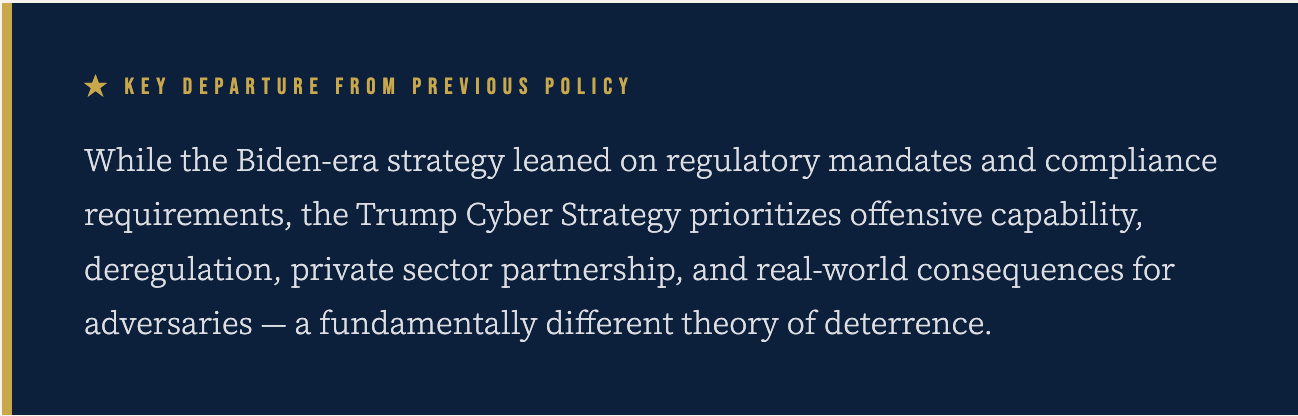
To understand why this document matters, you have to understand how thoroughly the previous approach failed. The Biden Administration’s 2023 cyber strategy was a well-intentioned document that prioritized regulation, compliance frameworks, and, inevitably, a thicket of new mandates on the private sector. The theory was that if you burdened American companies with enough reporting requirements and liability exposure, security would improve. The results speak for themselves: major breaches of federal telecommunications infrastructure, Chinese hackers maintaining persistent access to critical networks for months, and ransomware attacks on hospitals that cost lives.
The Trump strategy makes a sharp break. It explicitly commits to reducing regulatory burden on the private sector, recognizing what any competent CTO already knows — compliance theater is not security. Checking boxes doesn’t stop nation-state hackers. Speed, agility, and genuine technical capability do
Six Pillars, One Clear Vision
The strategy is organized around six policy pillars, and reading them together, a coherent and serious vision emerges. This is not a document designed to be filed away. It is a declaration of intent.
1. Shape Adversary Behavior
The U.S. will deploy the full suite of offensive and defensive cyber operations and unleash the private sector to help identify and disrupt adversary networks. The goal is to impose real costs before attacks succeed, not just clean up afterward. This is deterrence through strength, not deterrence through paperwork.
2. Promote Common Sense Regulation
Cyber defense should not be a costly compliance checklist. The administration will streamline regulations, reduce burdens on industry, and restore agility to the private sector — enabling companies to respond to threats at the speed those threats actually move.
3. Modernize Federal Networks
Zero-trust architecture, post-quantum cryptography, AI-powered defense tools, and genuine cloud transition. The federal government will finally modernize its aging digital infrastructure rather than defending legacy systems that were never built for today’s threat environment.
4. Secure Critical Infrastructure
Energy grids, hospitals, financial networks, water systems. The administration will harden these targets and move away from adversary vendors. The era of Chinese hardware inside American critical infrastructure must end.
5. Sustain Technological Superiority
AI, quantum computing, blockchain. America will secure its lead across every frontier of emerging technology and counter foreign AI platforms that embed censorship and surveillance into their architecture.
6. Build the Cyber Workforce
The administration calls the cyber workforce a strategic national asset and commits to building a robust pipeline through academia, vocational training, and private-sector partnerships — removing bureaucratic obstacles that have kept talent out of government service.
The Proof Is Already in the Record
Critics will say — as they always do — that a strategy document is just words. But the Trump Administration has already demonstrated it means business. The document itself points to concrete examples: the seizure of $15 billion from online scammers’ networks, cyber operations supporting the dismantling of Iran’s nuclear infrastructure, and the digital operations that supported the capture of Nicolas Maduro. These are not hypothetical capabilities. They are deployed, operational, and effective.
This matters because deterrence only works when adversaries believe threats are credible. Under previous administrations, the implicit American posture in cyberspace was one of studied restraint — absorb attacks, attribute them with careful diplomatic language, and issue strongly-worded statements. The result was predictable: our adversaries concluded the cost of attacking us was low. The Trump strategy changes that calculus fundamentally
The AI Dimension Nobody Is Talking About
Perhaps the most forward-looking aspect of the strategy is its treatment of artificial intelligence — both as a weapon to be wielded and a vulnerability to be defended. The document commits to rapidly deploying AI-enabled cyber tools for detection and defense, and to promoting “agentic AI” — autonomous systems that can operate at machine speed to disrupt adversary attacks before human analysts even see them.
This is the right instinct. The next generation of cyber conflict will not be fought at human speed. It will be fought by algorithms against algorithms, and the side with the more capable AI — and the fewer regulatory constraints on deploying it — will win. By explicitly embracing AI-powered defense and calling out the threat of foreign AI platforms that embed surveillance and censorship, the strategy positions America to compete on the frontier that actually matters.
What Conservatives Should Take Away
This strategy reflects something conservatives have long argued: that genuine security requires strength, not compliance; deterrence, not appeasement; and American exceptionalism, not multilateral deference. It treats the private sector as a partner rather than a problem to be regulated. It treats adversaries as adversaries rather than stakeholders to be engaged. It treats American cyber operators as warriors worthy of respect and resourcing.
Most fundamentally, it treats cyberspace the way Ronald Reagan treated the Soviet nuclear threat — not as a permanent condition to be managed, but as a problem to be solved through superior capability, clear commitment, and the willingness to impose consequences. The strategy is, at its core, a statement that America intends to win.
After years of playing defense in a domain we invented, that’s exactly the posture this moment demands.
The full text of President Trump’s Cyber Strategy for America was released by the White House in March 2026. Readers are encouraged to review the primary document.

Love the picture of Ronnie with a keyboard. That was him acting there for sure. Lol. How the Dems just fight everything just shows they want this country to die. People are seriously protesting the killing of Khomeni! You cannot have a weak defense and be a strong country. Sometimes you have to go on the offense to have a strong defense. In the age of the internet there is no way the US should take a backseat to any country. We built it! No reason not to be the masters of it. I love peace through strength. Trump is showing the world the US is still the strongest country in the world and everyone should be feeling patriotic over it. I know I am. Even with those who wish to destroy the country from within there should be enough of us patriots to have the majority over them. Love it or leave baby.
Yay, finally!