


Every season brings a new health scare, a new public health grift. This spring it is ticks.
Open a newspaper, turn on the television, or scroll through social media, and you will be told that America is facing a terrible tick season. Lyme disease is spreading. Alpha-gal syndrome is lurking in the woods. Emergency rooms are seeing record numbers of tick bite patients. Public health officials are warning the public to take precautions.
The evidence most often cited comes from the CDC’s Tick Bite Tracker. Earlier this year, the agency announced that emergency department visits related to tick bites were running at the highest level for this point in the season since 2017, when the program began.
That sounds alarming until you look at what is actually being measured.
The CDC is not measuring ticks. The CDC is tracking people who seek medical care in emergency rooms after a tick bite.
Furthermore, the CDC database lists only three years in total, as shown below. The data for 2018-2024 are unavailable. Three data points, that’s all we have:
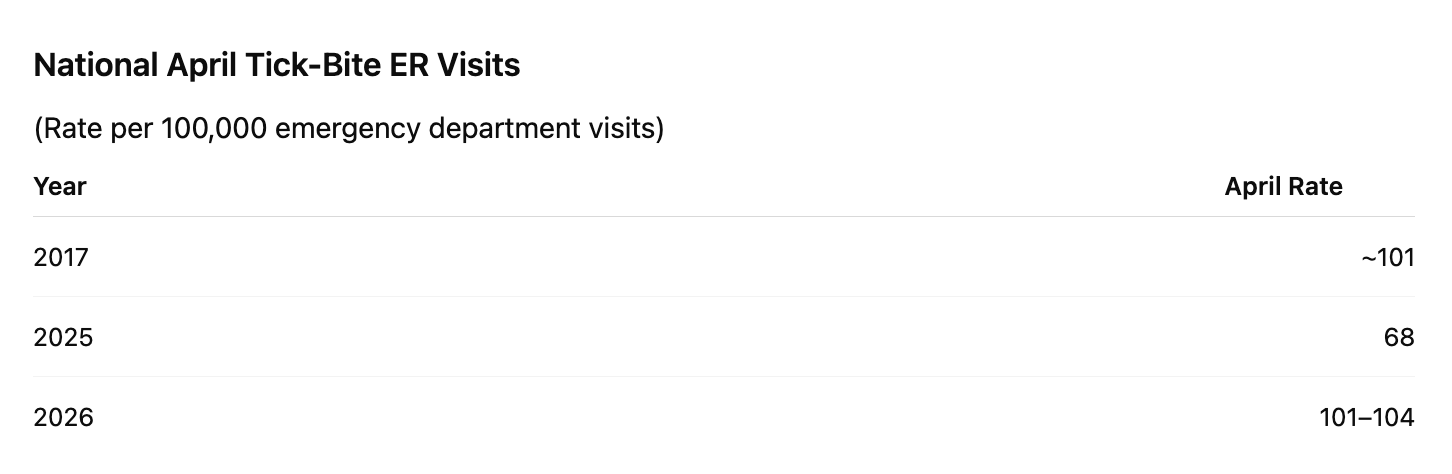
Also note that this is an expression of tick-bite chief complaints per emergency department visit, not all tick bites, or even tick bites at doctors’ offices. Only people who were so scared of a tick bite that they went to the emergency room, as opposed to a doctor’s office. That just reeks of fear porn driving this epidemic of tick bite-related ER visits.
Those are not the same thing.
A rise in emergency room visits could, theoretically, reflect an increase in tick activity.
It could also reflect increased media coverage, greater public awareness, more physician referrals, more urgent care advertising, more telemedicine consultations, and greater anxiety.
The surveillance system does not distinguish between these possibilities. It simply counts visits. It could also reflect that during the COVID years - which for some, included 2025, many people stayed mostly indoors, particularly in the winter/spring - during “flu, RSV, and COVID season.”
Yet the headlines routinely leap from “more people sought medical care” to “there are more ticks” and then from “there are more ticks” to “the danger is increasing.” And finally, to conclude that tick populations are increasing. Without any evidence whatsoever. This is the usual corporate (pharma-sponsored) and social media (often also pharma-sponsored) fear porn marketing cycle. In other words, the Grift of Fear.
That is not what the data show.
The distinction matters because the public conversation around tick bites has changed dramatically over the last decade.
People who grew up farming, hunting, logging, surveying land, hiking, or working outdoors will remember a very different message. A tick bite was considered an exposure. You removed the tick. You monitored for symptoms. You paid attention to your health. Most people did not rush to an emergency room after finding a tick attached to their leg. Real farmers and sportsmen recognize that this would be a waste of time and money.
Today, the message is different. Tick bites themselves are increasingly treated as medical events. Public health agencies, healthcare systems, media outlets, and advocacy organizations routinely encourage people to seek professional evaluation following tick exposure. The bite is no longer merely an exposure requiring observation. It is increasingly presented as a reason to enter the healthcare system.
That shift alone has the potential to change surveillance numbers.
The CDC can tell us that more people are showing up at emergency departments because of tick bites. What it cannot tell us is why.
How much of the increase reflects more ticks?
How much reflects more disease?
How much reflects heightened awareness?
How much reflects changes in medical guidance?
How much reflects media coverage?
How much reflects public anxiety?
The current crude surveillance system cannot answer those questions. But it can be weaponized very nicely to promote fear. A self-licking ice cream cone.
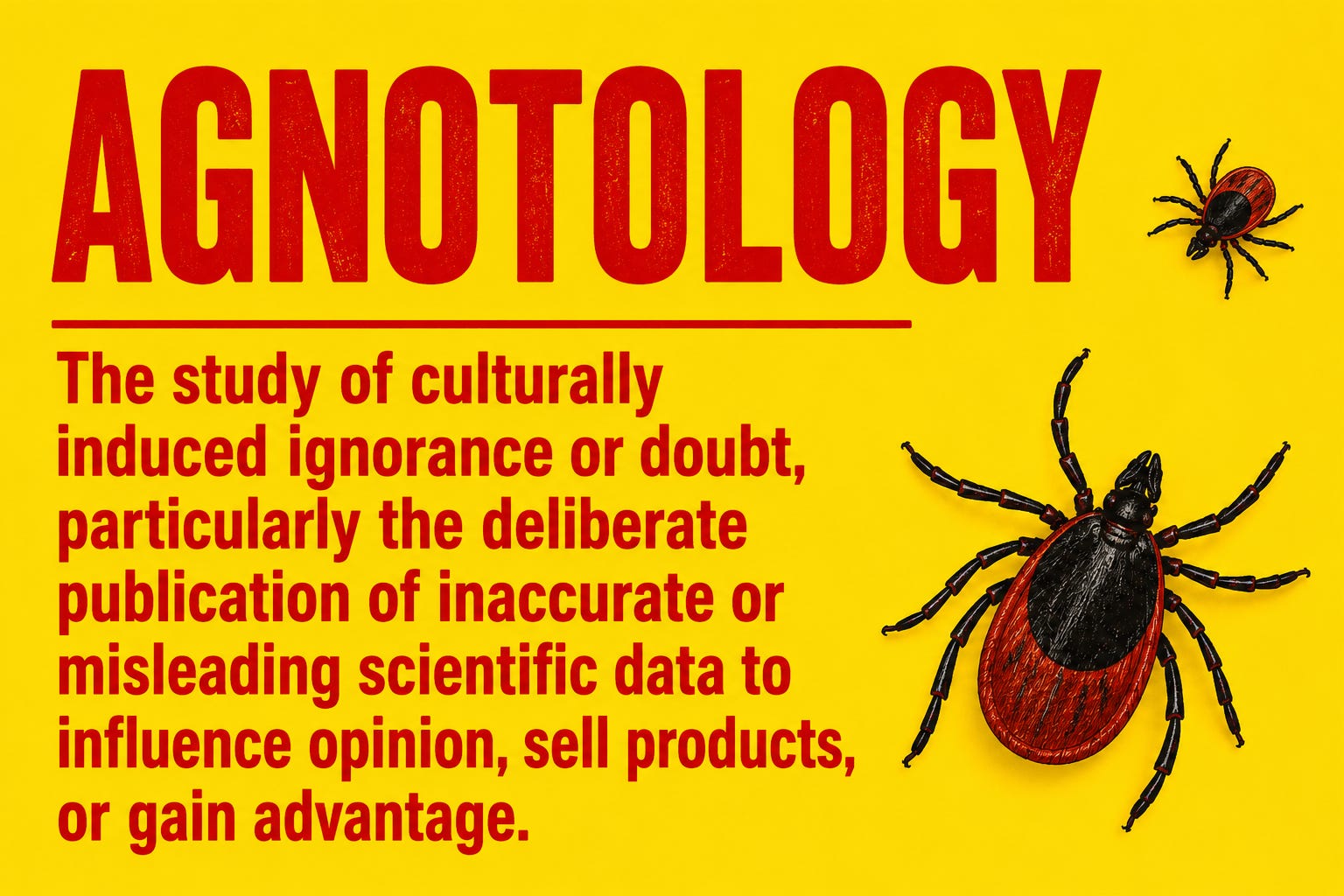
From the perspective of agnotology, the study of how ignorance and misunderstanding are created, maintained, and then utilized for ulterior purposes (propaganda) in science, this is an important distinction. An increase in medical encounters can be presented as evidence of a worsening threat even when part of that increase is driven by awareness campaigns, media attention, advocacy efforts, or changes in public guidance rather than a proportional increase in actual disease.
The data alone cannot disentangle those factors.
That does not mean Lyme disease is not real. It is.
That does not mean alpha-gal syndrome is not real. It is.
Nor does it mean that tick populations have not expanded in some regions.
What it means is that healthcare utilization is not the same thing as biological risk. Yet much of the reporting (and social media “outrage farming” hype) treats the two as interchangeable.
The timing of this year’s coverage makes the problem even more obvious.
Over the past year, Secretary Robert F. Kennedy Jr. has elevated Lyme disease and related tick-borne illnesses to a national priority. Federal initiatives have been announced. Roundtables have been convened. Diagnostic programs have received attention. HHS communications have repeatedly highlighted Lyme disease and alpha-gal syndrome.
Awareness campaigns work.
When government officials spend months drawing attention to a condition, more people think about it. More people look for it. More people seek care. More people report exposures that previously would have gone unreported.
That is not a criticism of Kennedy. It is simply a fact of public health surveillance.
The same thing happens with influenza awareness campaigns. It happened during COVID. It happens with skin cancer screening campaigns. Public attention campaigns change public behavior, and often in unintended ways.
What is remarkable is that almost no one discussing the CDC’s numbers seems interested in acknowledging this possibility.
Instead, every increase in healthcare encounters is quietly interpreted as evidence that the underlying threat must be worsening.
Perhaps it is.
But that conclusion has not been demonstrated.
If public health officials want to prove that 2026 is an unusually dangerous tick year, there are far better ways to do it.
Show us field surveys demonstrating higher tick densities.
Show us standardized tick-drag studies.
Show us infection rates in collected ticks.
Show us evidence that Lyme disease, ehrlichiosis, babesiosis, Rocky Mountain spotted fever, or alpha-gal syndrome are actually increasing beyond historical trends.
Show us measures that are independent of media coverage and healthcare-seeking behavior.
Instead, the public is being asked to infer a biological conclusion from a behavioral metric.
That is a surprisingly weak foundation for such confident headlines.
Even worse, alternative media is chock full of wild stories of swarms of ticks being dropped from helicopters, Bill Gates having millions of GMO ticks being released in the USA, boxes of GMO ticks being found on farms and forests, and humans being enslaved by GMO ticks that cause alpha gal. An X search on ticks pulled up absolutely crazy stuff. Don’t fall for the hype - this is about clicks, likes, follows, and X monetization. Once again, for emphasis and comprehension, outrage farming. Fear porn.
Perhaps this really is an unusually active tick season. Time may prove that to be true. But the evidence most commonly cited today does not establish that conclusion. It establishes something much narrower. It tells us that more people are showing up to emergency departments after tick bites than were showing up last year, but about the same number as in 2017, and for all other years, we have no data available. All the while, the fear porn over tick bites grows larger and larger.
The question that matters is the one nobody seems interested in asking.
Are we measuring ticks or tickbite frequency/risk?
Or are we merely measuring fear of ticks?
Until public health officials can answer that question, a great many of the headlines should be read with considerably more skepticism than they currently receive.
We live in Virginia and are outdoors a lot. This year my wife and I have pulled over 30 ticks off of each other. Tweezers, a lighter and gone. We watch the bite area for reactions but it has never crossed our minds to worry about it or rush to medical care. Just a fact of life if you spend time outside. Spend time enjoying the grass rather than worrying about the latest nonsense. Please.
Now I have to go to the ER to see if I have been bitten by a tick!