

One of my personal wish list items for the current Trump administration is the renegotiation of the international bioweapons treaty, including the addition of a verification process with teeth.
Looks like Christmas has come early for all of us who share this wish! And the best part of all, is that the person who is making this happen behind the scenes is a personal friend, who wishes to remain unnamed. Suffice to say, a tireless warrior who has been at the forefront of revealing the nefarious activities involved in the engineering and cover-up of SARS-CoV-2. Those who need to know will immediately recognize who I am talking about. This person has spent countless hours locked in a windowless, sensitive, compartmented information facility, poring over relevant classified documents. Another example of a selfless, committed senior government employee just working behind the scenes, getting the job done.
I am so glad to see progress on this issue!
Under President Trump’s leadership, MAGA and MAHA, State Department and HHS, working together to make the world a safer place for ourselves and our children.

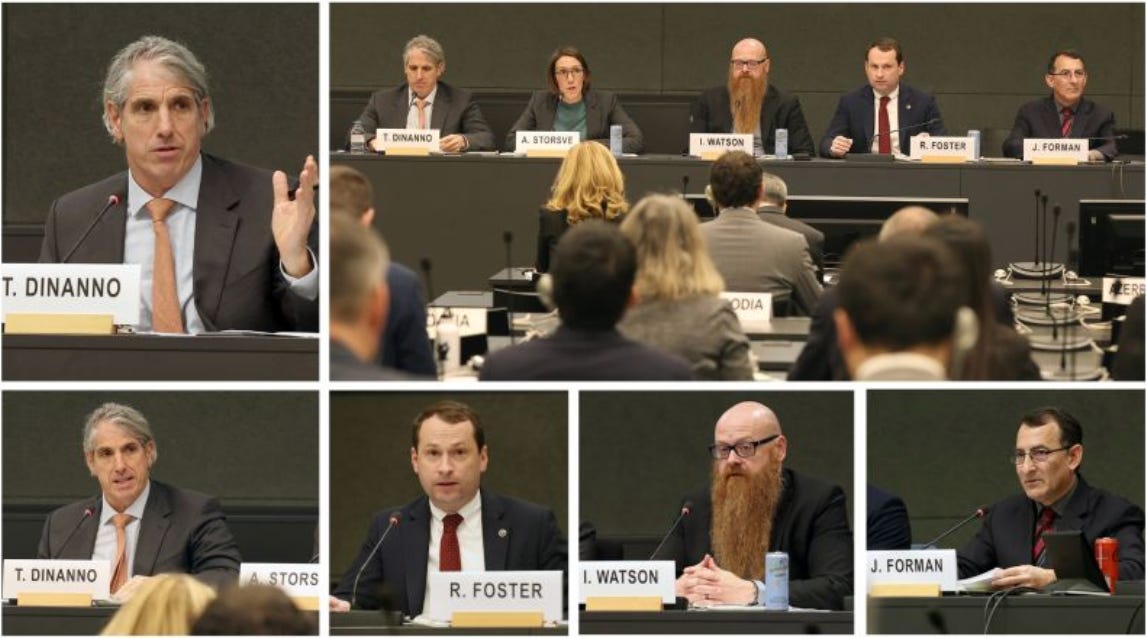
Undersecretary of State for Arms Control and International Security Thomas DiNanno delivered the keynote at “Modern Tools for Modern Threats—Towards Strengthening BWC Implementation, Verification and Assurance,” a side event at the Biological Weapons Convention Meeting of States Parties. In his remarks, he outlined how the United States will implement President Trump’s vision to use AI to strengthen the Biological Weapons Convention.
The threat posed by biological weapons is real, and rapid advances in biotechnologies bring what used to be science fiction into the realm of the possible. The United States is leading in applying modern tools to counter modern threats, making the American people and everyone around the world safer.
In addition to verification, AI could help to strengthen the BWC through increasing transparency, confidence building, improving national implementation of biosecurity policies, and supporting early detection of a potential biological weapons incident. The United States looks forward to working with all interested parties to end the development of biological weapons once and for all.

Secretary Kennedy fully supports President Trump’s challenge to the States Parties of the Bioweapons Convention to implement a BWC verification regime using AI. HHS’ Principal Deputy General Counsel Robert Fox Foster joined Undersecretary DiNanno in the first phase of making the President’s directive a reality.
December 16, 2025
BWC MSP Side Event “Modern Tools for Modern Threats: Towards Strengthening BWC Implementation, Verification, and Assurance”
Remarks by Thomas DiNanno,
U.S. State Department Under Secretary for Arms Control and International Security
UN Palais de Nations, December 15, 2025
As DeliveredThank you very much for that generous introduction. Ambassadors, distinguished colleagues, ladies and gentlemen – thank you for the warm welcome here in Geneva. My name is Thomas DiNanno and it is my honor to attend in my role as the U.S. State Department Under Secretary for Arms Control and International Security.
President Trump has made it clear that protecting the world from the threat of biological weapons is a priority. At the U.N. General Assembly this year he called on “every nation to join us in ending the development of biological weapons once and for all.” I am here today to reiterate that call.
Decades ago, it was President Nixon who said that “mankind already carries in its own hands too many of the seeds of its own destruction.” He was referring to biological weapons threats. Today we are here together in the lingering aftermath of a global pandemic that killed millions worldwide which was probably the result of risky biological research.
I invite you to join the President’s call to action as we work towards developing modern tools in the context of the Biological Weapons Convention, its implementation, assurance and verification.
Threats from biological weapons persist. The United States is deeply concerned that non-state actors and even some BWC States Parties continue to pursue the development of biological weapons. This undermines the Convention, threatens the security of every nation and, ultimately, risks the life of every human on the planet. Colleagues, we need to learn from our mistakes – not repeat them.
Threats from when the Convention started 50 years ago still continue today and have rapidly developed in recent years. AI technologies that can save lives can also lower the barriers to developing biological weapons.
The rapid advances in science and technology that are changing the possible modalities for the delivery of life-saving biological treatments, also change delivery options for destructive weapons.
We have not done enough together as States Parties to equip ourselves with the necessary mechanisms to address these threats. The COVID pandemic showed us the dangers to our population, public health, and to the global economic system from biological threats. As States Parties to the BWC, we have an obligation to ourselves and to future generations to take this threat seriously and do more within the Convention to detect and attribute risks.
We have seen heightened attention to the BWC as its Working Group tries to develop recommended measures to strengthen the Convention. There are good ideas such as establishing a Scientific Advisory Mechanism, an International Cooperation and Assistance Mechanism, and a slate of recommendations to strengthen the Convention – including a Working Group focused on Compliance and Verification. Each of these are important toward strengthening BWC implementation. We must seize the moment and build on this progress.
New scientific and technological advances offer enormous opportunities to prevent the threat of biological weapon development. As reflected in the U.S. National Security Strategy that was recently published, technologies like AI and biotechnology should be driving the world forward towards better health and overall quality of life.
Today, I want to focus on those opportunities and how modern tools, particularly AI, could strengthen BWC implementation, enhance compliance, and possibly support eventual verification measures.
The United States sees this as a multifaceted effort – and one that includes tools to strengthen existing or future approaches to be adopted by States Parties directly under the BWC. I’d like to take this opportunity at this first meeting of States Parties since President Trump’s UN speech to share some of our thinking on how to effectuate BWC improvements to ensure we are well positioned to address today’s challenges with the tools of the future.
There are several ways we can harness the capabilities of AI and machine learning today, starting on the administrative side to help eliminate inefficiencies and increase productivity.
For example, we can harness AI to improve confidence building measures within the Convention. Confidence building measures can be a critical component for enhancing transparency and increasing confidence of compliance.
AI may be able to assist States Parties with instructions on how to complete CBMs and assist in collating and filling out the CBM templates – noting the need to ensure accuracy. AI may also be helpful in developing and presenting information obtained from CBMs in a way that enhances States Parties’ technical capabilities – perhaps in a database or dashboard. This would increase not only the quantity and quality of the submissions, but would also increase the use of that information to enhance transparency and improve confidence.
We can also use AI to flag potentially problematic research and share concerns through CBM mechanisms, to prioritize safety and security which are not necessarily the same thing. We could use AI to share information about biohazards without compromising information security. The challenge is to share the right information without sharing information that might be used by a malign actor that could increase risk rather than reducing it. AI may be able to assist.
Other possible applications of AI include those that might better support national level capabilities relevant to the Convention and national implementation. For example, AI could assist in monitoring BWC-relevant supply chains and could assist with early detection of a biological weapons incident and possibly improve investigative approaches including attribution. These efforts could also support implementation of Article Seven, which focuses on preparedness and response.
AI may also be able to improve national biosecurity measures to enhance DNA synthesis screening to prevent acquisition of precursor materials by nefarious actors. Working with other States Parties to adopt and implement AI-based tools to enhance their national implementation of the BWC also supports implementation of Article Four and goals identified in Article Ten, which focuses on information exchange and cooperation.
There are also challenges – whether political, legal, or technical – with using AI and other technologies to strengthen the Convention. It will be important to use trusted data sources, have safe and secure means by which data and analyses are handled, and how to ensure trust and transparency in AI models, tools, and outputs.
We need new thinking on what it means to strengthen implementation of the BWC, how to increase assurance of compliance, and what measures may do in a way that leads to effective verification measures. And we need to think about how to get there in a practical and tangible way. Doing so will take cooperation among the international community, and we’re looking forward to increased engagement
going forward. We welcome all nations and responsible partners to join us in this effort.
Thank you.
There will be much more to come. Are you getting tired of winning yet?
I can't help but think the following:
Fauci funded the previous bioweapon used on all of us, followed by an injection that was even more harmful. He still walks around a free man even though he is personally responsible for many deaths due to his actions. Some people don't understand this and may think of him as a hero.
First step is stopping our government from doing and funding gain of function research.
Isn't it kind of like OJ looking for the real killer to have our government using AI to find the bioweapons threat somewhere in the world?
I agree get rid of gain of function. What a mess that made in the world.