


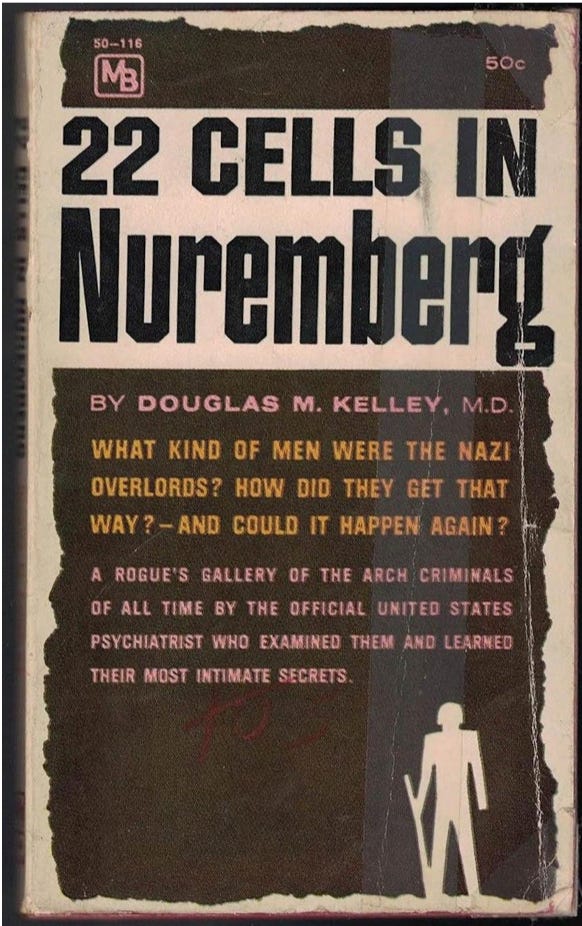
For those who do not subscribe to the service, Amazon (and soon Netflix) is hosting the Sony Pictures dramatized historical movie “Nuremberg”, which is significantly informed by a mostly forgotten 1947 book authored by Douglas M. Kelley, M.D. Dr. Kelly personally psychologically examined and profiled the original 22 German Nazi Nuremberg trial defendants on behalf of the US Government. The resulting book describing his findings, titled “22 Cells In Nuremberg; A Psychiatrist Examines the Nazi Criminals” is long since out of print, extremely difficult to find via used book sellers, and was considered a failure at the time of publication (the link provided is for a PDF version). However, Lewis M. Terman, Emeritus Professor of Psychology at Stanford University, called it one of "the three or four most important books to come out of World War II."
Having recently watched the Sony Pictures film, I was so impressed by the relevance of this work to my examination of the contributions of Mattias Desmet and Hannah Arendt on the same core topic that I thought our readers would appreciate a review that summarizes this long-overlooked contribution to 20th-century thought on the psychology of totalitarianism.
Book Review: 22 Cells In Nuremberg A Psychiatrist Examines the Nazi Criminals
Introduction
22 Cells in Nuremberg by Dr. Douglas Kelley is a landmark 1947 work by the psychiatrist who had unprecedented daily access to the 22 Nazi war criminals awaiting trial at Nuremberg, and its central finding, that these men were not monsters or madmen but psychologically ordinary people distinguished mainly by their ambition, moral emptiness, and willingness to exploit fear and grievance for power, remains its most important and most uncomfortable contribution. Through detailed psychological profiles of figures including Goering, Hess, Rosenberg, and Hitler himself, Kelley demonstrates that the conditions enabling Nazi atrocity were not uniquely German: the same racial mythologies, the same manipulation of public anxiety, and the same suppression of rational thought in favor of emotional tribalism were, he argued in a remarkable final chapter written directly to the American reader, already visible in 1947 American politics; a warning that has only grown more relevant across the decades since, from McCarthyism through the civil rights struggles, Watergate, the post-9/11 security state, and the COVID-19 era, each of which replicated, in American form, the core mechanisms Kelley had observed in those Nuremberg cells.
Overview
Published just a year after the Nuremberg verdicts were handed down, 22 Cells in Nuremberg stands as one of the most unusual and psychologically penetrating firsthand accounts to emerge from the aftermath of World War II. Its author, Dr. Douglas M. Kelley, served as the official psychiatrist to the Nuremberg Jail during the five months leading up to and throughout the International Military Tribunal. His access was unparalleled: he interviewed the prisoners daily, administered Rorschach ink-blot tests and intelligence assessments to each, and observed them under conditions of profound psychological stress. The book is simultaneously a clinical document, a historical memoir, and a disturbing warning about the fragility of democratic societies — a warning that feels no less urgent today than it did in 1947.
Lewis M. Terman, Emeritus Professor of Psychology at Stanford University, called it one of “the three or four most important books to come out of World War II.” That assessment remains relevant today, particularly in the post-COVID world where the reality of government sponsored propaganda, censorship, financial control, psychological manipulation of citizens, obsessive data gathering and creeping authoritarianism has rekindled broad interest in the conditions that can lead to totalitarian government and associated abuses.
Structure and Scope
Kelley organizes the book into eight parts, moving from the historical and ideological context of Nazism to individual profiles of the 22 defendants, then culminating in a sobering final chapter addressed directly to the American reader. The structure is deliberately pedagogical; Kelley wants readers not just to understand who these men were, but to understand what systemic conditions made them possible and what comparable conditions might produce their American equivalents.
Part One sets the intellectual stage. Kelley argues forcefully that the Nazi criminals were not insane aberrations but products of a long-cultivated German ideological tradition stretching back decades before Hitler. He marshals a striking parade of pre-Nazi German generals, professors, and politicians voicing doctrines of racial supremacy, glorified barbarism, and the dispensability of human conscience, all well before 1933. His point is blunt: Hitler did not create the ideology. He simply radicalized and weaponized what was already latent in German culture and used it to seize emotional control of a population already primed for it. Kelley invokes Korzybski’s concept of “time-binding”; learning from the experience of others rather than having to live through it oneself, as the animating purpose of his entire book.
Part Two through Part Seven constitute the heart of the work: profiles of the individual defendants, grouped into categories that Kelley labels with deliberate irony; “The Policy Makers,” “The Salesmen,” “The Gunmen,” “The Rabble Rousers,” “The Businessmen,” and finally a standalone analysis of Adolf Hitler himself.
The Psychological Profiles
Kelley’s portraits of the major war criminals are the most compelling sections of the book. Written with clinical precision but genuine psychological curiosity, each profile attempts to identify the personality structure that allowed these particular men to rise to power and commit the crimes they did.
Rudolf Hess receives perhaps the most nuanced treatment. Kelley spent more time with Hess than with any other prisoner, partly because Hess arrived at Nuremberg in a state of genuine amnesia that needed evaluation. Kelley’s diagnosis: a psychoneurosis of the hysterical type, grafted onto a paranoid and schizoid personality, is methodically argued. His account of Hess’s dramatic courtroom declaration that his amnesia had been entirely faked (which Kelley anticipated and interpreted as itself a hysterical performance) is one of the more vivid scenes in the book. Kelley presents Hess as a man who had spent his life in search of father figures, Haushofer, then Hitler, and whose catastrophic flight to England in 1941 was the desperate, delusional act of an emotionally juvenile man trying at last to exceed the people he had always played second fiddle to.
Alfred Rosenberg, the Party’s official philosopher, is treated with a mixture of clinical detachment and barely concealed contempt. Kelley’s intelligence testing showed Rosenberg to be of only low-average intelligence; a finding that surprised many contemporaries who had mistaken his intentional obscurantism for depth. Rosenberg’s racial theories, gleaned partly from Madison Grant’s American work The Fall of a Great Race, are laid out and mercilessly dissected. One of the darkest and most memorable passages in the book involves Kelley pressing Rosenberg on his proposed “solution” to America’s racial demographics, only to watch the philosopher cheerfully recommend deporting both Black Americans and Jewish Americans to Madagascar, with the island’s indigenous population pressed into agricultural labor to feed them. The casual totality of Rosenberg’s moral vacancy is on full display.
Hermann Goering commands the largest profile in the book, and rightly so. Kelley regarded him as the most formidable intellect among the defendants and found him personally engaging, even charismatic. Goering spoke openly and at length, and Kelley presents him as a highly dominant, conscience-free individual whose ego was so robust that even facing execution he treated the proceedings as a kind of final performance. Kelley describes treating Goering’s drug addiction at Mondorf before the trial began. He also presents Goering’s suicide, accomplished by concealing a cyanide capsule despite thorough cell searches, not as a mystery but as the logical final act of a man determined to deny the Tribunal the satisfaction of hanging him. Kelley’s analysis of Goering’s psychology (aggressive, amoral, highly intelligent, supremely confident, a natural bully who held genuine contempt for most of his colleagues) remains one of the most convincing portraits of the man in all of Nuremberg literature.
Among the other profiles, Julius Streicher, the violently anti-Semitic publisher of Der Stürmer, is presented as genuinely sadistic and psychosexually disturbed in ways that even some fellow Nazis found repellent. Robert Ley, the alcoholic head of the German Labor Front, committed suicide in his cell before the trial began; Kelley’s retrospective account of his psychological deterioration is sobering. Albert Speer is shown as the most intellectually dishonest of the group, a man who used cultivated charm and protestations of ignorance to distance himself from crimes in which he was deeply implicated. Hans Frank, the “Governor-General” of occupied Poland, is depicted as a man who underwent something like a religious collapse during captivity and confessed with almost theatrical grandiosity.
Adolf Hitler does not appear as a direct interview subject; he was dead before the trial, but Kelley devotes an entire section to a psychiatric reconstruction based on extensive interviews with those who knew him closely, including his personal secretary Christa Schroeder. The resulting portrait is of a man whose early frustrations and feelings of profound inferiority generated a pathological overcompensation. Kelley diagnoses him as a psychoneurotic of the obsessive-hysterical type, with paranoid elements, whose obsessive drives; inflexible, self-escalating, immune to rational correction, made his catastrophic trajectory almost mechanistically inevitable once he had access to power. Schirach’s description of Hitler’s three phases, “the human phase,” “the superhuman phase,” and “the inhuman phase”, serves as an organizing framework for Kelley’s analysis, which ends with the chilling conclusion that Hitler’s deviations were not so dramatic that an ordinary clinician would have flagged them before he was already dangerous.
Methodology and Intellectual Honesty
Throughout the book, Kelley is careful to explain his methods, particularly his heavy reliance on the Rorschach test, then a relatively new and fashionable diagnostic tool. He explains the test’s logic accessibly without talking down to lay readers, and he is honest about its limitations as well as its applications. His interpretations are not made to seem more definitive than the evidence warrants. Where he is uncertain, he says so.
One of the book’s most intellectually honest threads is Kelley’s consistent refusal to pathologize the defendants into convenient monsters. This is both a scientific position and a moral one: if these men were simply insane, the Holocaust becomes explicable only as the product of madness, and the lessons it offers are far narrower. Kelley insists, sometimes stridently, that these were not extraordinary people. They were ordinary in their psychological structures, distinguished mainly by their ambition, their ethical poverty, and the circumstances that gave them leverage over millions. This was his most important finding, and it made him profoundly unpopular with readers who wanted reassurance rather than warning.
The Final Chapter and Its Warning
The concluding chapter, “What Does It Mean to America?”, is the most explicitly political section of the book and the most prescient. Writing in 1947, Kelley argues that nothing he observed at Nuremberg was uniquely German. He identifies the same racial rhetoric, the same manipulation of popular anxieties, the same appeal to emotional rather than rational thinking, operating in American public life, naming, without hesitation, political candidates and movements of his own day.
His four prescriptions for preventing an American totalitarianism are: universal and unrestricted voting rights; maximal voter participation; refusal to vote for politicians who exploit racial and religious divisions; and fundamental educational reform aimed at producing citizens capable of critical thought rather than emotional susceptibility. He acknowledges that these are simple to describe and extraordinarily difficult to achieve. His final note is not optimistic so much as it is unsentimental: the choice belongs to citizens, individually, and the alternative to making it wisely is visible in the rubble of Europe.
Kelley’s Predictions and the Post-War American Record
The most unsettling way to read 22 Cells in Nuremberg is as a checklist. Kelley’s final chapter laid out a specific set of warning signs and prescriptions in 1947, and American history in the decades since has provided an extensive and often discomforting test of his foresight. The parallels he identified were not vague or theoretical, they were precise, and the record of how they played out rewards close examination.
McCarthyism and the Mechanics of Fear (1950–1954)
Kelley’s core warning was that the Nazi pattern of political power depended not on a uniquely German pathology but on a set of replicable techniques: the manufacture of an existential enemy, the exploitation of popular anxiety, and the suppression of rational evaluation through emotional saturation. Senator Joseph McCarthy’s campaign against alleged Communist infiltrators followed this template with remarkable fidelity. McCarthy’s methods; sweeping accusation, guilt by association, the degradation of due process, the cultivation of an atmosphere in which questioning the accuser became evidence of complicity, were precisely the tactics Kelley described as the operating system of totalitarian politics. Kelley had specifically warned that “political rabble rousers, the Streicher and Ley types can be encountered at any political meeting.” McCarthy was not a Streicher, and the United States was not the Weimar Republic; the democratic institutions held, eventually. But the episode demonstrated that the emotional susceptibility Kelley described was not a German monopoly, and that the corrective mechanisms Kelley prescribed; critical citizens, institutional pushback, a press willing to name what it saw, were necessary in practice and not merely in theory.
Racial Violence and the Limits of Democratic Promise (1950s–1960s)
Kelley’s most specific and pointed warning concerned race. Writing in 1947, he named the same racial mythology that Rosenberg had preached; white supremacy, the threat of minority “contamination,” the political exploitation of intergroup anxiety, as actively present in American public life. He quoted a passage from Rosenberg’s writings warning of the dangers of Black and Jewish political alliance and then noted, with deliberate restraint, that he had encountered the same ideas “thinly veiled in our public press.” He cited political candidates in unnamed states who had just won congressional and gubernatorial elections by running openly on white supremacist platforms.
The decades that followed confirmed every dimension of this warning. The violent resistance to the civil rights movement, the bombing of the 16th Street Baptist Church in Birmingham in 1963, the murders of civil rights workers in Mississippi in 1964, the systematic use of state violence against peaceful protesters in Selma in 1965, reflected exactly the dynamic Kelley described: organized political actors using racial terror to maintain power, operating within a democratic system whose formal guarantees of minority rights had not yet been made functionally real. Kelley had specifically called for the elimination of the poll tax and all voting restrictions on citizens, a goal that was not achieved until the Voting Rights Act of 1965, nearly two decades after he wrote.
The assassinations of Medgar Evers, Martin Luther King Jr., and Malcolm X; the COINTELPRO program’s systematic targeting of Black political organizations; the ongoing use of racially coded language by mainstream political figures; all of these fell within the pattern Kelley had outlined. He had noted that Rosenberg and Hitler did not originate racial ideology in Germany: they weaponized it. The same distinction applies in the American context. Racial violence in post-war America did not emerge from nowhere. It was organized, sustained, and politically rewarded in ways that tracked Kelley’s analysis closely.
The Concentration of Authoritarian Impulses: Nixon and Watergate (1972–1974)
Kelley described the mechanisms by which authoritarian power consolidates in democratic systems: the use of state apparatus against political enemies, the cultivation of personal loyalty over institutional allegiance, the treatment of legal constraints as obstacles to be circumvented rather than limits to be respected. The Nixon administration’s Watergate abuses fit this template in several respects; the enemies list, the use of the IRS and FBI as political instruments, the break-in and cover-up, the firing of the special prosecutor in the Saturday Night Massacre. What is perhaps most Kelley-relevant about Watergate is not the crimes themselves but the near-success of the cover-up and the degree to which institutional loyalty to a leader had to be actively broken before accountability could operate. The system held, but not easily, and not without significant individuals choosing institutional integrity over personal advancement; exactly the kind of civic maturity Kelley argued was essential but could not be assumed.
The Post-9/11 Security State and the Manufacture of Emergency
Kelley devoted considerable attention to how the Nazi state used manufactured crisis to justify emergency measures that progressively dismantled civil liberties, and how populations conditioned to think emotionally rather than critically were particularly vulnerable to this technique. The post-September 11 expansion of executive power in the United States; the PATRIOT Act, the authorization of warrantless surveillance, the establishment of indefinite detention at Guantánamo Bay, the legal memos authorizing torture, the targeted killing program, represented a compression of democratic norms under the pressure of genuine emergency and genuine fear. Kelley would have recognized the dynamic: the appeal to existential threat, the argument that normal legal constraints are luxuries the country cannot afford, the ease with which populations under emotional stress consent to measures they would otherwise reject. None of this is to equate the United States government with the Nazi state — the differences in scale, intent, and outcome are vast. But Kelley’s framework — that emotional crisis is the primary vector through which authoritarian overreach enters democratic systems — proved durable as a diagnostic tool.
Voter Suppression and the Integrity of Democratic Participation
One of Kelley’s four explicit prescriptions was the elimination of all voting restrictions, followed by maximum participation. He saw low participation and manipulated participation as the primary mechanical vulnerabilities through which a determined minority could seize disproportionate power. The post-war American record on this is mixed at best. The Voting Rights Act of 1965 represented the fulfillment of one of his demands. Its gutting by the Supreme Court’s 2013 ruling in Shelby County v. Holder, and the subsequent proliferation of voter ID laws, polling place closures, and registration restrictions in numerous states, would have struck Kelley as a confirmation of his worst fears. He had argued that the expansion of voting access was not merely a moral obligation but a structural defense against minority-faction seizure of power — and that the contraction of that access was therefore not simply unjust but politically dangerous in the specific way that the Nuremberg experience had illustrated.
The Thalamic Politics of a Pandemic
Kelley’s most transferable insight was his neuroscientific observation that a population kept in sustained emotional arousal; fear, grievance, tribal solidarity, loses its capacity for cortical (rational, evaluative) thinking and becomes susceptible to manipulation. The COVID-19 period represented perhaps the most complete natural experiment in this dynamic in American political history. Genuine fear of a novel and lethal pathogen created a baseline emotional state across the entire population. Into that state, political actors on all sides poured accelerants: catastrophizing on one end, minimizing and conspiracy-framing on the other. Kelley would have recognized both as variations of the same technique — the maintenance of emotional saturation as a precondition for cognitive capture. The result was that factual questions about mask efficacy, vaccine safety profiles, school closure trade-offs, and mortality data became almost impossible to evaluate publicly on their merits. They were absorbed instantly into tribal identity frameworks, where evaluation was replaced by affiliation.
The “Ordinary Leader” Problem
Kelley’s finding that the Nazi leadership consisted not of demonic outliers but of ordinary men with overweening ambition, low ethical standards, and a willingness to use nationalism and grievance as political tools applies directly to the COVID-era political landscape. The period saw the full elaboration of a political style, pioneered before COVID but turbocharged by it, that matched Kelley’s template almost feature by feature: the identification of an enemy class (variously: Anthony Fauci, state governors, “the unvaccinated,” mask mandates, pharmaceutical companies, those advocating early treatment, dissident physicians), the appeal to emotional rather than rational judgment, the punishment of institutional expertise as a form of elite betrayal, and the exploitation of genuine public anxiety for purposes of political consolidation. Kelley explicitly named this pattern in 1947 when he wrote that men of Streicher’s type, the political rabble-rouser who manufactures outrage for power, could be found at any American political meeting.
The Rosenberg Warning and COVID Scapegoating
Kelley spent considerable time on Rosenberg’s political methodology: the identification of a threatening out-group, the attribution to that group of responsibility for the population’s anxiety, and the offer of a strategy for dealing with that group as the path to collective relief. The COVID period produced multiple iterations of this structure. Early in the pandemic, Asian Americans experienced a sharp spike in harassment and violence following political rhetoric that framed the virus in explicitly racial and national terms. Later iterations targeted the unvaccinated as a morally blameworthy group responsible for prolonging collective suffering, a rhetorical move that, whatever the public health merits of vaccination advocacy, followed the same structural pattern of identifying a concrete out-group as the object for free-floating social anxiety. Kelley’s point was never that such rhetoric automatically produces genocidal outcomes, but that the mechanism it employs, the conversion of diffuse anxiety into targeted group blame, is the same mechanism that, given sufficient scale and permission, had produced the Holocaust.
The Dynamics of Demagoguery and Emotional Politics
Perhaps Kelley’s most durable analytical contribution was his neuroscientific framing of authoritarian political technique: the deliberate cultivation of emotional thinking (what he called thalamic rather than cortical cognition) as a precondition for mass manipulation. He argued that a population thinking emotionally cannot think critically, and that Hitler’s genius was his ability to keep a nation in a sustained state of emotional arousal, through spectacle, through fear, through grievance, through the constant identification of enemies that made rational evaluation structurally impossible.
This framework has found repeated application in post-war American political history. The politics of racial resentment in the South during the Civil Rights era operated this way. McCarthyism operated this way. The post-9/11 security consensus operated this way. And the broader rise of media ecosystems explicitly designed to maximize emotional engagement, outrage, fear, tribal solidarity, at the expense of deliberate reasoning represents a systemic elaboration of the exact mechanism Kelley identified. He could not have anticipated the internet, cable news, or social media, but his model predicted their political effects with uncomfortable accuracy. He wrote that the Nazi propagandists’ genius was in keeping people “thinking with their thalamus.” Contemporary media economics have industrialized that process.
Where Kelley’s Predictions Were Too Pessimistic
It would be unfair to Kelley, and to American history, to read the post-war record as unrelieved confirmation of his worst fears. His concluding assessment; that there was “little in America today which could prevent the establishment of a Nazi-like state”, proved, in absolute terms, wrong. American democratic institutions have been stressed severely since 1947 and have not collapsed. Civil rights were extended, however painfully and incompletely. McCarthy was censured. Nixon resigned. Watergate produced accountability. The civil rights movement achieved legal transformation. Courts repeatedly checked executive overreach. A free press, despite enormous commercial pressures, continued to perform its investigative function.
Kelley’s framework is more useful as a diagnostic tool than as a prediction engine. What he identified was a set of recurring vulnerabilities, emotional susceptibility, racial anxiety, apathy, the susceptibility of democratic systems to determined minorities, not an inevitable outcome. His four prescriptions, wherever they have been genuinely implemented, have functioned as he said they would. The problem is that their implementation has been contested, incomplete, and reversible, in ways that his analysis also predicted.
The Enduring Question
What Kelley ultimately left his readers with is a question rather than an answer: whether the lessons of Nuremberg could be absorbed before they had to be relearned through equivalent suffering. Nearly eight decades later, the answer remains genuinely open. His book has become more relevant with the passage of time. If anything, the accumulation of post-war American history has made his analysis harder to dismiss as alarmism and easier to read as a reasonably accurate map of the terrain Americans have been navigating ever since.
Limitations
The book is not without its weaknesses. Some of Kelley’s clinical interpretations feel dated, particularly in his handling of terms like “hysteria” and “psychopathic personality,” which have since been substantially revised. His chapter on Hess’s amnesia, while fascinating, engages in speculative reconstruction that occasionally outruns the evidence. A few of the shorter profiles, particularly those of Jodl, Raeder, Doenitz, and Neurath, feel cursory compared to the richly developed portraits of the major figures. And Kelley’s confident tone sometimes tips into overreach, as when he renders comprehensive verdicts on men he acknowledges he could only study under highly constrained conditions.
Assessment
22 Cells in Nuremberg is essential reading for anyone interested in the psychological, historical, or political dimensions of the Nazi period and its aftermath. It is not primarily a book about the Holocaust itself, nor about the mechanics of the trial. It is a book about human character, specifically about what kinds of human character produce atrocity when given the right conditions, and about how those conditions can emerge in any society, including ostensibly healthy ones.
Kelley’s central argument, that the Nazi leaders were not monsters but ordinary men of deficient conscience and overweening ambition, operating within a political culture that had been systematically conditioned to follow them, was controversial in 1947 and remains uncomfortable today. It demands something harder than horror. It demands recognition.
For a work written in the immediate shadow of the war, it is remarkably clear-eyed, restrained in its claims, and disturbing in its implications. Nearly eighty years later, those implications have not faded.
Published 1947. Originally by Chilton Company; later republished by Macfadden Books (1961). Approximately 152 pages.
Author Biography
Douglas M. Kelley (1912–1958) was an American psychiatrist best known for his role as the chief psychiatrist at the Nuremberg trials following World War II, where he had direct, prolonged access to the top Nazi war criminals awaiting judgment.
Kelley was born in Petaluma, California, and showed early intellectual gifts. He trained in psychiatry and became a skilled clinician, also developing an intense interest in the Rorschach inkblot test, which he would use extensively in his later work. During World War II, he served in the U.S. Army and was assigned to Nuremberg, where from 1945 to 1946 he interviewed, tested, and observed defendants, including Hermann Göring, Rudolf Hess, Joachim von Ribbentrop, Julius Streicher, and others.
His close relationship with Göring in particular was notable; the two men developed a complex rapport, and Kelley later expressed a degree of grudging admiration for Göring’s intelligence and force of personality. After Göring cheated the hangman by taking a cyanide capsule, Kelley was reportedly devastated and fascinated in equal measure.
His 1947 book, 22 Cells in Nuremberg, drew on his observations of the defendants and controversially argued that the Nazi leaders were not clinically insane — they were, in his view, psychologically ordinary men whose rise was enabled by circumstance and character flaws that could be found in any society, including American. This conclusion disturbed many readers who preferred to see the Nazis as monsters apart from humanity.
After Nuremberg, Kelley returned to academic life, eventually becoming a professor of criminology at UC Berkeley. He struggled, however, with the psychological weight of his wartime experiences and with personal demons. In a grim irony that shocked those who knew him, Kelley died in January 1958 by swallowing a cyanide capsule — the same method Göring had used — in front of his family on New Year's Day, an apparent suicide. He was 45.
Can you imagine an American administration coercing, lying, forcing the general American public into submitting to their tyrannical will. Think of a once trusted medical establishment along with this administration knowingly deceiving the entire public to take harmful chemical injections or be cast to the side, cancelled from society as a coercive power grab over the people. Could you ever picture a growing group of politicians teaming up with the medical establishment, social media, main stream media, even three letter organizations and local police to grow their power and lord over the public. This evil power that grew in Germany, engulfing so many could never happen in America. Could you possibly imagine a secretive group within our own government assassinating a sitting president, impossible. All of the people I know that had heart attacks, blood clots, strokes, cancers, auto immune diseases, digestive problems had nothing to do with the Biden administrations coercion, subjugation and forcing of these shots. It was all coincidence.
https://youtu.be/p7chQfQ67SM
If I have not misread this article, It seems that voter ID laws are held up as barriers to voting. Yet we use IDs to open bank accounts, to get on airplanes, to enter federal buildings, and countless other things. With up to 30 milliom illegal immigrants in America, why would we not require proof of citizenship? That's common sense: The policies Of its government should be Policies required by its citizens not by those who have not yet sworn loyalty. If it's a barrier, indeed it's only a barrier to those who should not be voting at all.