

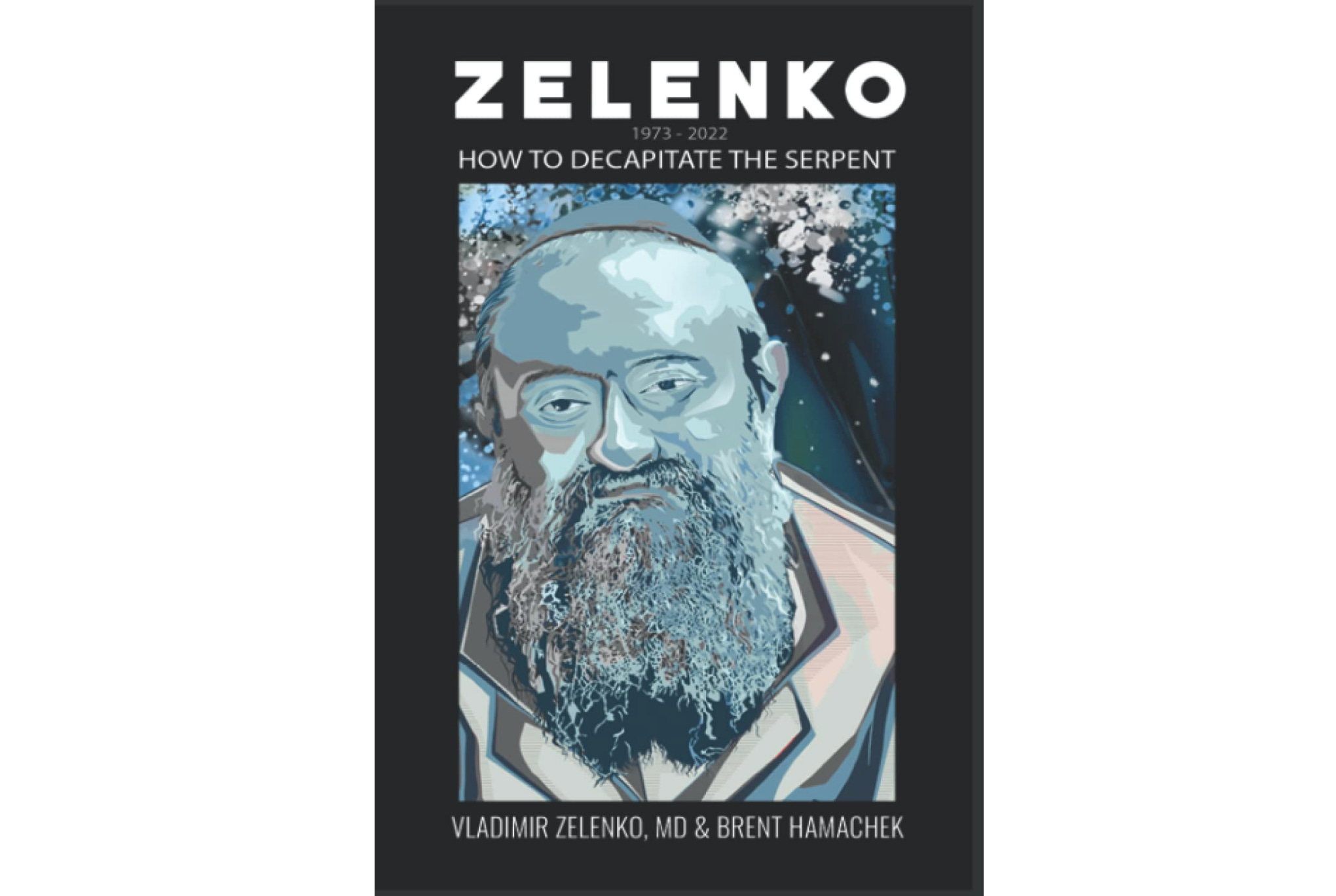
ZELENKO: How To Decapitate The Serpent –
Published November 18, 2022; Pierucci Publishing
By Vladimir Zelenko MD (Author), Brent Hamachek
350 pages
Available via Amazon in Hardcover, paperback, audiobook, and Kindle formats
Official Publisher’s Promo-
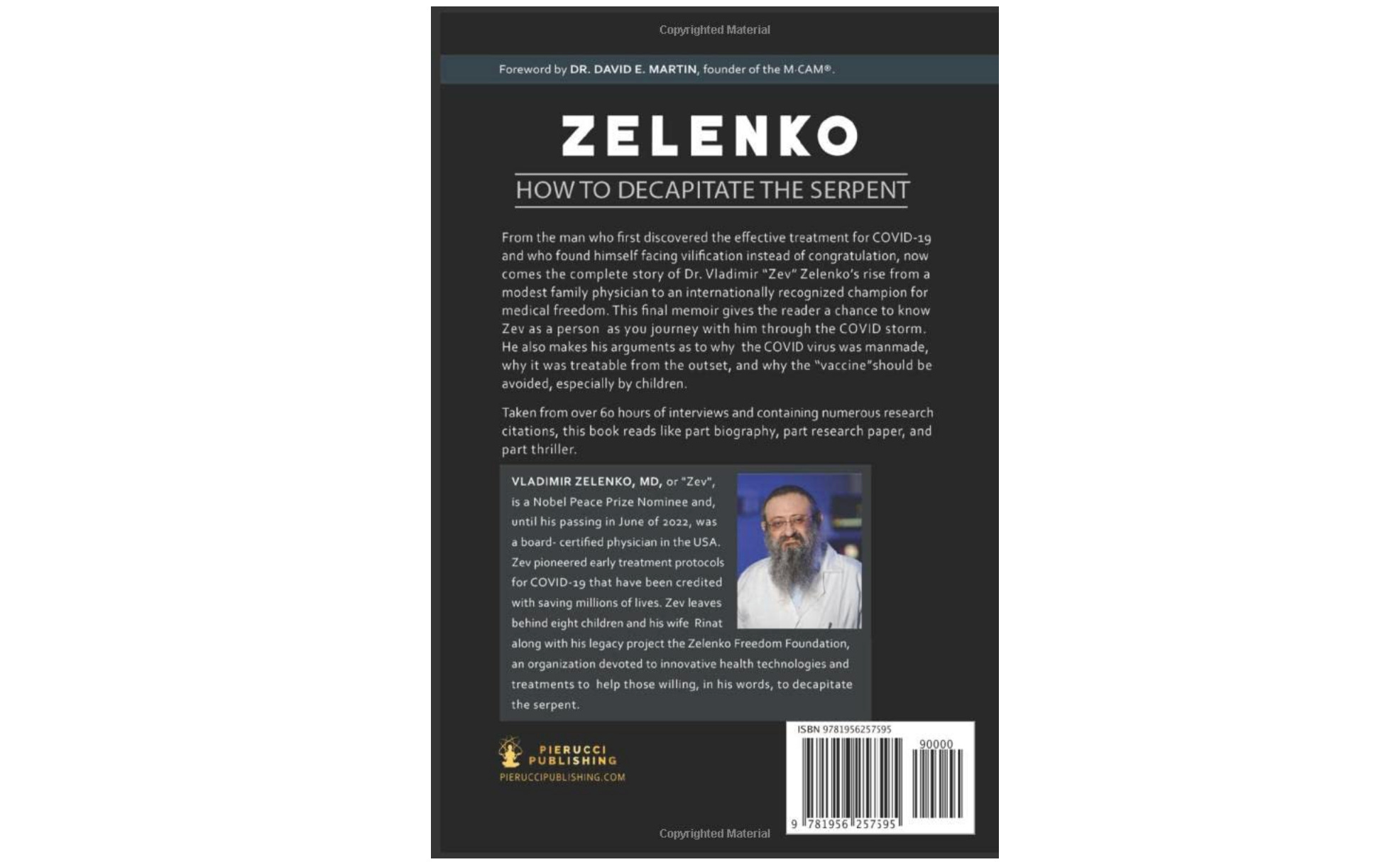
From the man who first discovered the effective treatment for COVID-19 and who found himself facing vilification instead of congratulation, now comes the complete story of Dr. Vladimir “Zev” Zelenko’s rise from a modest family physician to an internationally recognized champion for medical freedom. This final memoir gives the reader a chance to know Zev as a person as you journey with him through the COVID storm. He also makes his arguments as to why the COVID virus was manmade, why it was treatable from the outset, and why the “vaccine” should be avoided, especially by children.
Taken from over 60 hours of interviews and containing numerous research citations, this book reads like part biography, part research paper, and part thriller.
Vladimir Zelenko, MD, or “Zev,” is a Nobel Peace Prize Nominee and, until his passing in June of 2022, was a board certified physician in the USA. Zev pioneered early treatment protocols for COVID-19 that have been credited with saving millions of lives. Zev leaves behind eight children and his wife Renat along with his legacy project the Zelenko Freedom Foundation, an organization devoted to innovative health technologies and treatments to help those willing, in his words, to decapitate the serpent.
Visit www.zstacklife.com to learn more about Dr. Zelenko's healing formulas.
Book Review: “How To Decapitate The Serpent”
Introduction
How to Decapitate the Serpent by Dr. Zev Zelenko, written with Brent Hamachek, is a sweeping and controversial work that functions simultaneously as autobiography, spiritual testimony, political critique, and polemical argument. The book is organized into three major parts, each building on the previous one to frame Zelenko’s central claim: that the COVID-19 pandemic represented not only a medical crisis but a moral, spiritual, and civilizational battle. Across its chapters, the narrative blends personal history with broad accusations against institutions and leaders, creating a work driven less by detached analysis than by urgency, conviction, and a sense of final testimony. Each chapter builds a narrative arc from suffering → revelation → resistance.
The book moves from autobiography to spiritual philosophy to political accusation, culminating in a unified thesis: medical tyranny is merely the latest form of moral slavery, and faith-driven truthfulness is the only antidote.
PART ONE
Part One, Where I’m Coming From, is largely autobiographical and reflective, setting the emotional and philosophical foundation of the book. In the opening chapter, Zelenko recounts discovering that he had been placed on an alleged assassination list, using this episode to introduce themes of fear, courage, and moral responsibility. This dramatic beginning establishes the book’s tone: confrontational, personal, and unapologetic. Subsequent chapters trace his early life as a Jewish immigrant from Ukraine, his struggles with insecurity, identity, and self-esteem, and his academic rise through chemistry and medical school. These chapters humanize Zelenko, portraying him as intellectually gifted yet spiritually unsettled, searching for meaning beyond professional success. A significant portion of Part One focuses on his religious awakening and deepening Orthodox Jewish faith, which he presents as the central lens through which he understands truth, suffering, and duty. His battle with terminal cancer is also explored here, framed as a divine catalyst that stripped away fear of death and emboldened him to speak openly, regardless of consequences.
Chapter 1 – “These People Are Much More Dangerous Than Any Animal”
Zelenko opens with a dramatic account of discovering his name on an alleged Antifa assassination list in 2021. Seeing himself labeled a “misanthrope” for opposing pandemic policies, he reflects on fear, death, and faith. His terminal cancer had already made him immune to fear, so he viewed the threat as confirmation that he was on the right path. He interprets the event as spiritual warfare, connecting Antifa and globalist institutions through a “god of expediency” that thrives on chaos. The chapter ends with his vow never to change his convictions out of fear.
Chapter 2 – “From Humble Origins: An Ordinary Life With Extraordinary Moments”
This chapter traces his early life: born in Kiev in 1973, emigrating to America as a child, and growing up poor and insecure in Brooklyn. He recounts childhood trauma that shaped his self-image and later therapy that helped him confront it. Zelenko describes his academic path from Hofstra to SUNY Buffalo medical school and his philosophical awakening through Nietzsche and Sartre, which eventually gave way to a religious reawakening during a trip to Israel. His encounter with an Orthodox family and gradual embrace of Judaism mark the beginning of his spiritual formation.
Chapter 3 – “Battles, Blessings, and Revelations: My Personal Journey Through Cancer”
The most personal chapter yet. Zelenko describes the onset of his pulmonary symptoms in 2018, misdiagnosed as a blood clot until open-heart surgery revealed an extraordinarily rare and nearly always fatal pulmonary artery sarcoma. He loses a lung and is told his prognosis is terminal. His reflections on surviving against the odds serve as the spiritual groundwork for his later medical activism. The experience eliminates fear of death and leads him to view his disease as divine training for the battles to come—“a gift from God” that forged his moral courage.
PART TWO
Part Two, The COVID Storm, shifts from introspection to action and controversy, detailing Zelenko’s experiences during the early months of the pandemic. He describes developing what became known as the “Zelenko Protocol,” emphasizing early treatment and intervention, and portrays himself as acting in the best interests of patients while facing resistance from medical authorities and government officials. Chapters in this section recount interactions with political leaders, media figures, and public institutions, painting a picture of chaos, censorship, and bureaucratic hostility. Zelenko argues that effective treatments were deliberately suppressed, framing these decisions as acts of moral failure or intentional harm. The narrative here is fast-paced and accusatory, blending anecdotal experiences with broader claims about institutional corruption. Readers gain insight into how Zelenko perceived his sudden rise to prominence, as well as the personal toll of public scrutiny, professional backlash, and isolation.
Chapter 1 – “In the Beginning, Man Created a Virus”
Zelenko recounts the early days of the pandemic and argues that COVID-19 was a lab-engineered pathogen developed through gain-of-function research with U.S. taxpayer money. He presents himself as a frontline community doctor seeing patients deteriorate while bureaucrats obstruct early treatment. Inspired by necessity, he creates his now-famous early-treatment protocol combining hydroxychloroquine, zinc, and antibiotics. The chapter paints his discovery as a mix of divine guidance and scientific intuition.
Chapter 2 – “Cuomo on a Pale Horse, Followed by Death”
Turning political, Zelenko condemns New York’s Governor Andrew Cuomo for restricting outpatient access to HCQ, accusing him of “mass murder by policy.” He recounts media attacks, threats, and censorship. The chapter positions Zelenko as a whistleblower confronting political corruption and pharmaceutical greed, depicting authorities as agents in a coordinated suppression campaign.
Chapter 3 – “I Should Have Studied Harder”
Zelenko critiques the medical establishment as intellectually lazy and spiritually hollow. He contrasts common sense and compassion with bureaucratic conformity. He describes interactions with academics, government health officials, and even fellow Jewish doctors who refused to question policy. The core message: institutional credentialism replaced moral duty.
Chapter 4 – “Changes in Latitude – Changes in Attitude”
After national backlash, Zelenko moves to Florida for both health and symbolic reasons—a state of freer thinking and fewer mandates. He criticizes the World Economic Forum, Biden administration, and media for promoting authoritarianism. He praises figures like DeSantis and laments social media’s censorship.
PART THREE
Part Three, Making the Case, is the most overtly argumentative section of the book. It is structured around three central claims: that the virus was engineered, that early treatment was intentionally obstructed, and that COVID-19 vaccines were dangerous and unethical. Each chapter functions as a prosecutorial brief rather than a neutral inquiry, assembling assertions, interpretations of scientific developments, and moral judgments into a cohesive narrative of betrayal and deception. Zelenko presents himself as a whistleblower confronting powerful global forces, frequently invoking historical analogies, religious symbolism, and absolutist language. The tone in this section is uncompromising, with little space for ambiguity, and is likely to be the most divisive portion of the book. For supporters, it reads as a courageous exposé; for critics, it may feel ideologically rigid and dismissive of counter-evidence.
Chapter 1 – “The Case for an Engineered Virus”
Here, Zelenko lays out his argument that SARS‑CoV‑2 was a planned bioweapon: citing patents, funding trails, and research partnerships between U.S. agencies and Chinese labs. He frames the pandemic as not accidental but orchestrated for profit and control.
Chapter 2 – “The Case for Treatment”
A defense of early therapeutic approaches like the Zelenko Protocol and a denunciation of what he terms “fake and bad science.” He argues that low-cost treatments threatened pharmaceutical profits, leading to censorship, blacklisting, and reputational assassination of doctors who questioned the vaccine narrative.
Chapter 3 – “The Case Against ‘Vaccines’”
A critical exploration of mRNA technology and alleged adverse effects. Zelenko asserts that the injections alter biological function and were falsely marketed as vaccines. He characterizes the campaign as a moral and medical catastrophe, emphasizing that informed consent was impossible when information was deliberately suppressed.
EPILOGUE
The epilogue and closing sections return to a reflective mode, emphasizing themes of sacrifice, legacy, and moral awakening. In his closing reflections, Zelenko ties his personal suffering, his faith, and his activism together. He calls the COVID era the ultimate spiritual test of humanity’s relationship to truth and courage. He urges readers to guard conscience, cherish liberty, and “decapitate the serpent”—a metaphor for dismantling deception and reclaiming personal sovereignty before tyranny can fully envelop humanity. Zelenko frames the book as both a warning and a call to action, urging readers to reject fear, question authority, and defend individual conscience. His impending mortality looms over these final pages, lending them a confessional and almost prophetic quality. The book ultimately positions itself not as a conventional history of the pandemic, but as a moral record of one man’s experience and beliefs during what he sees as a defining moment for humanity. He finishes not with bitterness, but with conviction that truth will outlive him.
In Conclusion
Stylistically, the prose is conversational but intense. Brent Hamachek acts as a careful steward of Zelenko’s voice; eccentric, brilliant, sometimes abrasive, but never insincere. The language oscillates between the gentle humanity of a bedside doctor and the fiery cadence of a prophetic sermon. Zelenko’s humor, candor, and reliance on both Scripture and real-world detail give the book a strange dual energy: half personal memoir, half battlefield report from a metaphysical war. At times, the rhetoric risks overreach, but its emotional and intellectual authenticity keep it grounded. The heavy biblical symbolism, Cain and Abel, Amalek, Moses, and the Serpent, serves less as ornamentation and more as moral architecture for understanding human corruption.
As a work of literature, How to Decapitate the Serpent defies easy classification. It operates simultaneously as spiritual autobiography, cultural criticism, and testimonial indictment of what Zelenko saw as global medical tyranny. It is a document of a man unburdened by fear of professional exile or death, writing with the clarity of someone who understands that his words may outlive him. For readers seeking cautious journalism or academic neutrality, the book will feel jarring and perhaps relentless. For those interested in the view from inside the resistance to official COVID narratives, it is an invaluable primary source. A final testament of a dissident physician whose defiance resonated with millions.
As a whole, How to Decapitate the Serpent is a powerful, polarizing work. Its strengths lie in its emotional intensity, narrative cohesion, and the clarity of its author’s worldview. The autobiographical sections are vivid and engaging, providing valuable insight into Zelenko’s motivations and inner life.
Regardless of agreement or disagreement with its claims, the book stands as a striking example of dissent literature; deeply personal, morally charged, and shaped by a profound sense of urgency about truth, power, and human responsibility.
Thank you for doing this review of Dr. Zelenko‘s book. He was a great fighter in the early years of the pandemic and we lost him all too soon!
There are a lot of serpents that need to be decapitated. Many are in DC.