

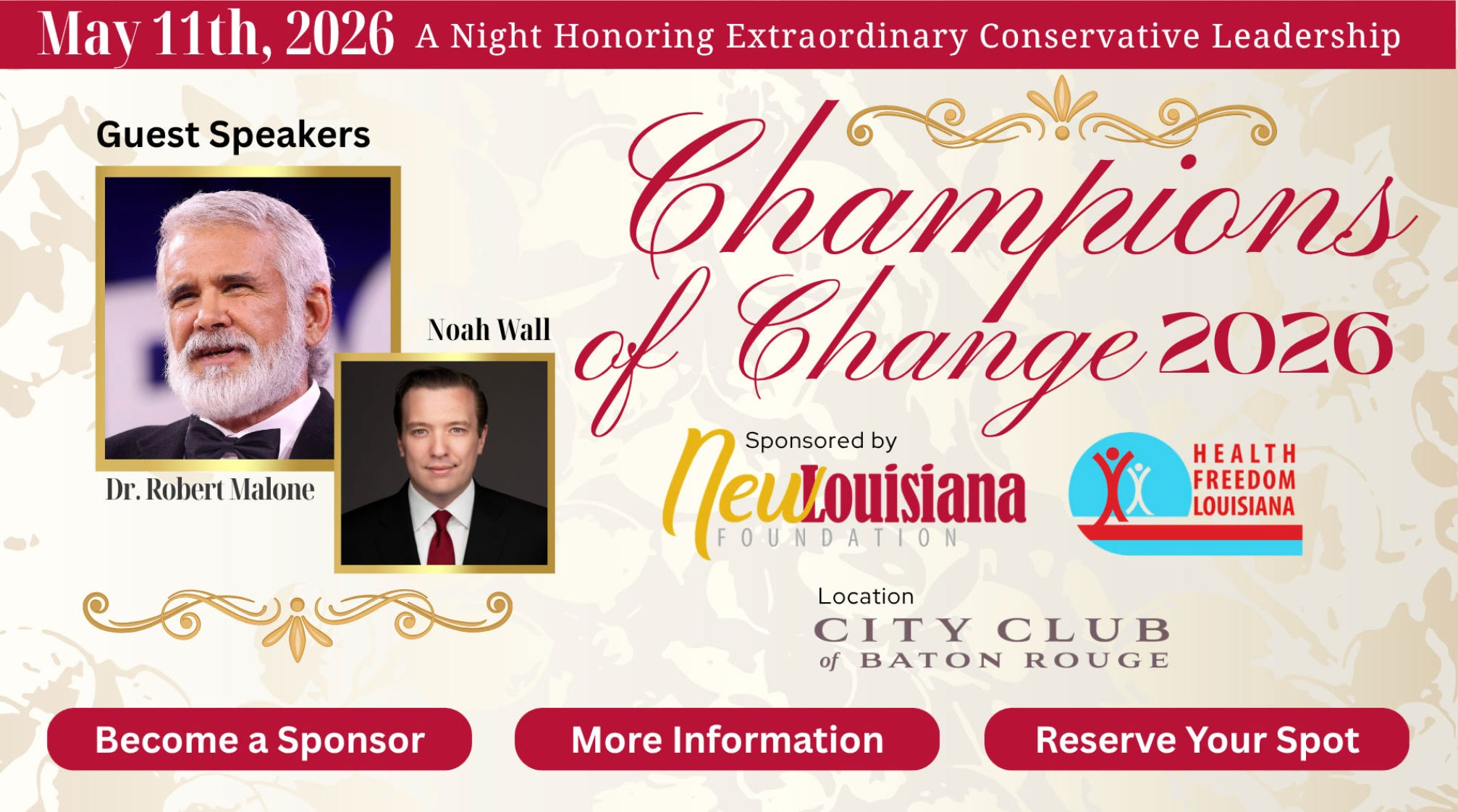
Jill and I have just returned from Baton Rouge, where I had the honor of speaking to the members of the New Louisiana Foundation and Health Freedom, Louisiana. For those who were there, and any wishing to know what was said, I am providing the text of last night’s address below, following the introduction provided for the meeting announcement.
Champions of Change Baton Rouge
How Policy Really Gets Made
Featuring Dr. Robert Malone & Noah Wall
From scientific authority to statehouse policy—discover how ideas move, who shapes them, and why it matters.
Most people believe laws are written by elected officials. In reality, policy often begins long before a bill is filed—developed through networks of institutions, experts, and organizations that shape the ideas, language, and frameworks lawmakers rely on.
At this special Baton Rouge event, you’ll hear from two speakers who illuminate this process from different—but deeply connected—angles.
Dr. Robert Malone brings a scientist’s perspective on how expertise, authority, and public health decisions are translated into policy—raising critical questions about informed consent, medical ethics, and the balance between institutional power and individual rights.
Noah Wall examines how policy is developed, packaged, and distributed across all 50 states—often moving in coordinated ways through trusted associations and professional networks.
Together, they offer a rare look at how influence flows through modern governance and what that means for transparency, accountability, and ultimately, individual liberty. If you’ve ever wondered why the same ideas seem to appear in multiple states at once, or how complex policies move so quickly through the system, this is a conversation you won’t want to miss.
REMARKS
Fear, the Apparatus, and the Coalition That Said No
Robert W. Malone, MD, MS
December 2021. Louisiana House Health and Welfare Committee. Some of you were there.
Governor Edwards wanted to put the Pfizer shot on the K-12 mandatory list. Jeff Landry was the Attorney General then. He didn’t like it. He invited me and Bobby Kennedy down to testify against it.
We did. That committee voted thirteen to two.
That vote mattered. It happened here. And the Attorney General who set it up is now your Governor. I don’t think that’s a coincidence.
Around that same time, Landry was filing Missouri v. Biden. The case about the federal government leaning on social media to silence people. People saying what Bobby and I were saying. Louisiana didn’t just push back politically. Louisiana sued. And won at the district court. The Supreme Court eventually narrowed it. But the record from that case is now part of the public history of what was actually happening between Washington and the social media companies during the pandemic.
I haven’t forgotten any of that. I doubt you have either.
That’s why I said it’s good to be back.
One thing I want to do before I get into it. My wife Jill Glasspool-Malone is here tonight. Jill is my partner in everything I do, professionally and otherwise, and she is the co-author of both books that the talk tonight comes out of. Most of what you’ll hear from me tonight, Jill helped me think through. So when I say I, I usually mean we. - Jill, would you wave so people can see you.
So. The organizers want me to talk about my own history. The mRNA work. How I ended up on the side of this I’m on now. I get why. Given what you sat through in 2021, that history is part of what I’m doing here. But if you’ll let me, I’d rather use the time on something else.
MAHA. The “Make America Healthy Again” movement. Where it came from. Where it’s going. What it is, and what it isn’t.
And I want to do it by way of a story that’s been in the news this week. Hantavirus. Because what’s going on right now with Hantavirus is the same thing that happened to us during COVID. Smaller scale. Same playbook.
Once you see it, you can’t unsee it.
One more thing. You’ll notice I’m reading from a laptop. Here’s why. I like to talk. If I don’t have something in front of me, we’re here all night. The people who put this together were very clear we needed to be done at a reasonable hour. So, the laptop is for you. Not me.
Three parts tonight. Where MAHA came from. Where it’s headed. And the Hantavirus story, and what it tells you about the system MAHA was built against. A system that didn’t change just because the administration changed.
The first two parts come out of work Jill and I have been doing for the book we just finished. It’s called “The Chronic Rebellion”. It comes out before the midterms. The third part comes out of work we did two years ago, in our last book, “PsyWar”.
So you’re getting the connection between the two books tonight. Which is something I haven’t had a chance to lay out in this form before.
PART ONE — Where MAHA Came From
Let me tell you what MAHA isn’t.
It isn’t something Bobby Kennedy invented when he endorsed Trump. It isn’t the Means siblings, Casey and Calley, who you’ve seen on every podcast in the country. It isn’t the Health and Human Services Secretary, even though that’s the face on it now. And it isn’t a Washington operation.
MAHA has been building for twenty years. Underneath everything else. You probably didn’t see it until it surfaced. But it was there.
Who built it? Not who took it over. Who built it?
Mothers. American mothers. Some grandmothers too.
Their kids got sick in ways the pediatric establishment couldn’t explain and didn’t want to be asked about.
Autism. Severe food allergies. Type 1 diabetes at four years old. Eczema head to toe on a baby. ADHD at seven, on stimulants through high school. Autoimmune conditions in kids who shouldn’t have autoimmune conditions. Chronic gut problems. Anxiety in middle school. Depression at nine.
The chronic disease curve for American children used to be flat. It started going vertical in the nineties. It hasn’t come back down.
Talk to any pediatrician who’s been practicing for thirty years. They’ll tell you the same thing. The patient mix in their office today does not look like the patient mix in their office in the early nineties. The volume of chronic conditions, the volume of allergies, the volume of behavioral and developmental issues — all of it is up. Not a little. A lot. And no one in the federal health establishment has a satisfying explanation for why. Or if they have one, they aren’t saying it out loud.
What they say instead, when you push them, is that diagnostic criteria have changed. That we’re catching more of what was always there. That parents are more aware now. Maybe some of that is true. Some of it. But anyone who has actually been in pediatric practice across these decades knows that what they are seeing is not just a change in how they count. Something has changed in what they are counting.
You see it. You see it in your own families. You see it at church. You see it in your grandkids’ classrooms.
These mothers organized. Some around vaccines. Some around the food supply. Some around environmental toxins — and if you’ve driven that stretch of river between Baton Rouge and New Orleans, you know what I mean by environmental toxins. Some around pharmaceutical advertising aimed at their kids. Some around all of it.
They had one thing in common. Their kids were getting sick. The institutions were telling them everything was fine. And they didn’t believe it.
They weren’t credentialed. They weren’t rich. They weren’t Republican operatives. They weren’t Democratic operatives. They were just paying attention. To their own kids.
For twenty years, the press treated this whole crowd as an embarrassment. Crunchy moms. Anti-vaxxers. Conspiracy theorists. If you knew anyone inside that world before 2020, you knew most of them were serious. A few weren’t. The press treated them all the same. Which was contempt.
Then came COVID.
And COVID gave the rest of America a four-year crash course in what those mothers had been saying for twenty years.
Three feet. Six feet. Ten feet. Cloth masks. N95s. Back to cloth masks. The vaccine prevents transmission. Then it doesn’t. Then there’s a booster. Then another. Then a fourth one nobody wanted. The lab leak is a conspiracy theory. Then it’s the leading hypothesis. Kids are fine in school. Then schools have to close. Then we’re catastrophizing the learning loss the closures caused.
The problem wasn’t that the science changed. Science changes. We learn things.
The problem was the certainty. Every step of the way, somebody on television was certain. Every step of the way, the people asking questions were called dangerous. And when the certainty turned out to be wrong, nobody who had been certain had to answer for it.
You were told something was true. Your eyes told you something else. You were told to trust the science. The science was changing every week. You were told that asking made you a bad person.
You watched your kid fall behind. Your business close. Your mother die alone in a nursing home with nobody allowed to visit.
You were told it was for your own good. And you were told that wondering whether it was for your own good was itself a public health emergency.
Louisiana lived all of that. The closures. The mandates that didn’t apply equally. Schools shut for months while the big-box stores stayed open. Hospitals turning away ivermectin scripts. Pharmacists in this state losing their licenses for filling them.
MAHA is what happened when the people who’d been getting that treatment for twenty years met the people who just got it for four. And they figured out they were the same people.
That’s where it came from. That’s who built it.
Now. The part I told you I’d be honest about.
The base of this movement is mothers. The top of every MAHA organization built since 2023 is almost entirely men.
The founding chief operating officer of the main MAHA political organization was a woman. She left last year to start her own firm. Mary Holland runs Children’s Health Defense. Mary will tell you herself, and she’s told me, that CHD is not MAHA. CHD is the older medical-freedom outfit that MAHA bolted onto. Not the other way around.
So we’ve got a movement the mothers built, and a top leadership that’s mostly men.
That happens. There’s a name for it. Founder displacement. It’s what happens to populist movements as they get organized. The people who built the thing at the kitchen table get replaced by the people who can navigate the paperwork.
The men running these organizations are good men. I’ll defend them. But here’s the truth. If MAHA forgets who built it, MAHA is done. The base isn’t going to keep showing up for something that’s become something else. Watch it. If you don’t see it being addressed, say so. To the people in this room who work in those organizations. To the donors. To Bobby. To me.
I’m sharing this because if I only talk about the good parts, you shouldn’t believe me about the rest.
PART TWO — Where This Is Headed
Where is this going. Quick version. Because I could go on, and you know what happens then.
American populist movements have a track record. Most of them don’t last as the original group. The ones that succeed leave something behind.
Moral Majority. 1979. Gone as an organization decades ago. But Focus on the Family, Family Research Council, Alliance Defending Freedom — those are still running. Forty-five years later. Still shaping the country. That’s success.
Tea Party. 2009. Gone by 2016. But FreedomWorks, Americans for Prosperity, Heritage Action, the House Freedom Caucus — still running. That’s a partial success.
Ross Perot. 1992. Nineteen percent of the vote. Built nothing that lasted. Reform Party dead within a few years. That’s failure.
The difference? The successful ones built institutions that outlived the founder. The ones that failed didn’t.
So which one is MAHA going to be?
Here’s what I see. At eighteen months, MAHA has built more than the Tea Party had at the same point. Less than Moral Majority had. The organizations exist. The policy work exists. State-level operations are real, and growing.
The cultural footprint is real. Ninety percent of Americans say they’re worried about ultra-processed food in their kids’ diets. That isn’t partisan. That’s a country that woke up. That isn’t going back.
So the food side of this — the dyes, SNAP reform, school lunch, whole milk back in schools — that’s locked in. Whatever happens in 2026 or 2028, the food fight is already won at the cultural level. It will outlast any one administration.
The vaccine and pharmaceutical side is harder. It’s earlier. It’s more contested. It will live or die based on whether the institutions Bobby and the team are building now survive the next transition out of power. They probably will survive. With losses.
Here’s what I want this audience to hear in particular.
This coalition came together because people from across the political map were getting the same treatment from the same institutions.
Christian conservatives in rural Louisiana watching their grandkids deal with food allergies that didn’t exist a generation ago. Libertarians watching the FDA dance with pharma. Organic-food people in California who voted for Bernie Sanders. Hasidic communities in upstate New York. Black mothers in South Los Angeles whose sons developed asthma. Hispanic mothers in Texas whose kids had conditions their grandmothers had never seen.
That coalition holds if it stays a movement. It falls apart the day it becomes the health wing of any one party.
Because the people who built it didn’t get into this to pick a team. Their kids were sick. The institutions weren’t listening. That’s it.
One more thing on this part, because it touches Louisiana directly.
The big case right now is American Academy of Pediatrics versus Kennedy. The case challenging Bobby’s decision to cut the pediatric vaccine schedule from seventeen vaccines to eleven. That case is in Massachusetts. The appeal is in the First Circuit, in Boston. So Louisiana is not the courtroom.
But Louisiana has Senator Bill Cassidy. Who chairs the committee that oversees HHS. Whose vote was the deciding vote on Bobby’s confirmation. Cassidy attached conditions to that vote. There’s a real fight playing out right now over whether those conditions are being honored.
And Cassidy is up in 2026. And he is being challenged in the primaries right here.
Cassidy did vote to confirm Bobby. He spent the months before the confirmation extracting commitments. Commitments about which vaccines would be reviewed, how the review would happen, what the public would be told. Then he cast the deciding vote. Then he watched what came next, while working closely with the newly created mRNA vaccine lobby. Cassidy has relationships with the vaccine manufacturers while also influencing vaccine policy. Some of the commitments he extracted have been kept. Some haven’t. There is a fight inside the Senate Republican caucus right now about whether Cassidy was right to take the deal he took, and whether what came out of HHS afterward honored the deal.
That fight is not theoretical. It will play out in your primary.
Draw your own conclusions about what that means. But Louisiana has more leverage on this whole thing than most states. Watch your primary.
PART THREE — The Hantavirus Moment
Now the part I really wanted to get to. Hantavirus.
If you’ve watched the news the last two weeks, you’ve seen it. Cable. Wires. New York Times. Washington Post. Coverage of Hantavirus cases. If you watched it without context, you’d think half the country was about to die in a cloud of mouse droppings from the HVAC at Tractor Supply.
That isn’t what’s happening.
Hantavirus is real. It can be serious. There are cases. Rodent control around homes and barns matters. Parts of the Gulf Coast, including parts of this state, see cases. Nobody serious is arguing otherwise.
But Hantavirus in this country is rare. Specific regions. Specific exposure situations. The CDC has thirty years of data on it. Known disease. Known footprint.
So why is it suddenly everywhere?
Watch the words. Every headline uses the word “could.” Could spread. Could mutate. Could get worse. Technically true. Almost anything in biology could happen. But that’s not how the public hears it. The public hears “could” as “will.”
That gap — between what’s technically possible and what the language makes you feel — that gap is the entire trick.
Jill and I published a piece on this just today in our Substack, Malone.News. We called it by the name it has in the academic literature.
Psychological bioterrorism.
I know that’s a strong phrase. So let me tell you where it comes from. Because if I’m going to use it, you deserve to know it’s not something I made up.
Alexander Kouzminov. Former Soviet intelligence officer. Worked in biological espionage and biosecurity. In 2017, in published academic work, he laid out how fear of disease gets used as a weapon. Not just by foreign adversaries. Sometimes by institutional actors inside a country. Using fear of disease to move public behavior, shape government decisions, and make money or expand authority along the way.
He named it. He documented it. He warned that Western governments had stopped recognizing when it was being used on their own people.
This is not a conspiracy theory. Jill and I wrote about it at length in PsyWar two years ago.
Psychological bioterrorism. Using fear of disease to manipulate people, populations, markets, and governments. Sometimes the goal is political. Sometimes financial. Sometimes bureaucratic — keeping agencies funded, keeping budgets up, keeping the power consolidated. Often all three at once.
Now here’s what I need you to understand. I am not telling you every public health official is a bad person. I am not telling you every reporter covering this story is a propagandist. That’s not how it works.
It works because the system is set up to reward fear and punish proportionality. Once those incentives are in place, the output comes out the same whether the people inside are good or bad. Most of them are decent people. They don’t have to be malicious. They just have to be doing their jobs inside a machine that rewards them for amplifying fear.
Here’s the pattern. Watch for it. Once you see it, you can’t unsee it.
One. A pathogen shows up somewhere. Maybe it’s real. Maybe it’s old news repackaged as new. Maybe it’s a case count that would have made the local paper and nothing more in a non-election year.
Two. The coverage goes apocalyptic. Experts on TV predicting catastrophe. Computer models projecting millions dead under specific worst-case assumptions. The hedging language gets buried in paragraph three.
Three. Politicians declare emergencies. Pharma companies announce new products. Federal agencies expand their authority and their budgets.
Four. Social media catches fire. “We must act now” appears in every editorial within forty-eight hours.
Five. And this is the step most people miss. The pathogen drops out of the news within weeks. The expanded authorities don’t.
Six. The cycle resets with a different disease, a different season. And we do it again.
And here’s the thing about that pattern. Every step is profitable for somebody. Cable news ratings spike. Pharma stocks move. Federal agency budgets grow. Politicians get to be seen taking action. Editorial pages get easy material. Everybody who runs the cycle wins. The only people who lose are the ones being told to be afraid. Which is to say, the rest of us.
We lived this at full scale during COVID. We’re still living with the consequences.
Think about the receipts.
Two weeks to flatten the curve. Remember that? March 2020. Two weeks. By summer 2020 it was a year. By the second summer it was two years. Nobody who said two weeks ever apologized for what those two weeks turned into.
The vaccine prevents transmission. Nobody who said that ever apologized when it didn’t prevent transmission.
The lab leak is racist disinformation. Nobody who said that ever apologized when our own intelligence agencies said the lab leak was the most likely origin.
Schools have to close. Nobody who said that ever apologized when the data showed it cost a generation of American children months and years of learning they’re still trying to make up.
That’s not a parade of mistakes. That’s a system. A system that doesn’t self-correct. A system that absorbs new information without ever reckoning with the old. A system that punishes the people who were right early and protects the people who were wrong loudly.
And that same system is still running. That’s the part you have to understand.
You see it in the agencies. The people who ran the COVID response are still mostly the same people. Different titles in some cases. Same people. You see it in the journals. The peer review networks that suppressed dissenting research during the pandemic are still running peer review. You see it in the press. The reporters who treated the lab leak as racist disinformation in 2020 are now the reporters covering Bobby’s tenure at HHS. And they are using the same playbook on him that they used on the rest of us.
The system has muscle memory. The system has incentives. The system has institutional habits that were built over decades and that do not change overnight just because the boss changed. And now the system has artificial intelligence and Wikipedia.
Hantavirus right now is a smaller version of the same script. So was avian flu. So was Mpox. So was the measles cluster in West Texas earlier this year — two pediatric deaths, lots of coverage, very little proportionality.
None of these run at COVID scale. That’s not the point. The point is what the cycles do over time. Each one trains you. Each one expands the apparatus. Each one makes the population a little more anxious. A little more dependent. A little less able to tell real risk from manufactured panic.
Fear scales faster than facts.
Here is where this comes back to MAHA.
MAHA is the people who stopped accepting that cycle as legitimate. Not because they’re anti-science. Not because they’re anti-vaccine. Not because they’re against public health. Because they watched the system run that cycle for twenty years, or four years, and produce harms the system could not admit to and could not fix.
Their kids’ autism rates kept climbing. The system said it wasn’t connected to anything. Their kids’ food allergies kept climbing. The system said it wasn’t connected to anything. Two weeks turned into two years. The supposedly transmission-blocking vaccines didn’t block transmission. And every time anyone pointed at any of it, the system said they were a public health threat.
That’s what built MAHA. The system didn’t produce MAHA by doing its job well. The system produced MAHA by failing in ways it couldn’t acknowledge. And by treating the people who noticed as enemies.
Now here’s the hard part.
That same system is the one running the Hantavirus fear cycle right now. With a MAHA Secretary in office. With Jay Battacharia, acting CDC director doing what he can to apply the brakes. The system didn’t change just because Bobby is in charge of the building. The career staff is the same. The journals are the same. The pharma money flows the same. The press infrastructure is the same.
Bobby cannot fix all of it in four years. Nobody could. And anyone who tells you he can is selling you something.
So, if MAHA’s measure of success is whether Bobby fixes the system in his term, MAHA loses. That can’t be the measure.
The measure has to be whether the people who built this stay harder to manipulate after the political moment passes. Whether the next time a Hantavirus story shows up, or the next pathogen lands in the news cycle, the audience of Americans who automatically reach for the panic button has gotten smaller. Whether enough people in enough places have learned to read the signals and ask the questions. So that the next time the system tries to run the play, it doesn’t work as well.
That’s a long fight. It’s not a four-year fight. And it doesn’t depend on Bobby. It depends on you. On me. On the parents and grandparents and pediatricians and pharmacists and small-town doctors who keep paying attention.
CLOSING
Let me close with this.
Louisiana has a long history with being told by Washington what’s good for you. Levees that weren’t enough. Water that wasn’t safe. Chemical plants in your parishes that nobody in a federal office building wanted to look at too closely. You’ve been told a lot of things by people in suits from D.C. The last fifty years have not been kind to the people in suits.
That experience is the same experience that built MAHA. Different topic. Same pattern. The institutions tell you something. Your eyes tell you something else. Too often, your eyes were right.
The lesson is the same. Don’t be fearless. Fearless is foolish. Some things are real.
Be harder to manipulate.
Next time the headline lands, ask four things. Who benefits from me being scared right now? What’s the actual evidence? What part is known and what part is speculation? Am I being asked to respond to a real risk, or to the way the risk has been packaged?
That last question is the one most people don’t ask. Because most people don’t separate the underlying risk from the way it’s been wrapped for them. The risk and the packaging show up together, in the same headline, in the same news segment, in the same conversation. Most people just take the package. The discipline is to pull them apart. The risk is one thing. The packaging is another. The packaging usually tells you something about who’s doing the packaging. Pay attention to that. It will tell you most of what you need to know.
Those questions aren’t radical. They aren’t partisan. They are what free people ask. They are what the apparatus would prefer you didn’t ask. And if enough Americans ask them, consistently, for the next decade, that is the difference between a MAHA that fades and a MAHA that lasts.
The mothers who built this coalition asked those questions for twenty years before the rest of us caught up. Some of them were in Louisiana. Some of them are in this room tonight.
The least we can do is keep asking them ourselves.
One last word. Everything I said tonight reflects work Jill and I have done together over the last several years. I am the one at this microphone tonight, but the analysis behind what I just told you is as much hers as mine. I want you to know that. And I want her to know I know it.
Thank you. I’m glad to take your questions.
Thank you for sharing your speech & for all the work BOTH of you do! Much appreciated!
Excellent! Excellent! Excellent speech!!