

Democracy in Israel
The wolf at the door, part seven: notes from the Israeli frontier
A note on what follows. Alexis de Tocqueville spent nine months in America between 1831 and 1832, ostensibly to study its prisons, and produced instead the most penetrating account of the American character ever written by a foreigner. He was thirty-two when he sailed and had no particular affection for democracy. What made the book last was that he neither flattered his subject nor condemned it, and that he insisted the decisive facts about a people are not its laws but its habits.
We have imagined him landing at Ben Gurion instead of Newport, and have written this analysis in his manner. The observations are drawn from the six essays preceding this one and from the sources listed at the end. The topical approach and judgments are aligned with what his might have been, which is to say ours, offered in his voice and style.
At least for now, this framework and essay provide the conclusion to this series. It has generated considerable engagement, which is the term X uses to describe both hate-posting and active debate, and predictably we have been subjected to a barrage of defamation. We knew that was likely, and we dove into the analyses and published our findings anyway. Publishing this series has cost us about three thousand general unpaid subscribers, though our paid subscriber count has held. We knowingly accepted that price for countering actively promoted misinformation, which is a key part of the Malone News mission.
The Israeli and US militaries are not merging into one; the relationship is far more complicated and nuanced than that. Israel does not control the White House. The Palestinian homeland settlement narratives are considerably more complicated than the versions printed in the New York Times. The spitting on Christians is real, and it is wrong, and it comes overwhelmingly from radicalized young men raised in a small number of very specific religious communities. And the Mossad is not only not all-powerful, but has a long history of serious intelligence failures.
We hope that those who have taken the time to read and think for themselves have developed a deeper understanding of these issues, as we have, and have become more resistant to the cloud of promoted and sponsored material (and hate) that currently surrounds them. As usual, we do not wish to tell you what to think. We strive to provide information that will help you think more clearly and draw your own conclusions.
Of the point of departure, and its influence upon all that follows
I have written elsewhere that a nation is like a man, and that the circumstances of its infancy govern the whole course of its life. Whoever would understand the Americans must return to the first Puritan who stepped ashore in New England with a covenant in his hand and no lord above him (Tocqueville 1835, vol. 1, ch. 2).
The Israelis have a point of departure also, and it is not the one a stranger expects.
They did not begin with a covenant. They began with a conclusion, drawn from evidence, and the conclusion was this: that respectability confers no protection whatever. Israel’s founders had watched a people make themselves useful, learned, prosperous, and indistinguishable from their neighbors, and had watched that make no difference at all when the knock came at the door. Pinsker wrote it down in 1882 and Herzl after him, and the century then supplied the proof (Pinsker 1882; Herzl 1896).
From that single conviction nearly everything else descends. A people who believe that virtue will be rewarded build institutions to display their virtue. A people who believe it will not build institutions to survive without it.
And so the second act of this state, within weeks of its founding, was to fire on a ship carrying arms to one of its own armed factions, and to dissolve the most distinguished fighting force among its founders. Jews shot Jews off the beach at Tel Aviv in June of 1948 in order that there should be one army and one flag. The Americans, whose republic was assembled out of militias, wrote the militia into their fundamental law. The Israelis, whose republic was assembled by liquidating its militias, hear the word and think of Beirut.
An observer who does not grasp this will misread everything he sees here, and will in particular misunderstand why a people so heavily armed have so little of what an American would call a right to arms.
Of the extraordinary propensity of these people to associate
Nothing struck me more forcibly in America than the general equality of conditions, and nothing struck me more usefully than the habit of association. Americans of all ages and all conditions were forever forming societies, and where in France the government would have acted and in England actions would have been dictated by some great lord, in America you were certain to find an association (Tocqueville 1840, vol. 2, pt. 2, ch. 5).
In Israel this habit exists in a degree I have not seen elsewhere, and it exists because the state, for all its centralizing temper, cannot arrive in time.
Every agricultural settlement near a hostile border maintains a body of its own neighbors, chartered and armed by the state, who are expected to fight until soldiers come. On the morning of the great massacre of October seventh, these bodies were, in many places, the entire defense. At one settlement nine such men faced some hundreds of attackers and four of them died. Off-duty soldiers drove south on their own authority. Volunteer ambulance corps assembled without orders.
I observed the same faculty afterward in stranger applications. When it emerged that Christians were being insulted and assaulted in the old quarter of Jerusalem, it was not the ministry that began counting the incidents. It was a Jewish scholar of Christianity and a corps of Jewish volunteers, who drive to churches to stand beside people they have never met.
When the hostages were taken, the families did not petition. They occupied a public square, erected a clock, and remained there for two years and three months until the last body came home.
The American forms associations because he is free and has time. The Israeli forms them because the alternative is to wait, and he has learned what waiting costs. The result looks similar and proceeds from an opposite premise, which is the sort of thing a traveler ought to notice before he congratulates a people on resembling his own.
Of the army as a school, and of those it does not admit
Among democratic peoples the army is always a difficulty, for it draws from the nation and returns to it, and whatever it teaches the nation eventually learns (Tocqueville 1840, vol. 2, pt. 3, chs. 22 to 26).
Here the army is not a difficulty but the principal school of the nation. Nearly the whole of the population passes through it at eighteen, and continues to be summoned back for decades afterward. It is where a man from a development town in the south meets a man from north Tel Aviv, and where both acquire the habit of speaking to a superior as though he were a cousin.
I have never encountered an army in which so little deference is shown and so much obedience is obtained. An officer is addressed by his given name. An argument with a commander is not insubordination but procedure. Some part of the Israeli temper that a European finds abrasive is simply the residue of this: a nation of people who have all been shouted at by a sergeant and have all shouted back.
But an institution that makes citizens also marks those it does not make.
Roughly sixty-nine of every hundred Jewish men were inducted in a recent year. Among the ultra-Orthodox the figure is very nearly nothing, and some sixty-three thousand of their young men are eligible. In June of 2024 the whole bench of the Supreme Court, nine justices, ruled unanimously that no legal basis for their exemption existed, that the arrangement was unconstitutional, and that the government had gravely undermined the rule of law and the principle that all persons stand equal before it. No statute governing the matter has since been enacted (Israel Supreme Court 2024).
The Arab citizens are exempted also, though by the army’s own policy rather than by law. The Druze are not exempted, and enlist at above eighty in a hundred, frequently into combat. Bedouin men volunteer in numbers greater than other Arabs and smaller than the Druze.
Here, then, is a nation whose principal instrument of equality is an institution that a fifth of its citizens may not enter and another eighth decline to. I do not know how such an arrangement is sustained indefinitely, and neither, so far as I can determine, does anyone here.
Of equality in manners, and inequality in condition
The Americans had achieved an equality of conditions unknown in Europe, and their manners followed from it. Here the manners have run ahead of the conditions, which is a different and less stable arrangement.
I know of no country where a stranger is so quickly addressed as an equal. There is no honorific that survives the second sentence. The taxi driver instructs the minister. The queue is a suggestion. A European mistakes this for rudeness, and it is not; it is the refusal of a people who were subordinate for eighteen centuries to perform subordination for anyone ever again.
Yet a short drive from this rough equality one encounters conditions no American township ever contained. Two populations occupy the same hills. One is tried in civil courts and the other before military tribunals. One builds with permits and receives roads, water mains, and a legal address; the other applies for permits which are granted at a rate near zero and builds anyway, under demolition orders that sit in a file (Bimkom 2021).
The manners are democratic. A portion of the conditions is not. A people may live with such a contradiction for a long while, and I have observed that they generally do so by not looking at it.
There is one exception to the levelling, and it is not the one a European expects.
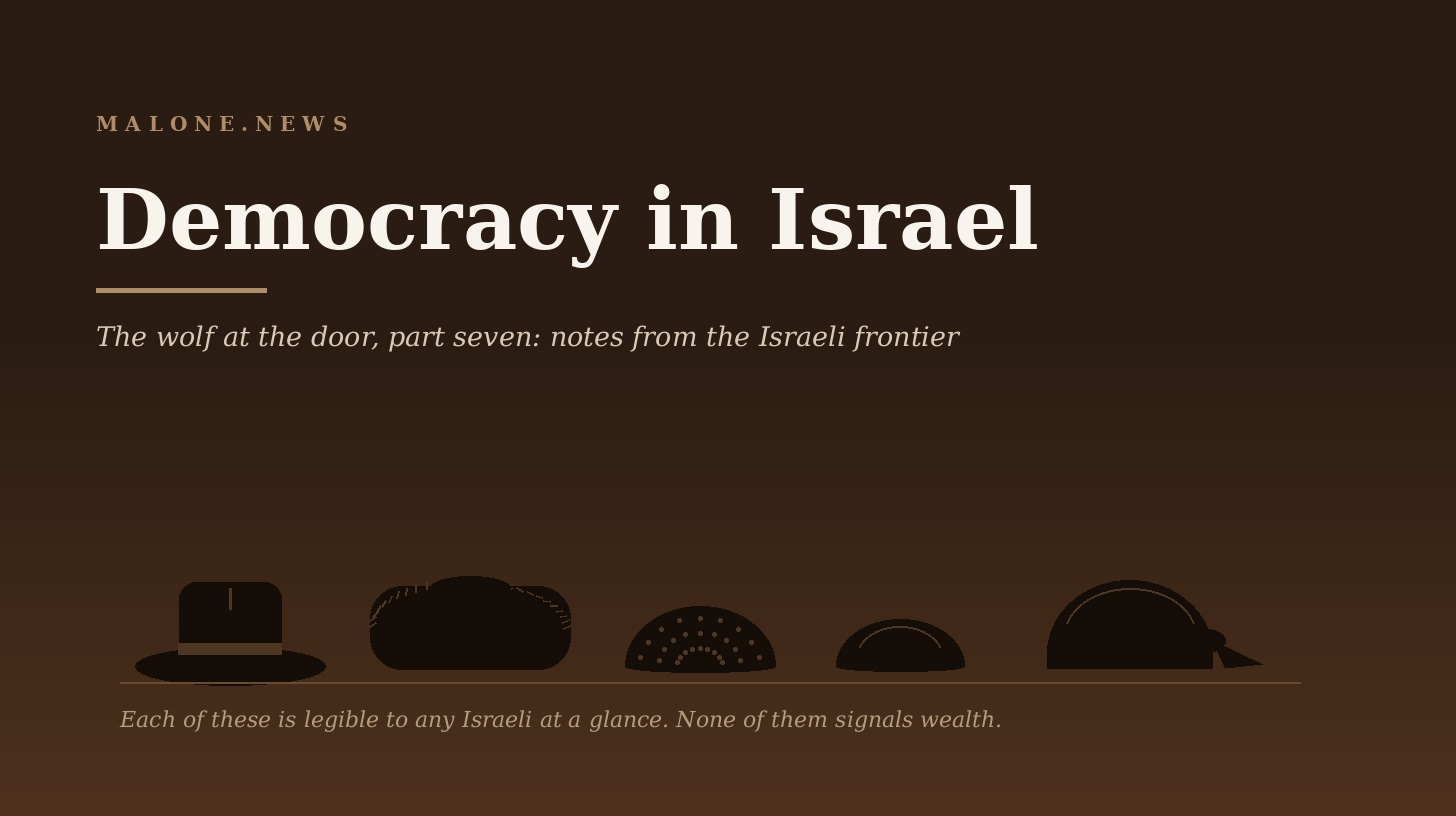
In the countries I know, dress announces rank. A man’s coat declares his income and his station, and in an aristocracy any observer reads it at fifty paces. Here dress declares nothing whatever about a man’s fortune and a great deal about his convictions.
A black hat of a particular brim. A fur hat worn only on the Sabbath and the festivals, and cut differently by each Hasidic court. A knitted skullcap, whose size and colour a stranger cannot read and every Israeli can. Fringes worn outside the trousers or tucked within them. A married woman’s wig, or her headscarf, or her hat, each carrying its own meaning. None of these signals wealth. All of them signal what a man believes and which authority he obeys, and the knitted skullcap in particular has become very nearly a ballot.
I know of no other country whose visible code is at once so precise and so entirely detached from money. The taxi driver and the minister dress as equals. The believer and the believer of another sort do not, and neither wishes to.
Of the piety of a people who call themselves secular
I must correct an impression every visitor arrives with, and which the Israelis themselves encourage.
They will tell you the country is divided between the religious and the secular, and they will give you proportions. Something under a tenth are ultra-Orthodox. Something near a tenth again are religious in the national manner. Near a third call themselves traditional. Four in ten call themselves secular (Pew Research Center 2016).
Those last two words do not mean in Jerusalem what they mean in Paris.
The secular Israeli fasts on the Day of Atonement. He circumcises his sons. He sits at the Passover table and reads the whole account through. He will not bring pork into his mother’s house. He knows the liturgy well enough to be bored by it, which is a wholly different relation to a religion than never having learned it. The Frenchman who calls himself secular has generally departed. The Israeli who calls himself secular has generally only stopped attending.
And the traditional category, which is the largest single body of them and for which I know no equivalent in any Western language, describes a man who keeps what he keeps, on his own authority, without system and without apology. He drives to the beach on the Sabbath and will not eat leavened bread at Passover. A European would call this inconsistency. It is not inconsistency. It is a man who has never accepted that the choice is between all of it and none.
From this soil grows the one conviction I found in every quarter of Israeli society, held as firmly by the man in the fur hat as by the man on the sand at Tel Aviv, and it explains behavior that appears to foreign observers to be madness.
The Mishnah holds that whoever saves a single life is accounted to have saved an entire world (Mishnah Sanhedrin 4:5). The principle they call pikuach nefesh holds that the preservation of a life overrides very nearly every other commandment, the Sabbath included, and the Sabbath is the most heavily defended institution in the whole of their law (Babylonian Talmud, Yoma 85b). A physician may drive upon it. A sick man must break the fast, and it is an offense to refuse. This is not a concession wrung from necessity. It is a ranking, and life sits at the head of it.
Now consider what the foreigner sees here and calls irrational.
This nation exchanged one thousand and twenty-seven prisoners for a single soldier. It has repeatedly traded the living for the dead, and negotiated for years to recover remains. There is a corps of volunteers who go to the sites of atrocities and gather fragments of bodies with tweezers, so that a whole man may be buried. Its hospitals treated some five thousand citizens of a state formally at war with it. Its surgeons have opened the hearts of children sent from countries that do not concede that Israel exists.
An economist would call every item on that list a mistake, and part three of this series sets out in colder terms what the exchanges have cost. I do not withdraw that analysis. But a traveller who reports the arithmetic and stops there has failed to describe the country. The arithmetic is bad because these people are operating a ranking in which one life outranks a great many other goods, and they did not invent that ranking in the last century. They have been arguing about it since the second.
Of religion, and of what an establishment costs a faith
I remarked in America that religion was powerful precisely because it asked nothing of the state, and that in France it had been ruined by the alliance it had contracted with power (Tocqueville 1835, vol. 1, ch. 17). The Americans had separated church from government and had thereby preserved both.
The Israelis have not done this, and the consequences are legible.
Marriage, burial, and conversion are administered by an official rabbinate, which is a department of state. A citizen who wishes to marry outside its rules flies to Cyprus. The religious schools receive public funds while their students decline the conscription that binds their neighbors’ sons.
An establishment of religion produces two effects wherever I have seen it. It makes the faith an object of political resentment among those who do not share it. And it relieves the faith of the necessity of persuading anyone.
The second effect is the graver one. There is a small number of young men in the old quarter of Jerusalem who spit upon Christian clergy and describe the act as a religious duty. Their numbers are counted, as I have said, by Jews. The count has risen from one hundred seven incidents in a year to one hundred eighty-one in the next, and higher since (Religious Freedom Data Center 2026). Of twenty-five complaints laid before the authorities across a decade, nineteen were closed without a suspect or without an offense (Israel Religious Action Center 2026).
A minister who once defended this practice in public now superintends the police. That is not a coincidence but a mechanism, and it is the same mechanism I observed on the American frontier, where the sheriff’s sympathies determined which crimes were crimes.
I would say to the Israelis what I said to the Americans about their own religion, and they will like it no better: that a faith which requires the state’s protection has already begun to doubt itself, and that the harm an establishment does is chiefly to the established.
Of the single opinion which could not be doubted
I know of no country in which there is so little independence of mind and real freedom of discussion as in America. That sentence gave offense when I wrote it and I do not withdraw it. In a democracy the majority draws a formidable circle around thought, and within it a man is free, and beyond it he is not persecuted but he is alone (Tocqueville 1835, vol. 1, ch. 15).
The Israelis argue more loudly than any people I have encountered, and I supposed at first that they were exempt. They are not. They have merely concentrated the effect into a single object.
They had an opinion about their enemy which everyone held. It was that he had been deterred, that he had property and office to lose, and that he would therefore not do the thing he had said for thirty years he would do. They gave it a name, which is always the sign that an opinion has hardened into a wall.
Young women watching the fence reported what they saw and were instructed to stop. A plan was found in the enemy’s own hand and judged aspirational. A junior officer had written the identical warning fifty years before, about a different enemy, and had been filed away by his superior.
The remedy had been devised after the first catastrophe. An office was established whose entire function was to compose the contrary opinion. It existed on the morning of the second catastrophe, staffed and mandated, and it did not fire.
I take from this what I took from America. The danger to a free people is not that it will be forbidden to think, but that it will not think of thinking, and that the office it establishes to do the doubting will attend meetings.
Of the peoples of this land who are not Jews
I come now to the chapter I would rather not write, as I did not wish to write of the Negro and the Indian, and as I could not honestly omit it (Tocqueville 1835, vol. 1, ch. 18).
There are three conditions here, and a stranger who conflates them will understand none of them.
The first is that of the Arab citizens, who number some two million and one hundred thousand, or better than a fifth of the state. Four in five are Muslim; the remainder are Christian and Druze in nearly equal parts. They vote. They sit in the parliament. A Muslim sits upon the Supreme Court, and is not the first to do so.
Their advance in the healing professions is the fact most often cited to me, and it is worth stating precisely rather than as the round numbers that circulate. Two scholars examined the licensure series of the health ministry and found that in 2023, among employed Israelis under sixty-seven, Arabs were a quarter of the physicians, better than a quarter of the nurses and the dentists, and very nearly half of the pharmacists, against twenty-two in a hundred of the working population. In 2010 the figure for physicians had been eight (Rosen and Miaari 2025).
That is a remarkable ascent in thirteen years, and I do not diminish it. The same study obliges me to record two things which the round numbers omit.
Much of that licensure was earned abroad. A great many Arab physicians, dentists and pharmacists took their training outside the country, because the places at home were not available to them. In the academic year 2022 and 2023, Arabs were seventy in a hundred of the first-degree pharmacy students in Israeli institutions, a third of the nursing students, a quarter of the dentistry students, and nine in a hundred of the medical students. That last figure had been eighteen a decade earlier (Rosen and Miaari 2025).
A people is advancing in a profession while its share of the domestic pipeline into that profession is falling by half. Both statements are true, and a traveler who reports only the first has flattered his hosts rather than described them.
I record also that their towns receive less; that their rate of poverty is higher; that criminal violence within their communities is severe and the state’s response to it has been widely judged inadequate; that infant mortality among Arab citizens stands above four times the Jewish rate, at some five deaths in a thousand live births against rather more than one (Israel Ministry of Health 2025); and that in 2018 the parliament removed Arabic from the status of an official language, which is the sort of act that costs a state nothing in law and a great deal in affection.
A traveler must hold both halves. A people is not oppressed which fills half the medical faculties. A people is not equal whose language has been demoted by statute.
The second condition is that of the Palestinians of the territories, who are neither citizens nor foreigners and who live under the authority of a state in which they cannot vote. Of this I will say only what the frontier taught me in America, which is that such arrangements are always described as temporary and are never temporary, and that the question is never whether they will end but in which of three ways: by admission, by subjection, or by departure. My American hosts used all three and were not proud of any.
The third condition is one no American of my century would have recognized and every American of this one will. There are foreigners here who do the agricultural labor, chiefly from Thailand, some tens of thousands of them, and on the morning of the massacre they died alongside the farmers and were carried into captivity with them. A Bedouin citizen of this state hid twenty-four of them, with eight Jewish young people, beneath his house, and went out to lie to armed men in Arabic to keep them alive.
I set that story down because a theory of this country which cannot contain it is a theory that should be abandoned. The categories offered to me by advocates on every side, settler, colonist, native, occupier, each explained a portion of what I saw and none explained that man.
Of a bargain struck in an hour of danger, and of what such bargains cost
I observed in America that a people may be governed for generations by a compromise it made in a single season, and that the compromise is nearly always struck when the danger is greatest and the future least legible.
The Israelis made theirs in 1949.
An assembly was elected to write a constitution and did not write one. The religious parties would not accept a secular instrument, the country was newly at war, and the man who governed it judged that unity was worth more than a document. The question was deferred by resolution, and the deferral is now seventy-seven years old. This nation has no constitution because it needed its quarrelsome factions in the same room during a war of survival, and it has needed them in the same room ever since.
From the same hour comes the exemption I described earlier. Some four hundred students of the Talmud were released from military service on the reasoning that they were the last remnant of a scholarly world destroyed in Europe and would not persist. They persisted. The number is now above sixty thousand, and the arrangement that was to expire with a generation has instead acquired a parliamentary constituency, two political parties, and a veto. Part five of this series sets out what that veto has cost the Christians of the old city, and by whose hand it is exercised.
I know this bargain. It is not Israeli.
The men who framed the American constitution in 1787 required the southern states, because a union of thirteen quarrelling provinces faced three empires on its frontiers and could not afford to lose four of them. They paid with a clause counting an enslaved man as three-fifths of a person, a clause obliging free states to return the escaped, and twenty years in which the traffic in human beings could not be touched. Several who signed it believed the institution would decay of its own economic weakness. Three years later a machine was invented for separating cotton from its seed, and it did not decay.
Both compromises were reasonable in the hour they were made. Both rested on a prediction about the future. Both predictions were wrong in the same direction, which is to say that the exempted thing grew rather than withered. And both, having been made under external pressure, could not afterward be revisited, because the pressure never let up long enough.
That is the mechanism, and it is the one I would have Americans understand before they pronounce upon it. It is easy to say that a nation which will not conscript an eighth of its young men has a self-inflicted difficulty. So it has. What is less easy to say, and truer, is that the difficulty is inflicted anew every year by the same circumstance that produced it. No first minister will bring down his government in a season of war, and there has been no season here that was not one. Each year of postponement enlarges the population postponed.
I have heard Americans propose that two parties would cure this, as they have at home. I doubt it, and I doubt it on American evidence.
Your Senate seats the smallest of your western territories equally with the largest of your states, an arithmetic settled on your own frontier for reasons of party advantage that nobody now defends and no amendment may alter. Your legislature has more than once been halted by a faction of some thirty men out of four hundred and thirty-five, and in one recent instance that faction removed the presiding officer of the chamber, a thing never done before. No elector was ever asked to approve the arrangement.
The difference between your system and theirs is not that yours lacks a hinge. It is that in Israel the bargain is struck after the election, written down, and published, so that a citizen may read what was traded for what. In America it is struck inside the parties, before the election, and never written down at all.
I do not say the Israeli arrangement is the better one. I say that a people which counts its own factions honestly is further along than a people which has hidden them, and that both are living inside decisions taken in a hurry by frightened men who thought the emergency would end.
Of the arithmetic that forbids the remedy
I said in the preceding chapter that the second condition here, that of the people who are neither citizens nor foreigners, is always described as temporary and never is. I did not say why the obvious remedy is withheld, and I ought to, because the reason is not wickedness. It is a sum, and the Israelis do it among themselves constantly and in front of strangers rarely.
Set it out plainly.
Within the borders this state actually governs as a state, Jews are near four fifths of the population, and the best demographer in the country expects them to remain about there. Add the territory of the hills and the fraction falls to something near three fifths. Add the strip on the coast as well and the two peoples arrive at parity (DellaPergola 2026).
Now consider how this parliament is constituted, because the arithmetic passes directly into it. There are no districts here. There is no man whose name appears upon a ballot. A citizen chooses a list, and seats are apportioned to the whole nation in proportion to the whole vote. What a population is, the chamber becomes, once every part of it votes at the same rate.
Two fifths of a hundred and twenty is forty-eight. That is not a government. It is a permanent hand upon the throat of every government thereafter.
I am told, and it is true, that matters do not presently work that way. The Arab citizens are a fifth of the state and their parties hold something nearer a tenth of the seats, because they vote in smaller proportion than their neighbors, because their parties quarrel and divide, and because no coalition has been willing to seat them except once, briefly, and at great cost to the men who did it.
A traveller ought to say what that means rather than repeat it approvingly. It means the present majority rests in part upon the other man’s abstention. A people may govern for a long while on such a foundation. It cannot call the arrangement settled.
Their own statesmen have said this more bluntly than I would dare to. A prime minister of the party of the right declared that if the separation of the two peoples failed, his country would face a struggle for equal suffrage after the South African manner, and that on the day such a struggle began the State of Israel was finished. That is not the complaint of an enemy. It is the reason five successive governments, of opposed parties and bitter mutual contempt, all pursued some form of partition.
Of the hope that time will do the arithmetic for them
There is an answer to all this which I heard more than once, and it deserves examination rather than dismissal, because the facts underneath it are real and are not widely known.
The birth rates have crossed.
In this country the Jewish woman now bears more children than the Muslim woman, and this is a recent and remarkable inversion. Twenty years ago the Muslim rate stood near four and a half and the Jewish near two and a half. The lines met about a decade ago and have since separated in the opposite direction, the Jewish rate rising to near three and the Muslim falling to near two and a half (Israel Central Bureau of Statistics 2025). Of all the developed nations I know, this is the only one whose birth rate has gone up.
From which some conclude that the question need not be answered at all. Defer it. Let the cradle settle what the treaty cannot.
I do not think it will serve, for four reasons, and the last is the one that ought to trouble them most.
The advantage is not general. It belongs almost entirely to the ultra-Orthodox, whose women bear six and a half children while the secular bear fewer than two. A nation adopting this strategy wins its count by enlarging precisely the community that does not serve in its army, that works in smaller proportion than any other, and whose parties hold the exemption I described earlier. It would solve the problem of numbers by deepening the problem of the bargain.
The advantage is also temporary. Every projection I have seen has all these rates declining together, the secular toward one and seven tenths, the religious toward two and a third, the ultra-Orthodox toward four and a third (Taub Center 2025). What they are looking at is not a plateau. It is a summit.
And the sum begins at parity, not at four fifths. A slight advantage compounding from an even division does not restore a governing majority within any span of years a statesman may plan for. It moves a point in a generation.
Then the fourth. Waiting does not shrink the population that cannot be enfranchised. It enlarges it. Every year the question is deferred there are more people to whom the answer must eventually be given.
But here is the objection I would put to them if they would sit still for it.
They have made this wager once already, and lost it inside a single lifetime.
The exemption from the army was granted in 1949 to four hundred students of the Talmud upon an explicit prediction about the future: that they were the last of a world destroyed in Europe and would not persist. They persisted. There are now above sixty thousand, they possess two parties and a veto, and the whole government of this country presently trembles upon the question.
To propose now that the question of citizenship be deferred until the birth rates resolve it is to make the identical instrument serve a second time, in a state that has direct and painful knowledge of what befalls a demographic forecast that runs the wrong way.
I know this instrument from my own reading of the Americans, and they used it longer and worse.
Several of the men who framed that constitution believed the institution of slavery would decay of itself, and they built accordingly. The clause counting an enslaved man as three fifths of a person was nothing other than a demographic accommodation, a device for weighing in the legislature a population that could not vote in it. And for forty years afterward the whole business of that republic, its compromises over Missouri, its admission of states in matched pairs, its arrangement of 1850, was the management of an arithmetic which everyone understood and no one would name aloud.
That management was skilful. It was conducted by serious men. It postponed the reckoning for two generations, and the reckoning when it came cost six hundred thousand of their young men.
I do not predict such a thing here, and I would not be believed if I did. I observe only that a people which has resolved to wait for numbers to relieve it of a decision has chosen the one course whose precedents are all bad, and that they of all peoples have the evidence in their own recent history.
Of the frontier which has not closed
The Americans had a frontier and believed it made them. I thought at the time that they overstated it, and I have since come to think they understated it.
Israel has a frontier still, and it is the last one in the developed world worth the name. Overlapping jurisdictions occupy the same ground. Title rests upon an Ottoman code of 1858 which rewards cultivation and forfeits land left three years untilled. Water is allocated by a committee in which each party holds a veto, which is to say by no one. Both peoples plant trees, because a tree is a claim, and both have understood that the survey decides what the soldier cannot.
That frontier is now closing, by registration rather than by cavalry, and it will close in favor of the party holding the stronger legal apparatus, as frontiers always do (Crisis Group 2025).
What I could not obtain from anyone here, and I asked, was a description of the closed condition. Every man I put the question to answered with the security case, which is strong, and none proceeded to the second half.
Of what I fear, and of what I do not
I do not fear that this people will be destroyed by its enemies. I have seen its soldiers and its scientists and its argumentative crowds, and I judge that a nation which can be summoned from its offices to its tanks in a day, and which produces more of certain useful arts than states forty times its size, will not be extinguished by neighbors who are poorer, less educated, and less united than themselves.
Nor do I fear, as some of my countrymen affect to, that it is a nation of fanatics. I met fewer fanatics here in a week than I meet in a Paris season, and the ones I met were counted and catalogued by their own neighbors, which is more than most nations do.
What I fear is what I feared for the Americans, and it is not what either people fears for itself.
I fear the effect upon a free people of governing another people who are not free, and I observe that this effect falls upon the governor before it falls upon the governed. I fear the habits that eighty years of emergency deposit in a state, and the difficulty of removing them once the emergency admits of no end. I fear the office established to do the doubting, and the certainty that it will attend meetings. And I fear the day when the sons of that shouting, arguing, unbowed people discover that they have grown accustomed to a condition their grandfathers would have found intolerable, and can no longer remember when it began.
The Americans were warned of this and did not attend, and the reckoning came to them in the fourth decade after my visit, and it cost them six hundred thousand of their young men.
I do not predict such a thing here. I say only that the question was posed to me in America by a country that would not look at it, and that it is posed to me again in Israel by a country that looks at it constantly and has not yet answered.
That is a considerable improvement. It is not a solution, and the difference between them is the subject of everything I have written.
RWM/JGM
References
Babylonian Talmud, Yoma 85b.
Bimkom. 2021. Building Permits in Area C: Data on Palestinian Applications 2016 to 2021. Jerusalem.
Crisis Group. 2025. Sovereignty in All but Name: Israel’s Quickening Annexation of the West Bank. Middle East Report 252. Brussels, October 9.
DellaPergola, Sergio. 2026. The Jewish People in 2126: Demography, Identity and the Future of a Global Minority. Jerusalem.
Herzl, Theodor. 1896. Der Judenstaat. Vienna: M. Breitenstein.
Israel Central Bureau of Statistics. 2025. Population of Israel: Selected Data. Jerusalem.
Israel Central Bureau of Statistics. 2025. Fertility Rates by Population Group. Jerusalem.
Israel Ministry of Health. 2025. Health Inequality and Coping with It. Jerusalem, June.
Israel Ministry of Health. Various years. The Health Care Professions (report series). Jerusalem.
Israel Religious Action Center. 2026. Complaints Concerning Harassment of Christians, 2012 to 2021. Jerusalem, June 4.
Israel Supreme Court. 2024. Judgment on the Conscription of Yeshiva Students. Jerusalem, June 25.
Jewish Virtual Library. 2026. The Status of Arabs in Israel. Chevy Chase, MD: American-Israeli Cooperative Enterprise.
Mishnah Sanhedrin 4:5.
Ottoman Land Code of 1858. Translated by F. Ongley. London: William Clowes and Sons, 1892.
Pew Research Center. 2016. Israel’s Religiously Divided Society. Washington, DC, March 8.
Pinsker, Leon. 1882. Auto-Emancipation. Berlin.
Religious Freedom Data Center. 2026. Documented Incidents Against Christians in Israel. Jerusalem, June 4.
Rosen, Bruce, and Sami Miaari. 2025. “Arab Representation in Israeli Healthcare Professions: Achievements, Challenges and Opportunities.” Israel Journal of Health Policy Research 14. doi:10.1186/s13584-024-00663-3.
Taub Center for Social Policy Studies. 2025. Israel 2025: A Demographic Fork in the Road. Jerusalem, December.
Tocqueville, Alexis de. 1835. Democracy in America, vol. 1. Paris: Gosselin.
Tocqueville, Alexis de. 1840. Democracy in America, vol. 2. Paris: Gosselin.
Well done, and very insightful. Thank you for your clarity and objectivity.
My husband and I really appreciate this series. Imagine...two people being willing to put their money and their time where their mouth is and go spend some time learning about the country at the center of the earth. And then put in all the time and effort to publish an immensely long, thoughtful, researched analysis so that more than three thousand people can shake the dust of your ideas from their feet. Whatever America has become, its people have more opinions than thoughts. And people talk too much and observe too little.
In any case, thank you, from the bottom of my heart. Something you said in this post I think offers a picture of what's going on in America, too: "The spitting on Christians is real, and it is wrong, and it comes overwhelmingly from radicalized young men raised in a small number of very specific religious communities." In America, you could replace "Christians" in this sentence with "Jews," with the spitting being usually metaphorical, for now, and have some semblance of the truth. Younger men on the Right are becoming radicalized anti-Semites fast, for no very good reason, it seems to me, and unfortunately, certain segments of the traditional Catholic population--of which I am one, steadfastly--seem to foster this. One such person said to my husband, "The Catholic Church ought to have the Holy Land. The Church is the New Israel, and the Jews shouldn't have it." My husband said, "Well, I might agree with you, but there's someone who doesn't." The man said, "Who?" and my husband said, "God, apparently." (My husband is a historian of the crusades.) Not sure what other conclusion one can draw if one believes that God does indeed order the ways of men. And then, of course, there are the young Muslims who have always been more or less radicalized and have always spit upon Jews, and they're a significant faction in this country to which the Christian faction I was talking about seems strangely oblivious.
I may have to drop my subscription sometime, but it won't be because I'm offended. Your joke/meme/cartoon pages have never offended me. And I really like the mixture of serious analysis, funny stuff, and homesteading posts. It's kind of like my life. Thanks again, so very much.