


Dengue fever is making an unwelcome comeback in Florida. According to recent reporting by The Hill, the state has recorded more than 400 locally acquired cases this year, spread across 11 counties. In addition to the 425 locally acquired cases, 288 international cases were reported in Florida. Most of the locally acquired cases have occurred in the Tampa Bay region, particularly Hillsborough and Pinellas counties.
This essay is not about promoting fear; it is an honest, objective assessment of the changing risk of mosquito-borne infectious diseases in that state and the available options for addressing this risk. And to be clear, there is no evidence that the currently circulating Dengue serotypes have been intentionally weaponized or bioengineered!
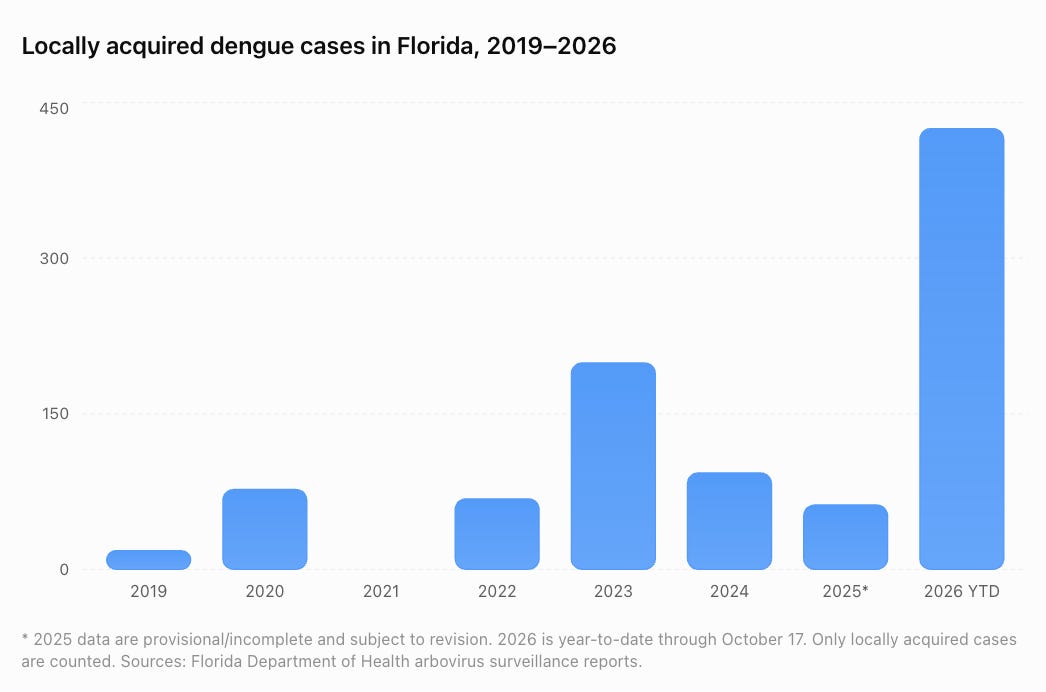
Historically, Dengue was once a familiar disease in Florida, with major outbreaks during the early twentieth century. Improved mosquito control and changes in housing helped push it out of the continental United States for decades. But dengue returned to Key West in 2009, and Florida has experienced periodic outbreaks ever since.
Now the question is whether dengue is becoming endemic again, meaning the virus can maintain regular transmission in Florida rather than depending on infected travelers to reintroduce it.
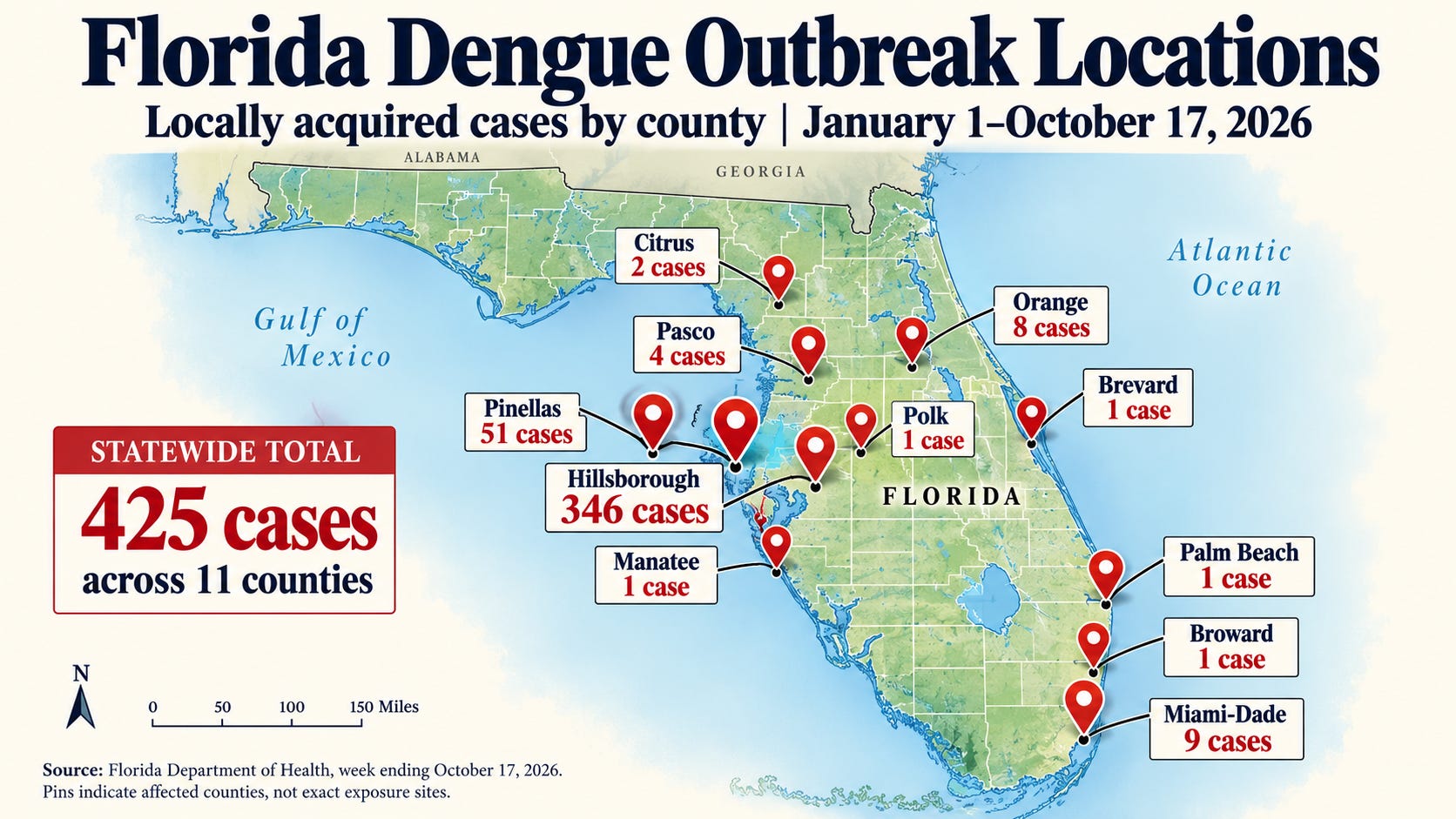
The geographic concentration of these cases is particularly important. Hillsborough and Pinellas counties, both in the Tampa Bay region, account for approximately 93% of Florida’s locally acquired dengue infections. This suggests that transmission remains heavily concentrated in one region, making targeted containment more feasible. Rather than relying on widespread pesticide spraying across Florida, public-health authorities have an opportunity to focus mosquito surveillance, breeding-site elimination, and control measures where they are most needed. Emerging technologies, including artificial intelligence and satellite imagery combined with weather data, could help identify mosquito breeding sites and improve the precision of these efforts. The challenge is to interrupt transmission before the virus becomes established in additional communities.
As the map illustrates, dengue has not yet spread extensively across Florida, but the current outbreak is a warning that the opportunity for effective containment should not be squandered.
The Mosquito Problem
Dengue is transmitted primarily by Aedes aegypti, a mosquito that thrives around human habitation. Unlike mosquitoes that breed in large swamps, these insects prefer small collections of standing water. Flowerpots, discarded tires, clogged gutters, buckets, and even bottle caps can provide breeding sites.
Aedes aegypti is strongly attracted to humans, a characteristic scientists call anthropophilic. However, its feeding preferences vary by location. A 2026 study in South Texas found evidence of dog blood in 88.2% of identified mosquito blood meals, compared with human blood in 72.1%, with many mosquitoes feeding on multiple hosts. This finding raises an intriguing possibility for mosquito control. Researchers have demonstrated that fluralaner, the active ingredient in the veterinary medication Bravecto, can kill Aedes aegypti after they feed on treated dogs. In one experiment, more than 99% of mosquitoes feeding on treated dogs died within 24 hours, even 56 days after treatment.
Whether similar systemic mosquito-killing treatments could eventually be developed safely for humans deserves investigation as a potential alternative to widespread environmental pesticide spraying, particularly in areas where dengue is endemic. Such an approach would require extensive safety testing and would not necessarily prevent the initial infectious bite.
Aedes aegypti mosquitoes are aggressive daytime biters, particularly during the early morning and late afternoon.
Florida’s warm climate, abundant rainfall, dense development, and international travel create favorable conditions for dengue transmission. Once an infected traveler introduces the virus, local mosquitoes can spread it to other people. The same holds true with infected dogs, unless they have been treated with fluralaner.
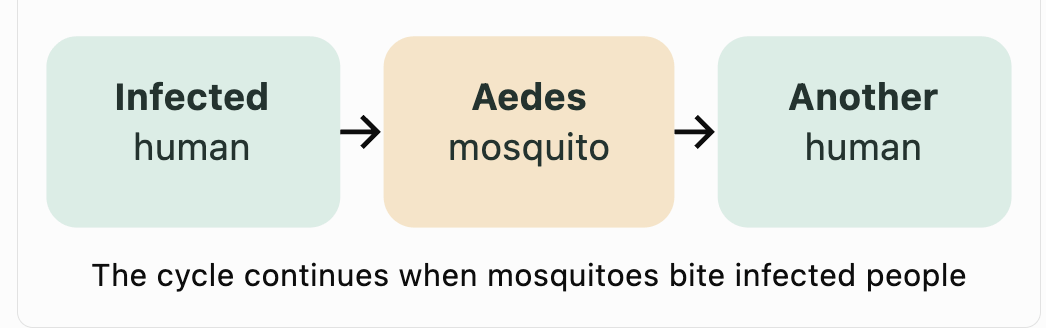
Unlike West Nile virus, which relies on birds as its principal animal reservoir, dengue relies on humans as its primary reservoir in urban outbreaks. Infected mosquitoes transmit the virus to humans, who then infect other mosquitoes, perpetuating the cycle. Although dengue can occasionally pass between mosquito generations or through mating, these routes are not known to sustain outbreaks independently. For practical purposes, dengue transmission in Florida depends on the human-mosquito-human cycle.
Interestingly, dengue is not confined to poor neighborhoods. Wealthy residential communities with elaborate landscaping, ornamental plants, swimming pools, and irrigation systems can provide excellent mosquito habitats.
However, people living in older housing, mobile-home communities, or poorly maintained apartment complexes may face additional risks from damaged window screens, inadequate drainage, and limited control over neighboring properties.
Another Approach: Making Mosquito Blood Meals Lethal
Years ago, Robert advocated unsuccessfully for investigating pharmaceutical agents that could render human blood lethal to mosquitoes, similar to the veterinary drug fluralaner (Bravecto). Such an approach might help interrupt transmission of mosquito-borne diseases, including malaria, without relying on vaccination or widespread environmental pesticide spraying.
However, meaningful population-level mosquito control would require treating a substantial proportion of the people or animals on which mosquitoes feed, raising serious questions about safety, cost, and practicality. Fluralaner itself carries documented adverse-event risks in animals, and any related drug intended for humans would require extensive independent safety testing. The risk-benefit calculation might favor investigating such an intervention in regions where malaria causes substantial mortality, but it is considerably harder to justify exposing large numbers of healthy people to a systemic insecticide to control dengue in Florida. Any use would need to be carefully targeted, voluntary, and supported by convincing evidence of reduced disease transmission.
Under no circumstances should people take veterinary fluralaner or other animal medications to prevent mosquito-borne infections. Such drugs would not reliably protect an individual from infection, because an infected mosquito could transmit the pathogen during its blood meal, before the drug had time to kill it. Their potential benefit would be in reducing subsequent transmission, not providing personal protection.
What Is Florida Spraying?
Florida mosquito-control districts are responding with aerial and ground spraying, including applications over residential neighborhoods.
One chemical used in Hillsborough County is naled, sold under the name Dibrom. Naled is an organophosphate insecticide that kills mosquitoes by interfering with their nervous systems.
Organophosphates are not harmless chemicals. At sufficiently high exposures, they can also interfere with the nervous systems of humans and other animals. The actual risk from mosquito spraying depends on the amount applied, how it is dispersed, and the resulting exposure. Organophosphates have been extensively used as chemical warfare agents, specifically in the form of nerve agents.
Organophosphate pesticides have not been comprehensively banned in the United States. While the EPA banned the use of chlorpyrifos (the most widely used organophosphate) on food crops in 2021, this ban was overturned by a federal appeals court in 2023, and the agency is currently proposing a new, limited ban for 11 crops.
Approximately 40 organophosphates remain approved for use in the U.S.
The EPA has taken accelerated action on high-risk uses of four other organophosphates (diazinon, ethoprop, tribufos, and phosmet) but has not issued a full ban.
Individual states, including California, Hawaii, Maine, Maryland, and New York, have enacted their own bans on chlorpyrifos.
Legislation such as the BAN OPs From Our Food Act has been introduced in Congress to ban all neurotoxic organophosphate pesticides, but it has not yet passed.
Other mosquito-control methods include synthetic pyrethroid insecticides and biological treatments that target mosquito larvae before they become flying adults.
The difficulty is that spraying adult mosquitoes provides only temporary relief. Unless breeding sites are eliminated, new mosquitoes quickly replace those killed.
This raises an important public-health question: Are repeated pesticide applications over residential neighborhoods producing meaningful reductions in dengue infections, and how are officials measuring both their effectiveness and potential environmental consequences?
As mentioned above, researchers at the University of South Florida are using artificial intelligence and satellite imagery to identify mosquito breeding habitats, and they are sharing the information with the state. Such technology could eventually allow more targeted interventions rather than relying so heavily on neighborhood-wide spraying throughout the United States.
Florida has also become a testing ground for experimental mosquito-control technologies. In the Florida Keys, the biotechnology company Oxitec released genetically modified male mosquitoes designed to produce offspring whose females die before reaching adulthood. That trial ended in 2024, and no genetically engineered mosquito releases are currently authorized in the United States.
Other Florida programs have released sterilized male mosquitoes or males carrying Wolbachia, a naturally occurring bacterium that prevents viable offspring when infected males mate with uninfected females. These approaches could reduce dependence on chemical pesticides, but their long-term ecological consequences deserve scrutiny. Suppressing an insect population could alter local food webs, affect birds, bats, and other insect-eating wildlife, or allow competing mosquito species to expand into the vacated ecological niche. However, Aedes aegypti is an invasive species in Florida, and there is currently little evidence that reducing its population would substantially disrupt wildlife.
Introducing Wolbachia into mosquito populations raises additional questions about unintended spread to other insect species, although such transfer appears uncommon and has not been demonstrated as a harmful consequence of these releases. Regulators have not identified significant environmental harms from Florida’s genetically modified mosquito trials, but the absence of demonstrated harm is not a substitute for long-term ecological monitoring. These programs should be evaluated not only by how many mosquitoes they eliminate, but also by whether they reduce human disease without creating unintended environmental consequences.
But technology alone cannot replace basic mosquito control: eliminating standing water, maintaining drainage, repairing screens, and preventing mosquitoes from breeding in the first place.
Dengue Is Not Necessarily a One-Time Illness
Here is where dengue becomes potentially dangerous.
The vast majority of people who contract dengue recover. Symptoms can include high fever, severe headache, pain behind the eyes, muscle and joint pain, nausea, and rash. The illness has sometimes been called breakbone fever because the muscle and joint pain can be so intense.
But dengue is not one virus in the usual immunological sense. There are four distinct varieties, known as serotypes.
Recovering from one generally provides long-lasting immunity against that particular serotype. Unfortunately, it does not provide permanent protection against the other three.
A person can therefore contract dengue multiple times.
And sometimes, the second infection is worse.
This happens because of a phenomenon called antibody-dependent enhancement, or ADE.
In some patients, antibody-dependent enhancement can contribute to a dangerous form of the illness historically called dengue hemorrhagic fever, which may progress to dengue shock syndrome. Today, physicians generally classify these life-threatening complications under the broader term severe dengue.
What is ADE?
Normally, antibodies help protect us against infection. But antibodies produced during an earlier dengue infection can sometimes attach to a different dengue serotype without neutralizing it effectively. Instead, they may help the virus enter certain immune cells.
Under these circumstances, a previous immune response can contribute to more severe disease rather than preventing it.
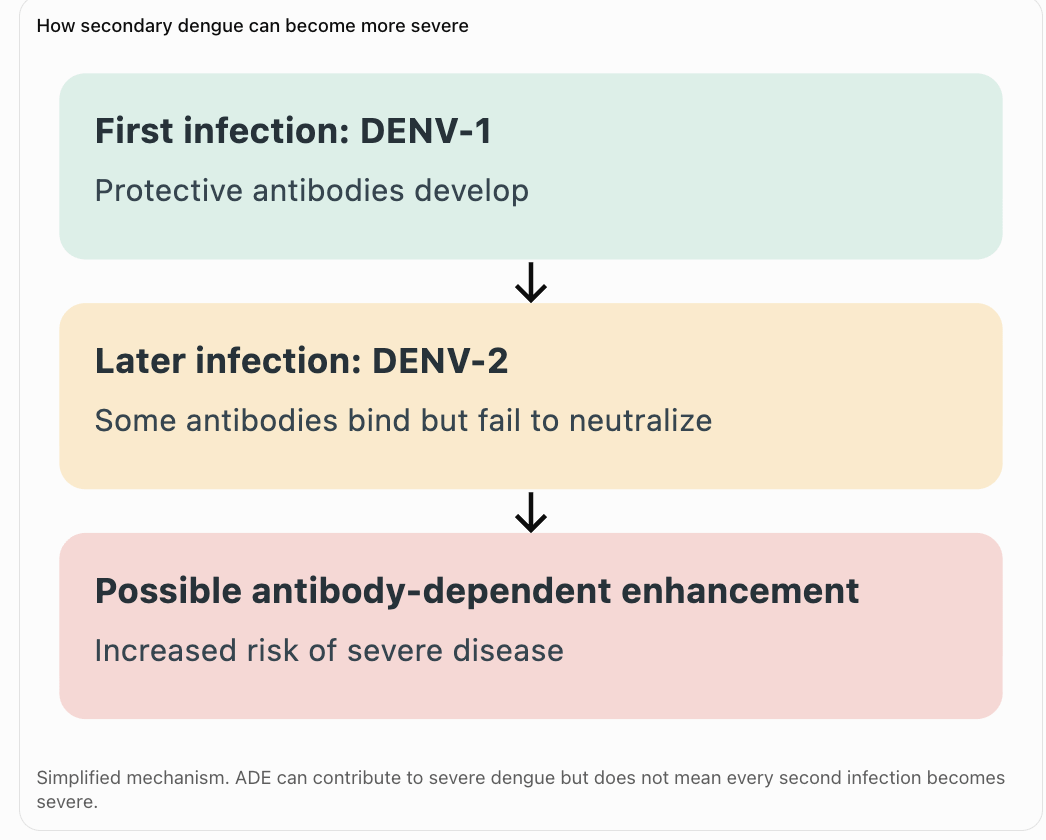
Not everyone who contracts dengue a second time becomes seriously ill. Most infections do not progress to life-threatening disease. Nevertheless, a second infection with a different serotype is an established risk factor for severe dengue.
Severe cases can involve internal bleeding, leakage of fluid from blood vessels, dangerously low blood pressure, and shock. Fortunately, most dengue infections are mild or asymptomatic, and many never come to medical attention. Consequently, the overall risk of death among everyone infected is considerably lower than mortality figures calculated from hospitalized patients. Even among patients with severe dengue, prompt and appropriate medical care can reduce mortality to below 1%.
One particularly troubling feature is that patients can deteriorate just as their fever begins to disappear, when they might reasonably believe they are recovering.
There is no approved dengue-specific antiviral treatment. Medical care focuses on hydration, monitoring, and management of complications. Anyone with suspected dengue who develops severe abdominal pain, repeated vomiting, bleeding, or unusual weakness should seek urgent medical attention.
What About a Dengue Vaccine?
This is where the story becomes even more complicated.
The first FDA-approved dengue vaccine, Dengvaxia, was licensed in 2019, but it already had a deeply troubling history. Beginning in 2016, the Philippines vaccinated more than 800,000 children before manufacturer Sanofi acknowledged that the vaccine could increase the risk of severe dengue in children who had never previously been infected.
The government suspended the program in 2017, and investigations followed reports of deaths among vaccinated children. Philippine investigators identified several deaths potentially associated with vaccination, although the precise number caused by the vaccine remains disputed. The underlying biological problem was as discussed above, antibody-dependent enhancement. Basically, the vaccine effectively primed the immune system so that a subsequent natural dengue infection became more dangerous. Despite this history, the FDA approved Dengvaxia in 2019, restricting its use to children with laboratory-confirmed previous dengue infection living in endemic areas. The manufacturer eventually discontinued the vaccine because of low demand.
As of October 2026, no dengue vaccine is available for use in the United States.
Other dengue vaccines have been developed, including Takeda’s Qdenga, which has been authorized in several countries, and a newer vaccine developed in Brazil. However, protection varies according to the viral serotype and whether someone has previously been infected. Continued safety monitoring remains essential.
The dengue vaccine experience provides an important lesson: producing antibodies is not necessarily the same thing as producing protective immunity.
In some infectious diseases, the quality and biological behavior of those antibodies matter enormously.
Is Dengue Here to Stay?
Florida’s current outbreak is dominated by dengue serotype 2, or DENV-2. That is important because future circulation of different serotypes could increase the number of people experiencing secondary infections.
It is still too early to conclude that dengue has become permanently endemic in Florida. Repeated introductions by international travelers and recent immigrants could explain recurring outbreaks, particularly when the local mosquito population is abundant.
Nevertheless, the conditions for sustained transmission are increasingly apparent.
If dengue becomes endemic in Florida, will it remain regional or spread across the United States? The mosquitoes capable of transmitting dengue are already established throughout much of the Southeast, Gulf Coast, and parts of the Mid-Atlantic, while the Asian tiger mosquito (Aedes albopictus) extends considerably farther north. Warmer temperatures and longer mosquito seasons could expand opportunities for transmission.
However, the presence of mosquitoes alone does not guarantee sustained outbreaks. Housing quality, air conditioning, window screens, mosquito control, and the number of infected people entering a community all influence whether dengue becomes established. For now, Florida and the Gulf Coast face the greatest risk of sustained transmission, but localized outbreaks elsewhere in the country are entirely possible. Whether dengue eventually becomes a recurring summer disease across a much larger portion of America remains an open question.
Florida already has the mosquitoes. It has a climate favorable to their reproduction, a large population living in mosquito-friendly environments, with porous housing, and extensive travel connections with countries where dengue circulates regularly.
The important question is whether public-health authorities can interrupt transmission without making routine, repeated pesticide applications over residential communities a permanent feature of life.
For homeowners, the immediate response is straightforward: eliminate standing water, maintain window screens, and protect against mosquito bites. Consider treating your dogs, similar to the tick pre-treatment we use here on our farm, if you live in an area of Florida experiencing an outbreak. These measures reduce risk without depending entirely on chemical spraying.
Florida counties generally provide public notice before aerial mosquito spraying, but the warning may be surprisingly short. Hillsborough County, where most of the dengue cases have occurred, acknowledges that residents may receive only a few hours’ notice, although Orange County has promised at least 48 hours before its announced aerial treatments.
Residents often must register for text or email alerts to receive direct notification. This raises questions about whether people have adequate opportunities to protect themselves, their pets, livestock, beehives, and gardens from unwanted pesticide exposure. At a minimum, residents should have ready access to treatment schedules, maps identifying the affected neighborhoods, and information about exactly which chemicals are being applied. Those wishing to avoid direct exposure should be able to make arrangements before spraying begins.
Where Florida residents and Visitors can register for Alerts
For public-health officials, the challenge is considerably larger. Effective mosquito control requires surveillance, targeted interventions, transparent reporting of pesticide use, and evidence that those interventions actually prevent disease.
For vaccine developers, dengue remains a cautionary example of the complexity of the human immune system.
Sometimes an earlier infection protects us.
Sometimes it doesn’t.
And occasionally, the antibodies left behind by a prior infection or vaccination can make the next encounter with the same family of viruses considerably more dangerous.
That is what makes dengue a disease worth watching, particularly as it establishes an increasingly visible presence in Florida.
A Note to Our Free Readers and Subscribers
Independent journalism takes time, research, and resources. At Malone News, we examine the scientific evidence, question official narratives, and investigate stories that often receive little attention elsewhere. We do this without corporate sponsors or institutional funding directing our editorial decisions. If you value this work and currently read for free, please consider becoming a paid subscriber.
Your support allows us to continue publishing independent reporting and analysis while keeping much of our work freely available to everyone. Even a small monthly contribution makes a difference.
If you believe independent journalism matters, please help us keep it independent.
References and Further Reading
The Hill, October 2026. New Florida counties report dengue cases as statewide total passes 400.
Florida Department of Health. Mosquito-Borne Disease Surveillance.
CDC. About Dengue.
CDC. Dengue Vaccination.
Katzelnick LC et al. Antibody-dependent enhancement of severe dengue disease in humans. Science, 2017. DOI: 10.1126/science.aan6836.
EPA. Mosquito Control.
Hillsborough County. Mosquito Control Operations.
Isn't Naled the pesticide that was used in Brazil that caused birth defects (swollen brains) and blamed on Zika? Pretty sure it was.
Rather than vaccinating people and dogs why not create 'honey pot' type device that simulates a mammal smell and blood source? CO2 generator to lure them in. Perhaps body heat simulator and either a blood similar substance or actual blood. Put the fluralander substance in the blood. No mass spraying of toxins or ingesting them in humans or pets. Just a device that appears to the mosquito as the perfect meal that will kill them quickly. Environment protected for all except the mosquitoes.
All I know is that it is no joke. I got it in Belize in 1995 when I was in my 40's and fit. I spent 2 weeks at home, in and out of bed with light hemorrhagic chest rashes, the worst headaches imaginable, sweats and chills and aches all over with supreme malaise. After this period I would then wake up feeling fresh and perfect like the sickness had broken so I would venture out. Then all of a sudden I would feel it coming back and bee line home for my bed! This lasted another two weeks. A month in total. Most of the locals who got it did not get bed bound but felt sick and called it the flu. This is definitely not a disease suited for caucasians!