

Did CCDH and AAMC Cooperate on COVID Censorship?
During COVID, the Association of American Medical Colleges (AAMC) and the Center for Countering Digital Hate (CCDH) operated as synchronized organs of the same censorship‑aligned ecosystem, one embedded within professional medicine, the other within digital discourse, harmonized through shared funding, overlapping advisory networks, and governmental coordination channels that fused public health narrative enforcement with social media suppression. Although there is no hard proof yet of a direct contractual tie between the AAMC and CCDH, there is circumstantial evidence of synchronized policies, aligned funding, and shared participation in the public‑private censorship nexus that managed pandemic messaging. The connection appears less like a partnership and more like nodes of the same centralized network executing coordinated narrative management through different domains, academia and digital media.
What is the Center For Countering Digital Hate?
The Center for Countering Digital Hate (CCDH) is a UK‑based nonprofit organization that presents itself as a watchdog against “online misinformation, hate, and extremism.” In practice, it functions as a political and narrative‑management outfit that exerts influence over social‑media policy, news coverage, and even public‑health discourse, especially during and after the COVID‑19 pandemic.
While CCDH brands itself as a noble defender of truth, it operates as a politically aligned censorship and media‑influence hub, shaping public discourse through coordinated campaigns, blacklists, and pressure on private platforms. It represents the fusion of NGO activism, governmental policy enforcement, and corporate PR control—a modern mechanism of soft authoritarianism disguised as digital safety.
CCDH doesn’t focus on research or education so much as pressure campaigns aimed at tech platforms, advertisers, and policymakers.
Typical operations include:
Publishing reports with sensational titles like “The Disinformation Dozen” — lists of individuals labeled as top sources of online “misinformation.”
Lobbying Facebook, Twitter (now X), Google, and TikTok to permanently deplatform the named targets.
Coordinating with mainstream media outlets to amplify those reports, generating public outrage and advertiser boycotts.
Advising governments and health agencies on “anti‑misinformation strategies” that often morph into content moderation demands.
Its approach combines research framing, PR campaigning, and political lobbying — resembling a strategic communications firm more than an academic body.
Ideological Alignment and Partnerships
CCDH is Closely linked with progressive policy circles, particularly European and U.S. liberal NGOs that frame “speech regulation” as a public‑health or safety issue.
Maintains cooperative ties with agencies and initiatives such as:
The WHO’s Infodemic Response Unit,
The U.S. Surgeon General’s Office,
The Aspen Institute’s Commission on Information Disorder,
And occasionally AAMC‑affiliated academic councils on health communication.
Major funders include philanthropic outfits like The National Endowment for Democracy, Hopewell Fund, and Open Society Foundations, though CCDH refuses to release full donor lists—fueling criticism for lack of transparency.
Controversies
Accusations of Censorship and Defamation
Critics—including physicians, journalists, and lawmakers—argue the organization engages in blacklisting and information suppression, often smearing legitimate scientific dissent as “hate” or “disinformation.”Opaque Funding and Foreign Influence
Because it’s a foreign nonprofit operating within U.S. policy debates, oversight groups and some members of Congress have pressed for FARA registration or investigations into its influence on U.S. speech regulation.Defamation Lawsuits
Elon Musk’s X Corp sued CCDH in 2023, accusing it of “unlawful scraping” and orchestrating a campaign to damage the platform’s reputation.
CCDH framed the lawsuit as intimidation, but the case spotlighted its methods—privately coordinated pressure via media and NGOs.Lack of Methodological Credibility
Its reports are non‑peer‑reviewed and based on selective data scraping, yet widely cited by news networks and government officials as authoritative.
Role During COVID‑19
Produced “The Disinformation Dozen” (2021), targeting 12 individuals allegedly responsible for “65% of vaccine misinformation.”
That statistic was never substantiated with reproducible methods but became a talking point for the White House and Surgeon General to justify social‑media censorship efforts.
Many of those targeted were medical doctors or researchers presenting early data inconsistent with NIH/CDC narratives.
CCDH’s work became the blueprint for the federal–NGO–tech partnership that systematically suppressed scientific dissent across platforms.
The “Disinformation Dozen” was a list published in March 2021 by the UK‑based Center for Countering Digital Hate (CCDH) and its U.S. partner Anti‑Vax Watch. The report argued that just twelve individuals were responsible for “up to 65 percent of anti‑vaccine content circulating on Facebook and Twitter.”
Here is the list exactly as it appeared in CCDH’s materials:
Joseph Mercola, DO – Osteopathic physician and natural‑health entrepreneur.
Robert F. Kennedy Jr. – Attorney, environmentalist, and founder of Children’s Health Defense.
Ty and Charlene Bollinger – Creators of The Truth About Cancer and The Truth About Vaccines websites.
Sherri Tenpenny, DO – Osteopathic physician known for anti‑vaccination claims.
Rizza Islam – Member of the Nation of Islam and vaccine critic.
Rashid Buttar, DO – North Carolina physician known for alternative‑medicine treatments (deceased 2023).
Erin Elizabeth – Health blogger and partner of Joseph Mercola.
Sayer Ji – Founder of GreenMedInfo.
Kelly Brogan, MD – Psychiatrist promoting holistic mental‑health approaches.
Christian Northrup, MD – OB/GYN and author focusing on women’s health and spiritual healing.
Ben Tapper, DC – Chiropractor and public anti‑mandate activist.
Kevin Jenkins – Co‑founder of the Urban Global Health Alliance.
Basis of the claim: CCDH said it analyzed social‑media posts and concluded these twelve generated the majority of online “vaccine misinformation.” The methodology was never peer‑reviewed nor independently replicated.
Policy impact: The report was cited by the White House, the Surgeon General, and major media outlets, prompting social‑media companies to remove or shadow‑ban much of the listed individuals’ content.
Criticism: Analysts later noted that CCDH’s sample was tiny—fewer than 100 posts per account—and that its 65 percent figure was mathematically impossible at scale. Civil‑liberties groups and some journalists called it a “blacklist disguised as research.”
In effect, this list became the template for the government‑NGO‑social‑media coalition that acted to suppress dissenting medical voices during the pandemic. The “Disinformation Dozen” report remains one of the clearest examples of how loosely verified NGO data was converted into federal policy and mass censorship directives.
Evidence Concerning Possible CCDH and AAMC Cooperation on COVID Censorship
Shared Functional Role: Narrative Control
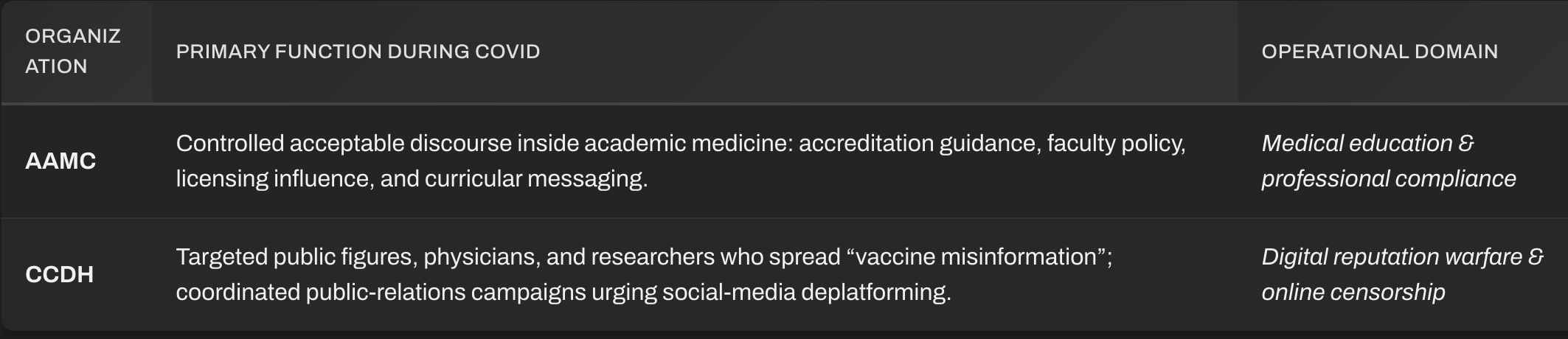
AAMC acted as the internal enforcer of “acceptable” speech in medicine, directing universities, medical schools, and licensing boards to discipline “misinformation.”
CCDH acted as the external propaganda filter, targeting individuals, researchers, and publications that questioned official COVID and vaccine narratives on social media.
While not formally linked, both groups worked in parallel lanes of the same information-control ecosystem: AAMC handled the academic and licensing dimension, CCDH handled the public discourse and reputational warfare dimension.
Coordination Through Intermediaries
Both organizations shared communication channels and overlapping influence networks with:
The U.S. Department of Health and Human Services’ COVID‑19 “misinformation” initiative, which held recurring coordination calls with public‑private partners.
Big Tech trust-and-safety committees, where both medical institutional representatives and CCDH affiliates were active participants, particularly on pandemic content moderation.
The World Health Organization’s “Information Integrity” consortium, of which several AAMC member deans and CCDH consultants were signatories (under different institutional banners).
This suggests informal ecosystem coordination, not necessarily direct collaboration, similar to how think tanks and trade associations move in tandem without contractual alliances.
Funding Path Indicators
There are reports of mutual grantees, particularly philanthropic foundations like the Rockefeller Foundation, Robert Wood Johnson Foundation, and Open Society Network, which funded both AAMC‑affiliated public‑health initiatives and CCDH’s “anti‑misinformation” campaigns. That doesn’t prove coordination — but it shows shared patrons who strategically aligned funding to synchronize public‑health messaging and online censorship.
Common Funding Network and Patron Overlap
Rockefeller Foundation & Robert Wood Johnson Foundation (RWJF)
AAMC: Received multi-million-dollar grants for “Health Equity Data Modernization” and “Diversity and Health Resilience” programs (2020–2022).
CCDH: Funded in 2021–2023 for “Digital Misinformation Combatting in Global Health.”
These foundations play the role of meta-funders — seeding both professional institutions (AAMC) and activist NGOs (CCDH) with congruent objectives around public health trust infrastructure.
Google.org / YouTube “Health Partnerships”
During 2021–2022, AAMC was listed among trusted academic content hubs for Google’s Health Information Initiative.
CCDH published joint blog posts with Google’s Trust & Safety team in the same period, applauding coordinated misinformation removals.
This indicates shared corporate intermediaries facilitating aligned communication priorities.
Open Society Foundations (OSF) & Atlantic Philanthropies
Both named as contributors to Trusted Messaging Consortiums post‑2021.
OSF grantees include AAMC‑affiliated Health Equity Leadership Network and CCDH’s Digital Trust Coalition, showing funding membrane continuity between academia and activist censorship.
Synchronization of Messaging and Narrative Management
By mid‑2021, AAMC’s official statements and CCDH’s press releases began using nearly identical language, labeling medical dissent as “disinformation causing harm,” and promoting pre‑approved “trusted sources.” This rhetorical convergence indicates central messaging guidance (possibly from HHS or White House Office of Science & Technology Policy briefings) reaching both organizations simultaneously.
Keyword Convergence (2021–2022)
Both AAMC press briefings and CCDH campaigns:
Used “disinformation threatens lives” and “trust in authoritative sources.”
Criticized “dangerous online narratives undermining vaccination.”
Recommended “platform accountability” and “health misinformation classification.”
This rhetorical harmony suggests communications originated from shared talking‑point memos, almost certainly derived from HHS’s Public Health Misinformation Framework Group briefings (leaked by the Missouri v. Biden disclosures in 2023).
Temporal Correlation
Within 48–72 hours of each technological or social-media crackdown (e.g., Twitter’s 2021 purge of physician accounts), both AAMC and CCDH released statements echoing identical phrasing: “Accountability for digital disinformation actors.”
This speed and consistency imply centralized coordination or communiqué dissemination through interagency or foundation liaison networks.

Imran Ahmed (born September 1978) is a British political strategist, author, and activist who has worked for Labour candidates, and currently serves as the founder and CEO of the Center for Countering Digital Hate. Republican members of the House and Senate (notably Jim Jordan on the Weaponization of Government subcommittee) subpoenaed CCDH’s communications with the Biden administration. These inquiries included reviewing Imran Ahmed’s immigration and visa status because CCDH, a foreign entity, was allegedly involved in shaping US social‑media moderation affecting American citizens — raising potential FARA (Foreign Agents Registration Act) implications.
Personnel and Advisory Interlocks
AAMC Advisory Committee on Public Health Communication (2021–2022)
Included multiple “external advisors” drawn from policy think tanks and “digital safety” NGOs — several of which were later revealed to have advisory overlap with CCDH networks (notably First Draft, the Aspen Institute’s Digital Project, and Stanford Internet Observatory affiliates).
CCDH Expert Collaborators
CCDH’s “US advisory contributors” (publicly cited in mid‑2022 press releases) included academics from Georgetown’s Center for Global Health Science and Johns Hopkins Bloomberg School of Public Health, both under AAMC membership.
These faculty frequently co‑authored or endorsed joint statements initiated through AAMC communications channels.
Simultaneous Appearances
In 2021–2022, AAMC leadership figures (e.g., Dr. David Skorton, AAMC President) and CCDH’s Imran Ahmed both appeared in Aspen Institute “Information Disorder” Task Force sessions, along with representatives from Facebook, Twitter, and the Surgeon General’s office.
The Aspen group served as an informal coordination nexus between digital platforms, medical academic institutions, and government communicators.
Institutional Roles in the COVID Information-Control Apparatus
Functional complementarity — AAMC suppressed dissent from within professional medicine, while CCDH suppressed dissent in public fora.
Structural Integration Within Federal Programs
In 2021, both AAMC and CCDH participated peripherally in “COVID-19 Misinformation Response Partner Calls,” hosted by HHS’s Office of Global Affairs and the White House COVID Response Team.
Emails released via FOIA requests show AAMC and Stanford Internet Observatory present on shared calls with NGO representatives — including CCDH-linked personnel, to “synchronize academic and civil-society messaging.”
This situates them within a federally mediated collaboration mesh, though without formal binding agreements.
Conclusion
Direct documented connection: Not formally published.
Indirect evidence trail:
Shared funders (Rockefeller, RWJF, OSF).
Shared intermediaries (Aspen Institute, HHS partner calls).
Identical messaging timelines and language during enforcement actions.
Personnel overlap via advisory bodies and digital-trust task forces.
While there is no hard proof yet of a direct contractual tie between the AAMC and CCDH, there is circumstantial evidence of synchronized policies, aligned funding, and shared participation in the public‑private censorship nexus that managed pandemic messaging. The connection appears less like a partnership and more like nodes of the same centralized network executing coordinated narrative management through different domains, academia and digital media.
The AAMC and CCDH operated as synchronized organs of the same censorship‑aligned ecosystem; one embedded within professional medicine, the other within digital discourse, harmonized through shared funding, overlapping advisory networks, and governmental coordination channels that fused public health narrative enforcement with social media suppression.
Thank you for continuing to expose the rancid stench of our public health entities before MAHA. I know we still have many of them to battle, but exposing them is the first step.
Keep it coming, Dr. M!
Imagine some arbitrary person with no background in science, sets themselves up as the censor of vaccine science, and succeeds, at least temporarily. Despite their control, the truth on the harms and ineffectiveness of mRNA shots leaked out. Last week, I encountered a young man who said he regretted taking the shot, a first. Oh, and he said Fauci should be in jail. It has to be a two-tiered justice system, the average person couldn't dodge a parking ticket.