

Audio Version:
Investigative Health Policy, MAHA Accountability
Drs. Robert Malone and Jill Glasspool Malone
Washington, DC: November 9, 2026
On Thursday, November 6, 2026, three days after Republicans lost control of the House, Susie Wiles resigned as White House Chief of Staff. Richard Walters, her deputy, resigned on Friday. President Trump elevated Stephen Miller to Chief of Staff. Secretary Robert F. Kennedy Jr. posted on X:
“Stephen Miller is the strongest MAHA supporter in the administration. It’s time to unleash the Kraken.”
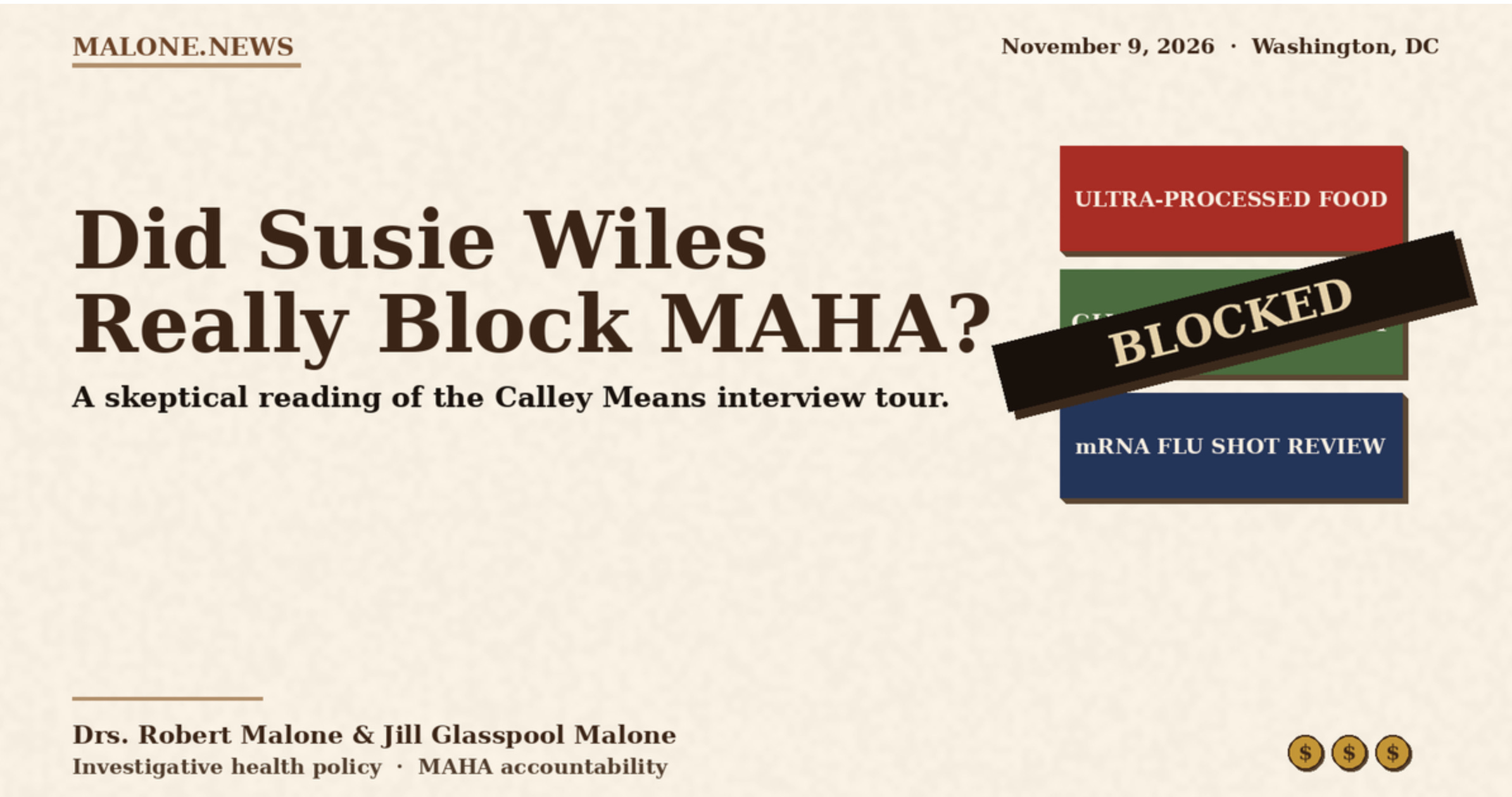
Calley Means had resigned his own White House and HHS roles on October 22, 2026, twelve days before the midterms. The specific trigger, as he told it on Rogan, was Chief of Staff Wiles pulling the ultra-processed-food definition after lobbyist calls, including from Coca-Cola and Mondelez. His resignation statement named “a corrupt DC bureaucracy that is doing everything possible to protect the status quo.” On the day Means left, stock prices for General Mills, Kraft Heinz, and other packaged-food companies rose roughly 8 percent. Means framed the exit as his own choice. Wiles sent him a text afterward praising him and asking that he not speak negatively of her. He has not honored that request.
Means went on the podcast circuit in the two weeks that followed. He appeared on The Joe Rogan Experience on November 6 for a little over two hours. He appeared on Face the Nation with Margaret Brennan on Sunday, November 8.
Both interviews are now in the public record. Together they give the fullest account yet of how the first two years of the Kennedy HHS tenure ran. They also give the fullest account yet of how Calley Means wants that history remembered. The two accounts diverge in ways the public record can test.
What Did Calley Means Allege on Rogan and Face the Nation?
Means directs his allegations at four groups.
Against Chief of Staff Wiles and her deputies. Wiles kept the president in the dark about the midterm headwinds. She pulled the ultra-processed-food definition after lobbyist calls to her office. She told Means directly that she needed sugar-industry money for the midterms. Her daughter Katie Wiles joined Continental Strategy, a lobbying firm whose revenue rose from $1.8 million in 2024 to $27.3 million in 2025, per filings under the Lobbying Disclosure Act. Wiles’s former firm, Ballard Partners, generated $82 million in 2025 lobbying revenue, the highest single-year total in LegiStorm’s data.
Against pollster Tony Fabrizio. Fabrizio took Pepsi and pharmaceutical-industry money while serving as the political check on cabinet policy decisions. Means recited Fabrizio’s Corporate Public Affairs client list on Rogan, reading from the firm’s own website. The list visible during the broadcast included Pfizer, PhRMA, RJ Reynolds, Philip Morris, Dow Chemical, Pepsi, Procter and Gamble, Penn National Gaming, and the Vaping Heritage Foundation. Fabrizio has denied the allegations.
Against White House staff members Walker Barrett, James Blair, Chris LaCivita, and Richard Walters. Policy decisions on glyphosate, kratom, fruit-flavored vapes, and the sugar-industry threat to the ultra-processed-food definition were driven through the interagency process by these staff members. The driving party, in each case, was a named industry interest. Blair and LaCivita allegedly traveled to Republika Srpska and collected money from parties there while running the midterm strategy. Blair denies telling Wiles about the trip.
Against FDA-commissioner nominee Heidi Overton. Overton blocked psychedelic policy. She blocked MAHA food policy. She drove the reversal of the FDA decision on Moderna’s mRNA flu vaccine after former Commissioner Marty Makary was pushed out. She wrote the rule relaxing the 7-OH kratom concentration tolerance by twenty times. She worked with the Solicitor General’s office through attorney Sarah Harris on the brief urging Supreme Court certiorari in the glyphosate liability case. Harris came from Bayer’s main law firm, Means says.
What Can the Public Record Confirm?
Several of these specific claims are confirmed outside the interview transcripts. Continental Strategy’s revenue growth is in the public filings. Ballard Partners’ 2025 revenue total is in LegiStorm’s data. Reynolds American contributed $5 million to MAGA, Inc. on April 30, 2026, according to the Federal Election Commission. The contribution preceded the administration’s rollback of Makary’s kratom and vape posture. Fabrizio’s client roster is published on his firm’s website and confirms the associations with clients whose interests were directly related to the polling data he was providing to the White House.
Marty Makary’s on-record statement to CBS News reads: “Big tobacco exploited their connections to administration and HHS officials to put repeated pressure on me to approve fruit-flavored vapes that appeal to children. I wouldn’t do it.” Makary names “tobacco” rather than a single named staff member. The pressure channel he describes runs through the same staff offices Means names.
Means’s account of the glyphosate executive order is also partly supported by the document itself. The signed order carries the title “Promoting the National Defense by Ensuring an Adequate Supply of Elemental Phosphorus and Glyphosate-Based Herbicides.” That is a national-security framing for a chemical with no national-security application other than munitions precursors. The order attempts to link phosphorus and glyphosate under the banner of national security, but the logical disconnect between the two is so glaring that even a high school student could recognize it.
Is Calley Means a Neutral Witness?
Means is not a neutral witness. He co-founded TrueMed, which enables pre-tax health-savings dollars to flow to wellness-industry products through letter-of-medical-necessity certifications. Representative Jake Auchincloss and other congressional Democrats have raised the question of whether Means’s holdings in TrueMed, valued between $25 million and $50 million through November 2025, constituted a conflict of interest during his tenure as a Special Government Employee. Means states that he divested when he moved to full-time government status. Mary Talley Bowden, an ear, nose, and throat physician in Houston, published an essay in April 2025 titled “The Truth About TrueMed” that raised the same question. Bowden has been raising concerns about TrueMed and Means for two years, long before congressional Democrats began questioning whether Means’s substantial financial interests conflicted with his government responsibilities.
Means also helped build the apparatus he now criticizes. He is the person who introduced Secretary Kennedy to the Trump 2024 campaign. He led MAHA implementation within the White House for the first 21 months of the administration. The lobbying-firm dynamic he describes on Rogan was already running on inauguration day. He worked within it for twenty-one months before leaving.
The allegations still deserve to be judged on their merits. But Means’s interview tour is doing far more than exposing alleged wrongdoing. It allows him to defend his own record while deflecting questions about his financial interests in TrueMed. It positions him as a champion of the MAHA grassroots movement, fighting the very Washington establishment he recently served.
And perhaps most importantly, it constructs a convenient political narrative in which unelected staff members bear responsibility for the administration’s failures, while the two men ultimately in charge, President Trump and Secretary Kennedy, escape meaningful scrutiny. The question is whether Means is exposing the machinery of government or helping protect the people who control it.
Why Does Toby Rogers Call the Rogan Interview a Psyop?
Toby Rogers, a political-economy scholar who publishes the Substack newsletter uTobian, watched the full 138-minute Rogan interview and published his own reading on X on November 8, 2026. The post drew more than 622,000 views at this writing. Rogers has published on autism causation, regulatory capture, and the political economy of the pharmaceutical industry for over a decade. Rogers represents the more skeptical wing of MAHA, one increasingly unwilling to accept political loyalty, promises of reform, or carefully managed narratives as substitutes for measurable results and accountability.
Rogers argues that Means is selling the MAHA movement a politically convenient fiction: that President Trump and Secretary Kennedy are well-intentioned reformers whose agenda is being systematically sabotaged by unelected bureaucrats. He distills the story into five increasingly implausible propositions. Trump and Kennedy are the heroes. Their own staff members repeatedly deceive and undermine them. Somehow, neither man knows what is happening, despite extensive news coverage and repeated warnings from activists. When they finally discover the betrayals, they express outrage but fail to fire anyone or reverse the decisions. And rather than exercise the authority they already possess, Means suggests that the real solution requires a constitutional amendment whose actual language he never provides. Rogers’s central objection is devastatingly simple: If Trump and Kennedy are genuinely being betrayed by their own appointees, why do they continue to employ, protect, and even promote them? But, for some reason, Joe Rogan never asks that question.
The most damaging contradiction in Rogers’s analysis centers on Heidi Overton. According to Means, Overton worked with the Department of Justice to push the glyphosate liability case toward Supreme Court review, helped draft the executive order benefiting Bayer, and orchestrated the reversal of the FDA’s decision on Moderna’s mRNA influenza vaccine after Makary was pushed aside. These are serious allegations involving major regulatory decisions, not minor bureaucratic disagreements. Yet the same administration that Means portrays as repeatedly betrayed by Overton subsequently nominated her to lead the FDA.
If Means’s allegations are accurate, how could Trump and Kennedy remain unaware of her actions? And if they were aware, why would they reward her with one of the most powerful regulatory positions in government? Either the administration’s leadership is astonishingly uninformed about its own appointees, or the narrative of helpless leaders being sabotaged by rogue staffers begins to collapse. “That’s how you know the interview is a psyop,” Rogers writes.
Rogers makes the stronger version of the skeptical case directly. He writes that “Trump or RFK Jr. could have stopped the approval of the Moderna mRNA flu shot or flavored vapes but refused to use their legal authority to do so. Both men know EXACTLY what is happening, but they do nothing because THEY are captured by industry.” He cites a June 30, 2026 letter from the Informed Consent Action Network to Secretary Kennedy listing twenty vaccine-program reforms the Secretary could implement by signature alone. None of those reforms have happened. The authority question has been on the public record longer than Rogers’s post. Our September 14, 2026 MALONE.NEWS essay, “Kennedy Can End Big Pharma’s COVID Immunity With a Signature,” notes that 42 U.S.C. § 247d-6d(b) authorizes the Secretary to amend the COVID-19 PREP Act declaration through Federal Register publication, without Congress. The declaration remains in force through December 31, 2029. The Secretary has not amended it.
Rogers also offers a specific theory on former FDA Commissioner Marty Makary. Rogers writes that Makary “knew he was finished at the FDA and he was thinking about his next career move. He quit over flavored vapes so that he could go out like Scott Gottlieb.” If Makary had instead resigned a week later over the Moderna mRNA flu vaccine approval, which Rogers calls “the worst example of regulatory capture in history,” he would have been labeled an anti-vaxxer. His post-government career would have narrowed.
Our own analysis stops short of Rogers’s conclusion that the interview was a deliberate psychological operation. But the contradictions he identifies cannot simply be dismissed. The public record shows that Secretary Kennedy endorsed the glyphosate executive order, publicly thanked his departing Chief of Staff, and nominated Heidi Overton to lead the FDA. Whether those decisions reflect industry influence, political calculation, or genuine agreement remains an open question. What is much harder to reconcile is Means’s portrayal of Trump and Kennedy as helpless victims of their own staff. These are not powerless figureheads. They possess the authority to remove appointees, reverse policies, and demand accountability. Yet the very people Means identifies as responsible for undermining MAHA appear to have retained the confidence of the administration’s leadership. Rogers exposes the central weakness in Means’s narrative: At what point does repeated betrayal, followed by continued protection and promotion of those allegedly responsible, cease to be sabotage and become a matter of leadership accountability?
Was RFK Jr. Really Blocked by His Own Staff?
Means tells Rogan directly: “Bobby Kennedy is a hero.” He says he left with more respect for the Secretary than ever. He says he has never seen Secretary Kennedy do anything that wasn’t in the best interest of the American people. On Face the Nation he tells Brennan: “America is very, very lucky he is sitting at HHS.” The accompanying claim is that the Secretary has been surrounded, blocked, and overridden by a captured apparatus running policy around him. But that narrative becomes increasingly difficult to reconcile with Kennedy’s own public statements and decisions. Three episodes deserve particular scrutiny: his repeated defense of the glyphosate executive order, his public praise for Susie Wiles, and his enthusiastic nomination of Heidi Overton to lead the FDA.
The glyphosate executive order was signed on February 18, 2026. Means describes being handed the signed order by Walker Barrett and being told to inform Kennedy that it was not up for discussion. Within four days, Secretary Kennedy publicly defended the order. He told CNBC on February 19: “Donald Trump’s Executive Order puts America first where it matters most, our defense readiness and our food supply. We must safeguard America’s national security first, because all of our priorities depend on it.”
On February 22, he posted at length on social media. He wrote that “our agricultural system depends heavily on these chemicals.” He warned that without them “crop yields would fall, food prices would surge, and America would experience a massive loss of farms.” He added that “reform at this scale will test entrenched interests, and it will not move in a straight line.” He told The Epoch Times: “When hostile actors control critical inputs, they weaken our security. By expanding domestic production, we close that gap and protect American families.”
A Secretary blindsided and overridden four days earlier does not publish three separate defenses of the order in the ensuing week. Those statements describe a cabinet officer embracing the policy under his signature. If the order was driven by Ballard Partners and Bayer through Wiles and Barrett, as Means now describes, Secretary Kennedy’s February 2026 statements provided the political cover that let the order stand.
On Wiles, Secretary Kennedy’s public statement at the moment of her departure, as reported by CBS News on November 8, credits her with brokering his partnership with President Trump. He thanked her for helping bring disruptive leaders into HHS. Brennan put that statement to Means on air. He did not challenge the quote. He said he was comfortable with his own account and declined to speak for the Secretary.
On Heidi Overton, Secretary Kennedy’s X post nominating her reads: “A pantheon of superstar candidates made choosing our next FDA Commissioner one of the toughest decisions of my tenure at HHS. I’m confident President Trump and I chose the best person for the job: Dr. Heidi Overton. Heidi brings exceptional judgment, professionalism, discipline, and strategic leadership to every policy she touches.” Means on Face the Nation now says Overton “does not have the character or integrity to be FDA commissioner.” Both statements cannot be true. Kennedy’s nomination letter went to the Senate under his signature in August. Means’s character attack on Overton came on November 8, seventy-two hours after the White House staff shake-up.
Why did Kennedy repeatedly endorse the very people and policies Means now accuses of sabotaging MAHA? Means claims he spoke with Kennedy every day. Are we really supposed to believe he never warned the Secretary about the people allegedly undermining his agenda? Having watched Kennedy’s leadership at HHS, we find it increasingly difficult to accept that he was unaware of what was happening inside his own department and in the White House.
Who Benefits from the Means Interview Tour?
The Means interview tour serves three purposes. It externalizes blame for the first two years. Policy failures on the ultra-processed-food definition, glyphosate liability, kratom tolerance, fruit-flavored vapes, and the Moderna mRNA flu vaccine are assigned to named staff members. The cabinet officer who defended them, the president who signed them, and the senior adviser who worked inside the process throughout are left outside the blame game.
The tour also positions Secretary Kennedy and President Trump for a reset. By attributing the failures of the first two years to compromised staff members, Means creates an explanation for why the promised reforms have not materialized. Removing those individuals then becomes the justification for renewed confidence that the administration can deliver on its 2024 campaign promises during its remaining two years. The underlying assumption is that Trump and Kennedy were prevented from implementing their agenda rather than being responsible for the decisions made under their leadership.
Third, the interviews serve Means’s own interests. Rather than being held accountable for his participation in the administration and the unresolved questions surrounding his financial interests in TrueMed, he presents himself as the insider who fought against regulatory capture. In this telling, his departure becomes evidence of his independence, while his accusations against former colleagues reinforce his standing with MAHA supporters.
The allegations of lobbying influence deserve serious investigation. Public lobbying disclosures provide a basis for examining the relationships and financial interests involving Ballard Partners and Continental Strategy, although lobbying revenue alone does not establish improper conduct. But the effort to separate Trump and Kennedy from responsibility for their administration’s decisions is much harder to defend.
Kennedy publicly endorsed the glyphosate executive order, praised Wiles upon her departure, and nominated Overton to lead the FDA. These were not merely decisions made by anonymous staff members operating beyond his control. They were actions Kennedy publicly supported. Means has offered an explanation for why the administration failed to deliver on its promises, but he has not adequately explained why its leadership repeatedly endorsed the very decisions and individuals he now condemns.
What Can Congress Do With What Calley Means Just Said?
The November 3 midterms handed Democrats control of Congress, and Democratic leaders have already made clear that Secretary Kennedy is a target. Some are demanding his resignation. Others are preparing congressional investigations, subpoenas, and possible impeachment proceedings. The House Oversight Committee, Senate Finance Committee, and Senate Health, Education, Labor, and Pensions Committee have the authority to investigate the allegations Means has now made publicly.
But Means has given Democrats a very particular version of events. In his telling, Kennedy and Trump are reformers betrayed by corrupt staff members, while lobbying firms and corporate interests operate behind the scenes. The responsibility rests with Susie Wiles, Heidi Overton, and other officials. Kennedy and Trump are portrayed as victims rather than participants in the decisions made under their authority.
This is precisely why Toby Rogers calls the interview a psyop. Whether deliberate or not, Means has provided a narrative that could redirect congressional scrutiny away from Kennedy and Trump and toward the staff members he identifies as responsible. The people with ultimate authority are effectively excused before the investigation even begins.
Congress has the power to test that account. Committees can subpoena communications involving Wiles, Overton, Ballard Partners, Continental Strategy, and other named parties. They can examine the development of the glyphosate executive order, the Moderna mRNA influenza vaccine decision, lobbying relationships, campaign contributions, and financial conflicts. They can compel Means to testify under oath about what he knew, when he knew it, and what he told Kennedy.
But Democrats face a credibility test of their own. They have spent years defending federal health agencies while frequently dismissing concerns about pharmaceutical industry influence. Now they have an opportunity to investigate regulatory capture across the federal government. Will they follow the evidence wherever it leads, including into the relationships between pharmaceutical companies, political donors, regulators, and officials of both parties? Or will they use congressional oversight primarily to attack their political opponents?
The critical question is whether Means’s account will become the framework for the investigation or one of the claims being investigated. Kennedy publicly defended the glyphosate order, praised Wiles, and nominated Overton. Those decisions cannot simply be attributed to rogue staff members without examining the Secretary’s own knowledge and responsibility.
The danger is that Democrats will pursue a partisan investigation while Means succeeds in shifting attention away from the people who actually held the authority to make these decisions. That would leave Congress investigating the alleged sabotage without fully examining the leadership that permitted, endorsed, or failed to prevent it.
If Congress is serious about accountability, it must investigate Means, Kennedy, Trump, the named staff members, and the corporate interests involved. Anything less risks turning a potentially important investigation into another exercise in partisan theater.
What Three Reforms Would End the Lobbying Capture?
Means identifies a serious problem: lobbying firms, political consultants, and corporate interests can exercise enormous influence over federal policy while the public has limited visibility into those relationships. But replacing a chief of staff or removing a handful of political appointees will not solve that problem. As Toby Rogers points out, cabinet secretaries already possess substantial authority over their departments. The failure to exercise that authority cannot always be blamed on subordinate staff. Reform must address both corporate influence and accountability at the highest levels of government.
First, require full disclosure of corporate influence over federal policy. Lobbying firms, political consultants, polling contractors, and senior White House advisers involved in shaping federal health policy should be required to disclose relevant clients, financial relationships, and contacts with government decision-makers. Disclosures should be timely, searchable, and machine-readable. Existing lobbying laws leave significant gaps involving consultants and political advisers who influence policy without registering as lobbyists. Those gaps should be closed, with meaningful penalties for false reporting and concealment.
Second, impose meaningful revolving-door restrictions. Senior political appointees should face a five-year prohibition on lobbying the agencies in which they exercised substantial authority, rather than relying on shorter and narrower existing restrictions. The movement of government officials into industries affected by their decisions creates obvious opportunities for conflicts of interest. Disclosure alone is insufficient when public service can become a pathway to lucrative private-sector influence.
Third, require transparency and accountability for major regulatory decisions. The government should publish a reviewable record identifying the officials, outside interests, and substantive recommendations involved in major health-related executive orders and regulatory actions, subject to legitimate legal protections. The glyphosate executive order and kratom proposal illustrate why this matters. The public should be able to determine who proposed a policy, who objected, who influenced the final decision, and who approved it.
But these reforms will accomplish little if political leaders can continue to claim ignorance whenever their administrations make controversial decisions. The president and cabinet secretaries must remain accountable for the policies they authorize, defend, and implement. Regulatory capture cannot be addressed by exposing the lobbyists while excusing the officials who possess the power to say no.
Conclusion: Will RFK Jr. Just Talk the Talk, or Will He Walk the Walk?
None of the three proposed reforms requires a constitutional amendment. Congress can enact them through ordinary legislation. But legislative reform is not an excuse for inaction today. As Toby Rogers points out, Secretary Kennedy and President Trump already possess substantial authority to change federal health policy, replace political appointees, and reconsider regulatory decisions. They do not need permission from lobbyists, political consultants, or White House staff to exercise their lawful powers.
The public record lends weight to Means’s allegations of corporate influence within the administration, but it also raises a far more uncomfortable question: Why did Kennedy and Trump repeatedly endorse the very policies and officials Means now accuses of undermining MAHA? Continental Strategy’s reported revenue growth, Reynolds American’s $5 million political contribution, Ballard Partners’ record lobbying revenue, Fabrizio’s corporate relationships, and Makary’s allegations of tobacco-industry pressure provide reasons to investigate corporate influence over administration policy. But Kennedy’s own actions cannot be ignored. He defended the glyphosate executive order, publicly thanked Susie Wiles, and nominated Heidi Overton to lead the FDA. These were decisions and endorsements made by the Secretary himself.
Means asks the MAHA movement to believe that Kennedy was repeatedly betrayed by people operating around him. Rogers asks a more fundamental question: Why didn’t Kennedy stop them?
This essay opened with Kennedy’s November 6 declaration that Stephen Miller was the administration’s strongest MAHA supporter and that it was time to “unleash the Kraken.” If Kennedy intends to deliver on that promise, there are concrete actions he can take.
He can amend the COVID-19 PREP Act declaration under 42 U.S.C. § 247d-6d(b), reconsider the Moderna mRNA influenza vaccine decision through the appropriate FDA process, seek withdrawal of Overton’s nomination, reopen the ultra-processed-food definition process, and address the vaccine-program reforms identified by ICAN. Some actions fall within his delegated authority; others require presidential involvement or established regulatory procedures. None requires a constitutional amendment.
And Congress, regardless of which party holds the gavels, has a responsibility to investigate the allegations Means has made, including the conduct of Kennedy, Trump, and Means himself. Accountability cannot stop at the doors of the White House or the Secretary’s office.
MAHA supporters were promised fundamental reform of America’s public-health institutions, not another explanation for why reform remains impossible. Nearly two years into the administration, blaming departed staff members is no substitute for demonstrating results.
Kennedy has publicly defended his decisions and the people involved in those decisions. Means has now challenged the integrity of the people involved in making them. The contradictions demand answers.
The next ninety days should be measured not by interviews, promises, or declarations of war against the bureaucracy, but by actual policy decisions, published regulatory actions, and the willingness to hold responsible officials accountable.
The question is no longer who prevented Kennedy from acting.
It is what Kennedy intends to do with the authority he already has.
References
Brennan, Margaret. “Transcript: Calley Means on Face the Nation with Margaret Brennan, Nov. 8, 2026.” CBS News. cbsnews.com/news/calley-means-health-and-human-services-face-the-nation-transcript-11-08-2026.
CNBC. “Kennedy defends Trump glyphosate order; MAHA erupts as midterms approach.” February 19, 2026.
Executive Order, “Promoting the National Defense by Ensuring an Adequate Supply of Elemental Phosphorus and Glyphosate-Based Herbicides.” The White House, February 18, 2026.
Federal Election Commission. Contribution record, RAI Services Company to MAGA, Inc., April 30, 2026.
Informed Consent Action Network. Letter to Secretary Robert F. Kennedy Jr. on Immediate Vaccine Reforms, June 30, 2026. icandecide.org/wp-content/uploads/2026/07/2026-06-30_Letter_Kennedy_Immediate_Vaccine_Reforms.pdf.
Kennedy, Robert F. Jr. (@SecKennedy). X post nominating Dr. Heidi Overton for FDA Commissioner. x.com/SecKennedy/status/2090116085978632385.
LegiStorm. Ballard Partners lobbying revenue data, 2025.
Lobbying Disclosure Act filings. Continental Strategy revenue, 2024 and 2025.
Makary, Marty. Statement to CBS News, November 8, 2026.
Malone, Robert W. and Jill Glasspool Malone. “Kennedy Can End Big Pharma’s COVID Immunity With a Signature.” MALONE.NEWS, September 14, 2026. malone.news/p/kennedy-can-end-big-pharmas-covid.
Rogan, Joe. “The Joe Rogan Experience #2578 with Calley Means,” November 6, 2026.
Rogers, Toby (@uTobian). X post reading the Rogan interview as a psyop and citing the ICAN letter, November 8, 2026. x.com/uTobian/status/2119361157781942420.
Rogers, Toby (@uTobian). X post on Marty Makary’s resignation timing and the Scott Gottlieb exit model, November 8, 2026. x.com/uTobian/status/2119513667389767838.
The Epoch Times. Statement by Secretary Kennedy on the glyphosate executive order, February 2026.
Truthout. “RFK Jr. Supports Trump Push to Ramp Up Glyphosate Output, Angering MAHA Backers.” February 2026.
I think Susie could have supported Malone when the court went against his committee. IMO she allowed Malone etc to be deep sixed. Lets see if the new Chief of Staff is willing to stand up for the children of this country.
To repeat myself (seem to do that a lot lately) there is way too much government in medicine. It is constantly falling over its own feet every time it acts