


Dire Straits: Part 3 (Chapter 1)
The Impact on the Global Economy - Getting to Net Zero and Lockdown 2.0
By Justine Isernhinke, Fellow and Head of Geopolitics and UAP Research, The Malone Institute
“I am forced to know things about what could happen in the coming week, and the effects it will have on the economy and our daily lives, that no longer allow me to sleep,” Italy’s defense minister this week.
The impact of a war on Iran was always known. This should be stated upfront as the severity of the economic impact unfolds.
About one-fifth of shipping for oil, diesel, jet fuel, and gasoline passes through that Strait at any one moment in time. Saudi Arabia, the United Arab Emirates, Iraq, Qatar, Bahrain, Iran and Kuwait all export through that 3 kilometer stretch.
As a result, oil prices have gone stratospheric - and will continue to even with releases from strategic reserves. Fertilizer and other commodities are also heavily affected. 44% of the world’s sulfur, 31% of urea, 18% of ammonia and 15% of phosphates travel through the Strait. Not only with gas prices be affected, this is going to massively impact agriculture.
The world has experienced several oil crises, the worst of which occurred prior to most us being alive or certainly being gainfully employed.
In 1973, the Organization of Petroleum Exporting Countries (OPEC), responded to the Yom Kippur War by reducing or terminating oil shipments to countries supporting Israel. The price soared from under $3 to more than $20 per barrel. This might not have been so bad had the rest of the world remained on coal as its prime source of energy. However, between 1950 and 1970, coal went from being 60-78% of a country’s needs to less than 25%. Imported oil accounted for more than 55% of Western Europe’s total energy use and nearly 70% of Japan’s. By 1973, the USA was importing nearly a third of their petroleum.
The1973 oil crisis marked the beginning of a massive shift in wealth to the OPEC countries and ended the economic boom of 1968 -1973 in the Western industrialized world. However, the crisis ended in March 1974 and soon the world forgot about their vulnerability until 1979.
In 1979, the departure of the Shah from Iran in January was followed by intense instability in Iran, the nationalization of foreign oil assets in Iran, strained relations with the US, the hostage crisis and then the outbreak of the Iran-Iraq War. By late September 1980, oil which had beens selling for $16/barrel in January 1980 cost more than $36/barrel. This resulted in a devastating impact on the global economy which contracted so sharply, unemployment rates started to look very similar to those of the Great Depression.
Following Russia’s invasion of Ukraine in 2022 (the date that some say the Covid pandemic formally ended), we saw oil spike again, resulting in inflation and strained supply chains.
However, what we are seeing now is something far more concerning. The economic and financial impact of Covid took me by surprise as I’m sure it did most people. With this war, we can at least see the disaster looming. What follows is as best a summation of the various levers and pressures that are amassing on the horizon, the impacts already being felt in some countries and some industries.
The International Energy Agency
In the 70s, oil was 50% of the world’s energy (now 35%) The IEA was created out of the 1973 oil embargo, and its members are required to hold reserves specific for such a crisis. However, despite the IEA warning countries to have 90 days of strategic reserves, some of the most vulnerable countries like New Zealand and Australia completely ignored this.
The Head of the International Energy Agency was very clear on the impact:
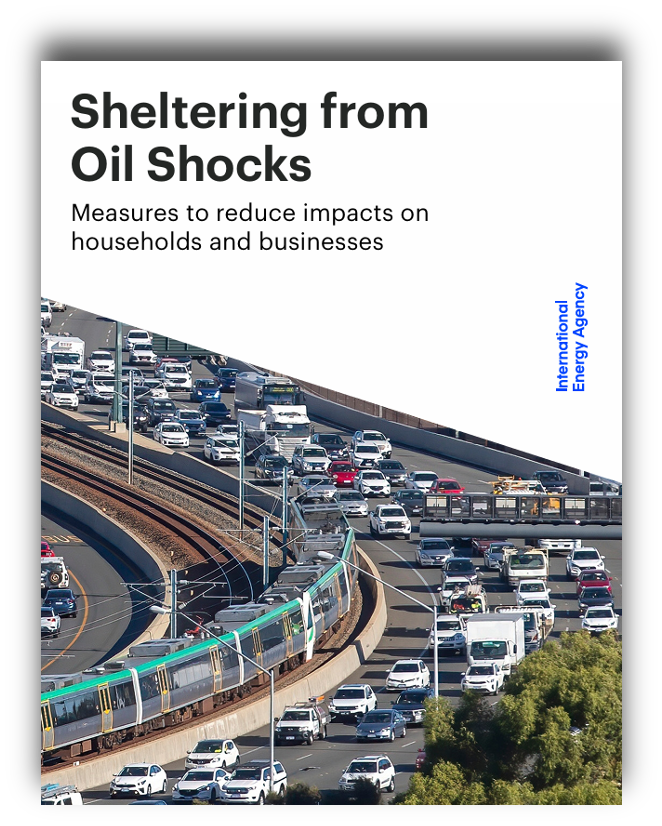
The IEA has now called for “Demand Restraint” and has offered up 10 ways in which households, businesses and governments can implement immediately to “manage their old demand and help shelter themselves from the oil shock”.In the last few weeks, the IEA published a 23 page report “Sheltering from Oil Shocks” which proposes measures that definitely has my Covid PTSD triggered. Welcome to Lockdown 2.0:
The IEA Recommendations:
For road transport, the IEA recommends:
· Work from home where possible: At the national level, three additional remote workdays, for those whose jobs allow for it, could cut oil consumption from cars by 2%-6%, with average potential reductions of around 20% for individual drivers.
· Reduce speed limits on highways by at least 10 km/h: Lowering the speed limit on highways by 10 km/h can reduce an individual driver’s oil consumption by 5% to 10% and overall oil use for private cars by 1% to 6%. Heavy freight trucks can save around 5% due to their already lower speeds.
· Encourage public transport: Shifting travel away from private cars to public transport, such as buses and trains, can reduce national oil use for cars by 1% to 3%. Options like cycling and walking for shorter journeys can lead to further reductions.
· Alternate private car access to roads in large cities on different days: Limiting cars’ access in designated zones to specific days based on their number plate could reduce traffic congestion, engine idling and fuel-intensive stop-and-go driving, with savings of 1% to 5% of national car oil use.
· Increase car sharing Carpooling increases car occupancy and relieves road congestion, reducing travel times and car usage. When combined with eco-driving measures, fuel demand for cars can be reduced by around 5% to 8%.
· Efficient driving for road commercial vehicles and delivery of goods: Eco-driving practices, including regular checks of tyre pressure, reduced idling, adjusting air conditioning settings, and efficient driving practices, and reduction of braking and accelerating, combined with operational improvements, such as optimisation of vehicle loads, can reduce fuel demand for road commercial vehicles by 3% to 5%.
· Divert LPG use from transport: Around 2% of the global car fleet runs on LPG. Switching on gasoline in converted vehicles or bi-fuel ones can preserve LPG supplies for prioritised uses, such as cooking.
For air transport fuels, cooking fuels, and industry:
· Avoid air travel where alternative options exist: A reduction of around 40% of flights taken for business purposes is feasible in the short term and, with very high participation in work-related flight reduction campaigns, could reduce jet kerosene demand by 7% to 15%.
· Where possible, switch to other modern cooking solutions: As LPG supply becomes increasingly constrained, greater adoption of electric and other alternative modern cooking solutions could manage potential cooking fuel shortages alongside other measures to conserve LPG in other non-essential applications.
· Leverage flexibility with petrochemical feedstocks and implement short-term efficiency and maintenance measures: Prioritizing the processing of oil feedstocks with higher volumes available can release pressure on other oil products. Optimizing equipment operations and maintenance can reduce oil use in individual facilities by up to 5%.
If this sounds similar to what we experienced during Covid, you would be right. The IEA takes no shame in drawing upon “lessons learnt” during Covid and you would be right in being fully turned-off by the concept of another crisis and lockdown but I don’t believe governments would have a choice here. However, the crisis is creeping upon us at a pace that is misleading to the severity. We are somewhat buffered and it’s important to know what they are as there is a limit to how long we’ll be sheltered.
Why it’s taking its time for us to feel the crisis:
Oil on Water
At any given moment, there are roughly 7,500 to 9,000 active oil tankers in the world’s fleet. This translates into there being about 1.2 BILLION barrels of oil in transit or in floating storage at any given time. VLCCs (Very Large Crude Carriers) can carry up to 2 million barrels each. “Dirty” tankers carry crude oil and “clean” tankers carry refined products. We are still making our way through this “on water” inventory.
Strategic Oil Reserves
The oil price hasn’t yet translated the squeeze into the price yet. At the start of the war, there were still hundreds of millions of barrels of oil, LNG and other commodities on the water – meaning ships that were fully loaded sailing to their offloading destination.
The US Strategic Reserves were created in 1975 following the 1973 oil embargo to fulfill US obligations as an IEA member and mitigate severe supply disruptions. As of March 13, 2026, the SPR holds 415 million barrels which covers only about 64 days.
In cases of a major loss to world supply, the International Energy Agency will propose a coordinated release from member countries. There have been five such releases, most recently in 2022, when Russia’s invasion of Ukraine caused oil prices to go above $120. Together, members hold government stockpiles of about 1.2 billion barrels, with another 600 million barrels stored by private industry.
On 11 March 2026, the 32 member countries of the International Energy Agency agreed to make 400 million barrels of oil from their reserves available to reduce oil price shocks. The United States’ expected contribution of 172 million barrels is nearly half of the upcoming release.
China has about 1.5 Billion barrels in its strategic reserves. At 5M/barrels per day, they have oil for 300 days if they needed it.
Pipelines
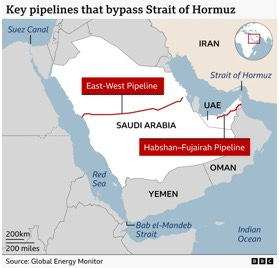
There are two main pipelines that can pump oil to cities outside of the Persian Gulf.
Saudi Arabia operates the 1,200km-long East–West Crude Oil Pipeline ending at the Port of Yanbu. Saudi Aramco, the world’s biggest oil exporter, has been pumping crude along its East-West pipeline to Yanbu to keep supplies flowing and offset the effective closure of the Strait of Hormuz due to the conflict.
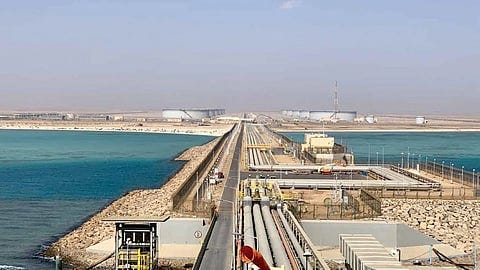
Yanbu terminal, Saudi Arabia Saudi Aramco
Aramco can pump up to 7 million bpd (barrels per day) through the pipeline, around 5 million bpd of which could be available for export, with the rest supplying local refineries.
The UAE has connected its inland oilfields to the port of Fujairah on the Gulf of Oman via a pipeline with a daily capacity of at least 1.5 million barrels.
Whilst oil can be diverted along the alternate infrastructure to bypass Hormuz, it would at most provide 8-10 million barrels per day. This still leaves us short 10 million barrels. Iran and its proxies are very well aware of these pipelines, and have attacked Yanbu and Fujairah already. Any tankers picking up oil at Yanbu then have to navigate the Bab El Mandel, a chokepoint the Houtis still target.
Ghost/Shadow/Dark Fleets
Between 2021 and 2023, roughly 1,600 tankers are estimated to have participated in carrying sanctioned oil between 2021 and 2023.
Bloomberg ran a very informative piece on Iran’s Ghost Fleet:
Within weeks of the conflict beginning, concerns about oil price shocks rises led President Trump turn a blind eye to the illicit Iranian and Russian trade, temporarily lifting sanctions on the roughly $15 billion worth of oil Iran has at sea, as well as that of the Russian shadow fleet. Since then, the Islamic Republic has exported millions of barrels of oil, likely earning Iran more than $140 million a day. At least 15 Iranian tankers have transited through the Strait of Hormuz.
The downside is that Iran has never sold so much oil as it has in the last few weeks. India has been a big buyer of this Iranian Crude.
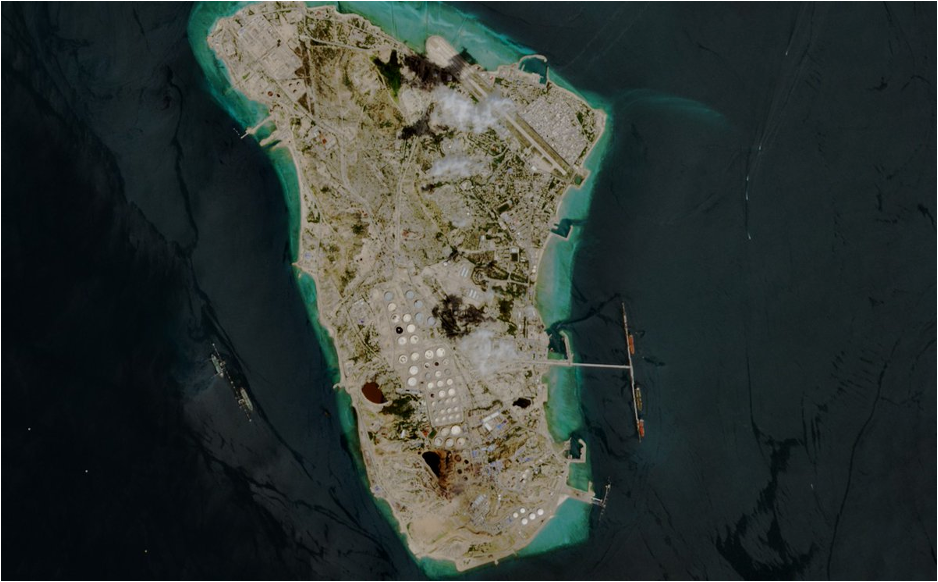
Tehran was loading five oil tankers simultaneously this past week at Kharg Island, as the US-Israel-Iran war enters into its fifth week. Photo: Sentinel-2 L2A @CopernicusEU
Aya-Toll-Ah
Iran has allowed certain ships through the Strait provided they pay the Islamic Regime $2M in tolls (not accepted in US dollars though). An X post shows an Indian tanker stopping to pay the toll in Chinese Yuan. Allegedly Japan also agreed to make payment.
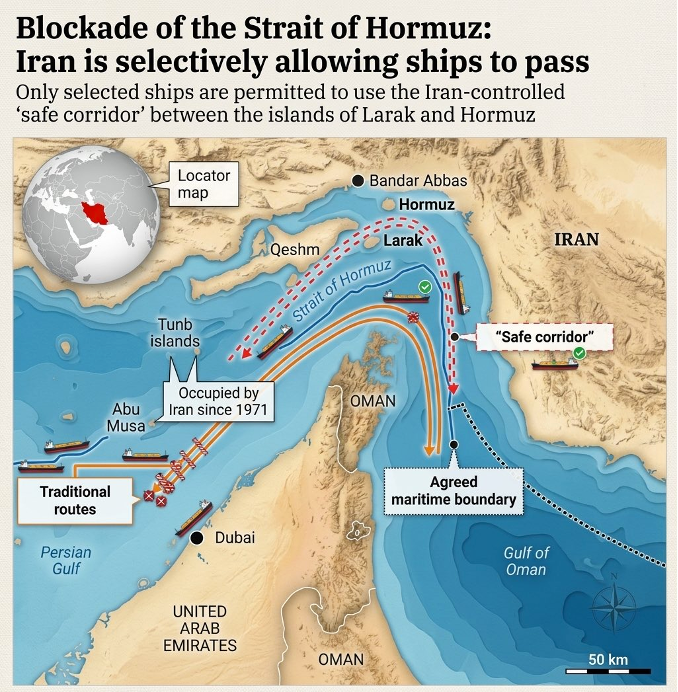
It requires tankers to sail up into Iranian waters and not through the TSS (Traffic Separation Scheme) in order to be checked over by the IRGC and to pay the toll. As you can watch in this video, vessels travel right up to the Iranian coastline
:
The Iranians recently turned back a UAE owned ship because it refused to pay.
Here is how the toll works in practice: every vessel must contact an IRGC-linked intermediary (Iranian Revolutionary Guard Corps) and submit full documentation: IMO number, ownership chain, cargo manifest, crew list, destination. The IRGC Navy’s Hormozgan Command runs multi-layer vetting: sanctions screening, cargo alignment, geopolitical assessment. If approved, the vessel receives a clearance code and routing instructions for a single controlled corridor through the five-nautical-mile gap between Iran’s Qeshm and Larak islands. On approach, VHF radio verifies the code. An IRGC pilot boat escorts the ship through under visual inspection. AIS transponders go dark on entry. Payment of $2M is settled post-clearance through the intermediary.
Ships are expected to raise the flag of the nation that negotiated the passage agreements, and in some instances, to change their official registration to that country.
So successful has this been, that Iran’s parliamentary National Security and Foreign Policy Committee codified this toll-booth in an eight-point “Strait of Hormuz Management Plan” into Iranian law. The plan establishes a rial-based toll on all vessel transits, asserts Iranian sovereign control over the Strait’s navigation, bans American and Israeli ships entirely, bans vessels from any country participating in sanctions against Iran, mandates security and environmental protocols, and formalizes cooperation with Oman on the legal framework.
As of this week, Lloyd’s List has tracked 43 vessels transiting the Strait in this manner.
This move might be hard to undo even in the medium term. The amount of money Iran could make if this stayed in place for a year is eye-watering: 140 vessels per day at $2M each. That’s over $100 billion in new revenue for Iran.
The Jones Act
The Trump administration waived a century-old maritime law – the Jones Act - that requires American ships be used to transport goods between US ports.
The 30-day exemption will apply broadly to vessels moving oil, gasoline, diesel, liquefied natural gas and fertilizer among US ports. That would enable generally cheaper foreign tankers to move those goods.
JP Morgan Chase & Co. in 2022 estimated that waiving the Jones Act could save East Coast motorists roughly 10 cents a gallon, facilitating the free flow of gasoline. There are very few US tankers that are available so the Northeast continues to import whatever gasoline they can’t get from pipeline.
However, international markets and internal US politics limit the benefit of the waiver. A small decrease could be swamped by broader movements in the global market and allowing foreign fleets into the US poses potentially national security risks and the competition would irritate US shipbuilders and operators, as well as their allies on Capitol Hill.
The US last waived the Jones Act in October 2022 for a tanker heading to Puerto Rico to deliver supplies after Hurricane Fiona.
The Biden administration also temporarily issued an exemption for refiner Valero Energy Corp. following a cyberattack on a major East Coast fuel pipeline in 2021.
The big problem is Trumps approval ratings. Before he started this war he was at 48% approve 52% disapprove. His approval rating has crashed to 24%, many of the groups that voted for him have left the tent. I don’t believe this oil crisis is going to be resolved by November leaving the Republicans to take a shellacking in the mid terms.
You know before Fauci produced the Covid virus and then spread it all across the globe people were doing pretty well. They could take the family out to dinner once a week, maybe vacation for a week on the beach each year. They remember that. Now people are struggling to pay there mortgage and there taxes. Credit card debt is at an all time high. The average American can’t go out to dinner once a week or take a vacation.
This argument would you rather have a nuclear ballistic missile hit the US or pay 50 cents more a gallon is a horrible add campaign for the mid terms. For one thing gas is up a dollar not 50cents. People don’t care about foreign countries when they can’t pay their bills. They voted to make America great again not more foreign entanglements. I’m honestly surprised how naive this plan of bombing Iran is just before the midterms. He should have waited. Iran doesn’t have a missile that can reach America and I’ve heard they’ll have a nuclear bomb in two weeks for 50 plus years. I wish the government would change its focus back onto America.
Not looking forward to the communists back in power in the USA. If you thought it was bad under Joe Biden just wait for the next communist authoritarian regime it’s going to make Biden look like Mary Poppins!
A long line of gutless presidents has led us to this. And now iran is serving as a throwback to the Barbary pirates that we had to abolish 200 yrs ago and here they are again pirating oil largely needed by a europe that, again, refuses to see to its own problem but waits for us to do it for them...like we did 200yr ago.