


Fauci and “Good Faith”
MALONE.NEWS
He put the correct mortality estimate in his own notebook, published it under his own name, and gave Congress a figure three to five times higher. Eighteen months later, he was hiring litigators to claim a share of the product he was telling Americans to take.
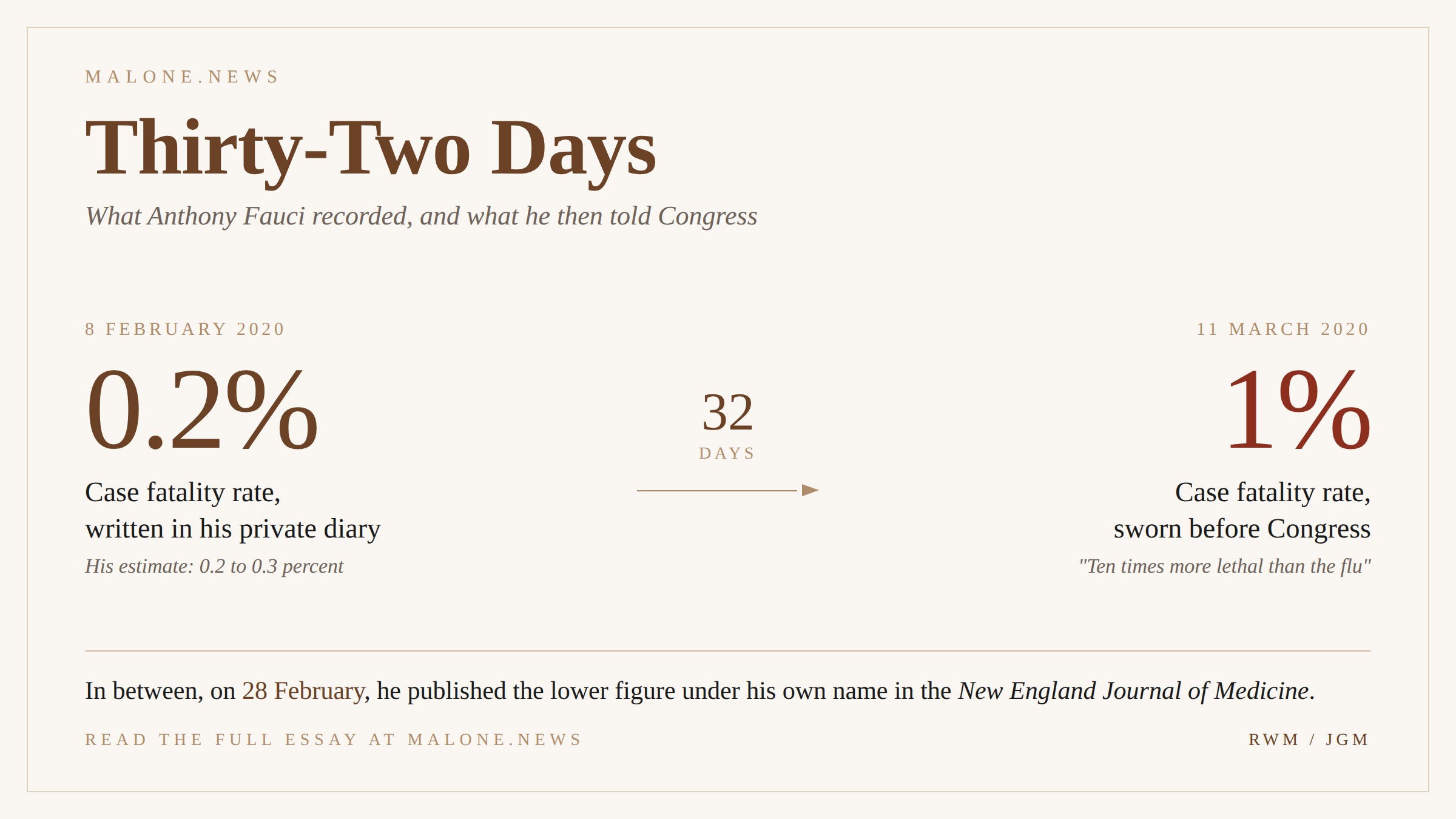
On 8 February 2020, Anthony Fauci took a morning telephone call from Tom Frieden, formerly the director of the CDC. He wrote down what they discussed. Both men agreed the new coronavirus was behaving like a bad influenza in transmissibility. Fauci recorded 34,867 known cases against 724 deaths, then observed that the real denominator was far larger than the confirmed count. That put the case fatality rate at 0.2 to 0.3 percent rather than 2.0 percent (Paul 2026).
He was right, and the estimate has held up better than most of what was said in public over the two years that followed.
Twenty days later, he published the same reasoning under his own name. Writing with H. Clifford Lane and Robert Redfield in the New England Journal of Medicine, he noted that a reported case fatality rate near two percent rested on a case definition requiring pneumonia. If asymptomatic and minimally symptomatic infections ran several times the reported count, the true rate might fall considerably below one percent. The clinical consequences, the three authors wrote, could prove closer to those of a severe seasonal influenza, which they put at roughly 0.1 percent, than to SARS or MERS (Fauci, Lane, and Redfield 2020, 1268). The article went online on 28 February 2020.
On 11 March 2020, he appeared before the House Committee on Oversight and Reform. Chairwoman Maloney administered the oath, and the record reflects an affirmative response (U.S. House 2020, 4). Representative Michael Cloud of Texas asked how the virus compared to what had come before. Fauci answered that seasonal influenza carries a mortality of 0.1 percent, that the stated mortality for this virus was about three percent, and that counting minimally symptomatic and asymptomatic infection brought it to around one percent. Ten times more lethal than seasonal flu, he told the committee, adding that this was something people could get their arms around and understand (U.S. House 2020, 29).
Thirty-two days separate the diary entry from the sworn testimony. In the middle of that window, he put the low figure into the most widely read medical journal in the English language.
The arithmetic
The obvious defense is that the science was evolving and that hindsight is cheap. It fails on the arithmetic.
Both figures are denominator-adjusted. Neither is a raw count. On 8 February, he began with a raw rate of 2.0 percent and corrected downward roughly eightfold. On 11 March, under oath, he began with a raw rate of three percent and corrected downward roughly threefold. The operation is identical in both cases, reasoning about uncounted mild infections and enlarging the denominator to match. Privately he applied that correction with confidence. To Congress he applied less than half as much of it.
New data moves an estimate. It does not explain why a man would apply a weaker version of his own published correction to a congressional committee than he had applied to his own notebook five weeks earlier. The intervening document runs against the defense rather than for it, because on 28 February, three weeks into the supposed evolution, he was still publishing the low number.
A practice he has admitted
He has also described calibrating public figures deliberately. In December 2020 he told Donald McNeil of the New York Times that he had been slowly and deliberately moving the goalposts on herd immunity, raising his public estimate from seventy to seventy-five percent toward eighty or eighty-five. He attributed the shift partly to new science and partly to polling. When surveys showed roughly half the country willing to take a vaccine, he cited the lower figure. When the polling improved, he judged that he could nudge the number up, because the country was finally ready to hear what he really thought (McNeil 2020).
Masks are the second instance, and the structure differs. On 5 February 2020 Fauci wrote to Sylvia Burwell, formerly Secretary of Health and Human Services, that masks were meant for infected people rather than for protecting the uninfected. The email surfaced later under the Freedom of Information Act (Fauci 2020b). He told the country much the same thing on 60 Minutes in March, saying there was no reason to walk around in a mask, and warning that general use could exhaust the supply needed by healthcare workers (CBS News 2020).
The private and the public statements agreed. The explanation changed afterward. In a June 2020 interview, he accounted for the early guidance by pointing to shortages of N95 and surgical masks, and to the need to protect access for healthcare workers treating infected patients (TheStreet 2020). On that account, a supply management objective, rather than his reading of the evidence, had shaped what the country was told. Harvard’s Kennedy School now teaches the episode as a case study under the heading of a noble lie (Harvard Kennedy School, n.d.).
Twice, by his own account, his public statements were shaped by something other than his best reading of the evidence. The mortality gap is larger than either admitted instance, and he has never given any account of it at all.
Why the number mattered
Nearly every projection made in 2020 was calculated from an assumed mortality rate. The estimate was an input, and the outputs moved with it.
Five days after Fauci testified, Neil Ferguson’s team at Imperial College published Report 9. The model assumed an infection fatality ratio of 0.9 percent, within a stated range of 0.4 to 1.4 percent. Run without intervention, it projected roughly 510,000 deaths in Great Britain and 2.2 million in the United States (Ferguson et al. 2020). A copy reached the Trump administration that weekend and the CDC the following Monday. Patrick Vallance, the British chief scientific adviser, confirmed that his government was working from it.
In models of this kind, deaths scale with the fatality ratio in something close to a straight line. Hold the assumed attack rate constant, substitute the figure from Fauci’s own notebook, and the projection falls by roughly two thirds. The gap between 2.2 million dead Americans and something nearer 700,000 is not a rounding error. It is the difference between a catastrophe that suspends ordinary life and a severe epidemic that a country manages.
Ferguson did not take his assumption from Fauci. He derived it from Chinese case data. But the sworn figure and the modeling input converged on the same number in the same week, and that number, rather than the one in the notebook, became the premise of American policy. Among the few people in the country positioned to tell the White House that the input might run three to five times high, one had written the lower figure down and published it. He did not offer it.
The second problem was worse and lasted longer. A single national number carries the implication that risk is spread evenly across a population. COVID mortality was never spread evenly. It concentrated in the old and the already ill to a degree with few parallels in modern infectious disease.
British government advisers noticed the consequence within days. On 22 March 2020 the behavioral science subgroup SPI-B submitted a paper to SAGE observing that many people did not feel personally threatened, and suggesting they had been reassured by the low death rate in their own demographic group. Its recommendation was that “the perceived level of personal threat needs to be increased” among the complacent, by means of emotionally forceful messaging (SPI-B 2020). SAGE discussed the paper the following day.
A government advisory body had observed that the public correctly perceived its own low risk, identified that accuracy as an obstacle to compliance, and recommended raising the perception. The paper is British and I know of no published American equivalent. The mechanism it describes operated on both sides of the Atlantic.
The result showed up in survey data by that summer. In July 2020 Franklin Templeton and Gallup surveyed just over ten thousand American adults about who was dying. Respondents believed that people aged 55 and over accounted for a little more than half of COVID deaths, when the actual share was 92 percent. They put deaths among those aged 44 and under at about 30 percent, against an actual figure of 2.7 percent. Risk to Americans aged 24 and under was overestimated by a factor of roughly fifty (Franklin Templeton and Gallup 2020). Among respondents aged 18 to 24, a group accounting for about a tenth of one percent of deaths, 58 percent expected serious health consequences from infection.
A peer-reviewed survey study found the same misperception and traced it further. Deaths among Americans under 55 amounted to 7 percent of the national total, while respondents estimated 43 percent. Overestimating the risk was associated with greater household isolation, and greater household isolation was associated with more loneliness (JMIR 2021).
An inflated national figure produced an inflated sense of personal danger, and the fear produced consent.
Fauci’s own diary records him convincing the mayor of New York to close the city’s schools, a step he would later tell the public he had nothing to do with. Children were among the least endangered people in the country by a wide margin, a fact visible in the data by early 2020 and never seriously disputed since. National assessment scores afterward showed the largest mathematics declines ever recorded in that program, concentrated among the lowest-performing students.
All of it followed from a single national mortality figure standing in place of an age-stratified one, and from the silence of the people who knew better.
Fear and consent
Emergency powers rest on public consent, and public consent tracks perceived danger. The British behavioral advisers put that relationship in writing, named accurate risk perception among the young and healthy as the obstacle to compliance, and recommended raising it.
The measures Americans accepted had few peacetime precedents. Movement was restricted by executive decree, and businesses were closed by order, with the line between essential and inessential drawn by officials nobody had elected to draw it. Churches shut while liquor stores stayed open. Schools closed for a year, and considerably longer in some districts. Employment, education, and military service came to be conditioned on a medical procedure.
Each of those measures required a public convinced that the danger justified it. The conviction was there, and it rested on a picture of the danger that was wrong. Americans under 55 accounted for 7 percent of deaths and were thought to account for 43. The young overestimated their own risk by a factor of fifty.
Whether Anthony Fauci intended that misperception is not established by any document I have seen, and I will not assert it. No diary entry, email, or interview yet shows him linking a mortality figure to public compliance. The SPI-B paper is British and he had no part in it, which is why it belongs in this argument as evidence about pandemic governance rather than evidence about him.
He has twice conceded that his public statements were shaped by objectives other than his best reading of the evidence. He privately held a mortality estimate three to five times below the figure he gave Congress under oath. He never corrected the record, and the higher figure underwrote the most sweeping peacetime restrictions in the history of the republic. Having twice explained that he sets public numbers by what he judges the public should hear, he has forfeited any presumption that the third occasion was innocent. He has been asked, and he has never answered.
The question underneath is a political one. A government that secures compliance by managing what its citizens believe about their own risk has arranged for them to consent to what they would have refused had they been told the truth. That is the difference between governing a free people and administering one.
The entry about the patent
One passage in the released diary has drawn almost no attention.
“Moderna has not acted in good faith. They have actually put in their patent application and have explicitly stated that Barney Graham, John Mascola, and Kizzy Corbett are not inventors of the mRNA 1273 patent. This is absolutely outrageous, and I have had conversations with Francis Collins, Larry Tabak, and earlier this evening with Jeff <last name unknown- RWM> indicating that we need to get a heavy hitting law firm to argue our case. I suggested as did Jeff that we employ the firm of Williams & Connolly to represent us.”
The dispute it describes is a matter of public record. In a July 2021 filing with the United States Patent and Trademark Office, Moderna made a disclosure under 37 C.F.R. § 1.56. The company stated that its collaborators at NIH had submitted John Mascola, Barney Graham, and Kizzmekia Corbett as additional co-inventors. Moderna then stated that it had reached a good-faith determination that these individuals did not co-invent the mRNAs and mRNA compositions claimed (Public Citizen 2021, quoting application M1378.70145US07).
Francis Collins went public that November, after private negotiations collapsed. Moderna had made a serious mistake, he said, in withholding co-inventorship credit from people who played a major role in a product the company was making a fair amount of money from (Reuters 2021). Moderna projected fifteen to eighteen billion dollars in COVID vaccine revenue for 2021 and ultimately booked roughly thirty-six billion across 2021 and 2022.
Moderna told the Patent Office that its determination was made in good faith. Fauci wrote in his notebook that Moderna had not acted in good faith. Both invocations concerned who owned the patent, not what either party owed the people being asked to take the product.
Two disputes, not one
There were two separate fights with Moderna, and merging them is how this story keeps getting handed back to Fauci’s defenders.
1. The first concerned the prefusion stabilization technique for coronavirus spike proteins, the 2P modification, invented by Barney Graham at NIAID with Jason McLellan, then at Dartmouth, and Andrew Ward at Scripps. It settled. Moderna executed a royalty-bearing license in December 2022 and disclosed a catch-up payment of four hundred million dollars to NIAID in its February 2023 earnings release, along with low single-digit royalties on future sales. NIAID shares that money with Dartmouth and Scripps (Moderna 2023).
2. The second concerned inventorship of the mRNA-1273 sequence itself, the larger prize and the subject of the diary entry. It was still open when the first resolved.
The diary entry belongs to the second fight. The four hundred million dollars belongs to the first. Both flowed to the institute Fauci directed.
Moderna’s own filings show how entangled the two organizations were from the start. In a disclosure to the Securities and Exchange Commission the company stated that NIH and Moderna’s infectious disease research team finalized the vaccine sequence on 13 January 2020 (Moderna 2020). NIH’s technology transfer office lists Spikevax with a NIAID contribution described as research and development of prefusion-stabilized spike protein antigen mRNA technology, naming Graham among the inventors (NIH Office of Technology Transfer, n.d.).
What the statute does
The financial architecture is written into federal law rather than inferred from it.
Under 15 U.S.C. § 3710c(a)(1)(A)(i), when a federal laboratory licenses an invention, the agency must pay the inventor or co-inventors the first two thousand dollars of royalties each year and at least fifteen percent of everything after that. Payments to any one person are capped at one hundred fifty thousand dollars annually unless the President approves more, and they continue after the inventor leaves government service (15 U.S.C. § 3710c(a)(3)). Whatever remains is retained by the laboratory that produced the invention.
Inventorship on mRNA-1273 therefore carried two consequences. Graham, Mascola, and Corbett would each collect personally, at the statutory maximum for as long as the license generated revenue. NIAID would retain the remainder of a royalty stream drawn from a product with tens of billions of dollars in sales.
What I am not claiming
Anthony Fauci was not a named inventor on mRNA-1273, and he was not a named inventor on the stabilization patent either. He stood to receive no royalty from the four hundred million dollar payment. Anyone writing that he did is wrong, fact-checkers have correctly said so, and the claim should stay buried.
Nor am I claiming that he inflated the mortality figure in order to enrich his institute. The patent entry postdates the March 2020 testimony by roughly eighteen months. A document written later cannot establish motive for a statement made earlier.
The conflict of interest is structural
A structural conflict does more damage than a personal one, because nobody has to be bought and there is nothing to step away from.
NIAID paid for the research. Its scientists helped design the stabilized spike protein used in the shot. It settled the final sequence with Moderna in January 2020, ran the trials, and held a royalty stake in the technology inside the product. Fauci ran NIAID. He also went on television night after night telling Americans to take the vaccine. In the middle of that, he called in NIH leadership to hire lawyers who could grow the institute’s share.
No money has to reach him for this to be wrong. His institute had a financial stake in how well a product sold, and he was telling three hundred million people to take it. He was also running the legal fight to make that stake bigger. A journal author would have to declare an interest like that. So would a trial investigator, or anyone sitting on an FDA advisory panel. The public he spoke to every night was never told.
Consent that is not informed is not consent. The principle is older than the Nuremberg Code and does not rest on it. A doctor who backs a product while holding a hidden stake in its sales has not always lied about the product. He has kept back the one fact you needed to judge what he said. The silence is the injury.
None of this requires anyone to be corrupt on purpose. Nobody has to be bribed to end up biased. It is enough to sit inside a structure that pays better for one answer than the other, and people are very good at finding the answer that pays. A high death rate makes a vaccine essential and puts its emergency approval beyond argument. The lower figure, the one in his notebook and his journal article, makes it a judgment call. Careful doctors could differ. His institute had billions of reasons to prefer the first version, and nothing in the system was built to notice.
The question of remorse
Fauci will not be prosecuted. The pardon issued in January 2025 is broad and covers federal conduct through its stated cutoff. It does not reach state offenses, does not bar civil action, does not touch congressional process, and protects nothing said afterward. If he gives false testimony to the Senate today, he does so without a net. For what he did between 2020 and 2024, the criminal courts are closed.
What remains is whether he understands what he did, which is the question every legal system reaches after guilt is settled and before punishment is fixed.
The diaries have produced a wave of commentary reaching for clinical vocabulary. One widely read column concluded that they paint him as a psychopath (Vespa 2026). The people writing this are political commentators borrowing a diagnostic term for emphasis, and the reach is a mistake.
I have never examined Anthony Fauci and will not assign him a psychiatric label from across a hearing room. The stronger objection is that a diagnosis would be the most generous thing anyone has offered him. Disorders mitigate. A man who cannot help what he does is owed treatment and some measure of pity, and any court in the country would weigh it in his favor at sentencing.
The record will not support that reading. It shows a competent physician who recorded an accurate estimate in private, published it under his own name, and gave a different number under oath five weeks later. The competence is what makes it culpable.
The conduct itself is documented. He has never publicly revised the mortality figure he gave under oath, though his own contemporaneous notes and his own journal article contradict it. He told the country he had nothing to do with school closures, and the diary records him convincing the mayor of New York to close them. The six-foot distancing rule, he eventually conceded, sort of just appeared. He has never withdrawn his claim that criticism directed at him constituted an attack on science itself.
Twice in the 11 March hearing, roughly fourteen pages before the mortality answer, he addressed his own candor directly. He told Representative Lynch that he had never held back telling exactly what was going on from a public health standpoint (U.S. House 2020, 15). He told Representative Green that he had never done anything other than state the exact scientific evidence (U.S. House 2020, 24). Both are categorical claims, made under oath, in the same appearance that produced a mortality figure his own notebook contradicts.
Five years of documented error, and not one correction has ever issued from him unprompted. Every concession has been extracted under questioning. That is a pattern rather than a diagnosis, it sits in the public record, and readers are competent to weigh it themselves.
Burdick
One act of his own speaks to the question more clearly than any interview he has given. He accepted the pardon.
In Burdick v. United States the Supreme Court considered a newspaper editor who refused a presidential pardon so that he could continue asserting his privilege against self-incrimination. Justice McKenna wrote for a unanimous Court that a pardon carries an imputation of guilt, and that acceptance of it is a confession of that guilt (Burdick v. United States, 236 U.S. 79, 94 (1915)). Honesty requires the qualification. Later courts have generally treated that language as dicta rather than binding rule, and Biddle v. Perovich held that acceptance is not required for a pardon to take effect (274 U.S. 480 (1927)).
The doctrinal question can be set aside. The moral observation survives it. Burdick understood that taking a pardon says something about the man who takes it, and he refused one rather than say it.
A man who had spent five years insisting he told the country the exact scientific evidence had an obvious course available to him. He could have declined, gone before a grand jury, and let the documents speak. By his own account he had nothing to fear from them.
He took the pardon instead. Nobody forced it on him. He chose it knowing what his own notebook said, and knowing what a jury would have made of those thirty-two days in the winter of 2020. That judgment now falls to the rest of us.
References
“Association of COVID-19 Risk Misperceptions with Household Isolation in the United States: Survey Study.” 2021. Journal of Medical Internet Research. PMC8407438.
Biddle v. Perovich, 274 U.S. 480 (1927).
Burdick v. United States, 236 U.S. 79 (1915).
CBS News. 2020. Interview with Anthony S. Fauci. 60 Minutes, March.
Fauci, Anthony S. 2020b. Email to Sylvia Burwell, 5 February. Released under the Freedom of Information Act.
Fauci, Anthony S., H. Clifford Lane, and Robert R. Redfield. 2020. “Covid-19: Navigating the Uncharted.” New England Journal of Medicine 382 (13): 1268-1269. https://doi.org/10.1056/NEJMe2002387. Published online 28 February 2020.
Federal Technology Transfer Act provisions on royalty distribution. 15 U.S.C. § 3710c.
Ferguson, Neil M., et al. 2020. Report 9: Impact of Non-pharmaceutical Interventions (NPIs) to Reduce COVID-19 Mortality and Healthcare Demand. Imperial College COVID-19 Response Team, 16 March.
Franklin Templeton and Gallup. 2020. Economics of Recovery Study. Survey of 10,014 U.S. adults, fielded 2 to 14 July.
Harvard Kennedy School. n.d. “A Noble Lie? Dr. Anthony Fauci and Masking in the United States.” Case Program.
McNeil, Donald G., Jr. 2020. “How Much Herd Immunity Is Enough?” New York Times, 24 December.
Moderna, Inc. 2020. Current Report, Exhibit 99.1. U.S. Securities and Exchange Commission, EDGAR, CIK 0001682852.
Moderna, Inc. 2023. Fourth Quarter and Fiscal Year 2022 Financial Results. 23 February.
NIH Office of Technology Transfer. n.d. “Spikevax.” Technology Transfer Showcase. https://www.techtransfer.nih.gov/showcase/spikevax-r.
Paul, Rand. 2026. “Tony’s Diary.” The Reading Room, U.S. Senate Committee on Homeland Security and Governmental Affairs, 24 July.
Public Citizen. 2021. “Letter Urging NIH to Reclaim Foundational Role in NIH-Moderna Vaccine.” 9 November. Quoting Moderna patent application M1378.70145US07, disclosure under 37 C.F.R. § 1.56.
Reuters. 2021. “Moderna Covid-19 Vaccine Patent Dispute Headed to Court, NIH Head Says.” 10 November.
Scientific Pandemic Influenza Group on Behaviour (SPI-B). 2020. Options for Increasing Adherence to Social Distancing Measures. Paper prepared for the Scientific Advisory Group for Emergencies, 22 March. Discussed at SAGE meeting 18, 23 March.
TheStreet. 2020. Interview with Anthony S. Fauci, 12 June.
U.S. House. 2020. Coronavirus Preparedness and Response. Hearing before the Committee on Oversight and Reform, 116th Cong., 2nd sess., 11 and 12 March. Serial No. 116-96. Washington, DC: U.S. Government Publishing Office.
Vespa, Matt. 2026. “This Fauci Diary Entry Will Cause Your Blood to Boil.” Townhall, 28 July.
Truth and trust go hand in hand. Trust is built on telling the truth. Lies make people pull away.
To this day when I see Fauci’s wrinkled face I have to admit I have fear inside. Similar fear that I had when I saw him during the pandemic in his media briefings. What a face that I connect to the Americas medical establishment. Although I know the odds are it won’t happen, Fauci behind bars would ease my mind. Knowing he’s still out running around makes my fear remain.
Think how different things in this country would be today if Fauci had just been honest with the American people. If he had just said in public what he said in his “diary”. If he had just said this is a bad flu, with a .2% chance of death. First off people wouldn’t have lost complete faith in the medical establishment which itself has killed people. Fauci and Biden used state run medicine as a weapon. Sure older people would have had to be careful and people with comorbidities, but schools would have stayed open, people would have kept their jobs and businesses, care for the sick would have continued with family participation, weddings, gatherings, funerals could have happened as they should. Massive mail in balloting would never have happened and not be the norm as it is today. I could go on and on.
So while Fauci with all of his narcissistic pompous traits, was sitting down to dinner with Jake Tapper and their wives, he was telling families to stay apart at the holidays. He took his huge role and tore up our constitution and the people’s Bill of Rights for his smug self gratuitous ego.
He has the blood of millions on his hands.
Fauci should be stripped of his medical license, his pension, which is the largest pension in the country, his around the clock security, and certainly his freedom.
J.Goodrich
Thank you for your massive research, Dr. Malone. Thank God my bulls*it detector sniffed right about c*vid, and Fauci. I go with Justice McKenna writing about Burdick. He accepted the pardon, didn't he.