

MALONE.NEWS
Fauci Took the Fifth One Hundred Eleven Times
Peter Navarro has the diary that explains why, and a federal prison number of his own. A review of Why Fauci MUST Rot in Prison.
Book Review by Robert W. Malone, MD, MS
On July 29, 2026, Anthony Stephen Fauci sat down at a witness table under subpoena. He invoked his Fifth Amendment right against self-incrimination one hundred eleven times.
A man who spent forty years explaining himself to the American public, in more television appearances than anyone can count, declined to explain himself under oath. Days earlier, Senator Rand Paul had released 1,141 pages of Fauci’s private diary to the world. Something in those pages made silence the better option.
Peter Navarro has read all 1,141 pages. He has also read the earlier volume, the one Fauci emailed to himself from a government server on July 11, 2015, covering the anthrax letters, the smallpox scare, the bird-flu wars, and Ebola. Why Fauci MUST Rot in Prison is what he found.
I should tell you at the outset that I am not a neutral reader of this book. Navarro asked me to review the manuscript before publication, specifically the sections concerning me and the sections concerning Dr. Vladimir “Zev” Zelenko. I went at those sections the way I would go at a paper I had been asked to referee. I will come back to what happened when I did.
The two diaries
The book rests on a simple premise. Anthony Fauci wrote down what he actually thought. Then he went on television and said something else.
Navarro calls the older volume the Fauci Prequel Diary and the pandemic volume the Fauci Diary. He cites the second by date throughout. The provenance is unusual. Fauci did not release these pages, and no subpoena produced them. Robert F. Kennedy, Jr., who had written The Real Anthony Fauci before becoming Secretary of Health and Human Services, took over the filing cabinets when he took over the department. By Kennedy’s account, his team spent eight months pulling the diary out of eleven separate government servers where it had been, in his phrase, sequestered and secreted.
Books built on leaked documents usually have a credibility problem, and it usually shows up in how the author handles the parts that do not help him. Navarro handles this in an Author’s Note at the back titled “The Record and Its Limits,” and that note is the reason I can recommend this book to people who will be looking for a reason to dismiss it.
He sets out three rules. He quotes the diaries exactly as typed, misspellings and exclamation points intact, on the principle that you do not clean up a record in a book about the reliability of records. Where Fauci pasted a news article into an entry, Navarro labels it pasted press, a reporter’s account Fauci chose to keep rather than Fauci’s own testimony. And he states the record’s limits before his critics can: the pandemic release is incomplete, with gaps of months and a further installment referenced but absent, and parts of the earlier volume were written retrospectively, by Fauci’s own admission. Where Fauci’s dates are wrong, Navarro says so on the page instead of fixing them quietly.
Most polemics do not do this. This one does it in a section the casual reader will never reach.
The chapter I would hand to a medical student
Chapter Eighteen is called “The Country Doctor.” It is about Zev Zelenko, and it is the chapter I would put in front of anyone still trying to understand what went wrong.
Zelenko practiced in New York’s Hudson Valley, caring for the heavily Orthodox community around Kiryas Joel for close to two decades. When COVID moved through that dense housing in March 2020, he did not send high-risk patients home to wait until they were sick enough for a hospital bed. He treated them in the first days, with hydroxychloroquine, zinc, and azithromycin. His peer-reviewed series examined 141 laboratory-confirmed outpatients treated a median of four days after symptom onset (Derwand, Scholz, and Zelenko 2020).
What Navarro does with this chapter is the part I did not expect. He follows the paper trail up. Zelenko made a YouTube video appealing to the President on March 21, 2020. Mark Meadows called him the next day. Stephen Hahn, the FDA Commissioner, called the following week and routed him to Dr. Patricia Brennan, the Director of the National Library of Medicine. Brennan asked for his data. She got it. About a week later she told him the National Institutes of Health was not equipped to process real-world evidence, and referred him to a preprint server.
Navarro’s conclusion is sharper than the one his readers expect. Nobody suppressed Zelenko’s data. It was routed. Suppression requires a person to decide something. Routing requires nobody to decide anything at all.
This is where I have a professional stake, so I will state it plainly. Randomized controlled trials are the right instrument in many settings and an impractical one in others. In battlefield medicine, in austere field conditions, and in the opening weeks of a novel outbreak, the trial you want does not exist and the patient in front of you does not wait. Case reports, case series, and reports of direct clinical experience are evidence. They are weaker evidence than a well-powered trial, and they are not nothing. A public-health apparatus that has no mechanism for reading what a physician observed in his own patients has not built a higher standard. It has built a wall.
Zelenko died in 2022. He did not live to see this chapter written about him.
Where I come into it
In August 2021, Navarro and I published the first of three essays in the Washington Times arguing against universal vaccination and for individualized risk assessment. Facebook censored it. We opened the next essay by reporting that fact. The third essay, in January 2022, was the sharpest of the three, and it included a warning about myocarditis in young men.
Navarro uses that trilogy as a spine through the vaccine chapters, because the essays are dated and public and can be checked against what was known when we wrote them. That is the right use of them. The value of a contemporaneous document is that it cannot be revised after the fact, which is the same reason Fauci’s diary is the most dangerous exhibit in this book.
Now the disclosure I owe you. When Navarro sent me the manuscript, I checked the studies, the dates, and the regulatory record in the sections he asked me to review. I found real errors. One passage asserted a presidential executive order on hydroxychloroquine that does not exist. Another overstated the mortality finding in Zelenko’s own published study, which reported a strong signal on hospitalization and a mortality difference that did not reach statistical significance. A third described the March 2020 emergency use authorization in a way that implied outpatient prescribing had been made unlawful, which it had not.
Navarro fixed every one of them. The published text states the hospitalization finding and stops there. It describes the authorization accurately and makes the stronger argument available to him, which is that the government never had to ban the drug to stop physicians from prescribing it.
An author who takes that kind of correction from an outside reviewer, on material that weakens his own punch lines, is an author who wants to be right more than he wants to be loud. That is not the reputation Peter Navarro has. It is the reputation he has earned on this book.
The interludes
Five sections in this book are not about Fauci at all. Navarro calls them Crime and Punishment, numbers them I through V, and drops them between the parts. They are about the men he met in federal prison.
There is the young Puerto Rican bunkmate who built a paragliding tourism business, then picked up work in the drug trade, and is now five years into fifteen with three children in San Juan. Navarro does not use him for sentiment. He uses him to ask who actually chose the sentence. The prosecutor chose the charges knowing what they added up to. The jury found facts without being told what the facts carried. The judge, the one person the Constitution dresses in a robe and sets apart to judge, chose least of all.
These interludes are the most unusual thing in the book and the reason it is more than a polemic. A man who served four months in a federal facility is writing a book demanding prison for another man. He knows exactly what he is asking for. He describes the sixty-two-degree nights and the fork-comb economics of the place he is asking a court to send Anthony Fauci. He declines to go soft on crime while he is inside the fence, and he declines to pretend the machine that put him there is a just one.
The epilogue asks the question those interludes have been building toward. One man in this story has two misdemeanor convictions, a Bureau of Prisons number, and an appeal pending. The other has never been charged, holds a presidential pardon, and sleeps at home. Navarro asks which one is free.
The prosecution
The last part of the book stops arguing and starts filing.
Chapter Thirty-Five is titled “Venue Is Destiny,” and it turns on a single observation. The pardon Fauci accepted reaches offenses against the United States. It does not reach Florida. Navarro learned the lesson about venue in a District of Columbia courtroom, and he applies it here without pretending his motives are disinterested.
Chapter Thirty-Six is a charging memorandum. Chapter Thirty-Seven is a sentencing memorandum, and it does something I have not seen in a book of this kind. Navarro weighs the stacked statutory maximums against the seven hundred years the press tallied across the four indictments filed against Donald Trump. He runs the process and racketeering counts past one hundred thirty years before a single death enters the calculation.
Then he restrains himself, and the restraint is the tell. Homicide is charged one proved victim at a time, he writes: a named Floridian, dead of that virus, with a medical examiner’s causation and a culpable act behind it. Do not multiply by a county, or a state, or a nation. Count the graves the proof can carry. Florida buried its elderly by the tens of thousands, and Navarro says outright that the proof will not carry them all.
A writer working purely in the red-meat register does not add that paragraph. It costs him the biggest number on the page.
What I would flag
The title will cost this book readers who would have been persuaded by its contents. That is a deliberate choice by the author and his publisher, and it is not my choice to make. But the people most in need of the Author’s Note and Chapter Eighteen are precisely the people who will not pick up a book called Why Fauci MUST Rot in Prison.
The prosecutorial frame is also a commitment. Navarro has written the indictment he believes the record supports. Whether any Florida state attorney files it is a separate question, and the book cannot answer it. Readers should hold the legal argument and the political prediction apart.
And the register is the War Room register. The nicknames run throughout: Playing God Tony, Cover-Up Tony, Lockdown Tony, Myocarditis Tony. Some readers will find that this keeps thirty-seven chapters moving. Others will find it grates against the documentary discipline the book shows elsewhere. Both reactions are fair.
Whom this book is for
If you lost a parent in a nursing home in 2020 and were told it was nobody’s fault, buy this book.
If you are a physician who watched a treatment decision get made by a press conference rather than by a chart, buy this book.
If you are a young man who developed chest pain after a second dose, or the mother of one, buy this book and read Chapter Twenty-Four.
If you are a lawyer who wants to know whether a prosecutable case actually exists under Florida law rather than on cable television, the last four chapters are the reason to buy it.
If you are looking for a careful scientific treatment of gain-of-function methodology, the immunology of the mRNA platform, or the regulatory history that produced the emergency use authorizations, this is not that book. That work belongs to others, and some of it is still being written.
The verdict
Why Fauci MUST Rot in Prison publishes on October 13, 2026, from War Room Books and Skyhorse. You can pre-order it here: https://www.amazon.com/Why-Fauci-MUST-Rot-Prison/dp/1648213022.
The strongest thing I can say about it is the thing I learned by trying to break it. I went looking for the errors that would let Fauci’s defenders throw out the whole volume. I found three, I reported them, and Navarro corrected all three before the book went to press. What is left is dated, sourced, and quoted from the record rather than characterized.
On July 29, 2026, Anthony Fauci had the opportunity to explain those 1,141 pages under oath. He declined, one hundred eleven times. Peter Navarro has spent 240 pages explaining them instead.
Read them, and reach your own verdict. That is what the subtitle asks of you, and it is the right thing to ask.
.
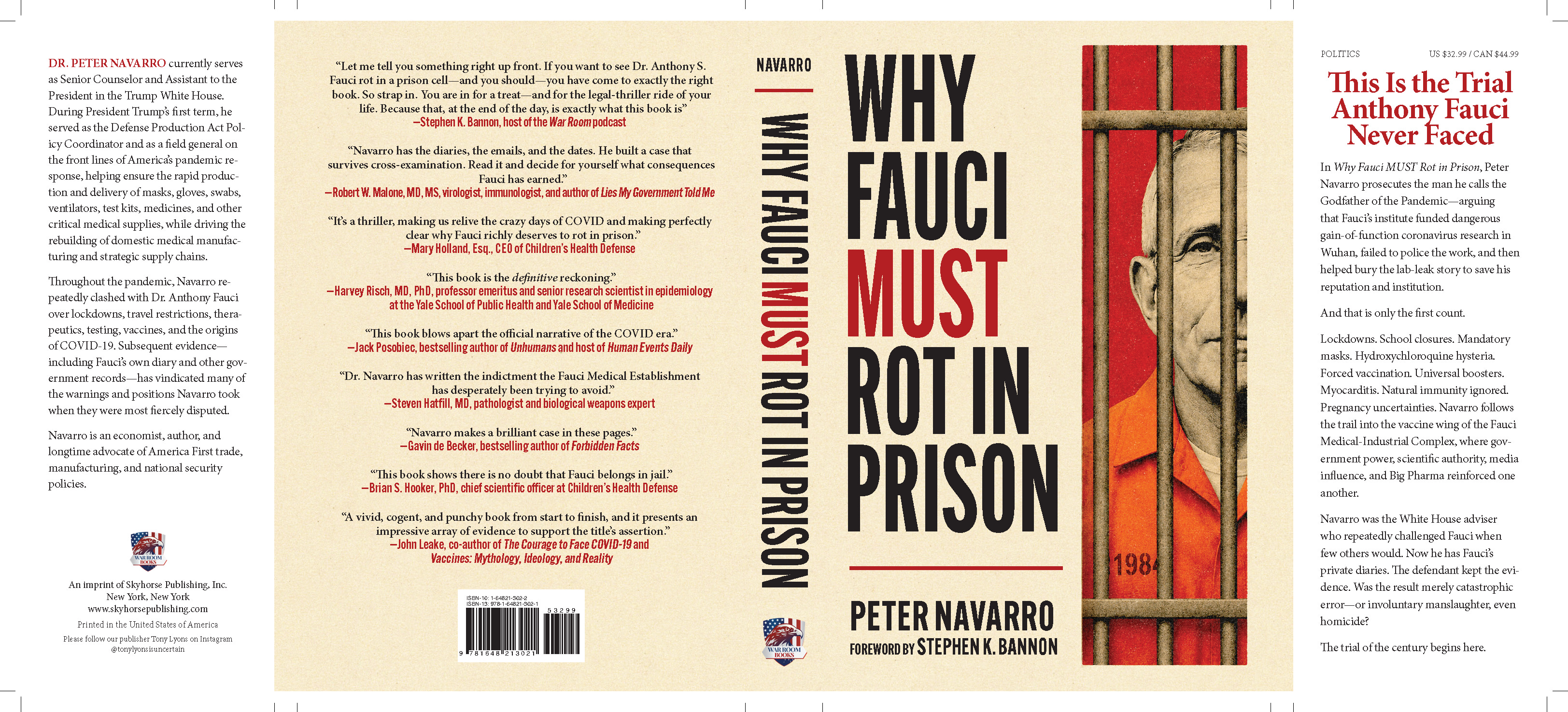
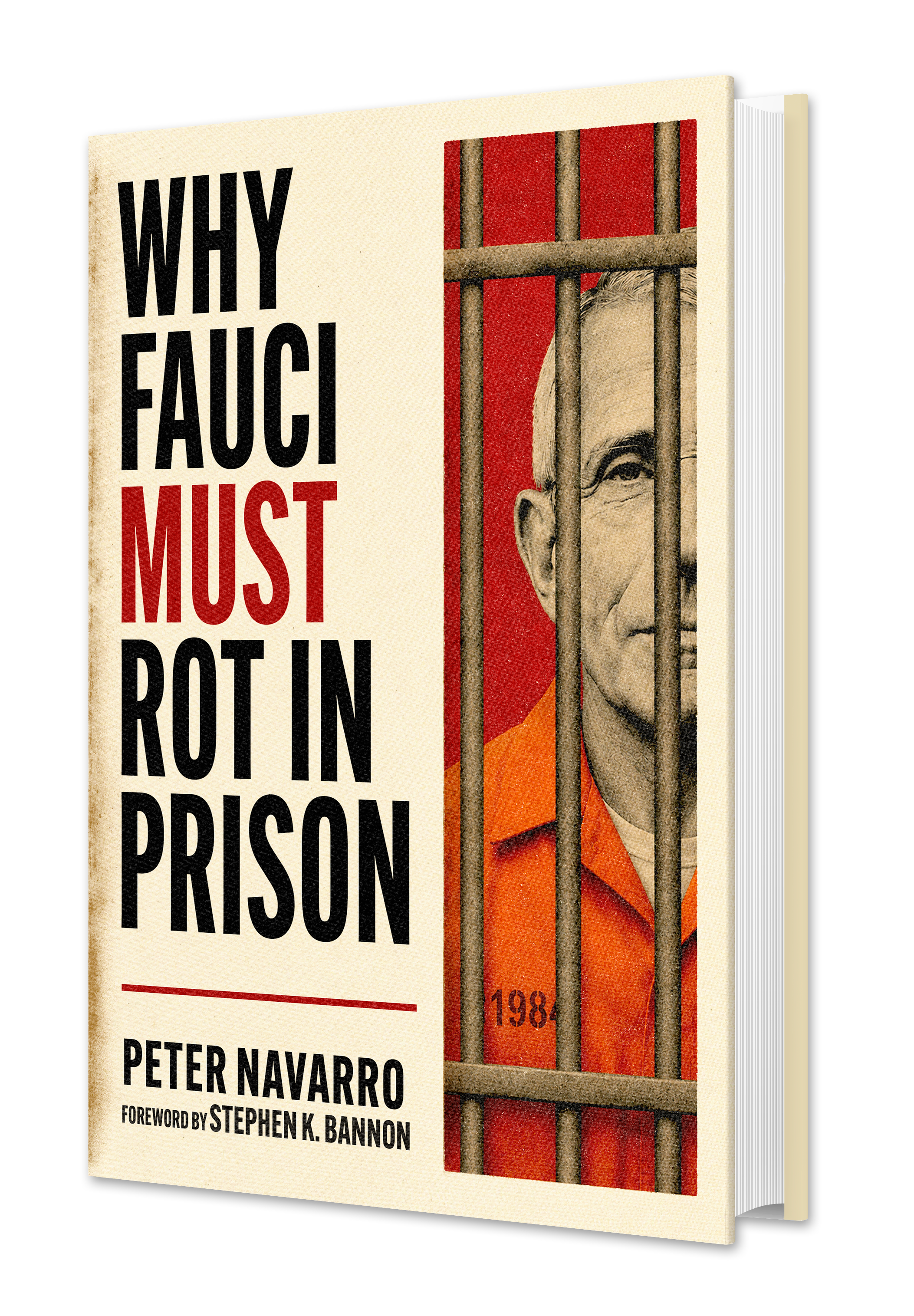
Peter Navarro, Why Fauci MUST Rot in Prison: His Diary. My Diary. Your Verdict. Foreword by Stephen K. Bannon. War Room Books / Skyhorse Publishing, October 13, 2026. 240 pages, hardcover. Print ISBN 978-1-64821-302-1. Ebook ISBN 978-1-64821-303-8.
Disclosure: Peter Navarro is my co-author on three 2021 and 2022 Washington Times essays. He asked me to review portions of this manuscript before publication and to supply a cover endorsement. I appear in the book. I received no payment for the editing, review, or for this notice.
References
Derwand, Roland, Martin Scholz, and Vladimir Zelenko. 2020. “COVID-19 Outpatients: Early Risk-Stratified Treatment with Zinc Plus Low-Dose Hydroxychloroquine and Azithromycin: A Retrospective Case Series Study.” International Journal of Antimicrobial Agents 56 (6): 106214.
Navarro, Peter. 2026. Why Fauci MUST Rot in Prison: His Diary. My Diary. Your Verdict. New York: War Room Books / Skyhorse Publishing.
Robert W. Malone worked as a carpenter and a farmhand before he was a physician and a scientist. He did the original discovery research on in vivo mRNA delivery and wrote the first patent disclosures for using mRNA as a drug including for vaccination purposes. He farms in Madison County, Virginia, and writes at malone.news with Jill Glasspool Malone, PhD.
quite possibly the best book title ever conceived.
One thing I find incredible is as a licensed builder everything I build must be done to code. There are books, many books, the code book just one, that is thousands of pages, that I must use as a guide and every screw and nail I use to hold a building together must be done correctly or if there are any issues I have to fix it, pay to have someone else fix it, or possibly be sued. I basically sign an affidavit stating I will do everything to the standards of those books mainly the code book. There is no exemption from liability, everything must be done to code. How is it possible that these trillion dollar pharmaceutical companies have no liability, even when they knowingly skip parts of the process like proper testing? How is it possible that the government officials that are there to see these test are not properly done but approve the drugs anyways are not held responsible, not even the loss of their job? Many of them get promoted.
Obama coined the saying “elections have consequences”. Anyone who pays attention to what this country has been through sees what’s happened when our government ignores our constitution and our bill of rights. This is what happens when authoritarians win elections and take power. This is why Novembers election is so important. When authoritarians win, our constitution is torn to shreds. People that are put in positions of power have no regard for the law. Just one, one of thousands, of examples;
https://www.facebook.com/share/v/1FD3bw3FrZ/?mibextid=wwXIfr