

Oct 5, 2026 0900h Washington DC · Robert W. Malone, MD, MS and Jill Glasspool-Malone, PhD
On Saturday, October 4, Russia’s federal health agency announced that nothing had happened at its plague laboratory in Irkutsk. No accident. No pathogen in the dead technician’s body. The epidemiological situation is stable.
The same day, Irkutsk closed five hospitals.
City Clinical Hospitals No. 1, No. 3 and No. 10 went under three-week quarantine. So did the Ivano-Matreninskaya Children’s Clinical Hospital and at least one maternity hospital. The Shelekhov district hospital, where Darya Shipilova died, was already closed. At the Irkutsk Aluminum Plant in Shelekhov, the chief executive ordered mandatory masking as a preventive measure.
Those two facts arrived within hours of each other, and they don't fit together. Nobody quarantines a children’s hospital and a maternity ward for three weeks over one case of undiagnosed pneumonia.
This is an update to “The Broken Tube,” published yesterday, which ran the Shelekhov death through the six-layer Biological Weapons Convention verification framework that Dr. Jill Glasspool-Malone, my co-author and wife of almost fifty years, and I have been testing since March. That assessment returned a moderate biosafety concern and a low treaty compliance concern. The developments of the past twenty-four hours do not overturn it. They sharpen one layer considerably, and they clarify what the remaining question actually is.
Three denials, carefully worded
Rospotrebnadzor is the Russian federal consumer protection and public health service. Think of it as the Centers for Disease Control, the consumer safety functions of the Food and Drug Administration, and a national workplace sanitation authority combined into one agency reporting to the prime minister. Anna Popova has run it since 2013. She flew to Irkutsk personally for this incident.
Its October 4 statement made three claims, and the wording of each one repays attention.
On cause of death. The technician was diagnosed with “пневмония неустановленной этиологии,” pneumonia of undetermined etiology. The agency did not name plague. It also did not rule plague out.
On the pathogen. Expanded testing “не выявили в ее биоматериале микроорганизмов, связанных с профессиональной деятельностью,” did not detect in her biomaterial microorganisms associated with her professional activity.
On the accident. “Комиссия по биологической безопасности также не обнаружила в институте аварийных ситуаций.” The biological safety commission found no emergency situations at the institute. That directly contradicts the account published by the Siberian journal Lyudi Baikala, which reported that Shipilova broke a tube containing the plague pathogen on September 25.
The agency also stated that the sanitary and epidemiological situation in Irkutsk Oblast and the cities of Irkutsk and Shelekhov “remains stable.”
Yesterday’s essay noted that no official had named the pathogen and that no formal death notice had been issued. That is now superseded. Rospotrebnadzor has spoken, on the record, and what it said is more useful to the analysis than its earlier silence.
What the region did instead
Irkutsk is a city of about six hundred thousand people. Over the weekend it closed a substantial share of its hospital capacity.
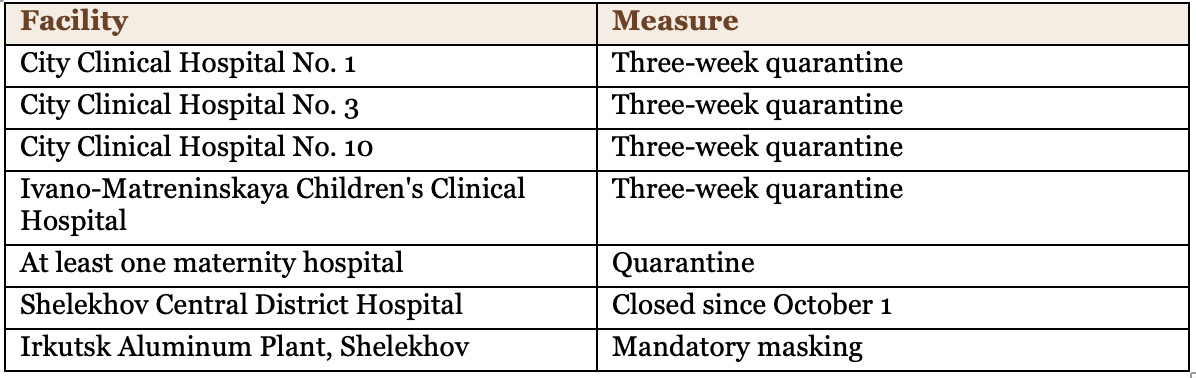
Patients at the quarantined hospitals are cut off from visitors. Only supplies and food may be delivered. Artem Fominykh, chief executive of the aluminum plant, announced the masking requirement and stated that identified contacts are under medical observation with negative test results.
The Insider reports something sharper. Physicians in Irkutsk are discussing plague openly among themselves while the hospital paperwork omits the diagnosis entirely. Sources told Lyudi Baikala that from October 1, FSB details have been escorting the ambulances carrying contacts to examination.
Two observations about the three-week figure. Primary pneumonic plague has an incubation period of one to four days, occasionally extending to seven. The World Health Organization recommends seven days of monitoring for exposed contacts. Twenty-one days is three times that window. It may reflect Russian protocol for particularly dangerous infections generally, which is broader than plague specifically. It is not a duration that plague alone requires.
When an institution’s words and its conduct diverge, the conduct is the better evidence. Words are cheap to issue and carry political cost when wrong. Closing a children’s hospital for three weeks is expensive, visible, and nobody does it casually.
Why the pathogen denial is narrower than it sounds
“Testing did not detect microorganisms associated with her professional activity” is not the same sentence as “she did not have plague.” The difference is microbiology, and it decides how much the denial is worth.
Shipilova spent three days in a district hospital with severe pneumonia before she died. Any patient admitted that way receives empiric antibiotics within hours of arrival. That is standard practice everywhere, including Russia, and the usual empiric regimens for severe community-acquired pneumonia include agents that kill Yersinia pestis efficiently. Doxycycline is a first-line plague drug. Fluoroquinolones such as ciprofloxacin and levofloxacin are first-line plague drugs. Third-generation cephalosporins including ceftriaxone work against it.
The Irkutsk institute published confirmation of exactly this in 2022. Testing thirty collection strains from Mongolia held lyophilized for thirty-one to fifty-nine years, Belkova and colleagues found all of them highly sensitive to streptomycin, ciprofloxacin and ceftriaxone (Belkova, Zakhlebnaya, and Balakhonov 2022). Her own institution had documented that the organism it holds dies readily to the drugs she would have been given.
A patient who has had several days of effective antibiotics frequently yields sterile cultures. The organism is cleared or rendered nonviable even while the patient deteriorates from the damage already done. Culture-negative in that setting is an expected result, not an exonerating one.
The word the agency used is микроорганизмы, microorganisms. Organisms. Not генетический материал or ДНК, genetic material or DNA. Polymerase chain reaction detects bacterial DNA whether or not the organism is still viable, and it stays positive well after cultures turn sterile. Serology detects the antibody response, which in plague appears within days and persists. Immunochromatographic assay for the F1 capsular antigen detects the protein rather than the living organism, and the Irkutsk institute uses that method routinely in its own published work.
Four tests exist. The statement is consistent with having run one of them.
None of this proves Shipilova had plague. It explains how the official statement could be literally accurate and still leave the central question open. The way to close it is to publish which assays were run, on which specimens, taken at which point relative to antibiotic administration. That is one paragraph of disclosure, and the agency has not offered it.
Who investigated whom
The Irkutsk Research Anti-Plague Institute of Siberia and the Far East is not a university laboratory that Rospotrebnadzor regulates from a distance. It is a Rospotrebnadzor facility. The agency assuring the public that no accident occurred is the agency that operates the laboratory where the accident is alleged to have occurred.
The biological safety commission that found no emergency situations is the institute’s own commission.
American readers have a reference point for this. When Dugway Proving Ground shipped incompletely irradiated live anthrax to nearly two hundred laboratories across nine countries between 2005 and 2015, the Department of Defense investigated itself and produced a report. What made that report credible was everything around it: a Centers for Disease Control investigation running in parallel, congressional testimony under oath, a Government Accountability Office with subpoena power, and journalists who could file Freedom of Information Act requests and litigate the refusals. We examined that case under this framework in March and found systematic sterilization and oversight failure at a declared defensive facility. The finding was possible because the surrounding machinery forced disclosure.
None of that machinery exists here. There is a criminal case, reportedly opened into violation of sanitary rules resulting in death, and no primary Investigative Committee announcement confirming it has surfaced. If that case is real and proceeds, it would eventually compel the records that matter: workplace logs, biosafety documentation, the exposure report, witness statements. That is the one domestic mechanism capable of testing the agency’s account, and it operates inside the same state.
Self-investigation is not evidence of wrongdoing. It is the absence of verification, which is a different problem and the one this series exists to describe.
What has not happened
Nobody else has gotten sick.
Roughly one hundred eighty-nine contacts remain under observation. All are asymptomatic. All laboratory results reported so far are negative. Governor Igor Kobzev said as much on October 2, and nothing since has contradicted him.
That is the most important fact available, and it has now passed the point where it means something. Primary pneumonic plague incubates in one to four days. Shipilova died overnight on October 2. Her hospital contacts were exposed between September 29 and October 2. If pneumonic plague had transmitted to the people around her, the first secondary cases would be appearing now.
They are not appearing. Four days on, with nearly two hundred people under daily observation and every one of them being watched by a health service that would struggle to conceal a cluster of that size, there is no second case.
Two readings fit. Either she did not have transmissible pneumonic plague, or she did and the contacts received prophylactic antibiotics fast enough to stop it, which is what the isolation and the three-week monitoring would be for. Both readings are reassuring. Neither is consistent with an uncontrolled release.
For anyone in the United States wondering whether this threatens them, the answer is no, and the arithmetic above is why.
Washington’s answer
A State Department official said on October 5 that the United States is aware of reports of “a fatal case of suspected pneumonic plague in Irkutsk Oblast, Russia” and is “monitoring the situation closely with the CDC and our other interagency partners.” The official added that “many details have not been confirmed” and encouraged Russian authorities to share information “quickly and openly.”
The State Department deserves credit for that statement..
Consider what the Department could have done with the same facts. A dead plague researcher, a Russian laboratory, a denial nobody outside Russia can check, and a domestic audience primed by four years of war to believe the worst about Moscow. The temptation to lead that story was available and free. State declined it.
The Department did four things correctly. It used the words suspected pneumonic plague, which is what the evidence supports and which Rospotrebnadzor itself will not say. It stated plainly that many details have not been confirmed, which is true and which costs something to admit. It asserted nothing about origin, intent, or treaty compliance. And it asked for disclosure rather than announcing a conclusion.
That restraint is the discipline this framework exists to impose, arrived at independently and under more pressure than anyone writing essays will face.
The posture is consistent with what Under Secretary of State for Arms Control and International Security Affairs Thomas DiNanno has argued since taking the job. At a Biological Weapons Convention side event in Geneva in December 2025, DiNanno set out the case that modern biotechnology leaves digital traces in sequence databases, procurement records and publication patterns, and that systems able to read those traces at scale could begin to close the Convention’s verification gap. He named DNA synthesis screening and supply chain monitoring as the priority applications. That initiative is the policy reason this series exists.
An administration that announced an artificial intelligence verification initiative in September 2025 has now met its first significant foreign plague laboratory incident. It named the suspicion accurately, declined to overstate the evidence, and asked for data. That is how an independent international treaty verification capability would behave if one existed, which is a decent argument for building one.
It also demonstrates the limit. The strongest action available to the United States government, confronting a possible fatal laboratory-acquired infection with a select agent at a foreign state facility, is a polite request that the facility’s owner publish more.
What changes in the assessment
Two layers move. The composite does not.
Layer 1, genomic surveillance. Yesterday this layer held nothing and was unscorable. It now holds one claim: expanded testing detected no occupationally associated microorganisms. That claim comes from the facility’s owner, describes specimens of unstated type taken at an unstated time relative to antibiotic treatment, and uses a word that denotes organisms rather than genetic material. It remains unscorable, and the reason has changed from absence of data to data that cannot be evaluated.
Layer 5, behavioral and organizational patterns. This moves from 4.5 to 5.5 out of ten. An explicit official denial contradicted by five hospital quarantines, mandatory masking at an industrial plant, and physicians who discuss a diagnosis that their own paperwork omits is a wider gap than the earlier silence was. Reliability stays low, near 45 percent, because much of it still rests on single-source and Telegram reporting.
Layer 4, environmental monitoring, holds at 2.0. The quarantine expansion looks alarming and is not, on inspection. Contacts from Shelekhov were distributed into Irkutsk city facilities for isolation, and those facilities then closed. That is a cascade running outward through the healthcare system from a single index patient, which is the nosocomial pattern yesterday’s essay described. A release of consequence produces a geographically patterned cohort along a plume axis. This is still a hospital pattern, now with more hospitals in it.
The composite moves from 3.0 to approximately 3.2 out of ten. The classification is unchanged: moderate biosafety concern, low treaty compliance concern. The Shelekhov incident still scores lower on treaty compliance concerns than two American facilities examined with the same instrument.
One scenario gains weight. Yesterday the distribution assigned seven percent to a non-plague etiology with the diagnosis wrong or misreported. Rospotrebnadzor’s statement, Gennady Onishchenko’s public skepticism, and the absence of any secondary case together push that to roughly twelve percent, drawn down from the laboratory-acquired categories. The offensive program scenario stays at three percent. Nothing released in the past twenty-four hours bears on it in either direction.
What would settle it
A plague laboratory investigated itself, announced that it found nothing, and closed five hospitals on the same day.
The gap between those two acts is not evidence of a weapons program. It is evidence that no process exists to check the work. Rospotrebnadzor may be telling the truth. The technician may have died of something else entirely, as her agency says and as its former director suspects. Or she may have died of plague contracted at her bench, with the organism cleared by the antibiotics that came too late to save her, and the laboratory’s own commission may have cleared the laboratory. From outside, those possibilities cannot be separated, and that is the finding.
Four disclosures would separate them, and each is small.
Which assays were run on which specimens, at what time relative to her first antibiotic dose. Whether she had received EV76, the live attenuated plague vaccine that Russia uses and that this institute historically manufactured. The occupations and home addresses of the isolated contacts, which distinguish a hospital cascade from a plume. The strain typing, if any organism was recovered at all, compared against the institute’s own collection accessions.
The institute performs that typing in-house. It publishes the results in its own conference proceedings. The work requires a week, and no one can compel it.
The Biological Weapons Convention entered into force fifty-one years ago without a verification mechanism, and still has none. Every argument about whether this death was an accident, a weapons program, or an ordinary pneumonia runs into the same wall: there is no inspector, no protocol, and no standing. The American answer this weekend was to ask Russia politely to publish more. That is not a criticism of the State Department. It is the complete inventory of available tools.
We will keep applying the framework as material arrives, and we will report what it returns. Yesterday it returned a finding that should reassure, and today it still does.
Addendum, October 5, 1200h, Washington DC.
Three things arrived after this essay was drafted. Two are real and both point the same direction. The third is worth examining because of how it was made.
A claim about airport screening does not hold up. Posts circulating on X this morning report that passengers traveling to Moscow and St. Petersburg are being held for screening. Jill and I could not confirm that from any sourced outlet, Russian or Western, and the available evidence runs against it. Russian Tourism News reported on October 5 that airports and normal transport services have not been closed because of the suspected infection, and that no region-wide travel prohibition was implemented. The only travel advisory on record remains the Baikalsk city notice of October 3, which asked residents to avoid Shelekhov district by road and was deleted within two hours.
The likely origin is instructive. Searching Russian-language sources for airport screening in Irkutsk returns two articles describing exactly that: medical staff in protective suits boarding aircraft with thermal imagers to check arriving passengers. Both articles are from 2020 and concern COVID-19. The first is dated March 24, 2020. The second, from June 15, 2020, describes the airport resuming normal operations. Note the direction of travel in those reports. The screening was at Irkutsk, on passengers arriving from Moscow, six years ago. The claim now circulating reverses the cities, reverses the direction, and moves the date forward six years.
We cannot prove that is what happened: the current posts do not provide citations or verifiable sources. Anyone who can should ask the authors for a primary source. A claim that cannot name one does not belong in an assessment.
Rospotrebnadzor disclosed two cases of COVID-19 and two rhinovirus infections among the isolated contacts. Not in Shipilova. In the people quarantined alongside her. That is a mundane finding and it carries weight. Pull two hundred people into observation and some of them will have ordinary respiratory infections, which is what the agency found and reported. It also explains a twenty-one-day monitoring period better than plague does, since plague would require seven.
Governor Igor Kobzev indicated that contacts could be discharged next week. If that holds, the quarantine is winding down rather than expanding. Four days after the index death, with roughly one hundred eighty-nine people under daily observation, there is still no secondary case of anything resembling plague.
On the American side, Secretary of State Marco Rubio noted that travel between the United States and Russia is already very limited. A White House official told Axios the administration is aware of the reports and evaluating options. Representative Don Bacon and former Representative Adam Kinzinger have called for flight restrictions, Kinzinger urging that the whole world ban all flights to and from Russia. Those are advocacy positions. No government has restricted travel over this incident, and there are no direct commercial flights between the United States and Russia to restrict.
None of this changes the composite score. It moves the same direction the assessment was already pointing. The non-plague scenario, which this essay raised from seven to twelve percent, is now better supported than it was this morning. The offensive program scenario remains at three percent, where no evidence has touched it in either direction since Friday.
One closing observation, since it bears on the method rather than the case. This assessment took four days to assemble, source and score. The screening claim took one post to make, and it will reach more people than this essay does. An independent international treaty verification capability has to be able to run faster than that, and the honest answer is that the current system cannot.
RWM/JGM
Dr. Malone currently serves as a U.S.-nominated Qualified Expert on the roster of the United Nations Secretary-General’s Mechanism for Investigation of Alleged Use of Chemical and Biological Weapons (UNSGM), whose experts may be called upon to participate in UN investigations of alleged chemical, biological, or toxin weapons use. The views expressed here as his own, and do not necessarily represent those of the US Department of State or the UNSGM.
References
Al Jazeera. 2026. “Russian Lab Worker Dies of Suspected Plague in Siberia; US Monitoring Case.” October 5. https://www.aljazeera.com/news/2026/10/5/russian-lab-worker-dies-of-suspected-plague-in-siberia-us-monitoring-case.
Balakhonov, S. V., ed. 2022. Aktualnye voprosy obespecheniya sanitarno-epidemiologicheskogo blagopoluchiya naseleniya Sibiri i Dalnego Vostoka. Proceedings of the Regional Scientific-Practical Conference with International Participation, November 15, 2022. Irkutsk: Irkutsk State University Press. https://irknipchi.ru/collection_materials.pdf. Includes Belkova, Zakhlebnaya, and Balakhonov on the antibiotic susceptibility of Mongolian collection strains.
DiNanno, Thomas G. 2025. “Modern Tools for Modern Threats: Towards Strengthening BWC Implementation, Verification, and Assurance.” Remarks at a Biological Weapons Convention Meeting of States Parties side event, Geneva, December 15. U.S. Mission to International Organizations in Geneva. https://geneva.usmission.gov/2025/12/16/remarks-on-msp-side-event-modern-tools-for-modern-threats-towards-strengthening-bwc-implementation-verification-and-assurance/.
Kursiv. 2026. “V Rossii zapodozrili vspyshku chumy, no Rospotrebnadzor soobshchil o pnevmonii i COVID-19.” October 4. https://kz.kursiv.media/2026-10-04/svvo-v-rossii-zapodozrili-vspyshku-chumy-no-rospotrebnadzor-soobshhil-o-pnevmonii-i-covid-19. Reports two COVID-19 and two rhinovirus cases among isolated contacts.
Kyiv Post. 2026. “White House Monitoring Reports of Plague Case and Quarantine in Russia.” October 5. https://www.kyivpost.com/post/86114.
Lyudi Baikala. 2026. “Po odnoi iz versii, pogibshaya ot chumy v Shelekhove rabotala laborantkoi i razbila probirku s vozbuditelem infektsii.” October 2. https://baikal-journal.ru/2026/10/02/pogibshaya-ot-chumy-v-shelehove-rabotala-laborantkoj-i-razbila-probirku-s-vozbuditelem-infekczii/.
Malone, Robert W. 2026. “The Broken Tube: A Plague Death in Siberia and What It Does Not Prove.” Malone News, October 4. https://www.malone.news/p/the-broken-tube-a-plague-death-in.
Meduza. 2026. “Hospitals in Irkutsk Impose Quarantines after an Employee at an Anti-Plague Institute Dies.” October 5. https://meduza.io/en/feature/2026/10/05/hospitals-in-irkutsk-impose-quarantines-after-an-employee-at-an-anti-plague-institute-dies-russia-s-public-health-agency-says-she-died-of-pneumonia-and-the-epidemiological-situation-remains-stable.
Radio Svoboda. 2026. “Karantin v bolnitsakh, maski na IrkAZ. Vlasti ne podtverzhdayut chumu.” October 4. https://www.svoboda.org/a/karantin-v-boljnitsah-maski-na-irkaz-vlasti-ne-podtverzhdayut-chumu/33870054.html.
Radio Free Europe/Radio Liberty. 2026. “Siberian Anti-Plague Institute Staff Isolated After Worker’s Death.” October 5. https://www.rferl.org/a/russia-plague-warning-siberia-irkutsk-laboratory/33870385.html. Includes calls for travel restrictions and confirmation that none are in force.
Russian Tourism News. 2026. “Travel Warning Issued Near Irkutsk After Suspected Pneumonic Plague Case.” October 5. https://www.rustourismnews.com/2026/10/05/travel-warning-issued-near-irkutsk-after-suspected-pneumonic-plague-case/. Confirms airports and transport services not closed.
TK Gorod. 2020. “Sotrudniki Irkutskogo aeroporta proveryayut sostoyanie passazhirov reisov, pribyvayushchikh iz Moskvy.” March 24. https://tkgorod.ru/news/sotrudniki-irkutskogo-aeroporta-proveriaiut-sostoianie-passazhirov-reisov-pribyvaiushchikh-iz-moskvy-21489/. COVID-era thermal screening at Irkutsk airport, cited as the probable source of the misdated screening claim.
The Insider. 2026. “Kak minimum tri bolnitsy Irkutska vveli karantin posle smerti sotrudnitsy protivochumnogo instituta. Rospotrebnadzor govorit o pnevmonii.” October 4. https://theins.ru/news/297886.
The Moscow Times. 2026. “Nearly 200 People Under Observation After Irkutsk Lab Worker Dies From Plague.” October 2. https://www.themoscowtimes.com/2026/10/02/nearly-200-people-under-observation-after-irkutsk-lab-worker-dies-from-plague-a93857.
The Moscow Times. 2026. “Officials Seek to Reassure Public After Irkutsk Anti-Plague Institute Worker’s Death.” October 5. https://www.themoscowtimes.com/2026/10/05/officials-claim-stable-health-situation-in-irkutsk-after-anti-plague-institute-workers-death-a93872. Kobzev on discharge timing; Rubio on limited United States travel to Russia.
World Health Organization. “Plague.” Fact sheet. Incubation period and contact monitoring guidance. https://www.who.int/news-room/fact-sheets/detail/plague.
Addendum Two, Oct 5, 2026 1600h Washington DC
Four developments since this morning. Three concern what Russian officials are saying and doing. The fourth concerns where the director of the Irkutsk institute was five weeks ago.
Anna Popova flew to Irkutsk
Popova runs Rospotrebnadzor. She traveled to Irkutsk on Friday, October 2, for an emergency meeting convened over a suspected особо опасная инфекция, a particularly dangerous infection.
That phrase is not loose language. In Russian public health regulation it is a defined administrative category, inherited intact from the Soviet system. It covers plague, cholera, anthrax, tularemia, smallpox and the viral hemorrhagic fevers. It triggers a specific response protocol and a specific chain of command. Pneumonia of unknown etiology does not belong to it.
So the agency that publicly characterized Darya Shipilova’s death as pneumonia of unknown etiology sent its director four thousand kilometers east, under a classification that the published diagnosis does not trigger. The two facts are difficult to hold together.
The head of Buryatia wrote that she died of plague, then edited the post
Alexei Tsydenov governs the republic next to Irkutsk oblast. Shipilova was from there, and she had traveled there on assignment shortly before falling ill. Buryatia contains natural plague foci.
His first post said she died of plague. He then edited it to say she had possibly died of plague. A sitting regional head wrote the first version and walked it back within hours. Nothing in the federal account explains why he wrote it at all.
Moscow hardened the line
Dmitry Peskov told reporters on October 5 that there is no outbreak and that citizens should rely solely on official information. That is the Kremlin putting its own voice behind a characterization that until now belonged to a regulatory agency.
Governor Igor Kobzev posted the same day that all identified contacts are under medical observation, that none is showing signs of illness, and that laboratory tests have returned negative results. He did not mention the death.
The negative-test claim carries the limitation set out in the original essay. Contacts were started on antibiotics within days. Culture goes negative quickly under treatment, and the Russian announcements have consistently said микроорганизмы, organisms, rather than генетический материал, genetic material. No one has released PCR results. Negative culture in a treated contact is close to uninformative.
Central Asia tightened border controls, and the measure is being misreported
Kyrgyzstan’s Ministry of Healthcare placed all sanitary-quarantine checkpoints on heightened alert on October 5, covering surveillance of persons, vehicles and cargo crossing the state border. Kazakhstan says it is monitoring the situation. Kazakh officials state that they have identified no travelers with fever, symptoms, or suspected dangerous infection.
No border has closed. No travel has been restricted. These are preventive postures of the ordinary kind, and the Kazakh statement is an explicit negative finding.
Online the same measures are circulating as evidence that plague has moved out of Siberia into Central Asia. That is the error corrected in yesterday’s addendum, repeating in a new jurisdiction: a precaution reported as a detection. Border screening going up is what a health ministry does when it reads the news. It is not what a health ministry does when it finds a case.
The director of the Irkutsk institute was in China in late August
Natalie Winters reported on October 5 that Sergey Balakhonov, who directs the Irkutsk Anti-Plague Research Institute, attended a joint Russian-Chinese exercise in China some five weeks before Shipilova died. Jill and I checked the claim against the primary source. It holds.
The source is a readout published on August 27 by 抚远宣传, the publicity department of the Fuyuan municipal Party committee, carried on The Paper’s government channel. Fuyuan sits at China’s easternmost land point, in Heilongjiang, across the Amur from Khabarovsk. The exercise ran August 24 through 27. The readout names Balakhonov by his full Russian title, director of Rospotrebnadzor’s Irkutsk Anti-Plague Research Institute, and records that he attended and delivered an address. He was one of four named principals who spoke, alongside Chen Lei, a deputy director-general of China’s National Disease Control and Prevention Administration.
The exercise ran three scenarios. The first was plague imported from abroad, with cross-border coordinated response. The second was a newly emergent tick-borne pathogen, designated X disease in the Chinese text, which is a narrower thing than the Disease X of World Health Organization planning documents. The third was post-flood sanitation and emergency medical response. Nineteen medical emergency teams from the three northeastern provinces took part, with more than three hundred personnel and more than forty vehicles.
Two details are worth stating precisely, because they cut in opposite directions.
Irkutsk does not border China. It sits roughly fifteen hundred miles west of Fuyuan. The standing bilateral agreements underpinning this channel are human infectious disease prevention protocols signed with Khabarovsk krai, Amur oblast and Primorsky krai, the three Russian regions that do border Heilongjiang. Balakhonov was the designated Russian speaker anyway, because the Irkutsk institute is the methodological and coordinating center for the entire anti-plague system across Siberia and the Russian Far East. He sits above the border regions’ own public health bodies in the scientific hierarchy. The senior plague authority for the whole theater stood on the platform at a Chinese national-level exercise.
And the event was published. A municipal Party publicity office put out his name, his title and his speaking role within hours, under a government imprint, and Chinese commercial outlets drew the same timing connection on October 3, four days after the death and two days before it reached English-language social media. Concealment does not look like this.
What it does to the scores
Nothing, on the offensive program scenario. That remains at three percent, where it has been since Friday. A director attending an openly announced, state-publicized, multilateral exercise is a transparency signature under layer five, not a concealment signature. The Irkutsk institute drills imported plague with Chinese border authorities because that is its assigned function. Finding the plague institute’s director at a plague exercise is finding the fire chief at a fire drill.
The non-plague scenario stands where the first addendum left it, at twelve percent, with Popova’s travel and the Tsydenov edit pulling modestly against it. The composite remains 3.0.
What the China finding does establish belongs to a different question than the one this series has been scoring. There is a documented Russia-China infectious disease channel operating at national level, resting on signed regional protocols, running annual joint exercises, and placing the director of Russia’s Siberian plague institute on a Chinese platform to discuss imported plague. No public accounting exists of what biological materials move through that channel, what biosafety standards govern the exchange, or who verifies either. Both governments are parties to the Biological Weapons Convention. Neither is subject to any verification mechanism that would answer those questions, because the Convention has none.
That is the finding worth having from this. It does not require the five-week coincidence to carry it, and it will still be true after the Irkutsk case is resolved in whatever direction the evidence eventually takes it.
RWM/JGM
References, Addendum Two
AKIpress. 2026. “Kyrgyzstan Strengthens Border Sanitary Control Following Plague Case in Russia.” October 5. https://akipress.com/news:922782:Kyrgyzstan_strengthens_border_sanitary_control_following_plague_case_in_Russia/.
Fuyuan Municipal Publicity Department. 2026. “2026 nian Zhong-E kuajing chuanranbing yiqing lianhe yingji yanlian zai Fuyuan shi juxing” [2026 China-Russia Cross-Border Infectious Disease Joint Emergency Exercise Held in Fuyuan City]. The Paper, government channel, August 27. https://www.thepaper.cn/newsDetail_forward_33961648. Names Balakhonov by title and records that he attended and delivered an address.
Heilongjiang Provincial Disease Prevention and Control Bureau. 2026. “Zhong-E kuajing fangyi yanlian: shouhu bianjing gonggong weisheng anquan” [China-Russia Cross-Border Epidemic Prevention Exercise: Safeguarding Border Public Health Security]. Tencent News, September 3. https://news.qq.com/rain/a/20260903A067UY00. Describes the signed human infectious disease prevention protocols with Khabarovsk, Amur and Primorsky.
Irish Times. 2026. “US ‘Monitoring’ Suspected Case of Plague in Russia after Lab Worker Dies.” October 5. https://www.irishtimes.com/world/middle-east/2026/10/05/mystery-death-at-russian-plague-research-institute-sparks-quarantine-measures-across-siberia/. Source for Popova’s travel, the Tsydenov edit, and the Kobzev statement.
NetEase. 2026. “Eluosi fang shuyi yanjiusuo yuangong siwang, suozhang yi ge duo yue qian gang lai Zhongguo yanlian shuyi fangkong” [Employee of Russian Anti-Plague Institute Dies; Director Came to China a Month Ago to Drill Plague Control]. October 3. https://www.163.com/dy/article/L8F3NDLP05528J01.html. Chinese coverage drawing the timing connection, with its own caveat that it implies no importation risk to China.
Qazinform. 2026. “Kyrgyzstan Tightens Border Sanitary Controls Following Plague Report in Russia.” October 5. https://qazinform.com/news/kyrgyzstan-tightens-border-sanitary-controls-following-plague-report-in-russia-711d78.
Qazinform. 2026. “Suspected Plague Case in Russia’s Irkutsk: Kazakhstan Monitors Situation.” October 5. https://qazinform.com/news/suspected-plague-case-in-russias-irkutsk-kazakhstan-monitors-situation-b4be98. Reports no travelers identified with fever or symptoms.
Tencent News. 2026. “2026 nian Zhong-E kuajing chuanranbing yiqing lianhe yingji yanlian zai Jiamusi shi Fuyuan shi chenggong juxing.” August 27. https://news.qq.com/rain/a/20260827A0CHIK00. Scenario list, participating organizations, and the counts of teams, personnel and vehicles.
Trud. 2026. “Kreml prokommentiroval soobshcheniya o chume v Priangarye.” October 5. https://www.trud.ru/article/05-10-2026/1842531_kreml_prokommentiroval_soobschenija_o_chume_v_priangarje.html. Peskov on October 5.
Winters, Natalie. 2026. Post on X, October 5.


. Surfaced the Balakhonov exercise attendance.
Checking a Russian agency’s wording against Russian primary sources takes a morning that nobody pays for. Checking a viral claim against a Chinese municipal Party readout takes an afternoon. Paid subscribers are why MALONE.NEWS can run an analysis to a low-scoring conclusion instead of a loud one. If the work is useful to you, consider a paid subscription.
Great interview with you on this very topic this am on my am radio station while driving to work ! Thank you !
Dr Malone Americas treasure of unbiased information
Thank you for everything you do!!