
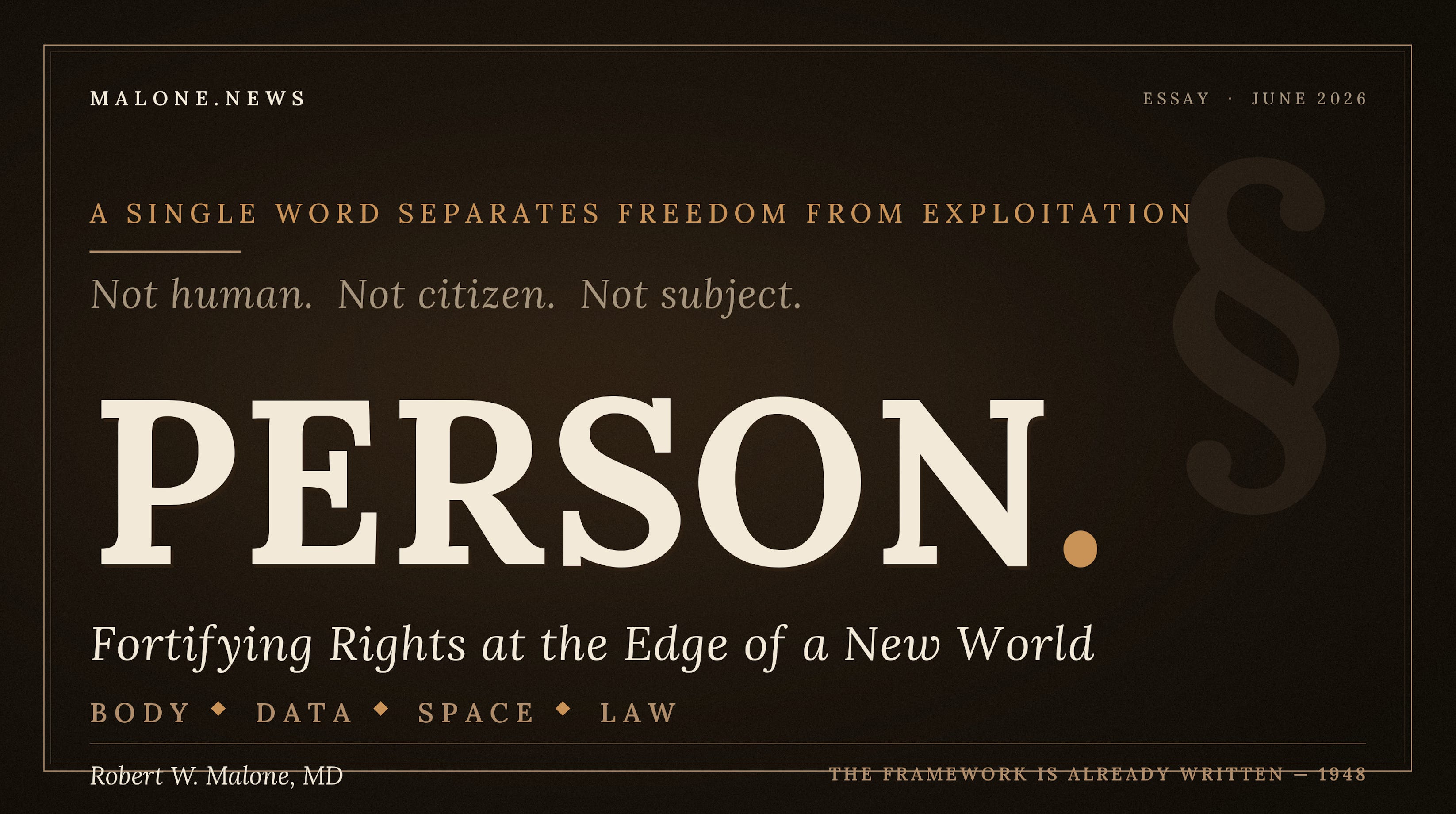
FORTIFYING RIGHTS AT THE EDGE OF A NEW WORLD
Natural Persons, Bodily Sovereignty, and the Frontiers of Rights Law in the Digital, Biological, and Spatial Age
Guest Author Sofia Karstens
A single word separates freedom from exploitation: persons. Not humans, not homo sapiens, not citizens… persons. This distinction, quietly embedded in the 1948 Universal Declaration of Human Rights (UDHR) by Eleanor Roosevelt and the drafting committee, was not semantic housekeeping – it was a legal firewall erected against a pattern of abuse the world had already witnessed in its most grotesque form.
Today, at a juncture when biotechnology rewrites the genome, artificial intelligence surveils every transaction, corporations mine asteroids, and digital identity systems determine access to society, that firewall is being tested again. And we are running out of time to reinforce it.
The architecture is neither accidental nor arbitrary. The Declaration does something quietly decisive in Article 6, which establishes the status on which every other right depends: “everyone has the right to recognition everywhere as a person before the law.” Read quickly, it scans as procedural housekeeping, but notice the load-bearing word is person – not human, not citizen, not subject. Personhood is the gate through which every other protection in the Declaration must pass, and the drafters knew it.
That gate did its hardest work over property. When the General Assembly adopted the UDHR in 1948, the most contentious terrain was not speech or even the prohibition of torture; it was the right to own. Article 17 provides that “everyone has the right to own property alone as well as in association with others” and that “no one shall be arbitrarily deprived of his property.” The language sounds benign. It is not. Property was the very instrument through which personhood had been denied: to make a person ownable, the law first had to place them outside the class of those entitled to own.
The pre-existing international legal order had previously operated on a bifurcated concept of personhood: natural persons (human beings) and legal persons (corporations, states, and chartered entities). Colonial powers had exploited this bifurcation brutally, reclassifying enslaved Africans, indigenous peoples, and colonial subjects as property rather than persons — or as a legally inferior subcategory of person not entitled to the same protections as European natural persons. The body itself became a unit of commerce. The question before Roosevelt’s drafting committee was: how do you write a right to property that protects the dispossessed without simultaneously legitimizing the mechanisms by which bodies are owned?
Roosevelt’s solution was precise and radical. First, she fixed the operative legal status as that of natural persons – not natural humans. The word human carries a biological and historically racialized weight. The word person is a legal status – one that, critically, cannot be subdivided by race, ancestry, or cognitive modification. Second, she added the phrase “alone or in association with others,” which formally acknowledged collective property rights – protecting indigenous communal land ownership that had been systematically denied under frameworks requiring individual titling. A tribe, a community, a collective – they too are associations of natural persons, entitled to property protections that no state can arbitrarily strip away.
The distinction between human and person is not philosophical abstraction – it’s a live legal weapon. Colonial law did not need to call indigenous peoples non-human; it was sufficient to define human so narrowly – through civilization, Christianity, property ownership, or literacy – that entire populations fell outside its protections. Courts upheld the dispossession of Native Americans not by declaring them animals but by ruling that their social organization did not constitute civil society capable of holding recognized title.
This is precisely what the Declaration’s persons framework was designed to prevent. Any being who is a natural person, regardless of cultural practice, genetic modification, technological augmentation, or planetary location, holds inalienable rights. But the danger returns. As genetic engineering advances and as the definition of normal human shifts toward augmented baselines, we risk recreating the same bifurcation: those who meet the new standard of enhanced human and those – including unmodified indigenous communities, those who opt out of medical intervention, or the genetically unimproved – who are reclassified by implication as lesser persons. Articles 3 and 5 of the UDHR – security of person, and freedom from cruel, inhuman, or degrading treatment – are the Declaration’s nearest safeguards for physical and mental integrity, and the UN Declaration on the Rights of Indigenous Peoples bridges the gap between collective cultural identity and individual bodily safety. These frameworks must be the floor, not the ceiling.
There is a definitional trap when considering trafficking, consent, and the body as property. Under international law, the concept that the body is property – even your own property – is formally rejected to prevent opening legal doors to human trafficking and slavery. Articles 3 and 4 of the UDHR are unambiguous: Article 3 guarantees the right to life, liberty, and security of person, explicitly prohibiting non-consensual interference with the physical body. Article 4 outlaws slavery and the slave trade in all their forms, establishing that the physical frame can never be treated as property owned by another entity. The body as property framework is, by design, excluded from standard international human rights law.
Yet a philosophical tension persists. When we reject your body belongs to you as property, we simultaneously erode the legal vocabulary to prevent your body being claimed by others. The UN’s trafficking definition, set out in the Palermo Protocol, requires three elements together: an act (the recruitment, transfer, or receipt of a person), a coercive means, and a purpose of exploitation – a category the Protocol confines to forced labor, servitude, slavery, and the removal of organs. Coerced medical or technological intervention does not slot cleanly into that frame, but it presses on the principle the trafficking regime exists to protect: that a person’s body is not a resource others may conscript. The squarely applicable law is the law of consent. The Nuremberg Code, written after the coerced experimentation of the war, made voluntary consent absolutely essential to medical experimentation, and the Universal Declaration on Bioethics and Human Rights (UNESCO, 2005) makes autonomy and informed consent foundational – not optional – principles of any intervention. When medical or technological interventions are administered without full, informed, uncoerced consent – in institutional settings, military contexts, technological integrations, or under vaccine mandates – it is these instruments, not an expansive reading of trafficking, that they most clearly offend.
The COVID-era vaccination debates acutely surfaced this tension. Whatever one’s view of the interventions themselves, the application of state coercion – employment termination, movement restrictions, social exclusion – as leverage to compel biological modification raises precisely the consent and autonomy questions these instruments exist to answer, and international law must grapple with them honestly. If we do not resolve this definitional gap, it will be exploited and, indeed, it already has been.
The 14th Amendment to the U.S. Constitution provides equal protection under the law and guarantees due process before deprivation of life, liberty, or property. The inclusion of property as a protected interest creates a specific and underexplored conflict when applied to children’s bodies, particularly when mRNA technologies or other novel interventions are added to mandatory childhood vaccine schedules.
Children are simultaneously rights-holders and legal dependents whose decisions are made by guardians – themselves operating within a state framework that can mandate medical treatment and compel compliance. The question is not merely what age constitutes consent, but whether age alone is the right standard. A rights framework grounded in natural persons rather than humans opens a different premise: that the immutable baseline of the body’s natural state is the legal default, and any permanent or irreversible biological intervention must be delayed until the natural person can give meaningful, informed, uncoerced consent – with the narrow exception of genuine emergency, defined by specific, objective, legally reviewable criteria.
Leaning into the Article 17 lens – that natural persons hold property rights over their own biological matter – actually reduces the constitutional conflict between the 1st and 14th Amendments on this issue. Under the 14th Amendment’s due process clause, property cannot be taken without due process. If a child’s unmodified genome is understood as their foundational biological property, then any non-emergency permanent modification without consent requires a constitutionally cognizable justification, and a procedure. This is not radical reading but rather a direct application of existing framework to emerging reality. Article 12 of the UDHR reinforces this, protecting individuals against arbitrary interference with their privacy — including, by natural extension, their genetic and biological privacy.
There is an urgent property debate that cannot be avoided around biopiracy and interestingly returns to the indigenous DNA debate. International law’s formal rejection of the body-as-property concept has an unintended consequence: it leaves indigenous peoples legally exposed to biopiracy. Corporate and scientific entities have patented genetic sequences and biological material sampled from indigenous populations without consent for decades. Because the body is not legally property, Article 17’s strong protections against arbitrary deprivation cannot be directly invoked to prevent this extraction.
The Native American experience with eugenics programs – including forced sterilizations carried out under state authority well into the 1970s – illustrates that the theoretical rejection of body-as-property does nothing to prevent state and institutional actors from treating indigenous bodies as resources. The security-of-person guarantee in Article 3 is clear, but enforcement mechanisms remain weak. The UN Declaration on the Rights of Indigenous Peoples makes progress, but its non-binding character limits its teeth.
A controlled, carefully bounded application of the body-as-property principle through Article 17 offers a pathway: ancestral human remains, genetic codes, biological tissue, and DNA data belong strictly to the natural person and the community from which they originate. No external entity – state, corporation, or scientific institution – may arbitrarily deprive them of commercial or medical rights to their own biological material. Article 17’s second clause, prohibiting arbitrary deprivation of property, functions as a shield: without legally recognized due process (consent, compensation, tribal authority approval) no extraction of genetic material is legally permissible. This framework stops the commodification of indigenous bodies while avoiding the dangerous generalization that all bodies are tradeable property.
In true fashion, the overlap of potentially conflicting language and interests again becomes an exposure point:
Maritime law – the body of law governing conduct on international waters – has long operated as a parallel jurisdiction that interacts uneasily with land-based human rights frameworks. Ships in international waters exist in a sovereignty gap. The law of the flag state technically applies, but enforcement is often nominal, and the persons aboard have limited access to national court systems. This creates structural vulnerability: workers aboard factory ships, fishers held in conditions of forced labor under flags of convenience, and migrants rescued at sea routinely fall between national jurisdictions – protected in theory and abandoned in practice.
A second sovereignty gap runs through investment arbitration. The International Centre for Settlement of Investment Disputes (ICSID), a World Bank body, was built to resolve disputes between states and foreign investors; it was never designed for natural persons. The gradual expansion of who qualifies as an investor – together with treaty-shopping and dual-nationality structures used to manufacture jurisdiction – has produced a forum in which commercial interests can challenge and override domestic regulation before tribunals answerable to neither electorate nor constitution. Two different gaps, one lesson: where ordinary courts give way to fora built for commercial parties, natural persons lose standing. That logic is now being eyed for space. Both the flag-of-convenience model of the high seas and the investor-first model of arbitration are being repurposed to manufacture property and extraction rights beyond Earth for entities that no planetary treaty authorizes to hold them.
As crazy and science fiction as it may sound… space rights are the frontier of person’s law. The Outer Space Treaty (OST) of 1967 – the supreme treaty authority governing human activity beyond Earth – states in Article II that outer space and celestial bodies are not subject to national appropriation by claim of sovereignty, by use or occupation, or by any other means. Its intent was to prevent a Cold War land grab from extending off-planet. Its effect on natural persons is severe: because no nation may claim sovereign territory in space, no nation can grant traditional property deeds or real estate titles in space. An individual’s property rights under Article 17 are acutely constrained; you may own your landed spacecraft or habitat module, but you cannot legally own the lunar or Martian land beneath it.
This legal gap is already being exploited. Through a combination of maritime law precedents, nationality frameworks, dual-national constructs, and domestic legislation – most notably the U.S. Commercial Space Launch Competitiveness Act of 2015 – private corporations are being granted extraction and resource rights that functionally constitute property rights in space, despite the OST’s prohibition on national appropriation. The mechanism is elegant in its cynicism: a nation cannot own the asteroid, but a corporation chartered by the nation can own the minerals extracted from it. Natural persons, meanwhile, have no pathway to the same rights.
The highest protection available to natural persons in this space operates across three tiers. The supreme authority is jus cogens – peremptory norms of international law that sit at the apex of the global legal system and bind all actors regardless of treaty. No space colony, corporation, or nation-state may enforce property or living arrangements in space that violate jus cogens: the prohibitions on forced labor, human trafficking, slavery, and arbitrary deprivation of life are absolute. They extend to the universe. Any rule – whether aboard a private space station, a Martian colony, or a lunar mining operation – that constitutes forced labor or arbitrary confinement is automatically void under jus cogens, regardless of whatever contractual, corporate, or flag-state framework purports to authorize it. Below jus cogens sits the OST itself; and below that, the emerging domestic legislative frameworks that fill jurisdictional gaps. Natural persons must be explicitly written into all three tiers… or they will be written out.
Whatever new enclosure we come up with, perhaps the most critical inclusion must be digital identity and surveillance. The digital domain has become the frontier where rights are most actively eroding in real time. Digital identity systems – government-issued or corporate-administered – now control access to banking, healthcare, employment, travel, and social participation. Biometric tracking systems map faces, gaits, voices, and behavioral patterns without consent. Digital censorship – whether by state mandate or by platform policy – suppresses political speech, medical dissent, and cultural expression in ways that would be facially unconstitutional in any physical public square. Technological surveillance of the depth now routinely deployed would, if conducted by police on a street corner, require judicial warrants in most democratic legal systems.
The natural person framework is essential here. The same Article 12 protections against arbitrary interference with privacy; the same Article 19 protections for freedom of expression; the same Article 17 protections against arbitrary deprivation of property – including, critically, your digital property: your data, your biometric profile, your behavioral model, your genetic record – all must be explicitly extended into the digital domain. The concept of digital rights is not a novelty to be addressed later… it is the governing question of this decade. Without explicit extension of natural persons’ rights to the digital sphere, we will have created an enormous sovereign-free zone… just as maritime law created one on the ocean and space law threatens to create one beyond the atmosphere, where entrenched power operates without constraint, and weaponizes every available tool in its arsenal – including the one most capable of destroying us – to remain entrenched.
Self-governance and territorial autonomy have become entangled in the sovereign quagmire. The concept of sovereignty as it applies to individuals – sometimes called territorial autonomy or personal sovereignty – has been systematically delegitimized in legal and political discourse. Over recent years, the association of ideas around individual sovereignty, self-governance, and opt-out rights has been treated as inherently extremist. A pattern developed in which any written or read notion linking these concepts – regardless of whether the actual language of sovereignty was even used – was flagged as conflicting with state authority. The ideas themselves became suspect, without regard for their legal pedigree, which extends through the entire lineage of Enlightenment philosophy and international human rights law.
This pattern is not incidental. The delegitimization of individual sovereignty language serves a structural function: it preemptively forecloses the legal arguments that would most effectively challenge overreach. When natural persons cannot invoke their right to bodily self-governance, territorial autonomy, or opt-out from institutional compulsion without being classified as fringe actors, the rights themselves atrophy. The chilling effect is constitutional erosion by stigma. The UDHR framework of natural persons – with its roots in anti-colonial, anti-slavery, and anti-fascist legal history – is the legitimate vocabulary of individual sovereignty and personal integrity all all levels. Reclaiming it is not radical; abandoning it is.
The enclosure is coming… the question is whether we see it. Every historical instance of systematic rights deprivation has followed the same pattern: first, the definition of personhood is narrowed or bifurcated; then, the excluded group is subject to extraction – of labor, of land, of biological material, of identity. The tools change. The logic does not. We are now at a moment when the same bifurcation is being prepared across multiple simultaneous dimensions: biological (enhanced vs. unmodified persons), digital (verified identity holders vs. the uncredentialed), spatial (licensed resource extractors vs. unrepresented natural persons on other planets), and financial (those inside the programmable currency system vs. those outside it).
Artificial intelligence will be the primary instrument of enforcement. Not because AI is malevolent, but because AI systems trained on existing legal and economic frameworks will replicate and accelerate existing power asymmetries at a speed and scale no human bureaucracy could match. The optimization function will run. The question is what it is optimizing toward, and on whose behalf. If the answer is entrenched capital, state authority, and corporate persons, then natural persons – all of us – will find ourselves the subjects of a form of administered servitude more comprehensive and more inescapable than any that preceded it, precisely because we will not have a word for it.
The word is persons. Natural persons. The framework is already written. Eleanor Roosevelt and her colleagues drafted it in 1948 because they had just watched the world nearly destroy itself by forgetting it. We do not have the luxury of forgetting it again – not with bioengineering rewriting what bodies are, not with digital systems rewriting what identity is, not with space law rewriting what territory is, and not with AI rewriting what governance is. The time to explicitly fortify the rights of natural persons – in bodies, in data, in space, in law – is now. Not because the crisis has arrived. Because it is being quietly assembled, component by component, and most of us do not yet see the whole.
Update: The UN meeting held in mid-June 2026 ended with a clear attempt to slip the no-property natural-persons clause from the Moon Treaty verbatim into the General Assembly Report.
Our experience during Covid when governments acted as if they owned us, mandated vaccinations of children, and transgender surgeries on children too young to consent, resulting in their sterilization, should be warning enough to us all what governments and corporations will try to get away with.
Greetings from the Thumb Coast, Michigan! An elegant and riveting explanation of "Natural Persons, Body Sovereignty, and the Frontiers of Rights Law . . . " as pertinent to the age in which we are living and which will dawn into a different tomorrow. As COVID-19 advanced and until his demise in mid 2024, our son was totally immersed in laws and treaties pertaining to "persons," and the rights pertaining thereto. This is a "keeper" in print and to hand. Thank you, once again, Drs. Jill and Robert for your awareness that familiarity with such an esoteric subject is necessary equipment for understanding and navigating the path ahead. I fear the sailor's by-words of "fair winds and followings seas" may prove insufficient. Rath De Ort.