

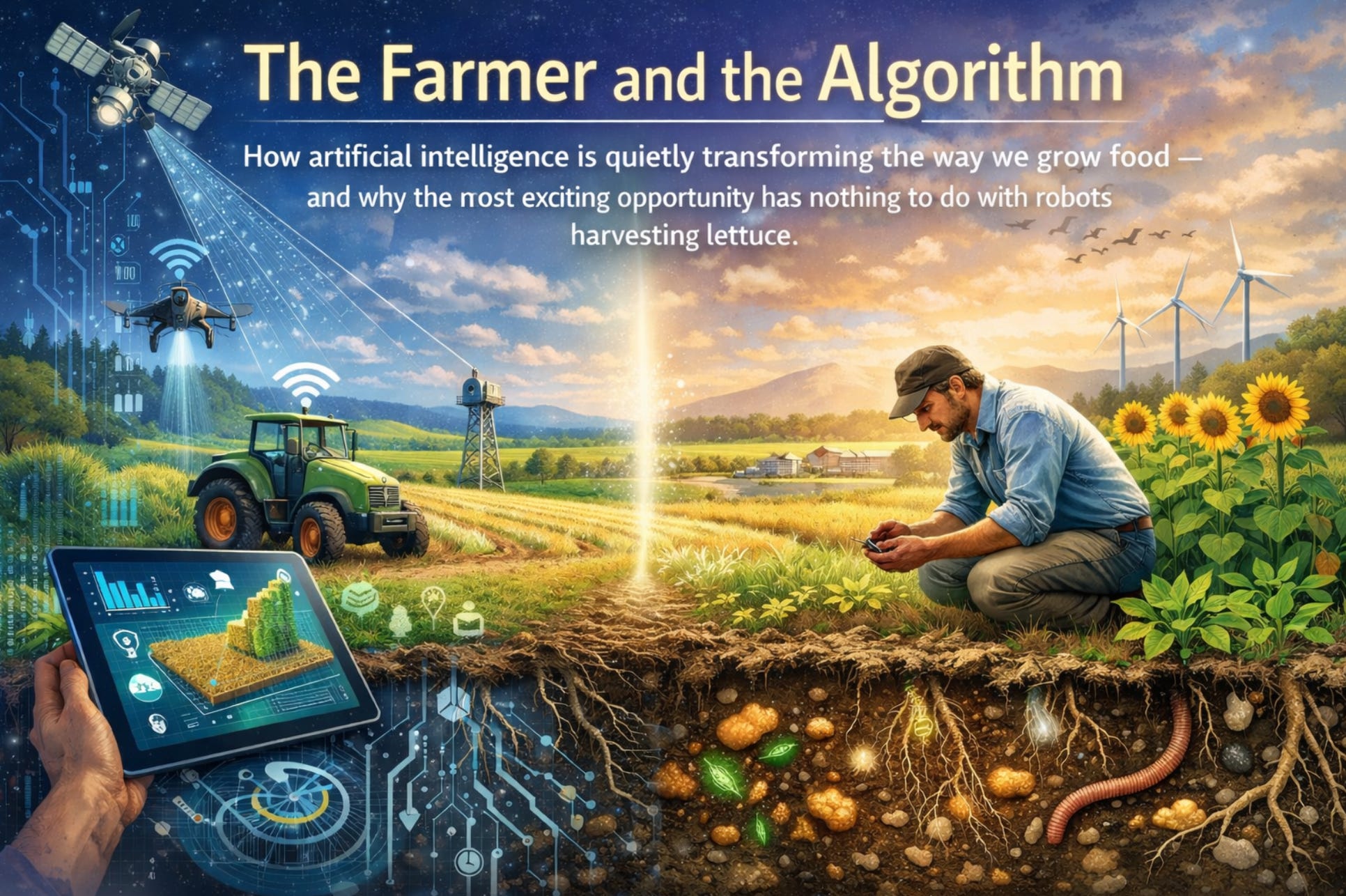
The Farmer and the Algorithm
How artificial intelligence is quietly transforming the way we grow food — and why the most exciting opportunity has nothing to do with robots harvesting lettuce.
Picture a farm in central Illinois. About 3,000 acres of corn and soybean country, worked by the same family for generations. A few years ago, the farmer there decided to try something different. He cut back on tillage, planted cover crops between his cash crop cycles, and started paying attention to his soil in a way he hadn’t before. Not just whether it was wet or dry, but what was living in it.
The results surprised him. Moisture retention went up. The soil held more organic matter. Nutrients cycled better. His fields, over time, started to feel different underfoot — spongier, more alive. He described the transition as demanding, though. New knowledge, new equipment, and a period of uncertainty while biology got its footing.
What he was practicing has a name: regenerative agriculture. And it is increasingly being paired with a technology that might seem, at first glance, completely alien to muddy boots and field notebooks: artificial intelligence.
This is a story about that pairing; what it actually looks like, why it matters, and what it might mean for the future of food.
First, a word about scale
AI in agriculture is not a fringe experiment. It is a rapidly growing industry, projected to expand from $1.7 billion in 2023 to $4.7 billion by 2028.1 Estimates suggest that combining AI with digital farming tools could add more than $450 billion a year to agricultural output in developing countries alone, a 28 percent improvement over what those countries might otherwise achieve.1
The pressure driving this investment is real. Agriculture already accounts for 72 percent of all the freshwater humans withdraw from rivers, lakes, and aquifers.2 About a third of the world’s farmland is degraded, so that it has become less productive.2 And by 2050, we will need to feed roughly ten billion people. That is a lot of pressure on a system that is already showing cracks.
AI is already involved in farming activities that increase production and reduce resource use. A major 2025 review of four years of field research found that AI-powered tools had moved well beyond lab demonstrations and into real farms, achieving accuracy rates above 90 percent in detecting crop diseases and pests, and delivering measurable improvements in how efficiently farms use water, fertilizer, and other resources.3
What AI is actually doing on farms right now
If you want to see where AI is already earning its keep, start with precision farming. The idea is simple: instead of treating an entire field as a uniform surface and applying the same water, fertilizer, and pest control everywhere, you treat each square meter individually based on real data. AI makes that possible by processing the flood of information coming from satellites, drones, soil sensors, and weather stations faster and more accurately than any human could.
Computer vision systems can now identify the first signs of fungal disease in a crop before a farmer walking the field would notice anything wrong. Robotic weeders — like those built by Harvested Robotics — can roll through a field and mechanically pull weeds without herbicide, distinguishing weeds from seedlings by size and species.5 Predictive platforms crunch historical weather patterns, soil data, and market prices to help farmers decide when to plant, when to irrigate, and when to harvest.
According to one thorough review of the field, AI is transforming farming across the entire supply chain, not just what happens in the field, but how food is processed, stored, and distributed.4 A compound annual growth rate of 25.5 percent over the next few years reflects how seriously the industry is taking this.4
But here is the problem. Most of these tools were built to optimize conventional, industrial farming; to grow more corn per acre of flat, chemically managed land. Applied to that kind of farming, AI can actually make some existing problems worse: pushing monocultures harder, reducing ecological diversity, and treating the farm as a factory floor rather than a living system.6 The more interesting question is what happens when you point these tools in a different direction.
What regenerative farming actually is
Before we get to the AI-regenerative agriculture connection, it helps to be clear about what regenerative farming actually means, since the term gets used loosely.
At its core, regenerative agriculture is the practice of farming in a way that actively improves the land rather than just extracting from it. That means using less tillage (or none at all, since plowing destroys soil structure and kills microbes). It means planting cover crops — things like clover, rye, or radishes — between cash crop cycles to keep living roots in the ground. It means bringing animals back into the rotation in managed ways, so their grazing and manure work with the land’s biology rather than against it. It means reducing synthetic fertilizers and pesticides and, as much as possible, replacing them with biological processes.
The goal is a farm where the soil gets better every year: more organic matter, better water retention, richer microbial life, more resilience against drought and heavy rain. It is a fundamentally different objective from conventional farming, which often maintains soil as a medium for holding crops upright while chemicals do most of the work.
What makes regenerative farming hard is that it is complex. Every decision about which cover crop to plant, when to graze, how to rotate, how much to till, interacts with dozens of local variables: soil type, rainfall, temperature, crop variety, and field history. There is no universal playbook. What works brilliantly in Iowa may fail in Georgia. This is precisely where AI becomes useful, because AI is very good at holding complexity.
The numbers behind the shift
A 2024 McKinsey survey of farmers worldwide found that 68 percent had already adopted crop rotations, 56 percent had moved to reduced- or no-till farming, and 40 percent were using variable-rate application technology. This means they were already adjusting their inputs field by field rather than blanket-spraying.7 These are not niche practices anymore. They are becoming mainstream.
Researchers and practitioners working at the intersection of AI and regenerative farming have identified five areas where the combination pays off most clearly: planning regenerative landscapes at scale using satellite data, tailoring practices to local conditions, reducing the financial risk of transitioning away from conventional methods, creating accountability in supply chains so buyers can verify what farmers are actually doing, and providing continuous field-level monitoring.8 All of these depend on the same underlying capability: making sense of large amounts of heterogeneous data quickly and translating it into decisions a farmer can act on tomorrow morning.
The soil is the whole game
If there is one thing that unites every aspect of regenerative agriculture, it is the soil. Everything from water retention, nutrient cycling, resilience to weather stress, and long-term productivity flows from having healthy, biologically rich, structurally intact soil. And for most of agricultural history, measuring soil health was slow, expensive, and inconsistent.
The conventional approach involved physically extracting soil samples, sending them to a laboratory, waiting weeks for results, and receiving measurements for a handful of locations across a field that might vary enormously. It was a bit like trying to understand a patient’s health by testing blood from five spots on their body, once a year, with a month’s delay between sample and result.
AI and satellite remote sensing are changing that completely. A 2025 study used data from two European Space Agency satellites, combined with a machine learning model called XGBoost, to map soil organic matter across farm sites in Japan and Togo. The model achieved a high degree of accuracy, which is exceptional for this kind of work, at a fraction of the cost of traditional sampling.9 What took months and lab fees can now be done continuously, from orbit.
A group of companies is developing commercial tools based on this science. Biome Makers sequences the DNA of soil microbial communities to provide farmers with a live portrait of their soil biology, showing which organisms are present, which are thriving, which are missing, and what that indicates for nutrient availability and plant health. Another company uses satellite imagery and machine learning to continuously monitor soil health indicators across entire farm portfolios, translating those measurements into outcome-based payments for farmers who show genuine improvement. Another soil modeling platform can reduce the cost of soil assessment by up to 90 percent compared to traditional sampling. And there is another methodology now officially approved by Verra (the global certification body) for evaluating soil health through digital mapping.10
Proving it actually works
One of the persistent frustrations in regenerative agriculture has been the difficulty of rigorously and cheaply proving that practices produce the outcomes farmers and buyers claim. A food company that wants to source from regenerative farms needs more than the farmer’s word for it. An investor financing the transition needs evidence. Historically, that evidence has been expensive to gather and inconsistent in quality.11 Furthermore, organic food labelling has proven to be an unreliable method for ensuring quality.
This is where AI-powered remote sensing becomes genuinely transformative. The same satellite platforms that can assess soil health can also monitor whether cover crops were actually planted, whether fields are showing signs of improved water retention, and whether biodiversity indicators are moving in the right direction. Continuous monitoring at low cost means that outcome-linked payments: paying farmers for verified ecological results rather than just for adopting certain practices, become financially feasible at scale.12 Because this is an issue of scale. If we want to replace glyphosate and petrochemical fertilizers in order to feed billions of people, regenerative farming has to be done at scale.
The legal and regulatory scaffolding is starting to catch up. In the United States, the Growing Climate Solutions Act created a USDA-administered pathway for farmers to participate in outcome-based agricultural markets. The European Union’s Carbon Removals and Carbon Farming Regulation, passed in 2024, established a certification framework with clear standards for verifying ecological outcomes from farmland. These are the institutional structures that AI-powered verification is being built to serve.13
The hardest part isn’t the technology
Ask anyone who has tried to transition a farm from conventional to regenerative practices, and they will tell you the hardest part is not buying new equipment or accessing new markets. It is the knowledge gap. Conventional farming is a well-documented, heavily supported system. There are extension agents, company representatives, and decades of research telling you exactly what to do in most situations. Regenerative farming is more experimental, more local, more dependent on the farmer’s own observation and judgment.
That Illinois farmer with 3,000 acres, no-till, cover crops, and careful attention to soil biology described the transition as demanding precisely because so much of the knowledge had to be built from scratch, one season at a time. Things improved. Soil water capacity went up. Organic matter levels rose. Nitrogen and phosphorus availability improved.14 But it took time, and there was real uncertainty along the way.
AI-powered advisory tools are beginning to close this gap. In May 2025, Farmland LP, a company that manages regenerative farmland as an investment asset, partnered with Microsoft’s Digital Impact Studio to explore how AI could support its operations. They identified around 35 potential applications and focused on 15 with the clearest near-term value. The starting point was unglamorous but essential: pulling together data that was scattered across accounting systems: field records, maps, and handwritten notes into a single place where AI could actually work with it. From there, conversational AI assistants, predictive crop models, and real-time alerts made it possible for farm managers to make better decisions faster, without drowning in information.15
The corporation, Boomitra, has technology that enables the measurement, reporting, and verification of soil carbon content, plant health, and soil moisture levels.
Boomitra is taking a version of this approach to smallholder farmers in South Asia and sub-Saharan Africa. Their AI assistant communicates in local languages and helps farmers implement regenerative practices step by step, while the platform’s satellite monitoring tracks whether those practices are actually improving the land. Verified outcomes trigger payments. The whole system: advice, monitoring, compensation, is designed to be accessible to someone with a basic smartphone and no technical background.16
Thinking bigger than a single field
One limitation of traditional farm management is that it stops at the fence line. But ecosystems do not. Water quality in a river depends on what is happening across its entire watershed. Pollinator populations depend on connected corridors of habitat. The resilience of a farming landscape, its ability to handle drought, flood, and pest pressure, depends on biodiversity and soil health distributed across many farms and landowners.
AI is starting to enable management at this larger scale. Satellite-based AI models can analyze land cover, soil conditions, and water availability across entire regions, identifying where regenerative practices would have the greatest impact and helping coordinate action across multiple landowners. Pilot programs in India’s Madhya Pradesh state have used this approach, integrating geospatial data from weather and satellite services to guide landscape-level planning and link that planning to financing for participating farmers.17
In Colombia’s Boyaca region, a similar initiative built around regenerative practices and digital tools produced a 36 percent increase in barley productivity, through better knowledge and coordination.17
A related trend is what the agricultural industry is calling “nature positive” farming. This is an approach that goes beyond soil health to actively measure gains in biodiversity. Acoustic monitoring technology can track which bird and insect species are present on a farm over time. Image recognition tools can survey plant diversity. These measurements are becoming part of the ecological scorecard that buyers, investors, and regulators are starting to ask for.18
The virtual farm
One of the more futuristic applications on the horizon is what researchers call an agricultural digital twin: a real-time virtual model of a farm that mirrors what is actually happening in the field. The idea is that a farmer could test a new cover crop rotation, a different grazing schedule, or a soil amendment strategy virtually before committing to it in the real world, learning from simulated outcomes rather than expensive trial and error. Given how nonlinear and complex regenerative systems are. how many variables interact in ways that are hard to predict. This kind of simulation could be enormously valuable.19 The technology is still early, but it is one of the most-watched trends in agricultural technology for the next several years.
What could go wrong
It would be dishonest to write about this technology without acknowledging its real risks. Three stand out.
The first is data ownership. Regenerative farming is deeply local; what works on one farm depends on the specific biology, hydrology, and history of that piece of land. Useful AI models need dense, high-quality local data, and that data is generated by farmers. If the commercial value from aggregating all that farm data flows primarily to technology companies and investors rather than to the farmers who created it, the technology will reproduce and deepen existing inequalities rather than addressing them.19
The second is bias. AI models are only as good as the data they were trained on. If the training data comes predominantly from large, well-capitalized farms in North America and Western Europe, the models will not perform well for smallholder farmers in Asia, Africa, and Latin America, who grow a large proportion of the world’s food. There is a real risk that AI-powered regenerative agriculture becomes an expensive tool for wealthy farms in wealthy countries, while the farmers who most need support are left behind.20
The third is cost. Drones, sensors, satellite subscriptions, AI advisory platforms, these things add up. A farmer who is already absorbing the income uncertainty of transitioning away from well-understood conventional practices is not well-positioned to also absorb significant technology costs. Making these tools widely accessible requires thoughtful subsidy programs, cooperative models, and public investment in the underlying data infrastructure.
Craig Wichner, who founded Farmland LP, put it well when he wrote that farming is deeply human work — that it requires judgment, intuition, and a relationship with the land that no algorithm can replicate. The most useful framing of AI’s role, he suggested, is not as a replacement for farmers but as a way of handling the tedious parts — data entry, monitoring alerts, routine analysis, so that farmers can spend more time on the work that actually requires their presence and expertise.21
What this is really about
Here is the thing about AI in agriculture that tends to get lost amid coverage of robots, satellites, and machine learning models: the technology itself is not the point. Technology is a tool. What matters is what you use it for.
For most of AI’s history in farming, it has been pointed at a narrow set of targets: yield per acre, cost per bushel, output per input. Those are important goals, but they are not the only ones that matter. A farm that maximizes short-term yield while depleting its soil, draining its aquifer, and eliminating the biodiversity that keeps it resilient is not a successful farm; it is a slow-motion failure.
What regenerative agriculture asks is that we optimize for different things: soil health, water retention, ecological function, and long-term productivity. These outcomes are harder to measure and slower to show up in quarterly reports. But they are the outcomes on which sustainable food production actually depends.
AI, properly directed, can make measuring and optimizing for those outcomes as tractable as measuring and optimizing for yield. The satellite platforms, the soil microbiome analyzers, the AI advisors, the outcome verification systems described in this piece are not theoretical. Many of them are running on farms today. The question is not whether the technology works. The question is whether we will build the supporting structures: equitable data governance, accessible financing, reliable verification standards, smart policy, that allow it to reach its potential.
That Illinois farmer is watching his soil get better, season by season, with better tools than he had when he started. That is what this technology, at its best, is for.
Notes
1. AI market projection from MarketsandMarkets, “AI in Agriculture Market Size, Share & Trends Analysis Report,” 2024; digital agriculture GDP estimate from “Farms of the Future: How Can AI Accelerate Regenerative Agriculture?”, accessed February 2026.
2. Food and Agriculture Organization of the United Nations, “The State of the World’s Land and Water Resources,” FAO, 2022, https://www.fao.org/land-water/en/.
3. Adinarayana et al., “Artificial Intelligence in Sustainable Agriculture: Towards a Socio-Technical Roadmap,” ScienceDirect, October 27, 2025, https://www.sciencedirect.com/science/article/pii/S2772375525008093.
4. Ajaharuddin et al., “Artificial Intelligence in Agriculture: Ethics, Impact Possibilities, and Pathways for Policy,” ScienceDirect, September 2, 2025, https://www.sciencedirect.com/science/article/pii/S0168169925010336.
5. StartUs Insights, “10 AI Solutions for Agriculture to Watch in 2025,” June 6, 2025, https://www.startus-insights.com/innovators-guide/ai-solutions-for-agriculture/.
6. Omdena, “AI for Regenerative Agriculture,” December 18, 2025, https://www.omdena.com/blog/ai-agriculture-regenerative-practices-us.
7. David Fiocco et al., McKinsey Global Farmer Insights 2024 (McKinsey and Company, 2024).
8. Adinarayana et al., “Artificial Intelligence in Sustainable Agriculture,” ScienceDirect, October 27, 2025, https://www.sciencedirect.com/science/article/pii/S2772375525008093.
9. Adinarayana et al., “Remote Sensing-Based Soil Organic Carbon Monitoring Using Advanced Machine Learning Techniques,” ScienceDirect, May 21, 2025, https://www.sciencedirect.com/science/article/pii/S2772375525002692.
10. Biome Makers corporate overview,
https://biomemakers.com
; Boomitra, “Inside Boomitra’s Proven Technology,” September 17, 2025, https://boomitra.com/inside-boomitras-proven-technology/; EOS Data Analytics, “How EOSDA Uses AI and ML to Monitor Soil Health Indicators,” May 10, 2024, https://eos.com/blog/how-eosda-monitors-sequestrated-carbon-with-ai-and-ml/; Perennial Earth,
https://www.perennial.earth/
.
11. GlobeNewswire, “Agriculture Soil Health Market Research 2024-2034,” January 14, 2025, https://www.globenewswire.com/news-release/2025/01/14/3009211/28124/en/Agriculture-Carbon-Sequestration-Market-Research-2024-2034.
12. Tech4Future, “AI Techniques for Soil Fertility Monitoring in Agricultural Systems,” July 26, 2024, https://tech4future.info/en/carbon-farming-ai-co2-agricultural-soil/.
13. United States Department of Agriculture, “Growing Climate Solutions Act: Implementation and Farmer Participation,” USDA.gov, 2023,
https://www.usda.gov
.
14. Craig Wichner, “Farming Smarter: How AI Can Help Farmers Regenerate Land, Empower Workers and Feed the Future,” Green Money, October 5, 2025, https://greenmoney.com/new_version/farming-smarter-how-ai-can-help-farmers-regenerate-land-empower-workers-and-feed-the-future/.
15. Wichner, “Farming Smarter,” Green Money, October 5, 2025.
16. Boomitra, “Inside Boomitra’s Proven Technology,” September 17, 2025, https://boomitra.com/inside-boomitras-proven-technology/.
17. Agmatix, “Regenerative Agriculture Outcomes: Field Evidence from Colombia and India,” Agmatix Research Notes, 2025, https://www.agmatix.com/blog/top-5-agtech-trends-for-2025-whats-next-for-regenerative-agriculture/.
18. Agmatix, “Top 5 AgTech Trends for 2025,” accessed February 2026, https://www.agmatix.com/blog/top-5-agtech-trends-for-2025-whats-next-for-regenerative-agriculture/.
19. Adinarayana et al., “Artificial Intelligence in Sustainable Agriculture,” ScienceDirect, October 27, 2025, https://www.sciencedirect.com/science/article/pii/S2772375525008093.
20. Ajaharuddin et al., “Artificial Intelligence in Agriculture: Ethics, Impact Possibilities, and Pathways for Policy,” ScienceDirect, September 2, 2025, https://www.sciencedirect.com/science/article/pii/S0168169925010336.
21. Wichner, “Farming Smarter,” Green Money, October 5, 2025, https://greenmoney.com/new_version/farming-smarter-how-ai-can-help-farmers-regenerate-land-empower-workers-and-feed-the-future/.
Bibliography
1. Adinarayana et al. “Artificial Intelligence in Sustainable Agriculture: Towards a Socio-Technical Roadmap.” ScienceDirect, October 27, 2025. https://www.sciencedirect.com/science/article/pii/S2772375525008093
2. Adinarayana et al. “Remote Sensing-Based Soil Organic Carbon Monitoring Using Advanced Machine Learning Techniques.” ScienceDirect, May 21, 2025. https://www.sciencedirect.com/science/article/pii/S2772375525002692
3. Agmatix. “Regenerative Agriculture Outcomes: Field Evidence from Colombia and India.” Agmatix Research Notes, 2025. https://www.agmatix.com/blog/top-5-agtech-trends-for-2025-whats-next-for-regenerative-agriculture/
4. Ajaharuddin et al. “Artificial Intelligence in Agriculture: Ethics, Impact Possibilities, and Pathways for Policy.” ScienceDirect, September 2, 2025. https://www.sciencedirect.com/science/article/pii/S0168169925010336
5. Boomitra. “Inside Boomitra’s Proven Technology.” Boomitra.com, September 17, 2025. https://boomitra.com/inside-boomitras-proven-technology/
6. EOS Data Analytics. “How EOSDA Uses AI and ML to Monitor Soil Health Indicators.” EOS.com, May 10, 2024. https://eos.com/blog/how-eosda-monitors-sequestrated-carbon-with-ai-and-ml/
7. Fiocco, David, Vasanth Ganesan, Ana Luiza Mokodsi, Franziska Alesso, and Otto Gryschek. McKinsey Global Farmer Insights 2024. McKinsey and Company, 2024.
8. Food and Agriculture Organization. “The State of the World’s Land and Water Resources.” FAO, 2022. https://www.fao.org/land-water/en/
9. GlobeNewswire. “Agriculture Soil Health Market Research 2024-2034.” January 14, 2025. https://www.globenewswire.com/news-release/2025/01/14/3009211/28124/en/Agriculture-Carbon-Sequestration-Market-Research-2024-2034
10. Lal, R. “Artificial Intelligence and Soil Modeling Demystified: Power, Potentials, and Perils.” Carbon Footprints 1 (2022): 1-12. https://www.oaepublish.com/articles/cf.2022.03
11. Omdena. “AI for Regenerative Agriculture.” Omdena.com, December 18, 2025. https://www.omdena.com/blog/ai-agriculture-regenerative-practices-us
12. Perennial Earth. Accessed February 2026.
https://www.perennial.earth/
13. StartUs Insights. “10 AI Solutions for Agriculture to Watch in 2025.” June 6, 2025. https://www.startus-insights.com/innovators-guide/ai-solutions-for-agriculture/
14. Tech4Future. “AI Techniques for Soil Fertility Monitoring in Agricultural Systems.” July 26, 2024. https://tech4future.info/en/carbon-farming-ai-co2-agricultural-soil/
15. United States Department of Agriculture. “Growing Climate Solutions Act: Implementation and Farmer Participation.” USDA.gov, 2023.
https://www.usda.gov
16. Wichner, Craig. “Farming Smarter: How AI Can Help Farmers Regenerate Land, Empower Workers and Feed the Future.” Green Money, October 5, 2025. https://greenmoney.com/new_version/farming-smarter-how-ai-can-help-farmers-regenerate-land-empower-workers-and-feed-the-future/
As a result of government efforts and subsidies, we have a NOAA weather system that reports fake data from ghost weather stations. The excuse for this long standing problem is that they can extrapolate data from the remaining, surrounding stations to create data to ascribe to the no longer existing stations. From this kind of “data” the global warming 🤣 predictions have come. How can we prevent such subsidized fakery from governing soil use?? The faked weather data has given us vast lithium mines and wind farms and solar farms on arable land, and forced production of all electric vehicles. What’s to prevent similar damage from increasing government management of soils??
While I like regenerative farming, I fear government oversight.
Just a word of caution and humility when it comes to doing things on a planetary scale. While this is really exciting stuff, the idea of monitoring bird songs triggered my fears that this could play into global surveillance and tokenization of everything. Will a small farmer be forced to do something on his/her land for the 'greater good'? It is in a way reminiscent of Mao's 4 pests campaign which yielded suboptimal results. I like the comment by @randallstoehr that mentioned battery powered drones - at least there you could own the drones and data and be more divorced from big tech (aside from GPS of course).