


High Risk Research: HHS Should Publicly Share More Information on How Risk Is Assessed and Mitigated
GAO-26-107348 Published: Jan 20, 2026. Publicly Released: Feb 19, 2026.
The U.S. Government Accountability Office (GAO) is an independent, nonpartisan agency that works for Congress. Its mission is to investigate how the federal government spends taxpayer money and provide Congress with objective, reliable information to help improve government performance and accountability. It conducts audits, evaluations, and investigations of federal programs and agencies, and issues reports and recommendations to make government more efficient, effective, and transparent.
This January 2026 GAO report examines “high-risk” or “gain-of-function” pathogen research — studies that modify pathogens to better understand how diseases spread and cause illness — and how the Department of Health and Human Services (HHS) manages the associated risks.
Key findings:
Gain-of-function research has advanced scientific understanding of how pathogens infect and spread among humans, but there is no broad consensus on whether it has directly led to vaccine or therapeutic breakthroughs (such as for COVID-19).
There is wide agreement that this research poses real biosafety and biosecurity risks, since enhanced pathogens could cause widespread harm if accidentally or deliberately released.
HHS does have internal review procedures for assessing and mitigating risks before funding or conducting such research, and can decline to fund projects where risks can’t be adequately mitigated.
However, HHS does not consistently share key details about these risk reviews with the public — including how many projects involve higher-risk pathogens or what steps were taken to reduce risk.
GAO's recommendation: HHS should publicly share more information about its risk review processes, outcomes, and mitigation steps with researchers, Congress, and the public. HHS neither agreed nor disagreed with the recommendation but said it would work toward greater transparency on higher-risk pathogen research.
The Secretary of Health and Human Services should work with HHS funding agencies to ensure that key information on the agencies' risk reviews of extramural research and intramural projects involving pathogens are publicly shared with researchers, Congress, and the public, as appropriate. Such information should be regularly updated and include the outcomes of risk reviews, steps HHS funding agencies and researchers took to mitigate risk, and the total number of research projects involving higher-risk pathogen research that agencies support.
What GAO Found
Research that involves modifying pathogens that have the potential to cause a pandemic—sometimes referred to as “gain-of-function research of concern”—has been a topic of debate. Based on GAO’s review of literature and other sources, this research has advanced scientific knowledge of how pathogens infect humans and transmit and cause disease. However, there is no broad agreement on the extent to which this research has directly led to the development of vaccines and therapeutics, such as for COVID-19. There was broad consensus that gain-of-function research of concern can pose biosafety and biosecurity risks. This is because this research can involve enhancing the transmissibility or virulence of pathogens that have the potential to cause widespread and uncontrollable disease, resulting in significant morbidity and mortality if they were to be accidentally or deliberately released from a lab.
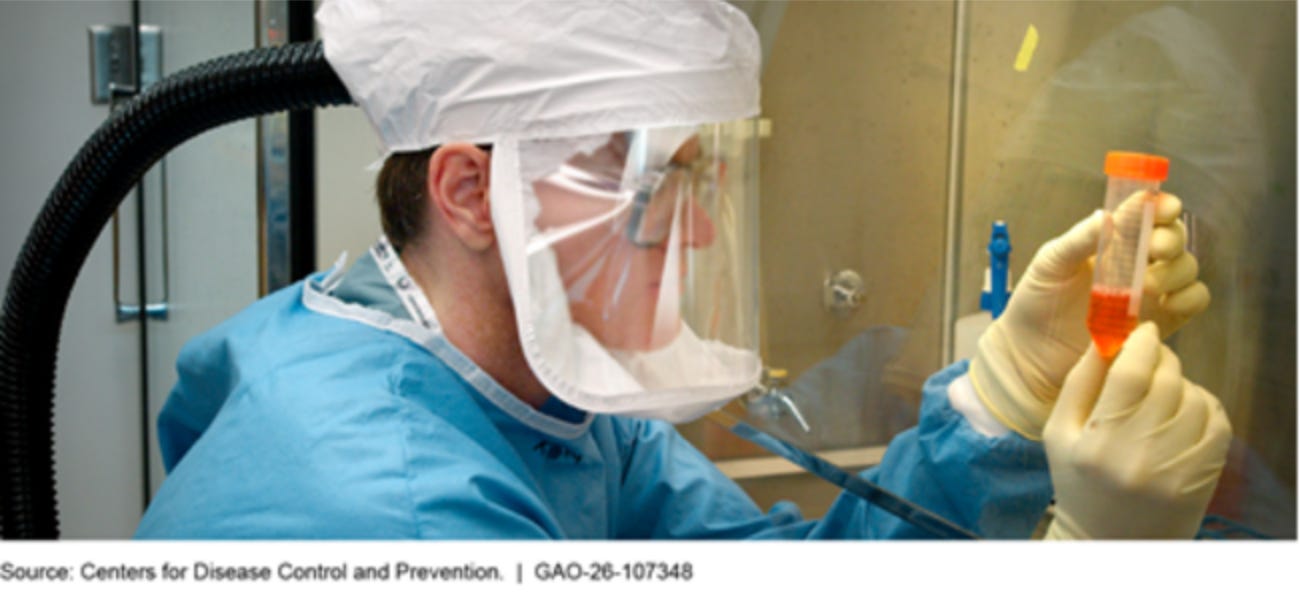
As part of its effort to lead the federal public health and medical response to potential biological threats and emerging infectious diseases, the Department of Health and Human Services (HHS) provides funding for, and conducts research on, pathogens of varying risk level. GAO found that HHS procedures for reviewing research—including research that can be considered gain-of-function research of concern—generally include identifying and assessing the risks of the pathogen and the proposed experiment and assessing the adequacy and appropriateness of proposed risk mitigation strategies. If risks cannot be mitigated, HHS agencies can decide not to fund or conduct the research. However, GAO also found that HHS does not always share key information on these risk reviews with the public. For example, HHS reports to federal stakeholders about the number of research projects involving certain higher risk pathogens and the related risks and associated mitigation measures but does not report more widely. Some HHS officials told GAO they supported sharing general information about their risk reviews with the public. HHS has also reported that transparency helps to ensure public trust in federally funded scientific research. Sharing such information would help provide greater assurance to the public, science community, and Congress that HHS has procedures to manage risks.
Why GAO Did This Study
Recently introduced legislation and executive actions have aimed to restrict or ban federal departments and agencies, like HHS, from conducting or funding gain-of-function research of concern.
GAO was asked to review the outcomes of gain-of-function research of concern and related risk mitigation strategies. This report (1) describes findings from literature and reports that discuss outcomes of gain-of-function research of concern and (2) examines HHS’s procedures for reviewing risk and risk mitigation strategies for research involving pathogens.
GAO identified outcomes of gain-of-function research of concern by reviewing literature and other sources published from 2019 to 2024. GAO reviewed HHS procedures for reviewing risks and risk mitigation strategies and federal policies and guidance for the oversight of higher-risk pathogen research and interviewed HHS officials. GAO also interviewed eight biosafety and biosecurity experts selected because they authored relevant articles and had experience with gain-of-function research of concern.
HHS Response to the GAO Gain of Function Research Report
No additional public HHS response to the February 2026 report has emerged yet, which is not surprising given it was released just two days ago. What we do know is the following:
The only formal HHS response captured in the report itself is that HHS neither agreed nor disagreed with GAO’s recommendation, but stated it would work to improve public transparency about higher-risk pathogen research going forward. This non-committal response is notable and consistent with HHS’s historically cautious posture on this issue.
It’s also worth noting that this is not the first time GAO has raised these concerns with HHS. A 2023 GAO report on a related topic found similar transparency problems, and at that time, HHS’s assistant secretary for legislation stated the department was “committed to ensuring that it carefully reviews, considers, and incorporates guidance to increase transparency.” Despite that commitment, the problems appear to have persisted, which is part of what prompted this latest 2026 report. That pattern suggests some skepticism about whether HHS will act decisively on this newest recommendation without congressional pressure. Given the current political environment around gain-of-function research, it is likely that Congress will continue to scrutinize HHS’s follow-through closely.
Conclusion
The GAO’s review of HHS’s high-risk pathogen research practices reveals a fundamental tension between scientific advancement and public accountability. While gain-of-function research has demonstrably expanded our understanding of how dangerous pathogens behave, its potential to cause catastrophic harm if mishandled is widely acknowledged by biosafety experts. HHS does maintain internal procedures for evaluating and mitigating these risks before approving or funding such research, which suggests that some level of institutional safeguard is in place. However, the absence of consistent public disclosure about the scope and outcomes of these reviews leaves Congress, the scientific community, and the general public without the information needed to independently assess whether those safeguards are adequate.
Transparency is not merely a procedural nicety in this context — it is essential to maintaining public trust in federally funded research, particularly given the ongoing political and scientific debate over gain-of-function research and its potential role in past pandemics. The GAO’s recommendation that HHS regularly publish key details about its risk reviews is a modest but important step toward greater accountability. The fact that HHS neither agreed nor disagreed with the recommendation introduces some uncertainty about whether meaningful change will follow. Nonetheless, the report makes clear that the current gap between what HHS knows internally and what it shares externally is untenable, and that closing that gap should be a priority for both the agency and its congressional overseers.
GOF is what got us into the COVID mess. I don’t see the advantage of manipulating pathogens to infect humans that most likely never would have except for the manipulation. To me this is mad science. Why would we want to try to inflict more infectious diseases on humans? God save us from these lunatics!!
I see zero benefit for GAF research. The pathogens created are not in nature so there’s no reason to create vaccines or therapies for them. We have already lived through the “accidental” release of one of these and it changed the world and not for the good either. Americans lost civil liberties that have been real hard to claw back and even what we got back is nowhere near what we are supposed to be guaranteed before that. Whether it’s HHS or DARPA or DOD there has been a worldwide treaty on chemical weapons which you’d think would include GOF. The conspiracy we are still living with since Covid has been even worse as answers came slower than molasses in winter. We are still unwinding what happened and not one person has been charged or indicted over it. In fact right now Covid investigation is most likely even on the back burner because the nation got riled up over several other issues since and those responsible skate free with millions in their pockets. If we had any accountability about anything in this country over those who are in power and make decisions this sort of thing probably doesn’t happen. Long prison sentences do happen to be a deterrent. Thanks for a report that won’t ever make the MSM at least those that read you are that much more in the loop.