

Executive Summary
America’s chronic disease crisis did not emerge by accident. It was, in part, the predictable consequence of a food system shaped by government policy.
Beginning in the 1970s, federal agricultural programs encouraged the large-scale production of a small number of subsidized commodity crops, particularly corn and soybeans. Those subsidies helped make refined carbohydrates, corn sweeteners, industrial seed oils, and highly processed foods some of the cheapest calories in human history. For fifty years, Americans have been told this was a triumph of efficiency.
This essay argues that the apparent cheapness of modern food is, to a significant extent, an accounting illusion.
Some of the low cost reflect genuine advances in productivity. But much of it reflects costs that have been shifted elsewhere: onto taxpayers through subsidies, onto future generations through the depletion of soil and water resources, and onto society as a whole through the rising burden of obesity, diabetes, cardiovascular disease, and other chronic illnesses.
The result is a system that often appears efficient only because it excludes some of its highest costs from the price tag.
Drawing on Austrian-school economics, this essay argues that the problem is not simply industrial agriculture itself, nor is the solution a new form of centralized planning. The problem is a food economy built on distorted price signals. When prices are manipulated, producers respond rationally, consumers respond rationally, and the resulting outcomes can still be profoundly unhealthy.
The alternative is not a government mandate for local food, regenerative farming, or any other preferred model. The alternative is to restore honest price signals by removing subsidies, enforcing liability for environmental damage, reducing regulatory barriers that favor scale, and expanding transparency so consumers can make informed choices.
The central question is straightforward: if food prices reflected their true costs, including the costs now shifted onto public health, the environment, and taxpayers, would Americans eat the way they do today?
The essay below suggests the answer is no.
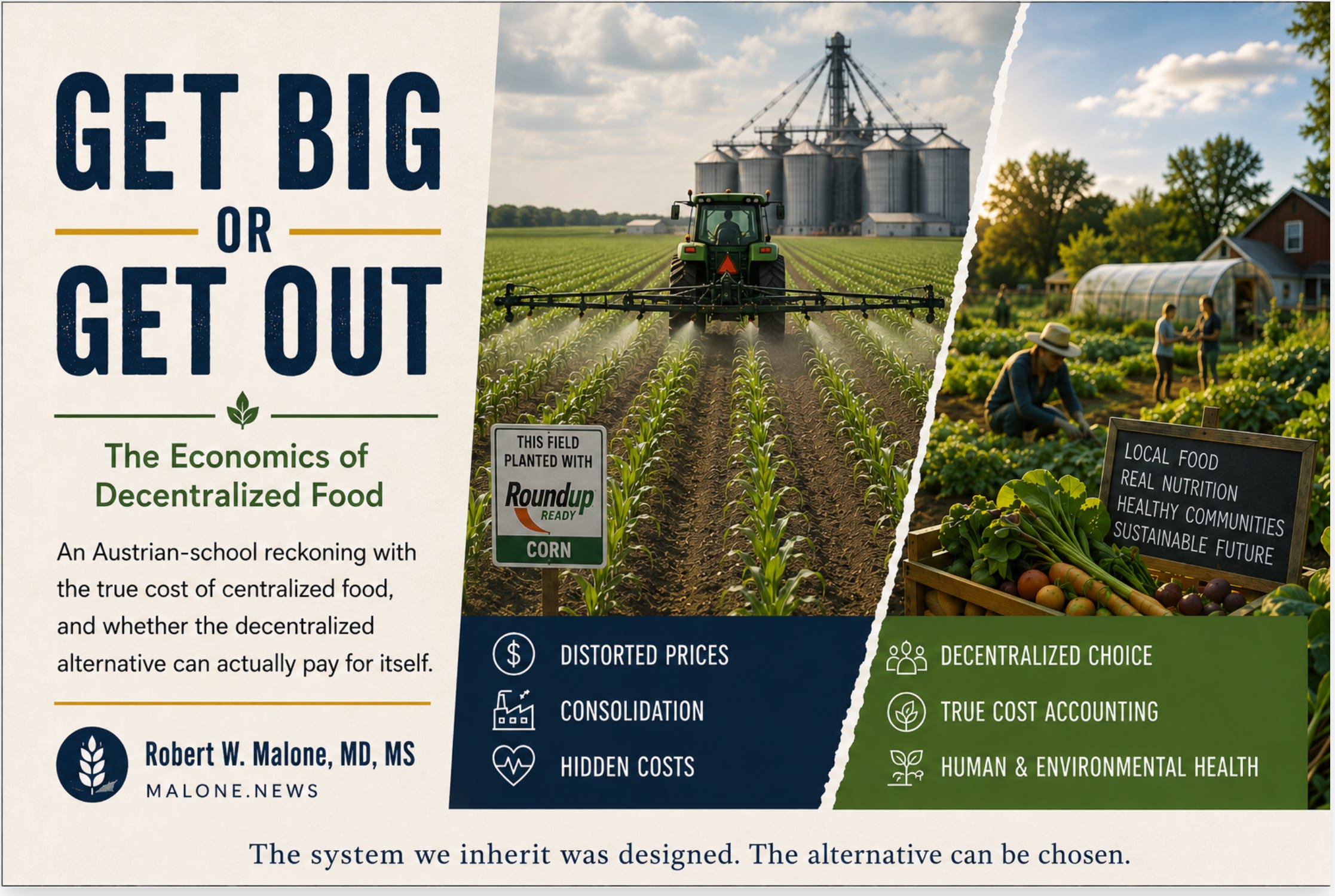
Get Big or Get Out
In 1971, Earl Butz left the board of Ralston Purina to become Secretary of Agriculture, and within a few years, he had rewritten the operating logic of American farming. His advice to farmers was to plant “fencerow to fencerow,” and his counsel to those who could not expand was blunter still: “get big or get out” (1).
The phrase was folksy. The policy behind it was not.
The New Deal programs that had once paid farmers to restrain production were redirected toward maximizing it, and the federal government committed itself to backstopping the price of a short list of storable commodities, corn and soybeans foremost among them. Every operator in the country received the same signal: grow as much of these crops as the land will bear, expand or be absorbed, and the Treasury will cover the difference. Butz, in the end, did not so much replace the New Deal as redirect it toward a different objective.
This was central planning, though it never used the word. It did not nationalize a single acre or impose a Soviet-style output quota. It did something quieter and, judged by the standards of the Austrian school of economic analysis, more corrosive. It reached into the price system and bent it.
The consequences of that distortion reach far beyond the farm gate, and they are the real subject of this essay. The policy did not merely favor large producers over small ones. It helped determine what Americans would eat. By artificially cheapening a narrow band of storable commodities above all else, it cheapened refined carbohydrates, corn-derived sweeteners, and the industrial seed oils and feedlot protein made from the surplus. In doing so, it made the engineered, calorie-dense, nutrient-poor product the rational commercial default for everyone who processes and sells food.
Half a century later, we treat the result as the natural condition of food, a baseline against which any alternative appears expensive and quaint. It is nothing of the kind. It is the downstream effect of specific decisions made by specific people in the 1970s, and the bill for those decisions is now arriving in a form few could predict or bothered to tally at the time: an epidemic of obesity, type 2 diabetes, and the cardiovascular disease that follows. The resulting burden is helping to bankrupt public accounts while sustaining a pharmaceutical and medical complex whose business model is the lifelong management, rather than the cure, of conditions the food system helps create.
To question the food is therefore to question the policy. To question the policy is to reopen assumptions that two generations have been taught to accept without examination. That is the purpose of what follows.
A Central Plan That Did Not Call Itself One
The coalition that produced the Butz settlement was not a free-market coalition, whatever its later defenders have claimed. It joined a mid-century progressive conviction, inherited from the New Deal and amplified by Cold War ambition, that an imperial American state bore a duty to feed the world, with a set of financial and industrial interests that stood to profit from consolidation. Grain traders preferred volume. The implement manufacturers preferred the large operator, who would finance a new combine every few seasons, over the smallholder, who would not.
The banks preferred the collateral of a thousand contiguous acres to the diffuse credit of a hundred mixed farms. The moral language of abundance and the material language of margin pointed in the same direction, toward scale, and the policy followed.
Austrian-school economics holds that economic order emerges from the voluntary decisions of individuals operating through free markets, and that government intervention in prices, money, and production disrupts the price signals that coordinate economic activity.
An Austrian-school economist has no quarrel with bigness as such. Scale that emerges from voluntary exchange and survives the test of profit and loss is simply efficiency made visible, and there is nothing to object to in it. The objection is narrower and more serious: not bigness, but bigness manufactured by subsidy and sustained by distorted prices. In that environment, neither managers, investors, nor policymakers can reliably distinguish genuine productivity from political favoritism, because the market's measuring stick has been bent.
What Austrian-School Economics Claims
Ludwig von Mises established the point a century ago, in his demonstration that, by definition and structure, a socialist commonwealth (including European or Bernie-style “democratic socialism”) cannot calculate true costs (2). Without market prices for the means of production, for the land, labor and machinery that go into making things, the planner has no way to know whether any given use of resources creates wealth or destroys it. Prices are not arbitrary tags. They are the distilled, dispersed knowledge of everyone who has ever bid for or offered a thing, and they are the only instrument by which a society discovers what its scarce resources are actually worth in their competing uses.
The Butz system did not abolish prices. It corrupted a subset of them, which was and is enough to do real damage. When the state alters the effective price of corn through deficiency payments, target prices, and subsidized crop insurance, it does not merely transfer income to corn growers. It falsifies the signal on which every downstream decision depends: the decision of what to plant, where, by what method, for whom. A nation that pours fertilizer onto sixty million acres of one grain does so because the price says to, and the price says to because the state has disconnected that price from the underlying realities of supply, demand, and scarcity.
Friedrich Hayek, the Austrian economist who won the Nobel Prize for his work on markets and knowledge, deepened the argument by locating the relevant knowledge where it actually lives (3). The knowledge that matters in agriculture is overwhelmingly local and tacit: the drainage of a particular field, the frost pocket at the bottom of a particular slope, the rotation that suits a particular soil.
No central authority (or government bureaucracy) can possess this knowledge, and the great virtue of a functioning price system is that it does not need to. It lets those on the ground act on what only they know. Industrial monocropping inverts this. It applies a uniform recipe of purchased inputs across radically heterogeneous land, precisely because the subsidized commodity price has overwhelmed the local signal that would have counseled otherwise.
And beneath both arguments sits the deepest Austrian-school commitment of all, the one most relevant to the healthy-food agenda: consumer sovereignty (4). In an unhampered market, the consumer is the final authority. Production is not an end in itself; it is the servant of consumption, and the entrepreneur who misjudges what consumers want is corrected by loss.
The Butz model severed this link. It set production as the goal and the consumer as an afterthought, to be supplied with whatever abundance the subsidy produced, and then to be sold, through a second industry of marketing (and its cousin, government propaganda), the appetite to consume it.
Where Bigness Genuinely Won
The industrial model achieved real and substantial gains. The division of labor, mechanization, plant breeding, and specialization raised yields to levels that would have astonished a farmer of 1940. The real price of calories fell. The fraction of the American household budget spent on food dropped to one of the lowest levels in human history, and the lowest on earth. Famine, the recurring companion of every prior agricultural civilization, vanished from the developed world. These are not small things, and the romantic localist who waves them away forfeits all credibility.
Productivity and policy are not the same thing, and they should not be confused. Some of the low prices consumers see at the grocery store are the result of genuine improvements in efficiency driven by specialization, technology, and capital investment. Some are the result of government subsidies that reduce market prices without reducing the underlying costs of production. Still others reflect costs that have been shifted elsewhere, onto taxpayers, future generations, rural communities, public health, or the environment.
The key question is how much of the system’s apparent success comes from real wealth creation and how much comes from transfers and deferred liabilities. Genuine efficiency creates wealth. Subsidies redistribute wealth. Unpaid costs represent the consumption of capital that does not appear on a balance sheet. Distinguishing between these categories is essential to understanding the true economics of modern agriculture.
The Unaccounted Ledger
The standard term for this third category is “externality,” but the concept deserves careful treatment. The conventional approach, rooted in the Pigovian tradition, assumes that experts can measure the social cost of an activity, calculate the appropriate corrective tax, and impose it from above.
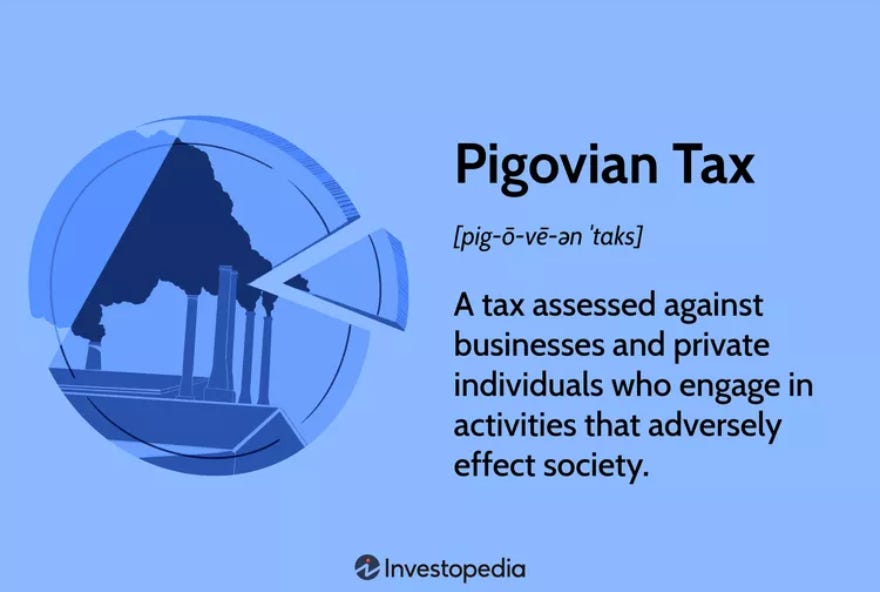
The Austrian school has long challenged this assumption. As Hayek argued, no individual or institution possesses the knowledge necessary to calculate and manage the countless interactions that make up a modern economy. No one can accurately determine the total cost of the industrial food system to society and then engineer the perfect correction through regulation or taxation. The belief that this can be done is itself a form of central planning (5).
The Austrian perspective, particularly as developed by Rothbard, approaches the problem differently (6). These are not market failures that require an all-knowing regulator. They are often failures to define and enforce property rights. When a producer contaminates an aquifer with nitrates, pumps groundwater faster than it can be replenished, or allows agricultural chemicals to enter a neighbor’s well without bearing responsibility for the damage, the cost has not disappeared. It has simply been shifted to someone else who did not consent to bear it.
Under those circumstances, food appears cheaper than it really is. The market price reflects only part of the cost of production, while the remaining costs are imposed on nearby landowners, local communities, taxpayers, or future generations.
From this perspective, the solution is not to empower planners to calculate and impose the “correct” price. The solution is to restore clear property rights and meaningful liability, so that those who cause harm bear the cost of that harm. When costs remain with the party that generates them, prices become more accurate signals of economic reality.
This distinction is important for any serious discussion of food, agriculture, and health. The objective is not to determine what prices should be. It is to remove the distortions, both subsidies and uncompensated harms, so that prices can emerge from voluntary exchange and reflect the true costs of production.
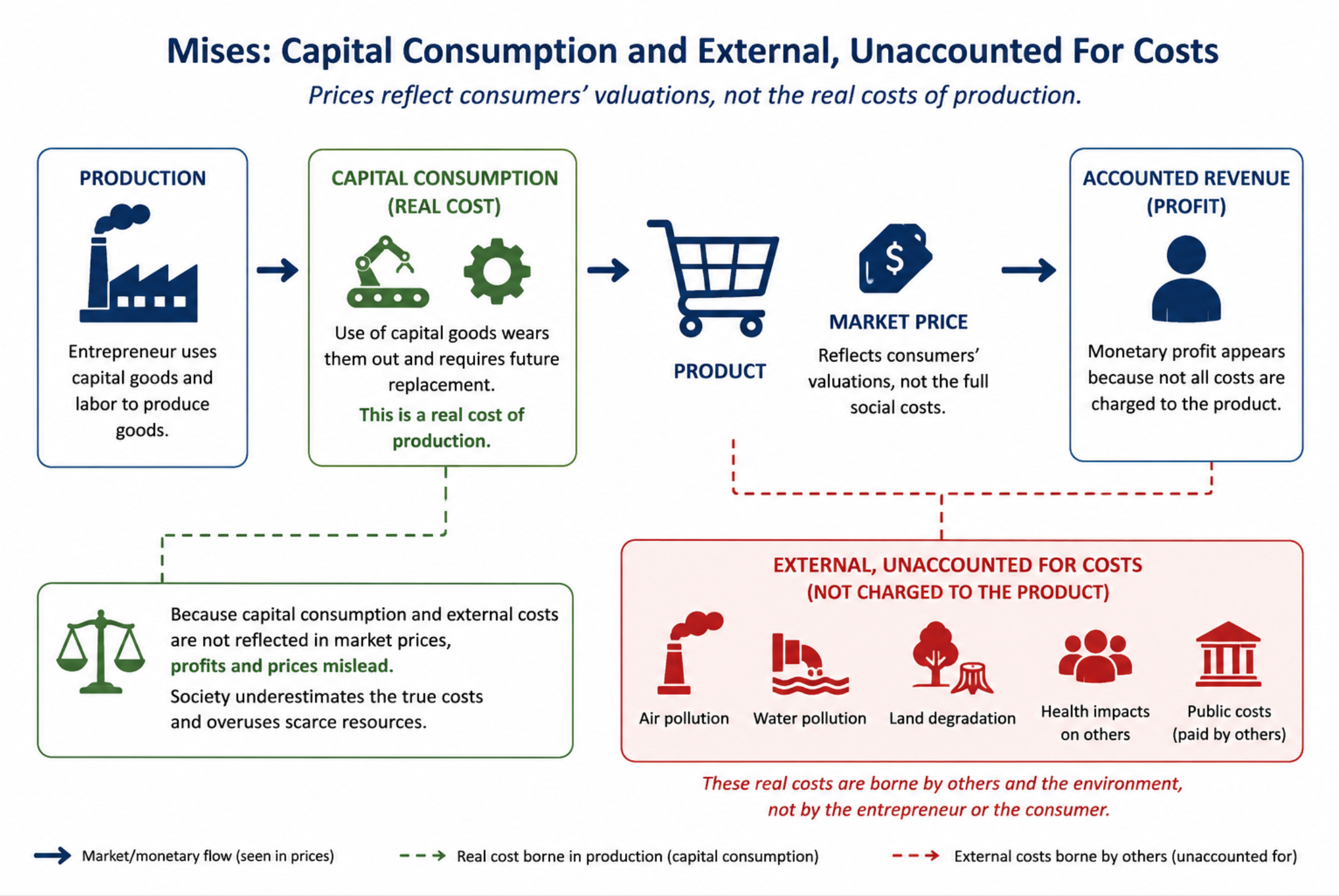
Austrian capital theory helps explain a cost that is often overlooked in discussions of modern agriculture. The industrial farming model frequently treats soil fertility and groundwater reserves as current income when they are actually forms of capital.
Continuous monocropping can reduce organic matter, disrupt soil biology, and deplete mineral reserves over time, replacing natural fertility with purchased fertilizers and other inputs. Likewise, large-scale irrigation in many regions draws groundwater from aquifers faster than natural recharge can replace it. These practices can support high yields and strong financial returns in the short term, but they do so by drawing down productive assets that took decades, centuries, or even millennia to accumulate.
Ludwig von Mises, one of the founders of the Austrian school of economics, described this process as capital consumption and argued that it is one of the most dangerous economic illusions because it creates the appearance of prosperity while the underlying productive assets are being depleted (7). A business can appear profitable while consuming the assets that enable future production. The same principle applies to agriculture. A food system may appear highly productive and efficient while steadily reducing the soil fertility and water resources on which that productivity depends.
The resulting food may be inexpensive at the checkout counter, but the price does not reflect the full cost of replacing depleted groundwater, rebuilding degraded soils, or adapting to the loss of these resources. Those costs remain largely absent from market transactions today, even though they will eventually have to be borne by someone.
Any serious accounting of the economics of food must therefore consider not only annual production and profits, but also whether the underlying stock of natural capital is being maintained, enhanced, or consumed.
The Cost Paid in Bodies
The largest item on the ledger, however, is written neither in soil nor in water. It is written in the health of the people the system feeds. The commodity programs did not make all food cheaper. They made a particular kind of food cheaper: refined carbohydrates, corn-derived sweeteners, industrial seed oils pressed largely from soybeans, and the inexpensive feedlot protein that commodity surpluses helped support. These ingredients became the foundation of the modern processed-food industry.
They also became some of the least expensive calories available. Food manufacturers responded accordingly, building products around the cheapest and most abundant inputs. Over the same half-century, rates of obesity, type 2 diabetes, metabolic syndrome, and other chronic diseases rose dramatically (8). While many factors contributed to these trends, no serious analysis can ignore the role of a food system that consistently made highly processed, calorie-dense foods abundant and inexpensive. The structure of that food system did not emerge by accident. It was shaped by policy.
This is where the Austrian distinction between internal and external costs becomes important. Part of the cost is borne by the individual consumer, and a free society must preserve individuals' right to make their own choices, including poor ones. But several factors complicate that simple picture.
First, the price signals consumers receive have been influenced by decades of subsidies that favored certain commodities and the products made from them. Second, many of the long-term health consequences of diet are difficult for consumers to evaluate in real time. The effects often emerge only after years or decades. Third, and most important economically, the costs of chronic disease are not borne solely by the individual. Through Medicare, Medicaid, public programs, employer-sponsored insurance, and pooled risk, a substantial portion of those costs is distributed across society.
As a result, the apparent affordability of many foods reflects only the price paid at the checkout counter. The downstream costs appear elsewhere in the economy, particularly in the healthcare system.
The distortion extends beyond agriculture. Price signals influence where capital, research, and entrepreneurial effort are directed. Over the past several decades, a vast medical and pharmaceutical infrastructure has emerged to manage chronic diseases associated with obesity, diabetes, cardiovascular disease, and related metabolic disorders. The incentives of that system naturally favor the ongoing treatment of disease, because treatment generates continuing demand for products and services.
This is not a conspiracy. It is how markets respond to the incentives they face. Public policy helped make calorie-dense, highly processed foods inexpensive and abundant. Public health programs then assumed much of the cost of treating the resulting disease burden. Taxpayers support both ends of the system: first through agricultural programs and again through healthcare spending. The result is a large-scale misallocation of resources that becomes visible only when the entire chain of costs is considered together.
The Myth of Cheap Food
So much for the indictment. The harder question, and the one the healthy-food movement must answer if it hopes to be more than a critique, is whether a more decentralized, local, and diversified food system can actually work at scale, and at what cost. The case is stronger in some areas than others, but it is strongest where the hidden costs of the current system are greatest.
The advantages are several. First, for perishable, high-value foods such as produce, dairy, meat, and eggs, shorter supply chains reduce spoilage, handling, refrigeration, and transportation costs. A tomato grown forty miles away generally requires fewer resources than one shipped across the continent.
Second, diversified farms can often substitute management and biological processes for purchased inputs. Crop rotation, cover crops, integrated livestock, and other regenerative practices can rebuild soil fertility while reducing dependence on fertilizers, pesticides, and other petrochemical inputs.
Third, local producers can apply local knowledge. As Hayek observed, knowledge is dispersed. Farmers who understand their own soils, climate, water resources, and markets can often make decisions that no centralized system can replicate efficiently.
Finally, diversified local agriculture tends to produce the nutrient-dense foods that support health rather than the commodity surpluses that become sweeteners, industrial seed oils, and highly processed foods. The distinction matters because the health costs associated with those products are among the largest hidden costs in the current system.
One common argument for local food should be rejected because it rests on the same error this essay has criticized throughout. The claim that local food is inherently superior because it travels fewer miles elevates a single measurable variable into a proxy for total cost. Transportation is only a small portion of the resources embodied in most foods, roughly a tenth by conventional accounting.9 That fact is often used to dismiss local food, but it points to a broader lesson. Transportation miles, carbon footprints, and energy audits each measure only a fraction of the picture. None captures the full cost of production.
The larger costs are often the hardest to measure: depleted soil, contaminated water, lost biodiversity, and the long-term health consequences of poor nutrition. No single metric can accurately account for all of them. The true cost of food is not something planners calculate in advance. It emerges only when prices are allowed to reflect the real costs of production rather than subsidies and cost-shifting.
The strongest objection to decentralization is that it often costs more, particularly for storable commodity crops. Large operations benefit from real economies of scale in equipment, processing, transportation, and regulatory compliance. A combine, grain elevator, slaughterhouse, or pasteurization facility becomes more efficient as output increases.
Those efficiencies are real. The question is whether the prices they produce reflect the full cost of production. Throughout this essay, the argument has been that they often do not. Some costs are shifted to the land through soil depletion and groundwater extraction. Others are shifted to watersheds through runoff and contamination. Still others are shifted to the healthcare system through diet-related chronic disease.
When those costs are excluded, industrial food appears inexpensive. When they are included, the calculation changes substantially. The apparent advantage of many commodity-derived foods depends in part on costs that are paid elsewhere and later.
This leads to a more realistic view of the alternative. The goal is not to replace every large farm with a farmers’ market or to produce every calorie locally. Staple grains will continue to be grown, processed, and stored at scale. The question is whether the current corn-and-soy commodity system deserves the privileged position it occupies today.
That system’s apparent advantage rests heavily on subsidies, cost shifting, and a pricing structure that does not fully reflect its environmental and health consequences. By contrast, decentralized and diversified agriculture is particularly well suited to producing the nutrient-dense foods that form the foundation of a healthy diet. Its potential market is therefore as large as the share of the national diet that consumers choose to move away from highly processed, commodity-derived foods.
The central question is whether that alternative can compete when the comparison is made honestly and the policy distortions are removed. There is good reason to believe it can. The next question is how such a transition might occur.
Demand, Not Decree
The healthy-food movement could make a serious mistake by responding to one centralized system with another. Replacing the Butz model with a new set of mandates, subsidies, and politically favored industries would not solve the underlying problem. It would simply substitute one distortion for another.
The flaw in the current system is not that the wrong people are making the decisions. The flaw is that decisions are being driven by political incentives rather than consumer demand and market signals. Subsidies for favored forms of agriculture distort prices just as surely as subsidies for commodity crops. They invite lobbying, regulatory capture, and the diversion of resources toward whatever qualifies for government support rather than what consumers actually want.
The alternative is to restore the forces that the current system suppresses: consumer choice and entrepreneurial competition.
The economist Israel Kirzner described markets as discovery processes. Entrepreneurs identify opportunities that planners cannot anticipate, test them in the marketplace, and succeed or fail according to whether consumers value what they provide. That process is already visible in regenerative agriculture, direct-to-consumer food sales, community-supported agriculture, and the growth of regional processing. None of these developments emerged from a national plan. They emerged because consumers increasingly want food that is healthier, more transparent, and more trustworthy.
The role of policy should therefore be limited and structural. The objective is not to direct outcomes but to remove distortions that prevent consumers and producers from responding to one another.
Four reforms stand out.
First, stop subsidizing the products policymakers claim they want less of. Commodity programs that favor monocropped corn and soy sit at the center of the current system. Removing those subsidies does not require new mandates or new bureaucracies. It simply allows relative prices to reflect actual demand rather than government preference.
Second, restore regulatory parity. Much of the apparent inefficiency of small-scale agriculture is the product of regulatory structures that impose high fixed compliance costs regardless of scale. Requirements that are manageable for a multinational processor can be prohibitive for a local producer. The result is an artificial advantage for large firms. Reforms such as the PRIME Act, which would allow states greater authority over local meat processing for local markets, are not subsidies or special favors. They remove barriers that disproportionately burden smaller operations.11
Third, restore liability. Producers who contaminate groundwater, degrade neighboring property, or impose measurable environmental harm should bear the cost of those actions. This is not a new principle. It is one of the oldest functions of property law. While legislative reform is often slow and politically constrained, courts already possess the tools to adjudicate claims involving nuisance, trespass, and demonstrable harm. When damages are assigned to those responsible, costs that are currently shifted onto others begin to reappear where they belong: in the price of production.
Fourth, improve transparency through private certification, labeling, and reputation. Food is a classic example of a product whose most important qualities are difficult for consumers to verify directly. Consumers cannot easily determine how food was produced or what its long-term health consequences may be. The answer is not a government definition of what constitutes “healthy” food. The answer is a competitive marketplace of certification systems, trusted brands, independent testing, and transparent labeling that allows consumers to make informed choices.
Taken together, these reforms share a common characteristic. None requires Washington to design the food system it prefers. None requires new national mandates. None depends on government planners determining the correct diet, the correct farming method, or the correct price.
They simply remove distortions and allow consumers, producers, and entrepreneurs to discover the answers for themselves.
Conclusion
What is at stake is not a preference for farmers’ markets or a nostalgic vision of rural life. It is the burden of chronic disease and the enormous public expense that follows from it. Obesity, type 2 diabetes, cardiovascular disease, and related metabolic disorders have become defining features of modern American health. No healthcare system can solve those problems if the foods most associated with them remain among the cheapest and most heavily promoted options available. The question of whether a different food economy can sustain itself is therefore also the question of whether the nation can stop paying for the consequences of the current one.
A more decentralized food system is economically viable, but its ultimate scope should be determined by honest prices rather than government policy. Commodity agriculture may continue to play an important role, particularly for certain grains and storage crops. What is far less clear is how much of the current system would survive in its present form if subsidies were removed, environmental costs were borne by those who create them, and the health consequences of commodity-derived foods were fully accounted for. Under those conditions, decentralized and diversified agriculture would compete on a far more level field than it does today.
Whether that opportunity can be fully realized depends on correcting distortions that result from policy rather than from market competition. Remove commodity subsidies, and industrial products lose an artificial advantage. Restore liability for damage to soil and water, and costs that are currently shifted to others return to the producer responsible for them. Achieve regulatory parity, and smaller producers can compete on their merits rather than on their ability to absorb compliance costs. Expand transparency and consumers gain the information needed to make informed choices.
Under those conditions, decentralized agriculture requires no special protection, no new subsidy, and no central plan. It will expand only to the extent that consumers value what it produces and are willing to pay for it. That is exactly how a market is supposed to work.
This is where Austrian-school economics and the healthy-food movement either align or diverge. The goal cannot be to achieve a government-defined percentage of local food production or to replace one agricultural plan with another. The goal is simpler and more durable: prices should reflect actual costs, and consumers should be free to choose among competing alternatives.
If food prices reflected the full costs of production, including the costs now shifted to taxpayers, ecosystems, and future healthcare spending, the American food economy would look very different. The resulting system would not be healthier because policymakers designed it to be. It would be healthier because consumers, responding to honest prices and accurate information, chose it for themselves.
References
Earl L. Butz served as Secretary of Agriculture from 1971 to 1976. His exhortations to plant “fencerow to fencerow” and to “get big or get out” are widely associated with his tenure and with the production-maximizing policy turn it represented.
Ludwig von Mises, “Economic Calculation in the Socialist Commonwealth” (1920); the argument is developed at length in Human Action (1949).
Friedrich A. Hayek, “The Use of Knowledge in Society,” American Economic Review 35, no. 4 (1945).
On consumer sovereignty as the organizing principle of the market, see Mises, Human Action, on the market as a process directed by consumers through profit and loss.
Friedrich A. Hayek, “The Pretence of Knowledge,” Nobel Memorial Prize lecture (1974); see also The Fatal Conceit: The Errors of Socialism (1988).
Murray N. Rothbard, “Law, Property Rights, and Air Pollution,” Cato Journal 2, no. 1 (1982).
Mises, Human Action, on capital consumption: the liquidation of capital mistaken for income, which resembles prosperity for as long as the stock lasts.
The sustained rise in American adult and childhood obesity and in type 2 diabetes prevalence dates from the late 1970s onward, the period following the commodity-policy shift and the rapid substitution of corn-derived sweeteners and refined, ultra-processed foods into the American diet. The relative causal weight of diet remains debated in particulars, but the association between the cheapened commodity diet and metabolic disease is extensively documented. Confirm specific prevalence and cost figures against current CDC and USDA sources before publication.
Christopher L. Weber and H. Scott Matthews, “Food-Miles and the Relative Climate Impacts of Food Choices in the United States,” Environmental Science & Technology 42, no. 10 (2008). The study attributes roughly 11 percent of household food greenhouse-gas emissions to transportation and about 4 percent to final delivery, with the method of production dominating the remainder. Verify the exact figures against the source before publication.
Israel M. Kirzner, Competition and Entrepreneurship (University of Chicago Press, 1973).
The FDA Food Safety Modernization Act (2011); on local meat processing, the proposed PRIME Act (Processing Revival and Intrastate Meat Exemption Act).
“Homesteading for Health” is available for pre-order, and this includes the audio version!
Will I ever trust the federal government again to do what's in the best interests of Americans and American ag? Yeah, when Pigovians fly.
Getting big is not beautiful! It is a method of dominating a market segment and maximizing profitability at the expense of the buyer. Eliminating competition that improves the welfare of the citizens does not happen when monopolies exist. Examples abound in the US economy.