

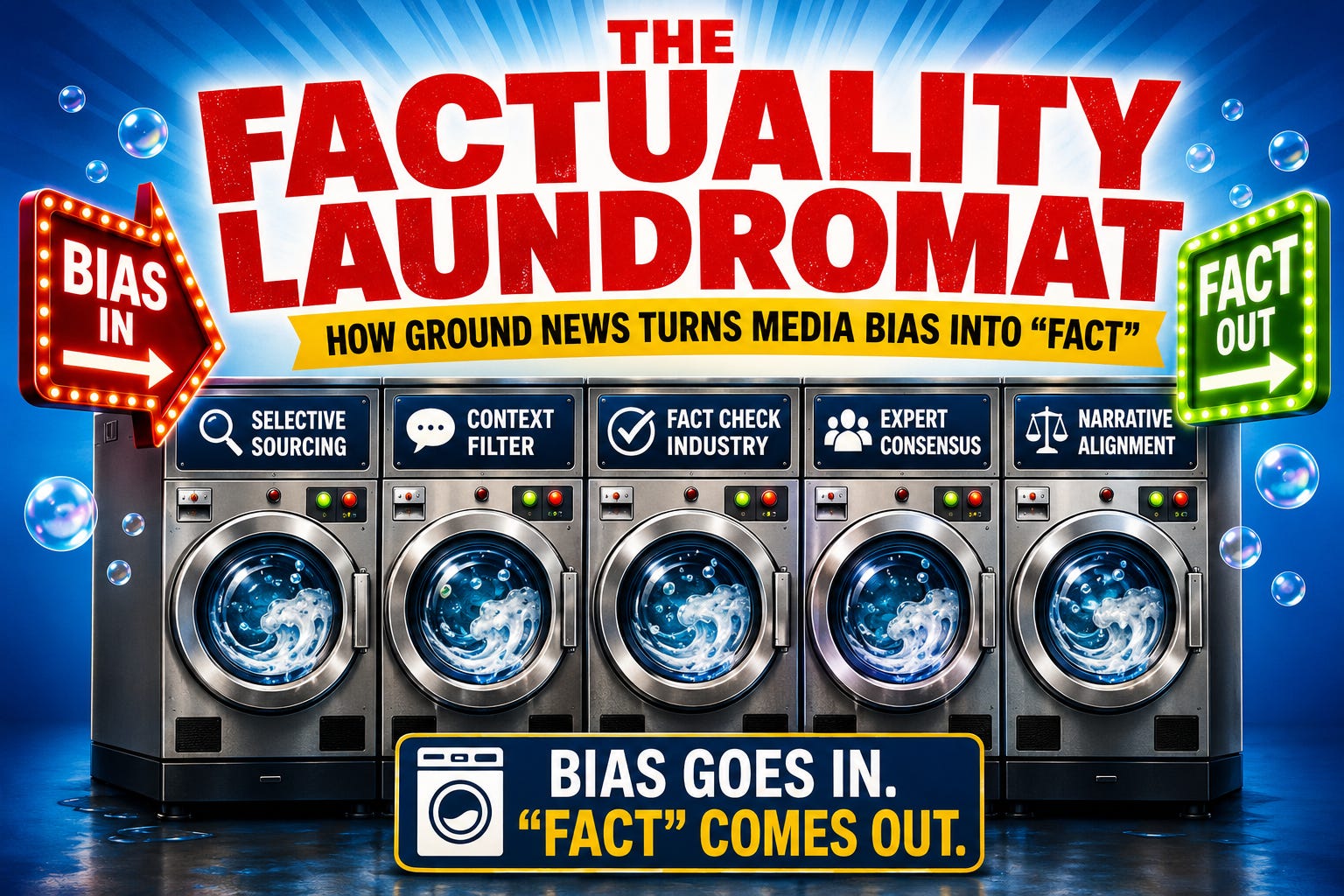
There is a relatively new player in the news business that I have been watching with considerable interest. Ground News was founded in 2018 by former NASA engineer Harleen Kaur and Sukh Singh around what, on its face, is an excellent idea: stop allowing an algorithm to decide which version of the news you are permitted to see.
That is a much bigger problem than most people realize. Google News presents itself as an aggregator, but aggregation is itself an editorial act. Someone, or more accurately an algorithm designed and tuned by someone, determines which publications appear at the top of the page, and which are buried twenty stories down, and which effectively disappear. An analysis released by AllSides found that 73 percent of the articles appearing on Google News in its 2025 audit came from publications it classified as being on the political Left. Just 1 percent came from the Right. Apple News was somewhat better, but hardly balanced: 50 percent from the Left and 2 percent from the Right. Yahoo is just as bad.
The old newspaper editor deciding what belonged above the fold has largely been replaced by an algorithm deciding what belongs on your screen. The technology changed. The gatekeeping did not - in fact, it became much, much worse and more homogeneous across billions of Google, Apple, and Yahoo accounts.
We learned how consequential that gatekeeping could become during COVID. Anyone who seriously challenged the official pandemic response, the vaccines or vaccine mandates risked being branded a purveyor of “misinformation.” The mainstream press overwhelmingly participated in that process, while conservative and independent media were far more willing to publish dissenting views. Google News and Apple News then aggregated an information ecosystem already heavily weighted toward one side of that debate, magnifying the effect.
We experienced this personally.
Robert was repeatedly attacked in the mainstream press for his role in the development of mRNA vaccine technology. The dispute was not some unknowable question of opinion. There are patents, patent disclosures, contemporaneous laboratory records, publications and primary-source documents. Yet major publications repeatedly framed him as falsely claiming to have invented mRNA vaccine technology.
The New York Times sent a reporter to our farm for two days. We offered primary documentation concerning Robert’s work, which she refused to review. The resulting article nevertheless became another vehicle for attacking his credibility and disputing his role in the technology. Similar treatments appeared in The Atlantic and the Washington Post. Those articles then became sources for subsequent articles, fact checks, and Wikipedia entries. The secondary reporting gradually displaced the primary historical record.
That experience matters because it demonstrates something fundamental about the modern information system. Once a major publication establishes a characterization, other publications cite it. Fact checkers cite those publications. Wikipedia cites the fact-checkers and publications. Search engines elevate the resulting pages. Eventually the sheer number of citations creates the appearance of independent corroboration, although much of the information may ultimately trace back to the same handful of original false or misleading claims.
During COVID, this problem became institutionalized. A network of government agencies, public-health officials, academic “misinformation” researchers, NGOs and social-media companies developed specifically to identify, track and counter claims about COVID and the vaccines.
One of the most important was Stanford's Virality Project, which brought together the Stanford Internet Observatory and other organizations to monitor vaccine narratives in real time and exchange information with public-health officials, government agencies and social-media platforms.
The CDC simultaneously published guidance for identifying and countering vaccine “misinformation,” while the Virality Project openly recommended greater government coordination and public-private collaboration with the social-media companies. The fundamental problem was that this machinery was operating while the science itself was still evolving. Questions about vaccine efficacy, transmission, natural immunity, adverse events, and mandates could therefore be classified as “misinformation” according to the official consensus of the moment, even when some of those questioning approved narratives were subsequently vindicated, or the topics proved far more complicated than officials had acknowledged.
The government did not need to establish an official Ministry of Truth. It already had something uncomfortably close to one in CISA, the Cybersecurity and Infrastructure Security Agency. During the COVID era, the federal government developed an extensive system for monitoring what it called misinformation and disinformation, communicating with social-media companies and working alongside academic and nonprofit organizations engaged in the same mission. CISA became an important part of that broader government-private information-control infrastructure, while the Virality Project and others monitored vaccine narratives and maintained relationships with government agencies and technology platforms. The result was an extraordinary arrangement: government officials could identify information they considered false or misleading, outside organizations could track and flag it, and private technology companies could suppress, label or remove it. No formal Orwellian Ministry of Truth was required. Much of the machinery already existed, distributed across government agencies, universities, NGOs and Silicon Valley, with CISA sitting inside that ecosystem.
After COVID-19, the fact-checking infrastructure did not disappear. It simply morphed again. What had begun, in part, as an apparatus designed to detect foreign election interference expanded into policing domestic election “misinformation,” then COVID and vaccine “disinformation,” and has now become institutionalized within the broader information ecosystem, including news aggregators and media-rating systems. The emergency may have ended, but the machinery built to police information during the emergency remains. In some ways, these organizations have become empty vessels waiting to be filled by the next national or global crisis, when government once again declares an urgent need to control “misinformation” for the public good. The subject changes. The infrastructure remains.
But there is the fact-checking issue and, of course, the bias of big aggregators toward publishing only stories from the left on their front pages. Effectively eliminating conservative voices.
Ground News appears, at first, to offer an ingenious solution to precisely this problem. Instead of hiding the political orientation of the sources it aggregates, Ground makes that information part of the product. It groups reporting on the same event and shows readers how publications on the Left, Right, and Center cover it. Its “Blindspot” feature identifies stories receiving extensive coverage on one side of the political spectrum while being largely ignored by the other. Instead of pretending editorial bias doesn’t exist, Ground News exposes it and lets readers make their own judgments.
The idea has caught on. Ground News says it now processes nearly 60,000 articles every day from more than 50,000 news sources worldwide. Its Android app alone has been downloaded more than a million times. It offers browser extensions, newsletters, and paid subscription products, and has established itself as a serious alternative to Google News, Apple News, and other major aggregators.
There is much to like about its philosophy. Ground News says its mission is to help readers “break free from algorithms,” escape political echo chambers and discover reporting they otherwise might never encounter. The company is not owned by Google or a legacy media conglomerate. It says it is primarily supported by subscribers and a small group of individual investors. Its slogan is “See every side of every news story.”
That is precisely why I started using it.
For the basic purpose of seeing how different parts of the political spectrum cover the same event, I still think it is an excellent concept. If the New York Times, CNN, and Washington Post are describing an event one way while Fox, the Daily Wire, and Washington Examiner are describing it another, I want to see both. More importantly, if one side of the media ecosystem has collectively decided that a story is not worth covering at all, I want to know that too.
But Ground News has incorporated something very different into this otherwise admirable attempt at transparency.
Ground News tells its readers which news sources are factual.
A couple of examples to illustrate the point:

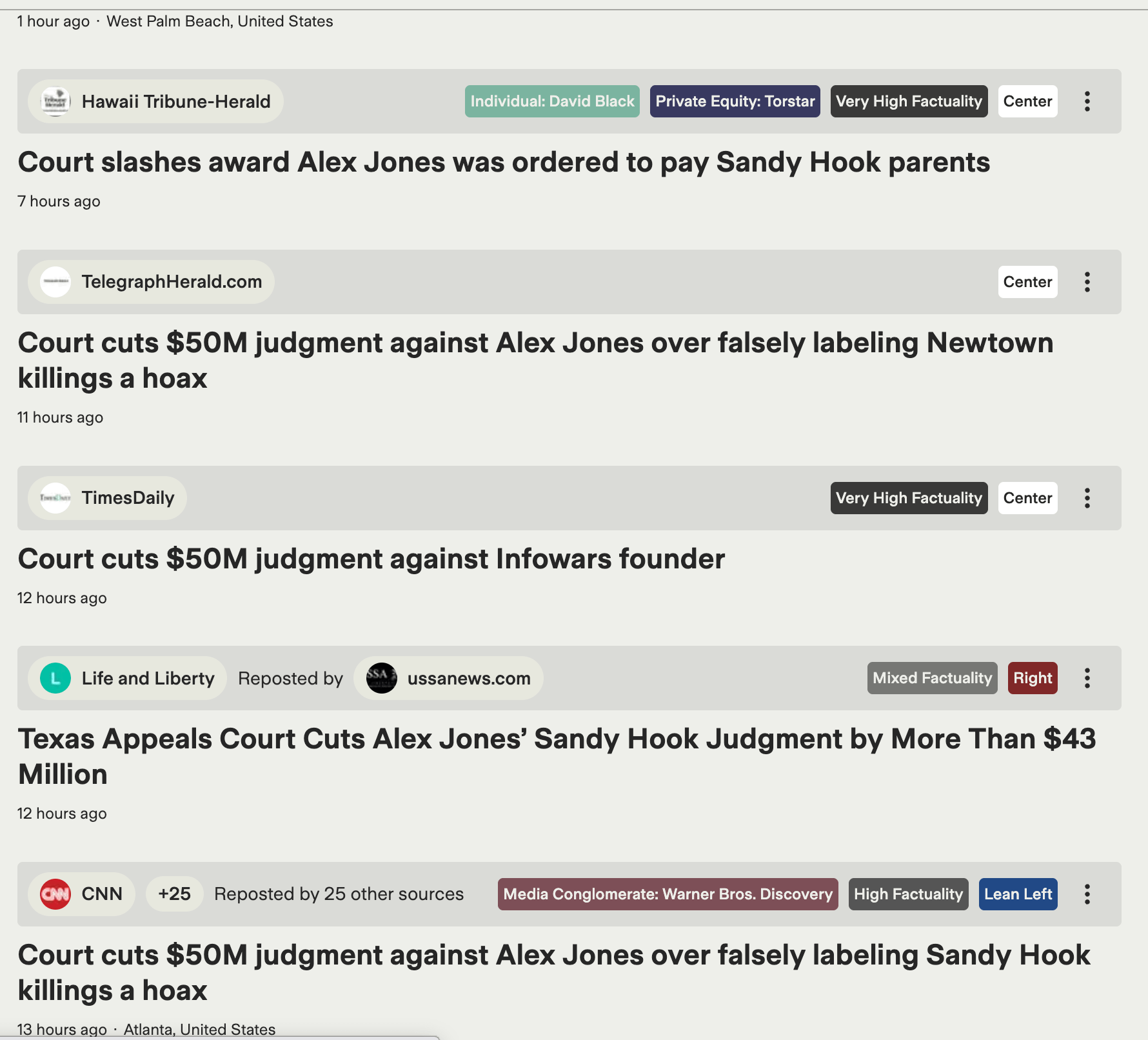
Alongside political bias, Ground News displays what it calls a “Factuality” rating. Publications are classified as Very High, High, Mixed, Low or Very Low factuality. Presented alongside news coverage, the obvious implication is that this tells readers something about the story's factual reliability.
It does not.
In its ratings of factuality, Ground News has not determined whether the article in front of you is factual. It has not checked the sources in that article. It has not verified the quotations, examined the primary documents, checked the statistics, or determined whether the headline accurately represents the evidence.
If you dig deep into their Ground News Methodology page, which doesn’t come up automatically in their news section, they acknowledge this explicitly in their own methodology:
“Scores apply to each publication as a whole, not to their individual articles.”
This changes the meaning of the rating. It is not a rating of the individual news story, but of the outlet itself
A publication-level reputation score and an article-level determination of factual accuracy are two entirely different things. Yet the publication-wide judgment is displayed alongside individual stories under the extraordinarily authoritative label “Factuality.” Most readers would think that the actual article had been fact-checked, but it has not.
Ground News has therefore solved one form of media bias while importing another directly into the solution. This is disingenuous at best.
Worse, Ground News doesn’t actually make these factuality determinations itself. The rating is derived from outside media-rating organizations, principally Ad Fontes Media and Media Bias/Fact Check. Ground’s own FAQ states that its staff does not participate in evaluating the Bias or Factuality ratings. It outsources those judgments and then incorporates them into the product.
That would be less troubling if the outside ratings were objective measurements of whether publications publish true information.
They aren’t.
The problem becomes clearer when we look at what these organizations actually measure. Neither Ad Fontes nor Media Bias/Fact Check restricts itself to determining whether statements published by a news organization are factually true. Ad Fontes incorporates such things as language, headlines, expression, context, the distinction between opinion and straight reporting, and comparison with coverage from other news organizations. Media Bias/Fact Check incorporates sourcing, omissions, one-sidedness, adherence to what it considers established scientific evidence, and the judgments of outside fact-checking organizations. These may all be legitimate subjects for media criticism, but they are not synonymous with factual accuracy.
More troubling is what happens when those methodologies are applied across the political spectrum. We took a preliminary sample of prominent left- and right-leaning publications and compared their current Ad Fontes reliability ratings using ChatGPT. The results were remarkably consistent. The left-wing publications in our sample averaged 35.54 for reliability, while the conservative publications averaged 30.74, a difference of nearly five points.
One obvious explanation might be that we simply selected more extreme publications on the Right. But according to Ad Fontes’ own political-bias scores, the opposite was true. The left-wing publications in our sample averaged 12.84 points from the political center, compared with 12.37 points for the conservative publications. In other words, the two groups were almost identically ideological by Ad Fontes’ own measurement, with the Left actually slightly farther from center.
Some individual comparisons are even more revealing:
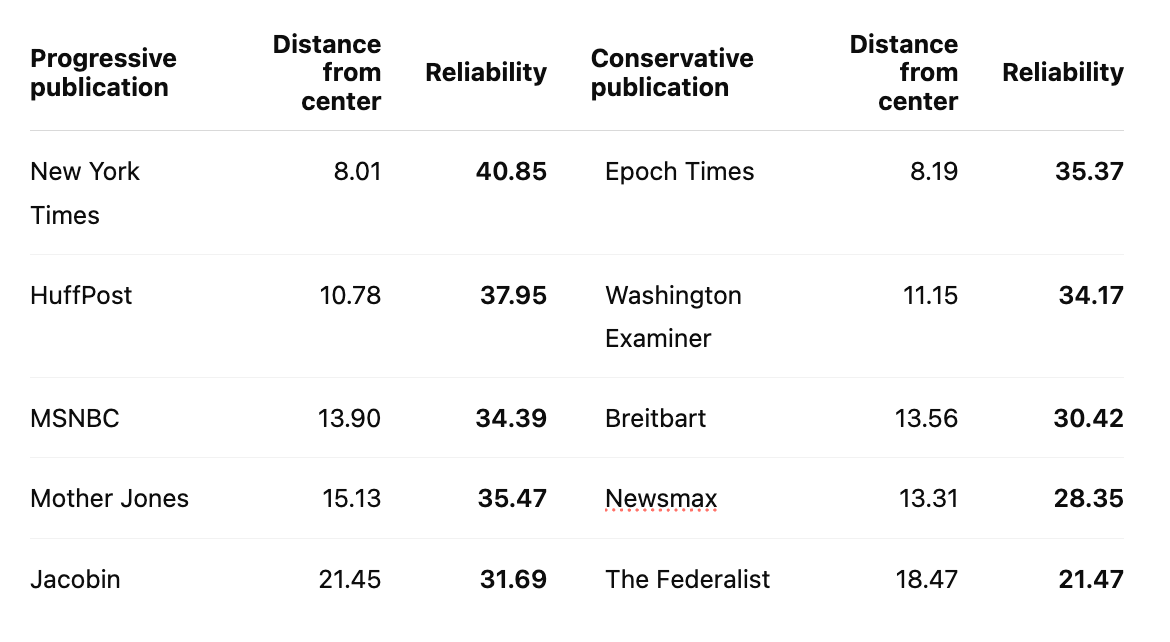
The last comparison is particularly difficult to explain as a simple consequence of political extremity. Ad Fontes considers Jacobin farther to the Left than The Federalist is to the Right, yet Jacobin receives a reliability score more than 10 points higher.
We then tested the entire sample statistically rather than relying upon individual examples. After controlling for each publication’s absolute ideological distance from the political center, right-leaning publications were associated with an approximately 5.2-point lower Ad Fontes reliability score in this sample. The result was statistically significant. We can’t prove that Ad Fontes deliberately discriminates against conservative media, but it sure looks that way. And it does establish that the disparity exists in the publications we examined and cannot be explained simply by the conservative outlets being more ideologically extreme.
Media Bias/Fact Check showed the same general pattern in our smaller comparison. Five prominent left-wing publications averaged 2.72 on its factuality scale, while five conservative publications averaged 5.50 (a higher score showing lower factuality). On the MBFC scale, lower scores indicate greater factual reliability, so once again the conservative publications received substantially worse ratings.
That matters enormously when Ground News takes these publication-wide assessments on individual news stories and presents the resulting classification to readers as “Factuality.” Ground News is not beginning with a politically neutral measurement of whether the article in front of you is true. It is importing a rating system that incorporates subjective judgments extending far beyond factual accuracy and which, in our preliminary examination, produces substantially different outcomes for comparable publications on the political Left and Right.
The result is a Factuality system tilted against conservative media before Ground News ever displays the first article. Ground News imports that bias, converts it into a simple label for individual news stories, and presents the result to readers as an objective measure of factual reliability.
Consequently, Ground News takes those publication-level judgments and attaches their consequences to individual journalism.
An article published by a conservative outlet can be completely accurate and rigorously sourced. Every quotation can be correct. Every statistic can be sourced. It can link directly to government documents, court records, or scientific papers. Nobody at Ground News needs to find a single factual error in it.
The reader can still encounter that story beneath the designation “Low Factuality.” The judgment is without evidence.
This is where the system begins to resemble what Nancy Pelosi once famously described as the “wrap-up smear.” The traditional version is straightforward. An allegation is introduced, usually in an unheard-of outlet, and often it is a “pay-for-play” hit piece - say, by the opposing politician, super PAC, or an industry under scrutiny. The press reports the allegation. Another newspaper republishes the allegation, citing the more recent news outlet as the source. Again, this can be a “pay-for-play” strategy. Then the existence of the press coverage is cited as evidence that the original allegation must have substance. The accusation is laundered through various news sources and eventually is determined by mainstream media to be “fact” - without any additional evidence whatsoever, just an accusation by some small-time media outlet. Finally, the newly minted “fact” makes its way to the AI Overview that Google now places above traditional search results and to Wikipedia.
We have experienced that process firsthand as well.
On a single podcast in the year 2022 or thereabouts, Robert discussed evidence suggesting that, in rare cases, mRNA COVID-19 vaccination could be associated with an acquired immune deficiency or immunosuppressive syndrome. The distinction is fundamental. Acquired immune deficiency describes a condition. It does not mean HIV infection or HIV-associated AIDS. Robert’s scientific training included early work in laboratories studying retroviruses and immunodeficiency during the period when AIDS itself was first being characterized. This was not an obscure distinction for him.
But the distinction rapidly disappeared in the retelling. His comments were transformed into the far more sensational claim that “Robert Malone says the COVID vaccine causes AIDS,” carrying the obvious implication of HIV/AIDS. That characterization moved from publication to publication, with later accounts citing earlier accounts until the media’s description of what Robert had supposedly said became more authoritative than what he actually said.
Eventually it arrived at Wikipedia, where Robert is described as having claimed that COVID vaccines were “causing a form of AIDS,” supported by citations to secondary reporting, not the original podcast (long gone from social media). It is a documented fact that these products are associated with immunoglobulin class switching, which represents a form of acquired immunodeficiency. The reporting establishes the characterization, and that characterization is then cited as evidence that it is true. The implication of this in his permanent record on Wiki either makes him look like a fool or a fraud, neither of which is true.
That is the wrap-up smear in action.
Ground News is now industrializing the wrap-up smear.
Ground News is now industrializing the wrap-up smear. Conservative news organizations are repeatedly downgraded by fact checkers and media-rating companies until being conservative itself becomes associated with being less factual. Ground News then imports that biased reputational judgment and places it next to every article it publishes.
The wrong publication is all that it takes to get a low factuality score on an article. And that low factuality can be based on whether a news organization is conservative. How f*cked up is that?
This produces an extraordinary paradox. Ground News was created, in part, to free readers from an information ecosystem in which algorithms and establishment media organizations decide which sources they should see. Yet its Factuality system allows outside fact-checking organizations, known to be statistically biased against conservative media outlets, to prejudge which of those newly visible sources readers should trust.
That distinction becomes particularly consequential since conservative publications systematically begin with lower reputational scores. Ground News may display more conservative journalism than Google News, while simultaneously presenting that journalism beneath warning labels that tell readers the publications producing it are less factual.
The consequence is that when a narrative written from a conservative or libertarian point of view has finally made it into at least one major aggregator, the Ground News organization has already told the reader how much to trust it before the reader has examined a single piece of evidence. That isn’t an assessment of the factuality of journalism. It is an assessment (made by biased sources) of the reputation of the journalist’s publisher.
Ground News is perfectly entitled to provide such ratings. Readers may even find them useful. But they should be labeled accurately. Call them Publisher Reputation, Source Reliability, or Third-Party Media Outlet Rating.
Do not imply that these ratings reflect the factuality of the news in front of the reader. Because Ground News itself acknowledges in the fine print that it has made no such determination.
Deceitful is a strong word, but if the shoe fits…
JGM/RWM
Independent journalism matters precisely because the institutions that once decided what you were allowed to see are increasingly deciding what you are supposed to believe. The systems described in this article do not require censorship. They work by assigning credibility in advance, elevating approved sources while quietly warning readers away from those that challenge the prevailing narrative.
Researching these systems takes time. It means reading the methodologies, checking the underlying ratings, comparing outlets, running the numbers and following the citations back to their original sources rather than simply repeating what another journalist has written.
That is what your subscriptions make possible.
If you value journalism that questions the gatekeepers rather than asking their permission, please consider becoming a paid subscriber. It keeps this publication independent and allows us to continue doing the research that increasingly falls outside the boundaries of what establishment media considers acceptable to investigate.
And perhaps most importantly, it means no fact checker, media-rating company, government agency, advertiser or algorithm gets to decide what we are allowed to write.
Never hire a reporter who has a university journalism degree. At one time, probably before World War II, they didn’t usually have a degree from college. Needless to say the common college graduates have been shifted to the left.
Here is an example of when I query Dr Robert Malone on Google (which absolutely needs to be broken up by the federal government for monopolizing the industry). I own an Android which is owned by the Alphabet Company. When I attempt to use a different search engine, my phone starts doing weird things.
This is the first thing displayed via Wikipedia:
Robert Wallace Malone (born October 20, 1959)[1][2] is an American physician and biochemist. His early work focused on mRNA technology,[3] pharmaceuticals, and drug repurposing research. He is credited for the first successful transfection of designed mRNA packaged within a liposomal nanoparticle.[4] During the COVID-19 pandemic, Malone promoted misinformation about the safety and efficacy of COVID-19 vaccines.[1][5][6][7][8].
You have to keep scrolling to get less propaganda.
Interestingly enough, GK Chesterton and Hilaire Belloc predicted after WW2 that the threat that would take over would be a cabal of globalists controlling the "official narrative" and that that narrative was already being pushed by the NYT. So in essence their premise was Nazism was defeated but in the next 100yrs this will be the predominant threat.