

By JGM:
There are a few inventions that quietly change the trajectory of how people actually live, not in some abstract, technological sense, but in the very practical question of whether you are going to eat well in February. The plow is one. Indoor plumbing ranks pretty high, especially if you have ever hauled water in the cold and had an existential conversation with yourself about your life choices. And then there is the lowly Mason jar, which looks so simple it almost feels like it should not count, except that once you have lived with a collection of Mason jars, you realize that you may not be able to function without them.
Before 1858, preserving food was less a system and more an act of faith. People used wax, corks, cloth, and a fair amount of optimism. Sometimes it worked. Sometimes it very much did not. You could do everything right and still open a jar months later to discover that nature had taken a different view of your plans. When your winter food supply depends on that jar, this is not a minor inconvenience. This is the difference between comfort and scarcity, between a full pantry and the anxious recalculation of how long the remaining potatoes will last.
Into that world stepped John Landis Mason, a New Jersey tinsmith who, in 1858, patented what now seems almost embarrassingly obvious. A threaded glass jar with a screw-on lid that could actually seal. That was it. No grand industrial system, no complicated mechanism, just a better way to keep air out and food preserved. It is the kind of idea that makes you wonder why it took so long to arrive, which is usually a good sign that it is both simple and transformative. Once that seal became reliable, everything else followed. Food could be stored with confidence. Households could plan ahead.
As the country expanded and refrigeration was still a distant luxury, the Mason jar moved from clever invention to absolute necessity. Homesteaders, farmers, and anyone living even slightly removed from regular markets depended on it. This was not about aesthetics or hobby canning. This was about taking a seasonal glut and turning it into a year-round food supply. The jar became a kind of multiplier. It allowed you to grow more than you could immediately eat and trust that the excess would not be wasted. On a working farm, that is the difference between abundance and loss.
By the late nineteenth century, companies began to recognize what Mason had started, and none more effectively than the Ball Corporation. They did not invent the jar, but they scaled it, standardized it, and put it into the hands of ordinary households across the country. They refined the design, moved away from zinc lids and unreliable gaskets, and eventually settled on the two-piece lid system we still use today. It is one of those rare cases where a design reaches a point of near-perfection and then simply stays there. If you have ever stood in a quiet kitchen listening for that small metallic ping as a lid seals, you know that this is not just a sound. It is a signal that the work you just did will hold, that the food you put up will be there when you need it.
Pressure canning (using jars under pressure) really took off in the 1910s–1940s, but the idea of routinely putting mason jars inside pressure cookers became more widespread among home users in the mid-20th century, especially in the 1930s–1960s, when home pressure canners became common.
The importance of the Mason jar became even more obvious during the World Wars, when households were encouraged to plant Victory Gardens and preserve what they grew. This was not framed as a quaint domestic activity. It was positioned by the US government as a national resilience strategy. They even had programs to teach America how to can, and pressure cookers became a mainstay. Millions of families participated, producing and storing a meaningful portion of their own food. Shelves filled with jars were not decorative. They were a distributed, decentralized food system that reduced pressure on supply chains and increased stability at the household level. It is a lesson that tends to get rediscovered every time systems become strained.
There is another benefit to the simple mason jar. The home canning and drying of food generally misses some of the “greatest hits” of the industrialized chemical food world listed below:
Sodium benzoate
Potassium sorbate
Calcium propionate
Sodium nitrite
BHT / BHA / TBHQ
EDTA

Fast forward to the present, and despite all of our modern conveniences, the basic design has not changed. We have larger refrigerators, global logistics networks, and more ways to outsource our food than at any point in history, and yet the same glass jar with a simple lid still does its job better than almost anything else.
On our farm, jars are not a novelty. They are part of the operating system. Tomatoes line up on shelves in late summer; berries and apples are freeze-dried and air-dried; cucumbers become pickles; chopped vegetables and berries are placed in mason jars and frozen; dry goods are transferred into mason jars to keep microplastics away, and raw milk and iced tea are stored in half-gallon jars, which take up the refrigerator shelves. There is a rhythm to it that does not change much from year to year. Plant, grow, harvest, preserve, repeat.
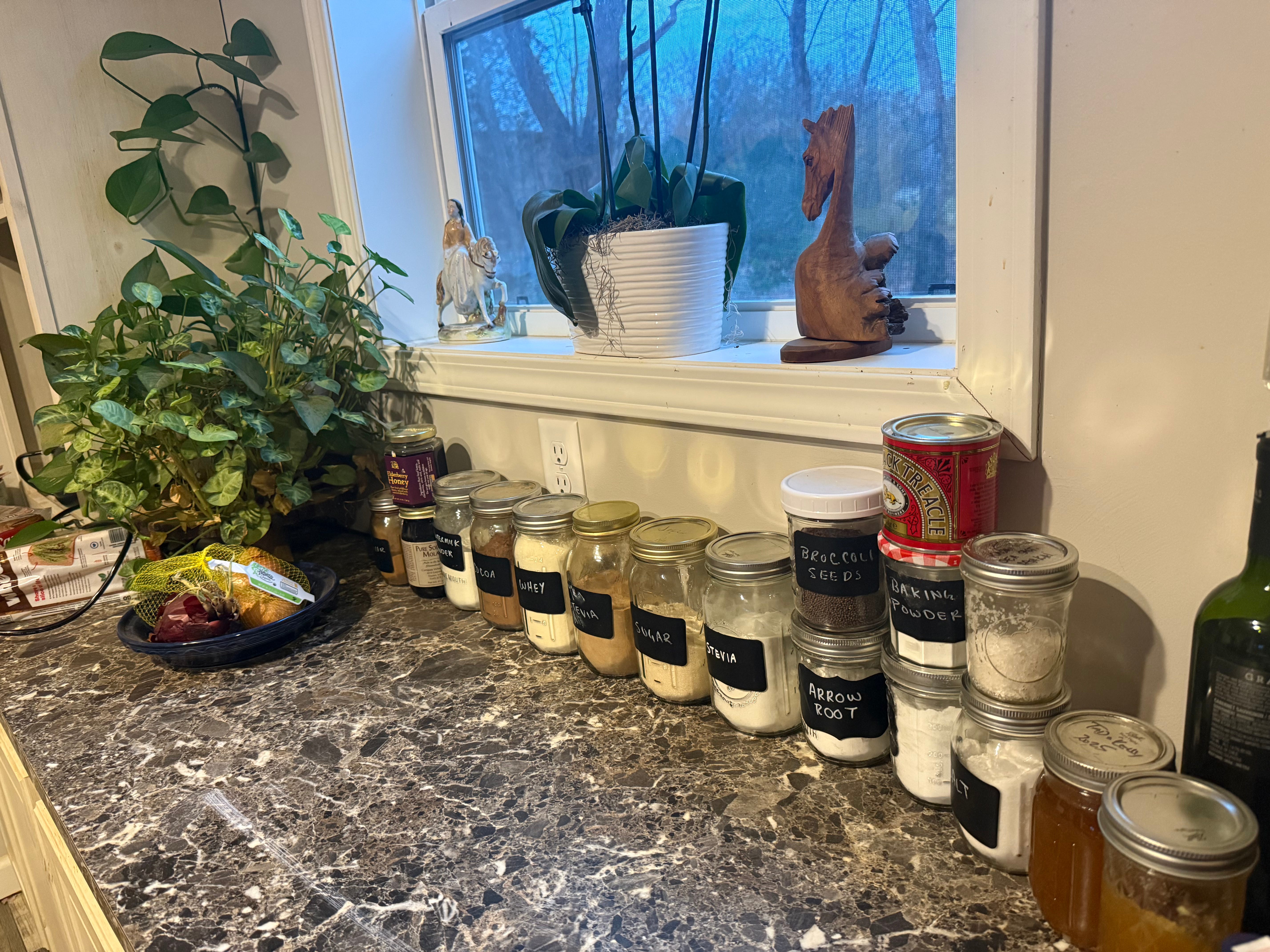
What no one really explains at the beginning is that jars have a way of multiplying. You start with a reasonable number, which feels entirely under control. Then you realize that “a reasonable number” is not actually enough. Then you begin acquiring them in cases, then in whatever quantity happens to be available when you find them.
Every glass jar that enters the house becomes a candidate for reuse. Store-bought pasta sauce suddenly looks less like dinner and more like future infrastructure. And if someone offers you a box of old blue Ball jars from a relative’s basement, you will accept them with a level of enthusiasm that might concern people who do not understand what they are looking at.
There is also the matter of labeling; if you are not careful, it will begin with admirable discipline and end in something closer to educated guesswork. Early in the season, everything is clearly marked, dated, and organized. By mid-summer, you are writing notes on lids in whatever marker happens to be nearby. By winter, you are opening jars with a mixture of curiosity and caution, trying to remember whether this particular batch of something was from last year or the year before. It is a small reminder that even the most well-intentioned systems have a way of drifting.
A few years back, I discovered chalkboard labels, and those have worked well for me. They are reusable, although not if exposed to the rigors of a dishwasher.


Food Preservation
More than anything, jars force a certain relationship with time. You cannot rush the process. You cannot decide that preserving food would be more convenient next week. The work happens when the food is ready, which is often when it is hot, busy, and you would rather be doing almost anything else. And yet, months later, standing in a cold kitchen in the middle of winter, opening a jar that you filled yourself, there is a clarity to the system that makes perfect sense. This is what it looks like to move effort forward in time. This is what it looks like to turn a moment of abundance into a period of stability.
So yes, at one level, it is just a jar. But it is also a tool that quietly shifts the balance of control back toward the household. It allows you to step slightly outside the system's constant churn and build a small buffer of your own. A shelf full of jars is not just visually satisfying. It is a record of work done, of planning carried through, of a season captured and held for later use. It is a jar of saved resources, both grown and store-bought. It says, in a very understated way, that you are just a little bit independent of the outside world.
Glass, a lid, and a seal. It is hard to imagine anything simpler. It is even harder to overstate how much difference that simplicity has made.

The “maintenance-free” garden
It has been a busy March on the farm, which is to say everything needs fixing at once and yet I am somehow behind on my gardening - yet planting has hardly started.
When we built the Valley House, where we live, we had a brilliant idea. Take the 14 x 55 strip outside the front of the house and make it “maintenance free.” You already know where this is going.
First came the dirt. Fifty to seventy five tractor bucket loads of compost and soil to build the grade up against a four foot foundation. Days of work. The kind that makes you question your life choices while reaching for coffee with arms that no longer function properly.
Then came the “solution.” Heavy duty landscaping cloth, seventy five blue rug junipers, and a thick layer of mulch. Permanent ground cover. No mowing. Clean. Tidy. We even added dwarf blueberries to make it more than just a pretty face.
It has been a disaster.
The junipers have chosen not to participate. Too hot, too dry, wrong pH, or perhaps a general objection to the entire plan. Meanwhile the mulch turned into soil, the cloth turned out not to be a barrier, and the weeds moved in like they had been invited.
And not polite weeds. Aggressive, enthusiastic weeds. The kind that make eye contact while you pull them and promise to return.
I swear that I have spent more time weeding that “maintenance free” strip than the entire farm combined.
So, over the winter, we came to a simple conclusion. If I am going to weed anyway, I would at least like to eat the results.
We are turning it into a no till kitchen garden.
Step one has been removing the landscaping cloth, which is now fused to a network of roots underneath it. This involves digging, cutting, and wrestling out massive sections like some kind of agricultural CrossFit. I have gone through an entire pack of razor blades just trying to cut the stuff into pieces I can move. One dump run down, one more to go.
Sadly, local labor seems non-existent or at least not willing to get into digging in the dirt in a meaningful way. So, “my project - my back”, time will tell whether the trade-off is worth it.
Next comes twenty tons of compost and old river sand, carefully worked into a space that our tractor barely fits into. Then raking. Then planting.
There will still be weeds. Of course there will be weeds. But now there will also be tomatoes.
The plan is clover between rows, vetch in the fall, and slowly building an actual living system instead of whatever that previous experiment was supposed to be.
In other words, after years of trying to eliminate maintenance, we have decided to farm it instead. Progress.
And not everything else is perfect either. Some of the fencing looks like the horses have been politely but firmly leaning on it to reach greener grass. The roads, once gravel, are again aspiring to be dirt. Fortunately, road grading is one of Robert’s domains, a skill I have wisely avoided acquiring.
So that is March. Things break, plans fail, weeds soon will outsmart us again come May, and we try again.
But this time, at least, the failure might come with dinner.

Next week, we will be in Dallas at CPAC.
But I, at least, am home on the farm today. Robert left at 3:45 AM to catch an early jet to go to Scottsdale, AZ to be on Aaron Siri’s podcast. He will be flying home tomorrow. I already miss him and it isn’t even 11:00 AM yet.
So, today is a cold, nasty day in Virginia, hopefully one of the last of this winter. I am heading over our office across the yard to do more writing and hang out with the dogs. Mostly, so that I can get a fire going in the woodstore. Later, I plan to make butter and yogurt - and this week, I started liming eggs (preserving eggs in lime water for future use). Putting up eggs is little early for next winter, but the girls are in production mode. And guess what, those big half gallon mason jars are perfect for preserving eggs!
EECKK! I need to buy more mason jars!
Stay warm everyone!
Always enjoy your perspective as it matches mine so well.
Does anyone out there has Mason Jar stress when sharing their wonderful harvest? I always wonder (deeply-lol) if I will get that jar back! I try so hard to accept that when I give someone a gift it is theirs now. But then I imagine that jar in the trash bin and it gives me a sense of sadness, hahaha, like an old friend just got discarded.
I am not sure how I lived the first 55 years of my life without Mason jars. For my birthday, my kids gift me with them--the half-pints and pints (perfect for storing herbs and seeds, and for canning jams), the quarts (for everything else, including brewing my daily herbal infusion), and the half-gallons for fermenting and lime-preserving my eggs. Thank you for the history lesson--I learned a lot! Here's to warmer growing weather. Peace...