

After nearly six weeks of nonstop travel, with at least eight airplane trips and many long car rides to and from DC; we've finally been home for more than a week. Now, we're catching up on preparing the farm for winter; cleaning, tidying up, taking care of deferred maintenance, and simply getting back into a more normal routine.
During this last week, my work for the Federal Advisory Committee on Immunization Practices (ACIP) has been intense, as we prepare for the December 4 and 5 meeting, now looming large.
A few days ago, I accepted an appointment as a full professor at Louisiana State University at the Pennington Biomedical Research Center. This is an adjunct position, so it doesn’t require me to move to Baton Rouge, although the way the last election went in Virginia, it is tempting!
The Pennington Biomedical Research was founded in 1981; it's the world's largest academic nutrition research center. It conducts clinical, basic, and population science research focused on chronic diseases such as obesity, diabetes, cardiovascular disease, and cancer, as well as the links between chronic disease and nutrition. As this has become a big focus of my writings, I am excited and honored about this new opportunity to work with researchers at LSU on these types of projects.
Even if it is another “gratis” employment opportunity.
So, it has been a busy time - a good time this fall.
But the farm goes on and our work here doesn’t stop, without enormous consequences, which is why, even though it is getting late in the season, we are tackling our pigweed problem this week.
In our pastures, we have specific areas where the pasture is compacted, has little topsoil, and has a layer of decomposed, nitrogen-rich manure. These are ideal conditions for pigweed.
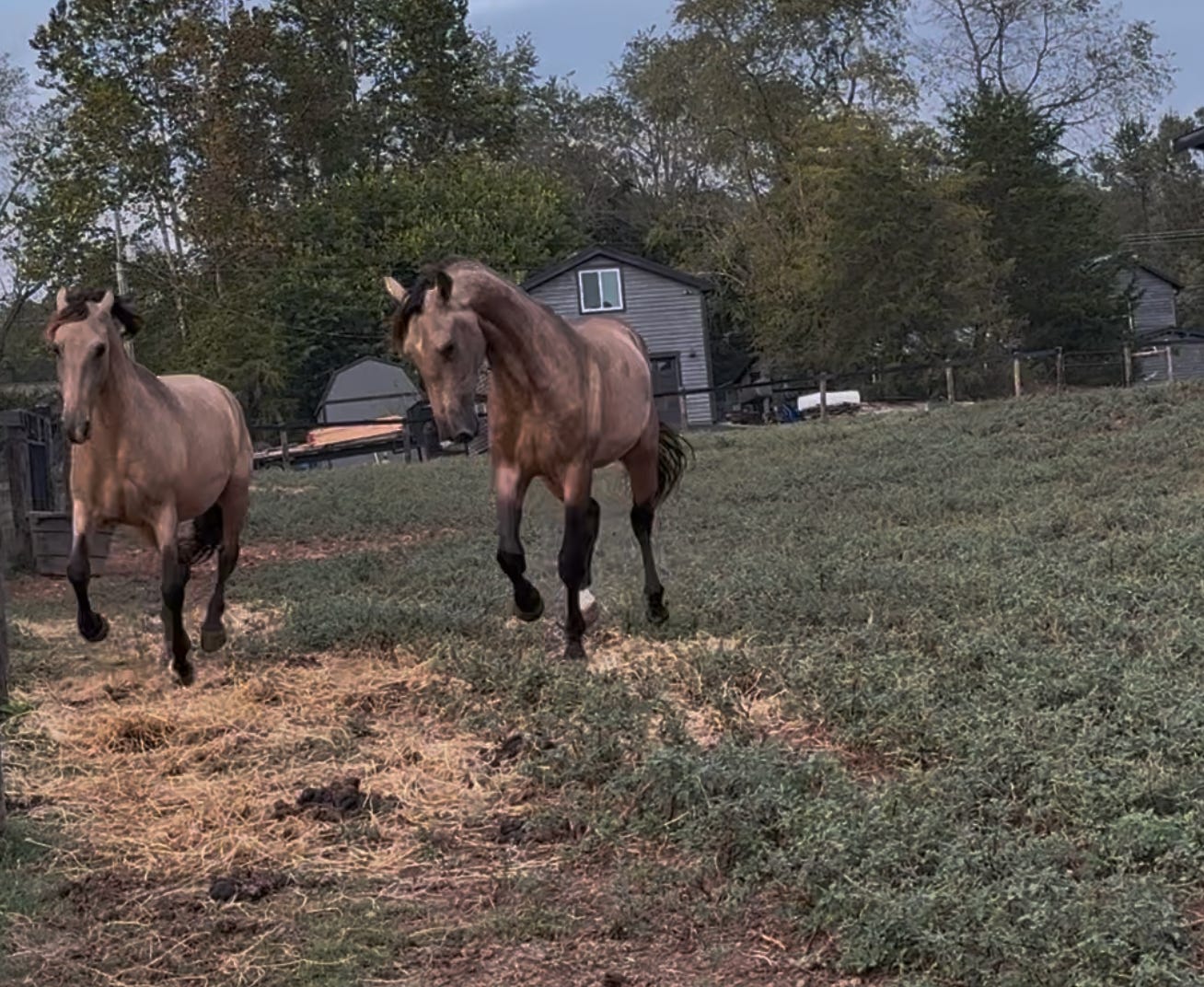
Spiny Amaranth (Amaranthus spinosus): The invasive weed, you have probably never heard of.
Amaranthus spinosus is not native to North America.
It originally comes from tropical regions of Central and South America, and possibly parts of Africa and Asia. It spread quickly through Indigenous cultivation (for greens and seed), then via the Spanish and Portuguese colonial movement, and finally through livestock and ballast soil from shipping routes. It has been in the U.S. since at least the 1700s or 1800s, but it behaved like a minor weed for most of that time.
So why Is It only a big problem recently?
Spiny amaranth was present for generations, but did not explode until the last 20–30 years.
As farmers shifted from traditional livestock practices, modern grazing systems established ideal conditions.
Pigweed thrives in:
Disturbed soil
High-nitrogen manure areas
Compacted pasture edges
Each plant can drop 100,000–500,000 seeds.
Seeds can remain viable 5–7+ years in the soil.
It thrives in disturbed soil, heat, and nitrogen-rich areas.
***It now has widespread herbicide resistance.
***Read that last statement again.
So, basically, as the traditional methods of farming, what people now have labelled regenerative farming, have almost wholly disappeared, pigweed, particularly this one very prickly variety, has become a nightmare for farmers in the US. This is particularly true for people who have livestock on small allotments and don’t want to use toxic pesticides (as the EPA classifies most herbicides).
Herbicide resistance exploded.
Due to the extensive use of herbicides, spiny amaranth has now evolved resistance to:
Glyphosate (Roundup)
ALS inhibitors (Pursuit, Classic, etc.)
Sometimes PPO inhibitors
This happened mainly between 2000–2015, especially in:
Southeast
Appalachia
Mid-Atlantic
Midwest livestock regions
Before resistance, it stayed under control.
Most livestock, particularly sheep, will eat pigweed when it is young and tender, but as it matures or is fertilized, it can become slightly toxic and very thorny, so one has to be a little careful using it as a main source of feed. The truth is that using livestock to control spiny pigweed really isn’t that viable an option once spring is over, unless one has a lot of sheep or pigs.
We have kept sheep. Personally, I don’t ever want to have a flock of sheep again. Managing sheep is a little like trying to manage a flock of cabbages with the ability to outrun or jump anything but a highly trained dog - at a moment’s notice, en masse. And yet, somehow, with very little brain power will manage to find trouble in all the wrong places.
“I fucken hate sheep.”
To understand why I (we) don’t have sheep, please watch this video from “Clarkson’s farm” - of note, this is not a BBC program - as the BBC is no longer capable of producing programming which doesn’t indulge in LGBTQXYZ programming aimed at children, or a love of the massive waves of immigrants into the UK year after year after year, the likes of which are overwhelming traditional British culture.
Of note: we sometimes had similar issues as Clarkson understanding the local folk in the Southeast, particularly when we lived in North Georgia. We always thought that too much drink, over too much time, had something to do with it. But just like Clarkson, we work with the clay we have, and generally, despite the native language barriers, local labor is best.
Of note, pigweed is from the amaranth family, and the leaves when young are very similar to spinach. The seeds of various amaranth species have been used for thousands of years or longer as a staple in many diets worldwide. However, the amount of pigweed we now have on the property - we could harvest this stuff and sell it at our local farmer’s market all year round and still have an abundance…
Besides which, spiny pigweed isn’t as productive in making leaves or edible seeds as the amaranth used for culinary purposes.
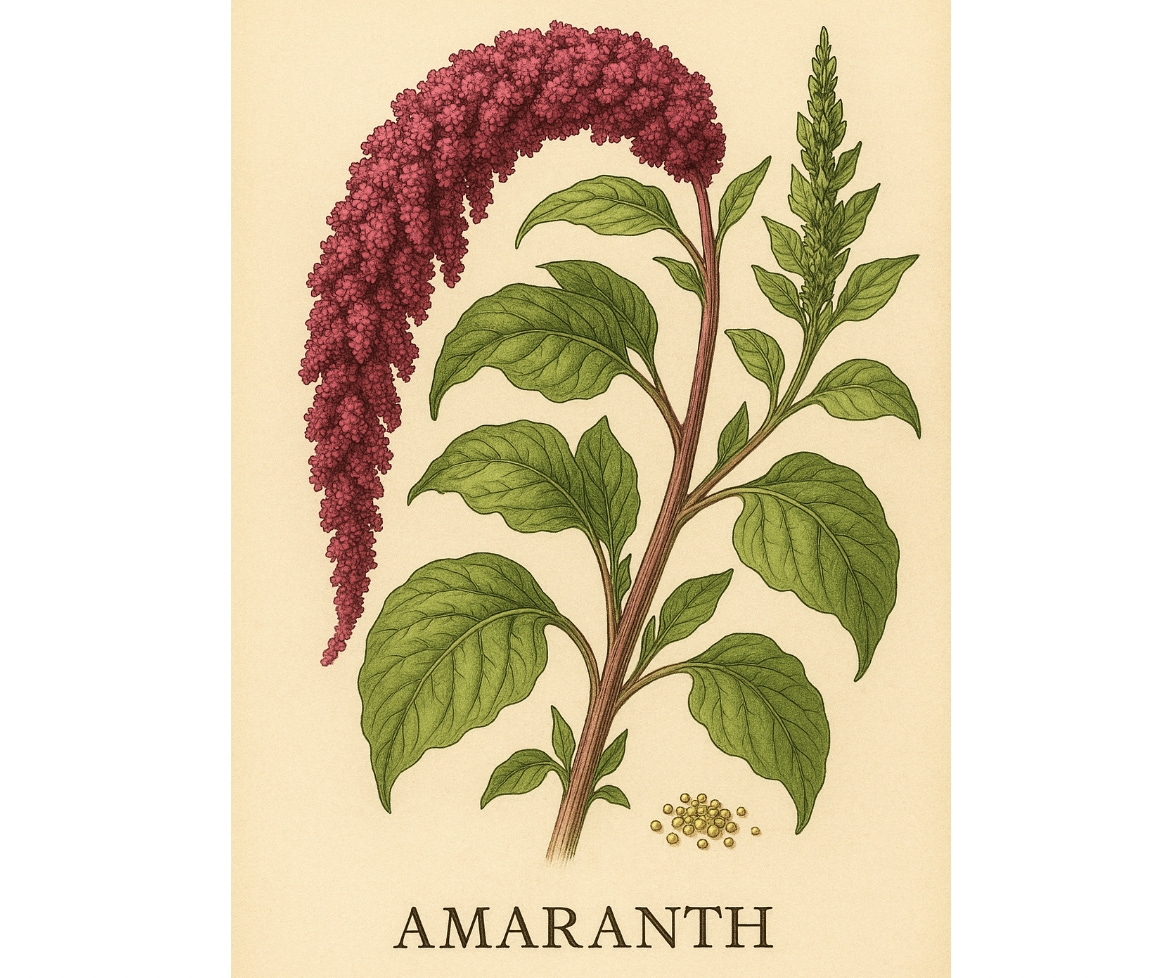


Definitely not…
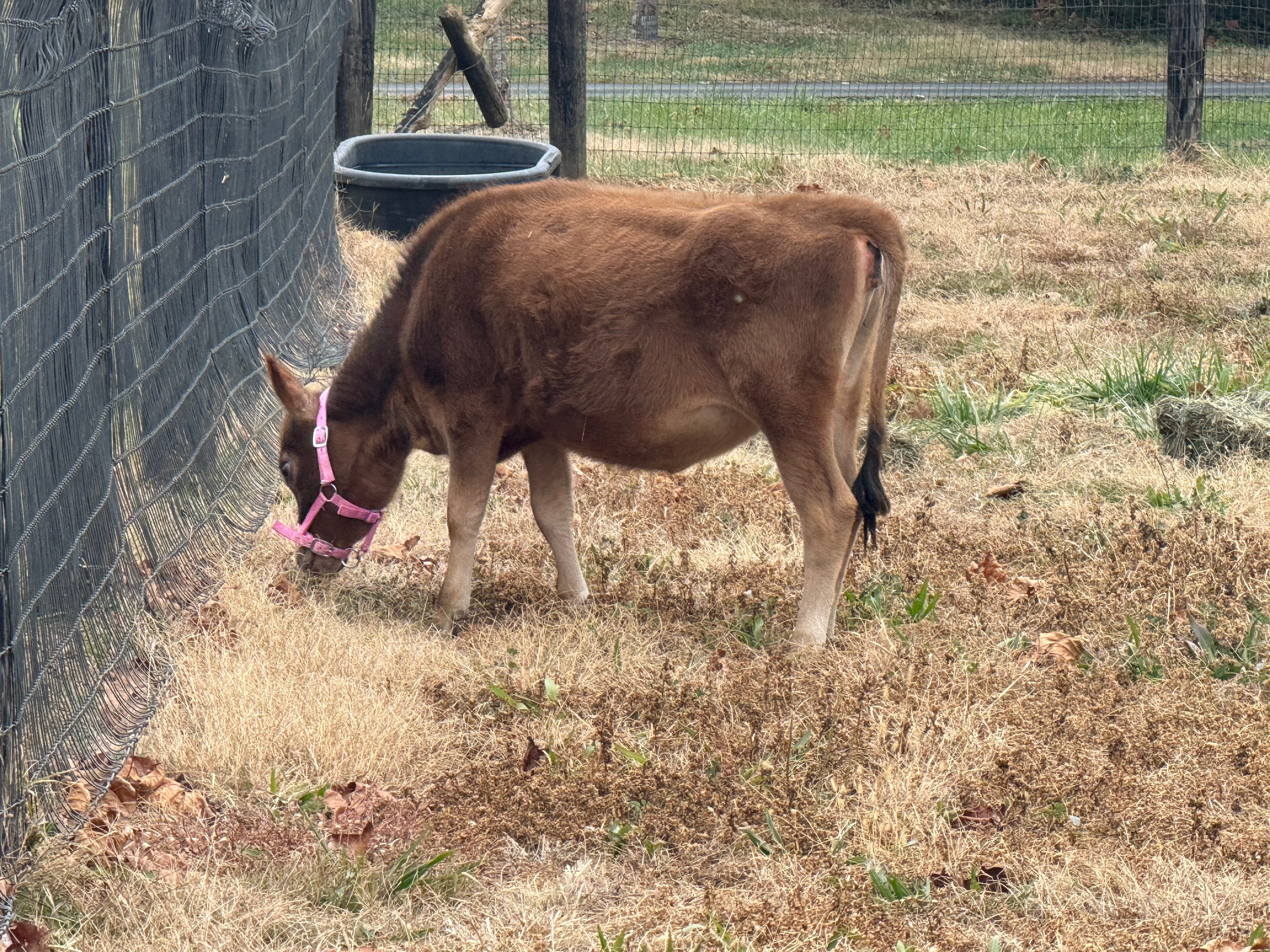
The new cows are here, and an unpleasant surprise.
So, on Saturday, the miniature jerseys arrived from West Virginia. They are every bit as wonderful as we were hoping. Evie, the mature cow is so endearingly friendly; it is silly. We named the yearling heifer Blossom, and yes, she really is that tiny. Blossom needs a relatively high protein/calorie diet right now, so put on some weight and muscle. Whereas, Evie most definitely does not need to put on weight, in fact, maybe the opposite. Blossom also needs a bit of TLC - to get her more used to people and being led on a halter.
Jill has Blossom’s ration in a feed pan and sits on the green grass beside her while she eats. She gets a nasty surprise when her pants and hands are covered with dried pigweed stickers. We knew it was bad, but until we felt the toxic nature of these stickers, we didn’t realize how bad the infestation had become.
Now, where we have established pasture, the pigweed doesn’t seem to be gaining a foothold. But let’s face it, where the horses like to stand around - by the feeding stations, the run-in sheds, and the water troughs have all become pigweed central.
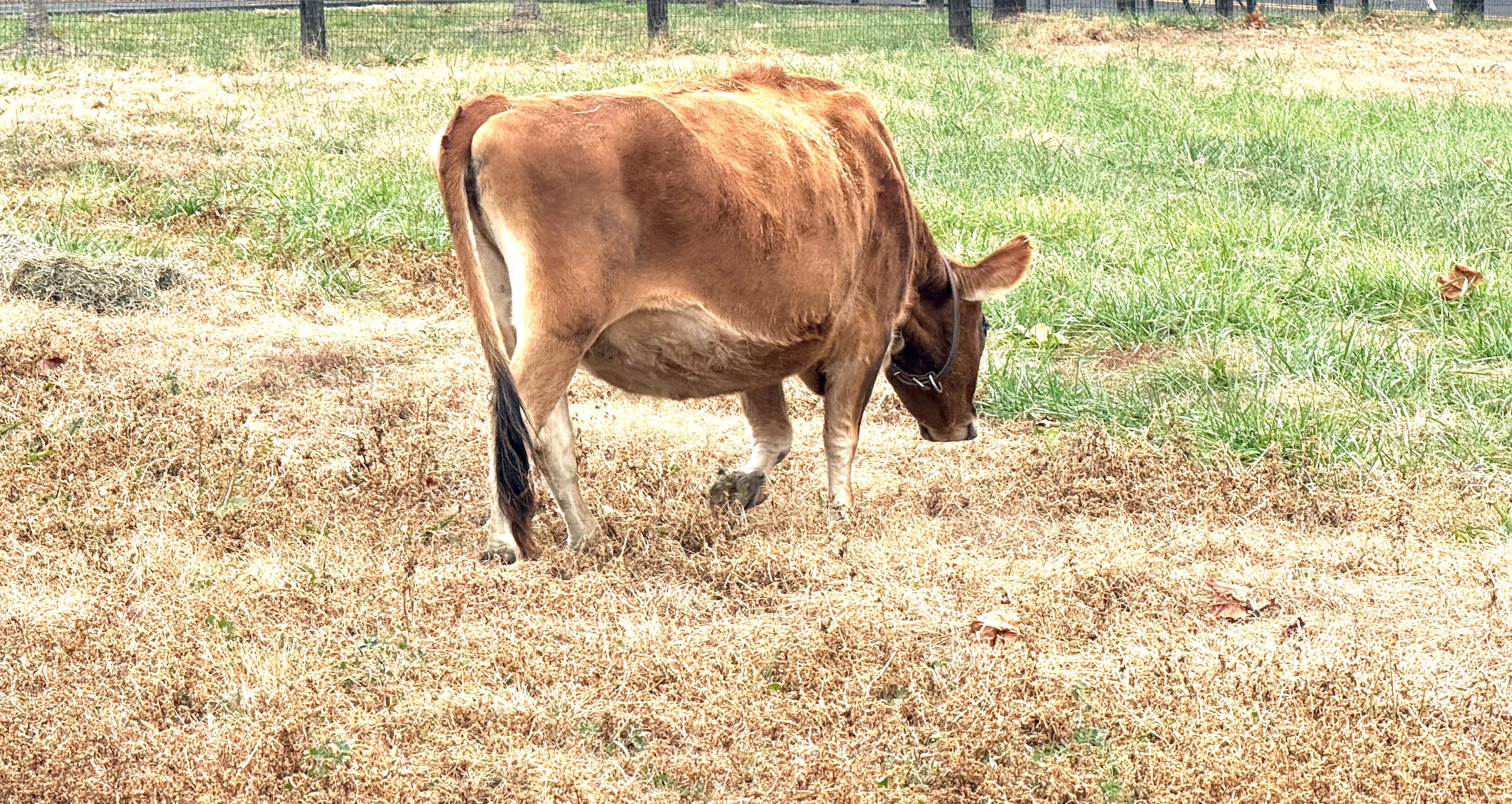
Those beige areas in the pasture above are so full of pigweed, that it is unpleasant to walk in with normal shoes - as the stickers get into socks.
Jill is now taking Blosson out of the pasture for her grain/protein mix. This allows handling and acclimation to our rather goofy dogs. It also means she can sit on the grass while Blossom eats.
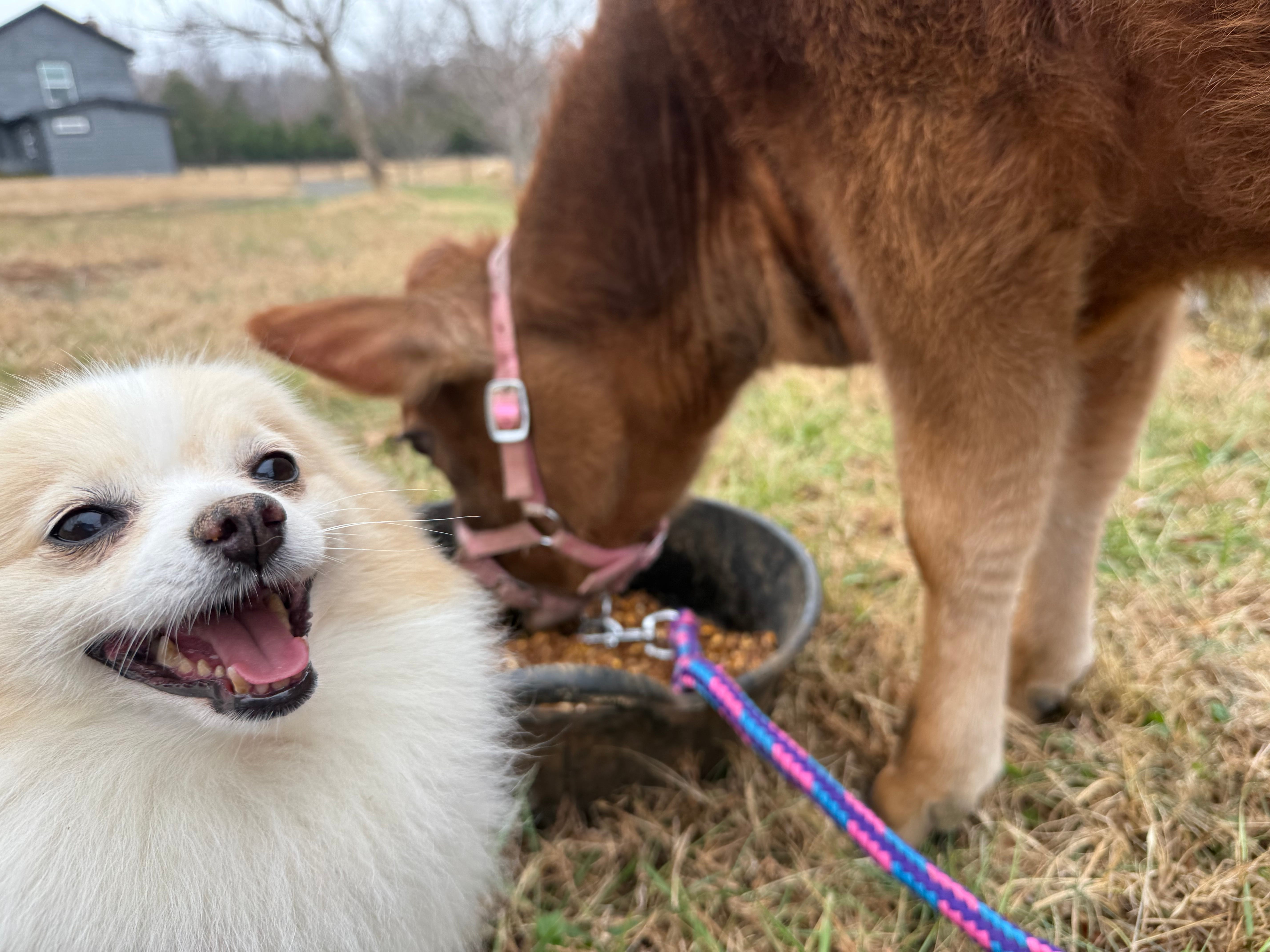
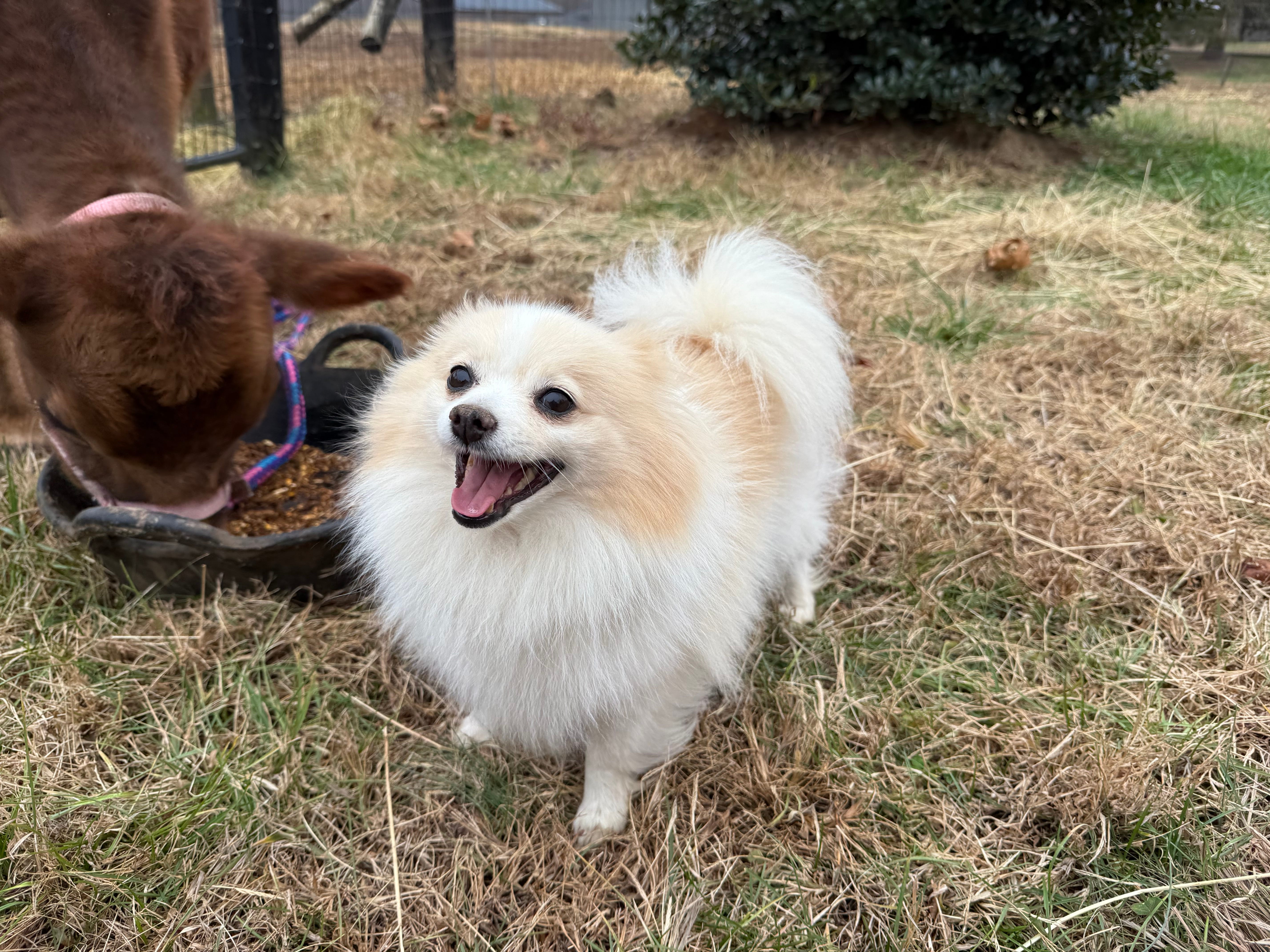
So kitty the Pom, knows the word stay - but she talks back about having to follow orders after a while… then when she thinks Jill is not paying attention, quietly walks off.
kitty is quickly turning into a farm favorite - all eight pounds of her.
Oso the Aussie is not having it - no way is he going to cooperate with posing next to a cow - even a miniature one unless it involves a tummy rub.
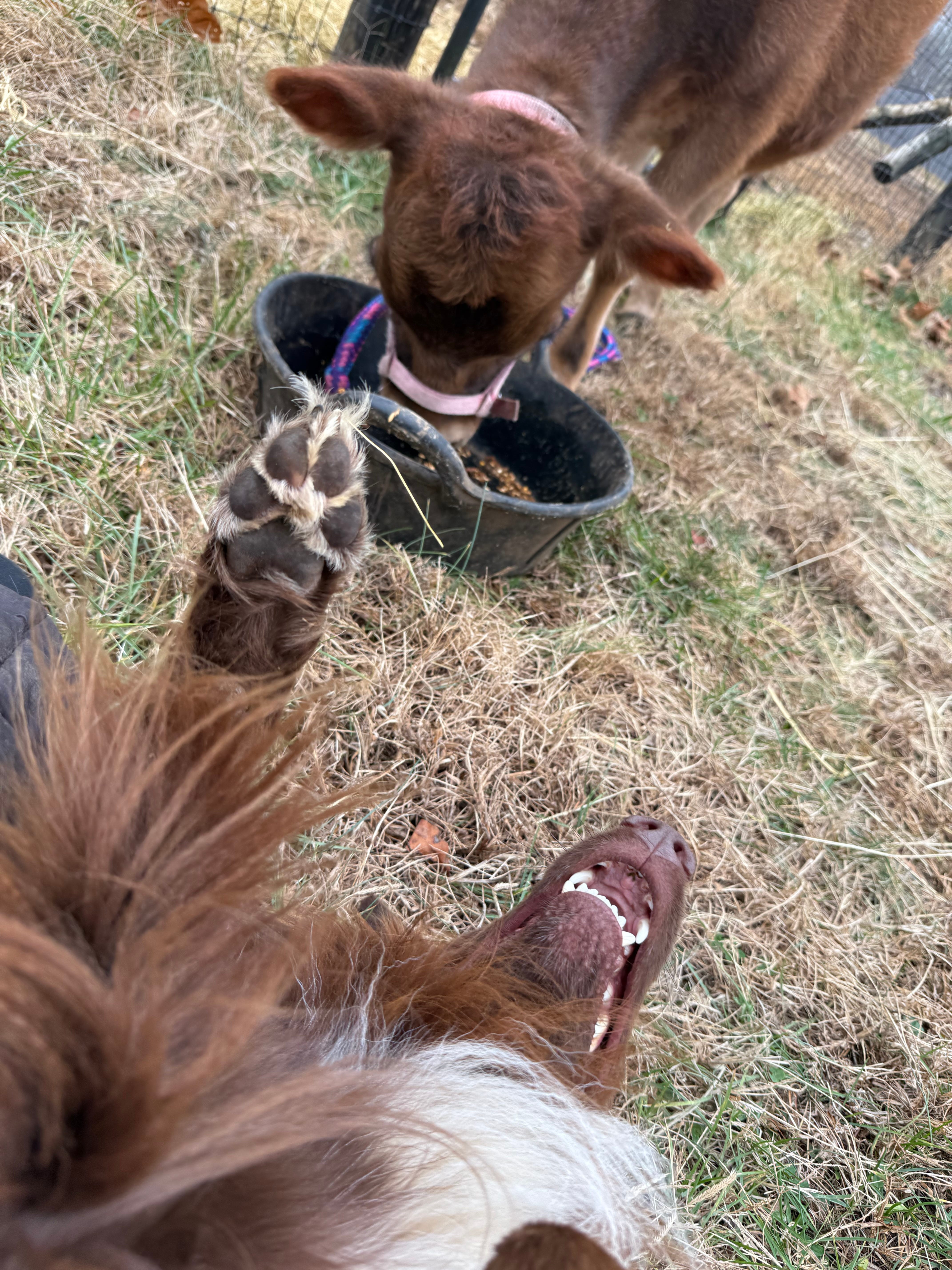
OK - under duress, maybe Oso can cooperate a little…
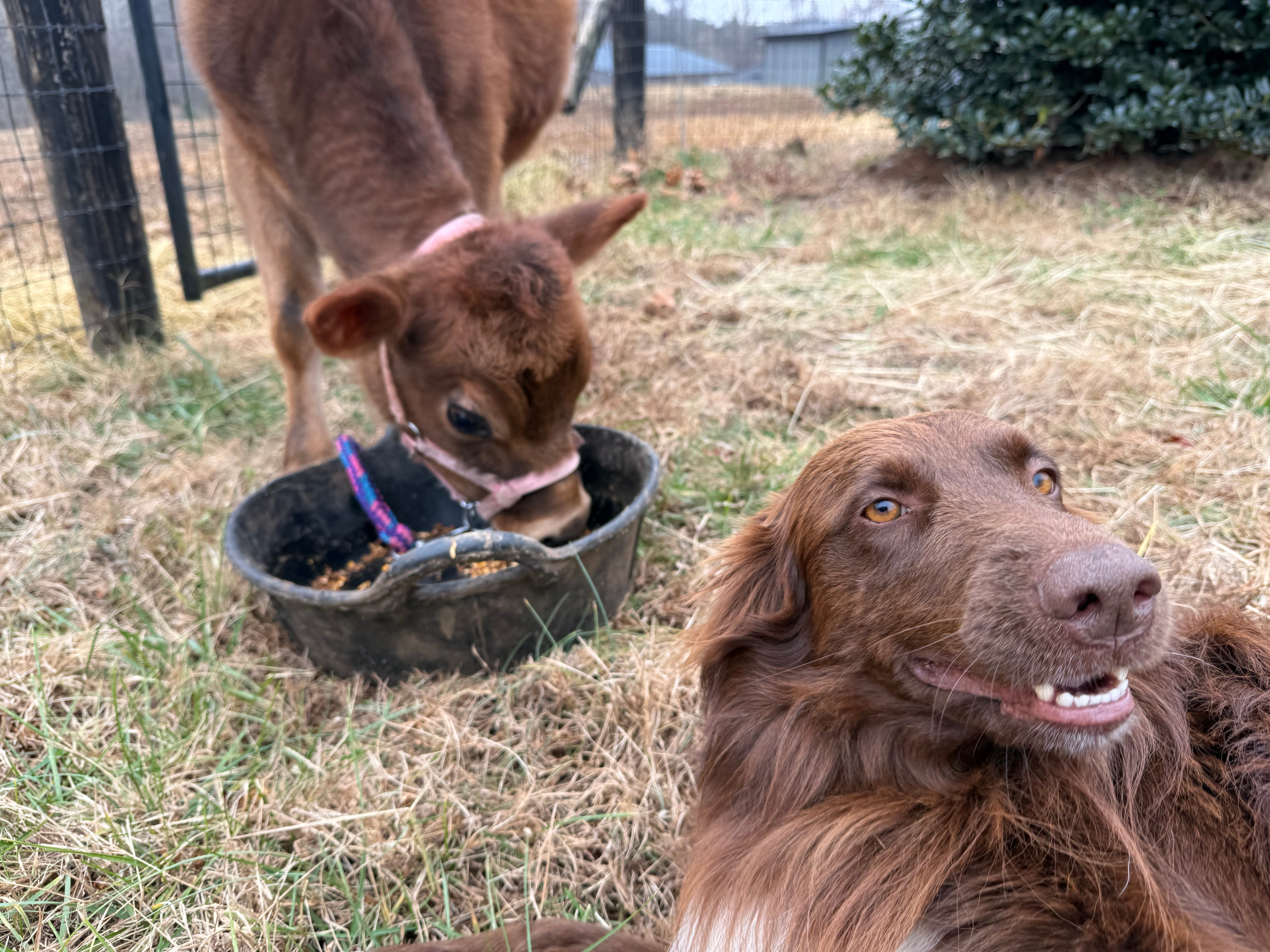
After all of Oso’s silliness about posing with a bovine, he then carefully went over and cleaned Blossom’s eyes. Oso is actually the lovebug of the family. He just looks a little fierce to strangers sometimes.
Note that baby Blossom is taking it all in stride. This is what we want - as the dogs accept livestock, they become a little protective (not that Kitty could do much), but Aussies Bella and Oso will and often do. No coyotes or foxes come onto the main part of our farm anymore.
But back to the issue at hand - pigweed.
What’s a person to do?
So, Jill got busy on the Internet and has come up with a plan to reduce our pigweed. It involves rototilling all of the dried pigweed patches into the ground, turning over the seeds to a depth of 3 to 4 inches into the soil. Evidently, pigweed seeds need light to germinate -
So this is the plan - starting ASAP.
Step one is plowing the dried pigweed under to stop germination.
Step two: Over seed with annual and perennial ryegrass this week. Then, we will use our big roller to compact the tilled earth to prevent erosion as the ryegrass seeds germinate. For some of the more sensitive areas, we will spread straw over the seeded areas.
Step three: Let the cows onto the pastures early in the spring, as they more readily eat immature pigweed than horses.
Step four: Add pasture mix early in spring to create a more diverse pasture.
Step five: Mow often in the spring and summer to keep pigweed in check. Also do some hand weeding and weed whipping in hard to get areas.
Will this work? It may or may not. This is an expensive project, with grass seed costing in the hundreds of dollars, and we can only hope for the best. It will take strategy and follow through, if it is to work.
The truth is that this is going to be a multi-year project. It is easy to use herbicides - it is not so easy to do it right.
But let’s face it. Farming is a type of gambling. If you don’t play, you won’t win.
Let their be dragons:
BTW- Topaz, the coming three year old stallion and his half sister, Quieta were rather upset by the cattle. They spent the first day cowering at the other end of their pasture.
Now, Topaz is completely obsessed with them and spends most of his time hanging out next to Elvie and Blossom. For whatever reason, Quieta is less interested.
Here Topaz is (video below), soon after the cattle were put into the pasture next to his. He spent the first two hours - trying to figure out what the heck those creatures were and more importantly, would they eat him?
One day, these horses are babies - and the next, they are full grown dragons:
(Just to day it, Topaz is a still a baby - at least in Jill’s mind).
Then there is our brave stallion Jade. Jill rode Jade by the cows yesterday. Jade was intrigued and glad to have them on the farm. He immediately went up to their pasture, made eye contact, and began grazing. The cows responded in kind - came up to the fence line for a “meet and greet.”
Of note, Jade is only allowed to graze while under saddle by command. Jill just drops the reins and says “OK”, and that is the magic word to get down to the business of eating.
Bananas taste different.
You like potato and I like potahto
You like tomato and I like tomahto
Potato, potahto, Tomato, tomahto.
Let’s call the whole thing off
But oh, if we call the whole thing off
Then we must part
And oh, if we ever part, then that might break my heart
So, our little bananas continue to grow ever so slowly. Who knew how long it takes bananas to tree ripen? We didn’t.
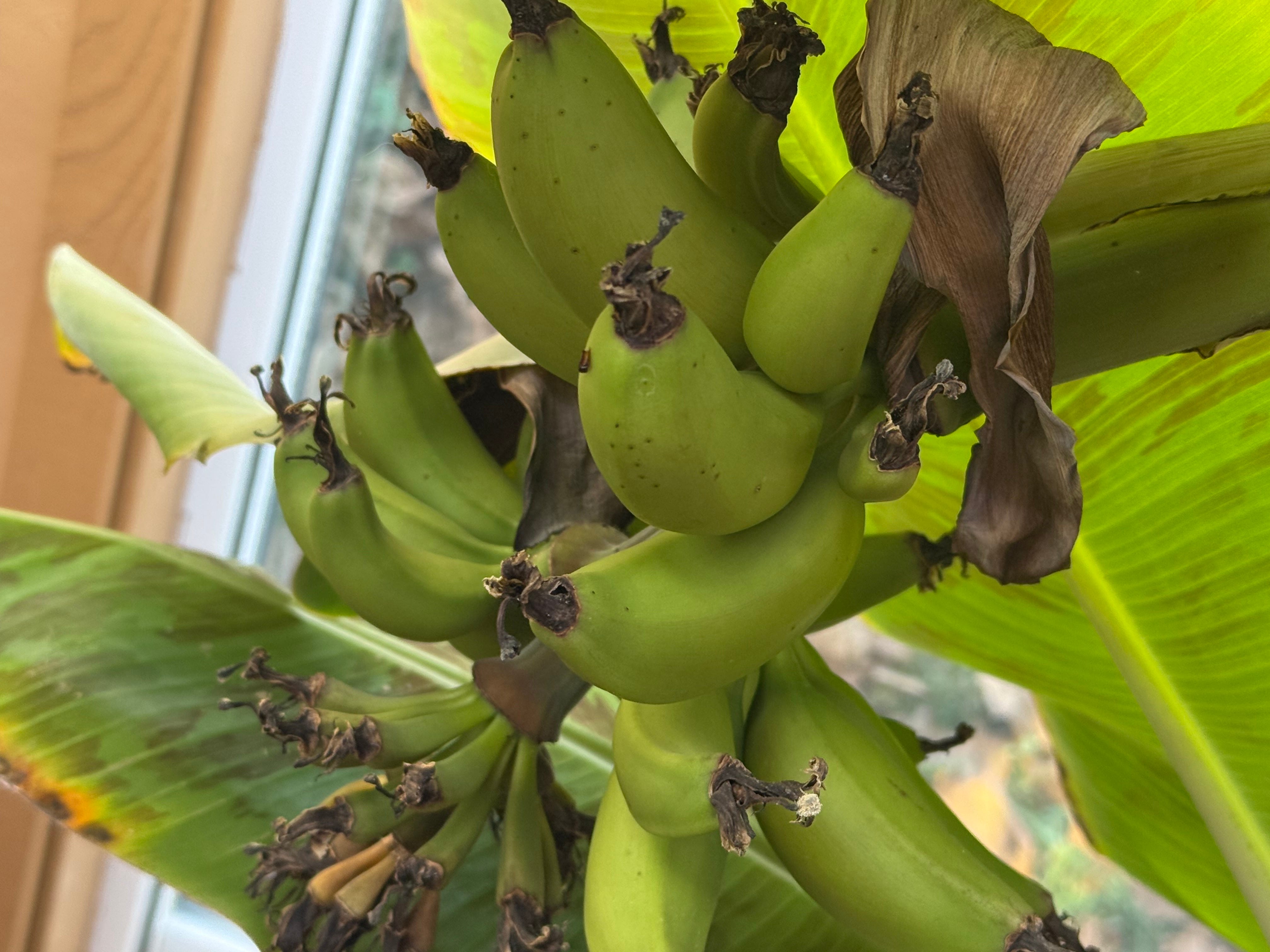
A few weeks ago, Jill clipped off two and left them on the counter to ripen. They didn’t look like much.
Last week, she was making banana muffins for a meeting we were having here on the farm, and so she peeled the little bananas, cut them up and popped a piece in her mouth. With that, she came flying down to the hall to find me, yelling that I had to try a piece.
OK- this was a banana taste like I hadn’t had before. It was fragrant, sweet, and creamy. Yet - I had tasted it, I had just forgotten. This is what bananas tasted like when I a very young child.
Who else remembers that bananas used to taste different?
The switch from Gros Michel to Cavendish bananas.
Up until the 1950s and early 60s, the world’s export banana was a variety called Gros Michel (“Big Mike”).
It was famous for its:
richer, stronger “classic banana” aroma
sweeter, creamier flavor
thicker skin and better shipping durability
But Gros Michel was nearly wiped out by what is known as Panama disease (a type of Fusarium wilt), so growers switched to the Cavendish variety in the early 1960s. Gros Michel banana plants still exist - the disease didn’t wipe them out, they just aren’t used commercially anymore.
Cavendish tastes milder, more like a vegetable, than a fruit, and is much less perfumed compared to Gros Michel.
That’s why banana flavor in candy and ice cream often seems “artificial”. That taste was developed or modeled from the Gros Michel flavor and people aren’t used to associating that strong a flavor with bananas anymore. Which all seems rather sad.
Cavendish bananas have become even less flavorful as bananas are now harvested green and ripened after harvest with an application of ethylene gas in a controlled chamber - that dulls flavor development. This is true also for organic bananas. Flavor is further decreased by the continued breeding for disease resistance and because of soil nutrient depletion.
Rumor has it that new, more potent strains of Fusarium wilt (TR4) are now threatening the Cavendish variety - so expect more changes and disruptions in the banana market in the future. However, that strain of wilt is not in the USA, nor is the strain that affects Gros Michel.
In the meantime, Jill, being Jill, tracked down Gros Michel banana plugs (baby banana plants) on Etsy and has ordered ten plants. Cause, hey - what’s a greenhouse for, if not for experimenting?
Christmas Lemons!
Most years, we put the citrus plants outside after the last frost and bring them into the house or greenhouse before the first frost of the fall. This year, we left them in the greenhouse all summer, mostly due to the pain in the ass process of moving big, heavy pots with stickery small trees outside. Living year round in the greenhouse, they have done remarkably well.
Our unique lemon tree with the 4-5 pound lemons has produced about ten fruit. They still need to ripen some, but Jill will cut them up into about 15 slices per fruit and then freeze the slices in mason jars. These, combined with the lemons and limes on the other trees last us a good, long time - almost all year long.
The difference in ripeness of the big lemons between the beginning on Oct to now is evidenced in the photos below:


BTW- these fruit are amazing. There is not that much pith, given the size of the fruit - which is larger than a grapefruit. For the home gardener, who freezes the fruit or the juice, this lemon tree is ideal. For commercial use, its market would be limited - as who wants to buy that much lemon in one go? However, we get asked all the time - what kind of lemon is that? ummm…?
Well, it isn’t a ponderosa variety - as that has lots of pith.
My best guess is that it is a hybrid between an Amalfi or a Interdonato lemon and maybe a ponderosa or one of the other larger lemons or citron.
Unfortunately, most lemon trees are grafted, so if we grow plants from seeds, we won’t end up with the same plants…
So, I did a little research on how I could get the same tree, and this is what all things internet came up with:
What NOT to do (as well as more than most of you ever wanted to know about growing an identical lemon tree):
Don’t plant a seed expecting the same lemon variety
You will almost always get a different fruit.
Don’t try to propagate citrus from suckers
Rootstock suckers are not the same variety and produce inferior fruit.
Why you shouldn’t grow lemons from seed if you want the same tree
Most citrus (including lemons) are sexually reproducing when grown from seed. That means:
The seedling contains mixed genetics (from pollen + mother tree)
The fruit quality will not match the parent
Trees take years longer to bear fruit
Fruit may be inferior, smaller, or completely different
If you want the same lemon variety, you must clone it.
2. The correct ways to clone a lemon tree
A. Air Layering, which may be considered the best option for home growers.
This produces a genetically identical clone of the parent tree while still attached.
Why it works well:
Fastest way to clone citrus
Root system forms before removal
Produces a fruiting-age branch → faster fruit production
Perfect for rare varieties (Amalfi, Interdonato, etc.)
How to do it:
Choose a healthy pencil-thick branch
Remove a 1” ring of bark
Apply rooting hormone
Pack with moist sphagnum moss
Wrap in plastic
Wait 6–12 weeks for roots
Cut below the root ball and pot it
Result: an identical clone of the parent tree.
B. Cuttings (easy & produces identical tree)
Citrus roots from cuttings readily, especially lemons.
How:
Take a 6–8” semi-hardwood cutting (not new green growth)
Strip lower leaves
Dip in rooting hormone
Place in well-draining soil or coarse perlite
Keep humid and warm
Rooting success for lemons is 60–80% with hormone.
Pros:
Easy
Cheap
True clone
Cons:
Root system is weaker than grafted citrus
Can be slower to start growing strongly
C. Grafting (best long-term method & industry standard)
This is how all commercial lemon trees are propagated.
Common grafting types: T-bud grafting (very common), cleft graft, whip-and-tongue, and chip budding.
Steps:
Buy a citrus rootstock (e.g., Flying Dragon, Sour Orange, C-35, Carrizo)
Take a piece of the parent tree (budwood)
Graft it onto the rootstock
Why grafting is best:
Ensures identical genetics
Better disease resistance
Better cold tolerance
Larger, healthier tree
Standard for Amalfi & Interdonato in Italy and Sicily
So which method is best overall?
If you want the strongest tree + identical fruit → Grafting
If you want the easiest cloning method → Air layering
If you want simple, cheap propagation → Cuttings
BEST TIME to air layer and grafting is late spring to early summer
May through early July is ideal in most climates.
Why this is the sweet spot:
New growth is firm enough (semi-hardwood), not soft
Temperatures are warm (70–85°F), which stimulates rooting
Humidity is higher
Sap flow is strong, helping callus + root formation
The tree has months ahead to grow roots before winter
This results in fastest root development and the highest success rate.
This lemon tree has produced fruit for us now for six or seven years consistently, yet has never grown that large. It almost acts as if it is a dwarf variety. This is a good thing, as our greenhouse isn’t that big and we do like to move the citrus trees out of the greenhouse most years during the warmer months. However, with only one tree, we risk losing this important genetic powerhouse, that has given us so much fruit.
So, it is time to think about propagation.
For for us, having done the research on how to airlayer (create clones) as well as graft, - these are the methods we will be experimenting with for this particular lemon. Stay tuned for next spring - as we start our new endeavor into lemon cloning and grafting.
Well that’s is it for now - have a great day folks!
Who knew the association between Big Mike & bananas had multiple meanings.
Congratulations on the LSU post. First, Jeff Landry is elected governor. Then you're welcomed into the university system. Next thing we know, common sense and a resurgent Hippocratic oath are breaking out all over the state.