

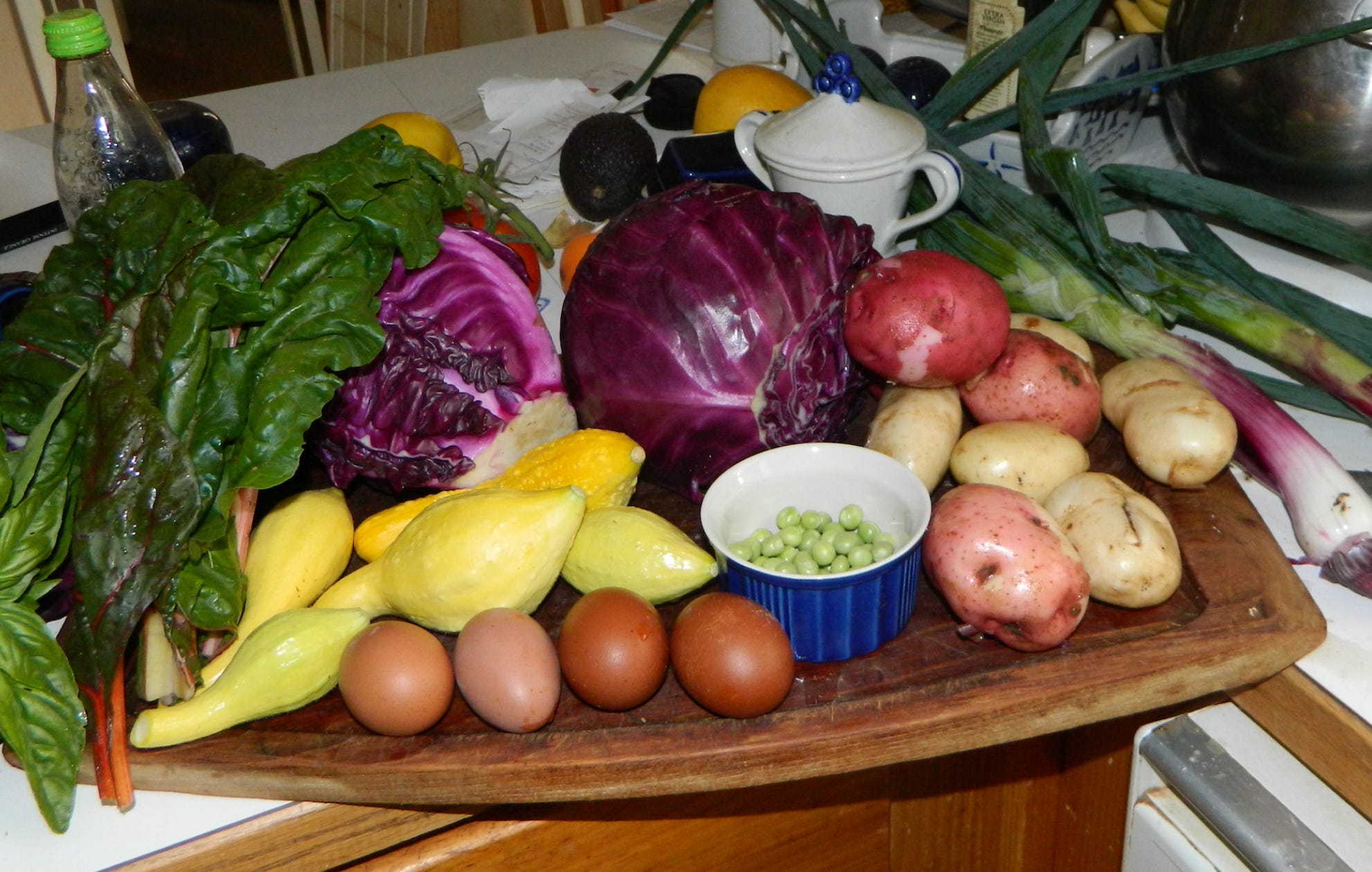
What Happened to Our Food and How to Fix It
The science of soil depletion, nutrient loss, and the regenerative path forward
Pick up a tomato from a supermarket shelf and compare it to one you pulled from rich garden soil this morning. You already know which one tastes better. You probably also sense, even if you could not prove it in a laboratory, that they are not quite the same food. As it turns out, your instincts are correct, and there is now a substantial body of scientific evidence to explain exactly why.
This essay is about what has happened to the nutritional quality of our food over the past seventy years, what caused it, and what you can do about it if you are managing your own land. The story involves soil chemistry, fungal networks, industrial farming practices, and one of the most hopeful bodies of agricultural research to emerge in recent decades. It is also, ultimately, a story about time: how long it takes to damage a living system, and how you can restore it much faster than most people believe.
The Vanishing Nutrients
In 2004, a researcher named Donald Davis and his colleagues at the University of Texas published a paper that quietly shook the nutritional establishment. They compared the mineral and vitamin content of 43 garden crops, everything from broccoli to spinach to carrots, using USDA data from 1950 against data from 1999. The same crops, the same agency’s measurements, fifty years apart.
What they found was a consistent, measurable decline across nearly every nutrient they examined. Calcium, phosphorus, iron, riboflavin, and vitamin C were all lower in 1999 than in 1950, with drops ranging from 6 to 38 percent depending on the crop and nutrient. A 38 percent reduction in iron in your spinach is not a rounding error. It means you need to eat almost twice as much spinach to get the same nutritional benefit your grandparents got from their garden. The study is notable for using government data rather than advocacy sources, which gives its findings unusual methodological credibility even for skeptics.
The authors were careful not to overstate their case. They noted that part of the decline was likely due to what researchers call the dilution effect: modern varieties bred for size, yield, and shelf life produce more biomass per plant, but the mineral content does not scale proportionally with the weight. A larger tomato is not necessarily more nutritious, as it may simply be a more watered-down one. But declining soil fertility, they argued, was also a contributing factor.
Supporting this at a global scale, soil scientist Rattan Lal published a landmark study in 2005 estimating the scale of nutrient depletion in agricultural soils worldwide. His analysis of major cereal crops found that potassium deficits affected 90 percent of global harvested area, phosphorus deficits affected 85 percent, and nitrogen deficits affected 59 percent. These are staggering figures. More than half the world’s cropland, by Lal’s reckoning, is effectively mining its own fertility, taking more out each season than is being replaced.
On a homestead, you have the power to break this pattern on your own land. But first, it helps to understand why industrial agriculture created it in the first place.
Why Industrial Farming Depletes Soil
The short answer is that conventional farming treats soil as a substrate that holds crops upright while you pour nutrients into them from a bag. Synthetic fertilizers supply the three macronutrients, nitrogen, phosphorus, and potassium, in forms that plants can absorb immediately. This works remarkably well for producing high volumes of crop biomass. It works terribly for maintaining the complex, living ecosystem that makes soil genuinely fertile.
Healthy soil is not a collection of chemicals. It is a community. A single teaspoon of undisturbed forest soil contains more microbial organisms than there are people on Earth. Those microbes, including bacteria, fungi, protozoa, nematodes, and thousands of others, form an intricate network that does far more than simply break down organic matter. They cycle nutrients, suppress plant disease, regulate water movement, bind soil particles into stable aggregates, and most critically, they form partnerships with plant roots that make the difference between a plant that merely survives and one that thrives.
The most important of these partnerships involves a group of fungi called arbuscular mycorrhizae. These fungi are among the most ancient and ecologically significant organisms on Earth, having formed partnerships with plant roots for more than 400 million years, long before most modern plant families existed. They colonize plant roots and extend their thread-like hyphae far out into the surrounding soil, sometimes extending a plant’s effective root area by a factor of a hundred or more. In exchange for carbohydrates from the plant, the fungi deliver minerals, particularly phosphorus and zinc, that the plant’s own roots could never access. Research published in New Phytologist has found that micronutrients such as selenium and iodine reach crops almost entirely through this fungal pathway, not directly from soil chemistry, but through the biological network that mediates it.
Industrial or mechanized tillage of the soil, synthetic fertilizers (especially phosphorus), and pesticides all suppress or destroy these mycorrhizal networks. When you stop tilling and start building organic matter, one of the first things you are doing is creating conditions for these fungi to re-establish. That matters more than most gardeners realize.
Conventional farming disrupts the soil system in several compounding ways. Deep ploughing shreds fungal networks and exposes soil carbon to rapid oxidation. Synthetic nitrogen, applied in abundance, shifts the soil microbial community toward fast-cycling bacteria and away from slower, carbon-building fungal populations that sustain long-term fertility. Pesticides and herbicides, some of which persist in soil for years, directly suppress microbial diversity. And monoculture, growing the same crop year after year in the same field, starves the soil of the botanical diversity that feeds diverse microbial communities.
The result, compounded over decades, is a soil that can still grow crops but has lost much of its biological intelligence. It can deliver nitrogen, phosphorus, and potassium because you keep adding them. But it struggles to deliver the full spectrum of trace minerals, secondary metabolites, and phytochemicals that a biologically intact soil provides almost automatically.
But Is This Contested?
If you do much reading in this area, you will encounter skeptics. The most substantive of them, a Canadian researcher named Robin Marles, published a systematic review in 2017 in the Journal of Food Composition and Analysis, arguing that historical food-composition comparisons, including Davis et al.’s 43-crop study, are methodologically unreliable. Changes in analytical techniques, crop varieties, geographic origin of samples, and laboratory procedures over fifty years, Marles argued, make direct numerical comparisons untrustworthy. His conclusion was that allegations of soil mineral depletion causing nutritional decline are unfounded.
This critique is worth taking seriously and makes a good point. Comparing a 1950 laboratory analysis to a 1999 one is genuinely an imperfect comparison. Some of the apparent decline may reflect measurement artifact rather than real change. Anyone who cites these studies should acknowledge that caveat.
But Marles’s reassurance is harder to sustain when you look at the full picture. His analysis on soil mineral content as measured by chemical assay, essentially the total amount of a given mineral present in the soil. What it largely misses is the biological dimension: whether those minerals are in a form that plants can actually access and use. Soil can be chemically loaded with zinc while remaining biologically incapable of delivering that zinc to a crop, because the fungal networks that make zinc plant-available have been destroyed. The absence of a measurable decline in total soil mineral content does not mean the soil is functioning as well as it once did. It means only that the minerals have not been physically removed, not that the living system delivering them is intact.
For a homesteader, the practical implication is this: the scientific debate over whether food has gotten less nutritious does not need to be fully resolved for your decisions on your land to be clear. The evidence that biologically active soil produces more nutritious food than biologically depleted soil is robust and consistent. Your goal is to create soil that is alive, and that goal is well-supported regardless of how the historical comparison debate is eventually settled.
The Evidence That Regenerative Practices Work
The strongest direct evidence that regenerative management improves crop nutritional quality comes from a 2022 study by David Montgomery and colleagues at the University of Washington, published in the peer-reviewed journal PeerJ. They compared paired farms across the United States, fields side by side, with the same crops and soil type, where one had been managed conventionally and the other regeneratively for five to ten years. The regenerative farms used no-till, cover crops, and diverse rotations. The conventional farms used the standard synthetic-input, tillage-based approach.
The results were striking. Crops from the regenerative plots showed consistently higher concentrations of key minerals and phytochemicals. In one wheat comparison in Oregon, cover-cropped plots produced grain with 41 percent more boron, 48 percent more calcium, 56 percent more zinc, and four times as much molybdenum as the conventionally managed field immediately next to it. These are not small differences. They represent real, measurable improvements in food quality, achieved not by adding minerals to the soil but by rebuilding the biological systems that deliver minerals to plants.
What Montgomery’s team found, and what is key to understanding why regenerative practices work, is that the nutrient differences are tracked not with total soil mineral levels but with soil health scores, measures of organic matter, microbial activity, and soil structure. The regenerative soils were not chemically richer. They were biologically more functional. The fungi and microbes were doing their jobs again.
How Long Will It Take? A Realistic Timeline
This is usually the first practical question a new homesteader asks, and it deserves an honest answer. The good news is that meaningful recovery happens much faster than most people assume. Different aspects of soil health recover on different timescales, but the timeline for seeing real improvements in your food quality is measured in years, not generations.
Within the first six months to a year, microbial activity begins to rebound, and earthworm populations increase. You will notice that your soil smells earthier and breaks apart more easily. These are not cosmetic changes. They reflect real shifts in the biological community below the surface.
Over the first one to three years, labile carbon pools increase, and early mycorrhizal networks begin to establish themselves. Cover crops germinate and establish more vigorously as water infiltration improves. A 2024 study by Nyabami and colleagues found that just three years of cover crop management measurably increased soil organic matter and labile carbon pools even in inherently sandy, low-organic-matter soils in Florida, which are among the most challenging conditions imaginable for soil carbon accumulation.
The five-to-ten-year window is where the most practically significant changes accumulate. Montgomery et al. (2022) documented measurable improvements in crop micronutrient status in regeneratively managed fields after only five to ten years of practice change. During this period, soil organic matter measurably increases, crop micronutrient density improves, and yield gaps between organic and conventional systems begin to narrow. Many homesteaders report that produce tastes noticeably better and that disease pressure on crops declines.
Over 10 to 20 years, full soil structure develops, topsoil deepens, and yield parity with conventional systems becomes achievable. The University of Washington Farm study by Macray and Montgomery (2023) found that topsoil thickness increased fourfold over 20 years of regenerative management on a site that had previously been a garbage dump. Cover crops were estimated to sequester soil carbon at approximately 0.32 tonnes per hectare per year. A fifteen-year Italian experiment by Mazzoncini and colleagues (2011) documented a 51 percent relative increase in topsoil organic matter after fifteen years of no-till management, along with improvements in aggregate stability and reductions in compaction.
Beyond twenty years and extending to seventy or more, the deepest layers of soil ecology continue to recover. A 2025 chronosequence study by Navratil and colleagues in Restoration Ecology examined restored prairies and forests in Ohio ranging from three to seventy years old and found that mycorrhizal colonization and community diversity increased continuously across the full range, with no sign of plateauing. Full recovery of fungal community diversity toward undisturbed soil levels takes time, but practical farming benefits arrive well before ecological restoration is complete.
It is worth noting that soil degradation under intensive conventional farming happens much faster than natural restoration. Some estimates put the depletion rate at 100 to 1,000 times faster than natural recovery without active management. The encouraging news is that with intentional regenerative practices, restoration is dramatically faster than passive natural succession. A 2025 review in Frontiers in Nutrition also found that biofertilizers and microbial inoculants can accelerate recovery timelines, particularly for severely depleted soils, suggesting that targeted biological inputs can help jump-start the system when starting with badly damaged ground.
Will Going Regenerative Hurt Your Yields?
This question matters especially if your homestead is feeding your family, supplying a CSA, or providing any meaningful portion of your income. The honest answer is that yields will probably dip somewhat in the short term, and probably recover fully or improve in the medium and long term. Let’s examine that more carefully.
The Transition Period
The transition from conventional to regenerative or organic management typically involves a yield dip for the first one to three years. The soil biology is restructuring itself, the weed pressure may temporarily increase as you reduce tillage, and you are learning new management practices. The Rodale Institute’s Farming Systems Trial, now spanning more than 40 years, found that yields matched conventional levels again within three to five years.
If you are transitioning a market garden or small farm, this is the period to have financial reserves or to phase the transition field by field rather than all at once. If you are transitioning to a home food garden, the productivity impact is usually manageable and is quickly offset by lower input costs.
The Steady-State Picture
Once past the transition, the yield picture is more complicated than either organic advocates or conventional defenders typically admit. Several large meta-analyses, which pool data from hundreds of experiments worldwide, have found an average yield gap of about 19 to 25 percent between organic and conventional farming. Alvarez (2021) in Archives of Agronomy and Soil Science estimated the gap at around 25 percent overall, rising to 30 percent for cereals. Seufert, Ramankutty, and Foley’s influential 2012 analysis in Nature found a similar range.
But these averages conceal a great deal. First, the gap varies enormously by crop type. Legumes, fruits, and perennial crops, which are the mainstays of many homesteads, frequently show gaps of less than 10 percent or no gap at all. Cereals show the largest deficits. Second, management quality matters enormously. A meta-analysis by Ponisio and colleagues (2015) found that diversified organic crop rotations reduced the average yield gap to under 10 percent, and the researchers concluded that with better research and practice development, the gap could be eliminated for many crops and regions. But this isn’t the case for most home gardens or for organic farms starting up; no-till, organic methods require more knowledge up front about cover crop management and mulching. There is a whole skill set for no-till farming that must be learned, and much of it will be specific to your region. If you are combining no-till methods with regenerative farming techniques (rotating livestock or using composting techniques from livestock manure), this can also add a layer of complexity. Animal manure is often rich in weed seeds, the interplay between grazing animals and no-till farming can be difficult to manage.
Third, and most relevant for the long-term homesteader, the gap narrows as your soil recovers. A Dutch experiment that set up organic and conventional systems side by side on identical soil (Smukler et al., 2018) found that organic yields started lower but approached conventional yields after 10 to 13 years, directly paralleling the soil health recovery timeline. As your organic matter builds and your fungal networks re-establish, your soil’s ability to support productive crops improves. The yield gap is not a permanent feature of biological agriculture. It is largely a temporary artifact of starting from depleted ground.
That said, ten years is a long time to wait for crop yields to return. So, best to just assume that yields will be lower and accept it as the downside of getting more nutrients and less chemicals infused into your produce and fruits.
Where Regenerative Systems Can Outperform
The most dramatic yield reversal occurs in drought years and other stress conditions. The Rodale Institute’s 40-year data found that in drought years, organic corn yields were 31 percent higher than conventional yields. The reason is straightforward: soil with higher organic matter holds significantly more water, buffering crops against both drought and flood stress. If you are farming land that is vulnerable to dry summers or heavy rainfall events, this resilience premium is not a minor footnote. It may be the difference between a harvest and a crop failure.
There is also a profitability dimension that matters even when gross yield is lower. A study by LaCanne and Lundgren (2018) in PeerJ compared regenerative and conventional cornfields in the Northern Plains and found that regenerative farms produced 29 percent less corn but achieved 70 percent higher profit, because the elimination of synthetic inputs, including fertilizer, herbicide, and pesticide, dramatically reduced costs. For a homesteader, this logic applies directly: food you grow without spending as much money on, is food that costs you less to produce, even if the harvest is slightly smaller by weight.
One genuine caveat deserves attention here. A 2018 meta-analysis in Nature Communications by Knapp and van der Heijden found that organic systems show about 15 percent greater year-to-year yield variability than conventional systems. This is a real concern for homesteaders who depend heavily on specific crops for food security. The practical answer is diversity. A homestead with twenty different crops in a bad year for two of them is much more resilient than a homestead with three crops that all perform variably. Diversity is not just an ecologically sound regenerative practice. It is also your insurance policy against the inherent variability of any biological system.
What is also not discussed in all of this is that organic farming methods often yield fruit and produce that is not perfectly perfect. For the homesteader, cutting the bad bits of an apple out or ripping off the half-eaten lettuce leaves isn’t really an issue, but sorting through produce for resale or trying to sell less-than-perfect fruit can be challenging.
The Big Picture: Why This Matters Beyond Your Garden
It would be easy to read everything in this chapter as being only about your food and your land. But the problem of soil nutrient depletion is a global one, and its scale matters for understanding why what you are doing on your homestead is significant beyond its borders.
A 2021 review in Philosophical Transactions of the Royal Society estimated that nutrient depletion affects over 130 million hectares of agricultural land worldwide, roughly 8 percent of global cropland, with especially severe impacts in Latin America, sub-Saharan Africa, and parts of Asia. More than two billion people worldwide suffer from deficiencies in iron, zinc, and other micronutrients. The overlap between regions with the most depleted agricultural soils and those with the highest micronutrient deficiency rates is not coincidental. Soil health and human nutritional security are not separate problems. They are the same problem viewed from different altitudes.
This is an argument for the genuine importance of what regenerative land managers, including homesteaders, are doing. Every acre that transitions from biological depletion to biological abundance demonstrates, in the most concrete way possible, that a different approach works. And it works on a timescale relevant to a human life and a farming career.
What This Means for Your Land: Getting Started
Theory is useful. Practice is what changes your soil. Here is how the research reviewed in this chapter translates into concrete starting points for a homesteader transitioning toward regenerative management.
Stop Tilling, or Till Much Less
Every tillage event destroys mycorrhizal fungal networks, exposes soil carbon to oxidation, and sets back the biological clock. This is the single most impactful change most conventional gardeners and small farmers can make. Transitioning to permanent raised beds, no-dig market garden beds, or reduced-tillage broadfork preparation rather than rotary tilling will show results in soil biology within one to two seasons.
Keep the tractor and other heavy vehicles off the vegetable patch as much as possible. When soil is impacted, it damages the soil’s biome and makes it difficult for young plants to thrive.
Keep the Ground Covered
Bare soil is biologically dead soil in the making. Cover crops in the off-season, mulch between plants during the growing season, and living ground cover in pathways all feed the soil food web continuously. Legume cover crops also fix atmospheric nitrogen, reducing your dependence on purchased fertility. Even three years of consistent cover cropping in Florida sandy soil, one of the hardest conditions imaginable, measurably increased soil organic matter and labile carbon pools, according to a 2024 study by Nyabami and colleagues.
Feed Diversity Into the System
The soil microbial community is fed by root exudates, and different plants feed different microbes. A monoculture of tomatoes feeds a narrow slice of the possible microbial community. A polyculture of tomatoes, basil, marigolds, beans, and cover crop interplanted between them feeds a far more diverse underground community, which in turn delivers a broader spectrum of minerals to your crops. Diverse rotations, companion planting, and inclusion of perennials wherever possible all amplify this effect.
Add Organic Matter Generously
Compost, wood chip mulch, aged manure, green manure crops incorporated before flowering, and leaf mold all build the organic matter that is the foundation of biological soil fertility. A 2025 meta-analysis found that active mycorrhizal fungal communities increased soil organic carbon by an average of 21.5 percent. You build those fungal communities by giving them organic matter to work with.
Be Patient With the Transition and Plan for It
The first two to three years are the hardest. Your weed pressure may be higher. Some yields may be lower. Your soil biology is rebuilding itself, and it takes time. Have financial reserves if you are market farming, phase your transition to spread the risk, and document your soil health annually so you can see the trajectory. The Dutch study found yields approaching conventional levels after 10 to 13 years. Montgomery’s paired farm study found measurable improvements in micronutrient levels within five to ten years. The arc of recovery takes time, but it does happen. You just need to stay on it long enough to see the full benefit.
For practical, science-grounded guidance on regenerative soil management, the following books are highly recommended: Growing a Revolution by David Montgomery (2017); The Living Soil Handbook by Jesse Frost (2021); Teaming with Microbes by Jeff Lowenfels and Wayne Lewis (2010); and The Market Gardener by Jean-Martin Fortier (2014).
The Soil Remembers
There is something almost poignant about the science reviewed here.
Loss of biological function can be restored in topsoil. It responds to management changes with a speed that would surprise anyone who thinks of soil as an inert geological material. Within three years, microbial communities begin to rebound. Within a decade, your crops will be measurably more nutritious. Within a generation, you can rebuild a farm, and your land can be healthy again.
The tomato you pull from your well-managed garden soil this morning does not just taste different from the one on the supermarket shelf. It is different, genuinely, chemically, measurably different. It has more of what your body needs, because the soil that grew it is alive in the way soil was always meant to be. You cannot indefinitely take from the soil without giving back. But when you do give back, with attention, diversity, and organic matter, the soil responds. So does the food it grows. And so will you and your family’s health.
References
All citations are from peer-reviewed scientific literature unless otherwise noted.
Alvarez, R. (2021). Comparing productivity of organic and conventional farming systems: A quantitative review. Archives of Agronomy and Soil Science, 68(14), 1947–1958.
Bueno de Mesquita, C.P., et al. (2018). Benefits of mycorrhizal inoculation to ecological restoration depend on plant functional type, restoration context and time. Biological Conservation, 228, 73–81.
Conti, G., et al. (2025). The potential of arbuscular mycorrhizal fungi to improve soil organic carbon in agricultural ecosystems: A meta-analytical approach. Functional Ecology, 39(1).
Davis, D.R., Epp, M.D., & Riordan, H.D. (2004). Changes in USDA food composition data for 43 garden crops, 1950 to 1999. Journal of the American College of Nutrition, 23(6), 669–682.
Frontiers in Nutrition (2025). From soil to health: advancing regenerative agriculture for improved food quality and nutrition security. Frontiers in Nutrition, 12, 1638507.
Knapp, S., & van der Heijden, M.G.A. (2018). A global meta-analysis of yield stability in organic and conservation agriculture. Nature Communications, 9, 3632.
LaCanne, C.E., & Lundgren, J.G. (2018). Regenerative agriculture: merging farming and natural resource conservation profitably. PeerJ, 6, e4428.
Lal, R. (2005). Global soil nutrient depletion and yield reduction. Journal of Sustainable Agriculture, 26(1), 197–220.
Macray, J., & Montgomery, D.R. (2023). Trends in soil organic matter and topsoil thickness under regenerative practices at the University of Washington student farm. PeerJ, 11, e16217.
Marles, R.J. (2017). Mineral nutrient composition of vegetables, fruits and grains: The context of reports of apparent historical declines. Journal of Food Composition and Analysis, 56, 93–103.
Mazzoncini, M., et al. (2011). Fifteen years of no till increase soil organic matter, microbial biomass and arthropod diversity in cover crop-based arable cropping systems. Agronomy for Sustainable Development, 31(4), 785–795.
Montgomery, D.R., & Biklé, A. (2021). Soil health and nutrient density: Beyond organic vs. conventional farming. Frontiers in Sustainable Food Systems, 5, 699147.
Montgomery, D.R., Biklé, A., Archuleta, R., Brown, P., & Jordan, A. (2022). Soil health and nutrient density: Preliminary comparison of regenerative and conventional farming. PeerJ, 10, e12848.
Navratil, R.T., et al. (2025). The effects of land restoration techniques on mycorrhizal colonization in post-agricultural soils. Restoration Ecology, e70190.
Nyabami, G., et al. (2024). Three years of cover crops management increased soil organic matter and labile carbon pools in a subtropical vegetable agroecosystem. Agrosystems, Geosciences & Environment, 7(1), e20454.
Poeplau, C., et al. (2023). Cover crops do not increase soil organic carbon stocks as much as has been claimed: What is the way forward? Global Change Biology, 29(22), 6253–6265.
Ponisio, L.C., et al. (2015). Diversification practices reduce organic to conventional yield gap. Proceedings of the Royal Society B, 282(1799), 20141396.
Rodale Institute (2022). Farming Systems Trial: 40-Year Report. Kutztown, PA: Rodale Institute.
Rosenfeld, C.S., et al. (2021). The role of soil in the contribution of food and feed. Philosophical Transactions of the Royal Society B, 376(1834).
Seufert, V., Ramankutty, N., & Foley, J.A. (2012). Comparing the yields of organic and conventional agriculture. Nature, 485(7397), 229–232.
Smukler, S.M., et al. (2018). Crop yield gap and stability in organic and conventional farming systems. Agriculture, Ecosystems & Environment, 256, 123–134.
White, P.J., & Broadley, M.R. (2009). Biofortification of crops with seven mineral elements often lacking in human diets: iron, zinc, copper, calcium, magnesium, selenium and iodine. New Phytologist, 182(1), 49–84.
For decades we've heard how our soil is depleted, which makes our food depleted, etc.. but they never explain the whys and hows. So, thank you so much for breaking it down like this. Such important info!
This is a great piece . Living in Western North Carolina, we try to source our veggies from local regenerative farmers in the region. Our local regenerative farmers have better tasting produce than anything labeled organic in the grocery stores. Thank you for highlighting this !
Cheers