

Audio Version:
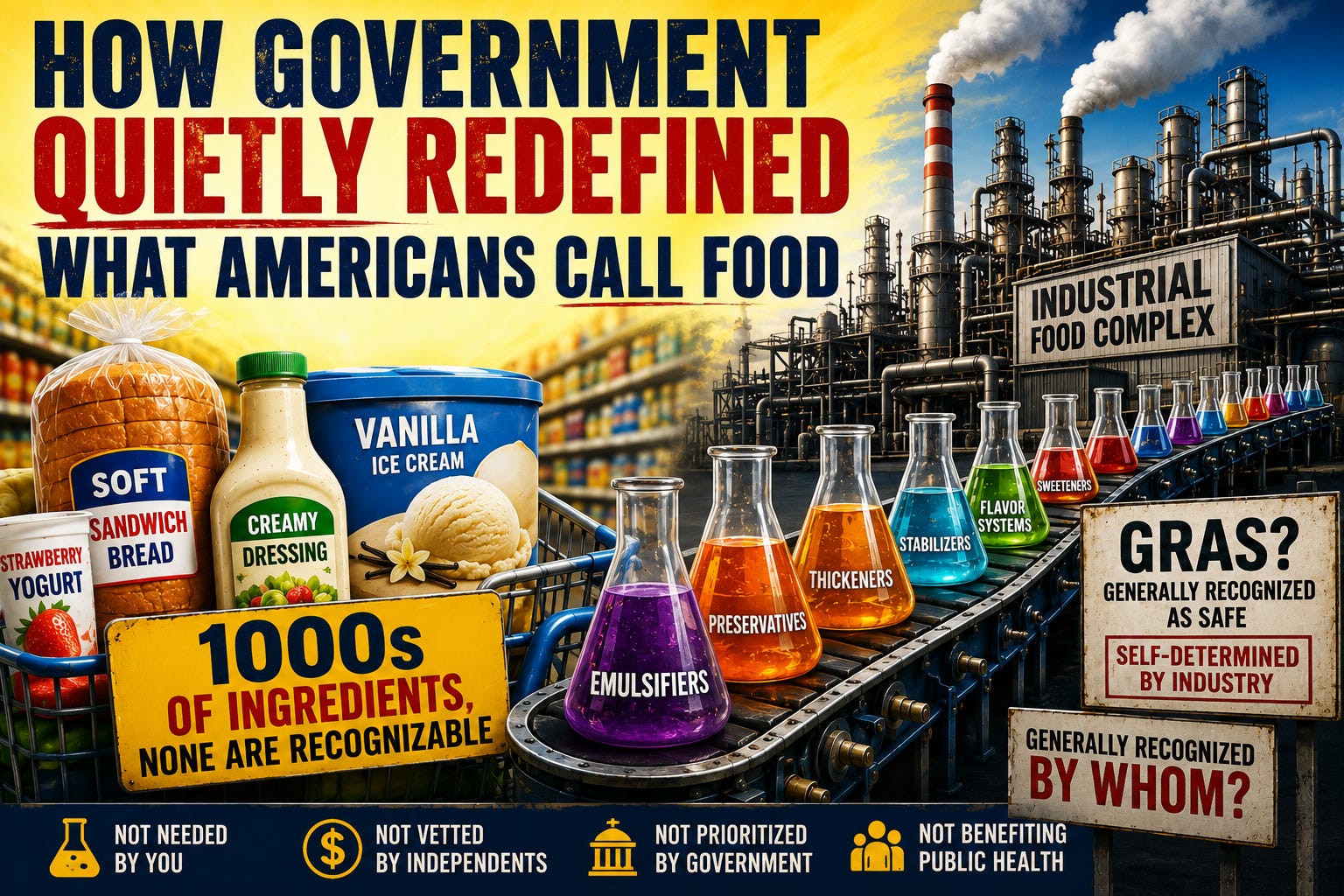
GRAS: How Government Quietly Redefined What Americans Call Food
Walk through any supermarket today and pick up a loaf of bread. Chances are, the ingredient list contains twenty or thirty items. Yogurt often includes gums, stabilizers, modified starches, emulsifiers, flavor systems, and preservatives. Salad dressing reads like a chemistry experiment. Ice cream may contain ingredients your grandmother never heard of, much less kept in her pantry.
We have become so accustomed to these long ingredient labels that we rarely stop to ask a very simple question.
Who decided this was normal?
It wasn’t consumers asking for more emulsifiers. It wasn’t farmers demanding additional stabilizers or modified starches. It certainly wasn’t physicians asking for more processing aids, anti-caking agents, artificial flavor systems, or texturizers.
The answer is that this food system evolved through thousands of decisions made over the past seventy years by Congress, federal regulators, and the food industry. Together, they fundamentally changed what Americans eat. The result is a regulatory philosophy that assumes if another industrial ingredient can be shown to be reasonably safe, then it probably deserves a place in our food.
I believe that assumption deserves to be challenged.
One of the pillars supporting that philosophy is a regulatory designation known as GRAS, or “Generally Recognized As Safe.” Most Americans hear those words and assume the FDA has independently reviewed the ingredient, declared it safe, and given it the government’s blessing. That is not what GRAS necessarily means.
In fact, the phrase itself deserves much closer scrutiny.
Generally recognized by whom?
Most consumers probably imagine panels of independent government scientists reviewing years of evidence before deciding that a new ingredient belongs in the food supply. That is not how the modern system works.
Today, manufacturers commission safety studies, assemble scientific evidence, hire outside experts to review the data, and conclude that their own ingredient meets the legal standard for GRAS. Those experts are often accomplished toxicologists, physicians, and food scientists. Their credentials are usually not the issue. The more important questions are who selected them, who paid them, and whether the public should consider that an adequate substitute for truly independent review.
Even more surprisingly, companies are not always required to submit those determinations to the FDA before marketing an ingredient. Many voluntarily notify the agency. Others do not. The FDA may never independently review some GRAS determinations before products appear on grocery store shelves.
Imagine applying that philosophy somewhere else.
Suppose a pharmaceutical company commissioned its own safety studies, hired its own panel of experts, concluded its new drug was safe, and then placed it on the market without mandatory FDA review. Americans would rightly object. We expect an independent referee for medicines. Well, to be honest, the independence is an arguable point. But you get the issue.
Yet when it comes to thousands of food ingredients that millions of Americans consume every day, the public has been led to believe a level of independent oversight that rarely exists.
Underlying all of this is the persistent problem of regulatory capture. The FDA is charged with protecting the public, yet it operates in a system where the industries it regulates wield enormous financial and political influence. Senior officials routinely move between regulatory agencies and the food, pharmaceutical, biotechnology, and consulting industries, creating the perception, and at times the reality, of a revolving door.
Congress has repeatedly expanded the FDA's responsibilities without demanding a corresponding level of truly independent scientific oversight. Industry-funded studies often form the backbone of regulatory decisions, advisory committees may include experts with financial ties to regulated companies, and post-government employment opportunities inevitably raise questions about institutional bias. None of this requires outright corruption to erode public confidence.
A regulatory culture can gradually come to identify with the industries it oversees rather than the consumers it is supposed to protect. When that happens, the agency's default question shifts from "How do we protect the public?" to "How do we accommodate industry while managing acceptable levels of risk?" That is the essence of regulatory capture, and it is a problem that extends far beyond food regulation.
To be fair, food additives and prescription drugs are not the same. Congress never intended them to be regulated identically. That is not the point. The point is that the phrase “Generally Recognized As Safe” conveys a level of independent scientific consensus that many consumers assume includes the government itself. In many cases, it does not.
America has become heavily dependent on overseas manufacturers, particularly in China, for a wide range of food ingredients, vitamins, amino acids, enzymes, gums, and food-processing chemicals. That dependence means our food supply increasingly relies on manufacturing practices occurring thousands of miles away, with FDA oversight largely exercised through importer verification. There is no country-of-origin labeling for most food additives, leaving consumers unable to make informed choices about where these industrial ingredients were manufactured.
Why was GRAS created?
This is the opposite of what Congress intended when it created GRAS in 1958.
At the time, lawmakers were trying to solve a practical problem. They wanted genuinely new food additives to undergo safety review, but they also recognized that no one needed federal scientists determining whether salt, butter, vinegar, wheat flour, or black pepper were safe. Those foods had already survived the most important safety study imaginable: centuries of human consumption. GRAS was designed to protect real food from unnecessary bureaucracy. Instead, somewhere along the way, GRAS became part of the framework supporting an increasingly industrialized food supply.
Today, depending on how they are counted, the American food supply contains roughly 10,000 to 12,000 intentionally added ingredients. Preservatives. Emulsifiers. Stabilizers. Gums. Sweeteners. Modified starches. Artificial and natural flavor systems. Processing aids. Enzymes. Coloring agents. Texturizers. Countless compounds that did not exist when Congress wrote the law.
That raises another simple question.
Needed by whom?
Most of these ingredients were not developed because consumers demanded them.
They exist because manufacturers wanted products with longer shelf lives, more consistent textures, improved freeze-thaw stability, standardized flavors, nationwide distribution, lower production costs, and fewer losses during transportation.
Those are perfectly rational business objectives.
They are not public health objectives.
At some point, the government stopped asking whether a new industrial ingredient actually improved the American diet. Instead, regulators increasingly asked only whether the ingredient appeared sufficiently safe under existing standards.
Those are profoundly different questions.
Perhaps the greatest irony is that government nutrition policy has spent decades warning Americans to eat healthier while simultaneously building a regulatory environment that made ultra-processed foods easier and more profitable to manufacture.
History demonstrates why that philosophy deserves far more skepticism than it has received.
For decades, partially hydrogenated oils, better known as artificial trans fats, carried GRAS status. Manufacturers loved them because they were inexpensive, extended shelf life, tolerated repeated heating, and improved the texture of countless processed foods. Crackers, cookies, pastries, margarine, frostings, fried foods, and packaged snacks all benefited.
Consumers trusted them because they assumed ingredients found throughout the food supply had already been thoroughly vetted.
Eventually, science caught up.
Large epidemiologic studies have demonstrated that artificial trans fats increase the risk of cardiovascular disease by raising LDL cholesterol, lowering HDL cholesterol, and promoting systemic inflammation. What had once been considered an innovative food technology became recognized as one of the most harmful dietary changes of the twentieth century. After years of pressure from scientists and consumer advocates, FDA finally revoked their GRAS status.
The lesson is not simply that regulators got one ingredient wrong.
The lesson is that they asked the wrong question.
The question was never whether trans fats could be manufactured safely.
The question should have been why Americans needed industrially hydrogenated oils in their food in the first place.
But it gets worse: eliminating trans fats did not eliminate highly processed foods. Instead, manufacturers often replaced them with refined seed oils, palm oil, and engineered fat blends that remain common in ultra-processed products. Thus, while one class of harmful fats largely disappeared, another experimental GRAS product replaced it.
The same philosophy continues today.
Take seed oils. Soybean oil, canola oil, corn oil, sunflower oil, and similar oils all qualify as GRAS. That designation says they are generally recognized as safe food ingredients under their intended conditions of use. It says nothing about whether replacing traditional animal fats with industrially refined vegetable oils has improved metabolic health. It says nothing about oxidation products created during repeated heating, the dramatic increase in omega-6 consumption, or the central role these oils play in ultra-processed foods. Those questions remain the subject of vigorous scientific debate, yet they largely fall outside the traditional GRAS framework.
Modern chronic disease is not driven by a single preservative, one emulsifier, or one food dye. Americans consume thousands of industrial ingredients in combinations that no human population had ever experienced before the second half of the twentieth century. Our regulatory system continues to evaluate most of these ingredients individually, while paying comparatively little attention to the cumulative effects of an increasingly industrialized diet.
If you think this article raises important questions, please share it.
The more Americans understand how our food supply has changed and why, the harder it becomes to ignore the need for real reform. Conversations like this don’t begin in Washington. They begin with informed citizens.
Thank you for helping spread the word.
This brings us to MAHA-DC.
Much of the current discussion in the government focuses on banning a handful of food dyes, removing several controversial preservatives, or replacing one additive with another. Those efforts may be worthwhile. But they leave the underlying philosophy untouched.
Lipstick on a pig.
If MAHA-DC spends the next four years banning GRAS food additives one by one, it will still leave intact the regulatory system that produced thousands of them in the first place. That is not reform. It isn’t even maintenance.
The larger question is whether the government should continue to assume that every industrial ingredient deserves a place in the American food supply unless someone can eventually prove it is harmful.
I would argue exactly the opposite.
Manufacturers should never be the primary arbiters of what enters the American food supply, and the FDA should never function as little more than a passive reviewer of industry-generated science. If a company wishes to introduce another industrial ingredient into foods consumed by millions of Americans, the burden should rest with both the manufacturer and the FDA to demonstrate not only that the ingredient is unlikely to produce obvious toxicity, but that it provides a meaningful public health benefit that cannot reasonably be achieved through simpler, more traditional foods. Extending shelf life, improving manufacturing efficiency, surviving cross-country shipping, reducing waste, and increasing corporate profit margins may be excellent business objectives, but they are not public health objectives.
The FDA's mission is not to facilitate the industrialization of the food supply. Its mission is to protect and improve the public's health. Somewhere along the way, those two goals became reversed.
Americans should know what chemicals are entering their food, and in the short term, the FDA should review every new (and old) GRAS determination. But requiring another form, another notification, or another government database is not the same as reforming the philosophy that created the problem. It simply adds another layer of process to a system that still begins with the assumption that another industrial ingredient probably belongs in our food unless someone can prove otherwise.
The real failure of GRAS is not that companies frequently self-determine the safety of their own ingredients. The real failure is that Congress and the FDA rarely ask whether another industrial ingredient is needed in the first place. The government has spent decades evaluating whether additives can be safely incorporated into increasingly processed foods, rather than asking how to encourage a food system that relies on fewer additives altogether. How can Congress modify GRAS back to its original intent? HHS Secretary should be lobbying Congress to do exactly that. It is the conversation MAHA should be leading and isn’t.
Perhaps the most important question is not “Generally recognized by whom?”
It is “Benefiting whom?”
Consumers?
Farmers?
Public health?
Or an industrial food system that has become extraordinarily good at manufacturing products that make America progressively sicker?
Congress created GRAS to protect salt, butter, flour, vinegar, and other real foods from unnecessary regulation. Instead, it created a regulatory philosophy that has steadily expanded the industrialization of the American diet while reassuring consumers that everything was “generally recognized as safe.”
It is time to retire that philosophy.
The purpose of food policy should not be to determine how many industrial ingredients can be squeezed into the food supply under an increasingly elastic definition of safety.
The purpose of food policy should be to maximize the amount of real food on the American dinner table.
Somewhere over the past seventy years, Congress forgot that distinction.
I am increasingly concerned that the MAHA-DC has forgotten it as well.
If you found this essay valuable, please consider becoming a paid subscriber.
The real story is almost never in the headlines. It takes time to dig through legislation, regulatory history, scientific papers, and government documents to understand how we got here and, more importantly, where we are headed. Your subscription helps make that work possible.
Thank you for reading and for supporting independent journalism.
It is interesting how fake meat has so far been soundly rejected, while fake most everything else flies off the grocery store shelves.
What if the food industry was in cahoots with the medical industry? All these damn diseases and conditions that have become “typical” for our society……overweight, diabetes, heart disease, and the myriad of cancers as well as others too numerous to name here. They throw cheap “fillers” in the food and no one is the wiser. The more we eat, the worse we get. And hasn’t childhood cancer been on the rise? Newborns with brain tumors and other complex cancers.
What with seeds being GMO altered, how can we trust that the original nutrition is still in our crops? No one asked us if we wanted to eat that crap…..? And as for those nutballs suggesting we all eat bugs…. well, you know where you can stick that!