

Audio:
Three years ago, we wrote about a joint UK and German Ministry of Defense report titled Human Augmentation – The Dawn of a New Paradigm (1,2). At the time, many critics dismissed the document as speculative futurism, military fantasy, or the fever dream of transhumanists intoxicated by Silicon Valley ideology.
It is no longer possible to deny the reality of the situation - human augmentation is being developed more rapidly than we all could have imagined.
What was once presented as theoretical is now becoming operational doctrine.
The discussion has shifted. Human augmentation is no longer framed primarily as a distant ethical dilemma. It is increasingly being treated by military planners, AI developers, and national security bureaucracies as an unavoidable strategic necessity. The language has changed from “should we?” to “how fast can we deploy it before our adversaries do?”
That should alarm everyone.
The original report argued that future wars would not be won by whoever possessed the best machines, but by whoever most effectively merged human beings with machines (2). At the time, that sounded like science fiction to many.
But look around today. AI copilots are everywhere. Autonomous drones -which rumor has it are capable of deciding who lives and who dies without a human pulling the trigger- dominate modern battlefields. Machine-learning systems increasingly assist intelligence analysis, targeting, surveillance, logistics, and command decisions.
The battlefield envisioned by the report is arriving faster than even its authors predicted.
And the missing piece is no longer the machine.
It is the human.
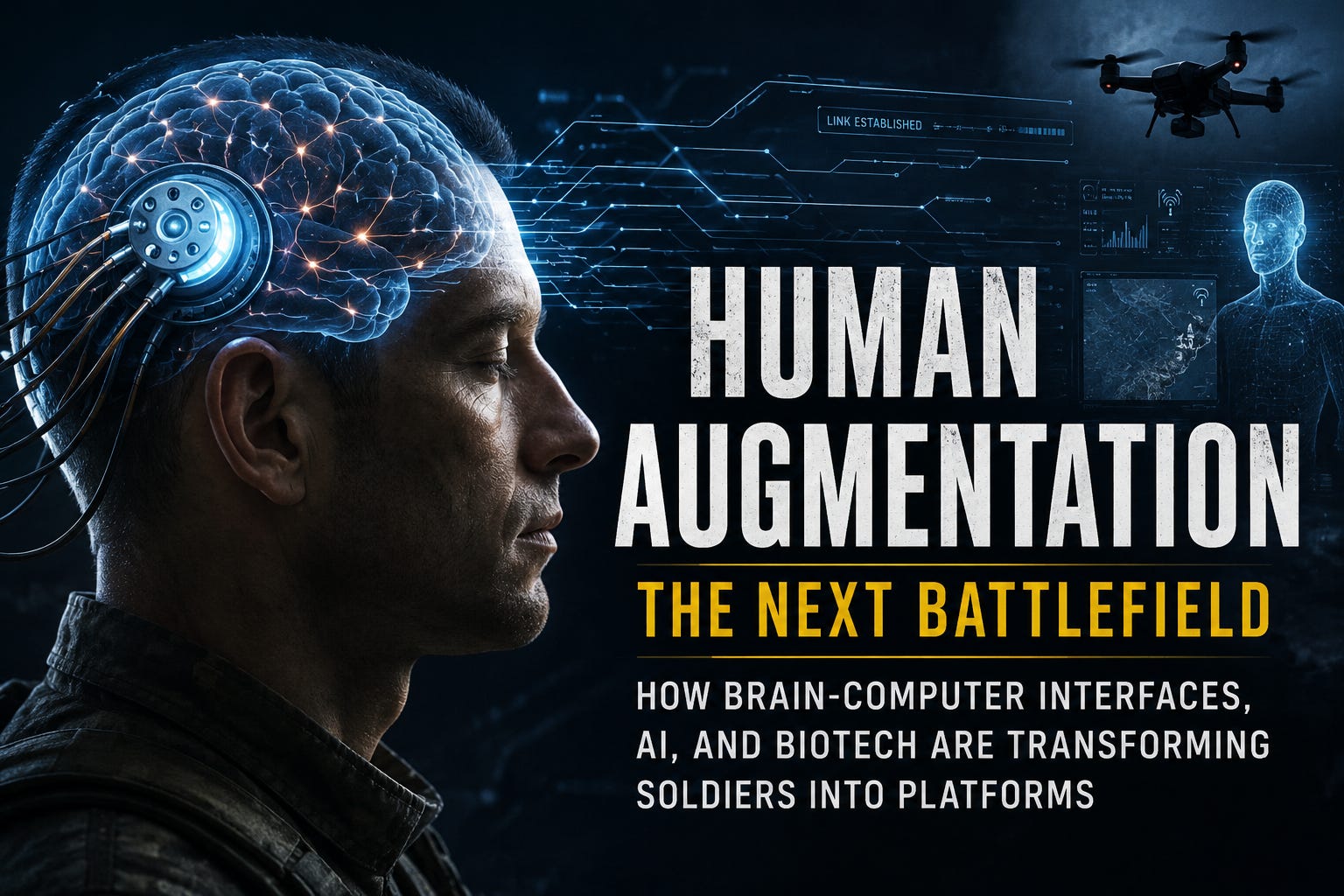
Military planners are now openly discussing ways to optimize cognition, decision speed, stress tolerance, fatigue resistance, emotional regulation, and direct brain-machine communication. Not someday. Now.
DARPA has aggressively advanced programs designed to create high-performance brain-computer interfaces for military personnel (3). The stated goal is to allow soldiers to directly interact with autonomous systems, including drone swarms and AI-assisted battlefield platforms. Recent military papers openly discuss reducing “cognitive overload” through neural interfaces linked to machine-learning systems (5).
Think carefully about what that means.
The problem modern warfare faces is not merely firepower. It is information saturation. The side that can process information faster, fuse data more efficiently, and shorten decision loops gains overwhelming advantage. Human augmentation is increasingly viewed as the solution.
This is not about stronger muscles or robotic exoskeletons, although those continue to be developed for logistics and battlefield endurance (8). The real focus has shifted toward the brain itself.
Cognitive warfare.
Neurostimulation.
Behavioral optimization.
AI-linked command systems.
Pharmacologic enhancement.
Predictive biometric monitoring.
Direct neural integration with machines.
This is where the money is going.
And once again, the same rhetorical pathway appears that we have seen so many times before. The technologies are introduced under the banner of therapy, rehabilitation, safety, and medical necessity. Advanced prosthetics become enhanced prosthetics. Neurological rehabilitation becomes cognitive optimization. Monitoring for wellness becomes monitoring for performance and compliance.
The line between treatment and enhancement rapidly disappears.
That is not speculation. That is exactly what military and bioethics literature is now openly discussing (7,9).
One of the most disturbing developments over the last three years is how quickly ethical resistance has softened inside defense circles. Increasingly, military ethicists argue that democratic nations may need to loosen ethical restrictions on enhancement technologies because authoritarian adversaries will not hesitate to deploy them (6).
In other words, the moral argument is becoming secondary to geopolitical competition.
The logic is brutally simple:
If China develops enhanced warfighters and the West refuses to compete, the West loses.
That argument is now appearing with increasing frequency in military policy discussions.
The original UK-German report bluntly stated that human augmentation should not ultimately be decided by ethicists or public opinion, but by national interest (2). At the time, that statement shocked many readers. Today it reads less like a warning and more like a roadmap.
Perhaps the most profound shift since 2022 is cultural.
The public has already been conditioned for much of this transition.
Millions of people now voluntarily wear devices that continuously track sleep, heart rate, movement, stress, location, temperature, and biological activity. AI systems increasingly monitor behavior, communications, productivity, and emotional state. Entire generations have normalized the idea that biological and behavioral data should be constantly harvested, analyzed, and fed into algorithmic systems.
Human beings are gradually being transformed into integrated biological data platforms.
And once that infrastructure exists, military and state applications inevitably follow.
The old industrial model treated humans as machine operators.
The emerging biotech model treats humans themselves as programmable platforms.
That is the real paradigm shift.
What makes this especially dangerous is the extraordinary hubris driving much of the field. Increasingly, scientists, technologists, military planners, and governments speak openly about directing human evolution itself through genetic engineering, neurotechnology, and AI-assisted biological modification (4).
Six million years of evolution are now viewed by some as merely an outdated starting point to be “optimized.”
History suggests caution here.
Every era that became convinced it could engineer a better human being eventually descended into ethical catastrophe. The tools change. The rhetoric modernizes. But the underlying temptation remains the same: centralizing power over biology itself.
And unlike the crude eugenics movements of the past, modern human augmentation is emerging wrapped in the language of medicine, national security, efficiency, resilience, and technological progress.
That makes it far more politically durable.
The greatest danger may not be some dramatic moment when governments announce the arrival of “enhanced humans.” The real danger is incremental normalization.
Small steps.
Therapeutic uses.
Military exemptions.
Workplace optimization.
AI-assisted monitoring.
Cognitive enhancement “for safety.”
Genetic modification “for resilience.”
Until eventually the infrastructure for total biological integration already exists before society fully understands what has happened.
Three years ago, many people laughed at the idea that governments and militaries were seriously planning for large-scale human augmentation.
They are not laughing anymore.
The frightening part is not that the technology is coming.
The frightening part is how quietly the debate is disappearing.
JGM/RWM
If you value work like this, please consider becoming a paid subscriber.
Researching, writing, editing, fact-checking, sourcing, and publishing essays like these takes an enormous amount of time and effort. Behind every article is not just our work, but the work of a dedicated team helping to manage research, production, editing, technical support, and the daily demands of keeping this platform running.
We do not have the backing of large corporate media organizations, pharmaceutical advertisers, or institutional funding streams. This publication exists because readers choose to support independent journalism, independent analysis, and the freedom to ask difficult questions.
Your subscription directly supports our staff, our investigations, our writing, and our ability to continue producing long-form work that many other outlets will not touch.
If this work matters to you, please help us continue.
References
Malone RW. Human Augmentation: The Dawn of a New Paradigm. Malone News. January 2022.
https://www.malone.news/p/human-augmentation-the-dawn-of-aUK Ministry of Defence and German Federal Ministry of Defence. Human Augmentation – The Dawn of a New Paradigm: A Strategic Implications Project. May 2021.
https://assets.publishing.service.gov.uk/media/60c749f8d3bf7f4bd0e3b1a5/Human_Augmentation_SIP_access2.pdfDARPA. Next-Generation Nonsurgical Neurotechnology (N3).
https://www.darpa.mil/research/programs/next-generation-nonsurgical-neurotechnologyDARPA. Safe Genes Program.
https://www.darpa.mil/research/programs/safe-genesShendruk TN et al. Brain Computer Interface Technology for Future Battlefield. arXiv. 2023.
https://arxiv.org/abs/2312.07818Small Wars Journal. Neither Ironman nor the Hulk: Human Enhancements for Military Purposes. January 2025.
https://smallwarsjournal.com/2025/01/24/neither-ironman-nor-the-hulk-human-enhancements-for-military-purposes/BMJ Military Health. Emerging Military Applications of Neuroenhancement and Cognitive Optimization. 2025.
https://militaryhealth.bmj.com/content/early/2025/08/18/military-2025-002964Wired Magazine. The US Army’s Vision of an Exoskeleton Future Lives On.
https://www.wired.com/story/the-us-armys-vision-of-an-exoskeleton-future-lives-onNational Library of Medicine / PMC. Ethical and Policy Challenges in Human Enhancement Technologies.
https://pmc.ncbi.nlm.nih.gov/articles/PMC12799693/
We never owned a smart phone, pay cash whenever we can, and ditched our Garmin watch long ago. We must stay in touch in the physical world or we will lose our humanity.
Check out some related material here:
REAL ID, a national digital identification, surveillance, and control system. Short link for sharing: https://tinyurl.com/3pjcv7y2
You don't even need implants or machine enhancements.
People on drugs and vaccines and those who rely on AI for morality and companionship are augmented (or diminished, depending on how you look at it).
All this is chilling and will lead us down the road to you-know-where.