

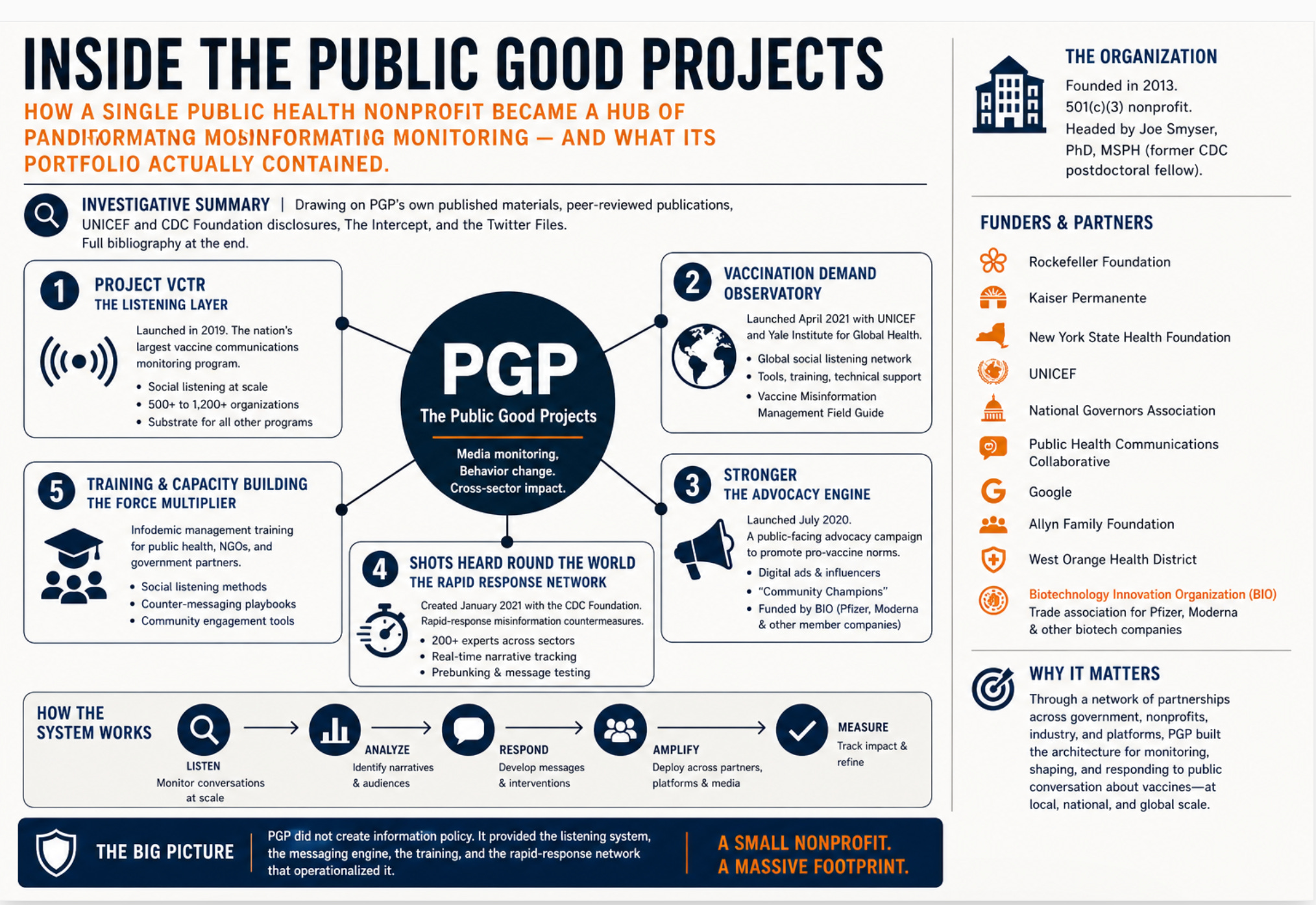
Inside The Public Good Projects
How a single public health nonprofit became a hub of weaponized pandemic-era “misinformation” monitoring, and what its program portfolio actually contained.
An investigative summary | Drawing on PGP’s own published materials, peer-reviewed publications, UNICEF and CDC Foundation disclosures, The Intercept, and the Twitter Files. Full bibliography at the end.
Most observers of pandemic-era information policy have heard of one or another piece of the apparatus. The Stanford Virality Project, the CDC Foundation’s Partnering for Vaccine Equity, the BIO-funded “Stronger” campaign, the rapid-response Shots Heard network: each has its own story. Fewer have noticed that a single small New York-based nonprofit sat at or near the center of nearly all of them.
That nonprofit is The Public Good Projects, or PGP. Founded in 2013 and granted 501(c)(3) status in 2014, PGP describes itself as a public health organization “specializing in large-scale media monitoring programs, social and behavior change interventions, and cross-sector initiatives” [1]. By the height of the COVID-19 pandemic, it was operating a portfolio of programs whose combined reach across federal agencies, multinational institutions, pharmaceutical trade groups, and major social media platforms was substantially larger than any single one of its programs would suggest.
This is an attempt to map that portfolio.
I. The Organization
PGP is led by Joe Smyser, PhD, MSPH, who completed postdoctoral training at the CDC before joining the organization. By 2024 PGP’s public materials described it as designer of “some of the United States’ most influential and impactful health campaigns to date in partnership with the CDC, FDA, Kaiser Permanente, Rockefeller, and Humana” [2]. The organization’s campaigns have spanned vaccine confidence, mental health, the opioid crisis, reproductive health, tobacco control, school nutrition, and domestic violence. In the aggregate, this portfolio places PGP within a comparatively small group of nonprofits operating at this scale and reach.
PGP’s funder list, drawn from its own published materials, IRS filings, and grantee profiles, includes the Rockefeller Foundation, Kaiser Permanente, the New York State Health Foundation, UNICEF, the National Governors Association, Public Health Communications Collaborative, the West Orange Health District, the Allyn Family Foundation, Google, and, most controversially in retrospect, the Biotechnology Innovation Organization, the trade association whose members include Pfizer and Moderna [3][4].
It is the breadth of this funder mix, combined with the fact that PGP routinely operated programs that were technically distinct yet practically braided, that makes the organization itself, rather than any single one of its programs, the more illuminating unit of analysis.
II. Project VCTR: The Listening Layer
PGP’s foundational program in this domain is Project VCTR (“Vaccine Communication Tracking Resource”), launched in 2019. By PGP’s own description, Project VCTR is “the nation’s largest vaccine communications monitoring program,” in use by more than 500 health organizations at one count and over 1,200 at another [2]. Its function is social listening at scale, continuously monitoring online conversations across platforms to identify trends, networks, and emerging narratives related to vaccines, with particular attention to vaccine hesitancy and opposition.
Project VCTR is the substrate beneath much of what PGP did during the pandemic. It is the surveillance and analytics layer; everything that follows draws on the data it generates: advocacy campaigns, content-moderation flagging, training programs, and rapid-response networks.
The program is presented in PGP’s materials and in commissioned overviews for the National Academies of Sciences, Engineering, and Medicine as a tool of “infodemic management” [5]. That phrase, borrowed from the World Health Organization, is doing significant work. It frames the monitoring of online conversations about a public health intervention as a public health activity in itself, rather than as a form of intelligence-gathering on private speech. Whether one accepts that framing largely determines how one views everything else, PGP did.
III. The Vaccination Demand Observatory
In April 2021, PGP partnered with UNICEF and the Yale Institute for Global Health to launch the Vaccination Demand Observatory, a global extension of the Project VCTR model. Per the joint press release: “To combat vaccine hesitancy worldwide, PGP, UNICEF and Yale Institute for Global Health launched the Vaccination Demand Observatory today… [It] is developing tools, training, technical support and research to equip in-country teams to mitigate the impact of misinformation and mistrust on all vaccines” [6].
The Observatory established social listening programs across UNICEF country offices, with first on-the-ground deployment in multiple West African countries supporting UNICEF polio teams. It also published the multilingual Vaccine Misinformation Management Field Guide in December 2020, which provided national governments and NGOs with a structured methodology for “rapidly countering vaccine misinformation and building demand for vaccination” [6].
This is the same template as Project VCTR (listen at scale, identify hostile narratives, develop counter-messaging) but operating at the scale of a UN agency’s global footprint. It is an instructive example of how a relatively small American nonprofit’s methodology became, through an institutional partnership, an instrument of global vaccine communications policy.
IV. Stronger: The Advocacy Engine
Stronger was launched by PGP in July 2020, six months into the pandemic and several months before any COVID-19 vaccine was authorized. PGP’s own announcement described it as “a first-of-its-kind national advocacy campaign against misinformation and for vaccines” [7]. Unlike Project VCTR, which was monitoring infrastructure, Stronger was action-oriented: “the campaign will show people how to block, hide, and report misinformation. People can also report to the campaign, and it will do it for them” [7].
In other words, Stronger was a crowdsourced content-flagging operation. Members of the public could report content they considered misinformation, and Stronger would then route those reports through to the relevant platforms. The campaign also used social network analysis to identify “falsehoods on the verge of going viral” and to direct support to clinicians under attack online for promoting vaccines [7].
Stronger was funded by the Biotechnology Innovation Organization, the pharmaceutical industry trade association representing Pfizer, Moderna, and other COVID-19 vaccine manufacturers. According to internal Twitter records released after Elon Musk’s acquisition of the platform and reported by Lee Fang in The Intercept, BIO provided $1,275,000 to Stronger over the course of the campaign [8]. PGP CEO Joe Smyser, in his on-record interview with Fang, characterized the funding arrangement as follows: “BIO contributed money and said, ‘You guys are planning on running a pro-vaccine, anti-vaccine misinformation effort and we will give you $500,000 [per year] no questions asked’” [8].
The internal records showed that PGP’s engagement with Twitter under the Stronger umbrella went well beyond simple content reports. According to Fang’s reporting, PGP staff worked with Twitter to help develop automated tools for moderating vaccine-related content; sent regular emails to Twitter’s trust-and-safety team containing lists of accounts and tweets recommended for action; influenced which public health accounts received platform verification; and maintained a direct line of communication with the Twitter lobbyist who served as the company’s point of contact with the Biden administration [8].
Some of what Stronger flagged was straightforward. Other items were not. Fang’s reporting noted at least one tweet that posed a policy question about vaccine passports given the Delta variant’s transmission characteristics among vaccinated and unvaccinated individuals, a question being openly debated in the public health and bioethics literature at the time. A February 2022 PGP email to Twitter, included in the published reporting, attached a “misinfo report” acknowledging that the New York Times articles in question “do not contain misinformation themselves but are using the news to further prove the CDC is untrustworthy,” and recommending action regardless [8].
V. ThisIsOurShot and VacúnateYa: The Trusted-Messenger Layer
Where Stronger operated as a flagging-and-takedown engine, ThisIsOurShot and VacúnateYa operated as their inverse: amplification networks built around trained physician messengers. Both were national grassroots campaigns coordinated by PGP, designed (in the language of a 2023 Annals of Internal Medicine case study authored by their leadership) “to spread accurate health information on social media and address false information” [9].
The case study describes a model in which 15 medical professionals partnered with more than 60 organizations to build a diverse team of clinician messengers, train them in social media engagement, monitor viral rumors and false information online, design counter-messaging, and engage with both digital and in-person communities [9]. ThisIsOurShot received institutional backing from the American Medical Association and the National Association of Manufacturers, among others; VacúnateYa was its Hispanic-community counterpart [10].
In structural terms, the relationship to Project VCTR is again the operative one. The trusted-messenger campaigns drew on PGP’s monitoring infrastructure to identify what to push back against, and the trained messengers then provided the human face of the response.
VI. Shots Heard Round the World: One Program Among Many
Shots Heard Round the World is the program that has drawn the most public attention, partly because of its origin story (the 2017 anti-vaccine harassment campaign against Kids Plus Pediatrics in Pittsburgh) and partly because its co-founder Dr. Todd Wolynn became one of the more visible public faces of pro-vaccine advocacy during the pandemic [11].
In the larger PGP architecture, however, Shots Heard occupied a relatively narrow operational lane. It was the rapid-response defense arm: a vetted, private network of clinician volunteers, organized through a closed Facebook group and listserv, that activated when an individual healthcare provider, practice, or hospital came under coordinated anti-vaccine attack online. Volunteers would post pro-vaccine content on the targeted page to draw attackers away, report harassing accounts and fraudulent reviews to platforms, and coach the targeted provider on bulk-blocking and moderation tools. The organization’s Toolkit, distributed in four languages, codified this methodology [12][13].
Wolynn, after Shots Heard was folded into PGP’s portfolio, took the title Executive Director of PGP’s Trusted Messenger Program. That title placed him in a leadership role across multiple PGP programs simultaneously [14].
It is worth being precise here. Shots Heard’s own published activity was reactive defense of identifiable victims, not proactive misinformation surveillance. The proactive surveillance and flagging operation was Stronger. The trusted-messenger amplification network was ThisIsOurShot and VacúnateYa. The monitoring substrate beneath all of them was Project VCTR. Shots Heard was one program in a portfolio: the visible defensive piece of an infrastructure whose other components were less visible but, in policy terms, considerably more consequential.
VII. The CDC Foundation Pipeline
Running parallel to its industry-funded work, PGP became a sub-grantee of the CDC Foundation under the agency’s Partnering for Vaccine Equity (P4VE) program. A peer-reviewed Journal of Community Health article authored by PGP staff disclosed the funding structure verbatim: “The project was funded by the CDC Foundation under a financial assistance award supported by the Centers for Disease Control and Prevention of the U.S. Department of Health and Human Services (HHS) totaling $25,660,048 with 100 percent funded by CDC/HHS” [15].
Under this funding, PGP partnered with the Hispanic Communications Network and World Voices Media on a multifaceted campaign to address COVID-19 vaccine hesitancy in Hispanic communities. The campaign, called El Beacon, had its digital-volunteer methodology written up in the Health Promotion Practice journal [16]. The methodology was familiar: monitor misinformation in the relevant linguistic and demographic space, recruit and train volunteer messengers, deploy counter-messaging, evaluate outcomes.
The CDC Foundation, established by Congress as the “sole entity authorized” to raise private funds for the CDC [17], occupies an unusual structural position. It is a 501(c)(3) public charity, formally independent of the CDC, but its programmatic activity is tightly coordinated with the agency’s public health priorities. When CDC dollars flow through it to organizations like PGP, the funds carry both federal authority and the operational flexibility of private grant-making. For an organization simultaneously receiving pharmaceutical-industry money, this represents a particularly clean way of holding both relationships at once.
VIII. The Moderna Engagement
PGP’s direct engagement with Moderna emerged in 2024 in a series of investigative reports by Lee Fang, drawing on internal Moderna documents and what he called the “Moderna Reports” [18]. According to the reporting, Moderna contracted with PGP and a network of former public health officials and law enforcement consultants on a coordinated misinformation-response operation that included an Infodemic Training Program reaching approximately 45,000 healthcare professionals and AI-driven monitoring of online conversations involving named public figures.
Among those reportedly subject to such monitoring were comedian Russell Brand, U.S. Senator Rand Paul (R-KY), and journalists Michael Shellenberger and Alex Berenson. According to the underlying documents, in some cases the monitoring was triggered not by specific false claims but by the figures’ reach and influence within COVID-skeptical audiences. PGP, which received funding from BIO during the same period, also figured in the reporting as a coordinator of social-media flagging activity that, per Fang, sometimes targeted material the organization itself acknowledged was not factually false but was deemed to undermine trust in CDC guidance [18].
IX. The Architecture, in Sum
Viewed as a whole rather than program by program, PGP’s pandemic-era operation looked roughly like this:
• Project VCTR provided continuous social-listening surveillance across the U.S. domestic information environment.
• The Vaccination Demand Observatory extended that surveillance globally through UNICEF’s country-office network.
• Stronger, funded by the pharmaceutical industry’s trade association, turned that surveillance into action by sending lists of accounts and tweets to Twitter’s trust-and-safety team and helping develop the platform’s automated content-moderation tools.
• ThisIsOurShot and VacúnateYa amplified counter-messaging through trained physician messengers.
• Shots Heard Round the World provided rapid defensive response when individual clinicians came under coordinated attack.
• The El Beacon campaign, funded through the CDC Foundation with federal CDC/HHS dollars, applied the same methodology to Hispanic communities at a cost of $25.66 million.
• A direct Moderna engagement, separately reported, layered AI-driven surveillance and 45,000-person training onto the existing infrastructure.
These programs were legally distinct, separately funded, and presented to the public under different brand names. They shared a single organizational home, a single operational methodology, and substantially overlapping leadership and staff.
X. The Open Questions
Several questions about PGP’s pandemic-era activity remain unresolved in the public record.
First, the line between “misinformation” and “material that undermines trust” appears to have been managed inconsistently across PGP programs. Stronger’s own February 2022 communications acknowledged flagging articles that were not factually false [8]. The Stanford Virality Project, which operated alongside PGP-style efforts and used similar methodologies, was later shown to have flagged true vaccine-side-effect testimonials and legitimate policy criticism [19]. How often PGP itself crossed similar lines, in which programs, and at whose direction: these are questions the public record does not yet resolve.
Second, the structural conflict of interest involved in receiving pharmaceutical-industry trade-association funding to monitor and flag online speech about pharmaceutical-industry products has not been adequately addressed by PGP itself, by the platforms that accepted its work product, or by the federal agencies whose programs ran in parallel. Smyser’s public statement that PGP “never flagged or focused on any drug industry content” [8] is a partial answer. It does not address whether the absence of such flagging was itself a function of who paid for the work.
Third, the institutional convergence raises governance questions that pandemic-era institutional review has largely avoided. A UN agency, a federal foundation, a pharmaceutical industry trade group, multiple major social-media platforms, and an academic institution all routed work through a single small nonprofit. The convergence may have been efficient. It may also have been precisely the kind of structural arrangement that public-private partnership frameworks are normally designed to prevent.
Conclusion
The Public Good Projects is not the largest player in the pandemic-era information landscape, nor is it the most familiar to the general public. But it is one of the more revealing ones, precisely because its program portfolio sits at the intersection of nearly every funding stream and institutional partner that mattered: federal agencies and their congressionally chartered foundation, the United Nations system, a major pharmaceutical-industry trade association, individual pharmaceutical manufacturers, leading social-media platforms, and one of the most prominent academic centers studying digital communication.
Shots Heard Round the World, the program most often cited in critical accounts, was a single visible piece of a substantially larger structure. Understanding that structure, including its funding, its methodology, and its institutional reach, is a precondition for any serious assessment of how the pandemic-era misinformation-response apparatus actually worked, who paid for it, and what its consequences were.
Bibliography
[1] The Public Good Projects. (n.d.). “About PGP.” publicgoodprojects.org. https://www.publicgoodprojects.org/
[2] National Conference on Health Communication, Marketing, and Media. (2021). “Dr. Joe Smyser, PhD, MSPH, Speaker Profile.” https://www.nchcmm.org/index.php/socialdeterminants?view=article&id=58&catid=11 (Description of Project VCTR as “the nation’s largest vaccine communications monitoring program.”)
[3] InfluenceWatch. (2024). “Public Goods Project.” Capital Research Center. https://www.influencewatch.org/non-profit/public-goods-project/ (Funder list, including Rockefeller Foundation, Kaiser Permanente, Google, NYS Health Foundation, BIO, and others.)
[4] New York Health Foundation. (2019). “Grantee Profile: The Public Good Projects, Inc.” https://nyhealthfoundation.org/grantee/the-public-good-projects-inc/
[5] The Vaccination Demand Observatory. (n.d.). “Resources.” https://www.thevdo.org/resources (NASEM workshop overview describing Project VCTR and the VDO as infodemic-management tools.)
[6] UNICEF, Yale Institute for Global Health, and The Public Good Projects. (2021, April 29). “Vaccination Demand Observatory launched to strengthen local communication programmes to address vaccine misinformation.” Joint press release. https://www.unicef.org/eap/press-releases/vaccination-demand-observatory-launched-strengthen-local-communication-programmes
[7] The Public Good Projects. (2020, July 15). “National Public Health Campaign Designed to Mobilize Support of Vaccines.” PR Newswire. https://www.prnewswire.com/news-releases/national-public-health-campaign-designed-to-mobilize-support-of-vaccines-301093876.html (Stronger campaign launch announcement; “supported by PGP, BIO, and individual donors.”)
[8] Fang, L. (2023, January 16). “Covid-19 Drugmakers Pressured Twitter to Censor Activists Pushing for Generic Vaccine.” The Intercept. https://theintercept.com/2023/01/16/twitter-covid-vaccine-pharma/ (BIO funding of $1,275,000 to PGP’s Stronger campaign; Joe Smyser on-record interview; February 2022 PGP-to-Twitter email regarding NYT articles “not misinformation themselves.”)
[9] Bhatt, J., Nakhasi, A., McDonald, A., et al. (2023). “The ThisIsOurShot and VacúnateYa Case Study,” reporting on national grassroots organizations spreading accurate health information on social media. Annals of Internal Medicine. (Coverage and citations via PGP LinkedIn announcement and case-study companion materials, bit.ly/TIOSVYCaseStudy.)
[10] American Medical Association. (2021, February 5). “#ThisIsOurShot elevates physicians’ voices supporting vaccines.” AMA COVID-19 Daily Update. https://www.ama-assn.org/delivering-care/public-health/thisisourshot-elevates-physicians-voices-supporting-vaccines
[11] Wolynn, T., & Hermann, C. (2021). “Shots heard round the world: better communication holds the key to increasing vaccine acceptance.” Nature Immunology, 22(9), 1068–1070. https://doi.org/10.1038/s41590-021-00998-y
[12] Hoffman, B. L., Felter, E. M., Chu, K.-H., Shensa, A., Hermann, C., Wolynn, T., et al. (2021). “#DoctorsSpeakUp: Lessons learned from a pro-vaccine Twitter event.” Vaccine, 39(19). PMC9351384. https://pmc.ncbi.nlm.nih.gov/articles/PMC9351384/
[13] Shots Heard Round the World. (2021). Shots Heard Toolkit: How Health Care Professionals Can Prepare For and Defend Against an Anti-Vaccination Attack. Vaccine Resource Hub. https://vaccineresourcehub.org/resource/toolkit-how-health-care-professionals-can-prepare-and-defend-against-anti-vaccination
[14] HealthDefend. (n.d.). “About.” HealthDefend.com. https://www.healthdefend.com/about (PGP as parent organization for Shots Heard, ThisIsOurShot, VacúnateYa, and Health Defend.)
[15] Dunn Silesky, M., Panchal, D., Bonnevie, E., et al. (2022). “A Multifaceted Campaign to Combat COVID-19 Misinformation in the Hispanic Community.” Journal of Community Health. https://doi.org/10.1007/s10900-022-01170-9 (CDC Foundation award disclosure: $25,660,048, 100% funded by CDC/HHS.)
[16] The Public Good Projects. (2024). “Digital Volunteers as Trusted Public Health Communicators.” Health Promotion Practice (Practice Note, El Beacon campaign methodology). Citation via PGP’s announcement on LinkedIn and journal publication.
[17] CDC Foundation. (n.d.). “FAQ” and “Partners.” cdcfoundation.org. https://www.cdcfoundation.org/FAQ (Established by Congress; sole entity authorized to raise private funds in support of CDC; partnership and conflict-of-interest framework.)
[18] Fang, L. (2024, January 16). “Exposed: Moderna’s Vaccine Against Vaccine Dissent.” RealClearInvestigations; companion reporting on Lee Fang Substack (leefang.com). https://www.realclearinvestigations.com/articles/2024/01/16/how_moderna_came_up_with_a_vaccine_against_vaccine_dissent_1004781.html (Reporting on Moderna’s contracts with PGP, the Infodemic Training Program reaching approximately 45,000 health care professionals, and AI-driven surveillance of figures including Russell Brand, Sen. Rand Paul, Michael Shellenberger, and Alex Berenson.)
[19] Taibbi, M. (2023, March 17). “Twitter Files #19: The Great Covid-19 Lie Machine, Stanford, the Virality Project, and the Censorship of ‘True Stories.’” Racket News / Twitter Files. (Reporting on Stanford’s Virality Project flagging of true vaccine-side-effect testimonials and legitimate policy criticism as ‘misinformation.’)
[20] Aspen Ideas Festival. (n.d.). “Joseph Smyser, CEO, The Public Good Projects.” Speaker biography. https://www.aspenideas.org/speakers/joseph-smyser (Smyser’s description of PGP’s portfolio, including Project VCTR, the Vaccination Demand Observatory, and Stronger.)
[21] Hoffman, J. (2020, February 4). “A Call to Arms: Under Attack, Pro-Vaccine Doctors Fight Back.” The New York Times; reprinted via Pennsylvania Immunization Coalition. https://immunizepa.org/a-call-to-arms-under-attack-pro-vaccine-doctors-fight-back/ (Origin of Shots Heard Round the World; Bigford and Baldwin rescue cases.)
[22] Nicklaus Children’s Hospital Continuing Medical Education. (n.d.). “Todd Wolynn, MD, Faculty Bio.” https://cme.nicklauschildrens.org/node/2327/bio/4466/view (Wolynn co-founded Shots Heard, now operated by The Public Good Projects.)
Note on sourcing: Where this piece relies on internal Twitter communications, those communications were reviewed and reported by Lee Fang under access granted by Twitter’s post-acquisition leadership. Fang has stated that searches were conducted by a Twitter attorney on his behalf, meaning the available record may be incomplete. Where this piece relies on tax disclosures, IRS Form 990 filings for The Public Good Projects, Inc. and the Biotechnology Innovation Organization were the underlying source. Where this piece relies on PGP’s own statements about its programs and funding, those statements come from PGP’s public materials, press releases, and the on-record interview given by CEO Joe Smyser to The Intercept.
So, our govt funded the GOF research that created COVID. Then used the FBI and other agencies plus funded NGO’s to censor free speech on privately owned platforms. Putting a bow on this. Our money paid for the whole shebang. Anyone feel now that we need a complete reset on how our govt works? A third party cannot come soon enough.
In the dreamlike world where there are clear clean blue skies, the temperature goes from 60 degrees in the morning to a comfortable dry 73 degrees. All my neighbors are friendly, we help each other, and I’m a free person that helps others, works hard to pay my bills, and isn’t coerced by anyone who’s main goal is to make money. Doesn’t it always go back to the almighty dollar, to hell with the welfare of others and their personal freedoms. Do whatever it takes to get people to do what I (we) want them to do, and we will profit. I’d love to live in a world where I’m really free. Why is that to much too ask?