

Audio Version:
Erica Samp did what the government told Americans to do. In 2021, facing an employer mandate, she received two doses of Moderna’s COVID-19 vaccine. She reports that her health deteriorated after the first dose and became dramatically worse after the second. She was subsequently diagnosed with encephalopathy and suffered serious vascular problems, vision and hearing loss, and debilitating headaches. Her medical bills eventually reached hundreds of thousands of dollars.
Samp also did what the government told injured people to do. She filed a claim with the Countermeasures Injury Compensation Program in February 2022, within the program’s one-year deadline. HRSA denied her claim in 2024, concluding that there was insufficient evidence that the vaccine directly caused her injuries. There was no appeal to an independent court, no discovery, and no jury.
So Samp did something else. She sued.
On May 19, 2026, Samp filed Samp v. Kennedy in federal court, seeking to force HHS to create the COVID-19 Countermeasures Injury Table required under the PREP Act. Such a table could fundamentally change the causation problem that defeated her CICP claim by establishing a presumption that specified injuries occurring within defined periods were caused by the covered countermeasure. HHS is now moving forward with that rulemaking, and the federal court has paused Samp’s lawsuit while it does so.
Her case brings us directly to Robert F. Kennedy Jr., because the Secretary Samp is suing is the same man who, before the election, promised to end the vaccine liability shield altogether.
Kennedy Promised to End the Liability Shield
On September 25, 2024, Representative Paul Gosar introduced the End the Vaccine Carveout Act. The bill would have dismantled key liability protections created by the 1986 National Childhood Vaccine Injury Act and removed COVID-19 vaccines from the PREP Act’s definition of covered countermeasures. People claiming vaccine injuries would once again have been able to sue manufacturers in state or federal court, with access to a jury, discovery, and the other protections of ordinary civil litigation (H.R. 9828, 118th Cong., 2024).
Robert F. Kennedy Jr. endorsed the legislation by name. In Gosar’s September 26, 2024 press release, Kennedy, then founder and chairman on leave of Children’s Health Defense, accused the four American vaccine manufacturers of having paid tens of billions of dollars in criminal penalties and argued that the 1986 liability protections had removed an essential incentive to make safer products. His conclusion left little room for ambiguity: “If we want safe and effective vaccines, we need to end the liability shield” (Gosar 2024). That was six weeks before the election.
React19, which represents Americans reporting COVID-19 vaccine injuries, also supported the legislation. The significance of Kennedy’s endorsement was not simply that he wanted injured people compensated. He endorsed restoring their ability to take manufacturers to court. The administrative compensation programs could remain, but they would no longer stand between an injured American and the right to pursue a civil case before a jury.
What Kennedy Has Actually Done
Kennedy has taken three actions that affect people injured by COVID-19 vaccines. None ended the liability shield he promised to end.
The first was useful, but limited. In April 2025, FDA ordered Pfizer, BioNTech, and Moderna to strengthen warnings for myocarditis and pericarditis, with revised labeling approved in June. The prescribing information estimates roughly eight cases per million doses among people ages six months through sixty-four, rising to roughly twenty-seven per million among males ages twelve through twenty-four. Those numbers require context.
Peer-reviewed studies have reported substantially higher rates in the highest-risk groups, particularly adolescent and young adult males following a second mRNA dose, with estimates ranging from roughly 50 to well over 100 cases per million and some product-specific estimates approaching 300 per million. The discrepancy reflects differences in vaccine formulation, dose number, age, sex, surveillance method, and risk window, but none of that is apparent to a patient reading the label. The revised warning is an acknowledgment of risk, but hardly a transparent or accurate account of the published literature (FDA 2025).
The label can nevertheless help an injured person establish causation. It does not compensate them or give them access to a court.
HHS also ended the COVID-19 emergency use declarations. That was widely reported as the end of the liability shield. It was not. Emergency Use Authorization and PREP Act immunity are separate legal authorities. The COVID-19 PREP Act declaration protecting manufacturers remains in force through December 31, 2029.
The third action remains unfinished. HHS is developing a COVID-19 Countermeasures Injury Table that would presume certain injuries occurring within specified time periods were caused by a covered countermeasure. That could make some CICP claims easier to prove. It still leaves those claims inside the same administrative compensation system Kennedy campaigned against as a substitute for access to the courts.
These are small changes to the system Kennedy inherited and are still incomplete. Big talk, small walk. The liability shield he promised to end remains untouched.
Claims Are Rejected. The Payouts Are Minuscule.
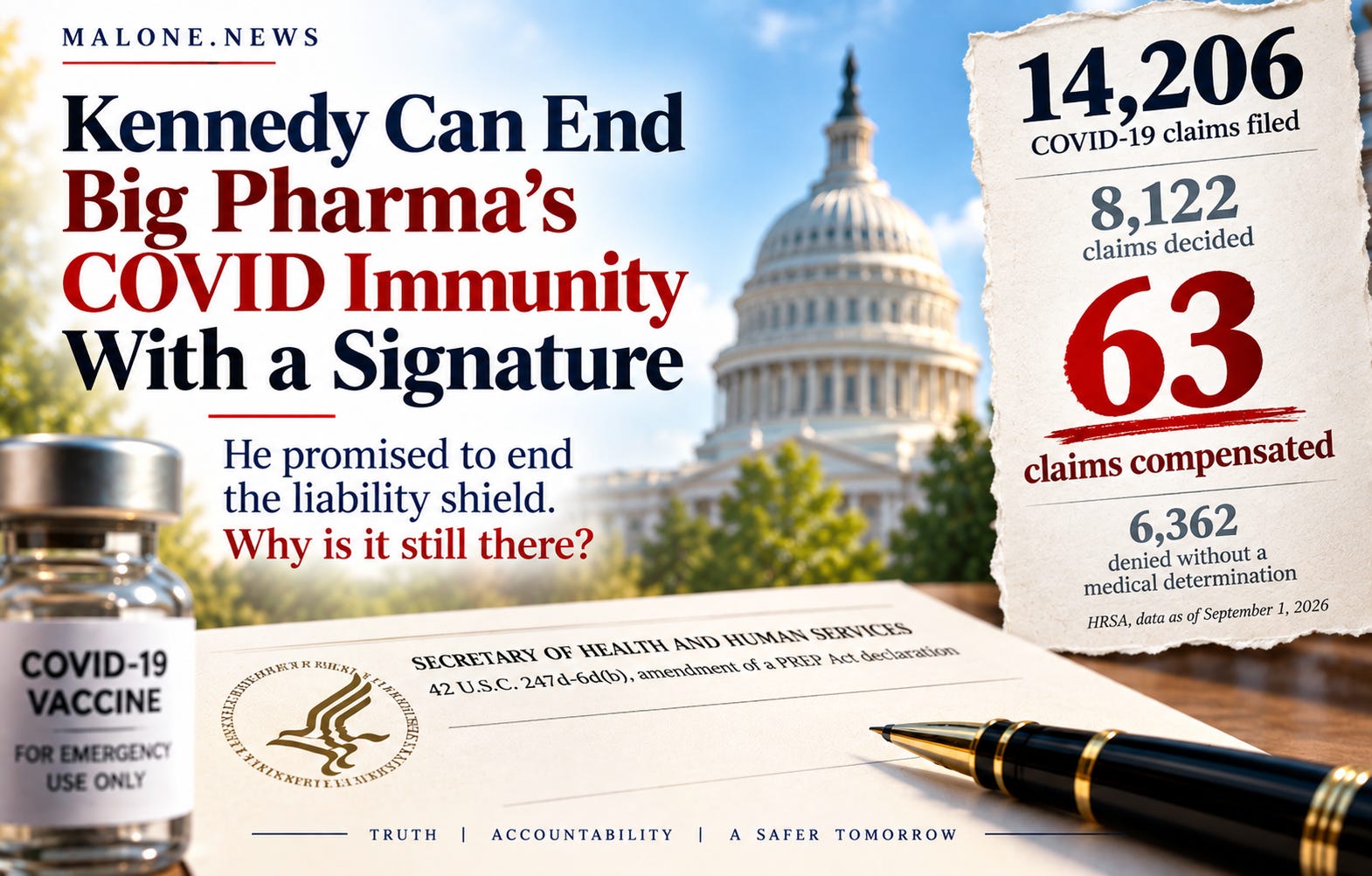
As of September 1, 2026, the CICP had received 14,206 COVID-19 countermeasure claims, including 11,145 alleging injury or death from a COVID-19 vaccine. The program had decided 8,122 claims and found only 120 eligible for compensation. Just 63 had actually been paid. That is less than one percent (0.78%) of claims were determined to be eligible (HRSA 2026a).
But the rejection rate hides something more important. Of the 8,002 denied claims, only 1,640 were rejected because the claimant failed to establish causation or a covered injury. Another 3,387 were denied because required medical records were not submitted, 2,711 missed the program’s one-year filing deadline, and 264 involved products the program did not cover.
That means 6,362 denials, or 79.5 percent, never reached a medical determination. Nearly four out of five rejected claims were disposed of without the government deciding whether the countermeasure actually caused the injury.
Those are not scientific determinations. They are consequences of how the program was designed to fail the victims. The one-year clock starts on the date the countermeasure was administered, not when an injury is finally diagnosed, a brutal standard for patients who spent months or years being passed among specialists. The records requirement creates another barrier for patients whose physicians were reluctant to document a possible vaccine injury in the first place.
The compensation is equally revealing. The 63 paid COVID-19 vaccine claims total $7.55 million, but one thrombotic thrombocytopenia case accounts for $5.9 million of it. Remove that single award and the average falls to roughly $25,900. The median payment is just $4,918.75, and 48 of the 63 awards were under $10,000 (HRSA 2026b). The compensated injuries are overwhelmingly myocarditis and myopericarditis, with a small number of cases involving Guillain-Barré syndrome, thrombosis, anaphylaxis, angioedema, and syncope. Persistent multisystem illness is conspicuously absent because the program still lacks an accepted diagnostic category for it. Note the program doesn’t pay out for anything but severe adverse events or death, so the median payout of under $5,000.00, which includes medical expenses is shocking.
The program is approving claims somewhat faster. Between March and September 2026, it decided another 1,295 COVID-19 claims and compensated 19, an approval rate of 1.47 percent. That is still fewer than two compensated claims per hundred decided, compared with fewer than one per hundred overall. An “improvement”, perhaps, but hardly a meaningful one.
This is why Kennedy’s proposed injury table, while potentially useful, does not fix the CICP. It could help people whose claims turn on causation, but it does nothing for the thousands already rejected by the filing deadline or records requirement. It provides no judicial review, no attorney fees, no compensation for pain and suffering, and no relief from the one-year deadline. Dr. Joel Wallskog, who developed transverse myelitis after vaccination and has litigated against the program, called the proposed table “more appearance than substance” (Stieber 2026).
The numbers explain why. A better injury table may improve one part of the CICP. It does not repair a system in which nearly four out of five denials never reached the medical merits of the claim.
HHS Stopped the Work on Chronic Vaccine Injury
I served as vice-chair of ACIP and as a member of its COVID-19 vaccine workgroup under Retsef Levi. Contrary to claims that the committee did nothing for the vaccine injured, an enormous amount of work had already been done. Many people contributed thousands of hours reviewing the evidence, debating definitions, developing recommendations, and building a framework for federal recognition of chronic COVID-19 vaccine injury. By February 15, 2026, that work had produced a completed report. What we were not allowed to do was present it.
The report proposed formal recognition of post-acute COVID-19 vaccination syndrome, defined as multisystem symptoms persisting for twelve weeks or longer after vaccination without another explanation. We recommended three concrete federal actions: ICD-10 diagnostic codes, including a chronic-condition code modeled on the U09.9 code for long COVID; formal clinical diagnostic guidelines; and a national network of specialized treatment centers coordinated by CDC and modeled on the Children’s Oncology Group (Demasi 2026).
These were not academic exercises. They addressed one of the central reasons chronically injured patients disappear inside the CICP. The government demands compelling, reliable, valid medical and scientific evidence of direct causation, while the federal medical system still lacks a diagnostic code, an accepted case definition, and a clinical infrastructure for recognizing persistent multisystem vaccine injury. A patient cannot easily prove a condition the government has not formally defined, and an injury table cannot adequately include a condition the medical system has no agreed name for.
Then HHS stopped the process. The ACIP meeting scheduled for February 25 through 27 was removed from the calendar without a public explanation. Thousands of hours of completed work were suddenly left without a forum where it could be presented, debated, or voted upon. The report was subsequently leaked and published on March 14 and 15, over my objection. A rescheduled ACIP meeting on March 18 and 19 again placed COVID vaccine injuries and long COVID on the agenda, with votes possible. That meeting never happened either. On March 16, a federal judge in Massachusetts stayed the appointments of thirteen of the fifteen sitting ACIP members in litigation brought by the American Academy of Pediatrics, creating a second and separate barrier to the committee’s work.
There were therefore two obstacles, and they should not be confused. The court stopped the committee in March. HHS had already stopped us in February.
Vaccine-injured patients have every right to ask why so little has been done. But they should know that the work itself was done. A large group of people devoted thousands of hours to developing a federal framework for recognizing, diagnosing, and ultimately treating chronic vaccine injury. The report was completed. The recommendations were ready. HHS canceled the meeting where they were supposed to be heard, and no public explanation has been given.
Then the Government Failed to Defend Its Own ACIP
There is another part of this story that has not been publicly reported. Kennedy assistant Stefanie Spear told me directly that President Trump did not want ACIP meeting again until after the midterm election. Jill was present and heard the conversation. I am not aware of any written directive from the President, so I can report only what Kennedy told me. But that conversation became considerably more troubling in light of what happened next.
When the American Academy of Pediatrics sued to stop the reconstituted ACIP, the qualifications of Kennedy’s appointees were directly challenged. The Justice Department knew this. Yet the government did not submit my curriculum vitae or, so far as I can determine from the court record, the CVs of the other challenged members. Instead, it relied largely on abbreviated biographies published on the CDC website.
The judge noticed the missing record. In his March 16 order, he stated that the evidence HHS had provided was insufficient to establish the relevant experience of several ACIP members and acknowledged that additional evidence of their qualifications might exist. In my case, HHS left the court with little more than the abbreviated biography published on the CDC website. That is particularly troubling because I had strenuously objected to that biography when I joined ACIP, precisely because I believed it substantially understated my experience in vaccine research and development and my role in the early development of mRNA technology. HHS therefore had reason to know that the CDC biography was disputed and incomplete.
Yet when my qualifications were challenged in federal court, the government relied on that abbreviated biography rather than submitting my CV. The judge then went outside that sparse record to cite a 2022 New York Times article challenging my role in the development of mRNA technology. The contrast is difficult to miss. The court faulted HHS for failing to provide sufficient evidence of my qualifications, while introducing an outside newspaper article that cast those qualifications in a less favorable light. My decades of vaccine research, clinical development, regulatory affairs, and related experience could have been documented rather easily. HHS had the opportunity to provide that record. It did not even submit my CV.
I resigned from ACIP shortly after the judge issued his decision. What followed was almost as revealing. A number of people I had considered friends and colleagues simply stopped communicating with me. Others were more candid. They told me they were afraid that publicly supporting me, or even being seen as aligned with me, could anger the White House or Kennedy. I cannot know what pressures, if any, were actually being applied from Washington. I can only report what people told me and what I watched happen. But the effect was unmistakable: people who had worked beside me suddenly believed that association with me carried a political cost.
Submitting our CVs would not necessarily have defeated the lawsuit. The judge also found problems with the process HHS used to reconstitute ACIP, and those issues were independent of our individual qualifications. But that does not explain the government’s failure to build the most basic evidentiary record in defense of its own appointees. Our qualifications were under direct attack. The government knew they were under attack. It defended them in its brief, yet failed to submit the documents that would have allowed the judge to evaluate them fully.
The result was exactly what the plaintiffs had sought. Thirteen of the fifteen sitting ACIP members were sidelined, and the March meeting did not take place. By then, HHS had already canceled our February meeting, where we were supposed to present thousands of hours of work on chronic vaccine injury.
I cannot prove why the government mounted the defense it did because it did not want a rogue ACIP to discover evidence of mRNA vaccine injury, and I will not pretend that I can. But the sequence deserves scrutiny.
Spear told me that President Trump and his West Wing team, under Susie Wiles, did not want the ACIP meeting again until after the midterms, fearing the likely controversy would hurt the midterm election. HHS then canceled the February meeting without publicly explaining why. When litigation threatened the committee itself, the government failed to place basic evidence of its appointees’ qualifications before the court. The resulting order stopped the committee from meeting.
Intent is a question I cannot answer without written documentation. The outcome is not. ACIP stopped meeting, and the work on chronic vaccine injury stopped with it.
Promises Made, Promises Broken
Kennedy has not done the one thing he explicitly promised to do: end the liability shield.
Under the PREP Act, the HHS Secretary has the authority to amend any portion of an existing PREP Act declaration through publication in the Federal Register (42 U.S.C. § 247d-6d(b)).
Kennedy does not need Congress to do it. The statute also makes clear that such an amendment cannot retroactively strip immunity from conduct already protected, so ending the declaration now would not reopen every COVID-19 vaccine injury claim dating back to 2021. But it could change the liability protection going forward. Kennedy has not done so, and the COVID-19 PREP Act declaration continues to protect manufacturers through December 31, 2029.
Congress could go considerably further. Gosar reintroduced the End the Vaccine Carveout Act as H.R. 4668 on July 23, 2025, and Rand Paul introduced the Senate companion, S. 3853, in February 2026. The legislation would remove COVID-19 vaccines from PREP Act covered-countermeasure protection and dismantle key barriers preventing vaccine-injured people from pursuing manufacturers through ordinary civil litigation. Neither bill has advanced out of committee.
There is an additional irony. Kennedy has not rejected the PREP Act authority itself. In May 2026, he used it. HHS issued a new PREP Act declaration granting liability protection for medical countermeasures against Andes virus during the hantavirus response. The declaration demonstrates that this is not some forgotten statutory power buried in the U.S. Code. Kennedy’s HHS knows how to use it and has used it.
The question is why Kennedy will use the PREP Act to create a new liability shield, but has not used the same statutory authority to amend the COVID-19 shield he campaigned against.
Kennedy Promised Juries. He Is Strengthening the System That Keeps Vaccine Cases Out of Court.
Kennedy campaigned on restoring the right of vaccine-injured Americans to take manufacturers to court. Yet much of what HHS has done since then runs counter to that: improving and expanding the administrative compensation system that keeps those cases out of court.
In July 2025, Kennedy announced an overhaul of the VICP with the Justice Department and brought claimants’ attorney Andrew Downing into HHS as a senior policy advisor. In January 2026, he removed members of the Advisory Commission on Childhood Vaccines, which reviews changes to the Vaccine Injury Table (Warren et al. 2026). Aaron Siri has separately petitioned HHS to add more than three hundred injuries to that table. These changes may make it easier for some injured people to receive compensation, and that would certainly be better than the system they face today. But compensation is not the same thing as accountability.
A claim resolved through an administrative injury table does not put a pharmaceutical company’s executives under oath. It does not produce internal emails, clinical trial records, safety analyses, or communications with regulators through discovery. It does not put that evidence before a jury or establish a public record through litigation. An administrative award can transfer money to an injured person. Civil litigation can transfer money and expose information.
That distinction matters. A more generous no-fault compensation system may help injured people, but it can also make the liability shield easier to defend and more politically durable.
Kennedy campaigned on ending that shield and restoring access to juries. Improving the system that exists behind the shield is not the same thing. In an important respect, it strengthens the very structure he promised to dismantle.
What Could Explain Kennedy’s Inaction?
There are legitimate obstacles. Repealing the 1986 liability shield requires Congress and, as a practical matter, sixty votes in the Senate. Pharmaceutical money permeates Congress, making that an extraordinarily difficult political fight. Ending or amending the COVID-19 PREP Act declaration is different.
Kennedy can act without Congress, but any attempt to withdraw manufacturer immunity would almost certainly face immediate litigation, and the change would operate prospectively rather than reopening claims from people injured years ago.
Kennedy’s defenders can therefore make a reasonable argument for fixing the compensation system first. A functioning injury table could put money into the hands of injured Americans while a congressional fight over liability might produce nothing. That argument deserves to be taken seriously.
But it does not answer the central question. Kennedy did not campaign merely on improving compensation. He campaigned on ending the liability shield. He claimed that his years of experience as a lawyer litigating cases against the federal government provided him the expertise to get the job done. If he has concluded that doing so is legally impossible, politically impossible, or simply bad policy, he should say so.
Secretary Kennedy, Why Does the Liability Shield Remain?
Kennedy has had the authority to amend the COVID-19 PREP Act declaration since the day he became Secretary. He has not used it. Two questions deserve answers:
Why does the COVID-19 liability shield remain in place through December 31, 2029?
What would have to change for you to amend or end it?
There may be defensible answers. HHS counsel may believe that ending the declaration would operate only prospectively, trigger immediate litigation, and do nothing for those injured in 2021 and 2022. The White House may oppose it. Kennedy may be building the evidentiary record through the injury table before confronting the liability shield, or he may simply have reconsidered the position he took before the election.
Any of those answers could be debated. What cannot be debated is that no answer has been given. There has been no transparency.
Kennedy explicitly campaigned to end vaccine manufacturers' immunity. He now holds an office that gives him the authority to amend the COVID-19 PREP Act declaration without waiting for Congress. If there is a legal, political, or policy reason he has chosen not to use that authority, the public deserves to hear it.
It is easy to make grand political speeches. It is much harder to convert that into sustainable policy changes.
The 14,206 people who filed COVID-19 countermeasure claims deserve an answer. So do the Americans who believed him when he promised to end the liability shield.
And Erica Samp Is Still Waiting
Erica Samp was injured in 2021. She filed with the CICP, her claim was denied, and no judge can review that decision. The proposed injury table does not erase the one-year filing deadline, create judicial review, or necessarily reopen claims the government has already closed. Whatever reforms arrive in 2027 may help the next Erica Samp. They may do very little for this one.
That is the unfinished business Kennedy inherited and then promised to confront. Thousands of Americans who reported serious injuries were routed into a compensation system that rejected almost everyone, usually without ever reaching the medical merits of their claims. The manufacturers remained protected from ordinary civil litigation, discovery, and juries.
We got big talk before the election, followed by small walk after the HHS cabinet secretary appointment.
Nineteen months into this administration, that liability shield remains in place through 2029. Kennedy has the authority to amend the COVID-19 PREP Act declaration but has not. Perhaps there is a compelling reason. If there is, he owes the vaccine injured and the Americans who believed his promises an explanation.
They have waited long enough
RWM/JGM
Why We Can Publish This
This was not an easy essay for me to write. I supported Kennedy, served in the administration’s reconstituted ACIP, and devoted thousands of hours alongside many other people to work that I believed could finally bring recognition and treatment to Americans injured by COVID-19 vaccines. I wanted that effort to succeed. I still want it to succeed.
But loyalty to a person cannot become more important than loyalty to the principles we claimed to be fighting for. Kennedy publicly promised to end the vaccine liability shield. Nineteen months into this administration, that shield remains in place. HHS stopped the ACIP process that was preparing to address chronic vaccine injury. When our qualifications were challenged in court, the government did not even submit my CV. I resigned shortly thereafter, and watched people I had considered friends and colleagues distance themselves, some telling me directly that they feared angering Kennedy or the White House by showing their support.
That experience makes this essay personal, but it does not make the evidence less significant. If anything, it makes getting the facts right more important. The CICP numbers came from HRSA’s own tables. Kennedy’s promise came from his own published statement. His authority comes from the PREP Act. The court record speaks for itself. Readers do not have to take my word for those things. We provide the citations. Readers can check them.
Jill and I built Malone News so that we could follow evidence wherever it leads, including when it leads somewhere we would rather it did not. We accept no pharmaceutical advertising, government grants, or corporate sponsorship. We answer to our readers.
That independence exists because you support it. If you believe there is value in journalism willing to criticize friends as well as opponents, to read the documents others ignore, and to say what the evidence shows regardless of who it embarrasses, please consider becoming a paid subscriber.
Your support allows us to keep doing exactly that.
References
Children’s Health Defense. 2026. “RFK Jr. to Create COVID Vaccine Injury Table.” The Defender, July 10, 2026.
Cirruzzo, Chelsea. 2026. “RFK Jr. Proposes Creating Covid-19 Vaccine Injury Table.” STAT, July 8, 2026.
Congressional Research Service. 2025. “The PREP Act and COVID-19, Part 2: The PREP Act Declaration for COVID-19 Countermeasures.” Updated January 3, 2025.
Demasi, Maryanne. 2026. “Leaked Report to Federal Advisers Calls for Urgent Recognition of Covid Vaccine Injuries.” MD Reports, March 14, 2026.
Food and Drug Administration. 2025. “FDA Approves Required Updated Warning in Labeling of mRNA COVID-19 Vaccines Regarding Myocarditis and Pericarditis Following Vaccination.” Safety Communication, June 25, 2025.
Gosar, Paul A. 2024. “Gosar Introduces Legislation to Sue Big Pharma for Vaccine Injuries.” Press release, September 26, 2024. https://gosar.house.gov/news/documentsingle.aspx?DocumentID=8582.
H.R. 4668. 2025. End the Vaccine Carveout Act. 119th Congress, introduced July 23, 2025.
H.R. 9828. 2024. End the Vaccine Carveout Act. 118th Congress, introduced September 25, 2024.
Health Resources and Services Administration. 2026a. “Countermeasures Injury Compensation Program (CICP) Data.” Data as of September 1, 2026. https://www.hrsa.gov/cicp/cicp-data.
Health Resources and Services Administration. 2026b. “Table 4. CICP Claims Compensated (Fiscal Years 2010 to 2026).” Data as of September 1, 2026. https://www.hrsa.gov/cicp/cicp-data/table-4.
Paul, Rand. 2026. “Dr. Rand Paul Introduces the End the Vaccine Carveout Act.” Press release, February 2026. S. 3853, 119th Congress.
Stieber, Zachary. 2026. “RFK Jr. Plans to Create a List of Injuries Caused by COVID-19 Vaccines.” The Epoch Times, July 2026.
Warren, Elizabeth, Richard Blumenthal, Ed Markey, and Angela Alsobrooks. 2026. Letter to Secretary Robert F. Kennedy Jr. and Attorney General Pamela Bondi, January 28, 2026.
Thank you for never giving up & remaining focused. I too have been shocked that the wheels keep turning despite the friction we have attempted to apply. Thanks for staying at the wheel and not jumping ship!
We can hope the right people in the right rooms read and heed! Thank you, Robert and Jill. Stand strong.