


Audio Version
Drs. Robert Malone and Jill Glasspool Malone
Investigational Commentary / Washington, DC · October 19, 2026
The Babies in the Drain
In 1988, archaeologists made a horrifying discovery beneath an ancient Roman bathhouse in Ashkelon, a coastal city in what is now Israel. Buried in a sewer drain were the bones of nearly 100 newborn babies. The remains dated to the fourth century AD, and researchers suspected that the infants had been discarded shortly after birth.
Years later, DNA testing identified fourteen boys and five girls among nineteen infants whose sex could be determined. Why so many boys? Nobody knows. Some researchers suggested the building had operated as a brothel, but that interpretation is disputed. There is no reliable evidence establishing why the infants ended up in the drain, who was responsible, or whether they were deliberately killed.
Infanticide was not unique to Ashkelon. Historical records from Greece, Rome, and other civilizations describe newborns being killed or abandoned, sometimes with the approval of prevailing laws and customs. Poverty, disability, inheritance, family circumstances, and cultural beliefs all played a role. The spread of Judaism and later Christianity helped change these attitudes by emphasizing the sanctity of human life and the obligation to protect even the most vulnerable children.
Which brings us to Virginia in 2026.
On November 3, Virginia voters will decide whether to amend the state constitution to establish a fundamental right to reproductive freedom, including abortion. Virginia already permits third-trimester abortions when continuing the pregnancy poses a serious threat to the mother’s life or health. What the amendment would change is the legal standard. Instead of requiring three physicians to certify a substantial and irremediable threat to health, the amendment would protect abortions that a single physician considers medically indicated to protect physical or mental health, without defining a minimum level of impairment. It would also place these protections in the Virginia Constitution, making them much harder for future lawmakers to change.
Jill and I live in Madison County, Virginia, and we will be voting in this election. As we examined the amendment, we found ourselves returning to a question societies have struggled with for centuries: At what point does the life of a child deserve legal protection, independent of the wishes of the adults making decisions about that child?
When Does a Child Become a Person?
Infanticide is generally defined as the killing of a child after birth. Killing a child before birth is classified as abortion or feticide, even when the pregnancy has progressed far enough that the baby could survive outside the womb. Under this terminology, an abortion at 34 weeks is not infanticide.
But where did that distinction come from?
Much of it can be traced to English common law. Centuries ago, courts struggled to establish whether a fetus had been alive when injured or whether an injury caused its death. Without ultrasound, fetal monitoring, or modern obstetrics, proving those facts was difficult. The law eventually adopted what became known as the born-alive rule, distinguishing between a child who died before birth and one who was born alive and subsequently died from injuries suffered in the womb.
This was partly a practical legal distinction shaped by the limits of medical knowledge. It was never evidence that a child suddenly became biologically human at birth. Yet centuries later, the law still relies heavily on that distinction when determining what protections apply to a child before and after birth.
Today, physicians routinely monitor fetal heartbeats, observe fetal development through ultrasound, and successfully care for babies born months prematurely. Yet the terminology separating abortion from infanticide continues to depend largely on whether the child has been delivered. Modern medicine has made enormous advances, while the ethical debate over ending a viable pregnancy remains unresolved.
There is another complication. Some modern philosophers have questioned whether birth itself should confer the moral rights associated with personhood.
In 2012, the Journal of Medical Ethics published a paper titled “After-birth abortion: Why should the baby live?” Its authors, Alberto Giubilini and Francesca Minerva, argued that newborn infants do not possess the same moral status as persons and that killing a newborn should be permissible in circumstances where abortion would be permitted.
Philosopher Peter Singer advanced related arguments decades earlier. Singer distinguishes between being biologically human and being a person in the philosophical sense. In his view, personhood involves rationality, self-awareness, and the ability to understand one’s existence over time. Because newborn infants have not developed these abilities, he argues that they do not have the same inherent claim to continued life as self-aware individuals.
The disturbing implication is that infanticide becomes not an absolute moral wrong, but an ethically defensible choice.
Nor is the debate confined entirely to philosophy. In the Netherlands, physicians may deliberately end the lives of newborns suffering from certain severe medical conditions under strict requirements developed from the Groningen Protocol. A separate Dutch procedure also covers some children between the ages of one and twelve who experience unbearable suffering without prospect of improvement. These are narrowly defined medical circumstances, not permission to kill healthy newborns, but they demonstrate that the deliberate ending of an infant’s life has become a legally regulated practice in at least one modern country.
The distinction between abortion and infanticide is largely a legal one, not a biological one. A viable child does not suddenly become more human simply by being delivered. Modern medicine can keep some babies born at 22 or 23 weeks alive, and their chances of survival increase dramatically with each additional week of pregnancy. A baby at 34 weeks is the same developing human being moments before and after delivery. Yet the law can treat the deliberate ending of that child’s life very differently depending on which side of birth it occurs.
Why should the deliberate ending of a viable child’s life be judged so differently depending on whether that child has been born?
Virginia’s Constitutional Amendment: What Would Actually Change?
On November 3, Virginia voters will decide whether to amend the state constitution to establish a fundamental right to what the amendment calls “reproductive freedom.” The language covers contraception, prenatal care, childbirth, abortion, miscarriage management, and fertility care. But one of its most consequential provisions concerns abortion in the third trimester, when a developing child may already be capable of surviving outside the womb.
The first thing to understand is that this is not an ordinary law. It is a proposed constitutional amendment. If approved, it would become part of Virginia’s Bill of Rights. A future governor or General Assembly could not simply repeal it. Changing it would require another constitutional amendment, approved by two separately elected General Assemblies and then by Virginia voters. Any existing law that conflicts with the new constitutional language could be challenged in court.
Virginia already permits third-trimester abortions under specific medical circumstances. The proposed amendment would change the legal standard governing those procedures.
Under current law, a third-trimester abortion generally must be performed in a licensed hospital. The attending physician and two consulting physicians must certify that continuing the pregnancy would likely cause the woman’s death or substantially and irremediably impair her physical or mental health. The law also requires life-support measures to be available and used when there is clearly visible evidence of viability.
The proposed amendment replaces that demanding medical threshold with a much broader standard. It would prohibit the Commonwealth from banning a third-trimester abortion when a physician determines that the procedure is medically indicated to protect the woman’s life or physical or mental health.
Three physicians become one. A requirement for substantial and irremediable impairment becomes a physician’s judgment that an abortion is medically indicated to protect health. No specific degree of mental-health impairment is defined.
Consider what this means at 34 weeks of pregnancy. At that stage, a baby is ordinarily capable of surviving outside the womb. Delivery does not suddenly make that child biologically human. The child was already a living human organism before birth. Yet the legal treatment of ending that life can change dramatically depending on whether delivery has occurred.
There is another provision that deserves close attention. The amendment expressly prohibits Virginia from prosecuting, penalizing, or otherwise taking adverse action against “any individual” who assists another person in exercising the constitutional right to reproductive freedom, provided that person voluntarily consents. Notice what is missing. The language does not say “licensed physician,” “nurse,” or even “medical professional.” It says “any individual.” Nor does this protection expressly require medical training or compliance with existing licensing requirements. This amendment allows someone performing an abortion without a medical license to claim constitutional protection.
And unlike an ordinary statute, the resulting constitutional standard would not be something the General Assembly could simply rewrite if serious problems emerged.
That is the significance of what Virginia voters are being asked to put into their constitution.
Mental Health: Where Is the Line?
The phrase mental health deserves particular attention.
The amendment does not require a specific psychiatric diagnosis, establish a minimum degree of psychological impairment, or mandate an independent mental-health evaluation. It leaves the medical determination to a physician’s professional judgment.
Mental health covers a broad range of conditions. There is an enormous difference between a woman experiencing anxiety about an unexpected pregnancy and one suffering from a severe psychiatric illness that places her life in danger. Yet the amendment does not expressly establish where the threshold lies.
The amendment leaves the determination of medical necessity to a single physician. It does not require a diagnosed psychiatric disorder, an independent psychiatric evaluation, or evidence that continuing the pregnancy would cause substantial and irreversible psychological harm. Anxiety, depression, financial stress, and fear of being unable to care for another child all affect mental health. The physician must still exercise professional medical judgment. The practical question is how broadly that judgment could be exercised under the new constitutional standard, particularly by clinics willing to interpret its protections expansively. The third trimester of pregnancy begins at 28 weeks, almost all fetus are viable outside the womb at that age.
There is also the question of physicians who refuse.
Virginia currently protects healthcare professionals who decline to participate in abortions on personal, ethical, moral, or religious grounds, subject to the law’s written-objection requirements. The proposed amendment neither expressly repeals nor reaffirms those protections.
A constitutional right to obtain an abortion does not automatically create a right to force a particular physician to perform one. Nevertheless, future courts could be asked to resolve conflicts between reproductive freedom and existing conscience protections.
Who Decides Which Restrictions Are Allowed?
The amendment also places significant limits on Virginia’s ability to regulate abortion. It requires the state to justify restrictions as necessary to protect the health of the person seeking care, while respecting that person’s medical decisions. But it does not separately recognize the life of a viable unborn child as a reason for restricting abortion. That distinction matters because a child at 34 weeks is ordinarily capable of surviving outside the womb.
Federal courts have already addressed the government’s authority to protect unborn life and thrown the question back onto the states. In its 2022 Dobbs decision, the U.S. Supreme Court overturned Roe v. Wade and returned authority over abortion regulation to the states and their elected representatives. Virginia voters are now being asked whether to allow the killing of viable babies inserted into its own state constitution.
The proposed amendment would not recognize protecting the life of a viable unborn child as a compelling state interest.
The amendment also prohibits the Commonwealth from penalizing or prosecuting individuals for exercising the protected right or assisting another person in exercising it with voluntary consent.
The amendment does not expressly exempt unlicensed practitioners from existing medical laws. Nor does it expressly repeal protections for infants born alive. Claims that it automatically does either are not established by the text.
That is a consequential amount of uncertainty to place into a state constitution.
The Legislature Had a Chance to Clarify the Language
Virginia lawmakers considered the amendment over two legislative sessions, as required for a constitutional change.
During the 2026 Senate debate, proposed amendments addressing care for infants born alive and parental consent were rejected. The General Assembly ultimately sent the constitutional language to voters without adding those provisions.
Those votes do not prove that lawmakers intended to eliminate existing protections. But they do establish that legislators had opportunities to address the concerns directly and chose not to change the text.
Two lawsuits have also challenged the amendment process and ballot language. One raised questions about whether required legislative procedures were followed. Another, brought by the Association of American Physicians and Surgeons and other plaintiffs, argues that the ballot description does not adequately convey the amendment’s possible legal consequences.
The courts have been asked to address those challenges, but the underlying questions about how the amendment would operate remain important regardless of the litigation.
What the Ballot Doesn’t Tell Voters
There is another serious problem. The Democratic-controlled General Assembly approved ballot language that conceals some of the most consequential provisions of the amendment.
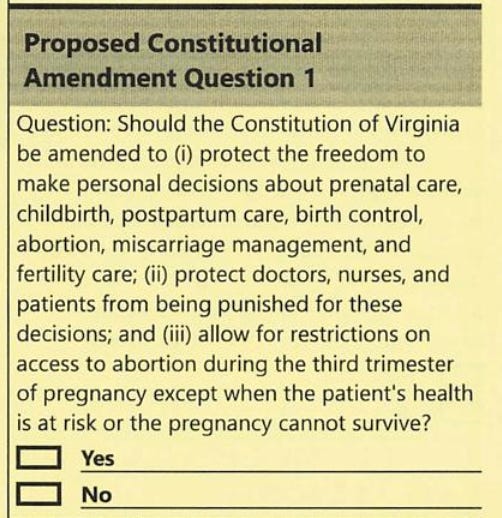
The ballot says nothing about replacing the current three-physician requirement with the judgment of a single physician, or removing the existing requirement for substantial and irremediable harm to the mother’s health. Nor does it even mention allowing for third-trimester abortions to protect the mental health of the mother.
Voters are also told it will protect “doctors, nurses, and patients,” while the actual constitutional text protects “any individual” who assists someone exercising reproductive freedom with voluntary consent.
These are fundamental changes, not minor omissions. The wording is already being challenged in court as misleading, with plaintiffs arguing that voters are being denied an accurate description of what they are being asked to put into Virginia’s Constitution. These omissions appear deliberately intended to conceal these changes, as their effect leaves voters without important information about the amendment’s reach.
What Do We Know About Later Abortions?
One difficulty in evaluating the debate is the limited information available about abortions performed late in pregnancy.
Federal abortion surveillance commonly groups procedures at 21 weeks or later together. That category includes pregnancies at very different stages of development and does not consistently explain why the procedures occurred. Reporting is also incomplete because not every state supplies comparable data.
Research suggests that women seek abortions later in pregnancy for a range of reasons. Some involve serious fetal abnormalities or threats to maternal health. Others involve discovering the pregnancy late, difficulties obtaining an earlier abortion, financial barriers, or changing personal circumstances. Of course, those later reasons could all be categorized under “mental health” issues.
Researchers at the University of California, San Francisco interviewed women obtaining abortions at or after 20 weeks and documented obstacles such as difficulty locating providers and raising money for care. Other interview research involving abortions between 24 and 35 weeks found complicated circumstances, including newly discovered medical information and delays in accessing services.
These studies are informative, but they do not establish what percentage of all third-trimester abortions occur for each reason.
The distinction matters. A pregnancy terminated at 21 weeks is not medically equivalent to one terminated at 35 weeks. Yet public debate often treats them as though they belong to one category.
The fact that state and federal governments have not collected this data again speaks of obfuscation. It appears that those states that allow third trimester abortions don’t want the public to know those answers.
The Fetal Tissue Question
There is another issue that sometimes enters this debate: the use of fetal tissue in medical research.
Some commentators have suggested that expanding access to later abortions is intended to increase the supply of fetal organs and tissue for research or commercial purposes. We found no evidence connecting fetal tissue purchasers to the campaigns supporting Virginia’s amendment. There is, however, a real history of controversy surrounding fetal tissue procurement.
Federal law prohibits the sale of fetal tissue and organs but permits reasonable payments for expenses such as processing, preservation, storage, and transportation. Companies involved in procurement have operated within that framework, although questions about whether particular payments crossed legal boundaries have prompted congressional investigations.
In 2016, a House investigative panel examined relationships between abortion providers and tissue procurement companies. Its Republican majority alleged improper practices.
The international market for human biological materials raises another question. Organ trafficking is already a documented criminal industry, with estimates placing its annual value in the hundreds of millions to more than a billion dollars. Meanwhile, commercial clinics are marketing stem cells, exosomes, and growth-factor treatments for anti-aging and regenerative medicine.
Fetal tissue is scientifically valuable because developing cells produce biological signals involved in growth and tissue formation. Whether those properties have created a significant illegal market for fetal-derived products remains unknown. Researchers studying human tissue trafficking have warned that the trade in cells and tissues receives far less scrutiny than organ trafficking. Without reliable information about sourcing, payments, and international distribution, the size of any illicit fetal-tissue market is impossible to establish.
The commercial market for human biological materials may extend well beyond conventional medical research. Experiments involving young and old mice helped fuel interest in blood-borne factors that might influence aging. By 2016, companies were selling young-donor plasma transfusions to customers seeking rejuvenation, despite the lack of proven clinical benefit. The FDA warned against these treatments in 2019 and again in 2024. Meanwhile, an international market for experimental stem-cell and regenerative therapies continues to operate, sometimes beyond effective regulatory oversight. Whether fetal-derived cells or growth factors have entered an illicit anti-aging market remains unknown. But the financial incentives, the scientific interest in developmental biology, and the difficulty of tracing some human biological materials make this a legitimate question for further investigation.
The University of Pittsburgh also attracted scrutiny over its fetal tissue research. Records discussed by investigators referred to collecting certain tissue samples across a broad range of gestational ages, prompting questions from members of Congress about tissue sources and collection procedures. The university commissioned an outside legal review, which found its activities compliant with applicable law. But legal compliance and ethical acceptability are not necessarily the same thing. Federal law establishes certain safeguards, while states impose additional requirements that vary considerably. A finding that researchers followed the rules does not, by itself, answer whether those rules adequately protect human life or prevent financial incentives from influencing tissue procurement.
In January 2026, under President Trump, the National Institutes of Health announced that it would end funding for research using human fetal tissue from elective abortions. That policy applies to NIH-supported research, not every privately funded or state-funded project.
Those questions deserve scrutiny. But the available evidence does not establish that fetal tissue procurement is driving Virginia’s proposed constitutional amendment.
Back to Ashkelon
Nearly seventeen centuries ago, the bodies of almost 100 newborn infants ended up in a drain beneath a Roman bathhouse. We may never know how they died or who was responsible. But their remains are a disturbing reminder of a time when some societies accepted the killing or abandonment of unwanted children. It took centuries of religious, moral, and legal change to establish the protections newborns enjoy today.
Modern medicine has eliminated much of the uncertainty that once surrounded life in the womb. We can observe a developing child’s heartbeat, monitor its growth, and save premature babies who would have had little chance of survival just a few generations ago. A viable child does not suddenly become biologically human at delivery. That child was already human, already alive, and already capable of surviving outside the womb.
Yet our laws continue to draw a sharp distinction between ending that life before birth and ending it afterward. That distinction is legal, not a sudden change in biological identity.
Virginia’s proposed constitutional amendment would not explicitly legalize killing a child after birth. But it would replace the existing third-trimester medical standard with a broader constitutional protection based on a single physician’s judgment about physical or mental health. It would also raise questions about existing safeguards for viable unborn children, medical licensing requirements, and physician conscience protections.
Worse, the ballot language omits some of these consequential changes. Voters are told the amendment protects “doctors, nurses, and patients,” while the constitutional text protects “any individual” assisting another person with voluntary consent. The ballot also fails to explain the change from three physicians to one or the removal of the existing requirement for substantial and irremediable harm. These omissions are already being challenged in court as misleading.
The history of fetal tissue procurement and experimental regenerative medicine raises additional questions about financial incentives and the importance of clear ethical safeguards.
Once adopted, these constitutional protections could not simply be repealed by a future legislature. Changing them would require another constitutional amendment.
The question is whether the law should treat a viable child’s life differently simply because that child has not yet been born.
That is a question worth answering before changing Virginia’s Constitution.
End.
Independent Medical Journalism Needs Your Support
Investigating the intersection of medicine, ethics, law, and government policy is not easy work. It takes time, research, and a willingness to ask uncomfortable questions, particularly when those questions challenge powerful institutions, entrenched interests, or political allies.
At Malone News, we do not believe medical ethics should change according to political convenience, financial incentives, or the demands of special interests. Nor do we believe that difficult questions about human life, medical freedom, and informed consent should be swept aside because they make people uncomfortable.
This is why independent journalism matters. We answer to our readers, not pharmaceutical companies, government agencies, political parties, or corporate advertisers. And we intend to keep it that way.
But independence comes at a price. Researching, documenting, and publishing this work requires considerable time and resources. Our paid subscribers make it possible to continue investigating stories that others would rather ignore.
If you value serious, independent reporting on medicine, medical ethics, and public policy, please become a paid subscriber today. Your support helps keep Malone News independent, our investigations moving forward, and our reporting available to the public.
Thank you for standing with us.
Robert and Jill
References
Virginia Constitutional Amendment and Legal Sources
Virginia Department of Elections. (2026). Explanation for Proposed Constitutional Amendment to Be Voted On at the November 3, 2026, Election: Question 1. Commonwealth of Virginia.
Virginia General Assembly. (2026). House Bill 781: Ballot Question for the Proposed Right to Reproductive Freedom Constitutional Amendment. Approved February 6, 2026.
Virginia General Assembly. (2026). Proposed Amendment to Article I of the Constitution of Virginia, Relating to the Fundamental Right to Reproductive Freedom. House Joint Resolution 1.
Code of Virginia. § 18.2-74. When abortion or termination of pregnancy lawful after second trimester of pregnancy.
Code of Virginia. § 18.2-75. Conscience protections concerning participation in abortion procedures.
Code of Virginia. § 18.2-371.1. Abuse and neglect of children; safe-haven provisions.
Association of American Physicians and Surgeons et al. v. Virginia State Board of Elections et al. (2026). Complaint filed in the Circuit Court of Tazewell County, Virginia.
Virginia Mercury. (2026, January 19). Virginia lawmakers send reproductive rights amendment toward November vote.
Virginia Mercury. (2026, August 28). If Va.’s reproductive rights amendment passes, challengers say they’ll fight to overturn it in court.
Dobbs v. Jackson Women’s Health Organization, 597 U.S. 215 (2022).
Doe v. Bolton, 410 U.S. 179 (1973).
Born-Alive Infants Protection Act of 2002. 1 U.S.C. § 8.
Partial-Birth Abortion Ban Act of 2003. 18 U.S.C. § 1531.
History of Infanticide and Medical Ethics
Stager, Lawrence E. (1991). Eroticism and Infanticide at Ashkelon. Biblical Archaeology Review, 17(4).
Faerman, Marina, et al. (1998). Determining the Sex of Infanticide Victims from the Late Roman Era through Ancient DNA Analysis. Journal of Archaeological Science, 25(9), 861–865.
Archaeology. (1997). Ashkelon. Archaeology, 50(2).
Harris, William V. (1994). Child-Exposure in the Roman Empire. Journal of Roman Studies, 84, 1–22.
Hrdy, Sarah Blaffer. (1999). Mother Nature: A History of Mothers, Infants, and Natural Selection. Pantheon Books.
Giubilini, Alberto, and Francesca Minerva. (2013). After-birth abortion: Why should the baby live? Journal of Medical Ethics, 39(5), 261–263. Published online in 2012.
Singer, Peter. (1979). Practical Ethics. Cambridge University Press.
Verhagen, Eduard, and Pieter J. J. Sauer. (2005). The Groningen Protocol: Euthanasia in Severely Ill Newborns. New England Journal of Medicine, 352(10), 959–962.
Didache, Chapter 2, Verse 2. Early Christian teaching prohibiting abortion and infanticide.
Josephus, Flavius. Against Apion, Book II, Section 202.
Philo of Alexandria. Special Laws, Book III, Sections 110–119.
Plutarch. Life of Lycurgus, Chapter 16.
Later Abortions and Medical Research
Foster, Diana Greene, and Katrina Kimport. (2013). Who Seeks Abortions at or After 20 Weeks? Perspectives on Sexual and Reproductive Health, 45(4), 210–218.
Foster, Diana Greene. (2016). Responses to Questions for the Record. U.S. Senate Committee on the Judiciary, March 15.
Diedrich, Justin, et al. (2024). Induction of Fetal Asystole Before Abortion. Society of Family Planning Clinical Recommendation. Contraception, 139, 110551.
Fetal Tissue Procurement, Research, and Commercial Interests
U.S. House of Representatives, Select Investigative Panel on Infant Lives. (2016). Final Report. Committee on Energy and Commerce, December 30.
Washington Examiner. (2016, December 22). House Panel on Fetal Tissue Makes 15 Referrals for Prosecution.
National Institutes of Health. (2026, January 22). NIH Announces Major Policy Shift to End Use of Human Fetal Tissue in NIH-Supported Research.
University of Pittsburgh. (2022). University of Pittsburgh Releases Results of External Review of Fetal Tissue Research.
Lankford, James, et al. (2021). Congressional Letter Requesting Investigation of University of Pittsburgh Fetal Tissue Research.
Fox News. (2021, August 4). Report on the University of Pittsburgh Fetal Tissue Project.
42 U.S.C. § 289g-1. Research on Transplantation of Fetal Tissue.
42 U.S.C. § 289g-2. *Prohibitions Regarding Human
It is quixotic that we impose capital punishment on crimes in which the death of a fetus occurs but states can wantonly kill viable babies at will.
Thank you for this. I can only pray for God to speak to the hearts of Virginia voters.