

Audio Version:
MALONE.NEWS
MODERNA’S mRNA FLU SHOT: FDA REFUSED IT, THEN REVERSED ITSELF IN TWO WEEKS
Approval is not evidence.
The Executive Summary: What This Essay Shows
On August 5, 2026, FDA licensed mFLUSIVA, Moderna’s first mRNA influenza vaccine. For Americans 50 through 64, it granted traditional approval. For those 65 and older, the population that accounts for roughly 70 to 85 percent of American influenza deaths, FDA used accelerated approval.
The central fact of this essay is simple: FDA licensed mFLUSIVA for seniors without clinical evidence that it works better than the enhanced influenza vaccines seniors already receive. The study designed to answer that question begins after approval.
That was not FDA’s original position.
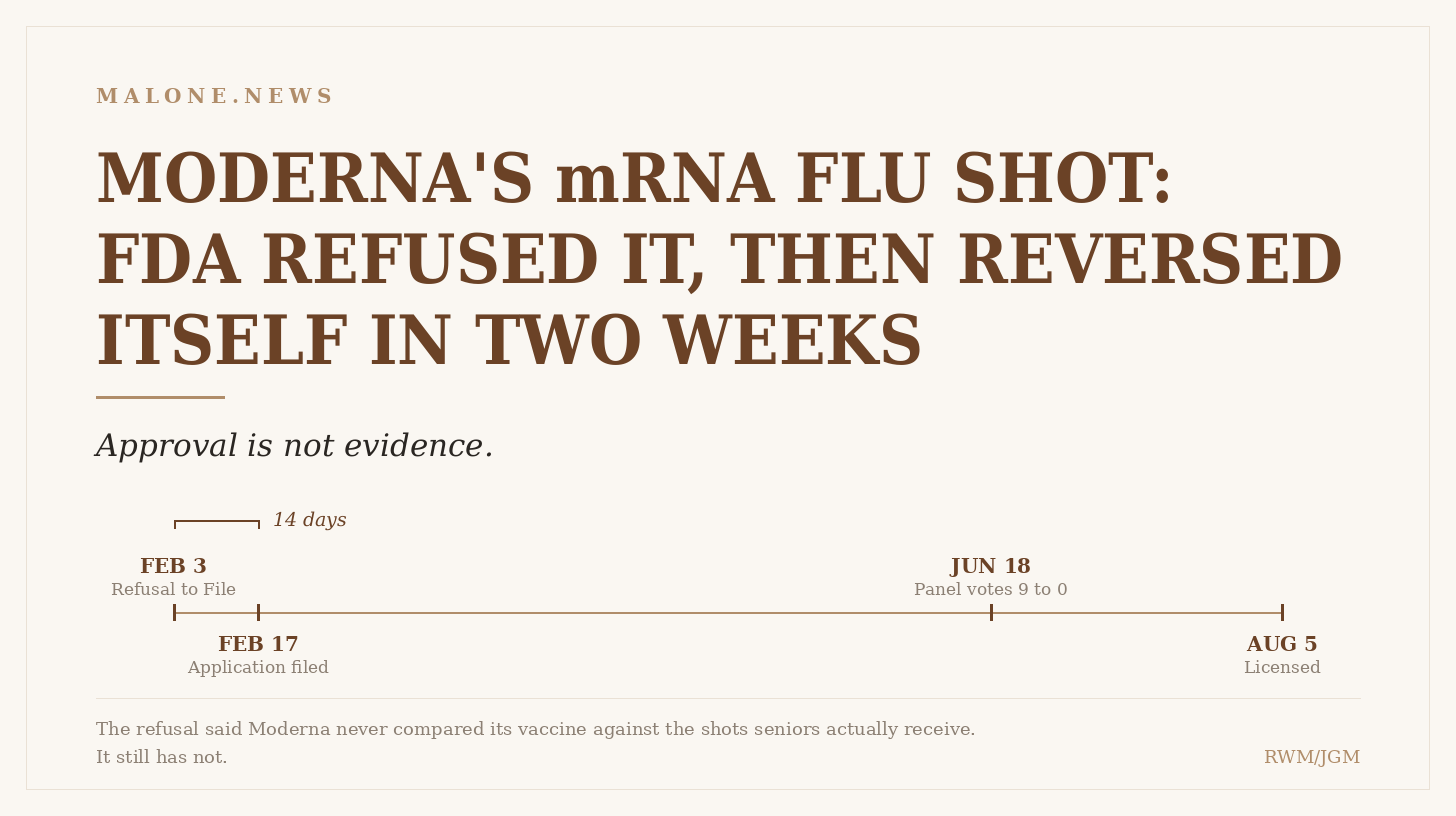
On February 3, FDA issued a Refusal to File letter because Moderna had not compared mFLUSIVA clinically with the enhanced vaccines preferentially recommended for older Americans. CBER director Vinay Prasad personally signed the refusal, overriding career vaccine reviewers who believed the application should be reviewed. Moderna made the letter public, challenged the decision, and called for White House intervention.
The White House intervened. FDA Commissioner Marty Makary was summoned to meet with President Trump. CNN reported that Trump berated him over the Moderna decision and that the confrontation prompted FDA’s reversal. A source close to the process told Politico that the subsequent meeting between FDA and Moderna provided the agency a way to reverse course publicly. Fourteen days after refusing the application, FDA accepted it without Moderna having performed the clinical comparison that triggered the refusal.
Within three months, Prasad was gone. Makary was gone. The vaccine-office director who had opposed the refusal remained and ultimately signed the license.
Moderna still has not performed that comparison. Instead, FDA granted accelerated approval for seniors and required a postmarketing study of as many as 800,000 people to determine how mFLUSIVA performs clinically against a vaccine preferentially recommended for them.
That reversal is the organizing fact of the regulatory record. The experiment FDA initially said was important enough to prevent the application from being reviewed became an experiment that could wait until after the vaccine was licensed.
The accelerated-approval rationale raises a second problem. The pathway exists for products addressing serious conditions that provide a meaningful therapeutic benefit over available treatment. Seniors already have three enhanced influenza vaccines: Fluzone High-Dose, Fluad, and Flublok. FDA had no direct clinical evidence that mFLUSIVA provides greater protection than those vaccines when it approved the senior indication.
FDA instead relied on antibodies.
In a separate study of approximately 3,000 seniors, mFLUSIVA produced stronger antibody responses than Fluzone High-Dose. But FDA acknowledges that no formal correlate of protection has been established for mFLUSIVA, and its own analysis produced a problem. For B/Victoria, one of the three strains in the licensed vaccine, Moderna’s analysis failed to demonstrate a statistically significant relationship between the antibody response and protection from illness. B/Victoria also produced an efficacy confidence interval ranging from 18.5 percent worse to 57.5 percent better, and its seroconversion result falls below the absolute threshold contained in FDA’s 2007 influenza guidance. In contrast, the FDA was obsessive about these issues during the review and authorization process for the live attenuated intranasal influenza vaccine called Flumist, to such an extent that the manufacturer has shied away from development and marketing of other innovative vaccines.
Three different measurements therefore fail to provide a clear answer for the same licensed strain. FDA moved strain-specific efficacy into the postmarketing study.
The large FLUENT trial did establish that mFLUSIVA performs better than a standard-dose influenza vaccine in adults 50 and older. Confirmed influenza fell from 2.8 percent to 2.0 percent, an absolute reduction of 0.73 percentage points that Moderna reports as 26.6 percent relative vaccine efficacy. Roughly 137 people had to switch to mFLUSIVA to prevent one additional case of laboratory-confirmed influenza.
The additional reactogenicity was much larger. Injection-site pain increased from 29.8 to 65.8 percent, fatigue from 20.3 to 45.1 percent, and reactions severe enough to prevent normal daily activity from 0.9 to 5.5 percent. For every 137 people switched to mFLUSIVA, roughly six additional people experienced a vaccine reaction severe enough to stop their normal daily activity while one additional case of influenza was prevented.
There was one favorable signal involving more serious disease. Influenza requiring hospitalization, emergency-room care, or urgent care occurred in 22 mFLUSIVA recipients and 42 controls. But only 64 such events occurred, the endpoint was exploratory, and the comparator was again the standard-dose vaccine, not the enhanced vaccines preferentially recommended for seniors.
Neither pivotal trial measured whether mFLUSIVA prevents influenza deaths. Mortality was not an efficacy endpoint anywhere in the development program.
The safety database raises a separate unresolved question. Across 71,916 participants, overall mortality was nearly balanced. But the coded categories encompassing unexplained death, sudden death, and sudden cardiac death occurred 29 times after mFLUSIVA and 12 times after comparison vaccines. FDA identified the imbalance, said the absence of autopsy data limited its ability to determine the causes, and nevertheless judged it unlikely to be vaccine-related.
No autopsies were performed on the mFLUSIVA deaths. This does not establish that mFLUSIVA caused them. It establishes that FDA identified an unexplained mortality imbalance, identified the evidence missing from its evaluation, and licensed the vaccine without obtaining that evidence.
Then there is the advisory process. FDA’s Vaccines and Related Biological Products Advisory Committee, VRBPAC, voted 9–0 in favor. Twice. Yet while the committee was deciding whether antibody responses justified approval for seniors, FDA was still reviewing Moderna’s analysis of whether those antibodies were actually associated with protection from illness. FDA twice declared that analysis outside the scope of the committee briefing. The committee endorsed the surrogate before FDA finished evaluating whether it predicted the clinical outcome.
The politics make this harder to dismiss as ordinary FDA procedure. Kennedy fired every member of CDC’s ACIP, calling the inherited vaccine committee a “rubber stamp” and arguing that wholesale replacement was necessary to restore trust. FDA’s largely inherited vaccine advisory committee was not similarly replaced. It then voted unanimously for the first mRNA influenza vaccine. HHS announced that new vaccines would undergo placebo-controlled safety testing before licensure, then exempted influenza vaccines because they had been used safely for more than 80 years, extending the safety history of conventional influenza vaccines to a delivery platform never before licensed for influenza.
And the approval matters beyond mFLUSIVA.
FDA does not describe the principal unmet need as the absence of effective influenza vaccines for seniors. It emphasized the manufacturing advantages of mRNA, including avoiding egg-adapted mutations, faster strain changes, and pandemic preparedness. Licensing mFLUSIVA also strengthens Moderna’s regulatory platform for its COVID-flu combination vaccine and H5 pandemic-influenza program.
That matters because Congress created a formal Platform Technology Designation Program in 2022. FDA had already been discussing this approach with WHO in 2021: once an mRNA platform is sufficiently established, data from one product can potentially reduce the testing required for subsequent products using the same manufacturing process and delivery system. Today, the U.S. licensed mRNA vaccine market belongs to Moderna and Pfizer/BioNTech.
FDA was not simply licensing one vaccine. It was establishing a regulatory foundation that can make Moderna’s next mRNA vaccine easier to approve.
The question is what FDA now means by “approval.”
For seniors, FDA did not establish before licensure that mFLUSIVA prevents more influenza, hospitalization, or death than the enhanced vaccines already recommended for them. It did not resolve the B/Victoria problem. It did not resolve the unexplained mortality imbalance. It had not completed its own analysis of the antibody surrogate when its outside advisers voted. And it had not finalized the enormous clinical study intended to answer the central question left by all of this.
Again and again, the missing evidence was not required before approval.
That is the essence of this regulatory record, and the reason the story matters beyond one Moderna vaccine. If an approval today becomes evidence supporting the next product on the same platform, then every unanswered question FDA accepts today can become an assumption it does not require anyone to test tomorrow.
FDA refused mFLUSIVA because an important experiment had not been done. Fourteen days later, it agreed to proceed without it. Six months later, it licensed the vaccine. The experiment comes next.
Let’s get into it:
Five Years Ago
On December 11, 2021, I wrote about Moderna’s experimental influenza vaccine data (Malone 2021), after the company released its first human data. The market reaction was immediate: Moderna fell 5.57 percent that day and BioNTech 9.33 percent. The reason for my concern was straightforward. Moderna’s own Phase 1 data showed that its influenza vaccine produced substantially more adverse reactions than conventional flu vaccines. That problem was visible in 2021. Five years later, the pivotal Phase 3 trial shows the same pattern.
That table showed 92 percent of participants aged 50 and older reported adverse events at the 100-microgram dose, compared with 33 percent in the placebo group. Among participants aged 18 to 50, the figures were 90.5 percent and 30 percent.
What made these results particularly important was that they offered a rare opportunity to separate the effects of the mRNA platform from the effects of the COVID spike protein. The COVID shots produce spike, and much of the concern about their side effects centered on that protein. Moderna’s flu candidate produced a different protein entirely, an influenza surface protein called hemagglutinin. Same delivery system, different cargo. If the side effects remained high after swapping out the cargo, then spike could not be the whole story. I attributed the remainder to the modified mRNA itself and to the synthetic fat particle that carries it into cells.
The published trial data later filled in distinctions that were not visible in Moderna’s investor slides.
I was working from the slides Moderna presented to investors, and I reported the adverse-event figures as adverse events. The published trial later provided an important distinction. Solicited reactions are symptoms investigators specifically ask participants to record, such as injection-site pain, fever, fatigue, and headache. Unsolicited adverse events are other medical events participants report during the specified follow-up period. Serious adverse events include events such as hospitalization, life-threatening illness, and death.
The 92 percent figure I cited was the rate of solicited reactions, not serious adverse events. In the published study, among participants 50 and older, solicited reactions occurred in 54.5 percent at 50 micrograms, 92 percent at 100 micrograms, and 95.2 percent at 200 micrograms, compared with 33.3 percent on placebo (Journal of Infectious Diseases, 2025). Severe reactions also increased with dose. Investigators reported no serious adverse events they considered related to the vaccine.
The mechanistic question is less settled. The influenza vaccine changed the antigen while retaining the basic mRNA delivery platform, yet reactogenicity remained high. That provides evidence that the spike protein cannot, by itself, explain the reactions seen with COVID mRNA vaccines. It does not tell us which component of the remaining platform is responsible. No influenza trial has independently varied the modified mRNA and lipid nanoparticle components in a way that would answer that question.
I attributed the remaining reactogenicity to the modified mRNA and the lipid nanoparticles carrying it into cells. Five years later, the evidence points more strongly toward the lipid nanoparticles. They are not inert packaging. The ionizable lipids used to deliver mRNA can themselves activate innate inflammatory pathways, and experimental studies have demonstrated inflammatory responses to LNP formulations even in the absence of the encoded antigen. What remains unresolved is how much of the clinical reactogenicity comes from the LNP, the mRNA-LNP interaction, antigen expression, or other components of the formulation.
What Got Approved
The vaccine FDA approved in 2026 was not the same formulation Moderna tested in 2021. The company cut the dose, dropped from four flu strains to three, and reformulated. FDA licensed the result as mFLUSIVA on August 5, 2026. The product contains 37.5 micrograms of mRNA, 12.5 per strain. That is a fraction of the 100- and 200-microgram doses that produced the striking early numbers.
Two earlier Phase 3 trials of this vaccine failed outright. Studies P301 and P302 tested the original formulation and missed their primary objectives. Moderna then modified the influenza B antigen with two stabilizing mutations. Those two failed trials contribute nothing to the efficacy case for the reformulated vaccine, but their participants were included in the pooled safety database FDA later used to evaluate deaths and other adverse events.
FDA applied two different approval standards to two different age groups, and that distinction is critical.
Adults aged 50 to 64 received standard approval, based on evidence that the vaccine prevents influenza illness. Adults 65 and older received accelerated approval, based on antibody responses, with a follow-up trial required to determine whether those antibody levels translate into fewer hospitalizations and deaths (Pharmacy Times 2026a).
Accelerated approval deserves an explanation because most people have never heard of it. Congress created the pathway during the AIDS crisis, when patients were dying while promising drugs sat in review. It allows the FDA to license a product based on a surrogate endpoint, a laboratory measurement expected to predict the outcome patients actually care about. Tumor shrinkage can stand in for survival. Antibody levels can stand in for protection against disease. The manufacturer then owes FDA a confirmatory study to establish whether that prediction was correct.
The pathway was built for a specific situation: a serious disease where the new product offers a meaningful advantage over available therapy. That requirement is written into the regulation, and it is the hinge on which this approval turns.
Seasonal influenza in American seniors does not obviously fit that description. Four vaccine types are already licensed and available in pharmacies.
FDA’s outside expert panel, the Vaccines and Related Biological Products Advisory Committee, voted 9 to 0 for approval in the younger group and 9 to 0 again for accelerated approval in the older group (BioPharm International 2026). The committee is a standing body of academic and clinical experts convened to advise the agency. Its votes do not bind FDA, and the agency occasionally departs from them. Usually, it does not.
The 65-and-older population is not some peripheral subgroup in influenza policy. It is the population bearing most of the serious consequences of the disease. CDC attributes roughly 70 to 85 percent of seasonal influenza deaths and 50 to 70 percent of influenza hospitalizations to people 65 and older. During the severe 2024–2025 season, they accounted for 71 percent of estimated deaths and 57 percent of hospitalizations (CDC 2025).
And it was this population, the one most likely to be hospitalized or die from influenza, for which the FDA accepted the weaker evidentiary standard of accelerated approval.
Evidence the FDA Knew Was Missing, Then They Licensed Around It
Companies submit a vaccine to the FDA through a Biologics License Application, a submission that can run to tens of thousands of pages. FDA’s first decision is whether the application (data) is complete enough to review. If it is not, the agency issues a Refusal to File letter. This is uncommon, and it says nothing definitive about the product itself. It means the company has not submitted enough for FDA to conduct its review.
Moderna got a Refusal to File letter for their mRNA influenza application.
The reason was specific. The company had not used the best available standard of care as its comparison group in the elderly: the high-dose or adjuvanted influenza vaccines preferentially recommended for Americans 65 and older. (Pharmacy Times 2026b). Agency leadership said at the time that FDA was finished rubber-stamping vaccines and would enforce requirements more aggressively after approval.
The promise of tougher standards lasted until those standards became inconvenient.
Moderna requested what FDA calls a Type A meeting, the category reserved for applications that have stalled. The company proposed splitting the age groups: standard approval below 65, accelerated approval for those 65 and older, with a study against a high-dose comparator vaccine to follow. FDA accepted the amended application and set a decision deadline of August 5, 2026.
But nothing about the evidence in the elderly changed between the refusal and the approval. Moderna did not run the trial FDA had said was missing. Instead, the company agreed to run it after approval, and FDA agreed to approve the vaccine first. The evidentiary defect FDA had identified in writing was not corrected. The requirement was moved to after licensure.
An agency that says it has stopped rubber-stamping vaccines should not accept a promise to produce evidence in place of the evidence it previously said was necessary. It should require the evidence. FDA had the authority to do that. It chose not to use it.
The refusal was not reversed because Moderna produced the missing evidence. It was reversed after political intervention, at the company’s public request, in fourteen days.
Vinay Prasad became director of the Center for Biologics Evaluation and Research on May 6, 2025. CBER reviews every vaccine licensed in the United States. Within it, the Office of Vaccines Research and Review conducts the scientific review. David Kaslow has led that office since October 2022.
FDA’s own reviewers opposed refusing Moderna’s application, and they said so before the letter was issued. Three agency officials told STAT that a team of career scientists had already been assembled and was prepared to conduct the review, and that Kaslow wrote a detailed memo explaining why it should proceed (STAT 2026a). At a January meeting, staff argued directly to Prasad that refusing the application was the wrong course.
Prasad overruled them. On February 3, 2026, he personally signed the Refusal to File letter rather than leaving it to Kaslow, whose office would ordinarily issue it. Such letters are not normally public. Moderna released a redacted copy.
On February 10, Moderna disclosed the refusal, arguing that FDA had previously accepted its trial design even though the agency had specifically recommended using an enhanced flu vaccine as the comparator in seniors. Moderna had chosen the permitted standard-dose comparator instead. The company pledged a formal challenge and publicly called for White House intervention. Its stock fell as much as 12 percent.
The White House intervened. Two days later, Makary was summoned to the White House. Politico reported that President Trump expressed frustration with FDA’s handling of vaccine matters, citing two people familiar with the meeting. CNN went further, reporting that Trump berated Makary over the Moderna decision and that the confrontation prompted FDA’s rapid reversal, also citing two people familiar with the matter (Fierce Biotech 2026).
FDA then granted Moderna a Type A meeting. One source described the meeting to Politico as giving FDA a public way to reverse course without simply conceding the original decision (BioSpace 2026a). Type A meetings normally occur within thirty days. This one occurred in half that time. FDA accepted the amended application on February 17. Moderna’s stock closed 6 percent higher.
At the same time, the White House was restructuring HHS leadership. On February 12 and 13, Medicare director Chris Klomp became chief counselor and effectively Chief Operating Officer, while two FDA deputy commissioners moved into senior HHS positions handling FDA matters (CNN 2026a). Jim O’Neill, the deputy secretary associated with the department’s vaccine-skeptical faction, was out that month.
The personnel changes continued. An investigation into Prasad’s professional conduct opened soon afterward amid media allegations that he berated staff and retaliated against reviewers who challenged his decisions (BioSpace 2026a). Makary announced on March 6 that Prasad would leave; his final day was April 30. Makary himself departed May 12. Three days later, FDA removed Tracy Beth Hoeg, then head of its drug review center. By the time FDA licensed mFLUSIVA on August 5, the agency had no confirmed commissioner. Trump nominated Heidi Overton on August 18. Her Senate confirmation hearing has not yet been scheduled, and it appears that, due to her anti- abortion stance, confirmation is not guaranteed.
There is an alternative explanation for Prasad’s departure, and the record requires that it be included. Makary later offered a benign explanation for Prasad’s departure. He told the Wall Street Journal that Prasad had always intended to serve only for the duration of a one-year leave from UCSF. But that arrangement had never been publicly disclosed when Prasad was appointed, nor during his earlier departure and return to FDA. It became public only when Makary announced that Prasad was leaving. Prasad declined to comment. His final weeks were also dominated by disputes over rare-disease drugs, not Moderna. His departure was announced the day after HHS publicly attacked an experimental Huntington’s treatment, and the Moderna dispute was by then five weeks old.
None of that changes the sequence: FDA refused Moderna’s application, Moderna publicly demanded White House intervention, the White House intervened, FDA reversed itself without receiving the evidence it had demanded, and within three months both the official, Dr. Vinny Prasad, who signed the refusal, and the FDA commissioner, Dr. Makary, were gone.
One piece of history bears on how much weight to give Makary’s explanation. This was Prasad’s second departure. He had been forced out in July 2025 during the Sarepta Elevidys dispute, and Politico reported that Trump personally directed his removal over the objections of both Makary and Kennedy. Makary then fought to bring him back, and Prasad returned within weeks.
That history does not establish why Prasad left in April 2026. It establishes something more insidious: this White House had already intervened directly in FDA personnel decisions against the wishes of both the FDA Commissioner and the HHS Secretary. Seven weeks before Prasad’s final day, Trump intervened again, this time after Prasad personally refused Moderna’s application.
The personnel decisions repeatedly led back to the White House. Politico reported that Prasad’s 2025 return was arranged by White House chief of staff Susie Wiles after Makary and Kennedy argued that he was important to the Trump coalition. During the February 2026 HHS restructuring, reporting described the operating divisions as answering through Chris Klomp and said Wiles had encouraged him to take the role as a stabilizing force. When Trump nominated Heidi Overton to lead FDA in August, CNN reported that her close relationship with Wiles had helped her candidacy (CNN 2026b).
These decisions do not point to a pro-Moderna motive. Wiles helped restore the same official who later refused Moderna’s application. What they show instead is where consequential FDA personnel decisions were made: at the White House, not independently within either the FDA or HHS.
There is also a possible political motive. Reuters reported in May that White House officials had urged Kennedy to move away from controversial vaccine actions before the midterms and toward issues such as food quality and chronic disease. In fact, I can personally verify this, as Stephanie Spear told me this was the case.
Kennedy later denied under oath that Wiles or anyone else at the White House had instructed him to stop discussing vaccine skepticism. No reporting places Wiles in the February Moderna reversal, and the reported Oval Office confrontation was between Trump and Makary. The evidence supports a pattern of White House control over personnel; it does not establish that Wiles directed this decision.
The record establishes that Moderna publicly requested White House intervention, Trump confronted the FDA Commissioner, and Prasad’s refusal was reversed within days, without Moderna producing any new data or evidence the refusal had demanded. A source close to the process described the subsequent FDA meeting with Moderna as providing a way for the agency to reverse course without publicly conceding defeat. Within three months, both Prasad and Makary were gone.
Moderna also had a serious argument on the merits, and Kaslow’s memo strengthens it. The company pointed out that neither 21 CFR 314.126 nor FDA’s seasonal influenza vaccine guidance requires comparison against the best available standard of care. More importantly, CBER had considered the issue before the trial began.
During an April 2024 consultation, FDA told Moderna in writing that a standard-dose comparator was acceptable, while recommending, but not requiring, an enhanced comparator for participants 65 and older (CIDRAP 2026). FDA’s own vaccine-review office therefore believed Prasad’s refusal was wrong.
That 2024 exchange is the central regulatory dispute. Before Moderna began its Phase 3 trial, FDA saw the comparator problem: Moderna planned to use a standard-dose flu vaccine as the control rather than one of the enhanced vaccines preferentially recommended for people 65 and older. The agency recommended that participants 65 and older be compared with one of the enhanced flu vaccines preferentially recommended for seniors, but it stopped short of requiring that design and told Moderna that using a standard-dose vaccine was acceptable. Moderna proceeded on that basis and enrolled 40,805 people. Two years later, Prasad made the comparison that the FDA had recommended but not required as a condition for even accepting the application for review. Moderna therefore had legitimate grounds to object that the FDA had changed the rules after the trial was finished.
FDA, however, had significant grounds for concern as well. Its briefing document cites ICH E10, the international guidance on selecting clinical trial control groups, which states that the comparator should reflect relevant standards of care. For Americans 65 and older, FDA argued, that meant the enhanced vaccines preferentially recommended for them. Whether a twenty-six-year-old international guidance document provided adequate notice when FDA’s own influenza guidance did not expressly require that comparison is a legitimate regulatory dispute.
If you grant that Prasad had overreached, that Kaslow was right, and that FDA changed the standard after the trial had already been run, the evidentiary problem still does not disappear. Moderna still did not test whether mFLUSIVA prevents influenza better than the enhanced vaccines elderly Americans actually receive. The White House intervention resolved the question of whether the FDA would accept the application without that evidence. But the phase III clinical trial was still flawed; it could not supply the evidence itself.
What followed was not an orderly succession. Prasad’s deputy, Katherine Szarama, became acting CBER director on May 1 and lasted less than three weeks. Karim Mikhail then took over, also in an acting capacity. Mikhail had spent more than two decades at Merck and later served as chief executive of the pharmaceutical company Amarin before joining the FDA as a senior adviser. He became CBER’s fourth acting director and its sixth leader since January 2025 (BioSpace 2026b).
The advisory committee met June 18. FDA licensed mFLUSIVA on August 5. Through both decisions, the FDA center responsible for every vaccine licensed in the United States was being run by an acting director with decades in the pharmaceutical industry, beneath a Commissioner’s office that no longer had a Commissioner.
David Kaslow signed the approval letter.
There is nothing improper about that by itself. The director of the Office of Vaccines Research and Review routinely signs vaccine approval letters, and Kaslow had argued from the beginning that Moderna’s application should be reviewed. But the asymmetry is difficult to miss. The refusal bypassed Kaslow. The approval carries his signature. By August, Prasad, who personally signed the refusal, was gone. Makary, who publicly defended it, was gone. Jim O’Neill, aligned with their approach to vaccines, was gone. Kaslow, whose office opposed the refusal of the application, remained and signed the license.
The history of Kaslow’s office makes that sequence more significant. He took over the Office of Vaccines Research and Review in October 2022. The office had previously been led by Marion Gruber, with Philip Krause as her deputy, until both departed FDA in 2021 amid an extraordinary internal dispute over COVID boosters. Gruber and Krause subsequently argued publicly that the available evidence did not justify boosters for the general vaccinated population, while FDA leadership moved toward broader authorization.
Whatever one concludes about that dispute, two of FDA’s most senior career vaccine scientists left the agency after finding themselves on the losing side of one of the most consequential vaccine decisions of the pandemic.
Kaslow came from vaccine development himself. He founded NIH’s Malaria Vaccine Development Unit and led its work from 1986 to 1999, later directing malaria and broader vaccine programs at PATH. But his career also includes the genetic-vaccine industry. From 2001 to 2006, he was Chief Scientific Officer of Vical, the San Diego biotechnology company that developed DNA vaccines, and later headed vaccine research and technology at Merck Research Laboratories. His FDA biography specifically notes his work applying gene-therapy technologies to vaccines.
None of that establishes improper motive. But regulatory independence is not demonstrated by refusing to discuss professional relationships simply because they do not prove corruption. Readers evaluating an mRNA vaccine approved partly on laboratory immunogenicity data are entitled to know that the FDA vaccine office deciding the case is headed by a scientist with decades in vaccine development, including senior positions at companies developing genetic vaccine technologies. In virtually every other regulated setting, that background would be disclosed as relevant context, not dismissed as irrelevant because it does not prove misconduct.
In my own case, that disclosure cuts both ways. Vical grew directly out of the same early work on nucleic-acid delivery to which I contributed in the late 1980s. I have a history with this technology as well. The difference is that I disclose mine, and I am not sitting inside FDA leadership making regulatory decisions about these products.
A Standard Announced, and an Exemption That Does Not Fit
On May 1, 2025, the Department of Health and Human Services told the Washington Post that, under Secretary Kennedy, all new vaccines would undergo placebo-controlled safety testing before licensure. HHS called it a “radical departure” from previous practice (HHS 2025).
A placebo-controlled trial compares the vaccine with an inert injection, usually saline. An active-controlled trial compares it with another vaccine. The distinction determines what can be measured. Against saline, the adverse-event rate attributable to the vaccine can emerge against a relatively clean baseline. Against another vaccine, the trial measures only the difference between two products. If both produce the same adverse event at elevated rates, the comparison can obscure it.
HHS never issued the policy as a regulation or formal guidance. It announced it to reporters and immediately carved out an exemption. The department declined to specify exactly which vaccines the new requirement covered, but told the Post that influenza vaccines were excluded because they had been “tried and tested for more than 80 years.”
That exemption does not fit mFLUSIVA.
The 80-year safety record belongs to conventional influenza vaccines. mFLUSIVA is the first licensed influenza vaccine built on an mRNA-lipid nanoparticle platform. The influenza antigen is familiar; the technology used to deliver the genetic instructions for producing it is not. HHS defined the exemption by the disease being vaccinated against rather than by the technology of the vaccine itself. It therefore extended the safety history of conventional flu vaccines to a platform never before licensed for influenza.
Moderna did use saline once, in its small first-in-human study, to evaluate safety and immune response. It never tested mFLUSIVA’s clinical efficacy against saline. Not once. Every efficacy trial compared mFLUSIVA with another influenza vaccine, and the early saline-controlled safety study was never repeated at Phase 3 scale.
That distinction matters because Kennedy’s announced policy was supposed to answer precisely the safety question an active comparator cannot fully answer: what does a new vaccine add compared with an inert control? For mFLUSIVA, FDA never obtained that answer at scale.
Kennedy promised placebo-controlled testing for new vaccines. His department then treated the first mRNA influenza vaccine as though it were not new, because influenza vaccines themselves are old. FDA licensed a novel vaccine platform under the inherited safety reputation of products built with different technology.
The Panel Recognized the Dangers and Voted Nine to Zero to Endorse
The FDA advisory committee (VRBPAC) met on June 18, 2026. It voted 9 to 0 that benefits outweigh risks in adults 50 to 64. It then voted 9 to 0 again for adults 65 and older, for which the supporting evidence was antibody levels rather than prevention of illness. The 800,000-person follow-up study was sized to fill evidentiary gaps the panelists themselves had identified (BioPharm International 2026).
This political hypocrisy cannot be ignored. Kennedy fired every member of CDC’s ACIP, declaring that the inherited vaccine committee had become a “rubber stamp” and that wholesale replacement was necessary to restore public trust. But the FDA committee sitting at the actual vaccine-licensure gate, VRBPAC, was not similarly replaced.
Most of the standing VRBPAC members participating in the mFLUSIVA meeting had been appointed during the Biden administration, with others inherited from even earlier administrations.
Trump and Kennedy cannot have it both ways. If Biden-era vaccine advisers were sufficiently compromised that ACIP required a clean sweep, why was the committee advising FDA on whether to license the first mRNA influenza vaccine left largely intact? They purged the committee that recommends vaccines after FDA approves them, while leaving the inherited committee, a committee with strong industry ties, that helps decide whether FDA approves them in the first place
The panelists themselves identified serious gaps in the evidence, discussed them openly, and then not one member voted against licensing a product with major issues. Two questions resting on entirely different grades of evidence produced identical unanimous votes.
A committee that returns the same verdict, whether the applicant brings evidence of prevented hospitalizations or a blood test, is not weighing evidence. It is ratifying a political outcome.
That vote was the last moment when anyone outside the agency could have insisted on a trial before the license. Nine people declined to do so, with no dissent recorded.
What the Big Trial Showed
The pivotal study, FLUENT, enrolled 40,805 adults aged 50 and older at 301 sites across 11 countries during the 2024–2025 Northern Hemisphere flu season (Moderna 2026b). Half received mFLUSIVA and half received a licensed standard-dose influenza vaccine. Participants were followed for a median of about six months.
Laboratory-confirmed influenza occurred in 2.0 percent of mFLUSIVA recipients and 2.8 percent of comparison recipients. Moderna reports that difference as 26.6 percent relative vaccine efficacy, and the trial cleared its prespecified statistical threshold (Roels et al. 2025).
The 26.6 percent figure is easy to misunderstand and makes the vaccine’s benefit appear substantially larger than it actually was.
In actual numbers, 411 of 20,179 mFLUSIVA recipients developed confirmed influenza, compared with 557 of 20,124 people receiving the standard vaccine. That is 146 fewer cases among roughly 20,000 people, an absolute risk reduction of 0.73 percentage points. Relative to the comparison group, the same difference is 26.6 percent.
Put another way, roughly 137 people had to receive mFLUSIVA instead of the standard vaccine to prevent one additional case of influenza.
And that comparison matters. This was not efficacy against placebo. Both groups were vaccinated. The trial therefore tells us how much better mFLUSIVA performed than one standard-dose influenza vaccine, not how much influenza mFLUSIVA prevents compared with receiving no influenza vaccine at all. Moderna never ran that efficacy trial against saline. A reader who sees “26.6 percent relative vaccine efficacy” and hears “26.6 percent effective” is hearing something the trial did not establish.
The modest reduction in influenza also came with substantially more adverse reactions. Injection-site pain occurred in 65.8 percent of mFLUSIVA recipients compared with 29.8 percent of controls. Fatigue occurred in 45.1 percent versus 20.3 percent, headache in 37.8 percent versus 18.0 percent, and muscle pain in 35.4 percent versus 11.6 percent. Most reactions were mild or moderate and resolved within days. Reactions rated severe, meaning severe enough to prevent normal daily activity, occurred in 5.5 percent versus 0.9 percent. Severe reactions at 5.5 percent are not insignificant!
That tradeoff deserves some perspective. For roughly every 137 people switched from the standard vaccine to mFLUSIVA, the trial prevented one additional case of influenza. Over the same number vaccinated, roughly six additional people would be expected to experience a reaction severe enough to prevent normal daily activity. Those outcomes are not equivalent: influenza generally lasts longer than most of these common adverse events, and can become serious. But the comparison matters when describing the size of the benefit against the additional burden imposed by the vaccine.
The trial did produce one favorable result involving more serious influenza. As an exploratory endpoint, influenza requiring hospitalization, emergency-room care, or urgent care occurred in 22 mFLUSIVA recipients and 42 comparison recipients, a relative efficacy of 47.9 percent (95% CI, 12.8 to 68.9). The nominal confidence interval excludes zero, but this was an exploratory endpoint, not a trial designed or statistically powered to establish protection against serious influenza.
Only 64 events occurred among more than 40,000 participants, and the comparison was again with a standard-dose vaccine rather than the enhanced vaccines preferentially recommended for seniors. So, for the most vulnerable cohort, the experiment did not use the correct control.
Against that same standard-dose comparator, efficacy appeared similar across age groups: 26.1 percent for adults 50 through 64, 28.0 percent for those 65 through 74, and 25.3 percent for those 75 and older. But the oldest group produced the least certain result. Its confidence interval ranged from 10.4 percent worse to 49.5 percent better, crossing zero, because only 103 cases occurred among 4,564 participants. The people at greatest risk of dying from influenza are therefore the people for whom the trial provides the least certain efficacy estimate.
The safety database contains additional events. No myocarditis or pericarditis occurred during the 42-day window in which vaccine-associated heart inflammation would be most expected. Beyond that window, across the pooled database, there were 10 cases among mFLUSIVA recipients and 7 among comparators, with an adjudication committee confirming 4 and 3, respectively. One case of Guillain-Barré syndrome occurred in an mFLUSIVA recipient on Day 134, compared with none in the comparison group.
There is another limitation. The trial population was healthier than the population that will actually receive the vaccine. Immunocompromised participants and the very frail were excluded. Fifty-seven percent of participants had a condition that placed them at high risk for influenza, compared with an estimated 78 to 93 percent of Americans in the corresponding age groups.
Among enrolled high-risk participants, relative efficacy was 22.3 percent, compared with 32.1 percent among those without those conditions. FDA itself notes that efficacy measured in this healthier trial population may overstate the benefit in the broader population.
Five years of dose reduction and reformulation substantially reduced the adverse-reaction rates Moderna reported in its first human study. They did not eliminate the substantially higher rate of adverse reactions with mFLUSIVA compared with a conventional flu vaccine.
For Seniors, FDA Approved Antibodies, Not Outcomes
For adults 65 and older, FDA relied on a separate study of 3,003 Americans at 96 sites comparing mFLUSIVA with Fluzone High-Dose, one of the enhanced vaccines preferentially recommended for seniors. The study did not measure influenza illness. It measured antibodies in blood. By that measure, mFLUSIVA performed extremely well, meeting both noninferiority and superiority criteria for antibody titers and seroconversion rates across all four strains.
FDA then identified a problem with the measurement itself. The antibody assays used exclusively cell-derived viruses matched to the strains encoded by mFLUSIVA. Fluzone High-Dose is produced in eggs, where egg-adapted mutations can alter the viral antigens. FDA warned that the assay choice “may underestimate the comparative immunogenicity of egg-based vaccines,” potentially biasing the comparison in favor of mFLUSIVA, and said its evaluation of the effect was still ongoing (FDA 2026a). The surrogate endpoint supporting the entire senior indication therefore came from an assay FDA itself acknowledged might systematically favor the vaccine being approved.
That assay question is the principal manufacturing-related issue visible in the public clinical record. Residual DNA template, which has drawn scrutiny elsewhere across the mRNA platform, is not discussed in the clinical review, while the detailed chemistry and manufacturing review and product-release specifications are not public. The available record therefore does not answer that question one way or the other.
Actual clinical benefit was deferred to a postmarketing study of as many as 800,000 adults across two influenza seasons.
The comparison FDA did not have matters, because CDC does not consider influenza vaccines interchangeable for seniors. Its Advisory Committee on Immunization Practices preferentially recommends that people 65 and older receive one of three enhanced vaccines rather than a standard-dose vaccine. CDC’s preliminary real-world estimates for the 2025–2026 season put effectiveness in that age group at 39 percent for the recombinant vaccine, 22 percent for adjuvanted and high-dose vaccines, and 16 percent for the standard dose. Those observational seasonal estimates cannot be directly compared with Moderna’s randomized-trial results. They demonstrate why comparing mFLUSIVA with the vaccine seniors actually receive matters.
Fluzone High-Dose had already cleared a substantially different evidentiary bar. In a randomized trial of 31,989 adults aged 65 and older, it prevented 24.2 percent more laboratory-confirmed influenza than standard-dose vaccine (DiazGranados et al. 2014). That was an actual clinical outcome, measured directly in the population for whom the vaccine was intended. Fluzone High-Dose demonstrated superior protection against influenza before receiving its indication. mFLUSIVA demonstrated superior antibody responses and was allowed to determine the clinical comparison after licensure.
Moderna has published an indirect comparison with enhanced vaccines in adults 65 and older. The estimated relative efficacy was 12.82 percent in mFLUSIVA’s favor, but the confidence interval ranged from 36.91 percent worse to 44.49 percent better. It crossed zero by a wide margin and could not establish which vaccine performed better. No randomized direct comparison of clinical influenza outcomes exists.
Even the study intended to provide that answer was unfinished at the regulatory stage. At the advisory committee meeting, FDA described the Phase 4 protocol and timeline as still under review and subject to ongoing discussions with Moderna. We have seen this sequence before.
Pregnant women were excluded from the pivotal COVID mRNA vaccine trials, while Fauci’s January 2021 texts show officials privately discussing the lack of pregnancy data and a theoretical concern about first-trimester miscarriage. The missing evidence was supposed to come later. Pfizer’s postmarketing pregnancy trial enrolled only 683 women and vaccinated them at 24 to 34 weeks, making it incapable of answering the first-trimester question. Moderna’s pregnancy registry enrolled only about 20 women before it was terminated. The reassuring miscarriage evidence that eventually emerged came largely from observational surveillance, not from the prospective studies that were supposed to fill the original evidence gap. That is the problem with “approve now, answer later”: later does not guarantee that the promised experiment will ever answer the question. mFLUSIVA now rests on the same promise.
Meanwhile, Moderna’s pharmacovigilance plan, dated January 28, 2026, identified no important identified risks, no important potential risks, and no missing information requiring measures beyond routine surveillance.
FDA therefore licensed mFLUSIVA for the population most likely to suffer serious consequences from influenza without direct evidence that it prevents more influenza than the enhanced vaccines already recommended for them. That experiment begins after approval, with no guarantee the experiments that answer the question will be concluded.
The Standard That Was Never Applied
A surrogate endpoint matters only to the extent that it predicts the clinical outcome it replaces. For influenza, FDA has never established a formal correlate of protection.
FDA’s 2007 guidance on seasonal influenza vaccines acknowledges the problem. Human challenge studies suggested that HAI (hemagglutination inhibition) antibody titers somewhere between 1:15 and 1:65 were associated with protection in roughly half of subjects, with higher titers generally associated with greater protection. Those estimates trace largely to small challenge studies conducted decades ago. They establish an association, not a validated threshold guaranteeing protection. FDA’s briefing document says the same thing about mFLUSIVA: no formal correlate of protection has been established (FDA 2026a).
What FDA does have is a set of absolute immunogenicity thresholds, generally known as the CBER criteria, published in its 2007 guidance. For adults 65 and older, the lower bound of the confidence interval for seroconversion should be at least 30 percent, and the lower bound for the proportion achieving an HAI titer of at least 1:40 should be at least 60 percent. These are not validated correlates of protection, but they are the closest thing FDA guidance provides to an absolute antibody standard for licensing an influenza vaccine on immunogenicity.
Moderna was not evaluated against those criteria.
The primary endpoints in the elderly study were comparative: the ratio of antibody titers and the difference in seroconversion rates between mFLUSIVA and Fluzone High-Dose. Success meant performing at least as well as, and ultimately better than, the comparator. Seroprotection, the proportion reaching the historically important 1:40 HAI titer, appears only as a descriptive secondary endpoint in the briefing document. FDA reports it as higher with mFLUSIVA but does not print the absolute rates there or test them against the 2007 criterion.
Apply the other CBER criterion to Moderna’s published seroconversion data and a problem appears. Among adults 65 and older, the lower confidence bounds were 47.1 percent for A/H1N1, 53.8 for A/H3N2, 27.5 for B/Victoria, and 23.8 for B/Yamagata. The licensed vaccine is trivalent, so B/Yamagata is irrelevant. B/Victoria is not. Its 27.5 percent lower bound falls below FDA’s 30 percent criterion.
Fluzone High-Dose performed still worse against that strain, which exposes the difference between the two standards. On the relative endpoint FDA chose, mFLUSIVA wins. Against the absolute criterion FDA historically published for elderly adults, one of its three licensed strains falls short.
The 2007 guidance expressly covers inactivated vaccines, recombinant hemagglutinin vaccines, and DNA vaccines encoding hemagglutinin; it does not mention mRNA vaccines. Moderna could argue that the DNA-vaccine provision extends by analogy to mRNA, since both genetic platforms instruct cells to produce the influenza hemagglutinin antigen. genetic platform encoding the same antigen.
FDA argued that those absolute CBER criteria did not apply, because its 2007 guidance also permits accelerated approval based on comparative immunogenicity against a licensed flu vaccine. That is the route FDA used. But the choice matters: under the comparative standard, mFLUSIVA passed because it outperformed Fluzone High-Dose. Under FDA’s absolute antibody benchmark, B/Victoria would not have passed. The regulatory pathway therefore determined which result counted.
The 2007 guidance also describes accelerated approval of seasonal influenza vaccines in a revealing context: vaccine shortage. FDA reasoned that during a shortage, a new vaccine could provide meaningful benefit because some people would otherwise receive no vaccine at all.
That rationale does not describe the senior influenza market in 2026. Enhanced vaccines already exist and are preferentially recommended for Americans 65 and older. The problem was not the absence of an influenza vaccine for seniors. It was whether mFLUSIVA offered a meaningful advantage over the vaccines already available to them.
Then there is what FDA knew when its outside advisers voted. Moderna conducted a case-cohort analysis to determine whether the antibody responses elicited by mFLUSIVA were associated with protection against laboratory-confirmed influenza. FDA’s June 18 briefing document describes that work, says it remained under review, and twice declares it outside the scope of the committee briefing. Nine outside experts therefore voted unanimously that the antibody evidence supported licensing mFLUSIVA for seniors without seeing FDA’s completed analysis of whether those antibodies actually predicted protection from illness. The committee was asked to endorse the surrogate before FDA finished evaluating whether it worked.
The result appears in FDA’s August clinical review. Higher HAI titers were significantly associated with lower risk of confirmed influenza for A/H1N1 and A/H3N2. For B/Victoria, they were not. Too few cases accumulated to establish a statistically significant relationship, and CBER’s statistical reviewers specifically flagged the result as a concern (FDA 2026c). The FDA analysis failed to demonstrate that the surrogate FDA relied upon predicted clinical protection against that strain.
And B/Victoria is where three separate weaknesses converge. Clinical efficacy against the strain produced a confidence interval ranging from 18.5 percent worse to 57.5 percent better. The antibody-versus-illness analysis was inconclusive. And the lower confidence bound for seroconversion was 27.5 percent, below the 30 percent criterion in FDA’s 2007 guidance. The same strain fails to provide a clear answer three different ways. FDA licensed the vaccine anyway and moved strain-specific clinical efficacy into the postmarketing study.
Antibodies are useful evidence. They are not influenza cases prevented. They are not hospitalizations prevented. And they are not deaths prevented.
Twenty-Nine Deaths and No Autopsies
FDA pooled safety data from four late-stage studies covering roughly 72,000 participants aged 50 and older. Serious adverse events within 28 days were 0.5 percent in both groups, and across full follow-up, 3.1 percent after mFLUSIVA and 2.9 percent after comparison vaccines. Overall mortality was 102 deaths after mFLUSIVA and 97 after the comparators.
Inside those totals was a finding FDA could not explain.
Clinical trials classify medical events using standardized codes so results can be compared across studies. One of those codes is death with the cause unspecified. It appeared 23 times among mFLUSIVA recipients and nine times among comparison recipients. Add the related categories of sudden death and sudden cardiac death, and the imbalance becomes 29 against 12 (FDA 2026a).
FDA compared serious-event rates between the groups and identified six categories in which the confidence interval for the risk difference excluded zero. Unexplained death was one of them, along with urinary tract infection, 25 against 12, and anemia, nine against two. This deserves an important qualification: dozens of adverse-event categories were examined, and when enough comparisons are made, some will cross a conventional statistical threshold by chance. That makes the finding a signal requiring explanation, not proof of causation.
But FDA did not obtain the evidence needed to explain it.
The contrast with the efficacy analysis is striking. Benefit was presented almost entirely on a relative scale: a 0.73-percentage-point reduction in influenza became 26.6 percent relative vaccine efficacy. For these safety findings, FDA used absolute risk differences. The type of presentation matters: the scale that makes a small benefit look large was emphasized for efficacy, while the scale that makes an imbalance look small was used for harm.
FDA wrote that interpretation of the mortality imbalance was limited by the absence of autopsy data. Then came the critical fact: no autopsies were performed on the mFLUSIVA deaths. Causes were recorded predominantly as unknown or natural causes (FDA 2026a).
Let this sink in: twenty-three participants receiving mFLUSIVA died without a specified cause, significantly more than in the comparison group. FDA itself identified the absence of autopsies as limiting its ability to determine causation. Yet autopsies were not required in the protocol, when the imbalance appeared, or before licensure. The agency identified the evidence it lacked, knew this was a major weakness in the data, and then approved the vaccine without obtaining any answers.
FDA nevertheless concluded that the imbalance was unlikely to be vaccine-related. There are legitimate reasons for that judgment. Overall mortality was nearly equal between groups. The median death occurred about 131 days after mFLUSIVA vaccination compared with 87 days among comparators. Within 28 days, deaths in these categories numbered only three, compared with two. About 60 percent of those who died were 65 or older, and nearly all had substantial underlying disease, including hypertension, diabetes, kidney disease, coronary artery disease and heart failure.
Those facts raise questions about causation. They do not determine the cause of the unexplained deaths.
One case illustrates the distinction. A 76-year-old woman with coronary bypass surgery, atrial fibrillation and type 2 diabetes died two days after vaccination. The investigator at her trial site considered the death vaccine-related because of its timing. FDA considered her underlying cardiovascular disease the more plausible explanation, while acknowledging that a contribution from a vaccine-related inflammatory response could not be fully excluded. No autopsy was performed to resolve the disagreement. So despite the investigator labeling it as vaccine-related, the FDA did not.
This establishes that the FDA found a statistically significant imbalance in deaths without assigned causes and approved the vaccine without obtaining the evidence it said was necessary to interpret that imbalance. Mortality will now be monitored after licensure… Sound familiar?
And saying that many of those who died were old and chronically ill does not dispose of the problem. The people for whom FDA granted accelerated approval are old and disproportionately chronically ill. That is not a confounder outside the intended population. It is the population that will receive the vaccine. In what world does this make sense?
If the absence of autopsies made the imbalance impossible to interpret, that same absence cannot logically resolve it as unrelated. FDA did not establish that the vaccine caused these deaths, but the counterfactual is also true. It also chose not to obtain the evidence that might have established why they occurred.
The Arithmetic FDA Never Required
Vaccines are given to healthy people. Influenza infects only a fraction of the population in any season, while vaccination exposes every recipient to whatever risks the product carries. Only some of those people would otherwise become infected, fewer would be hospitalized, and fewer still would die. Vaccination can produce an enormous net benefit against that arithmetic, particularly in the elderly. The regulator’s job is to demonstrate that benefit against the harms introduced by the product.
Scale the FLUENT results to one million recipients switching from the conventional standard-dose vaccine to mFLUSIVA. The trial rates imply roughly 248,000 additional episodes of fatigue, 198,000 additional headaches, 238,000 additional episodes of muscle pain, and 46,000 additional reactions severe enough to prevent normal daily activity. Those categories overlap and cannot be added together as separate people.
Against that, the same million switches would prevent roughly 8,000 additional cases of laboratory-confirmed influenza, based on the efficacy observed during that season.
That comparison alone does not determine whether the trade is worthwhile. A sore arm is not pneumonia. Two days of fatigue are not an ICU admission. The outcomes capable of overwhelming the additional reactogenicity are precisely the outcomes influenza vaccination matters most for in seniors: severe disease, hospitalization, and death. And against the enhanced vaccines seniors actually receive, FDA had no clinical evidence that mFLUSIVA prevents more of any of them.
The unanswered calculation is therefore simple. How many seniors must switch from a high-dose, recombinant, or adjuvanted vaccine to mFLUSIVA to prevent one hospitalization? One ICU admission? One death? And for each serious outcome prevented, how many additional severe vaccine reactions occur? FDA could not calculate those numbers when it licensed the vaccine. The postmarketing study of up to 800,000 seniors is supposed to provide them afterward.
The standard-dose trial does allow one version of the calculation. The number needed to vaccinate tells us how many people must switch vaccines to prevent one additional case of influenza. The number needed to harm tells us how many must switch before one additional adverse reaction occurs. In FLUENT, about 137 people had to switch to mFLUSIVA to prevent one laboratory-confirmed case of flu. Roughly 22 had to switch for one additional reaction severe enough to prevent normal daily activity, about four for one additional episode of fatigue, and about three for one additional sore arm.
That trade becomes much more compelling if the prevented influenza cases include serious disease. FLUENT offers one favorable but exploratory signal. Influenza requiring hospitalization, emergency-room care, or urgent care occurred in 22 mFLUSIVA recipients and 42 comparison recipients. On those raw rates, roughly 1,000 people would need to switch to prevent one such encounter. The nominal confidence interval favored mFLUSIVA, but only 64 events occurred, the endpoint was exploratory, and once again the comparator was the standard-dose vaccine rather than the enhanced products preferentially recommended for seniors.
For adults 65 and older, that distinction is everything. Their relevant alternative is Fluzone High-Dose, a recombinant vaccine, or an adjuvanted vaccine. Against those vaccines, mFLUSIVA has no randomized clinical-outcome comparison. Moderna’s indirect analysis estimated mFLUSIVA to be 12.82 percent better against medically attended influenza, but its confidence interval ranged from 36.91 percent worse to 44.49 percent better (Van de Velde et al. 2026). The authors describe that result as consistent with comparable effectiveness. It is also statistically compatible with mFLUSIVA being substantially worse or substantially better.
That uncertainty makes the clinically relevant number needed to vaccinate impossible to calculate. If mFLUSIVA is actually superior, some number of seniors must switch to prevent one additional case. If there is no difference, no additional cases are prevented. If the true effect lies on the other side of zero, switching vaccines causes more influenza rather than preventing it. FDA licensed mFLUSIVA for seniors without knowing which of those three possibilities is true.
The contrast with Fluzone High-Dose is difficult to ignore. In a randomized trial of 31,989 adults 65 and older, the high-dose vaccine prevented 24.2 percent more laboratory-confirmed influenza than standard dose (DiazGranados et al. 2014). That is a clinical endpoint measured directly in the target population. The incumbent demonstrated superior clinical protection. The new mRNA vaccine was licensed to compete with it without doing the same.
The harm side of the calculation is considerably less hypothetical. FDA’s pooled safety database contained 71,916 participants, divided almost evenly between mFLUSIVA and comparator vaccines. The coded categories encompassing unexplained death, sudden death, and sudden cardiac death occurred 29 times after mFLUSIVA and 12 times after comparators, an absolute difference on the order of one additional coded event per 2,000 recipients. That is a difference in coded events, not evidence that mFLUSIVA caused 17 additional deaths. FDA judged the imbalance unlikely to be causal, and no autopsies were available to test that judgment.
That distinction must be maintained. But so must the larger one: FDA had measurements for the additional reactions produced by mFLUSIVA. What it did not have for seniors was the corresponding clinical benefit against the vaccines they already receive. The harms were measured before licensure. The benefit that would justify accepting them was deferred until afterward.
Three physicians have now carried the benefit-harm calculation further. Peter McCullough, Nicolas Hulscher, and John Catanzaro published a reanalysis of FDA’s own briefing data on August 19, 2026 (McCullough, Hulscher, and Catanzaro 2026). Using hospitalization alone rather than the broader endpoint that also included emergency-room and urgent-care visits, they calculated that 5,017 people would have to receive mFLUSIVA instead of the standard vaccine to prevent one hospitalization. Across those same 5,017 people, the trial rates produce roughly 1,454 additional solicited adverse reactions and 233 additional Grade 3 systemic reactions. Their arithmetic follows from the FDA tables.
They add another term: approximately two excess unexplained deaths per 5,017 recipients. Here I part company with them. That calculation treats the 29-against-12 mortality imbalance as vaccine-caused. FDA judged causation unlikely; no autopsies exist to establish the cause either way; and an unexplained mortality signal cannot responsibly be converted into vaccine-caused deaths simply because the arithmetic permits it. The benefit and reactogenicity calculations stand without making that leap.
Their analysis does, however, expose a larger omission. Neither pivotal trial measured whether mFLUSIVA prevents anyone from dying of influenza. Mortality was not an efficacy endpoint anywhere in the development program. For seniors, preventing severe influenza, hospitalization, and death is the central reason vaccination matters. Yet the vaccine was never tested for the last and most consequential of those outcomes.
Put the two sides together. For adults 65 and older, the benefit side contains no measured clinical advantage over the enhanced vaccines they currently receive, an indirect estimate whose confidence interval extends from substantial benefit to substantial harm, and no influenza-mortality endpoint at all. The harm side contains substantially greater reactogenicity and an unresolved imbalance in deaths without assigned causes. FDA had considerably better measurements of what mFLUSIVA adds in adverse reactions than of what it adds in clinical protection for seniors.
Influenza makes that calculation harder still. Vaccine strains are selected months before each season, and circulating viruses continue to evolve. In a poorly matched year, effectiveness can fall sharply. The adverse-reaction rate does not fall with it. As effectiveness declines, more people must be vaccinated to prevent each case while every recipient remains exposed to the vaccine’s adverse effects.
Durability deserves the same scrutiny. Experience with the COVID mRNA vaccines shows why. CDC found that protection from the 2023–2024 COVID vaccines against hospitalization declined substantially over several months. That does not establish that mFLUSIVA will behave the same way. Its antibody levels declined while remaining above baseline through six months, and a comparison with FLUAD found broadly similar antibody decline through roughly a year. What remains unknown is the clinically important question: how long mFLUSIVA actually protects elderly recipients from influenza illness, hospitalization and death. Antibody persistence is not the same measurement as durable clinical protection.
Annual dosing raises another unanswered question. Several studies have associated repeated mRNA COVID vaccination with a shift toward spike-specific IgG4 antibodies after repeated exposure. IgG4 has different effector properties from subclasses such as IgG1, including less capacity to activate complement and engage some Fc-mediated immune functions. Irrgang and colleagues reported that the shift emerged months after the second dose and became more pronounced after the third. Whether repeated annual mFLUSIVA vaccination produces anything similar, and whether such a change would matter clinically, is unknown.
The development program could not answer that question. Both pivotal studies administered a single dose, and neither measured IgG subclasses. The immunogenicity endpoints were antibody titers, seroconversion rates and fold increases. None distinguishes an IgG1 response from an IgG4 response.
The confirmatory study finally introduces repeat exposure because it spans two influenza seasons and therefore two annual vaccinations. Its endpoints include relative effectiveness, strain-specific efficacy, and active surveillance for deaths, myocarditis and Guillain-Barré syndrome. But it still does not measure IgG subclasses. The first large study designed to give mFLUSIVA repeatedly is not designed to determine whether repeated dosing changes the character of the antibody response.
What Changed and What Did Not
Moderna answered one of my objections from 2021. At the time, the company presented immune-response graphs against a competitor without a statistical comparison, using axis scaling that made the mRNA product look more favorable. FLUENT is different. It is a properly powered randomized trial with a prespecified clinical endpoint and formal statistical testing. Moderna ran the efficacy trial that was missing in 2021, and it won against the standard-dose vaccine.
What Moderna did not resolve is the platform’s reactogenicity. After a 62 percent dose reduction and reformulation, mFLUSIVA still produced substantially more systemic reactions than the conventional comparator, often at two to three times the rate. The COVID spike protein is absent, but the excess reactogenicity remains. Whatever causes that difference, it cannot be attributed to spike alone.
The regulatory contrast is also difficult to ignore. During COVID, the FDA required vaccine candidates seeking emergency authorization to demonstrate at least 50 percent efficacy against disease, with the lower bound of the confidence interval exceeding 30 percent. CureVac’s first mRNA COVID vaccine reported approximately 47 percent efficacy in its European trial and never reached the U.S. market. That was a placebo-controlled trial, so the numbers cannot be compared directly with FLUENT’s active-controlled design. But five years later, FDA licensed an mRNA influenza vaccine for the age group bearing most influenza mortality without evidence that it prevents more severe disease, hospitalizations, or deaths than the enhanced vaccines already recommended for that population.
FDA knows that mFLUSIVA produces antibodies. It has evidence of clinical superiority to a standard-dose flu vaccine in adults 50 and older. What it did not have at licensure was evidence of clinical superiority to the vaccines seniors are actually preferentially given. That question was deferred to a postmarketing study of as many as 800,000 people.
The experiment that should establish the added clinical benefit for seniors begins after seniors can receive the vaccine.
Why This Was Expedited
Accelerated approval is not simply a faster way through FDA. It is a pathway reserved for products addressing serious conditions that provide a meaningful therapeutic benefit over existing treatments. The governing regulation, 21 CFR 601.40, gives examples: treating patients who cannot tolerate or do not respond to existing therapy, or producing an improved patient response over available treatment. Congress later directed FDA to consider the availability or absence of alternative treatments as well.
For Americans 65 and older, alternatives are not absent. Fluzone High-Dose, Fluad, and Flublok are licensed, widely available, and preferentially recommended. Fluzone High-Dose alone is supported by a randomized trial of 31,989 seniors demonstrating superior prevention of laboratory-confirmed influenza over standard-dose vaccine.
So what meaningful advantage did mFLUSIVA offer those patients?
FDA answered that question in writing under the heading “Meaningful Therapeutic Benefit Over Available Therapy.” The agency pointed to mRNA manufacturing: avoiding egg-adaptive mutations could improve antigenic fidelity, and faster production could shorten the time between selecting a strain and making vaccine available. Then FDA acknowledged the central problem: the clinical meaningfulness of those manufacturing differences over existing licensed vaccines remains to be fully characterized (FDA 2026c).
That sentence deserves attention. The regulation asks for meaningful benefit to patients. FDA identified potential manufacturing advantages and then acknowledged it did not yet know their clinical significance.
FDA did have another possible argument: mFLUSIVA produced stronger antibody responses than Fluzone High-Dose. But those antibodies were themselves the surrogate used to obtain accelerated approval. Their ability to predict the clinically important advantage is precisely what the postmarketing study is supposed to confirm. The surrogate cannot answer the question simply by restating itself.
FDA’s description of the unmet need clarifies the rationale. It does not say American seniors lack effective influenza vaccines. Instead, it identifies limitations of egg-based production, including mutations that can reduce antigenic match, and emphasizes the value of rapid strain reformulation for antigenic drift and, more importantly, antigenic shift.
The benefit-risk framework goes further, describing the persistent threat of pandemic influenza A arising from a major antigenic shift as creating an urgent unmet need for faster vaccine development and deployment.
That is a pandemic-preparedness argument for accelerating a seasonal influenza vaccine. It may be an important public-health objective. But it is not evidence that a 72-year-old receiving mFLUSIVA this fall will be better protected from influenza, hospitalization, or death than if that person received Fluzone High-Dose, Fluad, or Flublok.
A separate mechanism sped up the process. Moderna used a Priority Review Voucher, shortening FDA’s review timetable and setting an August 5 decision date. That timing was intended to make the vaccine available for the 2026–2027 influenza season. Priority Review explains why FDA moved quickly once it accepted the application. It does not explain why the senior indication qualified for accelerated approval in the first place.
The commercial stakes were substantial. Moderna’s COVID revenue had fallen sharply, and the company had not replaced it. February’s Refusal to File put pressure on its projected 2028 break-even target, and analysts began revising their models almost immediately (BioSpace 2026c). mFLUSIVA and Moderna’s COVID-flu combination vaccine were important pieces of its planned return to growth.
The strategic stakes were larger still. Moderna originally pursued the combination vaccine and withdrew its U.S. application after FDA requested additional influenza data. The standalone influenza program therefore became important to the combination product as well. Licensing mFLUSIVA provides clinical efficacy data relevant to that program and to Moderna’s H5 pandemic-influenza work with the Coalition for Epidemic Preparedness Innovations.
Here the policy becomes difficult to reconcile with itself. BARDA awarded Moderna $176 million in July 2024 and another $590 million in January 2025 for development of its mRNA-1018 pandemic-influenza vaccine. HHS terminated that funding in May 2025, and the administration’s subsequent wind-down of BARDA mRNA projects completed the withdrawal (Moderna 2025). Kennedy justified the broader decision by arguing that mRNA vaccines had failed to protect effectively against upper-respiratory infections such as COVID and influenza.
Fourteen months later, Kennedy’s department licensed the first mRNA influenza vaccine in the United States. The government withdrew support from Moderna’s mRNA pandemic-flu program while FDA subsequently approved the seasonal product that strengthens the same platform’s regulatory foundation.
The combination vaccine is already licensed in Europe as mCOMBRIAX. And supporters of mFLUSIVA have been unusually candid about the larger significance. Amesh Adalja told Healio that the approval demonstrates that mRNA can function as “plug-and-play” vaccine infrastructure beyond COVID and RSV, exactly the capability needed when another pandemic strain appears.
That may explain why this approval matters far beyond seasonal influenza. mFLUSIVA is not merely another flu shot. It establishes mRNA as a licensed influenza platform in the United States, strengthens the path for Moderna’s combination vaccine, and provides a regulatory foundation for future pandemic-flu products.
Seasonal influenza was the test case. The platform was the prize. And for seniors, the clinical evidence needed to determine whether the new product is actually better than the vaccines they already receive was deferred until after approval. They are the guinea pigs in this experiment.
Plug and play is a real engineering concept, and for vaccines its attraction is obvious.
A validated platform remains largely fixed. Manufacturing processes, formulation, and quality controls carry over while the genetic sequence encoding the antigen changes. Against an emerging pathogen, that can be much faster than developing an entirely new vaccine. Influenza is an obvious application because strains must be selected months before anyone knows precisely what will circulate.
Margaret Liu was an early and influential advocate for gene-based vaccination (from her work at Merck leveraging a teaming agreement with Vical for influenza vaccine development) and later served on the World Health Organization drafting group developing international regulatory guidance for mRNA vaccines. The basic idea was sound: once the delivery and manufacturing platform is established, changing the genetic sequence can substantially accelerate the development of the next vaccine.
The problem begins when a manufacturing shortcut becomes an evidentiary shortcut: once FDA accepts a platform, data from one vaccine can reduce the testing required for the next. FDA was not merely discussing this shortcut. By 2021, CBER was already allowing data from one mRNA vaccine candidate to eliminate testing that otherwise would have been required for another.
In April 2021, WHO convened an international consultation on regulation of mRNA vaccines. I wrote about that meeting in 2022. One participant was Keith Peden of FDA’s own Center for Biologics Evaluation and Research. According to the published WHO account, FDA had already been discussing whether mRNA vaccines should be treated as a platform technology and what that would mean for a new vaccine expressing a different antigen while retaining the same lipid nanoparticle and manufacturing process. The questions were explicit: what testing would still be required, what preclinical studies could be dispensed with, and could development be streamlined? WHO participants likewise concluded that prior experience with the same platform could be leveraged to accelerate development against future pathogens.
Peden described one concrete example. CBER had not required new biodistribution studies when another vaccine using the same manufacturing process and lipid nanoparticle had already generated such data. In other words, FDA was already allowing evidence generated for one mRNA vaccine to carry forward into another.
That was 2021. Congress supplied the statutory machinery the following year.
Section 2503 of the PREVENT Pandemics Act, enacted in December 2022, added section 506K to the Food, Drug, and Cosmetic Act and created the Platform Technology Designation Program. FDA’s subsequent guidance explains how data from an established platform can support development of later products. Nucleic-acid technologies are specifically contemplated. The purpose is straightforward: avoid repeating development work when the underlying platform has already been sufficiently characterized.
But the eligibility requirement matters. To qualify, the platform technology must already be incorporated into an approved drug or licensed biological product. The first approval therefore has value beyond the first product. It creates regulatory capital that can be carried into the next one.
For mRNA vaccines in the United States, that advantage currently belongs to two commercial groups: Moderna and Pfizer/BioNTech. A new competitor does not arrive with their accumulated regulatory history. The incumbents can point to manufacturing experience, platform characterization, clinical exposure, and prior FDA decisions when seeking efficiencies for subsequent products.
This is precisely the danger I raised in 2022. If FDA permits the original mRNA data package to become the foundation for subsequent vaccines, weaknesses in that original package do not remain confined to the COVID vaccines. They become inherited assumptions of the platform. A study not repeated becomes evidence deemed unnecessary to repeat. An uncertainty accepted once can become an uncertainty no longer investigated.
That reframes the significance of mFLUSIVA. This was not merely another Moderna product or another source of revenue. It establishes mRNA inside a second major vaccine category and adds influenza-specific clinical and manufacturing experience to Moderna’s regulatory platform. That experience can matter when the company returns with a COVID-flu combination vaccine, an H5 pandemic vaccine, or another product built on substantially the same machinery.
This does not require a conspiracy or improper intent. It requires only the incentives Congress and FDA have already created. Platform regulation rewards accumulated regulatory history, and accumulated regulatory history belongs disproportionately to the companies that got there first. The shortcut compounds: approval makes the next approval easier, and each approval makes the platform harder for a newcomer to challenge.
That is why the unanswered questions surrounding mFLUSIVA matter beyond one flu season. If evidence from this vaccine becomes part of the evidentiary foundation for the next mRNA vaccine, FDA is not merely deciding what evidence is sufficient for mFLUSIVA. It is deciding what may no longer have to be proved again.
The Pattern
FDA refused Moderna’s application because the company had not compared mFLUSIVA with the vaccines preferentially given to elderly Americans. It then licensed mFLUSIVA for elderly Americans without that comparison. HHS announced that new vaccines would undergo placebo-controlled safety testing before licensure, then exempted influenza vaccines using an 80-year safety history that does not belong to the first mRNA influenza vaccine. FDA found a statistically significant imbalance in deaths without assigned causes, said the absence of autopsies prevented definitive interpretation, obtained no autopsies, and nevertheless judged the imbalance unlikely to be vaccine-related. Its outside advisers identified important gaps in the evidence and then voted 9–0 for approval. Twice.
Every decision has an individual defense. Accelerated approval is lawful. FDA had previously told Moderna that a standard-dose comparator was acceptable. The placebo policy was never issued as a binding rule. Overall mortality was nearly balanced. Multiple statistical comparisons can produce chance findings. Advisory committees are supposed to weigh the entire benefit-risk record rather than vote on individual uncertainties.
The pattern is what the individual defenses cannot address. At every point where the agency could have required evidence to settle a question about the safety of this new vaccine in elderly Americans, it chose the option that pushed the answer that allowed for licensure. This was a pattern over and over again.
Regulatory capture in the familiar sense does not describe this. Industry did not persuade a settled agency to lower a standard. At nearly every point where the FDA could have required evidence to resolve an important question for seniors before licensure, it deferred the answer. Clinical effectiveness against the vaccines seniors actually receive: after approval. Strain-specific efficacy: after approval. The clinical significance of the manufacturing advantages used to justify expedited treatment: after approval. The unexplained mortality imbalance: surveillance after approval. Repeat dosing: after approval. The large trial intended to establish whether the vaccine actually provides greater clinical protection in seniors begins after the product is already available to them.
And this happened under an administration elected in part on a promise to end exactly this kind of vaccine regulation. Kennedy fired the entire CDC vaccine advisory committee because he said inherited advisers had become a “rubber stamp.” Yet FDA’s largely inherited vaccine advisory committee remained in place and unanimously endorsed the first mRNA influenza vaccine. HHS promised placebo-controlled testing for new vaccines, then allowed this one through an exemption written around conventional influenza vaccines. The administration terminated hundreds of millions of dollars in mRNA influenza research while arguing that the platform had failed against respiratory viruses, then licensed an mRNA influenza vaccine fourteen months later. These decisions were not inherited from the Biden administration. Trump and Kennedy own them.
The standard walked out with the officials who set it, and the people left in the chairs were acting appointees with no confirmed authority above them. Institutions with nobody accountable at the top revert to their defaults, and the default at CBER is to approve. One can judge for themselves whether regulatory capture was involved.
The FDA arranged its review so it wouldn't have to answer questions it couldn't answer favorably before the product reached the market. The agency documented every element of the missing critical data and stepped over each one.
Most Americans believe that FDA approval means the manufacturer has demonstrated a real health benefit before millions of people receive the product. For the group that suffers most of the deaths, that is not what happened here.
Regulatory science should not begin with the desired conclusion and spend the years after approval trying to confirm it. The experiment belongs before the license. After COVID, that should have been the floor. Under Trump and Kennedy, FDA has made it the ceiling.
RWM/JGM
This investigation required working through FDA reviews, briefing documents, trial data, regulatory guidance, company disclosures, and the reporting surrounding the agency’s reversal. And yes, a number of AI chatboxes were used to both find and confirm the data. That kind of work takes time, and it is supported by readers, not institutions.
If you value independent analysis that goes back to the underlying record rather than repeating the official summary, please consider becoming a paid subscriber.
References
Associated Press. 2026. “Marty Makary Resigns as Trump’s FDA Chief.” May 12.
BioCentury. 2022. “PATH’s Kaslow to Succeed Marks as Head of Vaccines at FDA.” BioCentury, September 9.
BioPharm International. 2026. “FDA Advisory Panel Votes 9-0 in Favor of Moderna’s mRNA Flu Vaccine, Setting Stage for August Decision.” BioPharm International, July 2026.
BioSpace. 2026a. “Moderna’s Once-Rebuffed mRNA Flu Shot to Face Scrutiny from FDA Adcomm.” BioSpace, May 22. See also “Makary, Prasad Under Fire as FDA Turmoil Reaches President Trump,” BioSpace, February 2026.
BioSpace. 2026b. “Prasad Ally Szarama Exits CBER After 3 Weeks as FDA Cleanout Continues.” BioSpace, May 19.
BioSpace. 2026c. “FDA Reverses Course on Moderna’s mRNA Flu Shot Application, Promising August Decision.” BioSpace, February.
Centers for Disease Control and Prevention. 2025. “Estimated Influenza Illnesses, Medical Visits, Hospitalizations, and Deaths in the United States, 2024-2025 Influenza Season.” Atlanta: CDC.
CIDRAP. 2026. “The FDA Refused to Review a Flu Vaccine, Contrary to Evidence. Now the Agency Reversed Itself.” Center for Infectious Disease Research and Policy op-ed, February 19.
CNN. 2026a. “White House Seeks to Tighten Control over HHS with Personnel Shakeup.” CNN Politics, February 12.
CNN. 2026b. “Trump Picks Dr. Heidi Overton to Lead FDA.” CNN, August 18.
Politico. 2025. “Wiles Intervened to Save RFK Jr.’s Top Vaccine Aide.” August.
Reuters. 2026. Reporting on White House guidance to health officials ahead of the midterm elections, May.
Department of Health and Human Services. 2025. Statement on placebo-controlled testing for new vaccines, provided to the Washington Post and CNN, May 1.
DiazGranados, Carlos A., Andrew J. Dunning, Murray Kimmel, Daniel Kirby, John Treanor, Avi Collins, Richard Pollak, et al. 2014. “Efficacy of High-Dose versus Standard-Dose Influenza Vaccine in Older Adults.” New England Journal of Medicine 371 (7): 635-45.
Code of Federal Regulations. Title 21, Section 601.40. Scope, Accelerated Approval of Biological Products for Serious or Life-Threatening Illnesses. See also 21 USC 356(c), as amended by the Food and Drug Administration Safety and Innovation Act of 2012.
Fierce Biotech. 2026. “White House Frustration May Have Fueled FDA’s Moderna Change.” February 20, reporting Politico and CNN accounts.
Food and Drug Administration. 2007. “Guidance for Industry: Clinical Data Needed to Support the Licensure of Seasonal Inactivated Influenza Vaccines.” Center for Biologics Evaluation and Research, May.
Food and Drug Administration. 2026a. “FDA Briefing Document, BLA 125869/0, Influenza Vaccine, mRNA (Proposed Trade Name: mFlusiva).” Vaccines and Related Biological Products Advisory Committee, June 18, 2026. Division of Clinical and Toxicology Review, Office of Vaccines Research and Review, Center for Biologics Evaluation and Research. https://www.fda.gov/media/193130/download.
Food and Drug Administration. 2026c. “BLA Clinical Review Memorandum, STN 125869/0, mRNA-1010 (mFlusiva).” Office of Vaccines Research and Review, Center for Biologics Evaluation and Research, August 5. https://www.fda.gov/media/194140/download.
Food and Drug Administration. 2026b. Approval letter, BLA 125869, Influenza Vaccine, mRNA (mFLUSIVA). Signed David C. Kaslow, MD, Director, Office of Vaccines Research and Review, Center for Biologics Evaluation and Research, August 5.
Journal of Infectious Diseases. 2025. “Safety and Immunogenicity of mRNA-1010, an Investigational Seasonal Influenza Vaccine, in Healthy Adults: Final Results From a Phase 1/2 Randomized Trial.” Journal of Infectious Diseases 231 (1): e113. [author names to be completed]
Irrgang, Pascal, Juliane Gerling, Katharina Kocher, Dennis Lapuente, Philipp Steininger, Katharina Habenicht, et al. 2023. “Class Switch toward Noninflammatory, Spike-Specific IgG4 Antibodies after Repeated SARS-CoV-2 mRNA Vaccination.” Science Immunology 8: eade2798.
Journal of Medical Economics. 2026. See Van de Velde et al. 2026.
McCullough, Peter, Nicolas Hulscher, and John Catanzaro. 2026. “Reanalysis of FDA Clinical Data for mFLUSIVA (mRNA-1010): Unfavorable Risk-Benefit Profile Supports Market Withdrawal.” Zenodo, August 19. https://zenodo.org/records/22016811.
Malone, Robert W. 2021. “Vaccine Nation Forever: Moderna Announces Positive Interim Phase 1 Data for mRNA Flu Vaccine and Provides Program Update.” Malone News, December 11. https://www.malone.news/p/vaccine-nation-forever-moderna-announces.
Healio. 2026. “FDA Approves First mRNA Flu Shot, mFlusiva.” Healio Infectious Disease, August 6.
Moderna. 2025. Statements on termination of BARDA pandemic influenza awards, May 28, 2025. See also Department of Health and Human Services, “HHS Winds Down mRNA Vaccine Development Under BARDA,” press release, August 5, 2025.
Moderna. 2026a. Refusal to File letter from CBER, February 3, 2026, posted by Moderna. See also “Moderna Receives Refusal to File Letter from the U.S. Food and Drug Administration for Its Investigational Seasonal Influenza Vaccine mRNA-1010.” News release, February 10. Form 8-K, US Securities and Exchange Commission.
Moderna. 2026b. “Moderna Receives U.S. FDA Approval for Influenza Vaccine mFLUSIVA (mRNA-1010).” News release, August 6.
New England Journal of Medicine. 2026. “Efficacy and Safety of an mRNA Seasonal Influenza Vaccine in Adults.” Fluent trial report, NEJMoa2516491.
PREVENT Pandemics Act. 2022. Section 2503, enacted as part of Public Law 117-328. Codified at 21 USC 356k, Platform Technologies. Implementing draft guidance: Food and Drug Administration, “Platform Technology Designation Program for Drug Development,” May 2024, Docket FDA-2024-D-1829.
Tech Times. 2026. “mFLUSIVA Approved: FDA Clears mRNA Flu Shot, Unlocking Combo and Pandemic Vaccine Resubmission.” Tech Times, August 6.
Pharmacy Times. 2026a. “FDA Approves mFlusiva, the First mRNA-Based Influenza Vaccine.” Pharmacy Times, August 2026.
Pharmacy Times. 2026b. “After Refusal-to-File, FDA Reconsiders Moderna’s mRNA Flu Vaccine With Higher Bar for Older Adults.” Pharmacy Times, 2026.
Roels, I. L., G. Huang, M. Ferguson, et al. 2025. “mRNA-1010, an mRNA-Based Influenza Vaccine, Is Safe and Efficacious in Adults Aged 50 Years and Older.” Open Forum Infectious Diseases.
Van de Velde, Nicolas, et al. 2026. “Indirect Comparison of mRNA-1010 versus Enhanced Influenza Vaccines in Adults Aged 65 Years and Older during the 2024-2025 US Influenza Season.” Journal of Medical Economics 29 (1): 2046-62.
STAT. 2026a. “Prasad Overruled FDA Staff to Reject Moderna Flu Vaccine Application.” STAT News, February 11. https://www.statnews.com/2026/02/11/moderna-flu-vaccine-application-rejected-by-prasad-overruling-fda-staff/.
STAT. 2026b. “FDA Names Katherine Szarama Acting Director of CBER.” STAT News, April 30. See also “FDA’s Vinay Prasad, Controversial CBER Chief, to Depart,” STAT News, March 6.
Your closing paragraphs — especially the last one— say it all:
“ The FDA arranged its review so it wouldn't have to answer questions it couldn't answer favorably before the product reached the market. The agency documented every element of the missing critical data and stepped over each one.
Most Americans believe that FDA approval means the manufacturer has demonstrated a real health benefit before millions of people receive the product. For the group that suffers most of the deaths, that is not what happened here.
Regulatory science should not begin with the desired conclusion and spend the years after approval trying to confirm it. The experiment belongs before the license. After COVID, that should have been the floor. Under Trump and Kennedy, FDA has made it the ceiling. “
Someone was paid 🤨