

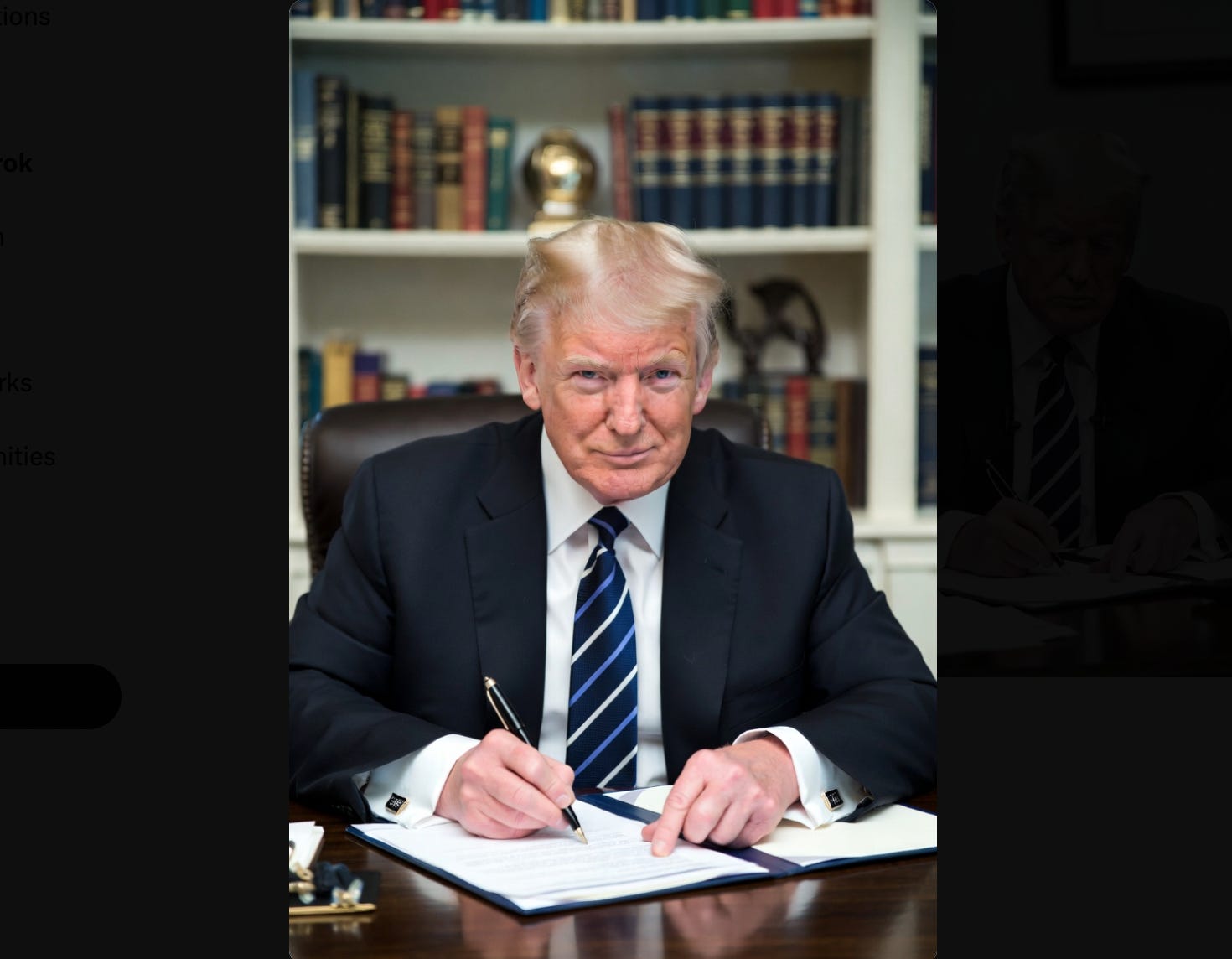
The White House issued two significant executive orders and a fact sheet on health-related issues this week, but extensive coverage of these orders was limited to mostly niche outlets. It's almost like the legacy media liberals are trying to avoid giving credit where it's due.
The first order came on December 15th, 2025.
Designating Fentanyl as a Weapon of Mass Destruction
The executive order officially designates illicit fentanyl and its main precursor chemicals as “Weapons of Mass Destruction” (WMD) under U.S. executive authority. It describes the fentanyl crisis not just as a public health issue but as a national security threat that drives violence and organized crime. In fact, it could be used to fund large-scale terror attacks.
The White House fact sheet emphasizes several points:
Fentanyl’s extreme potency (e.g., ~2 mg can be lethal) and high overdose death toll.
Illicit fentanyl and its profits allegedly fund foreign terrorist organizations and cartels engaged in violence and destabilization.
The designation is meant to unlock broader tools across law enforcement, financial sanctions, intelligence, and military support to disrupt production and trafficking.
Key Policy Actions & Directives
To implement this designation, the order directs key federal leaders and agencies to take specific actions:
1. Law Enforcement & Prosecution
The Attorney General is ordered to pursue investigations, criminal charges, sentencing enhancements, and sentencing variances in fentanyl trafficking cases.
2. Financial and International Actions
The Secretary of State and Secretary of the Treasury are tasked with taking appropriate actions against assets and financial institutions tied to the manufacture, distribution, or support of illicit fentanyl networks.
3. Military and Security Involvement
The Secretary of War (Defense) and Attorney General are to evaluate whether Department of Defense resources should be provided to help enforce federal narcotics laws under the WMD threat framework. This executive order will most likely enable the DoW to use military force in international waters.
4. Chemical Threat Response
The order requires updating U.S. Armed Forces’ chemical incident response directives to explicitly include the threat posed by illicit fentanyl.
5. Intelligence & Counter-Smuggling
The Secretary of Homeland Security is directed to use WMD and nonproliferation-related threat intelligence to identify fentanyl smuggling networks and support counter-fentanyl operations.
Fact Sheet: President Donald J. Trump Announces Largest Developments to Date in Bringing Most-Favored-Nation Pricing to American Patients
This is the rollout of the Trump Administration’s Most-Favored Nation (MFN) prescription drug pricing policy, designed to lower U.S. drug costs by aligning the prices Americans pay with those in other developed countries.
These are the Key New Agreements:
Nine major pharmaceutical manufacturers have agreed to lower prescription drug prices in the U.S. to MFN levels.
The companies participating include Amgen, Bristol Myers Squibb, Boehringer Ingelheim, Genentech, Gilead Sciences, GSK, Merck, Novartis, and Sanofi.
Pfizer is not listed in this fact sheet, as they signed the agreement in Sept. 2025.
These agreements apply to medications for many chronic and costly conditions, such as type 2 diabetes, rheumatoid arthritis, multiple sclerosis, asthma, COPD, hepatitis B & C, HIV, and certain cancers.
Benefits and Scope
The agreements will provide every State’s Medicaid program access to the most-favored-nation drug prices for products made by these companies, which the White House states will result in billions in savings for patients and the healthcare system.
Strategic Actions
The fact sheet recaps ongoing efforts under the MFN policy:
May 12, 2025: Trump signed an executive order directing agencies to implement MFN pricing.
July 31, 2025: Letters were sent to leading drug manufacturers outlining how to lower U.S. drug prices to MFN levels.
Since September 30, 2025: A series of 14 total deals with pharmaceutical companies have been announced to bring U.S. prices in line with those abroad.
Supply Chain Contributions
Several manufacturers are donating active pharmaceutical ingredients to the Strategic Active Pharmaceutical Ingredients Reserve (SAPIR) to strengthen U.S. supplies, reducing dependence on foreign sources. Examples include ingredients for asthma inhalers and blood thinners.
GSK will contribute 98.8kg of albuterol, the active ingredient in inhalers for people with asthma.
Bristol Myers Squibb will contribute tablets representing 6.5 tons of apixaban, the active ingredient in the drug Eliquis, a blood thinner taken by millions of American patients.
Merck will contribute 3.5 tons of ertapenem, an antibacterial medication used to treat complex infections.
The administration is working to end the practice where Americans both develop life-saving drugs and then pay higher prices that subsidize lower drug costs abroad.
The SAPIR functions much like the Strategic National Stockpile petro reserves, and is critical to reducing the risk of foreign nations (ergo China and India) withholding essential medicines that are almost exclusively manufactured offshore to advance diplomatic or military agendas. This needs to be further expanded to cover all essential medicines, as a step towards repatriating critical drug manufacturing back onto US soil.
Increasing Medical Marijuana and Cannabidiol Research
This order establishes a federal policy to expand scientific research on medical marijuana and cannabidiol (CBD) to better inform patients, doctors, and policymakers about their health effects, risks, and therapeutic potential. It states that decades of federal policy have limited research and medical guidance. Furthermore, it expedites the process by which medical marijuana is rescheduled from a Schedule I to a Schedule III drug.
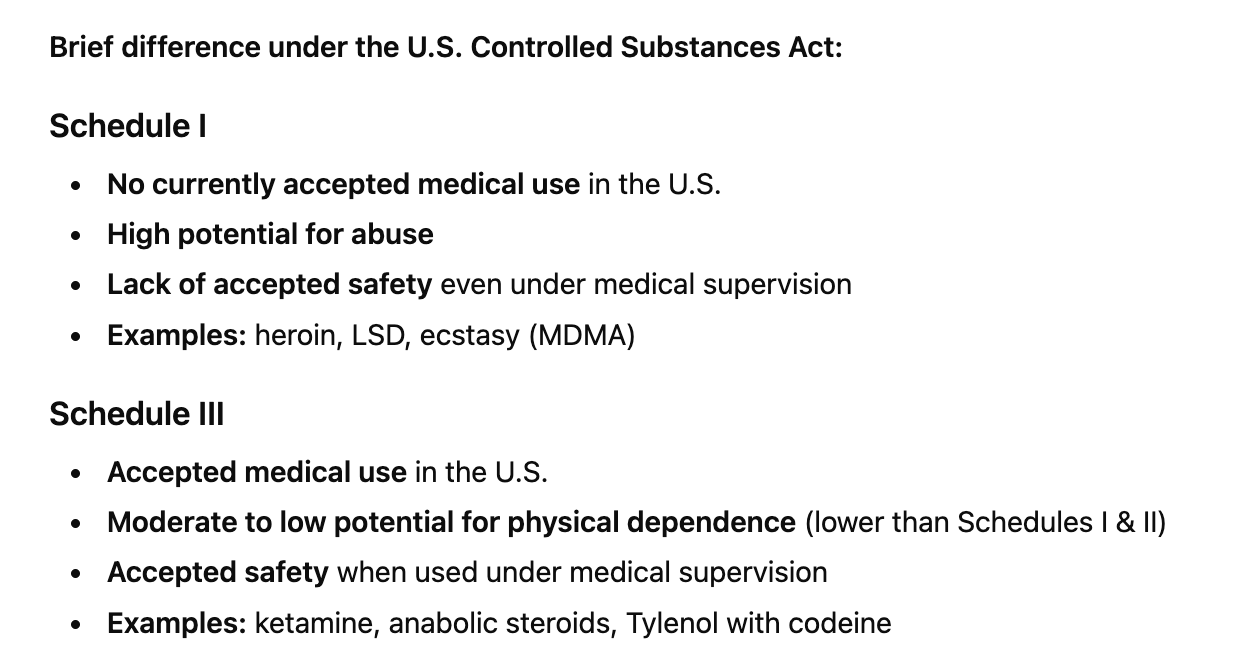
Schedule I drugs are legally defined as having no medical use, while Schedule III drugs are recognized as medically useful and can be prescribed and researched under standard medical regulations
Key Actions and Directives
Rescheduling Marijuana
Directs the Attorney General to expedite the rulemaking process to reschedule marijuana from Schedule I to Schedule III under the Controlled Substances Act (CSA).
Schedule III classification recognizes a currently accepted medical use and lower abuse potential than Schedule I.
This reflects previous recommendations by the Department of Health and Human Services (HHS).
Improving Access to Cannabidiol (CBD) Products
Directs White House officials to work with Congress to update the legal framework for hemp-derived cannabinoid products, especially full-spectrum CBD, to improve access while protecting consumer safety.
This includes developing guidance on acceptable THC/CBD content limits and safety standards.
All this means that medical marijuana may become available as a prescription drug across the nation, and opens up a lot of commercial opportunities for Big Pharma.
What intrigues me most at this point is whether medical marijuana, derivatives, and extracts might be defined as “dietary supplements” at some point, since they are plant-derived.
“Dietary supplement” is defined in 21 U.S.C. § 321(ff) as: a product (other than tobacco) intended to supplement the diet that bears or contains one or more of the following dietary ingredients: a vitamin; a mineral; an herb or other botanical; an amino acid; a dietary substance for use by man to supplement the diet by increasing the total dietary intake; or a concentrate, metabolite, constituent, extract, or combination of any [such] ingredient.
Such products must be intended for ingestion in forms like tablets, capsules, or powders, and labeled as a “dietary supplement.” They are generally deemed foods under the FD&C Act (except for certain drug-related purposes) and are subject to different regulations than drugs or conventional foods, with manufacturers responsible for safety and labeling compliance rather than pre-market FDA approval.
Expand Research and Real-World Evidence
Requires HHS, the FDA, CMS (Centers for Medicare & Medicaid Services), and NIH to develop research methods that use real-world evidence to assess medical marijuana and legal CBD products.
Focus is on long-term health outcomes, especially in vulnerable populations, such as adolescents and young adults.
Marijuana’s current federal Schedule I status has historically limited scientific research because it is legally considered to have no accepted medical use.
Moving toward Schedule III aims to reduce regulatory barriers for research and improve medical understanding.
The Order itself does not alter criminal law, legalize marijuana at the federal level, or override state laws. Note that it does not provide full legalization of marijuana.
The Order highlights that many Americans already use medical marijuana and CBD; for example, a significant number of adults and seniors report CBD use for chronic pain relief.
As a libertarian, I support this executive order. Even though I personally believe that too many people waste their lives away smoking pot and eating gummies. This drug only gets stronger and stronger, and both its addictive nature and neuropsychiatric effects should not be overlooked.
I find it fascinating how little attention media has paid to these two presidential executive orders and the fact sheet.
Instead, the media focus has been on the release of the Epstein files (despite the intelligence community having the ability to redact whatever they wish), and the shooting at Brown University and MIT.
Reporting to cover these important presidential orders has not occurred to any great extent. Yet these three new orders have the ability to at least partially re-order healthcare as we know it in the USA.
One has to wonder if reporting has been sparse because, generally speaking, the people - even liberals, can get behind all of these new initiatives and the mainstream media literally will not lift a finger to say anything positive about Trump’s presidency. Particularly if their reporting might actually help his poll numbers.
”
As a mother of two sons addicted to fentanyl (one has been off it for over a year now, praise God), I am thrilled with President Trump's war against it, and I rejoice with every Narco boat that is stopped.
Been taking CBD oil for several yrs to moderate arthritic inflammation. Was very annoyed by our lt. gov.patterson trying to get it banned outright in Texas, many believe at the behest of the alcohol lobby who pay him big bucks