

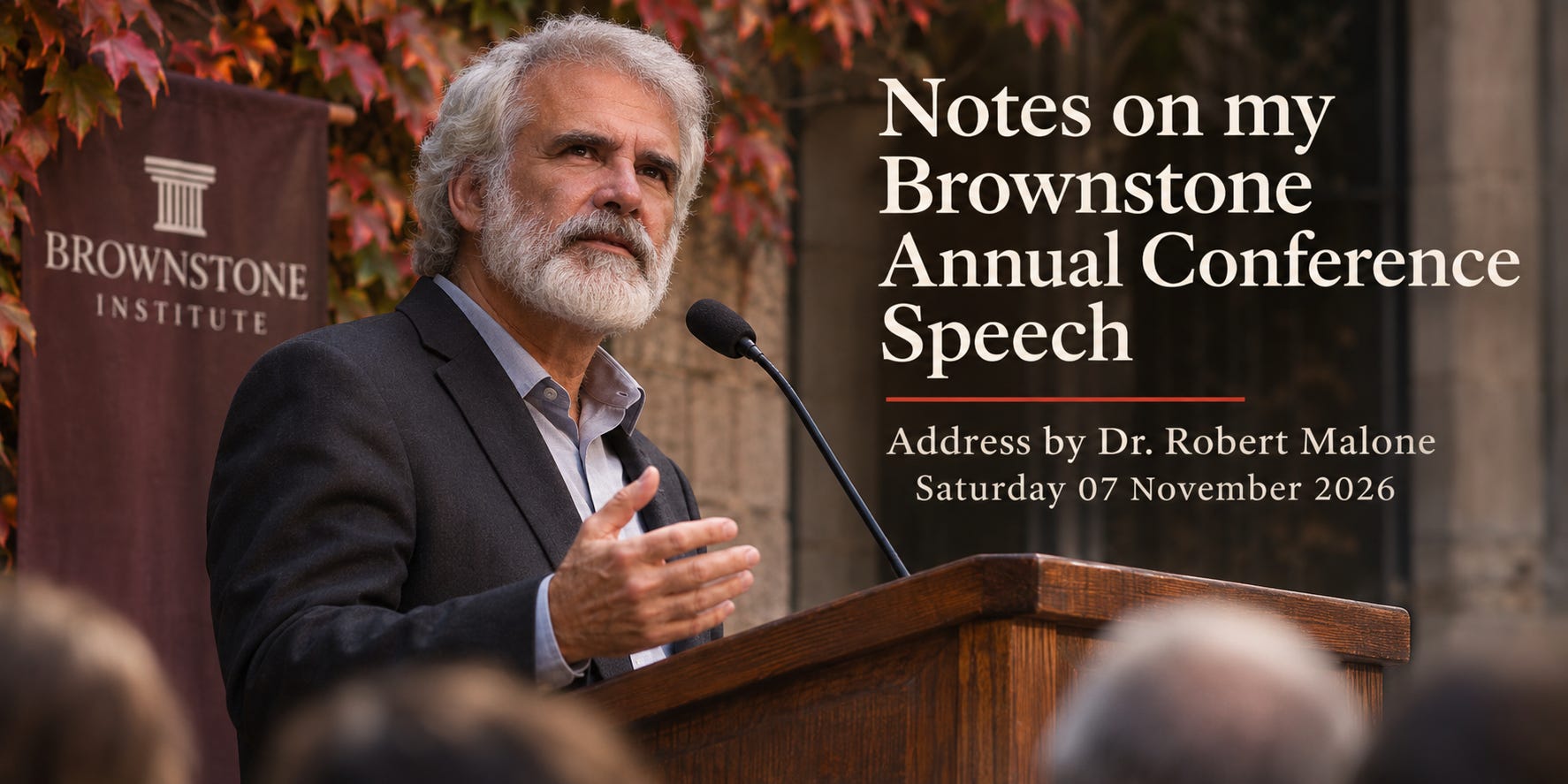
Audio Version:
Dr. Robert Malone
TWO QUOTES TO SET THE FRAME
The two quotes:
The first, from Robert Hunter, the bard of the Grateful Dead. And this quote may reflect something of my misspent youth: What a long, strange trip it’s been.
The second, widely attributed and of uncertain origin. We certainly live in interesting times.
THE AUDIENCE, AND WHAT I BRING TO IT
Brownstone is not an accident. It is an intentional community. Jeffrey built it in May 2021 with a specific charter: to be the gathering point for the people who had refused the promoted narrative during COVID, and who needed to make sense of what had been done, and of what had been lost.
What holds this community together is not a single political position. It is two things. The first is outrage. The second is the ongoing work of sense-making. Many of you came in through the first door. Most of you are still here because of the second.
Jeffrey opened yesterday with a candid admission: his own unreasonable resentment and judgmentalism of people in airports. Walter Kirn, the novelist whose book Up in the Air became the film, picked that thread up. He talked about the particular resentment we feel toward the people ahead of us in a boarding line. He extended
it. We should no longer be trying to save liberals from themselves, he said. We should treat them as an enemy to be defeated.
I looked into my own soul after those remarks. I did not find those feelings there.
What I was reminded of, standing in that space, is Mattias Desmet’s teaching. Human beings need two things to live well. Meaning in their lives. And genuine connection with other human beings. When a population is denied those two things long enough, the mass-formation dynamic that Desmet documented is what fills the vacuum. Intentional communities like this one exist, in part, because they answer that need. They give people the bonds without which happiness and fulfillment are not available to us. Brownstone, in that sense, is a medicine for a specific wound.
What I want to do with the time I have left, and what I hope the book I am going to describe can help others do, is make sense of the world as it actually is, help where help is possible, and offer a path forward. Not obsess over the harms that were done, as real and as deep as those harms were. Not treat myself or anyone else as a victim with a long account to settle.
My soul tells me I do not want to harm our political and philosophical opponents. I want to understand them. I want to help them better understand what we have seen and lived through. I understand the urge to strike back.I felt it most acutely this year during my travel to the Gaza border and through Judea and Samaria, where the urge is carried in the bodies of people on every side of every line. But striking back propagates a cycle of hate. It does not move the culture forward. It does not heal the country we live in.
Having said that, I want to be plain about something else. There will be no justice for what was done during COVID. No federal agency is pursuing accountability. No state attorney general is pursuing restitution on any serious scale. Both political parties enabled what went down, and both are now running the cool-out phase rather than the reckoning. The institutions that would have to insist on accountability are the institutions that would have to indict themselves.
Murray Rothbard set out the structural reason in Anatomy of the State. The judiciary is a branch of the state. Judges are appointed by the state, paid by the state, housed in state courts, enforced by state police. To expect such a body to deliver justice against the state is to expect a monopoly to rule against itself. In Rothbard’sframing, the court is a branch of the government interpreting the rules of the government in a game against the government. That is a feature, not a flaw. It is what the institution is for.
Yesterday, Calley Means went on Joe Rogan. Until last month, he was Senior Adviser to the Secretary of Health and Human Services. He named five White House staffers he says killed the MAHA agenda from inside: SusieWiles, Richard Walters, Walker Barrett, James Blair, Tony Fabrizio. He said industry pressure on Wiles stripped glyphosate out of a second MAHA report. He said the White House sided with Bayer in a Supreme Court brief over Roundup cancer lawsuits without telling Robert F. Kennedy, Jr. His conclusion from inside: Americans who get excited about policy promises through the existing structure are, in his words, being duped. The datapoint stands even if you discount everything Means says. MAHA had its own Secretary, its own Senior Adviser, its own public reports, its own moment of political alignment. And still, industry won. If MAHA could not deliver inside the administration it ran, COVID accountability from the same administration will not either.
So the task of sense-making does not sit alongside the task of accountability. It sits in place of it. That is why communities like this one exist, outside the apparatus of the state. That is why the work of sense-making is the work I am here to describe.
A THREAD ELON REPOSTED THIS WEEK
Before I come to the books, a brief detour through a post Elon Musk reposted and endorsed earlier this week. It touches on a set of questions this community has been working through in and around the sessions here: Artificial Intelligence, the Surveillance State, and the hyperscale data centers being built to run it. These are complex topics, and I do not have a tidy answer on them. I want to put one framing in front of the room, because the structural argument at the top of it is the same argument this book makes, applied to a different domain.
The thread’s argument runs this way. DOGE was an attempt to reform the state from the inside. It failed. The claim, which Elon’s endorsement foregrounds, is that it failed for a structural reason rather than a personal one. The machine protects itself. Nobody in power actually wants to cut, because the incentives of everyone in the chain run the other way. The deficit is not a policy choice. It is an output of the incentive structure.
From that premise, the thread argues there are only two exits. One is bankruptcy. The debt compounds until the system collapses under its own weight. The other is a productivity shock big enough to outrun the debt. The author’s candidate for that productivity shock is AI and robotics at hyperscale, delivered fast enough that abundance becomes visible in real time rather than invisibly over thirty years.
The thread’s secondary claim is the one with the most structural weight. Capitalism has had a two-centurymarketing problem. Its gains are real but slow and invisible. Two percent a year is not experienced as anything.Meanwhile, the left’s promises, a check, a subsidy, a benefit, feel immediate and concrete. That is why the left wins on promises even when it cannot deliver them. Capitalism produces the wealth. Socialism takes the credit. Robots, the thread argues, break that asymmetry, because they make the causal chain between enterprise and prosperity visible to the person living through it.
I am not endorsing every claim in the thread. The civilizational-collapse scenarios at the end are the author’s, not mine. What I do endorse is the structural premise at the top, because it maps directly onto the subject oftoday’s book. What Elon concluded about federal spending and debt- that the machine will not reform itself and that the incentive structure produces the deficit- is what Jill, Rob, and I concluded about pandemic governance. The machine will not reform itself. The incentive structure produces the next pandemic grift. And the question for us is the same one Elon is now asking in a different domain: what, exactly, breaks the mechanism from the outside?
THE THREE BOOKS SO FAR
The book I am going to describe is the fourth installment of Jill’s and my own sense-making work since 2020. The first three are already in print.
The first was Lies My Government Told Me. That book was about what was experienced by the people on the front lines who opposed the promoted narratives during COVID. Physicians who were threatened with loss of license for prescribing early-treatment protocols. Scientists who were de-platformed for publishing data that did not fit. Patients who were told that what their own bodies were doing was not happening. Families who buried people the official record will not count.
The second was PsyWar. That book was about the development of modern propaganda and censorship technology. How the techniques were built, who built them, and how they were used during COVID and in the broader globalist project to promote and reinforce specific narratives. The architecture of consent manufacturing is older than COVID. COVID is where that architecture was stress-tested at population scale.
The third was Homesteading for Health. That book offered a vision for how to live afterward. How to maintain autonomy, personal sovereignty, and household-level resilience in the world that COVID revealed. It is practical and specific. It is about the piece of ground you stand on and the food you put on your family’s table.
Each of the three answers a different question raised by what we lived through. What really happened on the ground. How were we told what we were told. And how do we live now?
THE FOURTH BOOK
The fourth book, the one I want to walk you through today, is called The Grift: How Pandemic Fear Became a Business, and Who Profits from Running It. Jill and I wrote it with Rob Nelson. Morgan James will publish it before the end of this year. It asks the question the first three set up but did not fully answer. What, exactly, was this that happened to us?
GRIFTING AS THE STRUCTURE THAT MAKES SENSE OF IT
The answer the book arrives at, and that we think holds, is that what we lived through was grifting. Not conspiracy. Not accident. Not incompetence. Grifting, in the formal sense, is a word that has been carried in American English for more than a century.
The term and the theory have a direct lineage. David Maurer, in The Big Con, published in 1940, documented the long con as a technical operation. The taxonomy has five stages. The setup, in which the mark is identified and groomed. The convincer, in which the mark is given a small early win so that trust is established. The sting, in which the mark hands over the money. The blow-off, in which the grifter exits before the mark realizes what has happened. And the cool-out, in which the mark is persuaded afterward that nothing really went wrong, that the loss was his own fault or his own imagination, and that the people now telling him he was played are themselves the problem.
Every stage of that taxonomy maps directly onto the pandemic response.
The setup was the manufactured sense of unprecedented danger, built on a decades-old infrastructure that I will come back to. The convincer was the early fatality projections and the two-weeks-to-flatten-the-curve promise, both revised downward only after compliance was secured. The sting was the trillions of dollars in transferred wealth and the compulsory medical product. The blow-off was the quiet end of the emergency declarations without acknowledgment, apology, or accounting. And the cool-out is what we are living through right now. The engineered persuasion that nothing much went wrong, that the people who said something was wrong at the time are the problem, and that the proper response is to move on.
That is the structural claim the book makes. It is not a metaphor. It is a technical description of what happened to you and what is being done to you now.
THE SYSTEM BUILT OVER FOUR DECADES
The second half of the argument is that this did not come together in 2020. It came together over four decades. Part II of the book walks the precedents, and each chapter is organized around what the next generation of grifters learned from the one before.
What AIDS taught the grifters was that fear of a novel pathogen could be converted into a permanent funding stream and an unfireable priesthood of experts whose credibility was insulated from outcomes. The institutional AIDS response built the template. Anthony Fauci’s career is the arc of that chapter.
What anthrax built, in the five years after 2001, was the biodefense apparatus. Mark Kortepeter, who ran USAMRIID’s response from inside, gives that chapter its primary witness. Billions of dollars moved. Companies were created to receive the money. The pandemic-preparedness industry was built in that period, and its clients are the same agencies that were about to spend COVID.
Swine flu taught them that definitions are a lever. In 2009, the WHO quietly revised the word “pandemic” to remove the severity-of-disease criterion. Lowering that definitional threshold was worth billions in automatic vaccine purchases and gave every future outbreak a smoother path to emergency declaration.
And the chronic-illness buildout that followed each wave turned acute scares into permanent product lines. Statins. Antidepressants. Long-acting injectables. Each engineered episode left behind a new maintenance-doseeconomy.
By March 2020 the system was in place. The institutions, the regulators who had become executives, the broadcast relationships, the automatic funding mechanisms, the pre-stocked emergency authorities, the model legislation sitting in drawers in fifty state capitals. COVID did not improvise. COVID executed.
WHO TOOK THE MONEY
Who profited. Pfizer booked the largest single-year revenue in pharmaceutical history. Moderna went from pre-revenue to the Fortune 500 in twenty-four months. BlackRock and the pension funds captured the upward wealth transfer that Ed Dowd documents in detail, chapter and figure. The regulatory class moved into the regulated class, with named individuals leaving FDA and CDC to board seats at the companies whose products they had just approved. The broadcast networks sold the advertising next to the fear. The censorship industry found its first mass commercial market and institutionalized itself accordingly.
And the public, on the mark side, paid twice. Once in taxes, in debased currency, in excess deaths, in lost education, in deferred care, in suicides that should not have happened and children who did not speak when they should have been speaking. And then again, on the contrarian side, where a parallel grift rose to serve the people who had seen through the first one. Part IV of the book documents this half with the same discipline we used for the institutional half. The grifter is as happy to sell you a supplement at ninety dollars as the hospital was to put you on a ventilator at nine thousand. Both operations run on your fear. Both need you to stay afraid for the business to work.
Naming both is uncomfortable. It is also necessary.
WHAT CAN BE DONE
The last chapter is called “How to Not Be the Mark.” It returns to Gavin de Becker’s first distinction, from his book The Gift of Fear. Warranted fear is a signal in the presence of actual danger. Unwarranted fear is a signal that has been produced in you by someone who stands to profit from your response.
The practical operation is to ask one question. Am I in the presence of real danger, or am I being sold something by someone who needs me to stay afraid?
That question, asked honestly and asked often, defuses the grift. Not because it answers what the next danger really is. Because it makes you unsellable to the industry that produces false danger for a living. It is a cognitive discipline, practiced one person at a time, and reinforced by communities that take the discipline seriously. Many of you here have, in the last five years, become people who ask that question as a matter of reflex. That is some part of what Brownstone is, and some part of why Jeffrey built it.
THE LIGHTHOUSE
There is an old saying that those who seek revenge should first dig two graves. Looking back on my own life, I now see the deep wisdom in that line.
I understand the urge to gird one’s loins and wield the flaming sword of righteous indignation. After Jill and I returned from Israel this year, after walking the carnage at the kibbutzim along the Gaza border and the killing fields of the NOVA festival site where the atrocity of October 7 was carried out, we gunned up. We bought large numbers of rounds. But that is for defense, not for offense. I prefer to live by New Testament ethics, even while living in what is still substantially an Old Testament world.
In Jerusalem I stood at the Temple ruins and walked through the archaeological excavations that document what the Roman Empire did to an independent minority community that confronted it. I have seen firsthand what happens to a community that treats empire as something to be defeated rather than something to be outlasted. The siege. The dispersion. The silence of two millennia.
So I want to offer a different metaphor for what this community is, and for what it can be.
A lighthouse. Not a fortress. Not an army. Not a political faction waiting for its turn to run the machine. A lighthouse. We burrow in. We keep the knowledge of a better way, a more decentralized way. We preserve it.We communicate it. We make ourselves findable by the people in the present and in the future who are open to learning our view of the world, and our sense of how things actually work. A view grounded in decentralized subsidiarity and free-market enterprise. Not in socialism. Not in central planning. Not in another empire.
That is the work. That is the book I came here to describe. And it is why I am grateful to be in this room this morning.
Thank you.
Support Independent Journalism and the Work Ahead
Robert and I have spent years researching, writing, speaking, and challenging the narratives that powerful institutions would rather leave unquestioned. This work has never been about simply revisiting the injustices of COVID. It is about understanding how those systems operate, who benefits from them, and how we can prevent the same machinery from being used against us again.
As Robert emphasized in his Brownstone speech, the answer is not revenge or endless outrage. It is knowledge, independent thinking, community, and the courage to build something better.
That is what we are working to accomplish at Malone News.
We do not have corporate sponsors, pharmaceutical advertising budgets, or government grants underwriting our research. We depend on readers who believe that independent journalism, honest inquiry, and freedom of thought are worth defending.
If you value this work, please consider becoming a paid subscriber. Your support allows us to continue researching, writing, publishing, and speaking without having to answer to the institutions we investigate.
And whether you subscribe or not, please share our articles with friends, family, and your communities. Help us keep the lighthouse burning.
Thank you for standing with us.
Robert and Jill Malone
Hello all. I am new here. I just subscribed. Though I have been very familiar with these ideas for years. I knew that COVID-mania was a hoax by late March 2020, and why. How brains were fried. Although almost no one wanted to hear the actual facts at that time.
However, I did not do the podcast/razzle-dazzle thing. I simply wrote about it quietly. Since various editors turned down my papers due to the conclusions being "too bizarre". Ahem.... So I did not enter the pantheon of gods of the New-Right Media. I have made myself and my explanations available gratis across social media since that time. Call me a sucker...maybe I should have done a prestigious book deal instead.
My background is in Depth Psychology, and I know my way around human nature and the human survival system. I am an excellent observer and critical thinker. I hope you are too.
I have some skill in solving mental mysteries. But you have to keep up with me.
Susie Wiles was as useless as Pam Bondi. Both answered to their deep state masters and had no regard for the mandate given to them by 70+ million legal voters.