


By: Dr.s Jill Glasspool Malone and Robert W. Malone
Audio Version:
The Sugar in Infant Formula that the FDA Hides from Parents
The FDA does not require infant-formula manufacturers to list sugar on their ingredients label, or tell parents how many grams of sugar are in their products.
Walk through an American grocery store and FDA generally requires packaged foods to disclose Total Sugars and Added Sugars. Every food label in America lists sugar, even if the amount is zero. Food marketed specifically for babies under twelve months must disclose Total Sugars and Added Sugars.
Infant formula does not require that on the label.
The exception is written directly into federal regulation. Foods for infants must disclose total carbohydrate, total sugars and added sugars, then the FDA says, “other than infant formula.”
Formula operates under its own labeling rules and does not have to tell parents how many grams are total sugars or added sugars.
FDA requires infant-formula manufacturers to tell parents how many milligrams of linoleic acid are in the can. It does not provide for telling them how many grams of Total Sugars or Added Sugars are in it. Yet Operation Stork Speed made linoleic acid a subject of intensive investigation while apparently leaving the sugar-labeling rule untouched.
Why?
Think about that for a moment. A jar of baby food has to tell you how much sugar it contains. The formula that may provide virtually every calorie a newborn consumes for months does not.
This is not a loophole FDA recently discovered. FDA created the rules. FDA knows the exemption exists.


The FDA also knows what can be hiding behind that single number labeled “carbohydrate.” Human breast milk is naturally rich in lactose, and infants need carbohydrate. But commercial formulas can obtain those carbohydrates from very different sources. Depending upon the product, the ingredient list may include lactose, corn syrup, corn-syrup solids, maltodextrin, sucrose or combinations of them. Standard formula commonly contains roughly 10 to 11 grams of carbohydrate per 100 calories, meaning approximately 40 percent or more of its calories come from carbohydrate. Yet parents are not entitled to a simple statement telling them how much of that carbohydrate is sugar or added sugar.
Even more remarkably, FDA specifically considered sugar disclosure when it modernized the Nutrition Facts label. It concluded that parents should be told the Total Sugars and Added Sugars in foods fed to infants.
Yet, the exemption for infant formula remained. As in the FDA designed the mandatory infant-formula nutrient panel without a place for Total Sugars or Added Sugars. Literally, sugar isn’t allowed on the label.
Why?
The formula industry certainly knew about it. Its trade association was publicly defending the existing carbohydrate-labeling rules at least as far back as 2011, explaining that manufacturers were required to disclose total carbohydrate but not the individual carbohydrates contained in their products.
Did the formula industry have a role in preserving this exception? Did the sugar industry? Or did an old regulatory exemption simply become embedded inside FDA, protected by inertia and by industries with no particular reason to see it changed?
We do not yet have the evidence to answer those questions. But after decades of special treatment, they are questions worth asking.
There is also a change that should not require another five years of study: stop unnecessarily replacing lactose with corn-syrup solids and other added or alternative sugars in formula intended for healthy infants.
The stakes extend far beyond infancy. Britain inadvertently conducted one of the most extraordinary nutrition experiments in modern history when wartime sugar rationing continued through September 1953 and then abruptly ended. People exposed to restricted sugar during the first 1,000 days of life, beginning in the womb and continuing through roughly age two, subsequently had about a 35 percent lower risk of type 2 diabetes and a 20 percent lower risk of hypertension. Diabetes appeared about four years later and hypertension about two years later. The protective association became stronger when sugar restriction continued after the first six months of life, precisely when foods other than breast milk normally begin entering the diet.
The story has only become more consequential. Subsequent analyses of the same historical experiment have linked early-life sugar restriction with substantially lower rates of cardiovascular disease and cardiovascular death, and newer work has found associations with lower cancer risk decades later. We now know that sugar and rapidly absorbed carbohydrate exposure during the earliest period of human development may leave metabolic consequences that persist for decades.
That changes the meaning of regulatory delay. Five more years of study is not simply five more years on an FDA calendar. It is five more birth cohorts passing through infancy under standards FDA itself acknowledges deserve reconsideration. If early nutritional exposure alters the lifetime trajectory of diabetes, hypertension, cardiovascular disease and possibly cancer, the consequences will not become fully visible until those babies are middle-aged or old.
The bureaucracy can wait. A baby’s first 1,000 days cannot.
Then Robert F. Kennedy Jr. arrived at HHS promising to change American infant nutrition.
In March 2025, Kennedy announced Operation Stork Stall Speed, promising what he called “radical transparency” about infant-formula ingredients. He met with the major manufacturers. He challenged the ingredients being fed to American babies. He raised seed oils and contaminants. FDA announced the first comprehensive review of infant-formula nutrient standards since 1998.
Yet somehow one of the most obvious transparency problems in the infant-formula aisle barely registered with Kennedy or the FDA reformers.
Sugar.
Instead, Operation Stork Speed became deeply interested in omega-6 fatty acids and the oils used to manufacture formula. Those are legitimate scientific questions. But FDA already knew that parents could not determine from the nutrition panel how many grams of sugar were in the formula they were feeding their babies. They also know just how powerfully sweet foods can shape infants’ and children’s preferences.
Why wasn’t this the first thing Operation Stork Stall fixed?
No multiyear contractor is required. No five-year nutritional study is required to tell parents what is already in the can. Manufacturers already know the composition of their own products.
Put Total Sugars and Added Sugars on the label.
And then ask the harder question: why are corn syrup, corn-syrup solids, maltodextrin and sucrose being used in formulas intended for healthy infants when lactose-based alternatives are readily available?
Eighteen months after Kennedy promised “radical transparency,” the labeling exemption remains.
How did Operation Stork Speed manage to go looking for problems in infant formula without fixing one that FDA already knew was sitting in plain sight?
Has the FDA informed Kennedy of this sugary oversight?
Maybe even more importantly, it is now up to FDA Commissioner Heidi Overton to rectify this. Our hope is that someone gets this article in front of her so she can raise holy hell with the FDA. Because we believe this is an issue where she could make a difference very rapidly.
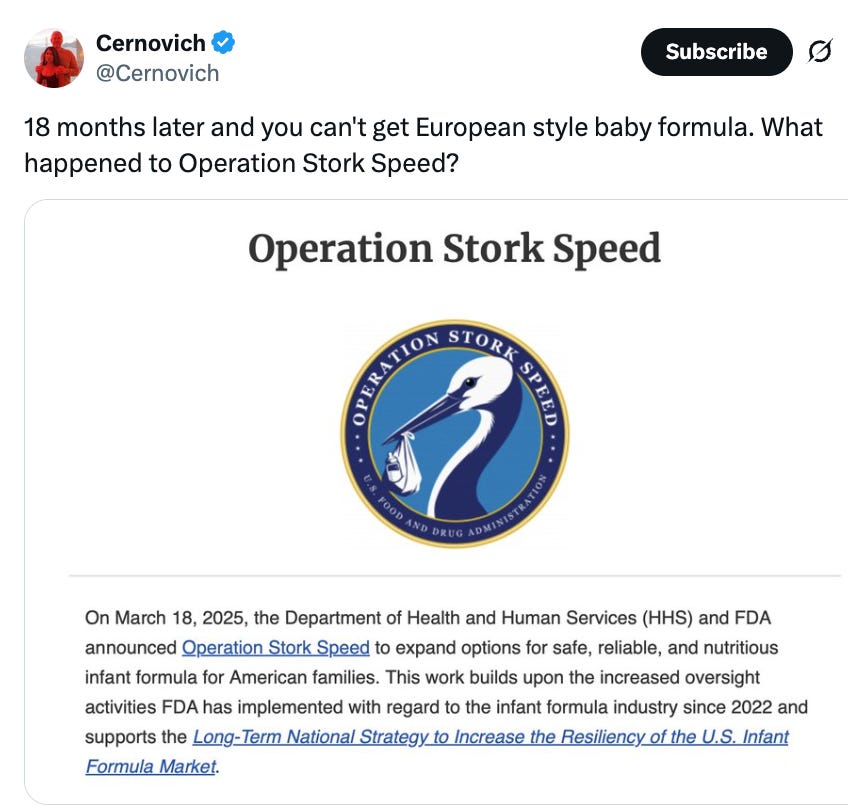
So What Has Operation Stork Speed Actually Accomplished?
Put the sugar issue aside for a moment.
Even if we judge Operation Stork Speed entirely on the agenda Kennedy and FDA chose for themselves, the obvious question eighteen months later is: What has actually changed in the infant formula parents are buying today?
The answer is considerably less impressive than the name suggests.
HHS promised more testing for heavy metals and other contaminants, greater ingredient transparency, clearer labeling, more competition and new formula options.
There has been real progress on safety testing. FDA conducted what HHS describes as the largest-ever examination of chemical contaminants in infant formula sold in the United States, releasing the results in April 2026. Testing included heavy metals and other environmental contaminants, and FDA has expanded surveillance for microbiological contaminants such as Clostridium botulinum and Bacillus cereus. FDA says that testing will continue.
FDA also continued the personal-importation policy created after the 2022 formula shortage, developed a centralized list of formulas marketed in the United States, established a nutrition-research partnership with NIH, and says it is encouraging new manufacturers and new formulas to enter the American market.
Those are legitimate accomplishments.
But what about the formula itself?
That is where Stork Speed slows to a crawl.
In May 2025, Kennedy announced what he called “radical transparency” and FDA opened its comprehensive nutrient review. The first major action was not a new standard. It was a Request for Information asking scientists, manufacturers, trade groups and the public what FDA should consider changing. The comment period did not close until September 2025.
FDA then convened experts, reviewed comments and began evaluating the evidence.
By 2026, the language had changed.
FDA now says it is pursuing a “strategic, phased approach” that will allow the agency to act where the evidence is clear while continuing to study “more complex areas.” Its official 2026 deliverable is merely to “begin implementation of a plan for modernizing infant formula nutrient requirements.”
Read that carefully.
Operation Stork Speed was announced in March 2025. By 2026, FDA’s promised deliverable was to begin implementing a plan for eventually modernizing the standards.
Meanwhile FDA and NIH have created a Nutrition Regulatory Science Program to investigate maternal and infant dietary exposures and health outcomes across the lifespan. The underlying FDA-NIH agreement can remain in effect for ten years.
Research is worthwhile. But parents were not told in March 2025 that Operation Stork Speed meant launching a decade-long research infrastructure while waiting for better formula.
Kennedy himself was still describing the program to Congress in April 2026 as an effort to increase labeling transparency, address research gaps, expand testing and undertake the nutrient review.
Notice what is missing in Kennedy’s description to Congress. A date.
When will the new infant-formula nutrient standards actually be proposed?
When will parents see substantially reformulated products?
When will FDA decide whether healthy infants should routinely receive formulas based on corn-syrup solids rather than lactose?
When will it decide whether American iron requirements should move closer to international standards?
When will it establish whether linoleic acid needs a maximum?
When will DHA and ARA become required?
And, after eighteen months of promises about transparency, when will parents finally be told how many grams of Total Sugars and Added Sugars are in the formula they are feeding their babies?
FDA’s current Operation Stork Speed page provides no date for final nutrient standards. It says the agency is reviewing the evidence and proceeding in phases.
This is not speed.
The irony is difficult to miss. FDA’s new Human Foods Program has an Office of Nutrition and Food Labeling charged with food-labeling policy and an Office of Critical Foods specifically responsible for infant formula, including its labeling. FDA’s 2026 priorities include improving food labels and giving consumers better information about added sugar.
Yet when the food in question is infant formula, sugar disappears.
The agency requires manufacturers to disclose linoleic acid down to the milligram, while its infant-formula nutrient panel does not provide parents with Total Sugars or Added Sugars. Some formulas list corn syrup as their first ingredient, yet a parent cannot turn the can around and find a simple number telling them how many grams of sugar their baby is consuming.
This is not a scientific problem waiting to be solved. It is a labeling problem FDA has chosen not to fix.
Operation Stork Speed was supposed to deliver “radical transparency.” Here is an obvious place to start:
Tell parents how much sugar is in the formula.
If you value this kind of work, please consider becoming a paid subscriber.
This story started with a simple question: Whatever happened to Operation Stork Speed? Following that question led somewhere much more important, to an FDA labeling exemption that allows infant-formula manufacturers to avoid telling parents how many grams of Total Sugars and Added Sugars are in products that may provide virtually every calorie their babies consume.
Finding these stories takes time. It means going past the press releases, reading the regulations, following the scientific literature, comparing what was promised with what actually happened, and asking the questions that somehow never seem to get asked in Washington.
Paid subscriptions make that work possible and keep Malone News independent.
If you can, please support us by becoming a paid subscriber. And if you already are one, thank you. You are the reason we can keep digging.
Maddening! Radical transparency my arse
Unbelievable! There’s absolutely no reason to leave off sugar content on baby formula unless there’s something to hide!