


Audio Version:
Executive Summary
Over the past day, we have worked our way through the thousands of pages of documents Senator Rand Paul recently released in his COVID-19 Reading Room, including the transcribed interview with Dr. Ralph Baric released today. Using AI to analyze this enormous collection of congressional testimony, emails, and Slack messages, we uncovered a series of remarkable revelations that fundamentally change our understanding of how the origins of COVID-19 were discussed behind closed doors.
For more than five years, the American public was told that the science was settled. The laboratory-origin hypothesis was dismissed as implausible, The Proximal Origin of SARS-CoV-2 became the definitive scientific narrative, and those who questioned it were censored, ridiculed, and marginalized.
The newly released documents in Senator Rand Paul’s COVID-19 Reading Room tell a very different story.
Congressional testimony from Dr. Ralph Baric and thousands of pages of private Slack messages reveal that the scientists closest to the evidence privately debated laboratory scenarios, acknowledged uncertainty, discussed gain-of-function research, and questioned many of the very assumptions that were presented to the public as settled science.
Baric himself confirms that DARPA’s proposed coronavirus experiments were gain-of-function research, acknowledges conducting gain-of-function unpublished experiments that undermined a central argument of Proximal Origin, and describes years of coronavirus work involving many of the same investigators and institutions that later became central to the origins debate.
Meanwhile, the Slack discussions show that the paper’s authors continued privately exploring laboratory-related mechanisms both before and long after their paper had become the foundation for government messaging and censorship.
These documents prove that the public was never given the full scientific debate. They expose serious questions about scientific transparency, government involvement, funding disclosures, oversight of gain-of-function research, and the extraordinary effort to present uncertainty as certainty during one of the most consequential public health crises in modern history.
What makes this all so important is that this information is now in the congressional record. It can be acted upon.
1. DARPA explicitly solicited gain-of-function research
Baric testified that the DARPA PREEMPT program required gain-of-function experiments to answer the scientific question it posed.
His exact words:
“That’s a gain-of-function experiment. There’s no other way to think about it.”
This undercuts years of semantic arguments that the proposed work somehow wasn’t GOF.
2. DEFUSE proposed inserting a furin cleavage site
Baric confirmed that under the DEFUSE proposal, his laboratory would have performed the furin cleavage site insertion.
The furin cleavage site became one of the central scientific features that fueled lab-origin scrutiny.
During his congressional testimony, Baric acknowledged that the DARPA DEFUSE proposal called for inserting a furin cleavage site into SARS-like bat coronaviruses and confirmed that his laboratory at UNC would have been responsible for engineering those viruses. He further acknowledged that inserting a furin cleavage site to determine whether it changes viral phenotype constitutes gain-of-function research, and he described DARPA's PREEMPT solicitation as asking for "a gain-of-function experiment" with "no other way to think about it."
At the same time, Baric testified that DARPA rejected the DEFUSE proposal and that the specific experiments outlined in that proposal were therefore never performed.
But then, Baric also acknowledged conducting other furin cleavage site insertion experiments in coronaviruses as part of his broader research program, demonstrating both the technical capability and the scientific interest in precisely the type of work described in DEFUSE.
The unresolved question is whether substantially similar experiments ultimately proceeded under other federally funded projects.
We know that NIH later funded coronavirus research involving many of the same investigators and institutions associated with DEFUSE - in fact there is evidence that NIH funded almost that exact same grant, but the documents released to date do not, by themselves, establish that the specific furin cleavage site insertion experiments proposed to DARPA were subsequently carried out under an NIH grant. Although that scenario is highly likely.
That question remains one of the central issues for investigators examining the documentary record.
Below is a chart comparing the DEFUSE proposal and the NIH-funded research.
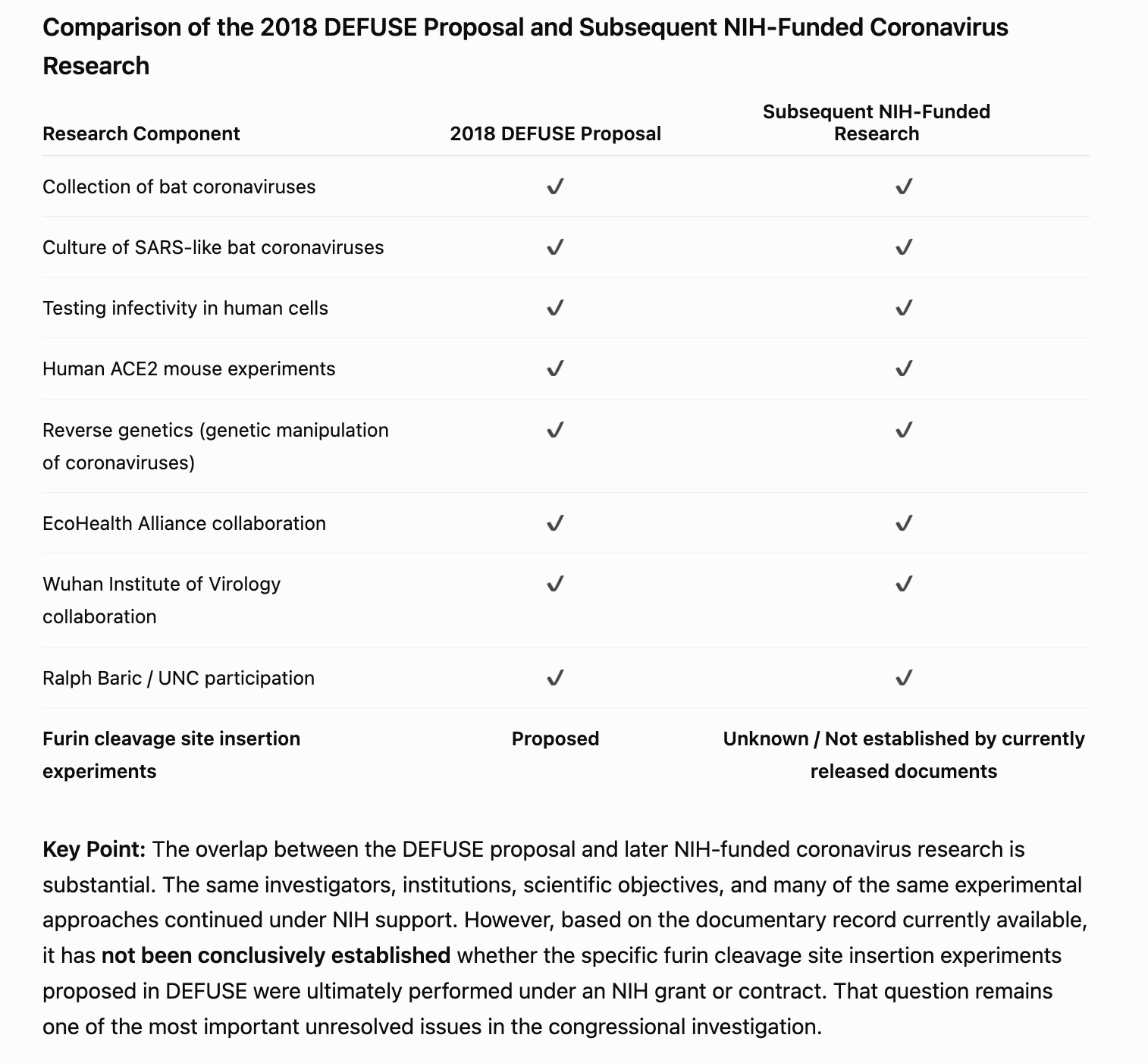
Were the furin cleavage site and related gain-of-function experiments proposed in DEFUSE later carried out under the NIH-funded grants or contracts, either in whole or in part? If so, where are the protocols, progress reports, sequence data, laboratory notebooks, and oversight reviews?
To be sure, Senator Paul’s research team is all over that question.
3. Baric had unpublished data that weakened a major argument in Proximal Origin
Published in Nature Medicine on March 17, 2020, "The Proximal Origin of SARS-CoV-2" became the most influential scientific paper arguing that SARS-CoV-2 was not a laboratory construct and that "any type of laboratory-based scenario" was not considered plausible. Since publication, prominent scientists and scientific organizations have submitted formal petitions and open letters calling for the paper to be corrected, withdrawn, or retracted in light of subsequently released evidence and congressional investigations. Nature Medicine has acknowledged receiving these requests but has refused to retract the paper, issue an Editorial Expression of Concern, or otherwise alter the scientific record.
Baric testified he had previously demonstrated that maximizing ACE2 binding is not necessarily advantageous.
Stronger receptor binding can actually reduce viral spread.
He says he informed NIH and destroyed the experimental materials.
That directly weakens one of the principal arguments used in Proximal Origin against deliberate engineering.
4. The “Proximal Origin” authors did not believe their own story about a natural origin for the virus.
Slack messages show Kristian Andersen did not have confidence in the natural origin theory by the time the paper was published.
He writes that he is moving “much more toward the middle.”
Elsewhere he indicates that, given what he knows, both origin scenarios are plausible (From the Slack archive in Rand’s reading room).
5. The scientists spent months privately debating tissue-culture scenarios
The Slack discussions repeatedly focus on:
tissue culture,
furin cleavage sites,
cell adaptation,
host-range experiments,
Wuhan Institute work.
Those are precisely the mechanisms central to laboratory-accident hypotheses, showing the issue remained an active scientific discussion rather than a settled question.
6. Baric confirms he attended the secret February 1, 2020 origins call
On February 1, 2020, Sir Jeremy Farrar, then Director of the Wellcome Trust, one of the world's most influential biomedical research foundations, organized a confidential teleconference bringing together Anthony Fauci, Francis Collins, Kristian Andersen, Robert Garry, Andrew Rambaut, Edward (Eddie) Holmes, Michael Farzan, Ron Fouchier, Christian Drosten, Marion Koopmans, and several other leading virologists to discuss whether SARS-CoV-2 had emerged naturally or from a laboratory accident.
Farrar later revealed in his memoir Spike that the discussions were considered so sensitive he used a disposable ("burner") phone for the communications surrounding the call.
Five participants in that call: Kristian Andersen, Robert Garry, Andrew Rambaut, and Edward Holmes would go on to author the highly influential The Proximal Origin of SARS-CoV-2 paper, while Anthony Fauci and Francis Collins were actively involved in discussions surrounding its development. Farrar now serves as Assistant Director-General at the World Health Organization.
Baric acknowledges being on the call with Fauci, Collins, Farrar, Andersen, Garry, Holmes, and others.
He cannot explain how he was invited.
He says he cannot find any record showing why he was included.
Some participants reportedly did not know he was present.
He gives somewhat inconsistent accounts about whether he spoke during the meeting.
Whether Baric was intentionally withholding information cannot be determined from the testimony. What the testimony clearly shows is that his explanations regarding his invitation and participation are incomplete and, at points, internally inconsistent. Those inconsistencies warrant further scrutiny by Senator Paul’s committee.
7. NIH apparently requested records it supposedly had already reviewed
During the February 2020 discussions, NIH officials reportedly asked Baric for research records that NIH had allegedly reviewed years earlier under its oversight process.
This raises questions about NIH’s recordkeeping and oversight of research involving enhanced pathogens.
8. Baric sent his taxpayer-funded ACE2 mouse model to Wuhan
He confirmed sending the mouse model to Shi Zhengli’s laboratory.
Later, when a Chinese company attempted to commercialize that model, Baric described the situation as unethical:
“What kind of crap is this?”
He also stated that sharing the model was effectively required under research-sharing norms and suggested Congress should change the rules if policymakers objected.
Baric also confirmed that he provided his NIH-funded human ACE2 transgenic mouse model to Shi Zhengli's laboratory at the Wuhan Institute of Virology. Although the transfer of the mice was not itself gain-of-function research, the human ACE2 mouse was specifically designed as an experimental platform for studies involving SARS-like coronaviruses that cannot efficiently infect conventional laboratory mice.
The model enabled researchers to evaluate viruses produced through reverse genetics, measure the effects of engineered mutations such as insertion of a furin cleavage site, serially passage viruses to select for increased adaptation or pathogenicity, and determine whether genetically modified viruses exhibited enhanced infectivity, tissue tropism, virulence, or transmissibility.
Many of these experimental approaches constitute gain-of-function research and involve the same experimental techniques that are plausible laboratory pathways for the creation of SARS-CoV-2.
9. The USAID-Funded Pipeline Behind the Wuhan Coronavirus Research
Although PREDICT was presented as a surveillance program, it created the scientific pipeline for coronavirus gain-of-function research. The full extent of USAID's role in building that pipeline only became apparent years later through congressional investigations and the release of internal communications.
USAID’s PREDICT program, led by the One Health Institute at the University of California, Davis, operated from 2009 through 2020 to identify potentially dangerous viruses before they spilled over into humans. In practice, it funded the discovery, collection, sequencing, cataloging, and international sharing of thousands of SARS-like bat coronaviruses through collaborators that included EcoHealth Alliance and the Wuhan Institute of Virology. Those viruses and their genetic sequences became the foundation for subsequent laboratory research involving reverse genetics, chimeric viruses, human ACE2 mouse models, and other experimental approaches that overlap with, or constitute, gain-of-function research. While PREDICT itself was not established to engineer viruses, it built the scientific infrastructure and international collaborations that made those experiments possible.
Internal emails also revealed that Peter Daszak requested that USAID’s PREDICT program be acknowledged as a funding source for the landmark 2015 Baric-Shi paper. That acknowledgment reportedly did not appear until 2020, five years after publication, raising additional questions about the transparency of funding disclosures for coronavirus research involving the Wuhan Institute of Virology.
Emails showed Peter Daszak asking that USAID’s PREDICT program be acknowledged.
The acknowledgment was reportedly added only in 2020.
The delay raises questions about transparency surrounding funding sources for work involving Wuhan collaborators.
10. The Slack archive shows genuine scientific disagreement: not a unified front
Kristian Andersen, PhD, is a professor at Scripps Research and Director of Infectious Disease Genomics at the Scripps Research Translational Institute. An internationally recognized evolutionary biologist, he was the lead author of the influential March 2020 Nature Medicine paper, The Proximal Origin of SARS-CoV-2, which argued that SARS-CoV-2 was not the product of laboratory engineering and dismissed a laboratory-based origin as implausible. In the years that followed, Andersen became one of the most aggressive public defenders of the natural-origin hypothesis. For years, he used his scientific authority and large social media platform to portray the laboratory-origin hypothesis as unsupported, repeatedly mocking critics and dismissing questions about a possible man-made origin, even as internal emails released later showed that he initially considered aspects of the virus concerning enough to merit serious discussion.
Edward “Eddie” Holmes is one of the world's foremost evolutionary virologists, whose decades of research on bat coronaviruses made him uniquely qualified to assess the emergence of SARS-CoV-2. A professor at the University of Sydney and a principal author of the influential March 2020 Proximal Origin of SARS-CoV-2 paper, Holmes also participated in the pivotal February 1, 2020 teleconference with Anthony Fauci, Francis Collins, Jeremy Farrar, Kristian Andersen, Ralph Baric, and others that shaped the early scientific response to the origins question.
Rather than revealing a scientific consensus, the private discussions show Holmes continually pressing for rigorous evidence while other participants privately acknowledged growing uncertainty, offering a far more nuanced picture than the certainty projected in public and written up in their proximal origins paper.
Eddie Holmes repeatedly challenges stronger lab-origin claims and asks for additional evidence.
The discussions reveal ongoing internal debate rather than unanimous agreement.
That makes the later shifts in Andersen’s position that the virus was of natural origin duplicitious, because they occurred despite his active scientific skepticism privately.
11. The scientists privately continued exploring laboratory-related mechanisms well after the Proximal Origin paper
The Slack archive includes detailed discussions of:
template switching,
recombination,
furin cleavage site generation,
co-infection scenarios,
alternative evolutionary pathways.
These conversations indicate the scientific inquiry continued after publication rather than ending with the paper.
The biggest takeaway
After reviewing thousands of pages of congressional testimony, private Slack messages, emails, and internal documents, one conclusion is unavoidable: the public was never given the full story.
These documents show that gain-of-function coronavirus experiments were not imaginary. They were openly discussed, proposed, and, in Dr. Ralph Baric’s own words, explicitly solicited under DARPA’s PREEMPT program. Baric himself acknowledged performing and proposing experiments that he scientifically characterizes as gain-of-function. His defense is not that such work never occurred. His defense is that it was lawful under the regulatory framework that existed at the time because it had been reviewed, exempted, or fell outside the government’s evolving oversight policies.
The documents also expose something equally troubling. The scientific assumptions that underpinned The Proximal Origin of SARS-CoV-2 paper were far less certain than the public was led to believe. During and after publication, the paper’s own authors privately debated tissue culture, furin cleavage sites, laboratory adaptation, host-range experiments, and other mechanisms central to a potential laboratory origin. The scientific discussion never ended. Only the public discussion did.
That raises profound questions about transparency, scientific integrity, federal oversight, funding disclosures, recordkeeping at NIH, and the role government officials played in shaping what became the accepted public narrative.
For more than five years, Americans were told that questioning the origins of SARS-CoV-2 was the province of conspiracy theorists. We were assured the science was settled. We were told Proximal Origin had closed the case and that a laboratory origin was implausible.
The newly released testimony from Dr. Ralph Baric and the private communications among the authors are important because they reveal that many of the scientists closest to the evidence privately entertained doubts, debated laboratory scenarios, and questioned key assumptions while presenting a far more confident story to the public.
They purposefully tried to change the history of COVID-19 itself. The question remains, to what end?
It begins with Ralph Baric.
There may be no scientist on Earth better positioned to discuss coronavirus gain-of-function research than Ralph Baric.
For more than three decades, Baric has been one of the world’s foremost coronavirus researchers. He pioneered reverse genetics systems for coronaviruses, developed the human ACE2 mouse model, collaborated extensively with the Wuhan Institute of Virology, and helped develop many of the experimental techniques that later became central to the debate over the origins of COVID-19.
His congressional testimony is remarkable because it dismantles, piece by piece, many of the simplistic arguments that were used for years to dismiss the possibility of a laboratory origin.
One of the most important moments came when Baric was asked about DARPA’s PREEMPT proposal. His answer was unequivocal.
“That’s a gain-of-function experiment. There’s no other way to think about it.”
For years, the public was subjected to endless semantic gymnastics over whether gain-of-function research was even being proposed or conducted. Baric swept aside that debate in a single sentence. In his scientific judgment, the proposed experiments were gain-of-function.
Why does this matter? Because COVID-19 changed the world.
The virus claimed millions of lives. Governments responded with lockdowns that devastated economies, disrupted education, deepened poverty, fueled food insecurity, and inflicted lasting social and psychological harm. Children lost years of normal development. Businesses disappeared. Families were separated. Public trust in science and public health institutions was profoundly damaged. The pandemic accelerated one of the greatest transfers of wealth and economic power in modern American history, from small businesses to multinational corporations, from wage earners to owners of financial assets, and from Main Street to Wall Street. The vaccines also became the subject of unprecedented controversy over safety, mandates, and adverse events that are still being investigated.
Baric’s testimony establishes one important fact: gain-of-function coronavirus research was real and probably caused one of the biggest pandemics that the world has ever known. We now need to know: which experiments were actually performed, who funded them, where were they conducted, what oversight existed, and which of that research contributed, directly or indirectly, to the emergence of SARS-CoV-2?
Those are no longer fringe questions. They are the central scientific and public policy questions of our time.
Senator Rand Paul’s team has had roadblock after road block thrown at them; they have been stymied by government officials and agencies. But they are managing to break through the floor and find missing documents. We know, because Robert has played a small part by using advanced systems to track down missing data that have now been shared with Senator Paul.
Then comes perhaps the biggest surprise.
Then comes perhaps the most remarkable revelation in Baric's testimony. One of the central arguments of the Proximal Origin paper was that if SARS-CoV-2 had been engineered, scientists would have optimized its binding to the human ACE2 receptor. Baric told Congress he had already performed unpublished experiments demonstrating that this assumption was flawed. According to his testimony, stronger ACE2 binding does not necessarily produce a more successful virus. In fact, excessive receptor affinity can reduce viral fitness and transmission.
He testified that he informed NIH of these findings, destroyed the experimental viruses, and chose not to publish the work because of “biosecurity concerns.” Although Baric did not characterize these experiments as gain-of-function research during this exchange, the testimony raises obvious questions about the nature of the experiments, whether they were supported by NIH funding, and why results that undercut one of the central scientific arguments in Proximal Origin were never published.
The Slack messages reveal the lies.
For years, the American public was told that The Proximal Origin of SARS-CoV-2 represented settled science. Government officials repeatedly pointed to the paper as proof that COVID-19 could not have come from a laboratory. Social media companies, under duress by the Biden administration, used it to justify censorship. Journalists cited it as the definitive scientific consensus. Scientists, physicians, and ordinary citizens who questioned that narrative found themselves labeled conspiracy theorists, censored, deplatformed, and, in some cases, professionally ostracized.
The private discussions tell a very different story. Kristian Andersen, the paper’s lead author, did not become more certain over time. He became less certain. In fact, by the time of publication, he was privately arguing that the virus was man-made.
After months of discussions about tissue culture, furin cleavage sites, coronavirus experiments at the Wuhan Institute of Virology, and newly emerging evidence, Andersen acknowledged that although he had initially leaned strongly toward a natural origin, he was no longer convinced. By the summer of 2020, he wrote that he was “moving much more toward the middle.”
Later, he went further still, stating that, based on what he had learned, he regarded both a natural spillover and a laboratory origin as plausible explanations.
That is extraordinary.
This was not a scientist reconsidering his conclusions years later after new discoveries. This was the lead author of the paper that shaped global opinion, questioning its central conclusion while the paper was still only just being published, and yet already being treated as the definitive account of COVID-19’s origins. At a time when the authors could have easily corrected the paper's original conclusions.
The Slack archive makes clear that the authors were privately debating precisely the issues the public was assured had already been settled: tissue culture adaptation, furin cleavage sites, laboratory selection, BSL-2 coronavirus research, host-range experiments, EcoHealth Alliance grants, and work conducted at Shi Zhengli’s laboratory in Wuhan. The discussions were technical, candid, and often vigorous. They do not reflect a group of scientists who had unanimously ruled out a laboratory origin.
Which raises the obvious question: Why was Proximal Origin written with such certainty?
Congressional records show that Anthony Fauci and Francis Collins were actively engaged with the authors during the paper’s development.
Those same records also show that shortly after publication, Andersen received a substantial NIH grant. This raises legitimate questions about Fauci's role in shaping the scientific narrative that would dominate public discourse for years.
Legitimate questions remain about Fauci's role in asserting that the “science was settled” in favor of a natural origin story by the publication of this paper, which shaped public discourse for years. Examining emails, internal memos, and phone call records from Fauci during this period may uncover whether a quid pro quo was involved.
Perhaps most striking of all, even as Andersen’s private confidence in a purely natural origin appeared to erode, his public rhetoric became increasingly absolute. On social media and in interviews, he repeatedly dismissed, ridiculed, and attacked scientists, journalists, and members of the public who questioned the natural-origin narrative, often portraying the laboratory-origin hypothesis as scientifically indefensible despite privately acknowledging that both scenarios remained plausible.
The Wuhan Institute itself also comes under much closer scrutiny.
One Slack discussion draws an important distinction between Ralph Baric’s reverse genetics experiments and the Wuhan Institute of Virology’s tissue-culture work.
According to Kristian Andersen, researchers in Wuhan had spent years growing SARS-like bat coronaviruses in different animal cell lines to determine what mutations allowed those viruses to infect human cells more efficiently. That type of research is precisely the sort of laboratory adaptation work that has become central to the debate over COVID-19’s origins. These experiments constitute gain-of-function research.
At the time, and still today, no international treaty specifically prohibited gain-of-function research conducted for peaceful scientific purposes, and similar work was and is being performed in laboratories around the world.
If research of this type were to produce a pathogen capable of causing a global pandemic, the consequences could rival those of a weapon of mass destruction, raising the obvious point that international oversight has not kept pace with modern biotechnology.
Baric acknowledged that the Wuhan experiments closely paralleled research proposed in EcoHealth Alliance grant applications but distinguished them from his own reverse genetics studies, noting they were being conducted under different biosafety conditions. Whether Baric’s experiments ultimately contributed to the emergence of SARS-CoV-2 remains unknown. What is no longer in dispute is that scientists were actively exploring how bat coronaviruses adapt to human hosts through laboratory experimentation and that this virus was almost certainly man-made.
If Baric’s experiments produced a virus capable of causing a global pandemic, the consequences would extend far beyond an academic debate over gain-of-function research. If the Wuhan Lab and the CCP were ultimately responsible, that raises another set of questions about culpability and liability. Questions that the world leaders clearly do not want to address.
The truth is that such research with the potential to create pathogens of catastrophic consequence should never have been conducted in the first place.
Where does that leave us?
The question is no longer whether a laboratory origin was “implausible.” After reading these documents, a more fundamental question emerges: was the natural-origin narrative ever as convincing as the public was led to believe?
The scientists who authored Proximal Origin privately wrestled with laboratory scenarios, debated furin cleavage sites, tissue culture, reverse genetics, and Wuhan’s coronavirus research. Yet publicly, they projected certainty. As their private confidence in a purely natural origin eroded, their public certainty only grew. Scientists who questioned the narrative were ridiculed. Journalists were dismissed. Citizens were censored. That is not how science is supposed to work. It is how narratives are protected.
These newly released documents do not prove 100% that SARS-CoV-2 came from a laboratory. But they do prove something equally important: the public was never given the full scientific debate. Instead, it was presented with a manufactured consensus that collapsed the moment private emails, Slack messages, and sworn congressional testimony saw the light of day.
Perhaps the greatest irony is that this reckoning is not being led by the institutions that spent years insisting they had already settled the matter. It is not being driven by the FBI, the CIA, the Department of Justice, or the vast machinery of the administrative state. Instead, much of the documentary record now reshaping this debate has emerged because Senator Rand Paul of Kentucky refused to stop asking questions.
COVID-19 killed millions of people. It upended the global economy, transformed governments, accelerated one of the largest transfers of wealth in modern history, deprived children of years of normal development, and fractured public trust in medicine, science, and government. If research contributed in any way to that catastrophe, then the world deserves a complete accounting—not to assign political blame, but to ensure it never happens again.
Science advances by questioning assumptions, following evidence wherever it leads, and correcting mistakes. These documents suggest that, for far too long, protecting the narrative became more important than pursuing the truth. History will ultimately judge which mattered more.
JGM/RWM
One final thought. Much of what you’ve just read wasn’t uncovered by the legacy media, government investigators, or billion-dollar news organizations. It came from painstaking review of thousands of pages of testimony, emails, Slack messages, and congressional records. That kind of work takes time, expertise, and resources. Our paid subscribers make it possible. They receive deeper investigations, exclusive analysis, and early access to the stories that matter most.
If you value independent journalism that follows the evidence rather than the narrative, please consider becoming a paid subscriber. It allows us to keep digging where others won’t.
I have a copy of an NDA between Moderna and Baric dated December 12, 2019 were Moderna sent Baric and mRNA vaccine and requested he run challenge tests against it. It appears to be for Sars-Cov-2. So they had the vaccine BEFORE we had a pandemic! This really stinks.
It appears highly likely that some of the individuals mentioned in this post are directly responsible for the "covid pandemic". These individuals must be held accountable to the extent of beinf forced to compensate, OUT OF THEIR PERSONAL WEALTH, each and every individual who lost a business, a home, a livelihood, health or a loved one.
This is the ultimate accountability, and until we have such accountability these bizarre and destructive events will continue occurring.