

Florida Man Pokes the Bear
There are bad ideas. There are Florida Man ideas. And then there is allegedly stealing Smokey Bear signs from state forests across Florida and listing them on Facebook Marketplace for $1,900 apiece.
Federal prosecutors say 30-year-old Hunter Drake Lovett traveled around the state collecting the iconic wildfire prevention signs before trying to cash in online. Unfortunately for him, Smokey Bear apparently has friends in federal law enforcement. A grand jury has now indicted Lovett on a charge of theft of government property, a crime that carries a maximum penalty of ten years in federal prison if he is convicted.
Florida Agriculture Commissioner Wilton Simpson may have summed it up best after the suspect’s arrest last year: “What happens when dumb criminals poke the bear?” Apparently, the bear calls the U.S. Department of Justice.
Only in Australia: Prime Minister Plays “Shag, Marry, Date”
For American readers, Anthony Albanese is Australia’s prime minister, which makes him the head of government. In other words, imagine the president going on a comedy podcast and being asked which famous woman he would “shag.”
That is roughly what happened.
Albanese appeared on the Bush Deep podcast, where the host asked him to play “shag, marry, date”. For those unfamiliar with Australian culture, "Shag, Marry, Date" is a party game where you're handed three names and forced to make increasingly awkward relationship decisions. It's the kind of thing stupid college students play after midnight. It is not generally considered a useful exercise in international diplomacy.
Given the choices: Kylie Minogue, Nicole Kidman, and Rhonda Burchmore, Albanese first tried to wriggle out by noting he had only been married for six months. Then, when pressed, he picked Kylie. When asked if that meant he would “marry Kylie and shag her and date her,” he replied, “All of the above.”
Kylie Minogue occupies a unique place in Australian culture and she’s been a media hit for four decades. Think of her as if Dolly Parton, Madonna, and apple pie somehow became a single person. Criticizing her is considered poor form. Fantasizing about her while serving as prime minister turns out to be even worse.
And that, children, is how a sitting prime minister turns a podcast game into a national incident.
By Monday, Albanese had apologized, and the nation spent part of its week debating whether its prime minister had been sexist, stupid, or simply too Australian for his own good.
The rest of us learned two things. First, never play middle-school sleepover games when you are running a country. Second, only Australians could create a political scandal involving a prime minister, Kylie Minogue, and the word “shag.”
The Great 7-Up Conspiracy
Here’s a little reminder that just because everyone “knows” something doesn’t make it true.
For almost a century, the accepted origin story of 7-Up has been that it was originally called Bib-Label Lithiated Lemon-Lime Soda before eventually becoming the much catchier 7-Up. It’s one of those delightful historical facts that appears in books, newspapers, documentaries, trivia games, and approximately 97% of internet articles about the soft drink.
But a deep dive into the original advertisements, trademarks, bottle labels, and company records suggests there is remarkably little evidence that the soda was ever officially sold under that tongue-twisting name.
Emma Baccellieri, who did the detective work in her excellent Substack, The Soda Fountain, writes:
There is, however, a second thing you will learn while researching the origin of the name 7Up, and this is that it was originally called Bib-Label Lithiated Lemon-Lime Soda.
It’s everywhere. This is on Wikipedia. It’s on Snopes. They ran it once in TIME. Look at in this article published by McGill University. There is seemingly no debate about the fact that it was first named Bib-Label Lithiated Lemon-Lime Soda. (And it did contain a bit of real, honest-to-god, mood-enhancing lithium, at least until the FDA banned it from soft drinks after World War II.) The claim pops up in every piece of writing about the soda’s name. Grigg launched the drink in Missouri in the late 1920s, and he’d renamed it 7Up by the middle of the 1930s, but its early years were seemingly definitively spent as Bib-Label Lithiated Lemon-Lime Soda.
Which struck me as insane.
Baccellieri dug deeper.
She discovered that “Bib-Label” appears to have referred to the paper label hanging around the neck of the bottle, like a bib, rather than the drink itself. Somewhere along the way, someone misunderstood the term, someone else copied it, and then everyone copied everyone else until it became “history.”
The really funny part? The drink did contain lithium citrate, a compound now used to treat bipolar disorder, until regulators eventually banned it from soft drinks. So the part that sounds completely insane turns out to be true, while the part everyone confidently repeats may be the myth.
It is, perhaps, the perfect modern parable: never underestimate humanity’s ability to repeat the wrong fact with absolute confidence for nearly a century.
After all, if we can collectively invent the origin story of 7-Up, imagine what else we’ve managed to get wrong.
The Annual Disease Marketing Calendar
We’ve noticed a recurring feature of modern science journalism. First comes the alarming headline about a disease you’ve never heard of. Then comes the expert explaining why you should. Within days, there’s a story about a brand-new test to detect it, followed shortly by a promising treatment. Sometimes there’s a vaccine. Sometimes it’s a diagnostic company. Sometimes it’s both. It’s almost as predictable as pumpkin spice season, only with more PCR and fear mongering
Meet “Disease X”
Just when you thought you had finally memorized COVID, mpox, bird flu, and the rest of the alphabet soup, the World Health Organization has another one waiting in the wings: Disease X. Fortunately, it isn’t an actual disease. It’s the WHO’s placeholder name for a future, as-yet-unknown pathogen that could someday spark the next pandemic.
The idea has actually been around for a while. In 2018, the WHO formally added Disease X to its list of priority pathogens, arguing that the next pandemic might come from something entirely unknown. In 2019, public health agencies ran “Disease X” pandemic exercises. By 2020, many experts declared that COVID-19 had effectively become the first real Disease X.
Then, in 2023, the United Kingdom announced a new high-containment research center specifically to prepare for Disease X, with the goal of developing diagnostics and vaccines within 100 days of identifying a new threat. The concept surged back into headlines during the 2024 World Economic Forum meeting in Davos.
One of the more surreal moments in public health came from a 2023 international survey of infectious disease specialists. Asked which pathogens posed the greatest pandemic threat, nearly four out of five chose influenza, a perfectly sensible answer. But the second most common response wasn’t Ebola, Marburg, Nipah, or even SARS-CoV-2. It was Disease X: an organism that, by definition, does not exist.
Nearly half of the experts ranked an imaginary future pathogen among the world’s greatest infectious threats. One has to admire the confidence. It’s rather like asking military generals which foreign army worries them most, and hearing, “The one that hasn’t been discovered yet.” Planning for the unknown is prudent. Ranking an unnamed, undiscovered microbe above real pathogens that actually kill people every year is where preparedness begins to drift into philosophy.
Over the past year, the WHO has continued emphasizing “plug-and-play” vaccine platforms, rapid diagnostics, and surveillance systems that could respond to an unknown pathogen. They have also ramped up the fear porn over disease X:
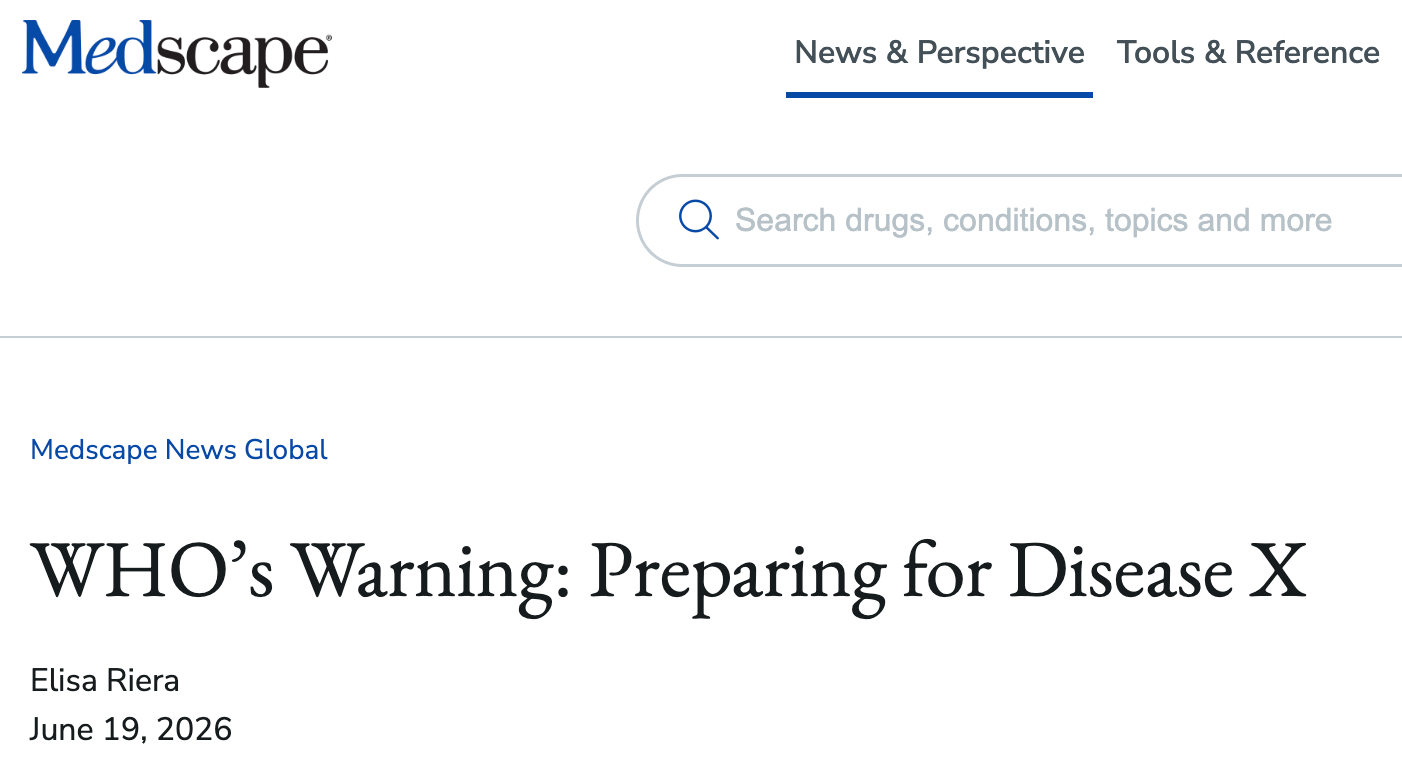
There is something wonderfully Orwellian about spending years discussing, funding, modeling, and building diagnostics and vaccines for a disease that, by definition, does not yet exist. One can only imagine the marketing campaign: “Introducing our newest test...for something we haven’t found yet.”
JGM
NIAID's Vincent Munster and Claude Kwe attempted to smuggle in pox viruses recently. Face a maximum federal imprisonment of 5 years.
Guy steals Smokey the Bear signs to sell on Facebook. Faces 10. Weird.
I do think most people should supplement with Lithium Orotate.