

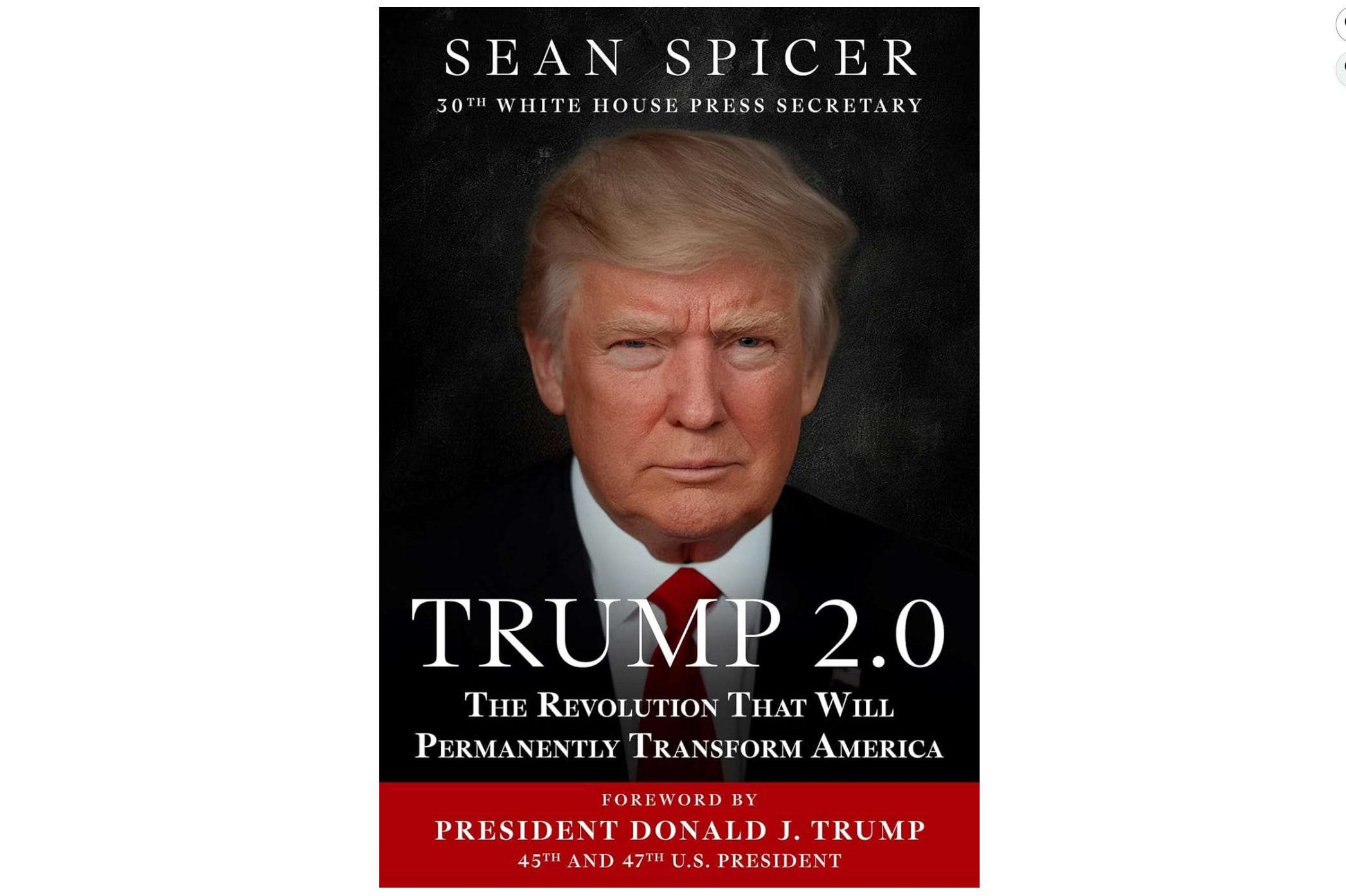
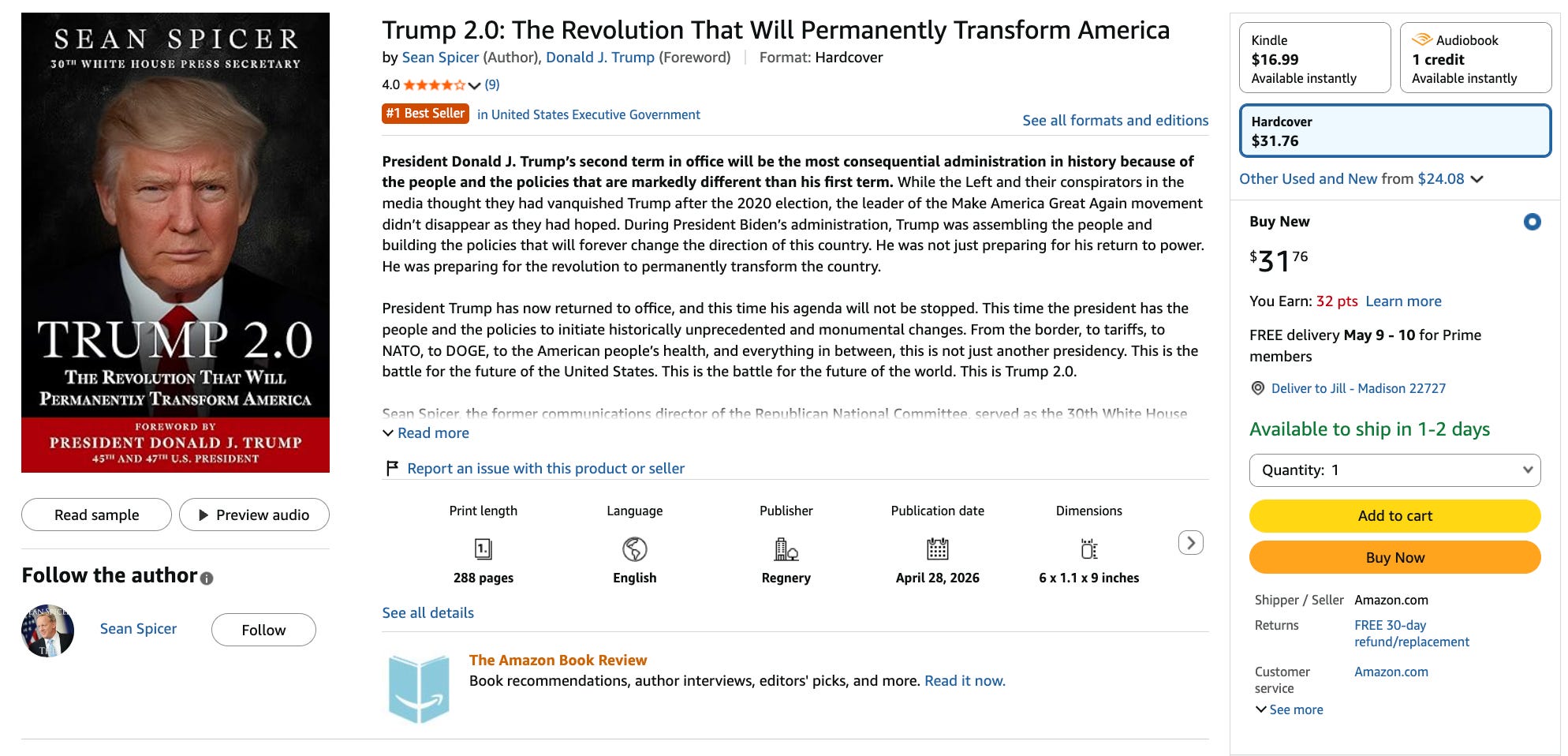
Sean Spicer’s new book Trump 2.0: The Revolution That Will Permanently Transform America (Regnery / Skyhorse Publishing, March 2026, 288 pages, foreword by President Donald J. Trump) arrives at a particular moment, and it is worth being clear about that moment before saying anything about the book itself.
We are roughly fourteen months into the second Trump administration. The midterms are in front of us. The MAHA Commission has issued its Make Our Children Healthy Again strategy. Robert F. Kennedy Jr. has fired six hundred employees at the CDC, dismissed the entire ACIP, removed the CDC director, and removed COVID-19 vaccines from the recommended schedule for healthy children and pregnant women. The FDA, under Marty Makary, is dismantling thirty years of accumulated direct-to-consumer pharmaceutical advertising that no other developed country except New Zealand permits. The petroleum-based food dyes are on their way out. Jay Bhattacharya, a man whose calls for open scientific debate got him censored by his own university and the federal government during COVID, now runs the National Institutes of Health.
If you had told me, in the spring of 2022 — when I was permanently banned from Twitter for “repeated violations of [the] COVID-19 misinformation policy” — that this would be the policy landscape four years later, I would have wanted to believe you. I would not, at the time, have been able to.
So that is the moment into which Spicer publishes. And the book ought to be evaluated as what it actually is: a participant’s ledger, written in real time by a man who has been in the MAGA inner circle since 2016, of the first year of an administration that is delivering — at a speed and across a breadth that even those of us inside the MAHA movement keep finding ourselves slightly stunned by.
It is not a work of policy analysis. It is not an academic history. It is not — and Spicer is honest about this — meant to be the final word. It is a chronicle. A ledger. A first-draft accounting, kept by a friendly hand, of what is being done. On those terms — and especially on the terms of what it does for the MAHA reader — it is a book worth having.
Let me say what it does well, where it lands particularly hard for those of us in this movement, and where the honest reader will want to keep their own counsel.
What the book is
Trump 2.0 is organized around ten chapters covering, in turn: the border, trade and tariffs, NATO, defense and intelligence, law and order, education, MAHA, DOGE, the media, and the Kirk assassination. There is a foreword from President Trump, an introduction, a conclusion, and an afterword on Vice President Vance.
The throughline — repeated, deliberately, on nearly every page — is that the four-year break between Trump’s first and second terms was not a defeat but a gift. It allowed the America First Policy Institute, the Heritage Foundation’s Project 2025 coalition, Newt Gingrich’s America’s New Majority Project, and what Spicer calls the “America First Avengers” to do something they had no time to do the first time around: think, plan, recruit, vet, and prepare. The thesis is straightforward. Trump 1.0 was the rough draft. Trump 2.0 is the published edition. The president, as Spicer puts it, “was not sitting around and reminiscing about all his monumental wins from his first administration. He was planning how he would win even more during his second.”
The book’s argument for this thesis is essentially evidentiary: chapter by chapter, sector by sector, here is what we said we would do, here is what we have done, here is the documented receipt. Spicer cites White House fact sheets, executive orders, court filings, legislative scoring, lobbying disclosures, polling data, OpenSecrets, KFF, and a wide array of news reporting. He quotes generously from the people doing the work — Susie Wiles, Karoline Leavitt, Brendan Carr, Ric Grenell, Ken Cuccinelli, Russ Vought, Joe Gebbia, and many others — and he quotes the critics too, often at length, before answering them.
For a book published by an author who is also a podcaster and Substack writer (The Sean Spicer Show; seanspicer.com), the prose is more substantive than I expected. There is a working journalist’s instinct here for documentary support. There is also — and I say this with appreciation — a clear refusal to apologize for the obvious: that Spicer is a friend of this administration, that he was the thirtieth White House Press Secretary, that he is writing as a partisan in the older and better sense of the word. He is a participant. He is a witness. And he tells you that on page one.
If you are looking for the dispassionate court historian’s account of Trump’s second term, this is not your book and never claimed to be. If you are looking for a thoroughly sourced, plainly written, in-house ledger of what has actually been done — kept by a man who was in the building for the first term and is in close conversation with the people in the building for the second — this is the best one currently in print.
Why the MAHA chapter is the heart of the book
For those of us in the MAHA coalition, Chapter 7 — “The MAHA Policy Blueprint” — is the centerpiece, and it is the chapter I want to spend the most time on, because Spicer gets it right in ways that are not trivial.
He opens not with a White House press release but with a 1995 New York magazine cover story titled “The Kennedy Who Matters.” The cover featured Robert F. Kennedy Jr. — then a darling of the progressive left, the man who Rolling Stone would later place on its 2009 list of “100 Agents of Change,” the lawyer who was building his reputation by holding industrial polluters accountable. Spicer’s point in opening this way is structural and important: Kennedy did not change. The political coalitions around him did. The man who has cared about public health since the 1990s, who has been hammering away at industrial corruption of the food and water supply for thirty years, is the same man who is now Secretary of Health and Human Services. What changed is which party was willing to put him in office to do the work.
This matters. It matters because the legacy media’s framing — that Kennedy is a “junk science” “anti-vaxxer” “conspiracy theorist” who has been “rejecting data” and “fueling distrust” — is, as Spicer correctly identifies, a framing that the legacy media has direct financial reasons to maintain. He walks through the numbers, and they are damning:
• The pharmaceutical and health products lobby, which had spent $341,316,466 in 2025 by year’s end, outspends every other lobby in Washington — by more than $100 million. (PhRMA alone spent $20.6 million in the first half of 2025; Pfizer $7.85 million; Merck $7.58 million.)
• The pharmaceutical ad market, per MediaRadar, contributed $10.8 billion to U.S. ad spend in 2024, with 59% going to TV. Linear TV alone took an estimated $5.12 billion in prescription drug ads from drugmakers in 2024 and $2.97 billion in just the first half of 2025.
• In March 2023 alone, pharmaceutical advertisers spent nearly $15 million on ABC World News Tonight with David Muir — a single thirty-minute newscast — and spent comparably across NBC Nightly News, Good Morning America, CBS Evening News, Today, and CBS Mornings.
• The top recipient of pharmaceutical industry contributions in the 2023–2024 cycle was former Vice President Kamala Harris, at $8,652,114. The top recipient in the 2019–2020 cycle was Joe Biden, at $9,002,834. The top recipient in 2015–2016 was Hillary Clinton.
Spicer’s interpretive frame on these numbers is the right one, and it is worth quoting because the framing is itself a contribution: “Big Pharma advertising is less about attracting new customers and more about buying silence from the news industry. In fact, it’s not just silence, but compliance.” Spicer understands what those of us who watched the COVID-19 pandemic from the inside watched in real time: that the legacy news outlets reporting on Kennedy’s nomination — Jake Tapper warning viewers “I hope you like measles,” the New Yorker running “The Junk Science of Robert F. Kennedy, Jr.” — were reporting on the man who threatens the single biggest single revenue stream in their business model. That is not a conflict of interest. That is the conflict of interest. And the American people, increasingly, can see it.
Spicer’s chapter then walks through what the MAHA team has actually accomplished in twelve months. He cites the White House’s published list, and the cumulative weight of it is genuinely striking when you put it down on the page in sequence:
• The MAHA Commission, established within weeks of inauguration, with an initial focus on childhood chronic disease.
• Roughly 35% of the American food industry has committed to eliminating artificial dyes — including Hershey, Kraft-Heinz, General Mills, JM Smucker, Conagra, Tyson, PepsiCo, Mars, McCormick, Sam’s Club, Nestlé, In-N-Out, and ice cream companies representing more than 90% of U.S. ice cream volume.
• HHS revived the Task Force on Safer Childhood Vaccines.
• Petroleum-based dyes (Red 40, Yellow 5, Blue 1) are being phased out of the food supply by end of 2026.
• COVID-19 vaccines have been removed from the recommended schedule for healthy children and pregnant women.
• The FDA, under Makary, is enforcing existing regulations on direct-to-consumer pharmaceutical advertising for the first time in three decades. Trump’s September 9, 2025 memorandum directs the FDA to require materially complete information that fairly balances benefits and risks.
• USDA Secretary Brooke Rollins has signed waivers restricting soda and energy drinks from food stamps in Nebraska — taxpayer dollars no longer subsidizing the consumption pattern that has produced a 41.64% adult obesity rate.
• Whole milk is being restored to schools.
• Steak & Shake has moved to 100% beef tallow and replaced its seed-oil “buttery blend” with Wisconsin butter. Coca-Cola is launching a U.S. cane sugar version. McCormick, Tyson, Mars, Nestlé, and Hershey are pulling synthetic dyes.
I am going to register, here, what every honest MAHA reader is going to feel reading this list: a kind of disorientation that the things we have been arguing for, in some cases for decades, are happening. The “GRAS loophole” — that “generally recognized as safe” self-certification regime under which thousands of food additives have entered the American food supply with effectively no FDA oversight — is being closed. Ultra-processed foods are being defined for regulatory purposes. The dietary guidelines are being reformed. The infant formula standards are being raised. The Surgeon General is being directed to launch screen-time initiatives. Direct-to-consumer pharmaceutical advertising — banned in every developed country except the United States and New Zealand — is being meaningfully regulated for the first time since 1962.
This is the policy program that those of us in the chronic-disease and food-safety community have been writing about for a generation. And here it is, on the books, with executive orders backing it.
Spicer also gets the team right, and that is not nothing. The roster he names — RFK Jr. at HHS, Marty Makary at FDA, Mehmet Oz at CMS, Jay Bhattacharya at NIH, Casey Means as Surgeon General nominee, Calley Means as the bridge between MAGA and MAHA, Jessica Reed Kraus as the chronicler — is the team. He calls Casey Means’ Good Energy “a central text in the growing Make America Healthy Again movement,” which is correct. He notes that Bhattacharya, “when the lockdowns took over America… was an outspoken critic of the liberal dogma that had engulfed his university and many parts of the country. The mainstream public health establishment dismissed him. Now he’s in charge.” That is the right register to strike, and Spicer strikes it.
He closes the chapter with University of Illinois polling data showing that 53% of “very conservative” Americans and 35% of “very liberal” Americans hold a “very positive” view of MAHA. The point — which is correct — is that this is not, fundamentally, a partisan project. It is a public health project that has been adopted by one party because the other party would not adopt it. Health policy, as Spicer puts it, “isn’t about profits. It’s about people. MAHA is real.”
I will say it plainly: this chapter alone is worth the price of the book for anyone who wants a clear, sourced, in-the-record narrative they can hand to a friend or family member who is still getting their MAHA news from CNN. It will not convince the dedicated opponent. It will, I think, genuinely help the curious skeptic.
The other chapters, briefly
The non-MAHA chapters do the same kind of documentary work, with varying degrees of depth.
Chapter 1 (Border) documents the closure of the southern border and the operationalization of deportation policy in the first year. The border-encounter numbers are what the numbers are; the change from the Biden-era figures is the change.
Chapter 2 (Trade and Tariffs) explains the Trump tariff structure — including the 145% tariffs on Chinese goods imposed in April 2025 and the resulting trade negotiations — and the case for reciprocal tariffs as the foundation of the “fair trade” doctrine.
Chapter 3 (NATO) documents the genuinely remarkable shift in allied defense spending: NATO members now committing to 5% of GDP for defense, with Spicer providing the specific commitments by country. The framing — that previous administrations let the alliance free-ride on American taxpayers and that Trump simply refused to keep doing it — is straightforward and correct.
Chapter 4 (Defense and Intelligence) covers the Tulsi Gabbard ODNI nomination, the renaming of the Department of Defense as the Department of War, and the operations against Iran’s nuclear program, the Maduro regime in Venezuela, and various drug cartels.
Chapter 5 (Law and Order) documents the 2025 murder rate decline — the largest single-year drop in recorded American history, reaching the lowest level in 125 years — and the federalization of public safety in Washington, D.C. The chapter lands with particular weight given the data.
Chapter 6 (Education, Not Indoctrination) is the chapter that most directly addresses what happened on September 10, 2025 at Utah Valley University, and the institutional reckoning at Harvard, Columbia, and Penn that has followed. Chris Rufo’s analysis of why elite universities are the strategic target — because they “establish the cultural signals that then flow downward to the university sector as a whole” — is given room to breathe. The Defending Women From Gender Ideology Extremism executive order is documented. The chapter is straightforward, and the prose carries genuine moral weight where it discusses Charlie Kirk.
Chapter 8 (DOGE, Finally) is the chapter that pleased me more than I expected. Spicer locates DOGE in a longer historical lineage — back to Reagan’s 1982 Grace Commission, the 1984 report that filled forty-seven volumes and twenty-three thousand pages and recommended 2,478 cost-cutting measures projected to save $424 billion over three years. The lineage matters because it makes clear that DOGE is not, as the legacy press would have it, an unprecedented assault on the administrative state. It is the latest iteration of a recurring Republican attempt — one Reagan got partway through before the bureaucracy beat him back — to do what Reagan called confronting the “unchecked cancer” of waste, fraud, abuse, and mismanagement. The chapter is honest about the fact that Trump and Musk’s January 2026 falling out complicated DOGE’s institutional trajectory, but it also documents what DOGE actually did before that point. The Cato Institute’s 2025 polling — that Americans now estimate 59 cents of every federal dollar is wasted, the highest figure ever recorded — gives the chapter its political backdrop.
Chapter 9 (Taking Back the Media) is the longest in the book and is, in some ways, the chapter where Spicer has the most personal investment. He is, after all, a former White House Press Secretary writing about the press. He documents the addition of nearly five hundred new media press passes (The Daily Wire, The Daily Signal, Right Side Broadcasting, Real America’s Voice, Lindell TV, podcasters, and Substack writers); the new media seat in the briefing room; the AP losing its special access for refusing to use “Gulf of America”; the FCC’s actions under Brendan Carr; the $16 million Paramount payment over the 60 Minutes edit and the $15 million Disney payment over the Stephanopoulos defamation. He is good — and pointed — on the Jake Tapper question of where Tapper was, exactly, between 2020 and 2024 when the legacy press was insisting that Joe Biden was running circles around Karine Jean-Pierre. The Glenn Greenwald material on The Intercept’s censorship of his Hunter Biden coverage is an honest inclusion — Greenwald is a man of the left, and Spicer treats him as a fellow truth-teller anyway. That instinct, that the truth is the truth regardless of which side a man’s quarrel with the establishment originates from, is the right instinct, and it is Trump 2.0’s instinct generally.
Chapter 10 (The Kirk Assassination) is the most difficult chapter in the book and is, I think, written with appropriate restraint. Spicer is not a stylist; he is a chronicler. The chapter does what a chronicler can do: it documents what happened, it places it in the context of the political-violence escalation of the last decade, and it refuses the easy temptation to reduce Charlie Kirk’s life to a political symbol. There is grief in the prose, and it is honestly registered.
The Conclusion and the Afterword on JD Vance are forward-looking. The afterword in particular is worth reading for anyone trying to think about what comes next. Vance is, on the substance, the most intellectually serious vice president the modern Republican Party has produced, and Spicer makes the case for him without overselling. The America 250 celebrations, the Patrick Henry and Howard Roark and Baron Haussmann references that Politico reached for in describing Trump’s architectural ambitions for Washington — these are the materials of a man who, in his second term, is thinking about what gets built and what lasts.
What a MAHA reader should know going in
I want to be honest in the way that, in our community, I have always tried to be honest, even when it costs.
This is a book by Sean Spicer. Spicer is a friend of MAHA in the broad sense — he gives the chapter its full due, he understands the stakes, he names the people, he runs the numbers. But he is not himself a MAHA principal. He is a MAGA institutionalist. He is writing from inside MAGA looking out at MAHA as one of MAGA’s coalition partners. That positioning produces some specific limits the reader will want to keep in mind.
First, the COVID-19 mRNA vaccines are touched on lightly. Spicer credits the executive order prohibiting federal funding for COVID-19 vaccine mandates in schools, and he credits the removal of COVID-19 vaccines from the recommended schedule for healthy children and pregnant women. Both are correct credits. But the deeper questions — about Operation Warp Speed, about the legal framework that suspended liability for vaccine manufacturers, about the lipid nanoparticle and IgG4 class-switch findings, about the regulatory capture that produced the EUA-to-BLA transition with no genuine safety review, about the ongoing question of myocarditis in young men — those questions are not in this book. That is not Spicer’s project. The book is a first-year ledger, not a reckoning. The reckoning, as I have argued elsewhere, is still ahead of us, and it will require its own chroniclers.
Second, the book leans, as a rhetorical matter, on the genre conventions of the campaign-trail bestseller — the punchy declarative sentence, the rhetorical question stacked next to its own answer (“Do you think these lobbyists are being paid to make America healthy? No, they are paid to make sure that these companies make money.”), the occasional Charlie Sheen quotation. Some readers will find this register congenial. Some will find it grates. It is the register of The Sean Spicer Show, and Spicer is who he is, and he is not, on this question, going to apologize for it. I did not, in the end, mind it. Your mileage may vary.
Third — and this is the only place I will register a substantive reservation — the book’s largest claim, repeated in its subtitle and throughout, is that the Trump 2.0 revolution will permanently transform America. I want this to be true. I am working, in my own small way, for it to be true. But the honest historical record on revolutions of this kind — the Reagan revolution included — is that the institutional counter-pressure of the administrative state, the legal academy, the credentialing professions, the legacy media, and the foundation-funded NGO archipelago is enormous, patient, and very good at outlasting its political opponents. Whether the changes Spicer documents become permanent depends on whether the next decade of personnel, judicial appointments, executive orders, and statutory codifications hold. The MAHA reforms are the most vulnerable in this respect, because they are the reforms most directly targeting the largest concentrated revenue streams in American commercial life. Big Pharma did not become Big Pharma by giving up. The book’s optimism on this point is real and it is earned in part. It is also, I think, slightly ahead of where the evidence currently warrants.
That is a friendly caution, not an objection. The book makes the right argument. The work of making the argument true is still in front of us.
What the book does that is genuinely valuable
Three things, beyond the policy ledger itself.
First, it gets the personnel right. The single most important argument Spicer makes — the one I would most want a curious reader to take away — is that Trump 2.0 differs from Trump 1.0 not principally in policy ambition but in personnel preparation. The four-year break gave the America First Policy Institute, Heritage’s Project 2025 coalition, and the various conservative-movement institutions the time to build a vetted bench. The single biggest lesson of Trump 1.0 was, as Spicer puts it, “not just getting the right people in, it was keeping the wrong people out.” That sentence is the thesis of this presidency, and Spicer is right to make it the thesis of the book. The MAHA team — Kennedy, Makary, Bhattacharya, Oz, Means — is the proof of concept. So is the absence, this time, of the John Boltons and Anthony Faucis.
Second, it documents the institutional realignment in real time. The renaming of the Department of Defense as the Department of War. The renaming of the Kennedy Center as the Donald J. Trump and John F. Kennedy Center. The Gulf of America. The triumphal arch for the 250th. The Joe Gebbia appointment as Chief Design Officer of the United States. The “Making Federal Architecture Beautiful Again” executive order. These are not, in isolation, the most important things this administration is doing. They are, in the aggregate, the cultural surface of the deeper restoration project, and Spicer is right to give them their due. Andrew Breitbart’s line — “politics is downstream of culture” — sits behind the chapter and gets the credit it deserves.
Third, it tells the truth about the legacy media in a way that is going to age well. The pharmaceutical advertising numbers I quoted above are not new. The COVID-era press cover-up of Biden’s decline is not, at this point, contested. The CCDH-and-Censorship-Industrial-Complex story has been told elsewhere, including in litigation. But Spicer puts it all in one place, in a book a general reader can hand to their parent or their cousin who is still trying to figure out what happened. That is a service.
A final word
I am going to recommend Trump 2.0. I am going to recommend it especially to MAHA-curious readers who want the policy receipts in a single accessible volume; to MAGA-aligned readers who want a clear-eyed first-year accounting from someone who has been in the building since 2016; and to anyone who is trying to understand why the United States of 2026 looks so different from the United States of 2024, and why the difference is not, principally, a matter of personality.
It is not a perfect book. It is, in places, a bestseller-genre book — punchy, declarative, occasionally too pleased with its own jokes. It is also, in the chapters that matter most for those of us in this movement, a serious one. The MAHA chapter in particular is the best summary I have read of what this administration’s public-health team has accomplished in twelve months. I would put it in the hands of anyone who is trying to understand the moment.
Sean Spicer was, before any of this, the thirtieth White House Press Secretary. He has, in Trump 2.0, written the kind of book a press secretary writes when the press secretary believes — correctly, in this case — that the work being done is real, the people doing it are serious, and the chronicle ought to be kept.
The chronicle is kept here. It is honest within its genre. It is more rigorously sourced than its surface signals. And the MAHA chapter, in particular, is going to do real work for the movement.
Buy it. Read it. Hand it to someone who hasn’t yet figured out what is happening.
The best, as the foreword promises, is yet to come — but a great deal has already been done, and Spicer has done the service of writing it down.
Sean Spicer, Trump 2.0: The Revolution That Will Permanently Transform America. With a foreword by President Donald J. Trump. Regnery / Skyhorse Publishing, March 2026. 288 pages, hardcover. ISBN 978-1-5107-8620-2.
Like the emphasis on the positives. Mass Media will continue to be controlled by Big Medicine and Big Pharma as long as that 10.7 billion keeps flowing. Consequently they will continue to put the emphasis on the negatives and untruths about the goals of RFK Junior. Since consumer prescription advertising was launched, there is no backing out because of competitive pressures to continue to run consumer ads. The TV ads are constructed to convey the message that drugs will make you feel good! Shameful! Years ago key insiders expressed to me that only an Act of Congress will reverse Consumer TV advertising of prescription drugs. Unfortunately our congressman don’t have the courage to give up their share of the big Pharma dollars that help them stay in office. The loudest voices including Senator Cassidy that disparage the goals of RFK Jr. march to the beat of the medical money machine. Has nothing to do with making Americans healthier.
Mr. Spicer was a guest of my US rep at a residential campaign event in 2022. I received from his hands a signed copy of his book there, which I read. "Radical Nation." The subtitle is "Joe Biden & Kamala Harris's Dangerous Plan for America." I think that subtitle was 100% on the mark.