

Stolen Money, Missing Approvals
Federal grant capture and the consequences that never came.
Robert W. Malone, MD, MS
Audio Version:
Executive Summary
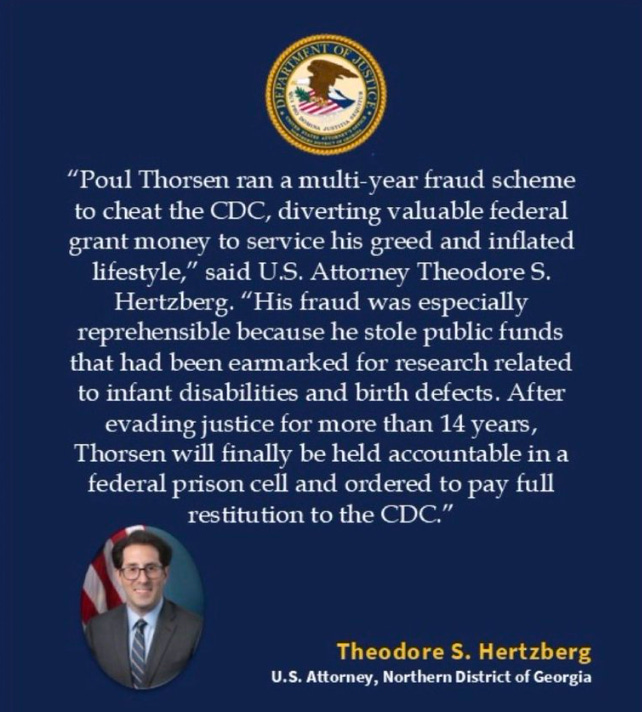
Poul Thorsen stole more than $1 million from a CDC-funded Danish research program and has now pleaded guilty.
Thorsen did not persuade someone at CDC to approve fraudulent invoices. He manufactured CDC approval himself. The indictment describes two separate streams of forgery. In May 2007 and March 2008, he sent the Danish Agency for Science, Technology and Innovation letters bearing forged signatures of CDC grant-management officers, falsely representing that federal funds had been awarded and were available. Between February 2004 and June 2008, he sent Aarhus University and Odense University Hospital more than a dozen invoices bearing the forged signature of a laboratory section chief at CDC’s National Center on Birth Defects and Developmental Disabilities (United States v. Thorsen, 2011, ¶¶ 7–8).
Aarhus then paid those invoices into accounts at the CDC Federal Credit Union in Atlanta. The university apparently believed it was sending money to CDC.
It was sending the money to Poul Thorsen.
He used it to buy a house on Briarlake Road, a Harley-Davidson motorcycle, an Audi, and a Honda. He converted still more into dozens of cashier’s checks. By the time it was over, more than $1 million had been diverted.
But the theft is the simplest part of this story.
The larger scandal is what the documents reveal about the federal research program surrounding him.
CDC scientist Diana Schendel helped create a sole-source funding opportunity for a Danish research program whose principal investigator was a man with whom she was having an undisclosed romantic relationship. She argued for sole sourcing, helped shape the program announcement, participated in the review process, accepted gifts from him, and co-authored research produced through the award. Those studies became part of the scientific evidence used by the United States government to reject claims that vaccines caused autism.
The required Danish human-subjects approvals were never obtained. CDC discovered the problem in 2009, after two of the papers had already been published. Rather than disclose the failure to the journals or to the special masters then adjudicating thousands of vaccine-autism claims, CDC personnel helped obtain retroactive ethical coverage by extending an unrelated approval from 2000.
Schendel was reprimanded. The reprimand remained in her personnel file for two years. She later left CDC and became a professor at Aarhus University, one of the institutions that had received the federal research money.
Much of the advocacy reporting about this case has nevertheless gotten an important part of the story wrong. Schendel did not approve Thorsen’s fraudulent invoices, and the evidence I have found does not establish that she participated in his theft. Thorsen forged CDC signatures precisely because he did not have legitimate authorization for the money.
The distinction matters because the documented case is more important than the exaggerated one.
This was a cooperative agreement, not a procurement contract. That distinction placed the award outside many of the competition, protest, conflict, recovery, and revolving-door safeguards that people assume govern federal spending. Scientific authority sat in one office. Financial authority sat in another. Ethics enforcement sat somewhere else. Each piece of the transaction could pass through its own bureaucratic channel without anyone being responsible for the whole.
This essay does not claim that the Danish autism data were fabricated. The record I have reviewed does not establish that - one way or the other. Of course, the CDC, doesn’t appear to have ever gone back and re-analyzed the study design, results, statistics, or papers - despite the fact that Poul Thorsen had stolen a million dollars and was the principal investigator responsible for the research program itself. One might think that further investigation is in order of the research.
This case establishes something else: a federal research system capable of putting more than $11 million behind politically consequential science despite an undisclosed intimate relationship, gifts, a sole-source award, missing human-subjects approvals, and a principal investigator who was stealing from the program, while producing almost no lasting institutional accountability.
That was the crime for which Poul Thorsen was eventually prosecuted. But it is not the institutional scandal this essay is about.
The question now is whether CDC will ever be required to account for everything else…
What Children’s Health Defense Got Wrong
Children’s Health Defense had the documents. It paid to obtain them. It published them. And then it repeatedly got some of the most basic facts of the case wrong.
That matters because the actual record is bad enough. The documented facts are damning enough. Getting them wrong only makes it easier for CDC, as well as public health pro-vaccine advocates, to dismiss the entire story.
In August 2026, Brian Hooker told The Defender that Diana Schendel “was Thorsen’s direct grant supervisor and lover and approved all of his invoices for expenditures from his CDC grant money.” He went further, suggesting that she “could have spent some of the stolen grant money as well” (Children’s Health Defense 2026). CHD’s own 2017 caption identifies Schendel as “supervisor to Poul Thorsen.” The MAHA Report similarly describes her as “the CDC administrator who was supposed to be supervising him” and claims that “she was involved, to some extent, in Thorsen’s financial fraud” (Conte 2026).
Those claims are not supported by the documents. In several important respects, they are flatly contradicted by them.
First, Schendel was not Thorsen’s employment supervisor. Thorsen was not a CDC employee during the grant period. He was the principal investigator for a foreign recipient institution, employed by Aarhus University and working in Denmark. Schendel was a CDC scientist collaborating on the project. Calling her his “direct grant supervisor” creates an authority relationship that the record does not establish.
Second, Schendel did not approve Thorsen’s fraudulent invoices. Nobody at CDC did. That is the entire point of the forgery scheme. The invoices were sent to Aarhus University and Odense University Hospital bearing the forged signature of a CDC laboratory section chief. Thorsen forged that signature precisely because he had no legitimate CDC authorization for the payments. The invoices never went through Schendel for approval.
Third, the evidence I have found does not establish that Schendel controlled the grant money, received the stolen money, or spent any of it. CDC’s own personnel records identify her as Lead Scientific Collaborator, while a November 2009 call sheet identifies her as Epidemiology Team Lead in the Developmental Disabilities Branch (Clay 2017, Exhibit 6). Those positions may raise serious questions about her scientific role, her influence over the cooperative agreement, and her conflicts of interest. They do not make her the financial officer who authorized Thorsen’s theft.
And that distinction is important. There is plenty to investigate about Schendel without accusing her of participating in a million-dollar theft for which the available evidence does not implicate her. She helped construct the sole-source opportunity. She argued for sole sourcing. She was romantically involved with the principal investigator. She accepted gifts from him. She co-authored the resulting research. Those are documented issues. Claiming she approved forged invoices only distracts from them.
Fourth, even the criminal charges have been repeatedly misstated. Thorsen was indicted on twenty-two counts total: thirteen counts of wire fraud and nine counts of money laundering. The MAHA Report turns that into twenty-two counts of wire fraud. It also says CDC officials indicted Thorsen. They did not. A federal grand jury indicted him. CDC employees do not have the power to indict anyone.
These are not obscure discrepancies buried in inaccessible government archives. Every one of them could have been checked against documents Children’s Health Defense itself obtained and published.
That is what makes this particularly frustrating. The FOIA work was valuable. The documents are important. They expose a story that deserved far more scrutiny than it received. But the reporting layered on top of those documents became careless, and in places speculative.
And that carelessness has consequences.
If you accuse Schendel of approving invoices she never approved, CDC can prove you wrong. If you call Thorsen her employee when he was not, CDC can prove you wrong. If you say he faced twenty-two wire-fraud counts when the indictment says thirteen, CDC can prove you wrong. If you suggest she spent stolen money without evidence that she did, CDC can dismiss the allegation as speculation.
Then something very convenient happens: the demonstrably false claims become the defense against the demonstrably true ones.
The undisclosed romantic relationship gets buried. The gifts get buried. The sole-source grant process gets buried. The missing ethics approvals get buried. The retroactive effort to cover them gets buried. And the absence of meaningful institutional consequences gets buried.
The underlying record does not need exaggeration. It needs accuracy. Because accurately told, the story is worse.
Schendel Did Not Control the Money. She Helped Control the Science.
To understand what Diana Schendel actually did, you have to understand how federal money moves. This distinction has been badly muddled in almost every retelling of the Thorsen story.
Federal money generally leaves an agency in one of two ways: acquisition or assistance. Different laws govern them, different officials control them, and confusing the two has led people to accuse Schendel of something the evidence does not show while missing what the evidence does show.
Acquisition means contracts. The government buys a good or service for its own use. The Federal Acquisition Regulation governs the process, and only a warranted Contracting Officer can bind the United States. That authority is specific and limited. Other agency employees may oversee technical work, but they cannot simply obligate federal money because they want to.
Assistance means grants and cooperative agreements. Here the government is funding someone else to carry out a public purpose. The Federal Grant and Cooperative Agreement Act of 1977 draws the basic distinction, and what separates a cooperative agreement from an ordinary grant is the expectation of substantial federal involvement in carrying out the work (31 U.S.C. § 6301 et seq.).
That distinction is crucial here.
The Denmark project was funded as assistance, specifically as a cooperative agreement. CDC was not simply writing a check and waiting for the results. The structure contemplated continuing involvement by CDC scientists in the work. Program Announcement 02006, later Cooperative Agreement U10 DD000230, was awarded first to the Danish Medical Research Council and then to DASTI, with more than $11 million flowing into the project from 2000 through 2009.
Three very different federal roles operated inside that system, and conflating them is one reason this story has been told so badly.
The Grants Management Officer held the business authority and signed the Notice of Award. At CDC during this period, that function sat in the Procurement and Grants Office. Aarhus University’s January 2010 statement identifies the official whose funding-commitment letter Thorsen used to obtain advances, and whose signature CDC subsequently suspected had been forged: Randolph B. Williams of CDC’s Procurement and Grants Office (Aarhus University 2010).
The Grants Management Specialist handled day-to-day grant administration. Nosrat Irannejad appears in that traffic in 2009.
Then there was the scientific side: the Project Officer, or in Schendel’s case, the Lead Scientific Collaborator. That person did not possess the authority to sign away federal money.
But do not mistake the absence of financial authority for the absence of power.
The scientific side helped shape the program announcement. It argued for the scientific concept. It participated in the justification for the award. It could suggest reviewers. It remained involved in calls and scientific decisions. And because this was a cooperative agreement rather than an ordinary grant, continuing federal scientific involvement was built into the relationship.
That was Schendel’s role.
She did not have the authority to approve Thorsen’s fraudulent invoices. She did not need to have it for the documented conflict to be serious.
The issue is not that Diana Schendel controlled the federal checkbook. The issue is that she helped shape a sole-source federal research program that sent millions of dollars to a project led by the man with whom she was having an undisclosed romantic relationship, and then became a co-author of the science that project produced.
That is a different allegation from participating in Thorsen’s theft.
And unlike the allegation that she approved his fraudulent invoices, it is supported by the documentary record.
There Was Only One applicant
Federal research money is normally competed. An agency publishes a funding opportunity, institutions apply, and a panel of reviewers scores the applications. Competition is the control that keeps a program scientist from choosing the recipient. She can argue for a subject, and she can shape what the agency asks for, but she cannot pick the winner, because people she does not control rank the applicants against each other.
A sole-source award removes that control. The agency declares that one entity alone can perform the work and writes the announcement so that only that entity qualifies. Nothing about this is illegal, and the justification here had substance. Denmark held population registers covering every birth in the country, and Danish privacy law barred American researchers from touching the data directly. If you want a Danish registry study, you fund Danes.
The justification is written by the person who wants the award to issue, and nobody outside her chain reviews whether the restriction is real or engineered to fit a chosen recipient. Once the field is narrowed to one, the review panel has nothing to compare the project to - there is no competition. The December 7, 2001 panel had a single applicant before it, met in the afternoon, and reported approval before the day ended.
Across the life of this award, Schendel held every one of those levers of control. She helped write the announcement, argued the sole-source case twice, and rewrote the concept in 2006 to make that case stronger. She obtained a five-year project period instead of the standard three, which stretches the interval between competitive renewals. She nominated names for the panel that would review the second competition. The recipient was a man she was involved with and had an intimate relationship with, from whom she accepted gifts, and with whom she published.
Taken together, they remove every external check on who received eleven million dollars. That is what sole-source contracting does when the person writing the justification has an undisclosed interest in the outcome. It converts one official’s preference into a federal award without requiring anyone else’s agreement. It allows conflicts of interest to creep into the process, in ways that are usually deemed unacceptable.
What she actually did
In November 2001 Diana Schendel, then a CDC employee, worked with colleagues to prepare the program announcement as a sole-source solicitation for the Danish Medical Research Council. She cleared it through the Office of Management and Budget and obtained an extension to a five-year project period rather than the standard three. The objective review panel met on the afternoon of December 7, 2001. There was one applicant. Before the day was out, the chair sent a memo to the center director reporting approval (Clay 2017).
In May 2006 Schendel argued internally for a second sole-source stream and rewrote the concept to strengthen the sole-source justification. In October 2006 she sent forward her preferred names for the Special Emphasis Panel that would review it. In November 2008 she asked colleagues to reissue a 2005 letter to Thorsen with a fresher date, because the institute leader at Aarhus wanted the reassurance in the first paragraph.
Under 5 C.F.R. 2635.202, an employee may not accept a gift from a prohibited source, and a current or prospective grantee is a prohibited source. Under 5 C.F.R. 2635.502, an employee whose impartiality would reasonably be questioned because of a covered relationship must not participate in the particular matter without authorization. Joanne Wojcik’s internal search reported roughly 330 responsive emails and at least four apparent gifts, including wine carafes, earrings, a sword, and a mountain retreat (Children’s Health Defense 2017).
Title 18 U.S.C. § 208, the criminal conflict-of-interest provision, applies to financial interests. A romantic relationship with a grantee’s principal investigator, standing alone, does not trigger it. That gap is why this ended as a personnel matter rather than a referral.
What the money bought
Three papers came out of this award, and all three are load-bearing have Thorsen name on them and the contracting officer’s name is one two of those papers.
Madsen and colleagues published a population-based study of measles, mumps, and rubella vaccination and autism in the New England Journal of Medicine in November 2002, following 537,303 Danish children. An ecological analysis of thimerosal and autism incidence was published in Pediatrics in 2003, again with Madsen as first author. Lauritsen and colleagues then validated the childhood autism diagnoses in the Danish Psychiatric Central Register, e-published in the Journal of Autism and Developmental Disorders in September 2009. Thorsen is an author on all three. Diana Schendel is an author on the first and third, while serving as the CDC lead on the award that funded them. Authorship like this requires that the author make substantial contributions to the manuscript. While serving as a CDC employee, Diana Schendel was clearly deeply involved in initial planning, award capture, research execution, and interpretation of the findings.
Government counsel relied on this body of work in the Omnibus Autism Proceeding, in which more than 5,000 claims for vaccine injury against the government were dismissed.
The Omnibus Autism Proceeding was a consolidated legal process established by the U.S. Court of Federal Claims in 2002 to efficiently adjudicate approximately 5,000 claims alleging that childhood vaccines caused autism spectrum disorder. Instead of hearing thousands of individual cases, the court selected six test cases to evaluate three specific theories of general causation: that MMR and thimerosal combined cause autism, that thimerosal alone causes autism, and that MMR alone causes autism.
Three Special Masters presided over the hearings, which concluded with rulings in 2009 that found no causal link between vaccines and autism. Consequently, the proceedings effectively closed the primary legal pathway for compensation in the National Vaccine Injury Compensation Program for parents claiming vaccine-induced autism, as the court determined the scientific evidence presented was untenable
In the fall of 2009, the CDC and Danish team discovered that the ethics committee permissions required by Danish law had never been applied for. Erik Mortensen checked with the committee and confirmed it. Thorsen had been asked repeatedly to produce the approvals and had not, because they did not exist (Clay 2017, Exhibits 18 and 40). Two of the three papers were already in print.
On the November 30, 2009 grantee call, Coleen Boyle, Marshalyn Yeargin-Allsopp, and Diana Schendel discussed the problem with the Danish investigators. The call notes record the working conclusion that permission could probably be obtained for ongoing and future work but not for research already finalized. The immediate concern was ethical coverage for Schendel’s own forthcoming paper on autism and inflammatory markers. The solution they settled on was to extend a separate 2000 approval, granted to Rikke Maimburg for a study of obstetric factors and autism, to cover Schendel’s study, which the committee had never reviewed (Clay 2017, Exhibit 7).
No retraction followed, and no notification went to the journals or to the special masters who were then relying on the work. To this day, these papers have not been retracted.
Nothing in this record shows fabricated data, and the advocacy literature blurs that line. The 2003 protocol change that dropped the 2001 birth cohort is a documented design criticism, and Irva Hertz-Picciotto told a 2007 Institute of Medicine workshop that the Danish registry shifted from inpatient-only to inpatient-and-outpatient coverage across the study window, which makes the before-and-after comparison unsound. Those are methodological objections, and they were available to any reader in 2007.
That said, anyone who would outright steal money from the government through fraud is certainly capable of tweaking a study's design and results to obtain more government funds. Of that I have no doubt.
The documents add three facts that can not be denied. The principal investigator stole money from the award and has now pleaded guilty. The CDC scientist who created the sole-source solicitation was romantically involved with him, accepted gifts from him, and co-authored the output. The legally required human subjects approvals were never obtained, and when CDC learned that, it papered over the gap instead of reporting it.
CDC’s public position has been that Thorsen’s conduct was a fiscal matter that did not influence the science. Interesting perspective…
Who decided on a letter, and why that was the ceiling
Schendel’s reprimand is dated May 14, 2009. It was signed by Marshalyn Yeargin-Allsopp, MD, Chief of the Developmental Disabilities Branch (Yeargin-Allsopp 2009) at the CDC.
She was Schendel’s immediate supervisor. She was also, by the letter’s own account, the official to whom others had reported the conduct. The same person received the complaints, also set the penalty. No independent deciding official was inserted anywhere in the process.
The charge is improper use of official authority or credentials. The specification recites the romantic relationship with the principal investigator, the sharing of sensitive budgetary and programmatic information with the grantee, and advocacy that others witnessed as a loss of impartiality and objectivity. Schendel is directed to suspend all activities as Lead Scientific Collaborator, retaining only analyses already begun. The letter invokes the standard expected of a GS-15 senior scientist. The reprimand stays in her Official Personnel Folder for two years.
The indictment came down in April 2011, by which time the reprimand was scheduled to be removed from her file.
The choice of instrument did the rest of the work. Under HHS Instruction 752, a written reprimand is discipline. A suspension of more than fourteen days, a demotion, or a removal is an adverse action under 5 U.S.C. 7512, and an adverse action requires a written proposal, a thirty-day notice period, a reply opportunity, a separate deciding official, and an appeal right to the Merit Systems Protection Board. Every one of those steps generates a record that outlives the branch. A reprimand generates a letter that a branch chief signs alone and that expires on schedule.
The letter itself lists the alternatives it declined to use, running through one-day, five-day, fourteen-day, and thirty-day suspensions and removal. Yeargin-Allsopp had the full range in front of her and took the option at the bottom. A simple reprimand.
No document I have seen establishes whether she chose it because it kept the matter inside her branch. That question is what the adverse-action file would answer, and the adverse-action file has never been released. In this case, the lack of transparency and accountability at CDC is self-evident.
The bottom line is that Diana Schendel received no disciplinary action, other than a temporary letter placed in her internal personnel file.
No Forum
The reprimand was a remedy against the employee. A captured solicitation calls for a remedy against the award, and HHS has several.
Under 45 C.F.R. 75.371, an agency that finds noncompliance may withhold payments, disallow costs, suspend or terminate the award in whole or in part, or begin suspension and debarment proceedings. Nonprocurement debarment runs through 2 C.F.R. part 180 and reaches individuals as well as institutions. All of it was available to CDC from January 2009, when the Danish investigators told Diana Schendel and her colleagues that the money was gone.
CDC used none of it, so far as the public record shows. Thorsen kept joining monthly calls with CDC staff through December 2009. The award continued. Whether he was ever excluded from federal awards can be checked against the SAM.gov exclusions record, and I have not confirmed an entry there.
When a competition is tainted, the fix is to cancel the solicitation and run it again. That remedy never happened.
Under 4 C.F.R. 21.5(m), the Government Accountability Office will not review a protest of the award of a grant, a cooperative agreement, or any other non-procurement instrument, because none of them is a contract under the Competition in Contracting Act. One narrow exception survives, for a protest that an agency is using an assistance instrument where a procurement contract is legally required, and it must be filed before award within ten days of learning which instrument the agency picked. The Court of Federal Claims is bounded the same way, to protests connected to a procurement.
Before standing comes the prior problem: no rule was broken. The Competition in Contracting Act requires full and open competition for contracts, treats sole source as one of seven enumerated exceptions, and makes each use of an exception depend on a written justification approved by the person above the requester. CICA does not apply to assistance. No statute imposes a competition requirement on grants or cooperative agreements, and GAO’s own appropriations law treatise notes that agencies hold broad discretion over grant competitions and that assistance instruments can be used to escape the rules governing contracts. In a contract, Schendel would have needed a signature above her own on a document any interested firm could attack. In assistance, her preference was the standard.
The gap runs to recovery as well. A compromised acquisition can be unwound, and the money pulled back. FAR subpart 3.7 implements 18 U.S.C. 218, delegated to agency heads by Executive Order 12448, and lets an agency head declare a contract void, rescind it, and recover the amounts expended and property transferred, less the fair value of any tangible benefit the agency kept. A demand under that authority is not a claim under the Contract Disputes Act, so the contractor does not get the ordinary disputes route. The Procurement Integrity Act adds a second track at 41 U.S.C. 2105, requiring an agency to consider rescission and permitting cancellation of the procurement and recovery of amounts paid. FAR 3.700 preserves the government’s common law right of avoidance on top of both, the line running through United States v. Mississippi Valley Generating Co., where a contract tainted by a conflict of interest was held unenforceable.
Three separate things keep this award from applying. The FAR governs acquisitions, and this was assistance. The conviction trigger in subpart 3.7 points to Chapter 11 of Title 18, sections 201 through 224, where the criminal conflict-of-interest provision sits, and that provision was unavailable because the conflict was romantic rather than financial. Thorsen’s conviction is wire fraud under 18 U.S.C. 1343, which is nowhere near Chapter 11.
The assistance-side tools answer a different question. Cost disallowance and the remedies at 45 C.F.R. 75.371 reach unallowable costs. Nothing in the Uniform Guidance permits HHS to recover eleven million dollars on the ground that a conflicted official wrote the solicitation. The restitution DOJ is seeking covers the stolen million.
One question remains open, and nobody appears to have asked it. The statute behind FAR subpart 3.7 reaches contracts, “and other transactions,” and the FAR implements it only for procurement contracts. Whether that phrase extends to a cooperative agreement is unsettled. If it does, 18 U.S.C. 218 is the only authority capable of voiding this award, and it would be available to the Secretary of Health and Human Services rather than to a court.
An entity could still have had standing. Three profiles fit, and none of them is the disappointed applicant.
The first is the instrument challenger, which is the one exception GAO preserved. The Federal Grant and Cooperative Agreement Act assigns contracts to acquisitions for the government’s own benefit and assistance to transfers serving a public purpose (31 U.S.C. 6303 and 6305). A protester arguing that CDC was buying studies rather than assisting Danish science would be heard. That entity has to be an actual or prospective offeror able to perform the work, has to read the announcement while it is open, and has to file within ten days of learning which instrument CDC chose. On these facts the merits were arguable, since CDC specified the studies it wanted, co-designed them, sat on the analysis calls, co-authored the papers, and used the output to defend its own vaccine program.
The second is an APA plaintiff. A non-awardee has no contract with the government, so the Tucker Act channeling that now governs grant-termination suits does not push it into the Court of Federal Claims. It would sue in district court under 5 U.S.C. 702, and because no statute required competition, its claim has to be that CDC departed from procedures CDC had bound itself to follow. That entity must have applied, or be able to show it stood ready to apply, and was excluded by eligibility terms written to exclude it.
The third is a relator. The False Claims Act reaches grant funds and requires no competitive injury at all. The qualifying characteristic is original-source knowledge of the false invoices. The Aarhus finance staff who found the forged CDC letters in the winter of 2008 and 2009 fit that description precisely, and for several years they were the only people who did.
Every one of those profiles requires knowing something before the award closes, or knowing something held inside a circle of a few people. The sole-source structure governs both. Restricting eligibility to one Danish government body meant no American research organization had reason to read the announcement, let alone to challenge the instrument within ten days. Keeping the conflict inside CDC email meant it surfaced in 2009, when CDC searched its own servers for another reason entirely.
The entity with standing exists on paper. It is an American research organization that read program announcement 02006 in November 2001, understood that CDC was acquiring studies rather than funding Danish public health, and protested inside ten days. Nobody occupied that position, and the announcement was written so that nobody would.
Acquisition is policed in part by the parties who lose. Assistance produces no losers, so it is policed by the officials who made the award, in whatever forum they convene and at whatever severity they select. Here the forum was a branch chief’s office and the severity was a letter that expired in twenty-four months.
The Forgery Nobody Chased
CDC did not detect this theft. Aarhus University did, in the winter of 2008 and 2009, when it went looking for research money that had not arrived.
Aarhus and DASTI found three letters purporting to acknowledge CDC grants. Falsified signatures appeared on documents totaling close to two million dollars. DASTI filed a police report in May 2009 that named no person. CDC investigated and, per Aarhus, a suspicion arose that the documents were forgeries (Aarhus University 2010).
The forged CDC funding letters entered the criminal case as a predicate for wire fraud. They were never charged as forgery of a federal document under 18 U.S.C. 495, and no separate false-statement count appears. Thorsen’s plea on September 1, 2026 was in regard to the wire fraud, not the forgeries.
Search the public record for what CDC did about the fact that letters bearing its grant management officers’ forged signatures circulated in Denmark for at least four years and moved millions of dollars. I have found no HHS Office of Inspector General report on the administration of the Denmark cooperative agreement, and no published corrective action governing how a foreign recipient verifies an award letter. Nothing indicates that the officials whose signatures were forged were ever notified, or that the Procurement and Grants Office asked how counterfeit award correspondence moved money undetected for four years.
An agency that learns its own award letters can be counterfeited has a control problem independent of whoever counterfeited them. Aarhus responded to that problem in five weeks by cutting Thorsen loose and going to the police. The public record shows no equivalent response at CDC.
From Funder to Faculty
Schendel has been a professor of psychiatric epidemiology at the National Centre for Register-based Research at Aarhus University since 2013. In July 2020, she also joined the A.J. Drexel Autism Institute as professor and leader of its Modifiable Risk Factors Research Program. She holds both positions today, continues to publish actively, and continued to co-author papers with Thorsen after his federal indictment.
Consider the sequence.
As a CDC scientist, Schendel helped shape the program announcement that directed millions of dollars into the Danish research program. She argued for sole-source funding. She participated in the scientific administration of the resulting cooperative agreement. She was in an undisclosed romantic relationship with its principal investigator, accepted gifts from him, and co-authored research produced through the collaboration. CDC eventually reprimanded her over conduct arising from that relationship and her advocacy on behalf of the Danish program.
Then she left CDC and became a professor at Aarhus University, one of the institutions at the center of the research collaboration she had helped fund from inside the federal government.
And federal post-employment law did not stop her.
Nothing applicable to her position required a cooling-off period before taking the Aarhus job. Nothing required public disclosure of the move. Nothing required CDC to make a public determination that the employment was permissible. The federal ethics system that was supposed to police conflicts while she was at CDC imposed essentially no barrier when she crossed from the agency that supplied the money to the university that had received it.
The revolving door did not malfunction. For this kind of federal assistance relationship, there was barely a door at all.
The Door Congress Left Open
The cooling-off period is the restriction most people assume covers this. It is found at 18 U.S.C. § 207(c), and it bars a former official from communicating back to her old agency for one year.
It did not apply to Diana Schendel because it applies only to senior employees. A senior employee is one whose basic rate of pay equals or exceeds 86.5 percent of Executive Schedule Level II (5 C.F.R. § 2641.104). In 2012, that threshold was roughly $155,000. GS-15 step 10 basic pay, excluding locality, was $129,517. A GS-15 program scientist came nowhere near the threshold. She could leave federal service with no one-year cooling-off obligation.
For the officials the restriction does reach, Congress wrote an exemption that swallows much of the rule in the world of biomedical research. Under 18 U.S.C. § 207(j)(2), the restrictions in subsections (c), (d), and (e) do not apply to acts performed as an employee of, and on behalf of, an accredited degree-granting institution of higher education, a hospital, or a medical research organization. The permanent bar at § 207(a)(1), covering particular matters the official handled personally and substantially, survives the exception. The NIH ethics office states the consequence plainly on its own website: a former NIH senior employee may represent a new employer back to NIH when that employer is one of those three (NIH Ethics Program 2021). A former Senior Executive Service official can leave NIH on Friday and telephone NIH on Monday on behalf of a university, lawfully.
The exemption appears to reach only domestic institutions. Section 101 of the Higher Education Act defines an institution of higher education as an educational institution in a State. Foreign schools are addressed separately through section 102, under which the Secretary of Education approves institutions outside the United States by finding them comparable to a section 101 institution (Public Law 108-98). Section 207(j)(2) incorporates section 101, not section 102, so a Danish university does not appear to fall within the exemption.
Nothing turns on that distinction here because the cooling-off period never reached Schendel as a GS-15 in the first place. But it reveals something important about how these controls work. Grade and funding mechanism determine whether the safeguards apply. The seriousness of the underlying conflict does not.
The third gap becomes obvious when the two kinds of federal awards are placed side by side. Under 41 U.S.C. § 2103 and FAR 3.104-5, a contracting official who is merely contacted about employment by a competing offeror must report the contact in writing and disqualify herself from the procurement. The duty is affirmative, documented, and triggered before any employment agreement exists.
There is no equivalent requirement for assistance awards.
A program officer negotiating employment with a grantee is instead governed by the seeking-employment rules at 5 C.F.R. §§ 2635.601–2635.606. Those rules depend largely on the employee recognizing the conflict and acting on it. Unlike the procurement regime, they do not create the same automatic written record of an employment contact.
That difference matters years later. In procurement, there may be a document showing that the contact occurred, when it occurred, and what the official did about it. In an assistance case like this, there may be nothing comparable to request. A FOIA request for a post-employment ethics determination can therefore return nothing responsive, not necessarily because records disappeared, but because the system never required such a record to be created.
And then there is the statutory carve-out itself.
Congress expressly exempted universities, hospitals, and medical research organizations from important parts of the cooling-off regime. Those are also among the institutions receiving enormous amounts of federal research money. The result is a revolving-door rule that is weakest in one of the places where the federal government spends most heavily and where scientific officials can exercise enormous influence without ever signing a check.
An FDA reviewer leaving for a drug company looks like a revolving door and attracts headlines. A CDC or NIH scientist leaving for the university whose federally funded work she helped shape can look like an ordinary academic promotion.
Sometimes the difference is not the conflict. It is the law governing the money.
This Is the Ordinary Case, Not the Exotic One
Strip the autism politics out of this case, and what remains is a template that can repeat across HHS.
A program scientist helps write the announcement for the work she wants done. Substantial federal involvement is built into the cooperative agreement, so extraordinary closeness to the recipient can look like the system working exactly as designed rather than a warning sign. The person most committed to the award can help make the case for sole sourcing. Objective review can run a single applicant through in an afternoon. The business authority sits in another office, staffed by people who do not evaluate the underlying science and cannot independently judge its merits. The scientists understand the science but do not control the money. The grants officers control the money but do not control the science. Nobody owns the whole conflict.
And when something goes wrong, the gaps become even more important.
Section 208 may not reach the conflict because the interest is personal rather than financial. The agency can handle the conduct as an internal personnel matter. A reprimand goes into a file. The reprimand expires. The employee leaves for the recipient institution. The award continues.
None of this requires a conspiracy to conceal an autism epidemic. It requires a federal assistance system capable of allowing a sufficiently motivated scientist to help select the recipient, shape the solicitation, influence the review, remain deeply involved in the resulting research, and eventually follow the money out the door. If the conflict falls between the statutory categories, the institutional response may amount to little more than a letter signed by her own supervisor and kept in her personnel file for twenty-four months.
A conspiracy would require people to organize it.
This is more troubling. This is what the machinery can produce when everyone simply follows the machinery.
What to Request Under FOIA
The criminal case against Poul Thorsen is finally moving toward its conclusion. The institutional case is not.
Anyone continuing this work should request the following records. CDC records should go to the CDC/ATSDR FOIA Office. Personnel and ethics records should go to the HHS Office of the Assistant Secretary for Administration.
Notice of Award and all amendments for Cooperative Agreement U10 DD000230 and its predecessor under Program Announcement 02006 or A02006, fiscal years 2001 through 2010. The award face should identify the Grants Management Officer and designated Project Officer. This should settle the authority question permanently.
The sole-source justification memoranda for both the 2001 and 2007 competitions, including OMB clearance correspondence.
The complete objective review files for the December 7, 2001 panel and the 2007 Special Emphasis Panel, including reviewer nominations and all conflict-of-interest certifications.
Diana Schendel’s OGE Form 450 filings for fiscal years 2001 through 2012, together with any CDC ethics-office record concerning gifts, disqualification, or authorization under 5 C.F.R. § 2635.502.
The complete disciplinary file supporting the May 14, 2009 reprimand, including any proposal memorandum, the deciding official’s rationale, and any grievance filed under the administrative grievance procedure.
All CDC Procurement and Grants Office records concerning the suspected forged award letters, including referrals to HHS-OIG, notifications to Randolph B. Williams or any other official whose signature was forged, and any resulting changes to award-letter verification procedures for foreign recipients.
HHS-OIG investigative and management records concerning administration of the Denmark cooperative agreement, separate from the criminal investigative file. Expect a 7(A) exemption claim while the criminal proceeding remains pending and refile after Thorsen’s sentencing on December 1, 2026.
Any post-employment ethics determination or advisory opinion concerning Schendel’s transition from CDC to Aarhus University.
All CDC correspondence from 2009 and 2010 concerning ethics-committee permissions for the Danish autism registry studies, including records of the November 10 and November 30, 2009 grantee calls.
Any HHS Office of the General Counsel opinion, memorandum, or referral addressing whether 18 U.S.C. § 218 or FAR Subpart 3.7 could reach a cooperative agreement, together with any consideration given to voiding, terminating, or recovering funds from the Denmark award.
Any suspension or debarment referral, notice, or determination concerning Poul Thorsen, the Danish Agency for Science, Technology and Innovation, Aarhus University, or Odense University Hospital, together with any enforcement action considered or taken on the award under 45 C.F.R. § 75.371.
Any CDC or HHS communication with the New England Journal of Medicine, Pediatrics, or the Journal of Autism and Developmental Disorders concerning the ethics-approval status of the Danish papers, and any communication with the Department of Justice or the Office of Special Masters concerning the same.
Two important documents do not require FOIA. The plea agreement and any statement of facts filed in United States v. Thorsen, 1:11-cr-00194, Northern District of Georgia, are available through PACER. A statement of facts may identify additional participants, describe what federal officials knew, or state explicitly that no agency employee participated in the theft. Any of those answers would matter.
But the unanswered questions are now larger than Poul Thorsen.
We know he stole the money. He has pleaded guilty to doing it. What remains unanswered is how a federal research program of this importance was administered before, during, and after the theft.
Who knew about the relationship between Schendel and Thorsen, and when? Who approved the sole-source arrangement? What conflicts were disclosed to the reviewers? What did CDC do when it learned that the required Danish ethics approvals had never been obtained? Who decided that retroactive coverage was an acceptable solution? Why were the journals not notified? Why were the vaccine-court special masters not notified? Why was Thorsen still participating in CDC calls after the problems were known? Why was the institutional response to Schendel apparently limited to a reprimand that disappeared from her personnel file two years later? And what, if anything, did HHS-OIG investigate about the administration of the award itself?
These are questions about whether the federal government followed its own rules while producing science that it subsequently held up as authoritative.
For years, the Thorsen scandal has been reduced to two competing stories. One side points to a convicted thief and concludes that the Danish autism research must therefore be fraudulent. The other points out, that stealing grant money does not prove scientific fraud and treats the matter as closed.
Both stories miss the institutional question.
The theft does not prove the science was fabricated. But the absence of fabricated data does not erase the conflicts of interest, the sole-source funding, the missing ethics approvals, the retroactive effort to repair them, or the remarkable lack of institutional consequences.
Furthermore, the research produced by Paul Thorsen needs to be scrutinized. Someone in charge of a huge program that produced the research used to determine that 5,000 petitions for vaccine injury be denied defrauded the government of a million dollars. His financial malfeasance makes the research produced suspect.
Poul Thorsen has finally been made to answer for the money he stole.
CDC has yet to answer for what happened on its watch.
References
Aarhus University. 2010. “Statement Regarding Dr. Poul Thorsen’s Involvement in Aarhus University Projects.” Ref. AU-2010-179-012, January 22. Signed Jørgen Jørgensen, Managing Director. Reproduced as Exhibit 3 in Clay 2017.
Children’s Health Defense. 2017. “The ‘LOVE’ Emails Between CDC’s Diana Schendel and Autism Researcher Poul Thorsen.” September 29. https://childrenshealthdefense.org/news/love-emails-cdcs-diana-schendel-autism-researcher-poul-thorsen/.
Children’s Health Defense. 2026. “Former CDC Scientist Whose Studies Were Used to ‘Debunk’ Vaccine-Autism Link Will Plead Guilty.” The Defender, August. https://childrenshealthdefense.org/defender/poul-thorsen-former-cdc-scientist-studies-debunk-vaccine-autism-link-plead-guilty/.
Clay, Beth. 2017. Poul Thorsen: Fugitive Researcher, Update August 2017. World Mercury Project. https://childrenshealthdefense.org/wp-content/uploads/world-mercury-project-report-on-poul-thorsen-9-7-17.pdf.
Conte, Louis. 2026. “Why Poul Thorsen Matters.” The MAHA Report, August 31. https://www.themahareport.com/p/why-poul-thorsen-matters.
Competition in Contracting Act of 1984. Full and open competition, 41 U.S.C. 3301, and exceptions, 41 U.S.C. 3304.
False Claims Act. 31 U.S.C. 3729 through 3733.
Federal Acquisition Regulation. Disqualification. 48 C.F.R. 3.104-5. Implementing 41 U.S.C. 2103.
Federal Acquisition Regulation. Voiding and Rescinding Contracts. 48 C.F.R. subpart 3.7. Implementing 18 U.S.C. 218 and Executive Order 12448 of November 4, 1983. Procurement Integrity Act remedies, 41 U.S.C. 2105.
Administrative Procedure Act. Right of review, 5 U.S.C. 702.
Government Accountability Office. Bid Protest Regulations. 4 C.F.R. 21.5(m).
Federal Grant and Cooperative Agreement Act of 1977. 31 U.S.C. 6301 through 6308.
Hertz-Picciotto, Irva. 2007. Remarks at Autism and the Environment: Challenges and Opportunities for Research, Institute of Medicine workshop, April 18 and 19.
Government Accountability Office. 2006. Principles of Federal Appropriations Law, 3rd ed., vol. II, chapter 10, Federal Assistance: Grants and Cooperative Agreements. GAO-06-382SP.
Health and Human Services. Uniform Administrative Requirements, Cost Principles, and Audit Requirements for HHS Awards. Remedies for noncompliance, 45 C.F.R. 75.371. Nonprocurement debarment and suspension, 2 C.F.R. part 180.
Higher Education Act of 1965. Institution of higher education. 20 U.S.C. 1001, section 101, and 20 U.S.C. 1002, section 102.
Lauritsen, Marlene B., Mette Jorgensen, Kreesten M. Madsen, Sanne Lemcke, Sonja Toft, Jakob Grove, Diana E. Schendel, and Poul Thorsen. 2010. “Validity of Childhood Autism in the Danish Psychiatric Central Register: Findings from a Cohort Sample Born 1990-1999.” Journal of Autism and Developmental Disorders 40 (2): 139-48. E-published September 1, 2009.
Madsen, Kreesten M., Anders Hviid, Mogens Vestergaard, Diana Schendel, Jan Wohlfahrt, Poul Thorsen, Jorn Olsen, and Mads Melbye. 2002. “A Population-Based Study of Measles, Mumps, and Rubella Vaccination and Autism.” New England Journal of Medicine 347 (19): 1477-82.
Madsen, Kreesten M., Marlene B. Lauritsen, Carsten B. Pedersen, Poul Thorsen, Anne-Marie Plesner, Peter H. Andersen, and Preben B. Mortensen. 2003. “Thimerosal and the Occurrence of Autism: Negative Ecological Evidence from Danish Population-Based Data.” Pediatrics 112 (3): 604-6.
NIH Ethics Program. 2021. “Additional Post-Employment Restrictions and Exception for Government Senior Employees.” National Institutes of Health. https://ethics.od.nih.gov/PostEmp-Senior.
Office of Government Ethics. Post-Employment Conflict of Interest Restrictions. 5 C.F.R. Part 2641, sections 2641.104 and 2641.204.
Office of Government Ethics. Standards of Ethical Conduct for Employees of the Executive Branch. 5 C.F.R. Part 2635, subparts B and E, and sections 2635.601 through 2635.606.
Public Law 108-98. 2003. Foreign school eligibility, amending section 102(a)(2)(A) of the Higher Education Act of 1965. 117 Stat. 1174, October 10.
Restrictions on Former Officers, Employees, and Elected Officials of the Executive and Legislative Branches. 18 U.S.C. 207, subsections (a)(1), (c), and (j)(2).
United States v. Mississippi Valley Generating Co. 1961. 364 U.S. 520.
United States v. Poul Thorsen. 2011. Criminal Indictment No. 1:11-CR-194, U.S. District Court for the Northern District of Georgia, filed April 13. Reproduced as Exhibit 8 in Clay 2017.
U.S. Attorney’s Office, Northern District of Georgia. 2011. “Autism Researcher Indicted for Stealing Grant Money.” April 13.
U.S. Attorney’s Office, Northern District of Georgia. 2026a. “Autism Researcher Extradited from Germany to Face Federal Charges of Stealing CDC Grant Money.” May 12. https://www.justice.gov/usao-ndga/pr/autism-researcher-extradited-germany-face-federal-charges-stealing-cdc-grant-money.
U.S. Attorney’s Office, Northern District of Georgia. 2026b. “Danish Autism Researcher Extradited After 14 Years on the Run Pleads Guilty to Stealing CDC Grant Money.” September 1. https://www.justice.gov/usao-ndga/pr/danish-autism-researcher-extradited-after-14-years-run-pleads-guilty-stealing-cdc.
Yeargin-Allsopp, Marshalyn. 2009. “Reprimand for Improper Conduct.” Memorandum to Diana Schendel, Department of Health and Human Services, Centers for Disease Control and Prevention, May 14. Reproduced as Exhibit 43 in Clay 2017. https://childrenshealthdefense.org/wp-content/uploads/poul-thorsen-criminal-conduct-exhibits-43-schendel-reprimand-for-improper-conduct.pdf.
Let's suppose that you are attacked by an angry mob of 16 people wielding blunt objects. The surveillance video had facial recognition technology that positively identified all 16 attackers. You sustained multiple injuries that were verified by a physician and fully documented in your medical record. However, there's a catch. The attack was so chaotic that the surveillance footage is not able to decipher which assailant landed which specific blows. Therefore, you cannot conclusively link any specific injury with any specific assailant. Heck, your injuries themselves are suspect - sure they are documented, and the timing of the injuries matches up with the timeframe of the assault, we have to remember that correlation does not equal causation. Because you can't prove that ANY of your injuries were caused by ANY of the assailants, then NONE of the assailants are responsible for ANY of injuries. And thus, we can further conclude that being attacked by an angry mob is 100% safe. That's the principle by which the CDC does vaccine safety research.
The Legal Framework: How Government Scientists Get Lifetime Cash Flows
The system was codified in the 1980s through a series of tech transfer laws—the Stevenson-Wydler Act (1980) and the Federal Technology Transfer Act (1986) being the big ones. The logic was: if government scientists invent something, they should share in the upside to incentivize innovation. Not unreasonable in theory. In practice, it created a machine.
How the money flows:
NIH licenses patents to pharma companies
Pharma pays royalties on sales back to NIH
NIH distributes a cut to the named inventors by statutory formula
Payments are bi-annual, every year, for the life of the patent (often 20+ years)
The estate keeps collecting after the inventor dies—yes, payments go "To The Estate of..."
The statutory formula per inventor, per license, per year:
Tier
Royalty Amount
Inventor Cut
1
First $2,000
100%
2
$2,001 – $50,000
15%
3
Above $50,000
25%
Annual cap: $150,000 per inventor per year. That's per license. A scientist named on multiple patents with multiple licensees can pull substantial money, year after year after year.
A GAO report found that from 1980–2019, HHS held 4,446 U.S. patents. Just 32 licenses on a handful of blockbuster drugs generated up to $2 billion in royalties. Three individual licenses broke $100 million each. The HPV vaccine Gardasil alone—developed from NCI technology—is a massive cash engine.
🩸 The Gallo Case: Fraud, Glory, and a Revenue Stream That Never Stopped
Robert Gallo's story is the template for understanding how broken incentives intersect with big money.
The short version: Gallo at NCI claimed to have discovered the AIDS virus (HTLV-III) and filed a patent in April 1984. The problem? The French team at Pasteur Institute under Luc Montagnier had already isolated the virus (LAV) and sent samples to Gallo's lab in September 1983—with a written agreement restricting commercial use. Gallo's lab used those samples extensively. The patent examiner later stated she would never have granted the patent had she known the French had a competing application.
A 1994 HHS Inspector General inquiry found Gallo failed to disclose the French work to the patent office. The summary was described as "damning" by Pasteur's director. Gallo was eventually found guilty of scientific misconduct by the Office of Research Integrity—though that finding was later walked back on appeal on a technicality about the standard of proof, not because the underlying facts were exonerating.
The money never stopped. The 1987 settlement split royalties 50/50 between the US and France. By 1994, HHS had pulled over $20 million in royalties, Pasteur $14 million. The HIV blood test patent generated revenue for decades. Gallo personally collected royalties the entire time.
Was he fired? He was pushed out of his lab chief position at NCI in 1995 after years of investigations, but he landed softly—heading the Institute of Human Virology at University of Maryland, which received substantial NIH funding. The royalty payments to him as named inventor continued regardless of employment status. That's the genius of the system: once your name is on the patent, the checks arrive twice a year no matter what.
💉 Fauci: The Interleukin-2 Money Trail
Fauci's royalty situation is less scandalous in origin but reveals the same structural opacity.
Fauci and his deputy Clifford Lane developed interleukin-2 as an AIDS treatment in the 1980s. Between 1997 and 2004, they each received about $45,000 in royalties. Open The Books later documented 37 royalty payments to Fauci between 2010 and 2021, mostly from Santa Cruz Biotechnology.
Fauci's defense: he told the AP in 2005 he donates all royalties to charity, that he tried to refuse the money but was told he was legally obligated to accept it. Whether he actually donated—NIH doesn't track it, and Fauci never provided proof.
The deeper problem isn't whether Fauci kept the money. It's that:
Royalty payments are classified as "federal compensation" — meaning they don't appear on public financial disclosure forms
The amounts are hidden behind FOIA exemptions for "confidential commercial information"
No independent verification exists for what individual scientists receive or what they do with it
The firewall between scientist-inventors and the licensing process is entirely self-policed by NIH
🎯 Was the Research Valid? Does It Have Positive Value?
This is where it gets uncomfortable, because the answer is: sometimes yes, sometimes deeply compromised, and the system is designed to blur the distinction.
The valid side
Some NIH-derived patents produced genuine breakthroughs. Gardasil prevents cervical cancer. Synagis protects premature infants from RSV. HIV antiretrovirals developed from NIH research have saved lives. The tech transfer system, in principle, moves taxpayer-funded discoveries into commercial products that wouldn't exist otherwise.
The compromised side
Gallo's HIV test patent was built on misappropriated French research. The patent was arguably fraudulent. The royalties were arguably unjust enrichment—the exact claim Pasteur made. Yet the checks kept clearing for decades. The research that actually discovered HIV was Montagnier's (Nobel Prize 2008, which pointedly excluded Gallo). The commercial value was real, but the attribution and compensation were corrupt.
Fauci's interleukin-2 work: The drug never became a blockbuster AIDS treatment. It had modest utility at best and significant toxicity. The royalties were small potatoes compared to Gallo's situation, but the conflict of interest is the same—a researcher directing clinical trials on a treatment they personally profit from, with no meaningful disclosure to the public.
The broader pattern: When a government scientist's personal income depends on a drug's commercial success, the incentive to honestly assess safety and efficacy is compromised. The NIH's firewall is a joke—the IRB is told whether a researcher receives royalties but not the amount. The IRB is composed of NIH colleagues. The system runs on trust in a building where everyone knows where the bodies are buried.
🏛️ The Big Picture
The $150,000 annual cap sounds modest until you realize:
A scientist can be named on multiple patents with different licensees
Payments continue for 20+ years per patent
The estate keeps collecting after death
No public disclosure exists—neither the amounts nor the conflicts
A well-positioned NIH scientist with their name on 3–4 commercially successful patents can quietly pull high six figures annually for decades, entirely hidden from public view, while directing research agendas and clinical trials involving the very products generating their income.
The GAO report noted that NIH had 93 patents that contributed to 34 FDA-approved drugs — and those 34 drugs generated up to $2 billion in royalties. The concentration is extreme. A tiny number of scientists attached to a tiny number of blockbuster patents capture enormous long-term cash flows.
Gallo wasn't an anomaly. He was the prototype. The system was built to reward people exactly like him, and it still does.