

Definitions (because the meaning of words matter)
Misinformation = information (deemed false at the time of distribution) that differs from the official State-approved narrative, but not intentionally deployed for political purposes.
Disinformation = information (deemed false at the time of distribution) differing from the official State-approved narrative, distributed to advance a political agenda.
Malinformation = information which may be true or false, but which causes those persons receiving the information to distrust the State.
Synformation = Synthetic information and realities fabricated by creating false knowledge and associated synthetic “truth” matrices using large language model-based “artificial intelligence” computational tools.
Epistemology = Epistemology is the philosophical study of knowledge, encompassing its nature, origin, and limits. It investigates what it means to know something, how knowledge is acquired through sources like perception, reason, memory, and testimony, and what distinguishes justified belief from mere opinion. Central concepts in epistemology include belief, truth, justification, and evidence, with the traditional definition of knowledge often being understood as justified true belief.
Epistemic Capture = As articulated by Dr. Toby Rogers in his Senate testimony and writings: “In the social sciences, there’s this term called epistemic capture, which is when the entire knowledge production process becomes captured by one industry (Big Pharma). And that’s what’s happened with science and medicine.” He elaborated that this capture means “the pharmaceutical industry has captured every step in the knowledge production process in science and medicine. Big Pharma controls what is studied, how it is researched, and what qualifies as evidence.”
Truthiness = Something has truthiness when it feels true, sounds true, or ought to be true based on emotion, intuition, belief, or ideological preference — regardless of evidence, logic, or objective verification. It prioritizes subjective conviction (“I feel it in my gut”) over empirical reality (“the evidence shows…”).
“Truthiness is the quality of seeming or being felt to be true, even if not necessarily true. It’s what you want the facts to be, as opposed to what the facts are. It’s truth that comes from the gut, not from books.”
Stephen Colbert, The Colbert Report (October 17, 2005)
Introduction and Context
In my role as Co-chairperson and member of the CDC Advisory Committee on Immunization Practices, I have been participating in a training course regarding the GRADE methodology for public health decision-making. The acronym stands for Grading of Recommendations Assessment, Development and Evaluation, and this methodology aspires to provide a structured, transparent framework to evaluate the quality (certainty) of evidence and the strength of recommendations derived from that evidence.
The intent of this method is to create an unbiased tool for evidence-based policy decision-making in public health and clinical medicine. The development of this complicated system was managed by an international working group starting in 2000, and their work product has now been adopted by the WHO, CDC/ACIP, Cochrane Collaboration, National Institute for Health and Care Excellence (NICE), UK, the Canadian Task Force on Preventive Health Care (CTFPHC) and many others including various medical specialty guilds here in the US.
It may come as a surprise to many insiders that, although historically endorsed by the CDC ACIP, the GRADE system is not universally accepted (internationally). The European Medicines Agency (EMA) does not use the GRADE system for its decision-making processes, such as evaluating medicines for marketing authorization or developing scientific guidelines. The EMA primarily assesses the quality, safety, and efficacy of medicines through its scientific committees (e.g., Committee for Medicinal Products for Human Use - CHMP). This involves a benefit-risk analysis based on clinical trial data, pharmacovigilance, and regulatory standards like Good Clinical Practice (GCP). While EMA produces scientific guidelines on topics like clinical trials and bioequivalence, these emphasize evidence-based approaches but do not incorporate GRADE for grading evidence quality or recommendation strength.
As I carefully listened to the GRADE training modules with my other ACIP members, pondering how this elaborate process had gone so horribly wrong during COVID, it occurred to me that the problem may lie in what Dr. Toby Rogers had so succinctly summarized in his sworn US Senate testimony. The concept of “Epistemic Capture” may hold the answer to the question.
The GRADE approach assumes that, in the case of peer-reviewed clinical and epidemiological data (otherwise referred to as “evidence-based medicine”,) individual studies will reflect various forms of bias (structural, intentional, or unintended), but when systematically analyzed as a collection of information, these biases will either cancel each other out or (if bias is detected) can be statistically compensated for. What could possibly go wrong? Clearly, something did. Even in the elaborate GRADE system that has been constructed, there can be an undetected bias skewing analysis outcomes.
As I consider my own internal post-mortem mindwalk concerning the bonfire of the COVID vanities, the dominant biases that distorted CDC and ACIP decision-making appear to stem from two principal sources. These two are intertwined, like the famous question of which came first, chicken or egg.
Bias #1. The Cult of Vaccination
One major source of bias is intrinsic to the human beings applying the GRADE system, which relies on a variety of subjective ranking processes and therefore, is influenced by cultural biases on the part of those applying the methods.
A less diplomatic way of saying this is that those involved in applying the GRADE system on behalf of ACIP and CDC during COVID were influenced by a range of apparent conflicts of interest. In the context of the CDC and its dual role as both vaccine promoter and vaccine safety monitor, I call this form of cultural bias the “Cult of Vaccination” and it was shared by staff, bureaucracy, and the bureaucratically captured “independent advisory group” called the CDC ACIP.
The priesthood and practitioners of this cult can be identified by their parrot-like repeated statements to the effect that all vaccines are “safe and effective”. Both Dr. Mattias Desmet and I might refer to this, and to the unquestioning adulation and acceptance of the mutterings of acting COVID POTUS Dr. Anthony Fauci, as examples of mass formation, groupthink, or both.
But this is yesterday’s news, and the reality that the US Government (and CDC) deployed COVID lies and disinformation are now so widely accepted as to verge on mundane. To underscore this, just wait for the upcoming Rasmussen polling relating to post COVIDvax adverse events, which is about to be disclosed on November 21 of this year. Personally, I find this general topic intellectually boring. I have covered it for years in hundreds of essays, podcasts, and interviews. I feel as if it has all been said before, at least in the USA. When I travel abroad and speak of this, it is still treated as a revelation, but domestically, there must be a thousand “influencers” that hammer the point home on a daily basis.
Bias #2. Epistemic Capture
When Toby Rogers introduced the concept of “epistemic capture” in the context of the academic/governmental/industrial vaccine industry, it hit me like a lightning bolt, much as when I first learned of Dr. Desmet’s application of the well-developed 20th-century theories and scholarship concerning mass formation and totalitarianism to the COVID situation.
The GRADE system suffers from an understandable naivety, an underlying assumption that is clearly no longer valid. One that I shared up until my experiences and observations during COVID. The assumption is of good faith and independence in the system of knowledge generation concerning public health, epidemiology, medical, and clinical science. This was combined with the assumption of good faith and independence on the part of the FDA and other Western regulatory authorities. COVID and subsequent revelations and investigations concerning fake studies and data, combined with weaponized, systematic suppression of all information contradicting governmentally approved narratives, have completely destroyed the credibility of those assumptions.
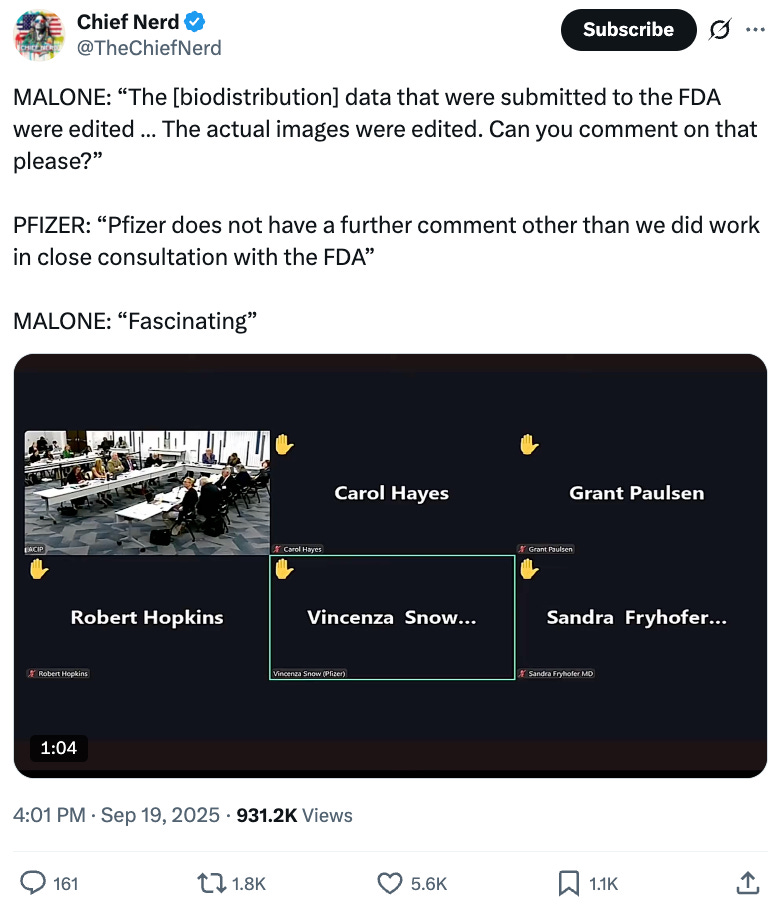
For me, this reality came to a head during the most recent ACIP meeting, where I confronted the Pfizer representative with the fact that the company had fraudulently altered and manipulated the data they had presented to the FDA, and the company representative basically acknowledged this well documented fact but informed the ACIP committee that the FDA had been aware that the data were fraudulently manipulated. As an aside, this position (the FDA knew) is very convenient for Pfizer, as it legally indemnifies Pfizer from any whistleblower (qui tam) case being brought on behalf of the US Government to recover money spent on purchasing a fraudulent product.
How can you apply a systematic review process when the underlying data and analysis have been fraudulently manipulated or distorted by the intersection of commercial interests and government agency groupthink/cult culture?
In his Senate Testimony, Dr. Toby Rogers refers to the complete domination of the knowledge production process in a field, such as science and medicine, by a single industry, in this case Big Pharma. This goes beyond mere regulatory capture, to a point where industries influence all aspects of policy and knowledge generation to control the very foundations of what is known, studied, and accepted as truth. This concept rang true to me and was entirely consistent with the experiences of everyone I knew during COVID who sought to publish data and clinical findings that were at odds with the Government/CDC-promoted narrative.
For example, see the following 2023 Substack essay:

From the first day of medical school to the final years of practice, doctors live inside an epistemic bubble carefully engineered by the pharmaceutical industry. What I’m describing here is bigger than “conflict of interest” — it’s systemic capture of the entire knowledge-production process.
Philosophers of science call this Epistemic Capture, which is when industry controls the conditions of knowledge production — what gets researched, how, and what counts as evidence. The problem is not one bad regulator or one compromised agency. The entire system of knowledge production in science and medicine needs to be overhauled to liberate it from the biases and distortions imposed by the pharmaceutical industry.
Dr. Toby Rogers, Sept 2025 Substack Note/Comment
In his September 9, 2025, testimony before the U.S. Senate’s Permanent Subcommittee on Investigations, Rogers stated: “In the social sciences, there’s this term called epistemic capture, which is when the entire knowledge production process becomes captured by one industry (Big Pharma). And that’s what’s happened with science and medicine.” He elaborated that this capture means “the pharmaceutical industry has captured every step in the knowledge production process in science and medicine. Big Pharma controls what is studied, how it is researched, and what qualifies as evidence.”
Rogers describes how this manifests across the system:
Education: Medical school textbooks, curricula, and training are shaped by academics with financial ties to pharma.
Research: Universities and department leaders receive substantial pharma funding; for-profit organizations run most clinical trials in low-regulation environments like China or the Global South.
Publication: A significant portion of journal articles are ghostwritten by industry insiders.
Promotion: Pharma spends over $27 billion annually on drug marketing and “continuing medical education” for doctors.
Practice: Standards of care are written by conflicted physicians, creating an “epistemic bubble” that engulfs professionals from training through retirement.
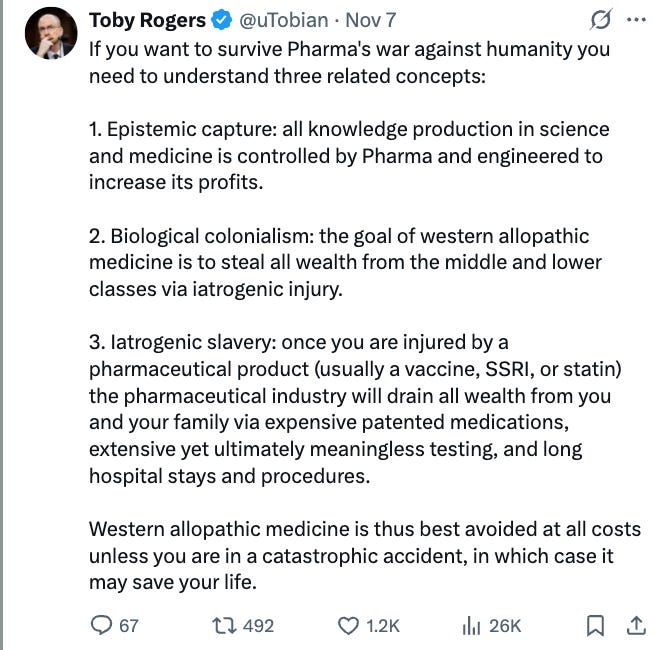
This engineered bubble, Rogers argues, prioritizes industry profits over public health, rendering certain questions unaskable, harms invisible, and genuine inquiry impossible. Rogers cites fields such as autism research and vaccine safety as examples. In a November 2025 X post, he succinctly framed it as: “Epistemic capture: all knowledge production in science and medicine is controlled by Pharma and engineered to increase its profits.”
The elaborate GRADE system, so carefully constructed, completely fails to reflect objective reality when epistemic capture has occurred, as was clearly the case during COVID. Therefore, all conclusions derived from even the most objective, unbiased application of this system will fail to provide accurate and reliable public policy guidance. Compounding this is the unfortunate but well-documented reality that, even without AI (more on this later), the majority of medical “peer-reviewed’ literature findings cannot be readily reproduced.
As I ponder this new reality, I find myself confronting a dilemma. I am forced to infer that all “peer-reviewed” literature can no longer be used as a reliable source for public health policy guidance, even when applied with the most objective standards of the well-intentioned GRADE systematic review system.
If so, how are public health advice and guidance to be developed by ACIP or non-conflicted public health policy decision-makers? Who and where can one turn for objective, accurate information? The State? From what I have seen emanating from both CDC and FDA during COVID, that seems quite naive. Academia? Captured. Pharma? You have got to be kidding. Contract Research Organizations? Get real. I used to work for the clinical research CRO industry. Deeply compromised, completely beholden to their big pharma sponsors.
I am at a loss on this one. We have a problem friends, right here in River City. My entire career now confronts an existential crisis: the death of evidence-based (“allopathic”) medicine and the deep, systemic corruption of medical and biomedical knowledge. And I don’t like it very much.
Normalizing “Truthiness”
The property of something seeming to be true, whether or not objective, verifiable evidence supports that “truth” is subjective, deeply influenced by cultural (and political) biases, and can be readily constructed using propaganda and the portfolio of modern comprehensive censorship and information control often referred to as Psychological Warfare (PsyWar) technology.
It is now quite clear and well documented that a global, harmonized propaganda campaign was deployed to build a veneer of truthiness around promoted core COVID belief system components. These synthetic narratives included that the SARS-CoV-2 virus originated in nature as an interspecies crossover event, is highly pathogenic, and will kill a considerable fraction of the global population.
Another key component of this constructed truthiness narrative was that the only medicines effective in averting the considerable risk of death from SARS-CoV-2 virus were the “safe and effective” genetic “COVID vaccines.” For fact-based information relating to the risk of death, please see the recently published “Regional patterns of excess mortality in Germany during the COVID-19 pandemic: a state-level analysis”, which is one of many examples now finally coming out. Anyone with the temerity to disagree with these narratives were (and still are) subjected to coordinated intimidation, censorship, loss of employment, blocking and rejection of submitted scientific manuscripts, and other coercive actions. How was this justified?
These truthiness narratives were normalized by government officials as necessary for maximizing public health. The logic was that any information (whether mis- dis- or malinformation) that could possibly cause “vaccine hesitancy” by revealing the falsehoods underpinning the promoted truthiness narratives would directly lead to avoidable death. Because, of course, the vaccine products were (claimed to be) safe and effective. Reports from front-line physicians and patients to the contrary had to be suppressed, including reports of vaccine-associated death, lest the general population become vaccine-hesitant.
Unfortunately for the propagandists, the fallacies of the promoted “safe and effective” narrative were so obvious to a large fraction of the population that the promoted falsehoods have resulted in widespread loss of trust in public health, the general vaccine enterprise, the medical specialty guilds, and in allopathic medicine in general. In retrospect, it has become clear that a similar logical fallacy has been widely applied and reinforced for the entire vaccine enterprise (including various adverse event risks) throughout the Western world, and that a similar backlash is in progress.
A recent, more general example of normalizing truthiness involves the British Broadcasting System’s creative editing of video of a speech by US President Donald Trump. Publishing in the British on-line publication “Unherd”, journalist and editor Mary Harrington has covered this dust up in an essay titled “Why we will miss the BBC. The world it represents is passing.” The entire essay is well worth the read. Here Harrington summarizes the context:
“The “doctored” Trump clip that helped defenestrate BBC Director-General Tim Davie over the weekend is, in 21st-century terms, a perfect political Rorschach test. In it, two parts of the President’s speech, 52 minutes apart, were spliced together, with some crowd footage, so it looks like he was inciting his audience to physical confrontation.
To many Right-wingers, including Trump himself, the edit was propaganda designed to portray him as a riot-inciting demagogue. To Trump haters, even if it’s not an accurate representation of what he said in that particular speech it’s a fair distillation of Trumpishness, and as such true in spirit. So who is right? It’s not even a debate about the facts, but about what the facts mean.
And this is precisely the larger issue at stake for the BBC, too: not so much whether, or in which direction, the BBC is “biased”, but whether we still have any faith in the possibility of neutral, authoritative arbiters of information as such. And if the answer is “no”, what does the future look like for our supposedly neutral and impartial national broadcaster?”
And in the following quoted text, she examines the crux of the situation, which is one of many examples used to make the point that previously BBC-promoted consensus reality has been splintered into a kaleidoscope of separate realities associated with various microcultures (“tribes”).
As accurately captured in the title, the overall thrust of the article is basically an obituary regretting the passing of the UK State-sponsored (and US-sponsored) BBC capability to normalize and reinforce truthiness.
Indeed, it was Covid-19 that provided the inflection point in this trajectory, for the simple reason that lockdowns forced everyone online. If it feels since then that the world has gone mad, it’s not that social isolation sent us crazy. It’s that the internet ate reality. In the resulting cacophony, everyone now assembles themselves a bespoke version of reality, from a near-infinite supply of media channels, podcasts, influencers, and the like.
And because humans are mimetic — that is, we decide what we want based on what those around us want — these realities have begun to agglomerate in affinity groups. In turn, these clusters have begun to define themselves in opposition to one another, and to mount information-war manoeuvres against one another. One notable result of these skirmishes, for example, is the progressive capture of Wikipedia, which was founded as a neutral, crowdsourced online encyclopaedia but has become bitterly politicised.
This dissolution of “truth” into tribal trench warfare is now the basic structure of what we used to call “the public conversation”. Huge amounts of money, status, and political influence are already at stake in this new environment; one the BBC, which was designed as a one-to-many vehicle for transmitting respectable establishment consensus, is hopelessly ill-equipped to navigate.
Bottom line, “Truth” has long been sacrificed for state-sponsored and promoted propaganda designed to fashion a cloud of synthetic “truthiness” around topics that are inconvenient for the State. The collapse of official State-sponsored media outlets (including USAID-sponsored media) has left a vacuum in which a wide range of opinions are being promoted in the quasi-open internet environment. But nature abhors a vacuum.
It is reasonable to infer that, in this splintered “truth” landscape, accepting the thesis that epistemic capture of the entire matrix of medical information generation and deployment has been accomplished by the Pharmaceutical industry, the “huge amounts of money, status, and political influence” that Harrington alludes to will be deployed to reinforce the truthiness of narratives that advance the commercial interests of the industry.
In other words, it is highly likely that information warfare or PsyWar technology has become central to modern Pharmaceutical industry marketing strategy and tactics, allowing the industry to routinely enforce synthetic versions of truth and reality relating to health and medical interventions.
So what about “Synformation”?
AS if this was not bad enough, into the context of this intellectual paradox, this particular existential crisis, a truth bomb dropped in the form of a recent, meticulously reported Epoch Times article titled “How AI is Supercharging Scientific Fraud”. The subtitle summarizes one key finding: “‘What we’re essentially seeing right now is the equivalent of a denial-of-service attack. Real researchers drowning in noise,’ one expert said.”
Academics and cybersecurity professionals warn that a wave of fake scientific research created with artificial intelligence (AI) is quietly slipping past plagiarism checks and into the scholarly record. This phenomenon puts the future credibility of scientific research at risk by amplifying the long-running industry of “paper-mill” fraud, experts say.
Academic paper mills—fake organizations that profit from falsified studies and authorship—have plagued scholars for years, and AI is now acting as a force multiplier.
…..
Manuscripts fabricated using large language models (LLMs) are proliferating across multiple academic disciplines and platforms, including Google Scholar, the University of Boras found. In a preprint posted on medRxiv in September, researchers at the University of Surrey observed that LLM tools—such as ChatGPT, Gemini, and Claude—can generate plausible research that passes standard plagiarism checks.
…
In an analysis of AI-generated “junk” science published on Google Scholar, Swedish university researchers identified more than 100 suspected AI-generated articles.
Google did not respond to The Epoch Times’ request for comment.
The Swedish study authors said a key concern with AI-created research—human-assisted or otherwise—is that misinformation could be used for “strategic manipulation.”
“The risk of what we call ‘evidence hacking’ increases significantly when AI-generated research is spread in search engines,” study author Bjorn Ekstrom said. “This can have tangible consequences as incorrect results can seep further into society and possibly also into more and more domains.”
….
Nathan Wenzler, chief information security officer at Optiv, said he believes that the future of public trust is at stake.
“As more incorrect or outright false AI-generated content is added into respectable journals and key scientific reviews, the near- and long-term effects are the same: an erosion of trust,” Wenzler told The Epoch Times.
This is an example illustrating the impact of the coming wave of Synformation, in which even the pretense of a commonly shared body of factual information will become an outdated anachronism. As this sweeps over allopathic medicine and literally all of internet-connected civilization, the problems of “old school” epistemic capture will seem nostalgic.
In closing, I recommend reading this 2024 academic analysis by John Wihbey, titled “AI and Epistemic Risk for Democracy: A Coming Crisis of Public Knowledge?”.
As a brief introduction to Withby’s thoughts on the topic, consider the following manuscript abstract:
As advanced artificial intelligence (AI) technologies are developed and deployed, core zones of information and knowledge that support democratic life will be mediated more comprehensively by machines. Chatbots and AI agents may structure most internet, media, and public informational domains.
What humans believe to be true and worthy of attention – what becomes public knowledge – may increasingly be influenced by the judgments of advanced AI systems. This pattern will present profound challenges to democracy. A pattern of what we might consider “epistemic risk” will threaten the possibility of AI ethical alignment with human values. AI technologies are trained on data from the human past, but democratic life often depends on the surfacing of human tacit knowledge and previously unrevealed preferences.
Accordingly, as AI technologies structure the creation of public knowledge, the substance may be increasingly a recursive byproduct of AI itself – built on what we might call “epistemic anachronism.” This paper argues that epistemic capture or lock-in and a corresponding loss of autonomy are pronounced risks, and it analyzes three example domains – journalism, content moderation, and polling – to explore these dynamics.
The pathway forward for achieving any vision of ethical and responsible AI in the context of democracy means an insistence on epistemic modesty within AI models, as well as norms that emphasize the incompleteness of AI’s judgments with respect to human knowledge and values.
We are entering unchartered waters, and therein be monsters. In the foreseeable splintered surreal information matrix, it may be that “truthiness” becomes our only guide. At which point objective, measurable reality (and scientific progress) will become as much an artifact of the past as the horse-drawn carriage, rotary telephones, and “evidence-based medicine”.
In the coming era of synformation, those seeking to promote any medical treatment narrative they desire will be able to flood the public square with synthesized scientific narratives that readily bypass both historic, cludgy, manual peer review processes as well as any AI augmented peer review methodology. We will end up with the dominant narrative becoming whatever synformation is crafted, weaponized and promoted by those with the most gold to spend on the campaign.
We will soon confront the consequences of a new “Golden Rule of Synformation”: Those with the most gold will not only make the rules - they will synthesize the very matrix of accepted truth and reality.
Legacy systems designed to support public policy decision-making that employ subjective criteria for knowledge analysis, such as GRADE, don’t stand a chance. We have to find some way forward to determine objective truth, or the Golden Rule of Synformation will not only destroy “democracy” via AI-based epistemic capture, it will destroy human civilization.
Key References for the Above Essay:
Wihbey, John, AI and Epistemic Risk for Democracy: A Coming Crisis of Public Knowledge? (April 20, 2024). Available at SSRN: https://ssrn.com/abstract=4805026 or http://dx.doi.org/10.2139/ssrn.4805026
“uTobian” Substack and Nov 07 “X” post, Toby Rogers

Toby Rogers, Substack Note/Comment
Why we will miss the BBC. The world it represents is passing. Mary Harrington (Unherd), Nov 11, 2025
If you are a juror in a trial and a group of witnesses gave their testimony which included several pieces of information, in fact they added additional info that proves the defendant is completely innocent, but then when cross examined, one by one, each piece of evidence they claimed proving innocence of the defendants are completely proven to be lies, the witnesses for the defense are proven to have lied again and again, and in the closing arguments the prosecution wheels in the dead bodies of the people that were harmed, the people who have suffered horrible adverse reactions, some in wheel chairs, and the families that had to bury their loved ones testified they were not allowed to visit their loved ones because of the defendants policies, you had seen this with your own eyes. To add insult to injury you yourself know many people harmed by the defendant. You quickly realize the defendant and all the people attached are evil greedy charlatans, you not only convict them you begin to extend their guilt to others that may or may not have been harmed by their actions because they were so evil and corrupt and they lied about everything. You see that absolute power absolutely corrupted them. Trust is completely broken. A whole open eyed generation will never again trust the defendants and anything they ever say or try to push. This to me is the mountain the medical establishment has to climb over, at least for me, to ever believe them again. They completely destroyed what was once a trusting integrity rich medical system.
IMO Bottom Line EMA has done a much better job than the FDA!
Two examples: Chemo treatment in Europe uses about 20% of what is adminstered in USA. They also prescribe Co Q 10 to compensate for the fact that Statins destroy's the essential body's stores. Also, only 400 chemicals are approved for processed foods and not what is allowed in USA. I am sure there are many more positives. Maybe EMA success needs to be explored.