

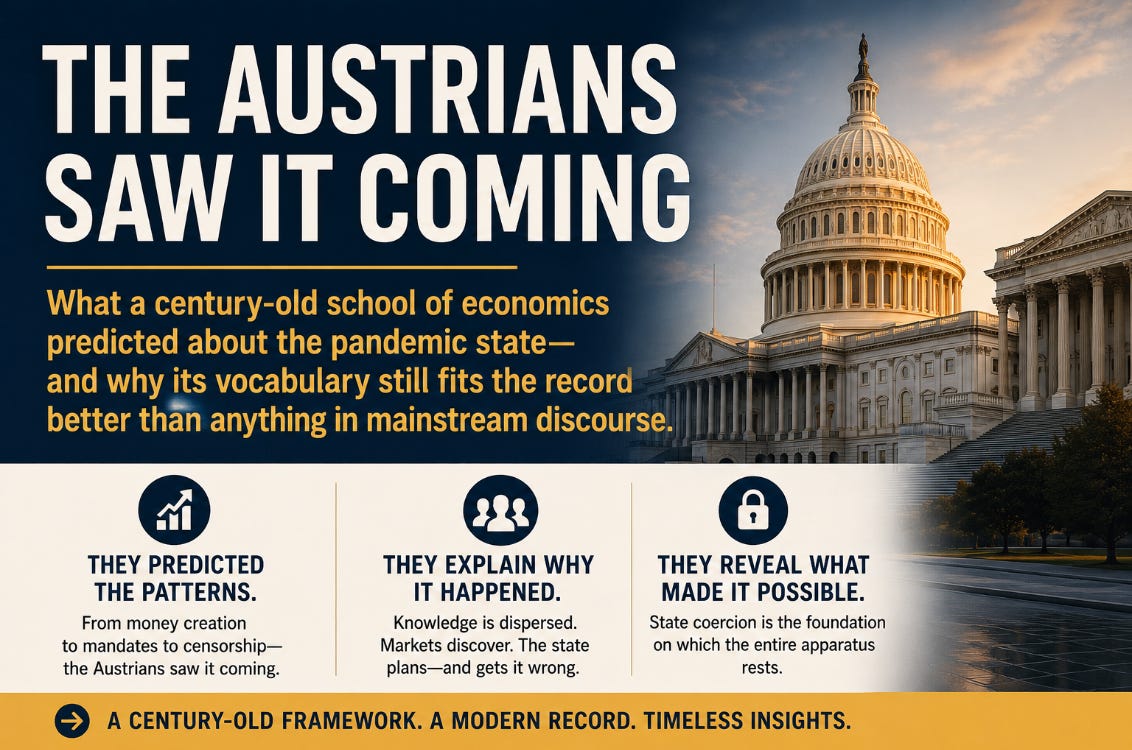
One tradition predicted what happened during the pandemic with unsettling accuracy. Most readers will have brushed against it only in passing, because its central figures wrote in the twentieth century, worked outside mainstream academic economics, and have been treated, where taught at all, as historical curiosities rather than live tools. The Austrian school, named for the nationality of its founders and built by Ludwig von Mises, Friedrich Hayek, Murray Rothbard, and their heirs, produced a body of analysis whose central claims line up with the pandemic record closely enough to demand attention.
What follows is not a full treatment of Austrian economics, which fills the many volumes its founders wrote. It is a guided application of a few Austrian ideas to the patterns the pandemic exposed. The goal is to give a coherent vocabulary for what the record establishes, and to show that the patterns are not quirks of the COVID era but expressions of forces the Austrians named decades earlier. The essay builds toward the framework that gives the rest its force: Rothbard’s account of state coercion as the foundation the whole apparatus rests on, and the reason these patterns could be enforced on entire populations.
The Cantillon Effect, Applied
In the early eighteenth century, the Irish-French economist Richard Cantillon observed that newly created money does not enter the economy uniformly. It enters at specific points and flows outward in predictable patterns, benefiting those nearest the point of injection first and most, and those farthest from it last and least. The phenomenon now bears his name. Mises developed it in his analysis of credit expansion. Hayek built it into his business cycle theory. Rothbard pressed it as the central indictment of central banking.
The Cantillon effect is the theoretical name for what the monetary record of 2020 shows. The Federal Reserve’s emergency facilities that year, which expanded the central bank’s balance sheet by approximately $4.5 trillion, did not distribute the new money uniformly across the American population. The money entered through specific channels — the corporate bond markets, the Treasury securities markets, and the financial sector — and flowed outward to the holders of assets nearest those channels.
The result was the largest upward transfer of wealth in modern American history, not as an accident but as the predictable way newly created money moves through an economy. The Austrian framework saw this coming three centuries before it happened.
Hayek and the Knowledge Problem
In a 1945 paper, “The Use of Knowledge in Society,” Friedrich Hayek argued that the central problem of organizing an economy is not allocating known resources. It is using knowledge that exists only in scattered, local, often unspoken form in the minds of people at the edges of any system. Central planning, however well meant, cannot gather that knowledge, and so cannot make decisions as well calibrated as the local actors would make for themselves.
The pandemic public-health apparatus was an experiment, run at planetary scale, in central planning under extreme information gaps. One-size-fits-all orders — close every school, mask everyone, require vaccination as the price of normal life — were dropped on populations whose actual situations varied enormously. The small-business owner who knew his shop could operate safely, the parent who knew her child could not take more isolation, the local doctor who knew her elderly patients’ specific risks, the rural county whose epidemiology looked nothing like a dense city’s: each held knowledge the central planners did not have and could not gather.
There is a deeper layer to the knowledge problem, and the pandemic exposed it. Hayek’s argument is not only that planners lack the dispersed knowledge; it is that a free system has a mechanism for putting that knowledge to use. In markets the mechanism is the price signal, which gathers countless private judgments into a number anyone can act on. In open inquiry the equivalent mechanism is unfettered debate: claims are made, contested, and revised, and the dispersed knowledge of many minds is incorporated through that friction. The censorship apparatus that operated through the pandemic was, in Hayekian terms, the deliberate destruction of that mechanism for ideas.
This makes the censorship more than a civil-liberties problem. When platforms throttled discussion of the laboratory-origin hypothesis, of natural immunity, of vaccine effects on transmission, and when encyclopedias and fact-checkers fixed an official account in place against correction, they were not merely silencing dissent. They were disabling the only process by which a system can discover that its central estimate is wrong. The suppressed claims were, in several cases, the correct ones. A system that suppresses the signal cannot self-correct, and is left to discover its errors only when reality forces the issue, long after the cost of the error has been paid.
The pandemic-policy failures — the closures that wrecked businesses with no public-health payoff, the mandates aimed at populations they could not protect, the messaging that made things worse for the very people it was meant to help — were not failures of execution. They were failures of the planning enterprise itself, the kind Hayek predicted eighty years earlier.
Mises on Bureaucracy
In Bureaucracy, published in 1944, Ludwig von Mises argued that bureaucratic management differs from profit-seeking business in one fundamental way: it has no means of matching its output to real value. A profit-seeking firm sells priced goods, and the prices customers pay tell the firm whether its output is wanted. A bureaucracy produces output whose value cannot be measured that way, so it expands to use up whatever resources it can get, whether or not the benefit keeps pace. Bureaucrats face a built-in push to grow their authority, their budgets, and their reach, because those are the yardsticks by which their success is judged.
The pandemic expansion of public-health bureaucracies tracks this exactly. The CDC, the NIH, the FDA, the WHO, and their counterparts across the developed world did not shrink after the acute phase. They grew. Budgets climbed, authority multiplied, payrolls thickened, and their reach extended into territory they had not occupied before. None of it was justified by any clear gain in public health. It was justified by the bureaucratic logic Mises identified, which produces growth regardless of outcome because growth is what the incentives reward.
Regulatory Capture and the Privileged Firm
The Austrian account of money explains who got the new liquidity first. A second Austrian theme explains who got the regulatory privileges, and it is at least as important. Mises argued that the interventionist economy, the “hampered market,” is unstable in a particular way. Each intervention creates distortions that invite the next, and the cumulative effect is a system in which political access, not consumer value, increasingly decides who succeeds. Rothbard pressed the point harder in Power and Market. He argued that monopoly power and cartel profits do not arise from free competition at all, but from government grants of privilege: the licenses, patents, purchase guarantees, and liability shields that protect favored firms from the discipline of the market.
The pandemic supplied an unusually pure case. The companies whose products the state mandated were granted advance-purchase contracts that removed market risk. They received liability shields that removed legal risk, and emergency authorizations that removed the ordinary burden of proof. Meanwhile regulators and the firms they oversaw exchanged personnel through a well-documented revolving door. This is not the free market that its critics blame for the outcome, and it is not socialism either. It is the hampered market the Austrians described, in which the state and a circle of privileged firms each extend the other’s reach. The public is left to absorb the costs of an arrangement it could neither price nor refuse. Naming it correctly matters, because the reflexive response to pandemic profiteering — more regulation — would deepen the very alliance that produced it.
Rothbard on the Court Intellectual
Murray Rothbard, the most prolific and politically pointed of the Austrian thinkers, devoted substantial attention to a figure he called the court intellectual. In Anatomy of the State and elsewhere, Rothbard argued that every state requires a class of credentialed experts whose social function is to translate naked power into legitimate authority through the language of expertise.
The court intellectual does not usually lie outright. He supplies the interpretive frameworks, the technical justifications, and the credentialed endorsements that make state actions look necessary, scientific, and beyond serious dispute. Without this class, state actions draw the kind of scrutiny that breeds resistance. With it, they are wrapped in the prestige of expert consensus and become hard to oppose without seeming anti-intellectual or anti-science.
The pandemic produced this class in unusually concentrated form. Anthony Fauci, Francis Collins, Deborah Birx, Rochelle Walensky, Tedros Adhanom Ghebreyesus, and their counterparts were, in Rothbard’s terms, the court intellectuals of the pandemic state. Their job was not mainly to produce new scientific knowledge but to translate state pandemic policy into the language of expert consensus, and to coordinate the silencing of credentialed dissent that would have spoiled the appearance of consensus. The Great Barrington Declaration episode, in which three credentialed epidemiologists were subjected to coordinated reputational attack for proposing an alternative policy framework, is the cleanest example of the court intellectual class performing its defining function. Rothbard would have recognized it instantly.
The court intellectual is not only the credentialed scientist. Rothbard’s category is functional, not occupational. It covers anyone whose work converts state action into legitimate authority, and the pandemic showed that the function extends across the institutions that shape public belief. The press performed it through what journalists themselves call access journalism. There, continued access to powerful sources depends on coverage those sources tolerate, so the official who controls access also shapes the resulting account. The fact-checking industry performed it too, by ruling contested questions settled in the official direction, with the rulings presented as neutral adjudication rather than the advocacy they often were.
The function was also performed by organizations built for the purpose. The Trusted News Initiative coordinated major outlets and platforms around a shared line on what counted as reliable. A censorship nonprofit with roots in one country’s party politics supplied target lists and the vocabulary of harm. These were not, in the main, producers of new knowledge. They were producers of legitimacy, manufacturing the appearance of a settled consensus that made the state’s pandemic policy hard to question without seeming to stand against science itself. Rothbard’s insight is that this is not incidental to state power but structural to it: the apparatus of expertise and the apparatus of opinion are recruited, knowingly or not, to the same task of making coercion look like agreement.
Hazlitt and the Unseen
In Economics in One Lesson, published in 1946, Henry Hazlitt boiled the foundational error of economic reasoning down to a single distinction. The bad economist, he argued, sees only the immediate, visible consequences of an action; the good economist traces the consequences that are unseen, delayed, or spread across people who never appear in the immediate tally.
Pandemic discourse made this error at scale. The visible consequences of pandemic policy — the cases prevented, the hospitalizations averted, the lives extended — were counted and publicized. The unseen consequences — the businesses destroyed, the educations disrupted, the deaths from delayed medical care, the suicides from prolonged isolation, the developmental damage to children, the wealth shifted upward by monetary policy, the institutional powers locked in for permanent use — were treated as inevitable, regrettable, or unmeasurable. They were not unmeasurable. They were simply left unmeasured by the institutions whose authority depended on the visible consequences being treated as the only ones. Hazlitt’s framework names the error and points to its political use.
Higgs and the Ratchet
Robert Higgs, an institutional economist working between the Austrian and public-choice traditions, gave us the ratchet effect in his 1987 book Crisis and Leviathan. Government powers that expand during a crisis, Higgs argued, rarely shrink back to their pre-crisis levels. The crisis-era powers become the new baseline, and the next crisis expands from there, so the cumulative growth of state power across crises becomes the dominant story of modern American politics.
The emergency powers invoked in 2020 did not return to their pre-2020 baseline. The biosecurity bureaucracies built or expanded in the response kept their crisis-era funding. The international preparedness architecture, including the WHO pandemic agreement, would lock the crisis-era arrangements into permanent international authority. This is what the ratchet produces. The COVID response was not a temporary expansion that later contracted. It was a permanent one that became the new normal, and the next crisis will expand from there.
Hoppe and the Short Horizon
The political theorist Hans-Hermann Hoppe, working within the Austrian tradition, has argued that democratic systems give elected officials shorter time horizons than other arrangements do, because officials have strong reasons to extract value from institutions during their term rather than preserve them for whoever comes next.
Pandemic decision-making fits the pattern. The agency heads who designed the response acted as if they would never be held to account for outcomes that would land after they left. The legislators who wrote the CARES Act and its successors acted as if the wealth-transfer consequences would scatter across an electorate too dispersed and distracted to organize against them. The officials who coordinated public messaging acted as if the dissent they suppressed would not produce organized backlash within their time in office. This short-horizon argument is more politically charged than the other Austrian frameworks here, but the record supports it, and it is worth naming for readers who want a systematic account of why officials behave as they do.
The Foundation: Coercion
The frameworks so far explain why the pandemic patterns took the shape they did. They do not, by themselves, explain why ordinary people went along with arrangements that most of them would have rejected if offered the choice cleanly. They describe the structure of the grift. They do not yet describe how it was enforced. For that, the Austrian tradition’s most direct analysis comes from Murray Rothbard, whose work on state coercion is the most uncompromising treatment of the question in the literature.
Rothbard’s foundational claim, developed across Anatomy of the State, For a New Liberty, The Ethics of Liberty, and many other works, is that the state is structurally unlike every other social institution because it claims a monopoly on the legitimate use of force within its territory. Every other institution — businesses, churches, associations, families — works through voluntary exchange, persuasion, social pressure, or moral suasion. The state alone works, in the end, through the threat and use of force. This is not a claim about whether state coercion is ever justified. It is a claim about what the state actually is, which sets it apart from institutions that may resemble it but lack its defining feature.
The pandemic was, by this analysis, an unusually clear demonstration of what state coercion actually consists of, made visible because it was deployed at scales and across domains where it had not reached in modern peacetime. Closure orders backed by criminal penalties, vaccine mandates backed by firing, travel restrictions backed by exclusion from commerce and movement, speech moderation backed by deplatforming coordinated with federal agencies, contact tracing backed by digital surveillance, quarantine backed in some places by physical detention — these were not, in Rothbard’s framework, persuasion. They were coercion. The distinction matters because persuasion lets people dissent without penalty, while coercion attaches a penalty to dissent. The defining feature of the pandemic arrangement was that the penalties for noncompliance were severe enough to override what large parts of the population actually wanted. People complied not because they were persuaded but because the alternatives had been made unbearable.
A useful illustration is the vaccine mandate, which became the most visible instance of pandemic-era state coercion in the developed world. The mandates did not require that citizens accept the vaccine. They required, formally, only that those who declined accept consequences: loss of employment, exclusion from education, denial of entry to commercial establishments, prohibition from travel, removal from professional licensure, separation from family members in healthcare settings, and in some jurisdictions, fines or detention.
Calling the mandates something other than coercion rested on the formal availability of the refusal option. In Rothbard’s framework, that framing falls apart on inspection. Coercion does not require that the coerced party have no option. It requires that the coercer has deliberately made the alternatives to compliance worse than compliance. A robber who says “your money or your life” is offering a choice in the formal sense. The choice is coercive because the coercer has imposed the relevant consequences on noncompliance. The vaccine mandates operated by the same logic, on a population scale, with the imposed consequences being the loss of livelihood, education, mobility, and social participation rather than the immediate physical violence of the street-level analogy. The structure was identical. The scale was vast.
The same analysis applies to the broader pandemic-era coercive apparatus. Closure orders were enforced through criminal penalties for noncompliant business owners; in multiple documented cases, individuals were arrested, fined, or jailed for operating businesses, holding religious services, or gathering with family members in defiance of them. Mask requirements were enforced through ejection, fines, and in some cases physical removal from commercial establishments and public transportation. Travel restrictions were enforced through denial of boarding, exclusion at borders, and in some jurisdictions mandatory quarantine in state-designated facilities under armed guard. Speech moderation, while not formally backed by criminal penalty in the American context, was coordinated between federal agencies and platforms in ways the Murthy v. Missouri litigation later documented as functionally state action operating through nominally private intermediaries. Rothbard would have recognized this last mechanism as a sophisticated extension of state coercion through coordination with private actors who could enforce restrictions the state itself could not directly impose under First Amendment constraints. The legal formalism was preserved; the coercive substance was delivered.
What Rothbard’s analysis stresses, more than any other framework here, is that the coercion was the point. The other Austrian frameworks describe what state action produces: wealth transfer, bureaucratic growth, court-intellectual cover, ratcheted authority. Rothbard insists that none of those outputs would be possible without the coercive foundation that forces the population to accept them. The Federal Reserve’s wealth transfer required that citizens accept the dollar as legal tender and pay their taxes in it. The bureaucratic growth required that citizens fund the growing institutions through compulsory taxation. The court intellectuals’ authority required that citizens treat their pronouncements as binding rather than as opinions to weigh on the merits. The ratchet required that the expanded crisis-era powers stay enforceable after the crisis passed. Coercion is the foundation the rest of the apparatus stands on. Remove it, and the apparatus collapses, because people would simply opt out of arrangements that did not benefit them.
The pandemic made that coercive foundation unusually visible, because the coercion reached new domains at new intensities. Citizens who had spent decades unaware of how coercive their relationship with state institutions really was — because the coercion operated in places they never personally hit — became aware of it when it reached their workplaces, their children’s schools, their churches, their travel, and their own bodies. The political fallout is still being worked out. The rise of populist movements across the developed world after 2020, the collapse of trust in public-health institutions, the cross-partisan surge of medical-freedom and bodily-autonomy advocacy: these are not unrelated. They are the political response of a population that became, briefly and partly, aware of the coercive foundation Rothbard had described his whole career.
What the Tradition Names
The Austrian tradition, and Rothbard in particular, gives us a more precise vocabulary for what happened than the alternatives on offer in mainstream discourse. The pandemic arrangements were not failures of communication, as their defenders sometimes claim. They were not excesses of zeal, as the apologetic histories frame them. They were not necessary measures whose costs were regrettable but unavoidable, as the official accounts insist. They were applications of state coercion, deployed across domains and at intensities the population had not met in peacetime, in service of arrangements that produced predictable distributional consequences, benefiting politically connected groups at the broader public’s expense.
The pattern across these frameworks is the same. Across the twentieth century, the Austrian tradition produced a body of analysis that anticipated how the pandemic institutions would behave. It predicted that newly created money would benefit those nearest its point of injection. That central planners would fail when knowledge is dispersed. That bureaucracies would grow regardless of any demonstrated benefit. That credentialed expert classes would provide cover for state action. That visible consequences would be counted while invisible ones were ignored. That crisis-era powers would become the new baseline rather than receding. That officials on short time horizons would strip value from institutions rather than preserve them. And that the coercive foundation under the whole apparatus would be deployed at scale to enforce arrangements that voluntary exchange would never have produced. Every one of these predictions was made before 2020. Every one was confirmed by the record.
Three Objections
The Austrian framework, applied to the pandemic record, has its critics, and an account that ducked them would do the framework no favors. Here are the three strongest objections. A reader who finds any of them persuasive is better placed to judge where, and how far, the Austrian analysis should be applied.
The first objection is to the knowledge-problem argument. Hayek showed that centralized planners cannot aggregate the dispersed contextual knowledge that local actors hold. The strongest version of the objection grants the point and then qualifies it. The knowledge problem is real, but it does not by itself entail that no centralized response to a pandemic can succeed. Some interventions, particularly those targeted at the vulnerable populations on whom the benefit–cost ratio is most favorable, may be both centralized in their organization and well calibrated in their application, because the relevant information for those specific interventions is reasonably aggregatable. The Austrian argument is strongest against the most ambitious applications of centralized planning — universal, one-size-fits-all mandates applied without regard to the heterogeneous risk profiles of the affected populations — and weakest against narrower interventions targeted at populations on whom the underlying epidemiology is well characterized. My view is that the strong version of the Austrian argument applies to the pandemic-era arrangements documented here, which were ambitious in the relevant sense; I do not claim, and the Austrian tradition does not require, that every conceivable centralized public-health intervention is illegitimate on knowledge-problem grounds. The framework identifies the conditions under which centralized planning is most prone to failure. It does not, by itself, demonstrate the failure in any specific case.
The second objection is to the Higgs ratchet argument. Higgs showed that emergency expansions of state authority tend not to return to their pre-emergency baseline. The strongest version of the objection grants the historical observation and then questions its normative implications. The ratchet effect is real, but it does not by itself entail that every emergency expansion of state authority is illegitimate, or that the failure of the emergency authorities to contract afterward indicates that the original expansion was unjustified. Some emergency expansions reflect the recognition of conditions the prior baseline had not adequately addressed, and the failure of those expansions to contract may reflect the persistence of the underlying conditions rather than bureaucratic self-protection. My response is that the burden of proof on this question runs in the direction the framework suggests. An emergency expansion of state authority that fails to contract after the emergency passes ought to be justified, explicitly and publicly, by reference to the conditions that continue to require it. In the pandemic case, the institutional expansions have not been so justified. They have been sustained by inertia, budget pressure from the institutions themselves, and the absence of organized political pressure for their contraction. That is the dynamic Higgs identified.
The third objection is more fundamental. It says: the Austrian framework treats state action as structurally distinct from voluntary social arrangements by virtue of its coercive substrate, and this distinction does analytical work the framework needs. But the distinction is not as clean as Rothbard’s presentation suggests. Voluntary social arrangements also produce coercive consequences — loss of social standing, exclusion from communities, denial of economic opportunity — and some of these can be as severe in practice as the formal coercions the state deploys. The pandemic-era social pressure on vaccine-hesitant individuals was, in some communities, enforced more aggressively by social ostracism than by formal mandate. To treat formal state coercion as categorically different from informal social coercion, the objection runs, is to miss the way coercive substrates operate across the institutional landscape rather than being confined to the state’s monopoly on force. My response is that the distinction Rothbard draws is analytically useful even if it is not absolute. Formal state coercion is enforceable through mechanisms — criminal law, regulatory penalty, professional licensure, employment as a condition of continued legality — that informal social coercion is not. The pandemic period demonstrated that the formal and informal coercive substrates can be coordinated to produce compliance pressure greater than either could produce alone. The Austrian framework names the formal substrate. The pandemic experience adds the observation that the informal substrate, coordinated with the formal one, multiplies the compliance pressure the formal substrate could otherwise produce.
None of these objections, in my reading, defeats the framework. Each identifies a limit to its application. The framework is strongest when applied to ambitious centralized planning that disregards heterogeneous local conditions, to emergency authorities that fail to justify their continuation after the emergency passes, and to formal-plus-informal coercive arrangements that achieve compliance through pressure greater than either substrate alone would produce. The pandemic-era record exhibits all three conditions. It is not, however, a universal solvent for the question of when state action is legitimately deployed, and I do not claim it to be.
A Tool, Not a Creed
You do not have to accept the full Austrian framework, with all its libertarian politics, to find these specific predictions useful. The tradition is internally diverse. Hayek’s politics differed from Mises’s, which differed from Rothbard’s, which differed from Hoppe’s. What they share is not a unified political program but a set of analytical tools for understanding how state action, regulatory authority, central banking, bureaucratic growth, and ultimately state coercion produce predictable consequences that benefit politically connected groups at the broader public’s expense. Those tools are available to readers across the political spectrum, whether their commitments are libertarian, progressive, conservative, or none of the above. A reader who is no libertarian can still recognize, after the pandemic, that the question of when state coercion is legitimately used deserves more serious public debate than it got, and that the frameworks for thinking about it are older, deeper, and more developed than the recent arguments suggest.
The Austrian tradition did not predict COVID. It predicted what would happen whenever a big enough emergency met a developed enough administrative apparatus running on the incentives modern central planning produces. The patterns are not a COVID story. They are the working out, at unusual scale and in front of unusual numbers of people, of forces the Austrians had named decades earlier.
* * *
Bibliography
Cantillon, Richard. Essai sur la Nature du Commerce en Général. London, 1755.
Hayek, Friedrich A. “The Use of Knowledge in Society.” American Economic Review 35, no. 4 (September 1945): 519–530.
Hazlitt, Henry. Economics in One Lesson. New York: Harper & Brothers, 1946.
Higgs, Robert. Crisis and Leviathan: Critical Episodes in the Growth of American Government. New York: Oxford University Press, 1987.
Hoppe, Hans-Hermann. Democracy: The God That Failed: The Economics and Politics of Monarchy, Democracy, and Natural Order. New Brunswick, NJ: Transaction Publishers, 2001.
Mises, Ludwig von. Bureaucracy. New Haven: Yale University Press, 1944.
Mises, Ludwig von. Human Action: A Treatise on Economics. New Haven: Yale University Press, 1949.
Mises, Ludwig von. A Critique of Interventionism. 1929. Reprint, Auburn, AL: Ludwig von Mises Institute, 2011.
Murthy v. Missouri, 603 U.S. 43 (2024).
Rothbard, Murray N. Anatomy of the State. Auburn, AL: Ludwig von Mises Institute, 1974.
Rothbard, Murray N. Man, Economy, and State, with Power and Market. 1962. Scholar’s ed., Auburn, AL: Ludwig von Mises Institute, 2009.
Rothbard, Murray N. For a New Liberty: The Libertarian Manifesto. New York: Macmillan, 1973.
Rothbard, Murray N. The Ethics of Liberty. Atlantic Highlands, NJ: Humanities Press, 1982.
This is an incredible essay — that could only have been written by a person with very deep knowledge of Austrian School achievements. A frustration I have had for a lifetime is understanding and then seeing that nobody else will ever understand. It is a great pleasure to see that this knowledge continues to live. It is very rare, almost painful to observe how rare, but nevertheless beautiful. Thank you for such an outstanding piece.
Herded like sheep by a shepherd (government-run medical establishment) with his dog (mandatory enforcement) through the gates (vaccines)of the herding trial. And the money for all this keeps flowing endlessly for the benefit of laboratories everywhere and at the expense of the public who are, in essence, “lab rats.” Somehow, I don’t believe Hippocrates had this in mind…..?