

There was a line item on the invoice. That’s the detail that still does the work, four years later, when you try to explain to someone why this issue went nuclear.
Cordectomy. Surgical severing of vocal cords.
A federal agency, your tax dollars, my tax dollars,, paid a contractor to slit the vocal cords of forty-four beagle puppies, six to eight months old, so that the experimenters wouldn’t have to listen to them cry while being force-fed an experimental drug for weeks until they were killed and dissected.
The American Veterinary Medical Association opposes the procedure. So does the American Animal Hospital Association. It is the kind of thing veterinarians refuse to do to a family pet absent extraordinary medical justification. But for the convenience of a research lab, the National Institute of Allergy and Infectious Diseases under Anthony Fauci wrote the check. $1.68 million, total. The cordectomy was a separate billable line.
When the documents came out in late 2021; pried loose by FOIA requests from a small watchdog group called the White Coat Waste Project, the public reaction was not partisan. It was visceral. Republican Representative Nancy Mace organized a bipartisan letter signed by twenty-four members of Congress demanding answers. Senator Joni Ernst started turning the screws from her side. PETA filed lawsuits. And a Beltway press corps that had spent two years treating Dr. Fauci as a secular saint suddenly found itself trying to explain “BeagleGate” to a furious country.
Some of what went viral turned out to be wrong. The most notorious image, beagles with their heads sealed in mesh cages full of sand flies, from a Tunisian leishmaniasis study, was misattributed; the journal eventually issued a correction stating that NIH had not funded that particular paper. The watchdogs got out over their skis on that one, and the fact-checkers gleefully pointed it out.
But the cordectomies were real. The University of Georgia study, where 28 healthy adult beagles were intentionally infested with parasite-carrying flies and then killed at the end, that was real.
The intramural sepsis experiments at NIH’s own Bethesda campus, where dogs had bacteria pumped into their lungs and were allowed to suffer through septic shock for up to 96 hours before euthanasia, going back to 1986, that was real, and it had been going on for decades. Over two thousand beagles, by the watchdogs’ count, in that single program.
Here is the thing about a moral catastrophe that has been quietly funded for forty years: when daylight finally hits it, the question is not whether to defend it. The question is who will move first to end it.
The settled consensus, and why it was never quite as settled as it looked
For most of the lifetime of anyone reading this, American biomedical research has operated on a presumption so deeply baked into the system that scientists barely articulated it: before a drug or biologic goes into a human, it goes into animals. Typically, a rodent species (mice, rats) and a non-rodent mammal, usually a dog, usually a beagle, because beagles are small, docile, and physiologically well-characterized. This was not a policy preference. It was federal law, traceable to the 1938 Food, Drug, and Cosmetic Act passed in the aftermath of an elixir-of-sulfanilamide poisoning that killed more than a hundred people, mostly children. The post-thalidomide reforms of the 1960s reinforced it.
The logic was straightforward: better a beagle than a baby. Given a choice between the two, almost any honest person picks the beagle. And so for decades, when an animal-rights group raised objections, the response from the scientific establishment was essentially: do you want children to die?
The trouble is that this framing, beagle versus baby, was never quite an honest description of what the research enterprise actually does. The honest description is closer to this: more than ninety percent of drugs that successfully pass animal trials still fail in humans. The animal-to-human pipeline leaks badly. Inbred mouse strains share 98.6% of their genetics with each other; immortalized cell lines share 99.9%. Cancer gets cured in mice on a quarterly basis. Alzheimer’s gets cured in mice with such regularity that it has become a running joke among researchers. None of it translates. The mice were never the bottleneck. The mice were the comfortable, familiar, institutionally entrenched stand-in for actual answers about actual humans.
This is not a fringe critique. It is the FDA's official position as of 2025, under Commissioner Marty Makary. It is the official position of the NIH, as of 2025, under Director Jay Bhattacharya. And it is now the basis for the most significant change in federal biomedical research policy in eighty years.
What just happened, in plain English
The story has three acts.
Act One was Congress, getting there first. In December 2022, quietly, with bipartisan unanimous consent in the Senate, co-authored by Cory Booker on the left and Rand Paul on the right, Congress passed the FDA Modernization Act 2.0. It amended the 1938 law. For the first time since FDR’s second term, sponsors of new drugs were explicitly authorized to use non-animal alternatives: cell-based assays, computer models, organ-on-a-chip systems, in their submissions to the FDA. The Act did not ban animal testing. It made the alternatives legal. That was the door opening.
Act Two was the FDA walking through it. In April 2025, the agency released a “Roadmap to Reducing Animal Testing in Preclinical Safety Studies.” The roadmap set actual timelines, not aspirational language, for phasing out animal testing wherever validated alternatives exist. It started with monoclonal antibodies, the class of biologic drugs for which animal models (especially monkeys) are known to be particularly lousy predictors of human response. By year one, the agency had qualified its first AI-based drug development tool, updated guidance to spare more than a million horseshoe crabs annually from endotoxin testing, and built a searchable database telling drug developers where alternatives are now acceptable. Makary’s stated goal: make animal research “the exception rather than the norm” within three to five years.
Act Three was the NIH, three weeks later, doing the same thing for federally funded research. Bhattacharya created a new office, the Office of Research Innovation, Validation, and Application, ORIVA, to coordinate the shift. By July 2025, NIH stopped funding new grant applications that proposed only animal research. Every new project has to address non-animal alternatives. And shortly afterward, NIH closed the last in-house beagle laboratory on the Bethesda campus. The sepsis program ended. PETA sent flowers, a sentence I never expected to write about a sitting NIH director.
The coalition that pushed this across the line is genuinely strange. PETA and Elon Musk on the same side of a policy fight is not something the polling data predicted. Joni Ernst and Cory Booker co-sponsoring legislation that actually passes is not a typical Tuesday in Washington. The Physicians Committee for Responsible Medicine cheering an NIH director appointed by Donald Trump is the kind of thing that makes pundits stare at their notes, wondering what happened to the axis they were supposed to plot the story along.
What happened is that, on this question, the left-right axis was never the right one. The right axis is institutional capture versus institutional accountability. And on that axis, the coalition lines up exactly as you would expect: the people who had been getting away with cordectomies for forty years lined up on one side, and everybody else lined up on the other.
The honest counterargument.
I want to be careful here, because the version of this story that says “the government was torturing puppies and a brave new administration stopped it” is true as far as it goes, but it also flatters certain political instincts without telling the whole picture. The whole picture includes some serious scientists who think the pendulum is now swinging too fast.
Arnold Kriegstein at UCSF, a neuroscientist who served on an NIH commission studying alternative models, has used the word “disaster” to describe what could happen if neuroscience research is pushed prematurely off animal models. There are things mouse brains and primate brains do: actual cognition, actual circuit-level processing, actual behavioral output, that no organoid in a dish can yet replicate. Organoids are, in the words of the scientists who pioneered them, “simplified versions of real organs.” They have no blood supply. They lack immune cells. They are powerful tools, but not yet substitutes for what they model.
The same caveat applies, with extra weight, to biodefense and pandemic preparedness research. If we want to know whether a vaccine will work against a novel airborne pathogen with pandemic potential, we eventually need to know whether it works in a whole animal with a functioning immune system, a functioning respiratory tract, and an observable disease course. There is no in vitro model for “did the ferret survive being challenged with H5N1?” You can model parts of it. You can’t model all of it. Not yet.
Notably, more than 111 million mice and rats are estimated to be used annually in U.S. biomedical research (ref). Recent totals for non-rodent mammals are around 774,000–850,000 animals annually, which includes dogs, cats, primates, rabbits, guinea pigs, hamsters, pigs, sheep, and other mammals (ref). Having worked in biomedical research, I can write with absolute certainty that 95% of what passes for scientific research involving animal models isn’t worth the time and resources spent on it. Mice lie, monkeys mislead, and the only thing that predicts safety and efficacy in humans is safety and efficacy in humans.
And there is a legitimate worry, voiced by researchers across the political spectrum, that the NIH has not yet defined, with sufficient precision, what counts as an acceptable “new approach methodology” in grant review. If your study genuinely requires a mouse and you cannot get funded without invoking some not-yet-validated alternative, you are not advancing the science. You are doing paperwork theater.
These objections deserve to be taken seriously, and the honest version of this story does so. The MAHA reader who wants to win this argument on the merits, not just on tribal affiliation, needs to understand and engage in dialogue about these objections.
But here is the thing. None of these objections justifies cordectomies on beagle puppies. None of these objections justify forty years of septic-shock experiments that did not produce a sepsis cure. None of them justify the institutional inertia that kept the system, by default, running on the most morally costly version of itself long after better tools became available. The honest counterargument is an argument for prudence in the transition, not for the indefinite preservation of practices that, exposed to sunlight, almost no one is willing to publicly defend.
What this is really about.
If you read the policy documents carefully, you notice that the federal agencies have stopped making the old argument. The old argument was that animal research is uncomfortable but necessary, and that the alternatives are not yet good enough. The new argument is: animal research often does not work, the alternatives are increasingly good enough, and the old system was preserved past its scientific usefulness by inertia and by the regulatory comfort of doing things the way they have always been done.
That is a remarkable concession for a federal agency to make. It is, in effect, an admission that institutional capture is a real phenomenon, that “the science” can be wrong for decades at a time, and that course correction sometimes requires outsiders shouting at the gates. It is the kind of concession that, if you are MAHA-curious, you have been waiting a long time to hear from the federal health establishment.
It is also a concession that should make all of us a little humble about the certainty with which other federally blessed scientific consensuses are sometimes communicated. If a beagle program could run for forty years past its sell-by date, hidden behind locked doors and FOIA-redacted documents, what else is running on inertia? What else is being defended on the grounds that the experts said so, where the experts are themselves the people who built and benefit from the system being defended?
This is the question the cordectomy invoice forces. It is a more uncomfortable question than the one about the dogs, although the dogs are the reason we are asking it. The dogs got us in the door. What we found, once inside, was an enterprise that had stopped asking itself the basic question every research program is supposed to ask continuously: Is this still the best way to do this, or is it just the way we have always done it?
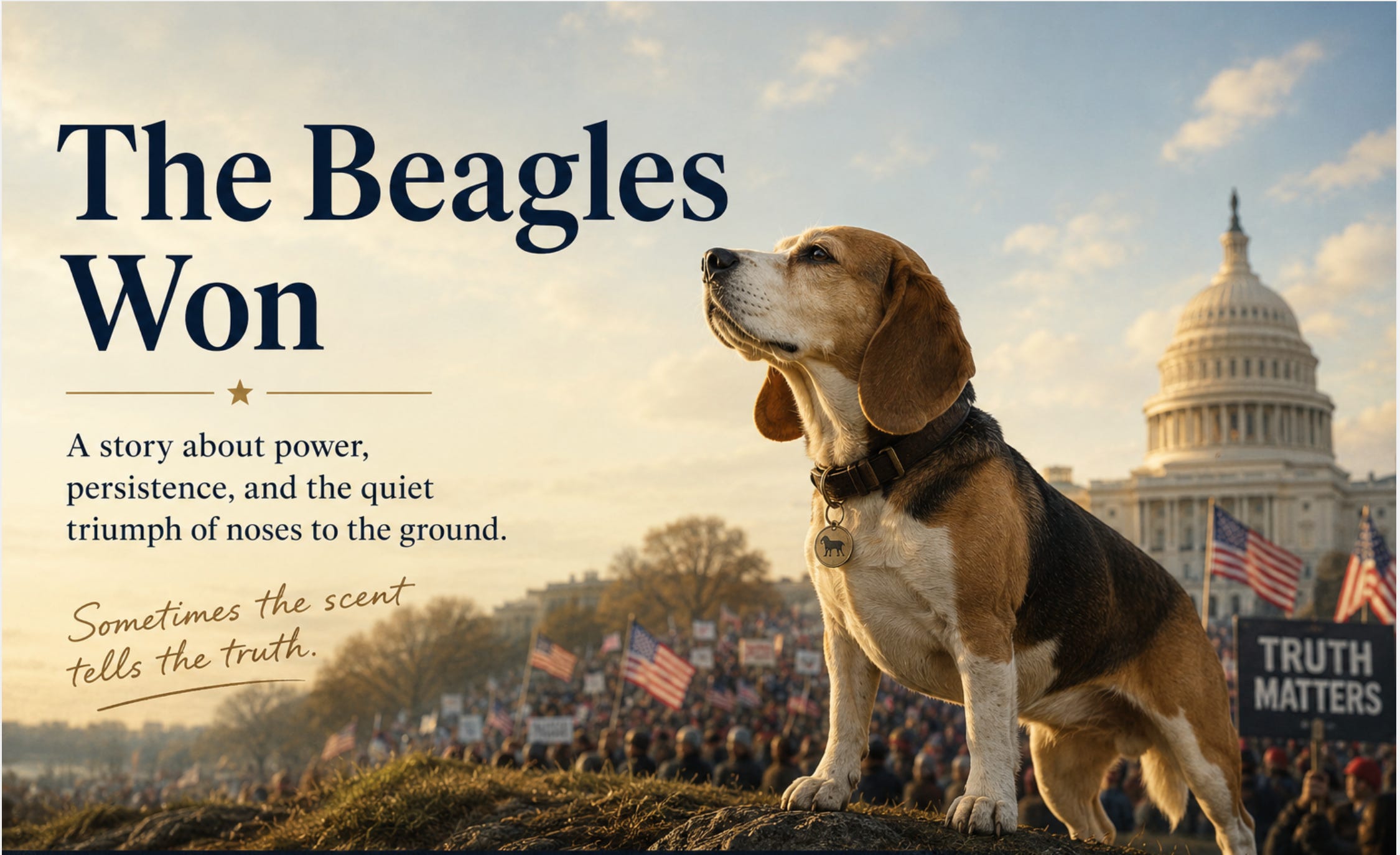
The beagles did not win in the end because they were cute, though they were. They won because the institutional defense of what was being done to them collapsed the moment it had to be made in public, in plain language, to ordinary people. A research program that cannot survive being described accurately to the citizens funding it is not a research program. It is a habit.
The habit is breaking. The question now is which other habits should break next, and whether the same coalition that broke this one has the discipline to ask that question carefully, with humility about what it does not know, rather than as the opening move in a wider war on expertise it does not trouble to understand.
Worth watching.
If you found this useful, consider subscribing. we write about institutional accountability, biomedical policy, and the strange political coalitions that occasionally crack open settled assumptions.
Those so-called researchers should be castrated without sedation.
Still a problem. The story below documents how beagles were rescued from a farm in Wisconsin that sold the beagles for medical research. The beagles are deficient in understanding how to behave because they have not been properly nurtured.
The Ridglan Farms Rescue Operation
The situation you are referring to involves a massive, coordinated effort to rescue beagles from Ridglan Farms, a commercial breeding facility in Wisconsin that has long supplied dogs for scientific research.
Rather than a single "puppy mill" bust, this was the result of intense public pressure, legal battles, and a negotiated settlement. In late April and early May 2026, animal welfare organizations—specifically the Center for a Humane Economy and Big Dog Ranch Rescue—finalized a deal to purchase 1,500 beagles from the facility.
⚖️ Context and Institutional Involvement
The Settlement: Under pressure from ongoing cruelty allegations and a 2025 finding of probable cause by a Dane County judge, the facility reached a settlement with the Wisconsin Department of Agriculture, Trade and Consumer Protection. This agreement allows the facility to avoid criminal charges provided they surrender their state-level breeding license by July 1, 2026.
The Scale: The rescue operation involves transitioning these beagles into a rehabilitation and adoption pipeline. While 1,500 dogs were part of the initial transfer, estimates suggest hundreds more may still remain in the facility's custody, with activists continuing to advocate for their release.
Civil Unrest: The path to this outcome was marked by significant tension. Earlier this year, activists engaged in direct action, including unauthorized entries onto the property and a later protest in April that resulted in arrests and confrontations with law enforcement.
🐕 Current Status
Rehoming: Organizations like the Dane County Humane Society and the Wisconsin Humane Society are currently facilitating the intake, medical screening, and adoption of these dogs. Interest has been overwhelming; thousands of applications have been submitted by the public.
The Reality of "Lab" Dogs: Advocates emphasize that these dogs, having spent their lives in confinement, require specific, patient environments to adjust to life in a home. The focus remains on securing the remaining animals while managing the massive logistical and financial demands of the current rescue.
This saga highlights the ongoing conflict between industrial, state-sanctioned breeding operations and the growing public demand for transparency and more humane practices in the scientific and agricultural sectors.