

Oct 4, 2026 · Robert W. Malone, MD, MS* and Jill Glasspool-Malone, PhD
Audio Version:
A twenty-eight-year-old woman died of plague in Siberia this week. She worked at the laboratory that exists to prevent exactly that.
Her name was Darya Shipilova. She was a laboratory technician at the Irkutsk Research Anti-Plague Institute of Siberia and the Far East, a federal facility operating under Rospotrebnadzor, the Russian consumer protection and public health service. She died during the night of October 1 at a district hospital in Shelekhov, a town of about forty-five thousand people south of Irkutsk. Roughly two hundred people who had contact with her were identified and isolated. Part of the hospital was quarantined. Anna Popova, Russia’s chief state sanitary physician, flew from Moscow to oversee the response.
The story reached English-language media as a laboratory accident, and within forty-eight hours it morphed into a larger story: that Russia has rekindled the Soviet biological weapons program, and that plague weaponization is back. That framework may eventually prove correct. Nothing yet released supports or refutes this hypothesis.
This assessment applies a structured method to the question rather than jumping to conclusions. Over the past year, Dr. Jill Glasspool-Malone, my co-author and wife of almost fifty years, and I have been building and testing a six-layer analytical framework for assessing compliance with the Biological Weapons Convention using only open sources. We have published seven applications of it, covering the Wuhan Institute of Virology, African swine fever in Spain, respiratory syncytial virus, Lyme disease, the Dugway Proving Ground anthrax shipments, the H5N1 panzootic, and the Omicron variant. In the Georgia case, the framework’s first pass returned a sixty-five percent probability of laboratory origin. Imposing base rates and reliability weighting brought that figure down to twenty-three percent. The method works as a brake on confirmation bias.
What follows runs Shelekhov through that same analytical process, along with the plague history and clinical background the assessment rests on. The evidence so far points to a laboratory accident, not a biological weapons program.
What is actually known
The story that has circulated worldwide traces back to a single original source.
The identification came from Lyudi Baikala, or People of Baikal, a small independent regional journal founded in Irkutsk in 2019 by Olga Mutovina and Elena Trifonova. It covers Irkutsk Oblast and neighboring Buryatia. The two founders were detained during protests following Russia’s 2022 mobilization and later left the country, although the publication says its network of reporters and sources remains inside the region.
Under Russian law, every page carries a mandatory “foreign agent” disclaimer. That designation was imposed on the founders for political reasons, not because of any finding that their reporting was inaccurate. And in this case, their local network matters: they have sources in the region that Moscow-based outlets may not.
Lyudi Baikala reported that Shipilova broke a tube containing the plague pathogen on September 25, fell ill shortly afterward, spent three days in the Shelekhov hospital, and died overnight into October 2. She had completed a residency in clinical laboratory diagnostics at Irkutsk State Medical University two years earlier, with honors. The story was then picked up by Mash and Baza, two Telegram channels with ties to the Russian security services. That is an unusual combination: an independent outlet branded a “foreign agent” by the Russian government and two security-connected Telegram channels all reporting essentially the same story.
The official statements have been far less clear, and at times contradictory. Irkutsk authorities referred only to a “particularly dangerous infection” and did not name plague. Governor Igor Kobzev said the identified contacts were asymptomatic and had tested negative. Alexey Tsydenov, head of neighboring Buryatia, publicly said the woman died of plague, while denying that she had visited his republic or that plague foci exist there. He later edited his post to say she had “possibly” died of plague. Gennady Onishchenko, Popova’s predecessor at Rospotrebnadzor, has questioned whether she had plague at all. No formal death notice was issued.
Within forty-eight hours, three different explanations for how she became infected were circulating: a recent trip to Thailand, a field assignment in Buryatia near the Mongolian border, and the broken tube in the laboratory. They cannot all be true. The Buryatia story was denied by the head of the republic. There is little support for the Thailand story, and Thailand is not meaningfully plague-endemic.
REN TV reported that 197 contacts had been identified and 189 hospitalized for observation. Of those, 114 were being held at one facility, 63 at another, and 12 at the anti-plague institute itself. Russian media also reported that a criminal case had been opened over alleged violations of sanitary rules resulting in death, although we have not found a primary announcement from the Investigative Committee confirming it.
Then came a more extraordinary response. On October 3, officials in nearby Baikalsk warned residents not to travel to Shelekhov. Advising an entire community to avoid another city is an unusually strong measure for an infection officials had still not publicly identified. The notice disappeared within two hours. REN TV also deleted several of its posts about the incident, although some had already been captured by other outlets.
Plague, and why the pneumonic form is a different disease
The early reports called this bubonic plague. It was almost certainly not, and the distinction matters.
Plague is caused by Yersinia pestis, a gram-negative bacterium that diverged from the relatively mild enteric organism Yersinia pseudotuberculosis within the last several thousand years. It acquired a small number of plasmids and lost a larger number of functional genes, a combination that produced one of the most lethal pathogens in human history. It caused the Justinianic pandemic, the Black Death, and the third pandemic that began in Yunnan in the 1850s. It has never been eradicated. It persists today in rodent populations across the American Southwest, Madagascar, the Democratic Republic of the Congo, Mongolia, and eleven recognized natural foci inside the Russian Federation.
The organism produces three clinical forms, and the differences between them are important to understanding what happened in Shelekhov.
Bubonic plague follows the bite of an infected flea. Bacteria travel to the regional lymph node, which swells into the painful bubo that gives the form its name. Incubation runs roughly two to eight days. Untreated mortality is on the order of fifty percent. Bubonic plague does not transmit person to person. This is the form that accounts for the overwhelming majority of naturally acquired cases worldwide, and it is the form that marmot hunters in Mongolia and Altai contract.
Septicemic plague occurs when the organism enters the bloodstream, either from a bubo or directly. It can kill before localizing signs appear. The 2009 death of Malcolm Casadaban at the University of Chicago, from a strain attenuated for laboratory use, was septicemic.
Pneumonic plague is the form that matters here. It arises either secondarily, when bacteria spread to the lungs from an established bubonic or septicemic infection, or primarily, through inhalation of an infectious aerosol. Incubation is short, commonly one to four days. It transmits directly person to person through respiratory droplets. Untreated, it is essentially uniformly fatal, and the window in which antibiotics still work is narrow, generally measured in the first eighteen to twenty-four hours after symptoms begin.
Primary pneumonic plague points to an inhaled organism. It is the form expected after a laboratory aerosol exposure, and it is also the form a biological weapon using Y. pestis would be intended to produce. That makes the reported clinical form in Shelekhov important to everything that follows.
Primary pneumonic plague presents as severe pneumonia with few distinguishing features. There is no bubo, no rash, nothing on initial presentation that clearly separates it from the community-acquired pneumonia a district hospital sees every week. A young adult presenting that way may be managed without respiratory isolation unless someone already knows the exposure history.
The problem is that plague is treatable if it is recognized quickly. Streptomycin, gentamicin, doxycycline, ciprofloxacin, and ceftriaxone all work against susceptible Y. pestis. The Irkutsk Institute published confirmation of this in 2022, reporting that thirty collection strains from Mongolia, held lyophilized for thirty-one to fifty-nine years, remained viable on reconstitution and highly sensitive to streptomycin, ciprofloxacin and ceftriaxone (Belkova, Zakhlebnaya, and Balakhonov 2022). In a plague laboratory worker, a death like this raises an obvious question: why was the diagnosis, and therefore effective treatment, apparently so late?
Plague as a weapon: what the record shows
Every major twentieth-century biological weapons program worked on plague. That history is why an accident at a Russian plague laboratory immediately raises questions. But the history is not evidence of what happened in Shelekhov.
Japan. The Imperial Japanese Army’s Unit 731, under Shiro Ishii at Pingfang in occupied Manchuria, is the only program known to have used plague operationally. Japanese aircraft dispersed plague-infected fleas over Ningbo in 1940 and Changde in 1941, producing documented civilian outbreaks. Unit 731 also conducted lethal human experimentation on prisoners. Most of the program’s senior scientists were granted immunity from prosecution by American occupation authorities in exchange for their data.
The United States. The American offensive program ran from 1943 at Camp Detrick in Maryland, with field testing at Dugway Proving Ground in Utah and production at Pine Bluff Arsenal in Arkansas. Y. pestis was studied as a candidate agent but was never standardized the way anthrax and tularemia were, in part because the organism is fragile outside a host and difficult to maintain in a stable aerosol. President Nixon terminated the offensive program by executive order in November 1969, extending it to toxins in February 1970. The United States destroyed its stockpiles and ratified the Biological Weapons Convention in 1975. We examined Dugway’s later record in a prior application of this framework: between 2005 and 2015 the facility shipped incompletely irradiated live anthrax to nearly two hundred laboratories across nine countries, a failure of sterilization validation inside a declared defensive program.
The United Kingdom. Britain ran an offensive program from Porton Down beginning in 1940, best known for the Gruinard Island anthrax trials. Plague received research attention. The program was terminated in 1956, and Britain became a principal drafter and depositary of the Biological Weapons Convention. Porton Down’s subsequent plague work has been vaccine development, and the British F1 and V antigen vaccine candidate entered American phase one trials in 2005 under a trilateral agreement with the United States and Canada.
The Soviet Union. This history is what makes an incident at a Russian plague laboratory impossible to dismiss without looking more closely. The Soviet biological weapons effort began in 1928 with a decree ordering the weaponization of typhus. After the Soviet Union signed and ratified the Biological Weapons Convention in 1972, it expanded the program rather than ending it. Biopreparat, established in 1973 and 1974, provided civilian pharmaceutical cover for roughly half of a workforce that exceeded sixty thousand people at its peak in the 1980s. The military portion ran through the 15th Directorate of the General Staff.
Plague was a strategic agent in that system. Ken Alibek, who served as first deputy director of Biopreparat from 1988 to 1992 before defecting, has stated that the Kirov facility stored approximately twenty tons of plague, and that smallpox, plague and anthrax were the three agents considered complete and ready for operational use. Vladimir Pasechnik, who defected to Britain in October 1989, ran plague research at the Leningrad Institute of Ultrapure Biopreparations and disclosed work aimed at increasing plague’s lethality and defeating antibiotics. The reported objective, antibiotic-resistant plague delivered as a dried powder by aerosol, is what made the pathogen particularly valuable as a weapon. Facilities included Obolensk south of Moscow, Kirov, Sverdlovsk and Vector at Koltsovo.
Sverdlovsk also established the precedent for concealment. In April 1979 an anthrax aerosol escaped from Military Compound 19 and killed at least sixty-six people downwind. The Soviet Union attributed the deaths to contaminated meat and maintained that account for thirteen years, until Boris Yeltsin acknowledged the military origin in 1992.
Russia inherited this complex. The United States Department of State has for years assessed in its arms control compliance reports that Russia maintains an offensive biological weapons program in violation of Article I of the Convention. That is a serious finding, and it means suspicions about an unexplained incident at a Russian biological laboratory cannot simply be dismissed. But those American assessments concern Ministry of Defence facilities. Irkutsk is a civilian plague surveillance institute. The question is whether there is any evidence connecting this incident, or this institute, to the military program. That is what the six layers below are intended to answer.
The vaccine question, which nobody has asked
No licensed plague vaccine exists in the United States today. Russia has one, and the Irkutsk institute historically manufactured it. Yet no official statement and no press account we have found has asked whether Shipilova was vaccinated.
The first plague vaccine was Waldemar Haffkine’s killed whole-cell preparation, developed in Bombay in 1897. The American successor, a suspension of heat-killed Y. pestis, was in use from 1946 and was licensed until 1999, when its sole manufacturer stopped producing it. It had two defects. It required repeated boosting and was reactogenic, with malaise, headache and local reactions in roughly ten percent of recipients. More importantly, it protected against bubonic plague but not against the pneumonic form.
The reason matters here. Killed whole-cell preparations deliver the F1 capsular antigen in quantity but little or no V antigen, the low calcium response protein. Protection against pneumonic disease appears to require both.
The Soviet Union took a different approach. EV76 is a live attenuated strain, a pigmentation locus deletion mutant, and it has been in continuous human use across the former Soviet states for decades. Because it is a live organism, it presents both F1 and V antigens and does protect against pneumonic plague in animal models. But it is not fully avirulent. It kills about one percent of vaccinated mice and has caused morbidity in nonhuman primates, which is why American and European regulators have never accepted it.
Russia vaccinates against plague on a population scale where natural foci are active. Rospotrebnadzor immunized more than eighteen thousand people in the Kosh-Agach district of the Altai Republic in 2018 alone. Laboratory personnel working with Y. pestis are among those for whom vaccination is indicated. The Irkutsk institute itself has published on post-vaccination antiplague immunity, including work by Korytov and colleagues on Y. pestis antigen complexes for assessing vaccine response.
The current Western alternative remains unlicensed. Recombinant subunit candidates combining F1 and V, either as a mixture or as a single F1-V fusion protein, have been in development for more than two decades. They have a good safety profile but have not fully protected African green monkeys against pneumonic challenge. There is another problem with relying on F1: naturally occurring F1-negative strains of Y. pestis remain fully virulent, and vaccines built around F1 may not protect against them. The same vulnerability would obviously be of interest to anyone deliberately trying to defeat a plague vaccine. When I (RWM) was employed at Dynport Vaccine Company, working on a US Army contract, I was tasked with reviewing the data on both the US F1+V and the UK F1-V vaccine candidates, and recommended the UK candidate for further development and testing. So I personally know something about and have experience in this field.
Which brings us back to Shipilova. If she was vaccinated with EV76 and nevertheless died of pneumonic plague, the obvious questions are whether she received an unusually large aerosol exposure, whether the vaccine failed, or whether the organism was one against which the vaccine offered inadequate protection. If she was not vaccinated, a different question arises: why was a technician working with virulent plague at a national reference institute not vaccinated? No official statement or press report we have found addresses either possibility.
The anti-plague system, and what Irkutsk is
The facility where Shipilova worked belongs to an institutional network older than the Soviet Union and separate from the Soviet biological weapons complex. Confusing the two is a common error in Western commentary on Russian biological incidents.
The anti-plague system grew out of Imperial Russia’s response to plague in the Kazakh steppe in the late nineteenth century: first quarantine cordons, then permanent stations, and eventually research institutes. Fort Alexander near St. Petersburg, the “Plague Fort,” housed one of the earliest. The work was dangerous from the beginning. Its head doctor, Turchinovich-Vyzhnikevich, contracted plague and died in 1904, diagnosing the pneumonic form in himself over three days. A second physician, Podlevsky, died in 1907.
The Soviet Union expanded this into a network of institutes and field stations covering the natural plague foci across its territory. The Irkutsk institute, founded under Alexey Skorodumov, covers Siberia and the Far East. By 1952, it was supplying dry live EV vaccine to the region under instructions issued by its own scientific council. A copy of those instructions reached Western intelligence and now sits in the CIA’s declassified reading room.
What the institute does today is extensively documented in its own publications. It maintains a Department of Collection of Pathogenic Bacteria holding viable Y. pestis across at least three subspecies, including Mongolian isolates from the 1950s through the 1980s. It conducts epizootic surveys of the Gorno-Altai, Tuva, and Transbaikal foci. It studies biofilm formation by Y. pestis in the gut of the flea Citellophilus tesquorum altaicus. It performs MLVA typing of strains from transboundary foci shared with Mongolia. It serves as the Russian reference center for tick-borne encephalitis monitoring. It hosts Mongolian scientists at its conferences and publishes their abstracts alongside its own.
But the distinction between the anti-plague system and the Soviet weapons program was never absolute. Western analysts, including researchers at Monterey who studied the anti-plague system, described the network as a potential second echelon: a civilian surveillance system that already possessed trained scientists, laboratories, and access to the same pathogens of interest to the weapons program. Igor Domaradsky moved between the anti-plague system and Biopreparat, demonstrating just how porous that boundary could be. A civilian plague institute has obvious dual-use capabilities, regardless of how much legitimate work it publishes.
So there are two facts to keep in mind. Irkutsk is a declared civilian institute with a long and extensively published record of plague surveillance and research. It also maintains virulent plague strains, specialized laboratories, and scientists trained to work with them. Neither fact, by itself, tells us what happened to Shipilova.
The six-layer framework
The Biological Weapons Convention has no verification mechanism. It is the only major arms control treaty that never acquired one. Negotiations on a verification protocol collapsed in 2001, and member states only agreed in 2022 to reexamine the question, on a timeline that may run into the 2030s.
In September 2025, the current administration announced plans to develop an artificial intelligence verification system for the Convention, and Undersecretary of State Thomas DiNanno outlined an implementation framework in Geneva that December. Whatever one thinks of that proposal, the underlying problem is real: how do you distinguish a laboratory accident from a biological weapons program using only information available outside the facility?
The framework Jill and I have been testing against historical cases examines six layers.
Genomic surveillance. Strain identity, genotype, plasmid complement, engineered markers, phylogenetic placement against known collections and natural foci.
Open source intelligence. The declared mission, the publication record, funding, collaborations, and whether the facility’s visible activity matches its stated purpose.
Supply chain and facility analysis. Containment level, staffing, infrastructure, and whether production scale is proportionate to the declared mission.
Environmental monitoring. The physical and epidemiological signature of the event: where cases appeared, in what pattern, over what distance.
Behavioral and organizational patterns. Institutional response, disclosure behavior, safety culture, regulatory conduct.
Predictive modeling. Base rates, scenario probabilities, and the comparison of competing explanations against prior frequencies.
After the first case studies, we added Bayesian weighting. Each layer receives both a weight and a reliability score, and the result is then tested against what is already known about how often the competing explanations actually occur. That adjustment can matter enormously. In the Athens, Georgia case, the first unweighted analysis produced a sixty-five percent probability of laboratory origin. Once historical base rates and the reliability of the evidence were included, it fell to twenty-three percent.
Shelekhov is the eighth application. We first set out the framework in “The Invisible Inspectors” on March 1, 2026, using the SARS-CoV-2 research network centered on the Wuhan Institute of Virology, EcoHealth Alliance, and the UC Davis One Health Institute as a retrospective case study. Seven applications followed within a week, including cases in which we had good reason to expect very different answers.
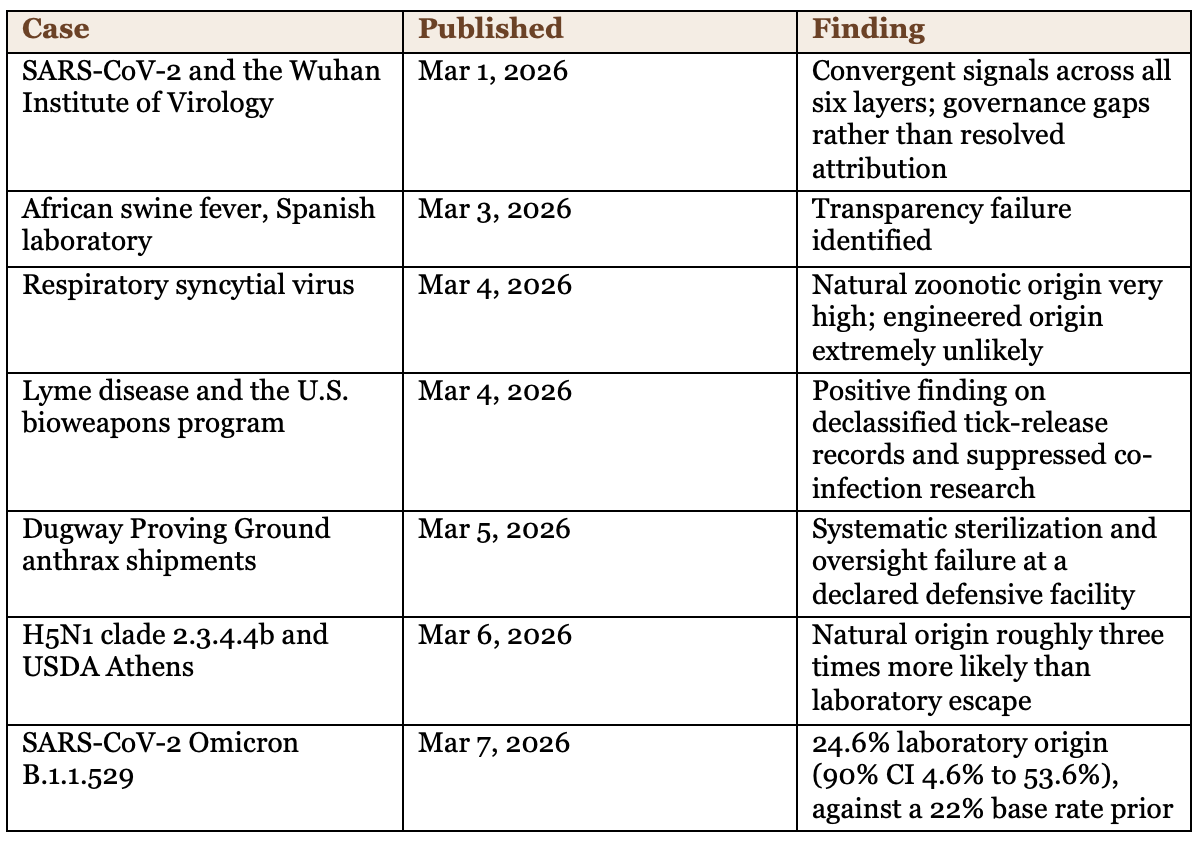
Two American facilities drew adverse findings. Three pathogen-origin claims popular with our own readership were not sustained. One historical allegation was substantiated. A framework that gives you the answer you expected every time is not much of a framework.
There is one important limitation in applying it to Shelekhov. The Omicron and H5N1 analyses used Bayesian integration over ten thousand Monte Carlo iterations. We do not have comparable data for this case. The numerical scores below are therefore subjective estimates, not computed probabilities. We include them to show the reader how much weight we are giving each category of evidence, rather than hiding those judgments behind qualitative terms such as “low,” “moderate,” or “high.”
Layer 1: Genomic surveillance
There are no data. Not thin data, none.
No strain identity has been released. No genotype, no sequence, no plasmid profile, no subspecies assignment, no antibiotic susceptibility result from the fatal isolate. There is no public confirmation that Y. pestis was isolated from Shipilova at all. The pneumonic designation rests on media reporting and one subsequently edited statement by a regional governor.
This layer carried the most weight in the previous analyses, and here it is empty. That matters. Every conclusion that follows has to be drawn from circumstantial evidence. Anyone offering a confident verdict about biological weapons activity is doing so without the one category of evidence most capable of establishing what actually happened.
Score: unscorable. Weight redistributed to Layers 2 and 5.
Layer 2: Open source intelligence
The institute’s publication record argues against a covert program, and consistency requires saying so.
Irkutsk is a declared civilian facility under Rospotrebnadzor. It publishes continuously: conference proceedings edited by its own director, strain collection characterizations with accession numbers and plasmid profiles, MLVA typing results, flea biofilm experiments, antibiotic susceptibility panels, and serological monitoring of its own staff. It names its scientists. It publishes jointly with Mongolian institutions and prints their abstracts in English. It even publishes its own biosafety risk-management methods, including a 2022 paper by Vityazeva, Sidorova and Konovalova on identifying laboratory hazards.
That is not what a covert weapons program looks like. A program trying to hide what it is doing does not normally publish detailed information about its strain collections.
We applied the same reasoning to the Georgia facility, where this layer scored 5.8 out of 10. There, extensive documentation of dual-use research counted as evidence supporting a legitimate mission. We cannot treat similar transparency as suspicious simply because the laboratory is Russian. Doing so would build the desired conclusion into the method.
American concerns about Russia’s biological weapons activities have focused on Ministry of Defence institutions descended from the old 15th Directorate complex, not the civilian anti-plague network. Evidence that Russia may maintain a prohibited biological weapons program does not make every Russian laboratory part of that program. Evidence must connect the particular facility to it.
Score: 2.5 out of 10 toward prohibited activity. Reliability: high, approximately 85 percent, because the evidence here comes largely from the institute’s published record.
Layer 3: Facility and supply chain
The institute holds large quantities of virulent plague, which is both expected and inherently dual-use.
Staffing is roughly ninety scientific personnel. Containment operates under the Russian pathogenicity group I and II classification, broadly comparable to American BSL-3 with enhanced practices. Documented holdings include viable Y. pestis across the main, altaica and ulegeica subspecies, with plasmid complements characterized and recorded in strain passports. The institute maintains animal facilities for guinea pigs, white mice and ground squirrels, and it has a vaccine production history reaching back to the 1950s.
Just as important is what we have not found. There is no visible production-scale fermentation capacity. No aerosolization or dissemination test infrastructure. No lyophilization at volumes beyond diagnostic sera and vaccine production. No munitions-related engineering. In the Dugway assessment, production capacity beyond what the declared mission required was an important warning sign. We see nothing comparable here.
There is an obvious limitation. We are looking at a Russian government facility through publicly available records, and the Russian government controls much of what becomes public. What we cannot find may simply be hidden. That is why this layer receives a lower reliability score.
Score: 4.0 out of 10 toward prohibited activity. Reliability: moderate, approximately 60 percent.
Layer 4: Environmental monitoring
The distribution of the nearly two hundred contacts may be the most useful evidence available, and it argues against a larger release.
A laboratory accident involving one person should produce contacts clustered around that person. A significant aerosol release should produce cases or exposures distributed geographically, particularly downwind of the source. Those patterns should look very different.
What was reported in Shelekhov is overwhelmingly hospital-centered.

Only about six percent of the isolated contacts were at the anti-plague institute. Ninety-three percent were associated with the two hospitals. That makes sense if a young woman with severe, undiagnosed pneumonia spent three days in a hospital without respiratory precautions. Her contacts would include emergency department personnel, ward staff, radiology and laboratory workers, transport staff, other patients and visitors.
That is very different from Sverdlovsk, where cases appeared geographically along the path of an aerosol plume. The Shelekhov contacts, at least from the numbers reported so far, are overwhelmingly nosocomial. The protective suits seen on Shelekhov streets and masks distributed in kindergartens are also consistent with authorities tracing contacts outward from the hospitals.
There is an important caveat. The contact figures come from REN TV rather than an official government release, and REN TV subsequently deleted several posts about the incident.
Score: 2.0 out of 10 toward prohibited activity. Reliability: moderate, approximately 55 percent.
Layer 5: Behavioral and organizational patterns
This is where most of the evidence sits, and also where it is easiest to read too much into it.
There are signs that the public-health response functioned once the danger was recognized: quarantine was imposed within days; 197 contacts were identified and 189 reportedly isolated and given prophylaxis; Russia’s chief sanitary physician was dispatched from Moscow; public events were canceled; and a criminal case was reportedly opened over sanitary violations resulting in death.
There are also signs of extraordinary official opacity. Authorities refused to name the pathogen. A governor would not say the word plague. The head of a neighboring republic said she died of plague and then edited his statement to say she had “possibly” died of plague. A travel advisory disappeared within two hours. Broadcast reports were deleted. A former head of Rospotrebnadzor disputed the diagnosis. Three incompatible explanations for her exposure circulated at the same time. No formal death notice was issued.
But secrecy surrounding an embarrassing event is not, by itself, evidence of a biological weapons program. Russian authorities have behaved similarly after mine disasters, aircraft accidents, methanol poisonings, and during disputes over pandemic mortality. In the Dugway case, we treated concealment and organizational failure as evidence of poor oversight, not offensive intent. The same standard should apply here.
There is, however, one problem that is much harder to explain.
If the institute knew on September 25 that an employee had broken a container of viable Y. pestis, she should have been placed under an occupational exposure protocol within hours. Post-exposure prophylaxis with doxycycline or ciprofloxacin is standard, and her own institution published in 2022 that its plague collection remained highly sensitive to those antibiotics. Instead, according to the timeline now being reported, she arrived at a general hospital four days later with undifferentiated pneumonia and died three days after that.
Either the laboratory accident was not reported when it happened, or somebody knew about it and failed to act appropriately. Both possibilities are serious. Neither requires a biological weapons program to explain them.
Score: 4.5 out of 10 toward prohibited activity, driven primarily by the unexplained delay in responding to the reported exposure. Reliability: moderate to low, approximately 45 percent, because much of the underlying account still depends on a single original source and subsequent Telegram reporting.
Layer 6: Predictive modeling and base rates
Base rates made a major difference in the Georgia assessment, and they matter just as much here.
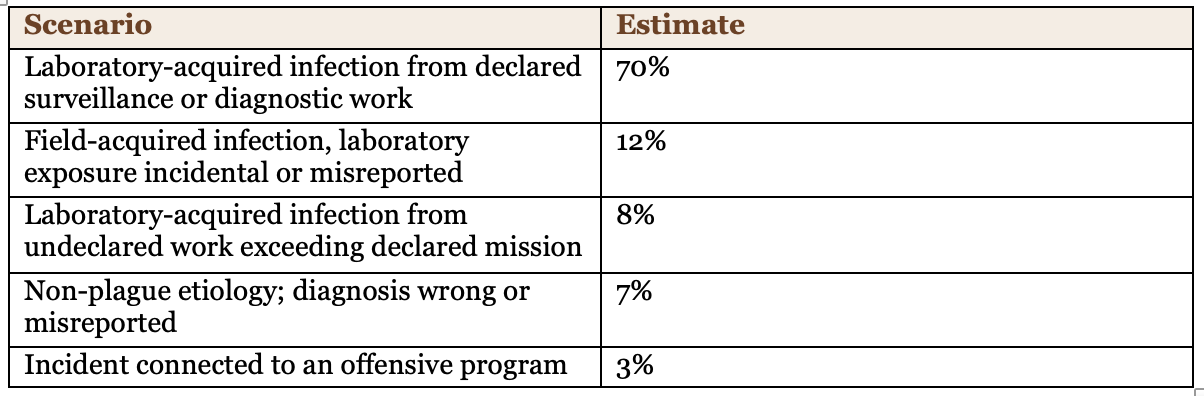
Estimated probability that this was a laboratory-acquired infection: 80 to 88 percent. Laboratory-acquired plague has been an occupational hazard of plague research since the field began. Turchinovich-Vyzhnikevich died of it in 1904, and Podlevsky in 1907. Malcolm Casadaban died in 2009 at the University of Chicago after infection with an attenuated strain, the first American laboratory-acquired plague death since 1959. In this case, the alternative explanations are considerably weaker. The head of the republic denied the Buryatia account. There is little evidence supporting the Thailand account, and Thailand is not meaningfully plague-endemic.
Estimated probability that a laboratory-acquired infection involved prohibited offensive work: 3 to 8 percent. Everything publicly known about the incident can be explained by the institute’s declared work: surveillance of natural plague foci, maintenance of a reference strain collection, antibiotic susceptibility testing and vaccine research. So far, nothing requires an offensive program to explain what happened.
Estimated probability that this incident ultimately produces evidence relevant to Russian compliance with the Biological Weapons Convention: about 15 percent. That estimate could change substantially if strain data become available. At present, Layer 1 remains completely empty.
The resulting scenario estimates are:
Score: 2.5 out of 10 toward prohibited activity. Reliability: moderate, approximately 60 percent.
Integrated assessment
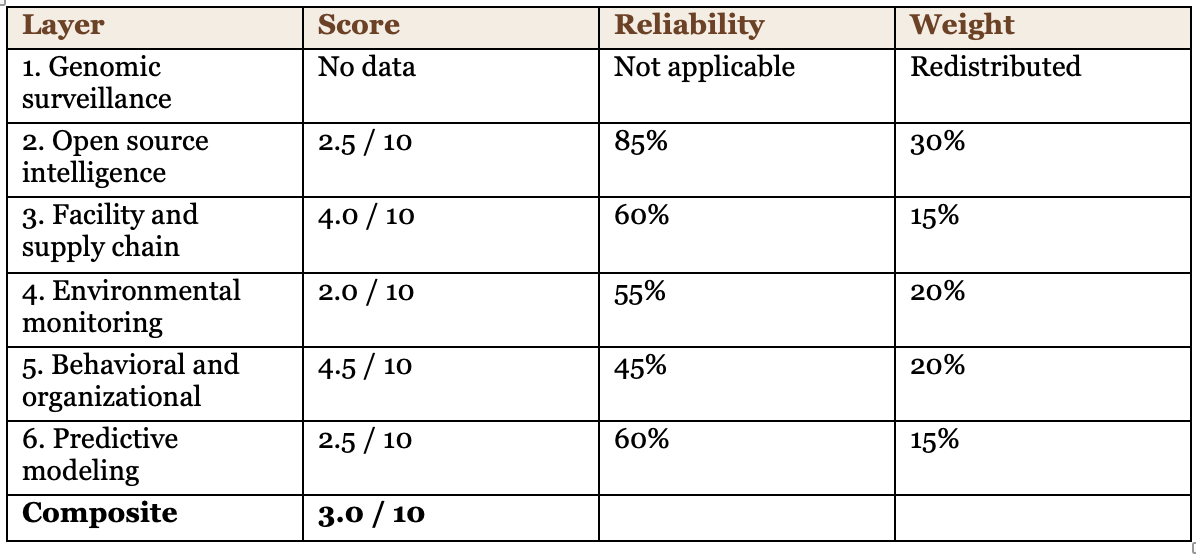
The composite score is 3.0 out of 10, below both Dugway and the Athens facility, which we classified as moderate to high dual-use concerns. In other words, applying the same framework to all three cases produces less concern about prohibited biological weapons activity at Shelekhov than at either of the two American facilities.
What the evidence supports strongly. The most likely explanation is a laboratory-acquired plague infection at a national reference institute, followed by a failure to recognize and respond to the exposure quickly enough to prevent Shipilova from reaching a community hospital with undiagnosed pneumonia. That delay resulted in nearly two hundred people being identified as contacts and 189 reportedly hospitalized for observation. If the events occurred as reported, this was a serious biosafety failure.
What the evidence does not support. There is currently no evidence of weaponization, a large-scale aerosol release, or renewed offensive biological weapons work at the Irkutsk institute. Claiming otherwise would make the same mistake we have tried to avoid throughout these analyses: beginning with the conclusion and then interpreting every uncertainty as evidence for it.
What could change the assessment. The most important missing evidence is the organism itself. A strain showing engineered antibiotic resistance, an altered virulence plasmid complement, or other evidence of deliberate modification would change this assessment immediately. An altered or absent F1 capsular antigen would also demand close examination, although F1-negative virulent strains occur naturally and therefore would not, by itself, establish engineering. Until strain data are released, there is no evidence connecting this death to prohibited biological weapons work.
What we still need to know
Layer 1 remains empty, so this assessment is necessarily provisional. Six pieces of information would go a long way toward resolving what happened, in roughly this order of importance.
1. Strain identity of the fatal isolate. The institute performs MLVA typing and plasmid profiling in-house and publishes the results. The fatal isolate should be compared with the institute’s own collection strains and with current isolates from the Gorno-Altai, Tuva and Saylyugem natural foci. A match to a strain held by the institute would strongly support laboratory acquisition. A match to a strain circulating in a natural focus would be less helpful, because the institute routinely handles those same strains. Evidence of deliberate genetic modification, particularly changes affecting virulence or antibiotic susceptibility, would substantially change this assessment.
2. Vaccination status. Was Shipilova vaccinated with EV76, and if so, when? Pneumonic plague in a vaccinated technician would raise immediate questions about the size of the exposure, vaccine failure, and whether the infecting strain was adequately covered by the vaccine. If she was not vaccinated, then the question becomes why a technician handling virulent plague at a national reference institute was working without that protection.
3. Who were the 189 contacts? This could settle one of the most important questions in the case. If they were overwhelmingly hospital staff, patients, and visitors, the current interpretation becomes considerably stronger. If instead they were geographically distributed across Shelekhov, particularly in a pattern related to the institute or prevailing winds, the possibility of a larger release becomes much more serious. Their occupations and locations matter.
4. What happened after the reported September 25 accident? When was the broken tube reported? To whom? Was Shipilova evaluated? Was post-exposure prophylaxis offered or administered? If a criminal investigation into sanitary violations is actually underway, investigators should have access to workplace logs, biosafety records, and witness statements that could answer these questions.
5. What was Shipilova actually working on? Routine diagnostic, surveillance, and strain-characterization work would fit the institute’s declared mission. Aerosol challenge experiments, deliberate enhancement of virulence, antibiotic-resistance work, or vaccine-escape studies would raise very different questions, particularly if they were being conducted in a laboratory with no declared aerobiology mission. Ordinary animal challenge studies with virulent wild-type strains would not, by themselves, indicate offensive work.
6. Was Shipilova an author on the reported 2026 plague paper? Proceedings of the 2026 All-Russian Congress on Infectious Diseases reportedly include a study of Y. pestis antibiotic susceptibility from Siberian natural foci listing D. N. Shipilova as a coauthor with Vityazeva, Balakhonov, Tokmakova, Khvoinova, Arkhipenko and Vishnyakov. We have not been able to retrieve the document itself. The other named authors are current institute staff, which makes the attribution plausible, but it remains unverified until the abstract or proceedings can be obtained.
What a low score demonstrates
A twenty-eight-year-old woman died of plague in Siberia last week after apparently being exposed at the laboratory where she worked. That laboratory exists, in large part, to prevent exactly this from happening.
That story is serious enough. A technician at a national plague reference institute apparently became infected with Yersinia pestis and then spent three days in a community hospital with undiagnosed pneumonia. She died of an organism her own colleagues had shown to be highly sensitive to streptomycin, ciprofloxacin, and ceftriaxone. By the time the danger was recognized, 189 people were reportedly hospitalized for observation, the overwhelming majority of them associated with the hospitals rather than the anti-plague institute.
But that is not the story now being suggested in some of the coverage. There is no evidence that Shipilova was working on a biological weapon, no evidence of a large aerosol release, and no evidence that the Soviet plague weapons program has been restarted at Irkutsk.
That matters for another reason. Russia is an adversary state with a documented history of concealing biological weapons work, and the United States government continues to accuse it of violating the Biological Weapons Convention. If this framework were simply a way to produce the conclusion we wanted, this would have been an easy case in which to do it. Instead, Shelekhov produces the lowest treaty-compliance score of the eight cases we have examined.
The previous cases have gone in different directions. The framework found no persuasive evidence of a laboratory origin for respiratory syncytial virus. It found natural origin more likely for H5N1 and put the laboratory-origin probability for Omicron at roughly one quarter. It found evidence supporting the historical Lyme disease allegation and serious problems at Dugway and in the research network surrounding the Wuhan Institute of Virology. The point is not that the framework is always right. The point is that it does not always give us the same answer.
That distinction matters if artificial intelligence is ever going to play a serious role in verification of the Biological Weapons Convention. Fifty-one years after the Convention entered into force, there is still no verification mechanism. Governments are unlikely to accept judgments about biological weapons from an AI system they cannot examine or challenge. Any useful system will have to show its evidence, explain how it weighed that evidence, acknowledge what it does not know, and be capable of concluding that the evidence does not support an accusation.
That is where the Shelekhov evidence stands today. A laboratory appears to have failed. A young scientist is dead. Nearly two hundred people were caught up in the response. That story is serious enough without turning it into a biological weapons story.
The strain data could change the assessment. If it shows evidence of deliberate engineering associated with prohibited work, we will revisit the conclusion. But based on what is publicly available now, an incident at a Russian plague laboratory, in the fifth year of the war in Ukraine and with the Soviet biological weapons program still within living memory, has produced no evidence that offensive plague work has resumed at Irkutsk.
That possibility has not been ruled out. It simply has not been demonstrated.
RWM/JGM
*Dr. Malone is a U.S.-nominated Qualified Expert on the roster of the United Nations Secretary-General’s Mechanism for Investigation of Alleged Use of Chemical and Biological Weapons (UNSGM), whose experts may be called upon to participate in UN investigations of alleged chemical, biological, or toxin weapons use.
References
Alibek, Ken, with Stephen Handelman. 1999. Biohazard: The Chilling True Story of the Largest Covert Biological Weapons Program in the World, Told from the Inside by the Man Who Ran It. New York: Random House.
Balakhonov, S. V., ed. 2022. Aktualnye voprosy obespecheniya sanitarno-epidemiologicheskogo blagopoluchiya naseleniya Sibiri i Dalnego Vostoka. Proceedings of the Regional Scientific-Practical Conference with International Participation, November 15, 2022. Irkutsk: Irkutsk State University Press. https://irknipchi.ru/collection_materials.pdf. Includes Belkova, Zakhlebnaya, and Balakhonov on Mongolian collection strains; Vityazeva, Sidorova, and Konovalova on laboratory risk identification; Yarygina, Vityazeva, and Balakhonov on MLVA25 typing.
bne IntelliNews. 2026. “Russia Isolates Nearly 200 People after Reported Plague Death at Irkutsk Lab.” October 2. https://www.intellinews.com/russia-isolates-nearly-200-people-after-reported-plague-death-at-irkutsk-lab-473117/.
Center for Infectious Disease Research and Policy. 2005. “US, UK, Canada to Jointly Test Plague Vaccines.” April 21. https://www.cidrap.umn.edu/plague/us-uk-canada-jointly-test-plague-vaccines.
Central Intelligence Agency. 1952. “Temporary Instructions on the Application of Dry Living EV Plague Vaccine,” Irkutsk State Antiplague Institute for Siberia and the Far East. CIA-RDP80-00809A000600150033-8. https://www.cia.gov/readingroom/node/1926295.
Lyudi Baikala. 2026. “Po odnoi iz versii, pogibshaya ot chumy v Shelekhove rabotala laborantkoi i razbila probirku s vozbuditelem infektsii.” October 2. https://baikal-journal.ru/2026/10/02/pogibshaya-ot-chumy-v-shelehove-rabotala-laborantkoj-i-razbila-probirku-s-vozbuditelem-infekczii/.
Malone, Robert W. 2022. “The Biological Weapons Convention Does Not Prohibit Biological Weapons.” Malone News, April 23. https://www.malone.news/p/the-biological-weapons-convention.
Malone, Robert W. 2025. “Bioweapons Treaty Update: Progress!” Malone News, December 20. https://www.malone.news/p/bioweapons-treaty-update-progress.
Malone, Robert W. 2026. “Biological Weapons Convention: Challenges, Limitations, Opportunities, and Approaches.” Malone News, January 29. https://www.malone.news/p/biological-weapons-convention-challenges.
Malone, Robert W. 2026. “The Invisible Inspectors: How Artificial Intelligence Is Quietly Reinventing Biological Weapons Monitoring.” Malone News, March 1. https://www.malone.news/p/the-invisible-inspectors-how-artificial.
Malone, Robert W. 2026. “Spanish Lab Leak Investigation Raises Questions About Transparency in Biological Security.” Malone News, March 3. https://www.malone.news/p/spanish-lab-leak-investigation-raises.
Malone, Robert W. 2026. “No Evidence RSV Had a Research Laboratory Origin, Multi-Layer Analysis Concludes.” Malone News, March 4. https://www.malone.news/p/no-evidence-rsv-had-a-research-laboratory.
Malone, Robert W. 2026. “Declassified Documents Link U.S. Bioweapons Program to Lyme Disease Outbreak.” Malone News, March 4. https://www.malone.news/p/declassified-documents-link-us-bioweapons.
Malone, Robert W. 2026. “Secret U.S. Army Lab Shipped Live Anthrax to 194 Facilities Worldwide for Over a Decade.” Malone News, March 5. https://www.malone.news/p/secret-us-army-lab-shipped-live-anthrax.
Malone, Robert W. 2026. “Statistical AI Analysis Contradicts Bird Flu USDA Lab Leak Claims.” Malone News, March 6. https://www.malone.news/p/investigation-usda-lab-may-be-source.
Malone, Robert W. 2026. “AI Analysis Finds Natural Origins More Likely for Omicron Variant B.1.1.529.” Malone News, March 7. https://www.malone.news/p/ai-analysis-finds-natural-origins.
Meduza. 2026. “Bolnitsu v Irkutskoi oblasti zakryli na karantin iz-za osobo opasnoi infektsii.” October 2. https://meduza.io/news/2026/10/02/bolnitsu-v-irkutskoy-oblasti-zakryli-na-karantin-iz-za-osobo-opasnoy-infektsii-po-dannym-smi-odna-iz-patsientok-umerla-ot-legochnoy-chumy.
Melikishvili, Alexander. n.d. Genesis of the Anti-Plague System: The Tsarist Period. Monterey Institute of International Studies, Center for Nonproliferation Studies. https://nonproliferation.org/wp-content/uploads/cns-archive/antiplague/melikishvili.pdf.
Public Broadcasting Service. 1998. “Interview with Kanatjan Alibekov.” Frontline, “Plague War,” October 13. https://www.pbs.org/wgbh/pages/frontline/shows/plague/interviews/alibekov.html.
The Insider. 2026. “V Irkutskoi oblasti ot chumy umerla 28-letnyaya laborantka protivochumnogo instituta.” October 2. https://theins.ru/news/297840.
VINnews. 2026. “Siberian Lab Worker Dies Amid Suspected Plague Exposure, Nearly 200 Under Observation.” October 4. https://vinnews.com/2026/10/04/siberian-lab-worker-dies-amid-suspected-plague-exposure-nearly-200-under-observation/.
Williamson, E. D., et al. 2005. “Human Immune Response to a Plague Vaccine Comprising Recombinant F1 and V Antigens.” Infection and Immunity. https://pmc.ncbi.nlm.nih.gov/articles/PMC1111881.
Williamson, E. D., and P. C. F. Oyston. 2011. “Protecting against Plague: Towards a Next-Generation Vaccine.” Clinical and Experimental Immunology. https://pmc.ncbi.nlm.nih.gov/articles/PMC3182760.
As I was reading your very careful analysis of this situation, I had in the back of my head the possibility of Sasha L. jumping to conclusions, but also reading and taking into account your findings. With as many unanswered questions as there are, no doubt there will be a detailed follow up. Your Sherlock Holmes tendencies await... (and this is serious, not to be taken lightly).