


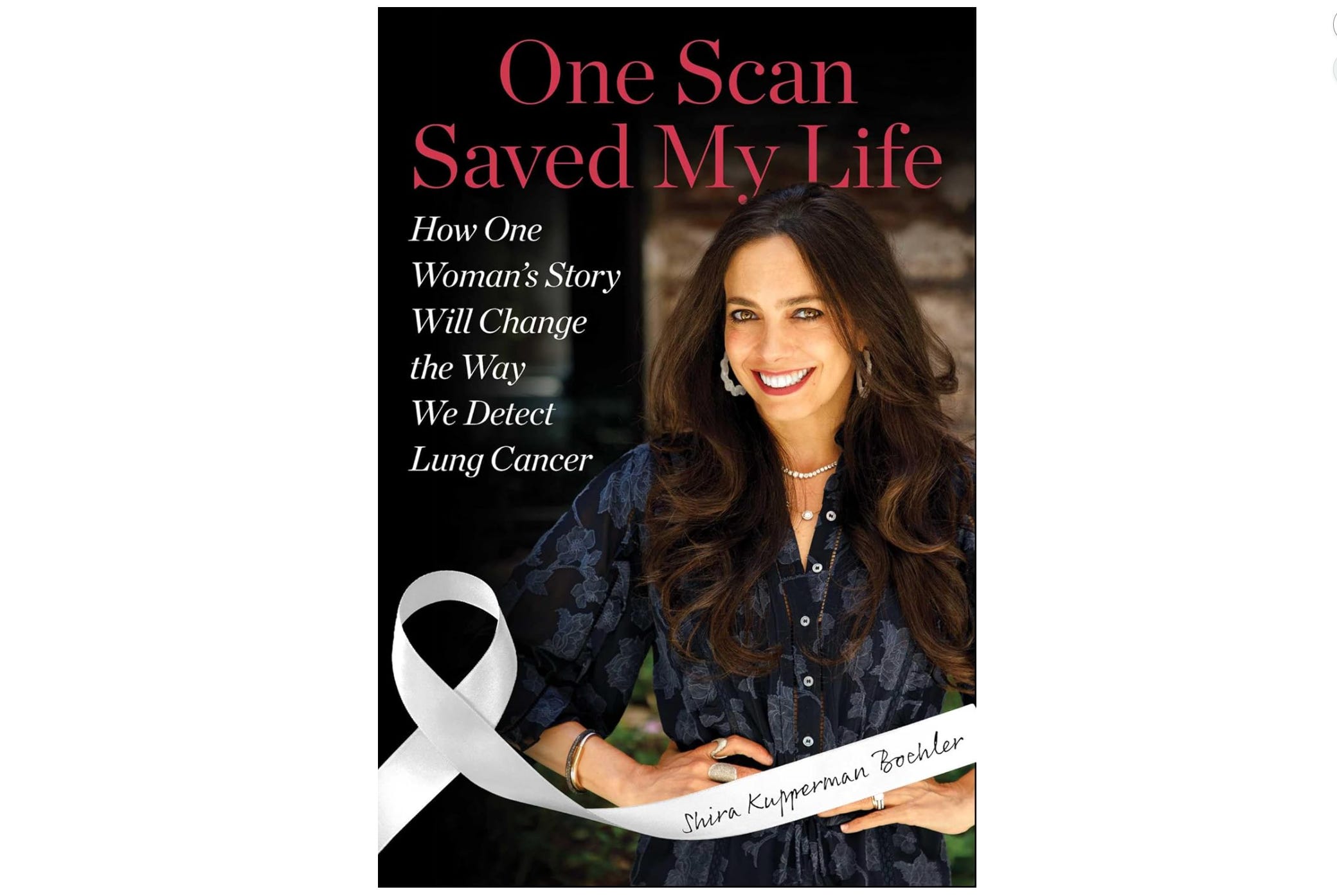
There’s a particular kind of book that arrives at exactly the right cultural moment, and Shira Boehler’s One Scan Saved My Life is one of them. A healthy, forty-three-year-old mother of four — a runner, a never-smoker, the daughter of a pulmonologist — gets blindsided by stage I lung adenocarcinoma. The only reason she’s alive to tell us about it is because her husband nagged her into a preventive scan that wasn’t covered by insurance, wasn’t recommended by any guideline, and wouldn’t have happened at all if she’d left her care entirely to the system. If that doesn’t crystallize the case for taking your health back into your own hands, nothing will.
For readers sympathetic to the Make America Healthy Again movement, this book is going to land with unusual force, and the reasons are worth spelling out plainly.
The story itself is the argument. Boehler did everything “right” by the conventional playbook. She ran six miles a day. She ate well. She avoided cigarettes — her dad, a pulmonologist, drilled that into her. She kept up with her annual scans for the cancers women are told to worry about. And a tumor was still growing in her lung that, on the trajectory she was on, would likely have killed her by the time symptoms appeared. The federal screening guidelines — the USPSTF criteria that gatekeep insurance reimbursement — would never have caught her, because they were built around a 20-pack-year smoker stereotype that increasingly fails to describe who is actually getting this disease. A full quarter of lung cancer deaths now occur in never-smokers. Two-thirds of newly diagnosed lung cancer patients don’t qualify for screening under current rules. Boehler quotes a Northwestern study showing exactly that, and the implication is unavoidable: the system isn’t catching the people it’s killing.
That’s a deeply MAHA-resonant indictment, and Boehler makes it without political theatrics. She isn’t picking a fight — she’s just telling the truth about what the data show.
On environmental causes, the book is better than most. Conservative and MAHA readers who’ve grown weary of the pharmaceutical-industrial framing of every illness will appreciate that Boehler takes radon seriously as the second-leading cause of lung cancer and the leading cause in never-smokers — a fact most Americans have never heard, and one the public health establishment has been remarkably quiet about. She walks readers through home testing, mitigation systems, and the patchwork of state disclosure laws. She covers occupational and household exposures: asbestos, silica, vinyl chloride, cooking-fume aldehydes, particulates from unventilated stovetops. She raises the unanswered question of why Asian-American never-smoking women are getting lung cancer at higher rates than their cigarette-smoking male relatives — a genuine mystery that suggests something environmental, hormonal, or genetic that mainstream research has been slow to chase. This is the kind of curious, root-cause thinking MAHA has been calling for, and it’s a welcome change from “take this pill, don’t ask questions.”
The endorsement page tells you who’s paying attention. This isn’t a partisan book. Tony Robbins is on the praise page next to Andy Slavitt (Obama’s CMS head) next to Dr. Mehmet Oz (Trump’s CMS administrator). In her acknowledgments, Boehler thanks Secretary Kennedy and Stephanie Spear directly, writing that they showed her “prevention is not a partisan issue, it is an American issue.” That sentiment is the whole game. When a 43-year-old never-smoking mother of four walks into a fight for early detection and finds RFK Jr., Dr. Oz, the previous administration’s officials, and CEOs all picking up the phone, that’s a coalition worth noticing. Skyhorse Publishing — RFK Jr.’s longtime publisher and one of the few houses willing to put out heterodox health and policy titles — putting this book out is itself a small data point about where the energy is in this conversation.
What conservative readers will love most: she trusts patients. The book’s spine is the conviction that you, the patient, have to advocate for yourself — and that the spouse, parent, or friend who pushes you toward a scan you don’t want may be the person who saves your life. Boehler’s husband is the hero of the opening chapters precisely because he refused to accept her “I’m fine, leave me alone” pushback. There is something deeply countercultural about a book that says: doctors miss things, guidelines are years behind, and your family’s instincts about your body matter. That’s the kind of common sense the medical establishment has spent decades training out of people, and it’s refreshing to see it championed by someone who grew up in a house full of physicians.
The book also takes the stigma issue seriously in a way that should resonate with anyone who’s watched the public-health apparatus moralize at ordinary Americans. Boehler is candid that lung cancer is treated as a “deserved disease” — the assumption being that anyone who gets it must have brought it on themselves through bad behavior. Her friend Donnita Butler, an Air Force and Navy veteran who battled smoking addiction while raising two boys alone in rural Maine (a radon hot zone, no less), offers some of the most honest writing in the book about how that contempt actually plays out for working-class Americans. Conservative readers who have been watching progressive public-health culture lecture rural and lower-income communities for a decade will recognize this dynamic immediately.
Now, the harder part — where MAHA readers may want to apply healthy skepticism.
The book’s policy ask leans heavily toward expanded federal screening programs and insurance mandates, holding up Australia’s centrally administered national lung-screening program as the model. This is where instincts will diverge. Universal screening genuinely does save lives — the data on stage-I detection are overwhelming — but a reader committed to medical freedom and limited government will want to ask: do we get there by expanding CMS coverage and leaning harder on USPSTF rules, or by lowering the cost of cash-pay scans, deregulating mobile imaging, and letting the market deliver $200 LDCTs the way it delivered urgent-care clinics? Boehler raises both possibilities but is more comfortable with the centralized solution than some readers will be.
There’s also a tension worth naming around the wellness-tech angle. The story begins with a $1,000-to-$5,000 full-body Prenuvo-style MRI, and the praise page features the CEO of Function Health — companies whose business model depends on bypassing insurance and selling preventive scans directly to people who can afford them. For MAHA readers, this cuts both ways. On one hand, it’s a beautiful illustration of what happens when patients can pay cash for the care the system denies them — a free-market success story embedded in a memoir about institutional failure. On the other, the book sometimes blurs into something close to advertising for premium concierge medicine, and an honest reader has to acknowledge that the same scan that saved Shira Boehler’s life is financially out of reach for the rural single mother she’d most like to help. Boehler clearly knows this — she comes back to access and equity repeatedly — but the resolution she offers (have insurance cover it) is one path, not the only one.
A few smaller notes. The radon and environmental chapters are strong but could go further; readers attuned to broader environmental-health concerns may wish she’d dug into air pollution, particulate exposure from gas stoves, and indoor air quality more aggressively. The chapter on biomarker and blood testing is genuinely exciting — Galleri-style multi-cancer early detection assays really are coming, and they may eventually do for cancer what home pregnancy tests did for obstetrics — but readers will want to keep an eye on how the FDA approval pathway and insurance mandates around these tools shake out, because that’s where bureaucratic capture tends to happen.
The bottom line. This is a brave, well-reported, and uncommonly readable book about a disease most of us have been quietly assuming we don’t need to worry about. Boehler is an unusually likable narrator — funny, self-deprecating, openly terrified, pragmatic — and she’s done the homework: dozens of interviews with surgeons, radiologists, epidemiologists, and survivors, with citations to back it up. For a conservative or MAHA-aligned reader, the most valuable takeaways are not the policy recommendations but the underlying convictions: that prevention matters more than treatment, that early detection should be normalized for everyone (not just smokers), that environmental exposures like radon deserve far more public attention, that patients and their families need to advocate aggressively because the system won’t, and that the federal screening guidelines we’ve inherited are badly out of date for the disease as it actually presents in 2026.
If you take one thing from this book, let it be the practical one: get a radon test for your house this week, ask your doctor about a low-dose CT if you have any reason at all to be concerned, and don’t let an outdated guideline talk you out of a scan you can afford to pay for out of pocket. As Boehler herself puts it, cancer doesn’t care about your demographics, your lifestyle, or your assumptions. The least we can do is stop pretending it does.
Recommended, with the caveats above, for anyone who believes American health policy is overdue for a rethink — and for anyone with lungs.
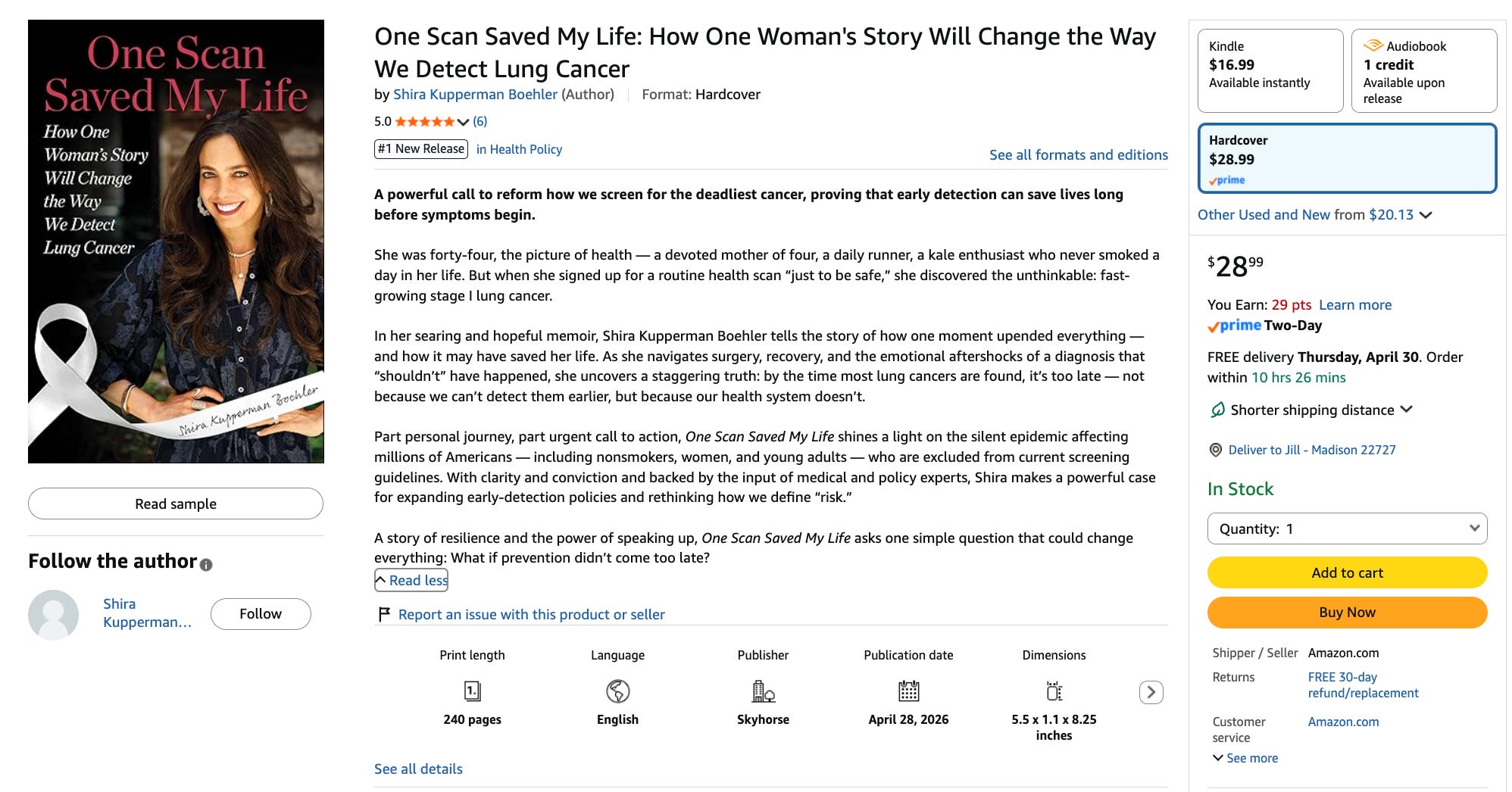
Available for purchase on Amazon at this link.
ok, call me confused. I have one question & I'm shocked it was not asked nor answered in the article, especially by Dr Malone, of all people: What vaccines did she take & when did she take them? In particular, did she get the Covid mRNA vaccine? With this question seemingly ignored, like I'm reading an MSM article, it's hard to take this article or book seriously. Indeed, with mRNA vaccines now synonymous with cancer, the article is absurd. Correct me if I'm wrong. Maybe I need more coffee. But did I REALLY just read an article entitled, "The Cancer We’ve Been Looking For in All the Wrong People", debate "scanning for cancer more often" as a possible solution, and NEVER ask about what vaccines were taken, in the year 2026? 🤣🙃🤔 ok, I'm going to get another cup of coffee & I'm just hoping it's April Fools Day joke. A young person, a non-smoker, gets cancer, and whether her lung screen is covered by insurance and how much it costs is the question here? OMG. I must still be asleep and stuck in some nightmare.
What is left out of this account is whether there was any basis for the husband's intuition to get the scan. Was she having any pulmonary or other symptoms that might have tipped him off?