

November 24, 2026 · Robert W. Malone, MD, MS, and Jill Glasspool Malone, PhD
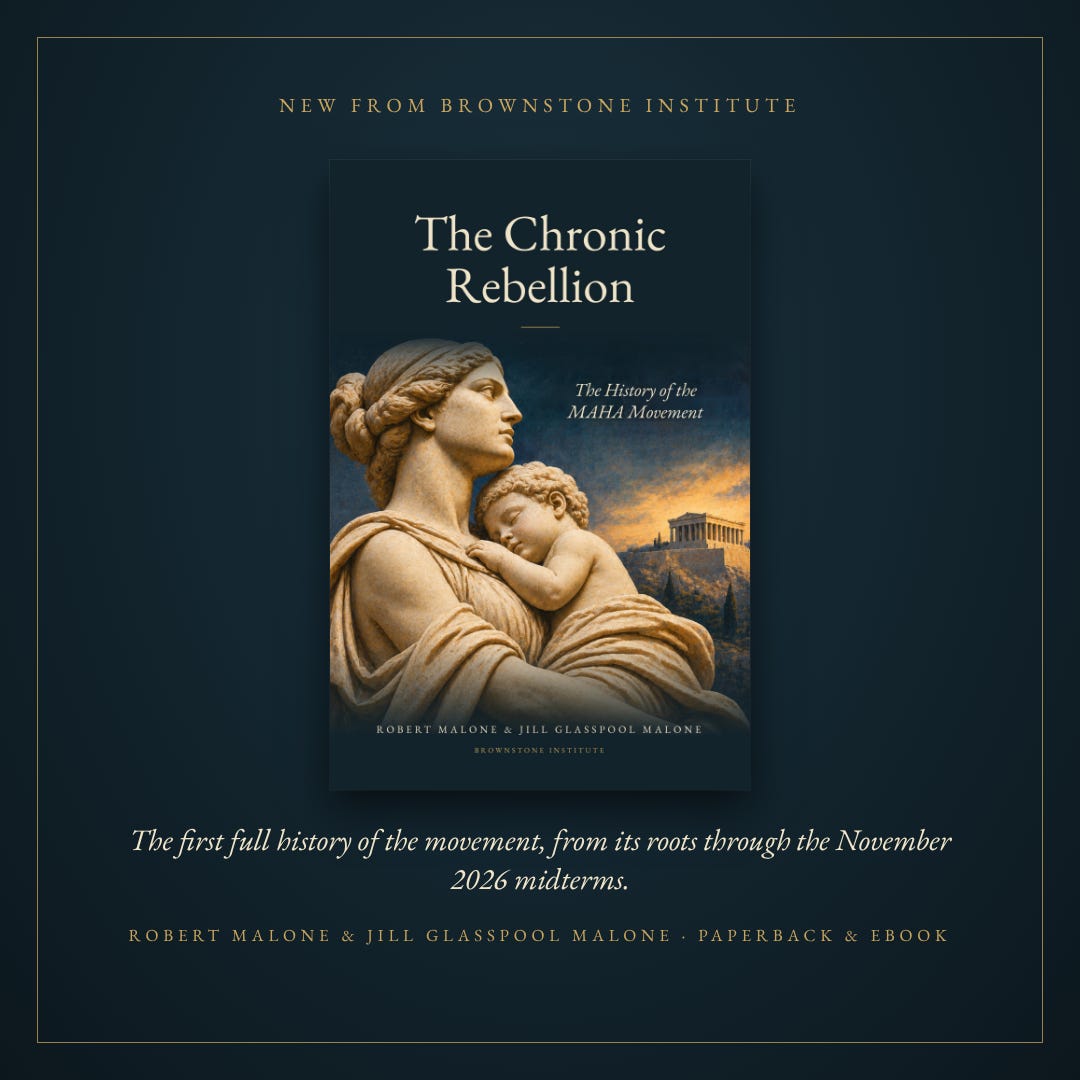
The Chronic Rebellion: The History of the MAHA Movement is out on Amazon this week, published by the Brownstone Institute. The paperback is $25, and the Kindle edition is $9.99. The book runs 394 pages, cites more than 890 sources, and carries the first full account of Make America Healthy Again from the August 23, 2024 Kennedy endorsement of Trump through the November 3, 2026 midterm result. We wrote it across fifteen months from inside the rooms the book describes.
Why did we write a history of the MAHA movement?
The primary reason we wrote The Chronic Rebellion is to take honest stock of MAHA: a populist movement that became part of a governing coalition. The base that fueled the movement from the beginning has substantive objectives. Achieving those objectives during the remainder of the Trump-Kennedy administration and beyond requires an honest assessment of what the coalition has accomplished, where it has fallen short, and what lessons can be drawn from its experience. Everyone invested in the success of the MAHA movement has a stake in understanding this history and using it to chart a path forward.
Another reason we wrote this book is that no one has brought together the documentary record, the firsthand accounts of those directly involved, and a critical examination of the MAHA movement. No single account has put the documentary record, the participant-witness testimony, and the honest counter-history of MAHA into one document.
Unfortunately, some of the most flawed reporting has become the accepted historical narrative. Within the movement itself, much of the history has been passed along through private conversations and personal recollections. What has transpired within HHS has emerged piecemeal through congressional subpoenas, leaked documents, and testimony. We wanted to bring these pieces together to provide a more complete and accurate account of what actually happened.
We were in a position to assemble it all. Robert served on the reconstituted CDC Advisory Committee on Immunization Practices and on its COVID-19 Vaccine Workgroup from the committee’s formation through its invalidation in March 2026. During the same period and until June, 2026, he served concurrently as a paid Medical Advisor to MAHA Action, the 501(c)(4) that led the movement’s political operation.
Jill served as the book’s co-author, lead researcher, and editor, although she would argue that it is Robert who insists on factual accuracy while she brings the human and emotional dimensions to the narrative. In reality, our writing process is a system of checks and balances. We challenge each other’s assumptions, interpretations, and conclusions, helping to ensure that our personal involvement in the movement does not come at the expense of historical accuracy, objectivity, or a willingness to examine uncomfortable facts.
Over the course of fifteen months, we had firsthand insight into both the scientific and political workings of the movement, taking notes and collecting documents as events unfolded. We compared what the press reported or what the HHS communications apparatus disclosed with what we knew to be true, while also documenting important developments largely unknown to those outside the movement.
What does the book cover?
From the Kennedy-Trump alliance to the 2026 midterm elections
The Chronic Rebellion consists of fourteen chapters, an interlude, and a conclusion. The book begins by examining the three American political and philosophical traditions that gave rise to MAHA: conservative populism, the health freedom movement, and Austrian School libertarianism. From these historical roots, we trace the evolution of the movement through Robert F. Kennedy Jr.’s August 23, 2024 endorsement of Donald Trump, the November 3, 2026 midterm elections, and the subsequent White House reorganization that saw Stephen Miller replace Susie Wiles as Chief of Staff.
Chapter 8 examines the extensive documentary record assembled by Senator Ron Johnson through the Senate Permanent Subcommittee on Investigations. Chapter 9 explores the January 2026 White House review that led to the reorganization of HHS and the establishment of two separate chains of reporting and accountability. Chapter 10 examines the consolidation of MAHA Inc. and its affiliated organizations, while Chapter 11 documents what may prove to be one of the movement’s most enduring accomplishments: a fundamental shift in how Americans think and talk about food, chronic disease, and public health.
In Chapter 12, we turn a critical eye on the movement itself, presenting the conservative case against MAHA from the perspective of those who have been involved in it. Chapter 13 examines criticisms of the movement that we believe deserve serious consideration but with which we ultimately disagree. In Chapter 14, we look to the future, exploring four possible scenarios for MAHA based on the political and institutional developments documented throughout the book.
The interlude provides Robert’s firsthand account of the reconstituted CDC Advisory Committee on Immunization Practices (ACIP), including the December 4–5, 2025 meeting addressing the hepatitis B birth-dose recommendation, the technical review of IgG4 antibody class-switching prepared for the subsequently canceled March 18–19, 2026 meeting, and the leaked document titled Post-COVID-19 Vaccination Chronic Injuries.
The book concludes with the May 15, 2026 firing of Dr. Tracy Beth Hoeg from the FDA, an event against which much of the history documented in this book must be considered.
Who is Dr. Tracy Beth Hoeg, and why does the book open and close with her?
Dr. Tracy Beth Hoeg is the former acting director of the FDA’s Center for Drug Evaluation and Research. The Chronic Rebellion opens and closes with two pivotal days in her time at the FDA. These two days, eight months apart, frame the history we recount throughout the book.
The book opens on the morning of September 5, 2025. Hoeg returned from a long run, sat down at her computer, and began pulling cases from the Vaccine Adverse Event Reporting System. She would spend a couple of hours pulling cases and a couple more reading them. The CBER career staff would eventually conclude that the evidence supported a possible or probable relationship in at least ten of the pediatric deaths. Five days later she walked through the findings, slide by slide, to the COVID-19 Vaccine Workgroup over Zoom. Robert was in that Zoom. Hoeg’s work is part of the reason this account exists.
The book closes on the morning of May 15, 2026. Hoeg read rumors of her own resignation across multiple media outlets. She had not resigned. Later that day, lawyers came into her office and presented her with a letter asking her to resign. She declined. That evening she was locked out of her computer and perp-walked out of the FDA building. In a public statement, Secretary Kennedy said he was unaware she had been fired. However, he did nothing to reinstate her. The heady days of Hoeg’s appointment and her eventual termination serve as the bookends of our history
What does The Chronic Rebellion reveal about MAHA that the press has not?
Four aspects of The Chronic Rebellion distinguish it from what has been reported in the press.
First, it combines firsthand testimony with primary source documents. For the first time, Robert provides a detailed account, under his own name and supported by the original documents, of what transpired within the ACIP COVID-19 Vaccine Workgroup. He also recounts the December 4–5, 2025 ACIP meeting addressing the hepatitis B birth-dose recommendation, which he chaired. The book examines the technical review of IgG4 antibody class-switching prepared for the March 18–19, 2026 ACIP meeting that was subsequently canceled, as well as the leaked document titled Post-COVID-19 Vaccination Chronic Injuries. Readers have the opportunity to examine the documentary evidence alongside the recollections of someone directly involved in these proceedings.
The second is our examination of the extensive documentary record assembled by Senator Ron Johnson and the Senate Permanent Subcommittee on Investigations (PSI). In Chapters 7 and 8, we reconstruct the chronology of events surrounding the reports of pediatric deaths in the Vaccine Adverse Event Reporting System (VAERS), beginning in 2022 and continuing through Dr. Vinay Prasad’s November 28, 2025 memo. We then document the events between February and May 2026 surrounding Moderna’s mRNA influenza vaccine, MFLUSIVA, including how a Refusal to File letter issued by the FDA’s Center for Biologics Evaluation and Research (CBER) was overridden through a White House channel.
We examine the August 5, 2026 approval of MFLUSIVA in the broader context of the FDA’s Platform Technology Designation Program, which was triggered by that approval. Understanding the relationship between these regulatory decisions is essential to understanding why, in our conclusion, we identify the consolidation of Moderna’s mRNA technology platform as the single most consequential regulatory development of 2025 and 2026.
The third is our examination of the history of MAHA from the perspective of its critics. In Chapter 12, we present the arguments that the movement’s most serious critics would make, drawing upon the same documentary evidence we have assembled throughout the book. Given our involvement in the movement, we believe we owe our readers a thorough examination of the opposing arguments, rather than simply acknowledging them in passing. We have devoted an entire chapter to this counter-history, and we anticipate that it will be among the most controversial and widely debated chapters within the MAHA movement itself.
The fourth is our documentation of MAHA’s accomplishments, many of which have the potential to outlast any individual officeholder or administration.
The administration has phased out petroleum-based food dyes and closed the Generally Recognized as Safe (GRAS) self-affirmation loophole.
Twelve states have filed SNAP waivers, and fifteen have enacted laws requiring the disclosure or restricting the use of certain food additives.
The January 2026 Dietary Guidelines reversed longstanding recommendations concerning low-fat dairy and saturated fat. Major food manufacturers and retailers, including Walmart, Hershey, General Mills, Kraft Heinz, Tyson, Nestlé, and PepsiCo, along with three major industry trade associations, have announced commitments to reformulate food products.
Utah and Florida have banned community water fluoridation, and since September 2024, sixty-two communities serving more than nine million people have ended, suspended, or prevented water fluoridation.
Beyond these policy and industry changes, however, lies what may prove to be MAHA’s most enduring accomplishment: a cultural shift in how Americans think and talk about their health. Chapter 11 examines how the movement has changed the language Americans use when discussing food, chronic disease, and public health. Taken together, these legislative, regulatory, commercial, and cultural changes represent a substantial and well-documented record of what the movement has accomplished in a relatively short period of time.
The future of MAHA: What happens next?
In Chapter 14 of The Chronic Rebellion, we explore four possible futures for the MAHA movement. Much will depend on the answers to three unresolved questions:
Will MAHA-aligned leadership remain in place throughout the remainder of the Trump-Kennedy administration?
Will the reforms governing food and chemical safety survive a subsequent Democratic administration?
Can the movement regain momentum on vaccine policy following the departures of Vinay Prasad, Marty Makary, and Tracy Beth Hoeg, or will meaningful vaccine reform be sidelined for the foreseeable future?
The results of the November 3, 2026 midterm elections have already closed off some possibilities, while the subsequent White House reorganization and replacement of Susie Wiles with Stephen Miller have opened others. Rather than attempting to predict the future, we examine the evidence supporting each of the four scenarios, assess their relative likelihood, and identify the developments to watch over the coming twelve months.
Did MAHA cost Republicans the 2026 midterm elections, and will RFK Jr. face impeachment?
In Chapter 14, we examine the results of the November 3, 2026 midterm elections and assess the political performance of the MAHA coalition in light of four significant findings. The first is the Republican loss of both the House and the Senate. The second is a Wesleyan University analysis showing that MAHA was featured in just 0.2 percent of Republican congressional campaign advertising. The third is that MAHA PAC spent approximately $1 million on federal races, despite its pledge of $100 million. Finally, of the twenty-one candidates for federal office endorsed by MAHA, twelve won their elections.
We do not conclude that MAHA cost Republicans the midterms. Rather, we examine the evidence for and against the movement’s contribution to the Republican losses and consider what the election results reveal about the political effectiveness and accountability of the MAHA coalition itself.
We also examine the Democratic effort to impeach HHS Secretary Robert F. Kennedy Jr. and the circumstances under which impeachment proceedings could move forward in 2027. Rather than predicting the outcome, the book identifies the political conditions and developments that would need to occur for each of the four scenarios to unfold.
Is the MAHA coalition turning on Trump, and is The Chronic Rebellion a defense of RFK Jr.?
The Chronic Rebellion was not written to defend HHS Secretary Robert F. Kennedy Jr., the MAHA movement, or ourselves. By August 2026, the MAHA-aligned FDA leadership of Vinay Prasad, Marty Makary, and Tracy Beth Hoeg had been dismantled. Nineteen months into Secretary Kennedy’s tenure, the COVID-19 mRNA vaccines remain fully licensed, PREP Act liability protections continue through 2029, and the overhaul of the Vaccine Injury Compensation Program that the coalition demanded has yet to be enacted. Republicans lost both the House and the Senate in the November 3, 2026 midterm elections, and the subsequent White House reorganization saw Stephen Miller replace Susie Wiles as Chief of Staff. These are developments that we document and examine without attempting to minimize their significance.
Nor did we set out to write a hit piece on the movement. Where we disagree with decisions that were made, we examine those decisions rather than speculate about the motives of the individuals responsible. Wherever possible, we include their own explanations, either through direct quotations or by summarizing their stated positions. We support our criticisms with the documentary record, citing sources throughout the book. We examine MAHA Action’s withholding of the Fabrizio-Ward polling data in November 2025, the ongoing publishing relationship with Tony Lyons and Skyhorse Publishing, and the role of political considerations in determining which MAHA reforms moved forward. In November 2026, Calley Means publicly addressed this last issue on both Joe Rogan’s podcast and Face the Nation, identifying the White House under Susie Wiles as an impediment to MAHA reforms.
Several of the individuals discussed in the book were given the opportunity to read the manuscript before publication. Three requested factual corrections, all of which we incorporated into the published text. Where individuals disagreed with our interpretation of events but did not dispute the underlying facts, we retained our conclusions while documenting their disagreements.
There is another aspect of writing contemporary history that we have come to appreciate through the publication of our earlier books, Lies My Government Told Me and PSYWAR. When we go back to consult some of the primary sources cited in those books, we find that they are no longer available on the internet. Government documents, materials published by government contractors, content on privately operated websites, and even articles published by major news organizations have disappeared. Material that was once publicly accessible and formed part of the historical record can no longer be readily located. In some instances, our books now preserve information that readers would have considerable difficulty finding elsewhere.
We tend to think of the internet as a permanent repository of human knowledge, but our experience as authors has taught us otherwise. There is still something to be said for committing history to paper while the documentary evidence is available and the memories of those who lived it are fresh.
Where can I buy The Chronic Rebellion, and how can I help get the word out?
The Chronic Rebellion: The History of the MAHA Movement, published by the Brownstone Institute, is now available on Amazon in paperback for $25 and as a Kindle edition for $9.99. The paperback is eligible for free shipping through Amazon Prime.
As authors working with an independent, non-profit publisher, we depend heavily on our readers to help get the word out. There are several ways you can help.
First, purchase a copy for yourself and consider buying another for a friend, family member, colleague, physician, or elected representative. With Christmas just around the corner, this might be a particularly timely gift for someone who has followed the MAHA movement over the past two years.
Second, once you have read the book, please consider leaving a review on Amazon. In an age when algorithms increasingly determine which books are brought to the attention of potential readers, reader reviews are particularly important to independent authors and publishers.
Third, ask your local public library to purchase a copy. A single library copy can reach many readers who might otherwise never have the opportunity to read the book.
Finally, please share or republish this article. We would particularly like this book to reach people both inside and outside the MAHA movement, including those who have been critical of it.
We have spent fifteen months researching, documenting, and writing this history. We believe that understanding what has transpired over the past two years is essential to the future of the movement. Our hope is that The Chronic Rebellion will become both a lasting historical record and a resource for those who wish to continue the work of making America healthy again.
Purchase your copy of The Chronic Rebellion on Amazon
Sorry but was sceptical of kennedy at his nomination and,remain so now. And that scepticism applies,to his entire family....all of them
This is an article that gives me hope. (Not pertinent to this article).Don't know how to send links but I found this Guardian article searching by title which is: A fight to demand that humans are worth investing in: Thaeaster Gates taking over America's last porcelain factory.