


Audio Version:
Investigational Commentary / By: Dr’s Jill Glasspool Malone and Robert W. Malone
How insurance companies, hospital corporations, and government bureaucracy displaced the independent physician, and why veterinarians may be next.
There was a time when American physicians were independent professionals who owned their practices, knew their patients, set their fees, and made medical decisions without consulting a corporate administrator or an insurance company’s utilization-review department. They were also small-business owners, responsible for their employees, their expenses, and the financial survival of their practices. Their success depended on their professional reputations and the willingness of patients to return.
That model is disappearing. American medicine has increasingly become an industry dominated by hospital conglomerates, insurance companies, government reimbursement systems, and corporate investors. Physicians who once owned their practices now work for organizations that determine how many patients they should see, how much time they can spend with them, what software they must use, how their work will be measured, and even what they are allowed to say to their patients.
This transformation is often described as modernization or efficiency. Yet Americans are paying extraordinary amounts for health care, independent physicians are disappearing, and public confidence in the medical system has collapsed.
There is an important distinction here that fiscal conservatives should recognize. Free-market capitalism and corporate consolidation are not the same thing. A competitive marketplace of independently owned businesses is fundamentally different from an economy dominated by a handful of large corporations whose business models depend heavily on government regulation, reimbursement policies, and barriers to competition. The former is an example of applying free-market principles. The latter has nothing to do with a free market; it is an example of how the State creates monopolies and oligopolies.
American health care mostly resembles the latter.
Americans Trust Small Business. They Do Not Trust Big Business.
Gallup’s June 2026 survey offers a remarkable illustration of this divide. Sixty-seven percent of Americans expressed a great deal or quite a lot of confidence in small business. Only 17 percent expressed that level of confidence in big business.
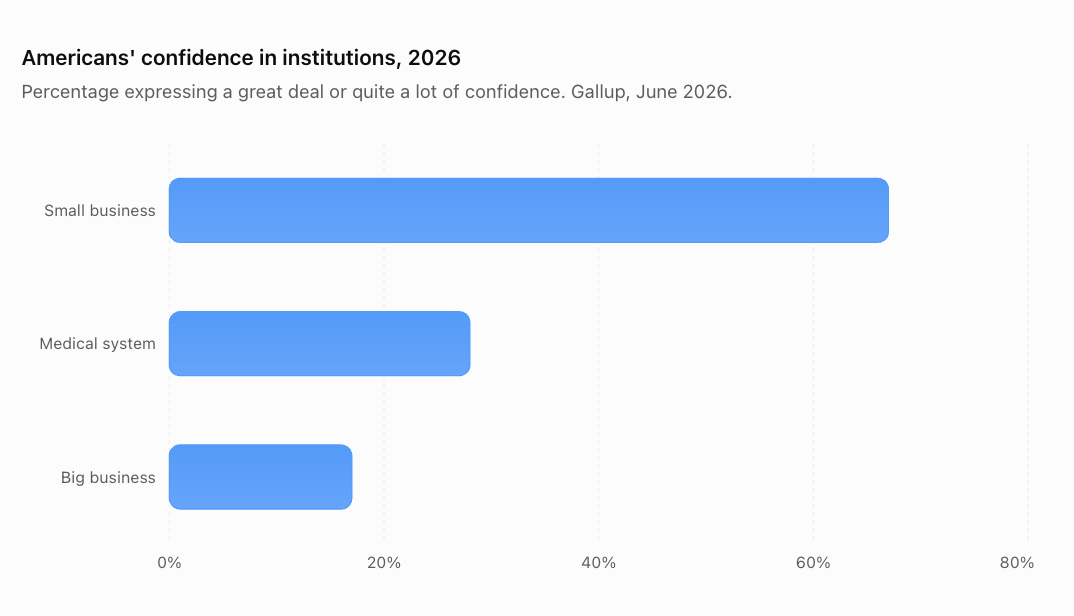
The medical system fared little better. Just 28 percent expressed confidence in it, the lowest level recorded in Gallup’s long-running institutional survey.
These numbers deserve attention. Americans have not rejected private enterprise. They have rejected much of what large institutions have become.
The distinction becomes even more interesting when examining physicians themselves. Gallup’s December 2025 survey found that 57 percent of Americans rated medical doctors highly for honesty and ethical standards, down from 65 percent in 2019 and 77 percent during the extraordinary circumstances of 2020. Nurses remained considerably more trusted, at 75 percent.
Confidence in the medical system as an institution has undergone a much more dramatic long-term decline. In 1975, 80 percent of Americans expressed confidence in the medical system. Today, that figure is 28 percent.
The problem is not the doctor, but the system surrounding the doctor.
Obamacare Made the Economics of American Medicine Worse
The Affordable Care Act (ACA) was sold as a way to expand access to affordable health insurance. It did initially expand coverage for the middle class and established important protections for patients with preexisting conditions. But expanding insurance coverage is not the same thing as making medical care affordable.
Sixteen years after the ACA became law, Americans face enormous premiums, substantial deductibles, complicated provider networks, and an administrative system that can make obtaining routine medical care unnecessarily difficult.
The temporary enhanced ACA premium subsidies expired at the end of 2025. Many marketplace customers consequently faced substantially higher premium payments in 2026, while others switched to plans with higher deductibles or dropped coverage. Insurers are also proposing additional premium increases for 2027.
For families receiving employer-sponsored coverage, the numbers are staggering. According to KFF, average annual family insurance premiums reached $26,993 in 2025. Employees contributed an average of $6,850 directly, with employers paying the remainder.
That employer contribution is not free money. It is part of the cost of employing someone, ultimately borne through the economics of wages, benefits, business expenses, and prices.
And after paying thousands of dollars in premiums, families may still owe substantial amounts before their insurance begins covering many services.
The ACA did not create America’s entire insurance bureaucracy. Employer-sponsored insurance, Medicare reimbursement, managed care, and hospital consolidation all predate Obamacare. But the law expanded coverage through an existing third-party payment structure rather than fundamentally changing the relationship between patients, physicians, and insurers.
The result is a system in which insurance companies remain central financial intermediaries, while taxpayers subsidize coverage and patients continue struggling with medical bills.
Fiscal conservatives should be asking why so much public and private money passes through this elaborate structure before reaching the physician or hospital actually delivering care.
And What About Medicare for All?
Then there is the perennial proposal for “Medicare for All,” often presented as the solution to America’s health care problems.
But how many Americans understand what Medicare actually covers? Part A, the hospital insurance that most eligible seniors receive without an additional monthly premium, does not cover ordinary physician office visits. Those require Part B, which costs at least $202.90 per month in 2026, with higher premiums for higher-income beneficiaries, a deductible, and generally 20 percent coinsurance for physician services.
Even hospitalization is not free: Part A carries a $1,736 deductible per benefit period. Prescription coverage generally requires a separate Part D plan, and traditional Medicare still lacks an annual out-of-pocket spending limit. Many seniors purchase supplemental insurance to protect themselves from these expenses. Proponents of Medicare for All envision a different program with broader benefits, but that raises the question of how those promises would be financed and administered. Expanding government insurance does not automatically lower the underlying cost of medical care, restore independent physicians, or eliminate bureaucracy.
Before promising Medicare for everyone, perhaps Washington should explain why Medicare itself remains so expensive and complicated for the people who already depend on it.
Medicare vs. Medicaid: What Americans Need to Know
Medicare is a federal health insurance program primarily for Americans age 65 and older, as well as certain younger people with disabilities. Eligibility generally does not depend on income.
Part A: Hospital insurance, generally premium-free for eligible beneficiaries. Does not cover routine physician office visits.
Part B: Physician visits, outpatient services, and certain medical equipment. Requires a monthly premium, generally $202.90 in 2026.
Part C (Medicare Advantage): Private insurance plans providing Medicare-covered benefits, often with network restrictions.
Part D: Prescription drug coverage, generally requiring a separate premium.
Medicaid is a joint federal-state program providing health coverage to eligible low-income individuals, including children, adults, people with disabilities, and seniors. Unlike Medicare, Medicaid can cover long-term custodial nursing home care.
The inheritance issue: Federal law requires states to seek recovery of certain Medicaid expenditures from the estates of deceased beneficiaries age 55 and older, subject to protections and exceptions. This can include claims against a family home. Medicare does not have an equivalent general estate-recovery program.
How the Government Recovers Nursing Home Costs After Death
Medicare generally does not cover long-term nursing home care, forcing many seniors to exhaust their savings before qualifying for Medicaid. After death, states are generally required to recover certain Medicaid expenses incurred after age 55, often by filing claims against the deceased person’s estate, including the family home.
Heirs may have to sell the property or repay the debt to retain it. Although federal law provides some protections for close family members, Medicaid-funded long-term care can ultimately consume much of the inheritance a senior intended to leave behind.
The Independent Physician Is Becoming an Endangered Species
The American Medical Association’s own numbers document the transformation.
In 2012, 60.1 percent of physicians worked in private practice. By 2024, that figure had fallen to 42.2 percent. Meanwhile, the proportion working in hospital-owned practices increased substantially, and private-equity ownership continued expanding.
The AMA identified inadequate reimbursement, expensive resources, and burdensome regulatory and administrative requirements as major reasons physicians sell their practices.
Think about what that means. Government payment policies and administrative requirements create economic pressures that make independent medical practice increasingly difficult. Large hospital corporations, insurance companies, and physician networks can afford entire departments of accountants, compliance officers, attorneys, billing specialists, and administrators. Independent physicians must shoulder many of those same obligations with a fraction of the resources. Eventually, some sell their practices, accept corporate employment, or close their doors.
This is where regulatory capture enters the picture. Large corporations have the money, lobbyists, and political connections to influence the regulations governing their industries. Once established, those regulations can become barriers to competition, protecting the very corporations supposedly being regulated. The more complicated the rules, the greater the advantage enjoyed by organizations large enough to absorb the costs. Regulations originally justified as protecting patients can end up protecting market share instead. The cumulative burden now favors large institutions while making it increasingly difficult for smaller competitors, the independent physician, to survive.
The result is a particularly troubling arrangement: government policies help create the financial pressures driving independent physicians into corporate employment, while the corporations benefiting from consolidation gain even greater resources to influence future policy. This is not the competitive free-market capitalism that fiscal conservatives have traditionally defended. It is an environment in which government regulation and corporate concentration reinforce one another, at the expense of independent physicians and patient choice. This is a classic example illustrating how the State (federal government) creates monopolies and oligopolies through its actions.
In some circumstances, the same outpatient service can command different reimbursement depending on whether it is delivered in an independent physician’s office or a hospital-owned facility. Hospital ownership often introduces facility charges or other payment arrangements that increase the total bill.
A physician can provide essentially the same medical service, in the same community, but the financial arrangements change because a hospital corporation now owns the practice.
How is that a competitive marketplace?
There are legitimate reasons physicians choose employment. Some want predictable salaries, reduced business responsibilities, and access to sophisticated equipment. Large organizations can also coordinate complex medical care and support services that smaller practices cannot easily provide.
But voluntary employment is one thing. A reimbursement and regulatory structure that increasingly makes independent ownership economically untenable is another.
The Government Accountability Office has documented growing physician consolidation and examined evidence of its effects on prices, spending, and competition. The problem is not merely theoretical.
For the patient, the change can be deeply personal. A longtime family physician retires or sells the practice. The office becomes part of a hospital network. Appointment scheduling changes, familiar staff disappear, billing becomes more complicated, and the patient may discover that a routine visit now is much shorter and carries additional charges.
The physician may still be sitting in the same examining room. But the business relationship has fundamentally changed.
How Washington Turned Medical Records Into an Administrative Industry
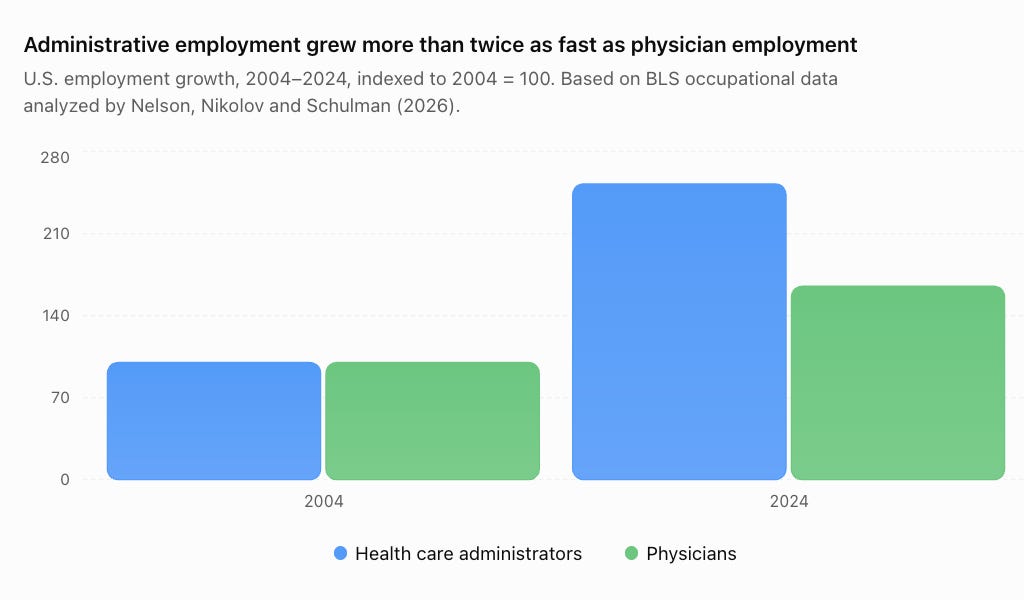
Medical records once served a straightforward purpose: documenting a patient’s condition, diagnosis, and treatment. Today, they have become the foundation of an enormous administrative industry, one that consumes physicians’ time, drives up operating costs, and gives large hospital corporations another advantage over independent practices.
Washington helped build this system. The Health Insurance Portability and Accountability Act of 1996 (HIPAA) was supposed to establish federal privacy, security, and administrative requirements. The HITECH Act of 2009 accelerated electronic medical record adoption through federal financial incentives, followed by Medicare payment penalties for eligible providers who failed to meet electronic-record requirements. Additional rules governing billing, coding, quality reporting, and documentation added further complexity. Each initiative came with promises of efficiency, accountability, or improved patient care. Collectively, they helped create a costly administrative infrastructure that small medical practices struggle to support.
Physicians now spend substantial time entering data, navigating electronic menus, documenting services for reimbursement, responding to insurer demands, and satisfying regulatory requirements. Medical records increasingly serve the needs of billing departments, insurers, regulators, and hospital administrators alongside those of patients. The physician becomes a data-entry worker, while the patient waits.
And who benefits from this complexity? Large hospital systems and corporate medical networks can spread compliance costs across hundreds or thousands of physicians and administrators. They employ dedicated administrators, attorneys, information technology specialists, and billing departments. Independent physicians face many of the same obligations without those economies of scale. Meanwhile, electronic-record vendors and compliance businesses have developed profitable markets around the requirements.
The irony is that, after billions of dollars in public and private investment, medical records still do not always transfer easily between competing health systems. Patients can find themselves repeatedly filling out forms and requesting records from institutions that supposedly operate in a modern, interconnected medical system.
The privacy risks extend far beyond commercial tracking software. In 2015, Chinese hackers breached the federal Office of Personnel Management, stealing sensitive background-investigation records involving 21.5 million Americans, including my own security-clearance information. Robert Malone, a co-author on this investigative essay, subsequently learned that the deeply personal information he had been required to provide to the federal government as part of obtaining a security clearance was now in the hands of a foreign adversary.
These investigations demand extraordinary disclosures about our lives, including medical and mental health histories, finances, family relationships, and personal associations. We provide that information because the government requires it and promises to safeguard it. Yet once stolen, there is no getting it back. Robert has lived with the knowledge that his private information from detailed disclosures required by DoD security clearance scrutiny remains in the hands of Chinese intelligence, with no way to know how it has been used or how it might be used in the future. If the federal government cannot protect information collected for national security clearances, why should Americans trust enormous, interconnected government and corporate health care databases with their most intimate medical information?
Medicare beneficiaries have also suffered repeated data breaches. In 2023 and 2024, breaches involving Medicare contractors potentially exposed information belonging to more than 1.5 million beneficiaries, including medical histories and claims data. Then came the enormous 2024 Change Healthcare cyberattack, compromising information belonging to approximately 192.7 million Americans. These incidents expose a fundamental vulnerability of modern health care: enormous quantities of sensitive personal information are concentrated in interconnected government and corporate systems, creating attractive targets for criminals and foreign intelligence services. HIPAA imposes extensive privacy and security obligations, yet compliance with those regulations does not guarantee that patient information will remain secure.
Privacy protections and accurate clinical records are necessary, but these large-scale, government-mandated data-tracking programs have made the situation much worse. And protecting patient privacy should not require building an administrative empire that makes independent medical practice increasingly difficult or nearly impossible. The federal government helped create this system, and the largest health care corporations are best equipped to operate within it - and probably wrote the very laws they operate under. The result is another structural advantage for corporate medicine, paid for through higher operating costs and physicians’ lost clinical time as well as greater risk of large data breaches.
Patient Privacy: Another Broken Promise
The enormous electronic medical record system has also created serious privacy and security vulnerabilities. In September 2026, Allina Health agreed to a $12.5 million settlement over allegations that tracking technology in its MyChart patient portal disclosed sensitive patient information to third parties, including Google and Facebook.
Allina had previously acknowledged that Google Analytics received patient information, including, in some cases, diagnoses and insurance details. Meanwhile, the 2024 Change Healthcare cyberattack compromised information belonging to approximately 192 million people.
The documented problem is that health systems transmitted sensitive patient information into commercial technology platforms, sometimes connected to advertising systems, without adequate protection. Whether particular patients were subsequently targeted with advertisements remains a separate evidentiary question.
In October 2026, electronic-record giant Epic reportedly paused much of its software development after discovering security flaws that could expose patient records. Americans were promised that digitizing their medical histories would improve efficiency and protect their information. Instead, highly sensitive records can be exposed through commercial tracking systems, unauthorized access, and cyberattacks.
Veterinary Medicine Is Following a Familiar Path
For decades, veterinary medicine offered a useful contrast to human health care.
Most veterinarians owned or worked in independently operated practices. Clients paid directly for examinations, vaccinations, surgeries, and other services. Estimates were discussed with the animal’s owner, who made decisions based on medical recommendations, available resources, and the value of the treatment.
Veterinary medicine was never inexpensive, and the system had limitations. Owners sometimes had to decline expensive treatment because they could not afford it. But the financial relationship was relatively straightforward.
Now veterinary medicine is undergoing its own corporate transformation.
Major companies, including Mars Veterinary Health through its Banfield, VCA, and BluePearl businesses, have assembled extensive networks of veterinary hospitals. Private-equity-backed groups have also acquired independent practices, particularly in specialty and emergency care.
A 2025 economic study found that the arrival of corporate veterinary competitors was associated with a higher probability that nearby independent practices would exit the market, along with reductions in their employment and revenue.
Meanwhile, veterinary costs have risen, and expensive pet insurance is becoming more prevalent. What this demonstrates is that, from the standpoint of Wall Street and the investment community, this system of corporatized monopolistic health care is a feature, not a bug. It is an intended consequence, aided and abetted by Congress and executive branch administrations (including the present one).
What Patients Have Lost
The greatest casualty of this transformation may be the relationship between physicians and patients.
An independent physician has a direct professional and economic relationship with the people seeking care. Reputation and continuity matter to the independent physician. A dissatisfied patient can take business elsewhere.
Corporate medicine introduces additional layers of accountability. Physicians answer to employers, insurers establish coverage rules, hospital administrators manage budgets, and government agencies impose reimbursement and documentation requirements. When corporate medicine moves in, the ability to transfer to a different practice is often unavailable. These large networks diminish the physician’s independence and leave patients wondering who is actually making decisions about their care.
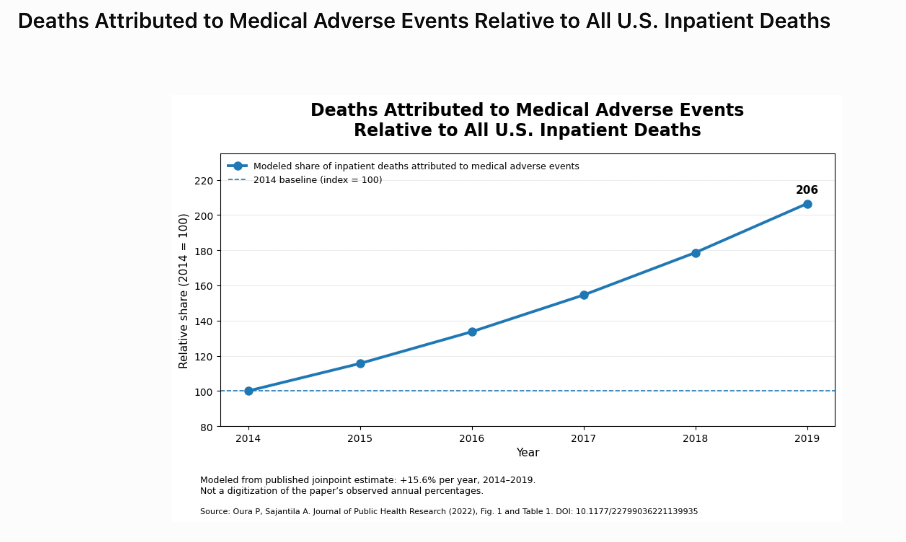
But has all this increased administrative burden and the ACA itself, improved outcomes? A 2022 study published in the Journal of Public Health Research, examining more than 18 million U.S. inpatient deaths between 1999 and 2019, found that the proportion of deaths attributed to medical adverse events approximately doubled between 2014 and 2019.
The American health care debate has become trapped between arguments for more government intervention and arguments for protecting the existing insurance industry. Both approaches can leave the underlying corporate structure largely intact and patients vulnerable.
This health care system is not the only possible model, nor is socialized medicine.
The older American medical system was built on more than independent physicians. Catholic hospitals, religious charities, community hospitals, and other nonprofit institutions played an essential role in providing medical care, including free or reduced-cost treatment for patients who could not afford to pay. Many physicians also provided charity care themselves. These institutions were not primarily organized around corporate growth, shareholder returns, or maximizing revenue from every patient encounter.
They were rooted in their communities, often supported by charitable donations, and guided by a mission of service. The system had shortcomings, but it provided an alternative to both corporate medicine and government-controlled health care. Today, even many nominally nonprofit hospitals operate as enormous corporate enterprises, acquiring physician practices, accumulating substantial assets, and competing for market share. Somewhere along the way, the mission of caring for the sick became increasingly entangled with the business of extracting revenue from illness.
A competitive marketplace requires more than privately owned corporations. It requires meaningful competition, accessible entry for new businesses, transparent prices, and the freedom of customers to choose among genuinely independent providers.
The distinction matters because defending free enterprise does not require defending every large corporation that claims to operate in its name.
Ron Paul, himself a physician, spent decades advancing a different philosophy of medical economics, emphasizing physician independence, patient choice, competition, and less government interference. Why have these ideas largely disappeared from mainstream health policy debates?
Why should opening an independent medical practice be so difficult? Why should physicians need expensive administrative infrastructures to receive payment? Why should hospital ownership change the economics of an otherwise identical medical service? And why should patients have so little visibility into the actual prices of their care?
Americans still trust small businesses far more than large corporations. They continue to place considerable trust in individual medical professionals, even as confidence in the medical system has deteriorated. They believe in free market enterprise.
Perhaps it is time to take those preferences seriously.
How did a profession built around independent medical judgment become so dependent on corporate ownership, insurance companies, and government bureaucracy? And what would it take to restore physicians' and patients' independence?
In Part Two, we will examine a different model for American medicine, including direct primary care, catastrophic insurance, independent practice financing, medical-school business education, and ways existing federal loan programs could help physicians return to private practice.
Independent Journalism Needs Independent Support
There is a certain irony in writing about the disappearance of independent physicians while working to preserve independent journalism. The same forces that favor large corporations over small businesses are reshaping the media. Independent voices are increasingly competing against enormous institutions with deep pockets, corporate sponsors, and powerful political connections.
At Malone News, we answer to our readers, not corporate advertisers, pharmaceutical companies, hospital conglomerates, or political organizations. That independence allows us to ask uncomfortable questions, follow the money, and challenge powerful institutions without worrying about offending the people who pay our bills.
But independence has a price. Research, investigation, writing, editing, and publishing require time and resources. If you are reading this as a free subscriber, or have been following our work without subscribing, please consider becoming a paid subscriber.
The same principle applies to medicine and journalism: if we want independent professionals who answer to the people they serve, we have to be willing to support them.
Your paid subscription helps keep Malone News independent, accountable, and willing to investigate the stories that powerful institutions would rather leave alone.
References
Gallup. (2026, July). Confidence in U.S. Institutions Remains Near All-Time Low. Gallup News. Examines public confidence in small business, big business, and the medical system.
Gallup. (2026). Honesty and Ethics Ratings of Professions. Gallup News. Historical comparisons of Americans’ trust in physicians, nurses, and other professionals.
American Medical Association. (2025). Physician Practice Characteristics in 2024: Private Practices Account for Less Than Half of Physicians in Most Specialties. AMA Policy Research Perspective.
Kaiser Family Foundation. (2025). 2025 Employer Health Benefits Survey. KFF. Documents average annual family insurance premiums of $26,993 and average employee contributions of $6,850.
Kaiser Family Foundation. (2026). What We Know So Far About 2026 ACA Marketplace Enrollment, Premiums, and Deductibles. KFF.
U.S. Government Accountability Office. Physician Consolidation: Trends and Implications for Medicare Spending and Beneficiaries. GAO reports and analyses examining physician-practice consolidation and hospital ownership.
Nelson, Nikolov, and Schulman. (2026, July). The Growth in Healthcare Administrators Since 2004 in the United States. Health Management, Policy and Innovation. Analysis of Bureau of Labor Statistics data documenting administrative employment growth relative to physician employment.
U.S. Congress. (1996). Health Insurance Portability and Accountability Act of 1996 (HIPAA). Public Law 104-191.
U.S. Congress. (2009). Health Information Technology for Economic and Clinical Health (HITECH) Act. Enacted as part of the American Recovery and Reinvestment Act, Public Law 111-5.
U.S. Department of Health and Human Services, Office for Civil Rights. (2023). Use of Online Tracking Technologies by HIPAA Covered Entities and Business Associates. Federal guidance concerning tracking technologies and protected health information.
U.S. Department of Health and Human Services, Office for Civil Rights. (2024–2026). Change Healthcare Cybersecurity Incident and Breach Investigation. HHS reports and public notices concerning the exposure of protected health information.
U.S. Office of Personnel Management. (2015). Cybersecurity Incidents Affecting Federal Personnel and Background Investigation Records. Official disclosures concerning the compromise of sensitive background-investigation information involving approximately 21.5 million individuals.
Centers for Medicare & Medicaid Services. (2026). 2026 Medicare Parts A and B Premiums and Deductibles. CMS.
Centers for Medicare & Medicaid Services. Medicare Coverage of Skilled Nursing Facility Care and Long-Term Custodial Care. Medicare.gov.
Medicaid and CHIP Payment and Access Commission. Medicaid Estate Recovery. Federal statutory requirements and state implementation of estate recovery for certain Medicaid expenditures.
Steinbach, S. (2025). The Corporatization of Veterinary Medicine and Its Impact on Independent Practices. Journal of the Agricultural and Applied Economics Association, 4(3), 405–423. DOI: 10.1002/jaa2.70024.
North American Pet Health Insurance Association. (2026). State of the Industry Report. Industry data on pet insurance enrollment and market growth in North America.
Federal Trade Commission. (2022). FTC Orders Divestitures in Veterinary Services Markets Following Corporate Acquisitions. Federal antitrust enforcement concerning competition in veterinary services.
American Hospital Association. (2026). Fast Facts on U.S. Hospitals. National hospital ownership and organizational data, including nonprofit, investor-owned, and government hospitals.
Internal Revenue Service. Revenue Ruling 69-545: Hospital Exemption Under Section 501(c)(3). Historical federal tax policy concerning nonprofit hospitals and community-benefit requirements.
Congress long ago gave giant managed care bureaucracies the perverse legal power to control use of prepaid premiums in the belief that corporations would control the cost of care. This evolved into ratioing patient care by “prior authorization” or denial of care ordered by professionals and by down streaming their financial risk for their populations’ medical care. Downstream are the mini hospital corporations and professional staff impoverished by ever lower capitation rates, i.e., the money paid professional providers of population care. Cost control by rationing care has failed for decades and produced impoverished care, patients, and a few rich corporations.
Can the private and public sectors become affordable? The private sector became affordable briefly from 2004-2009 when congressional reform created a retail medical marketplace for empowered patients with tax-free first dollar coverage linked to low-cost insurance. This program almost put out of business high priced giant managed care pre-paid corporations until killed in 2009 to make way for the giant corporate cartels of the 2010 Accountable Care Act.
The Fix? Eliminate giant “cartel care” by restoring American late 2000s family control of their medical budgets for affordable professional care and insurance. Public programs could follow that same formula to affordability. Why not?
RW Geist MD
rgeistmd@comcast.net
763-276-8092
When these idiots rant about the "need for Medicare for all," they mean "Medicaid for all."
The clapping seals in media and the fawning "gimme" acolytes don't understand or care that Medicare isn't "free," and actually has a pretty high premium - especially if one has a moderate income.
I didn't sign up for it, but as I recall my premium would be almost $400 per month.