

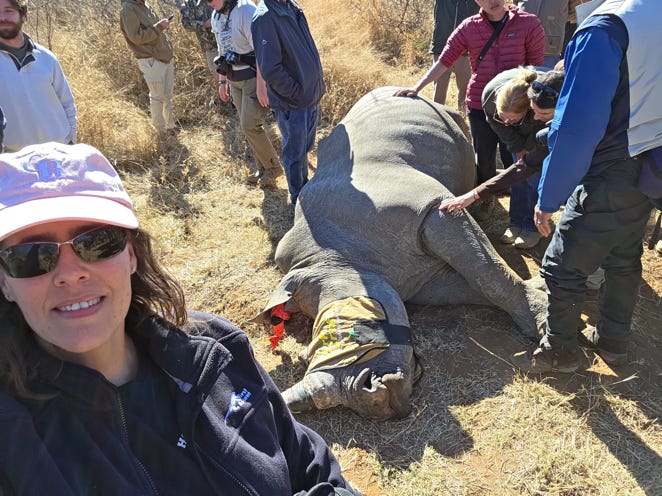
The Fate of the Chubby Unicorn
Investigative essay by Justine Isernhinke, Fellow and Head of Geopolitics and UAP Research, The Malone Institute
Unicorns are real. They are just fat, grey and called “rhinos”. As unicorns are magical so too is there something magical about a rhinoceros. Their ears and body language mimic that of horses. If their ears look at you, they’re curious and alert. If their ears go back, someone is grumpy. That their little calves squeak like your puppy’s toy is just too adorable for words.
The Chubby Unicorn, however, is facing extinction as their horns continue to attract ruthless, brutal poachers. At one point their horns were worth more than gold per ounce. They still garner a huge premium, resulting in the animal effectively being wiped out from all of Asia with small pockets of surviving herds in Nepal, Indonesia and in Southern Africa. But for the valiant efforts of a handful of conservationists, there would be no more rhinos left in the wild. Having said that, rhinos aren’t even safe in zoos or as natural history remnants in a museum.
I’ve been involved in wildlife conservation in South Africa for some time now. Around 2015, it became very clear to me that we were witnessing the demise of the rhinos in realtime. As a South African that grew up loving the scrubby bushveld and its wild inhabitants, I could not stand by. This journey has brought many wonderful and interesting people into my life and I’ve been fortunate to have seen how much incredible work is done to save this species.
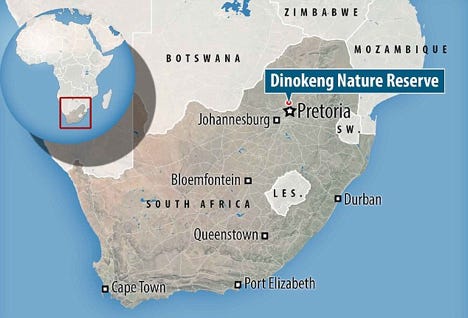
I was flying to Johannesburg this summer when a friend messaged me on the plane telling me about a rhino collaring to take place in the Dinokeng Reserve, just north of Pretoria. I moved mountains on United’s WiFi and organized my place on that collaring as well as accommodation, all whilst battling for elbow space in cattle class.
A week later, I found myself waking up at 6am to well below freezing temperatures (it’s winter down under when it’s summer up here), to huddle off to the main lodge where we were meeting up before tracking the rhino and darting it.
I arrived and, as is the way of South Africans, immediately began making friends around the coffee dispenser. Apparently, this particular collaring was being done on a black rhino - the more elusive and far more vulnerable of the two rhino species in South Africa. The black rhino is smaller than the white rhino and is a tree browser. With this diet, its mouth comes to a point at the end, whilst the white rhino has a wide, straight mouth. The name “white rhino” likely comes from early settlers finding the large rhinos wallowing in the white pans of the southern Kalahari savanna - the white mud caked onto their bodies.
We were on our third cup of coffee before the rangers came to tell us that the particular black rhino they were searching for was maintaining its elusive reputation and that they were now looking for a white rhino. We were a crowd of some 30 individuals, mostly consisting of vet students from a Texan university and their American professors. For the South African cohort, I was joined by a lady who sponsors the son of another conservationist, Kevin Richardson, who was also there. His friend Cameron, who runs a first rate luxury safari company joined us with his wife and the four of them would prove to be excellent and well-informed company. We became fast friends by the time the Head Ranger, David Boshoff, gathered us around to tell us that they had spotted a rhino.
Prep talk by David Boshoff:
We hopped into safari vehicles and in a mad dash of dust and gasoline headed out into the bushveld, chasing the chopper.
In Africa, similar to when they herd wild mustangs out West, helicopters are used to herd the horses. The pilots doing this work out in Africa are probably some of the best pilots in the world.
Not only are they flying a helicopter (which is worth trying to fly once only to realize that there are far cheaper hobbies that won’t get you killed and which are far easier to learn), they navigate tall trees and dive towards the ground to pressure the animal to move, with the speed of the dive determining the speed of the animal. If you’ve ever herded cattle, mix in some insane chopper skills, and then a pinch of a vet hanging out the heli with a dart rifle trying to hit a fast-moving animal.
One of us saw the bushes rustle and “boom” out shot a white rhino at a wobbly full gallop across the road. The chopper followed a little behind. The rhino had been hit twice, the first dart didn’t take but the second one seemed to take effect.
The darts are filled with M99, a substance so deadly that if humans have even a minute amount, we’re dead.
The rhino crashed a little off the road.
The chopper landed and all the 4x4s came rushing in. Teams of rangers and experienced wildlife vets jumped to the ground and dashed to ensure that the rhino didn’t hurt itself and that it was safely out cold.
After a few minutes, they called us to join them. 30 of us scrambled all around the rhino, the vet students doing tasks that had been assigned, the local vets making sure that the rhino was being taken care of.
Conservation Work
The ruggedness of the bushveld, the smell of the grass, and the ever-present dust has an appeal that’s hard to describe. There is something about the connectedness you feel to a bygone, primitive past. You have be a soulless drone not to feel the energy of vast wilderness. It draws you in. I’ve lived out of South Africa for years now, but I go back every year. An annual migration of a sort. I yearn for connection with this ancient continent and its animals. But like many sacred things on this planet, this wildness is at risk, and it takes special men and women to step up and defend it.
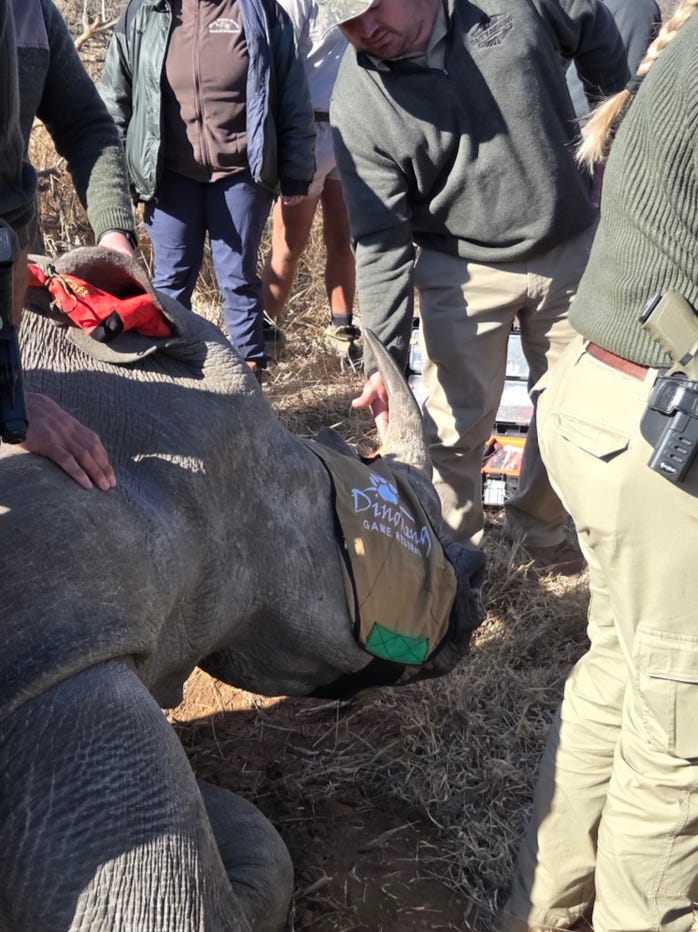
The reason they needed to insert a tracking device in the rhino is to protect the rhino. This allows the anti-poaching unit to know where the rhino is at all times and if the animal is shot by poachers for its horn, they will be able to track the horn - at least until the tracker is removed by a drill or saw.
Game reserves in Africa are huge. Dinokeng is 81 square miles. It’s fenced and local townships sit along its border. It also has a traffic through-road, dividing the park into 2 hemispheres - north and south - with different vegetation and species. To surveil such an extensive park is financially beyond the means of the park, despite fees and tourism. This is where non-profits come in and help. They bring expertise, training, human and dog resources to help monitor the park and react to incidents.
One of my friends, Peter Milton, heads up SPOTS, a conservation NGO that works with the Dinokeng’s Reserve’s Anti-Poaching Unit (APU).
Peter Milton:
The foundation of SPOTS is to provide “boots on the ground” along with capability, and leading-edge technologies for the fight against poaching and the illegal trade in wildlife.
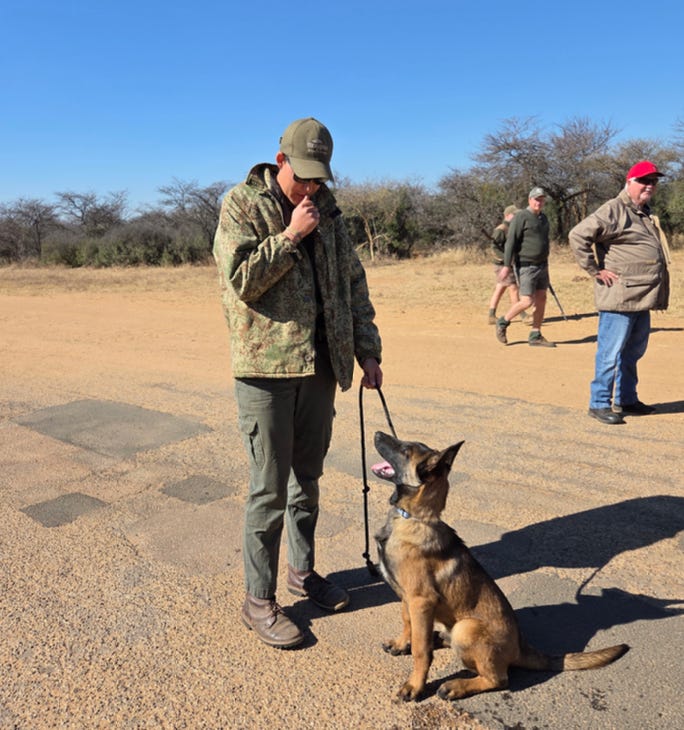
Peter was not around, but I spoke to Ariana who works with him. This day she was training a new Belgian Malinois pup who was more demanding than any student vet and required constant attention!
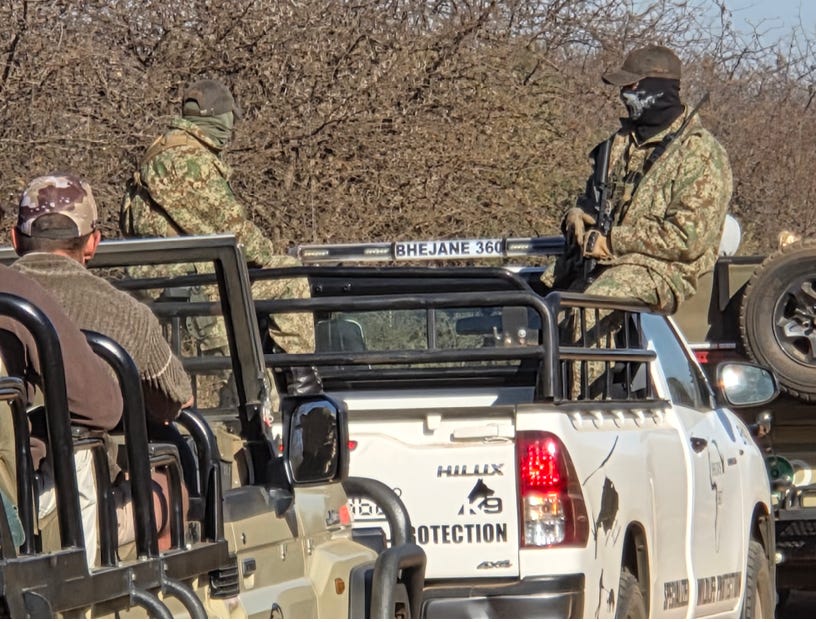
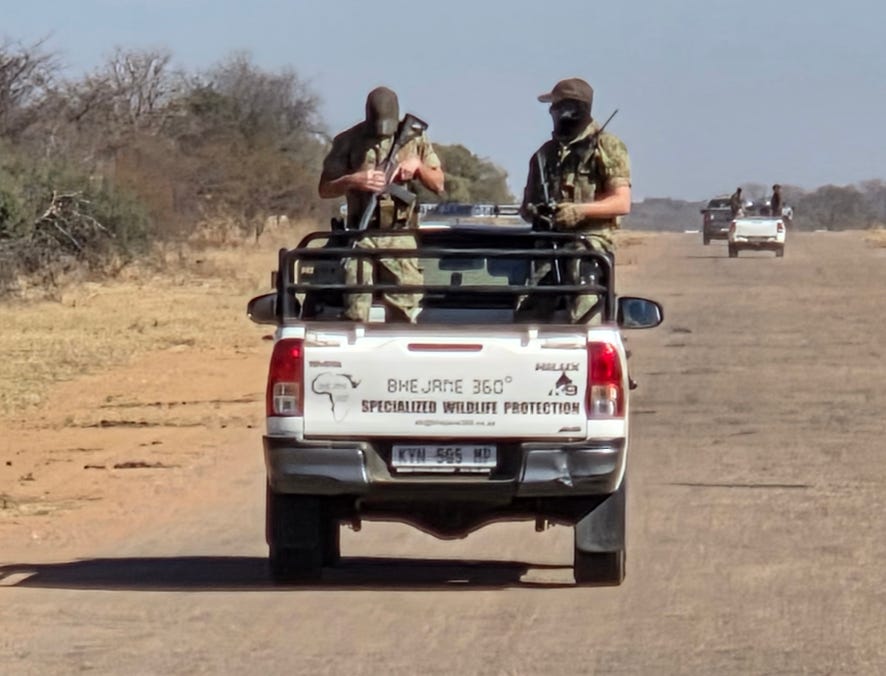
The anti-poaching unit looked fairly mean as they accompanied us on the collaring:
Checking microchips:
Rolling a Rhino:
Dental Acrylic and Drills
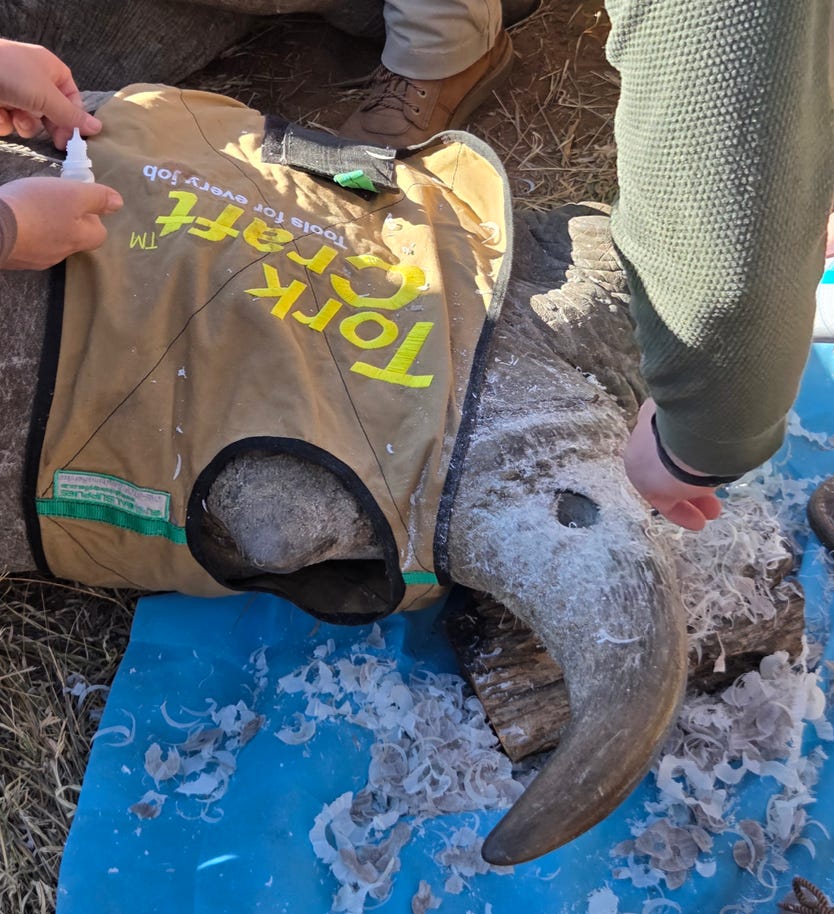
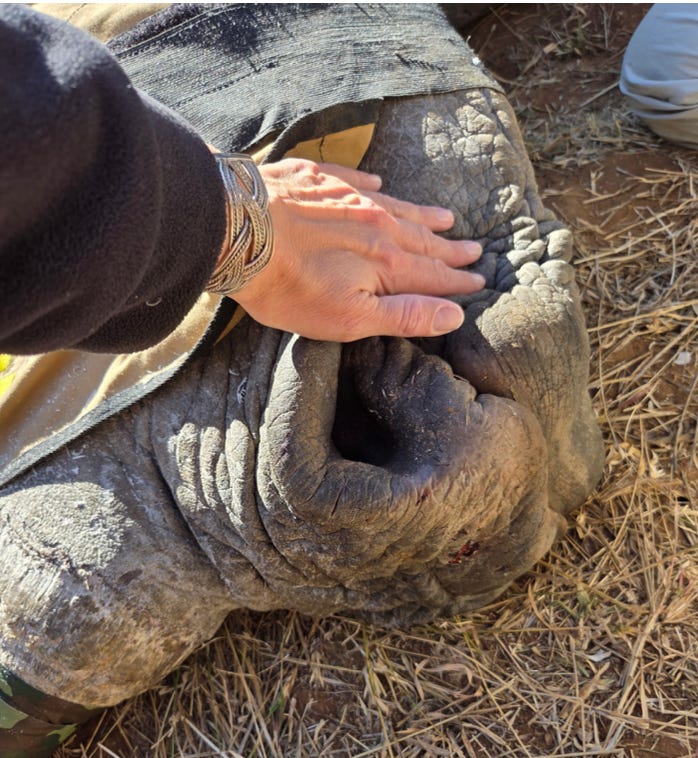
The sedated rhino is blindfolded and ear plugs inserted into the ears of the animal. This keeps the noise level down and helps the animal remain calm. They cover the eyes as well, and every 3 mins a vet student put eye drops into the animal’s eye to keep it dry. Bloods were taken, hair and skin samples taken. The vets had plenty of practice… how many rhinos do they come across in Texas, one wonders?
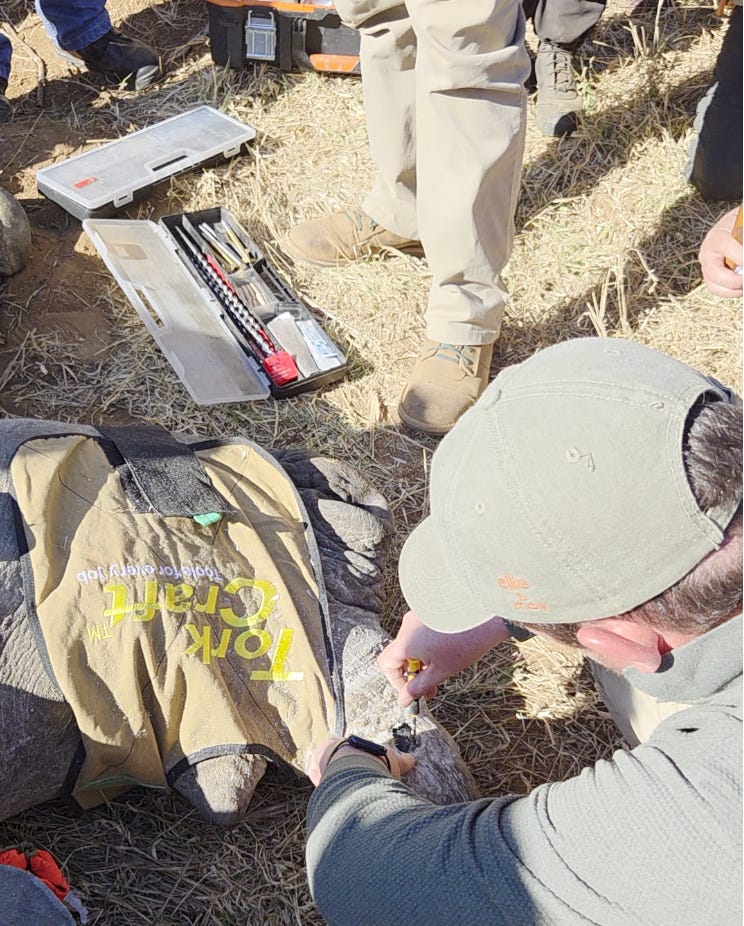
The Reserve Manager, Gavin Sterley, began drilling a hole into the horn. I hunched down and videoed it. Asking questions between the drilling.
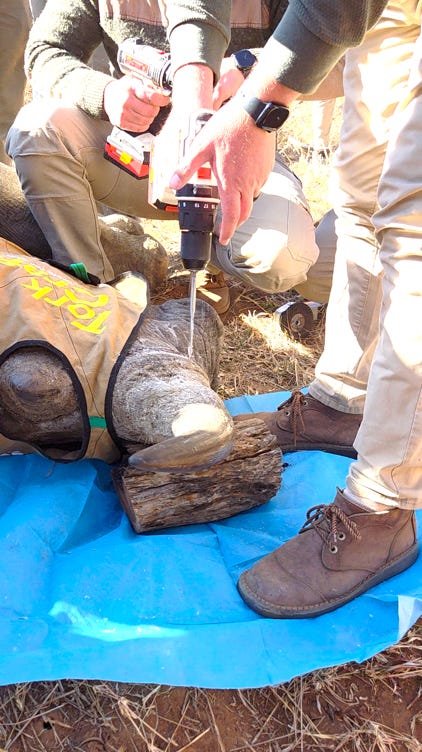
“Collaring” these days is not a thick leather collar wrapped around the neck but some tiny little tracker device that has an antenna that lies in the horn and points up to the sky. I kept thinking if Dr Malone would like to try out his carpentry skills on a rhino horn… truly at the sharp end of the animal.
A full physical was done whilst Gavin went from one kind of drill to another kind to then inserting the tracker and using dental acrylic to keep the tracker in place.
Speaking with the head vet:
Speaking with David Boshoff:
Drilling where the antenna of the tracker would go:
Once the tracker was placed into the horn, dental acrylic was used to fill the gap. Duct tape - suitably camo-designed, was wrapped around the dental acrylic to give the paste some time to harden.
Gavin talking about the rhino and the collaring:
When we were done, we all headed out back to the vehicles and jumped on. The remaining rangers and experienced vets injected the rhino to awaken it and then they all hightailed it back to their vehicles.
The rhino was up in no time and we had the privilege of watching it charge across the road clearly miffed off that his rather pleasant morning consisted of bodily violations and root canal in its horn.
Legalizing the trade in rhino horn?
One interesting point was that the rhino was relocated to the Dinokeng Reserve from the herd that John Hume had bred for the specific purpose of selling their horn - harvesting the horn off the rhino every second year. John Hume met significant opposition amongst conservationists. Whilst John bred over 2,500 white rhinos some say helping delay the animal’s extinction for a little longer, legalized trade would provide aircover for poached horn to be sold under the label as “safely harvested”. We’ve seen this with elephant ivory (illegal) being sold as mammoth ivory (legal). Kenya also tried trading in ivory legally which resulted in the decimation of wild populations of elephant. There is almost no way of easily determining the origin of the ivory or horn. DNA testing exists but is prohibitively expensive and impractical for customs officials.
The instinct of conservationists about John Hume was correct, though. The rhino collaring I joined took place in July but by mid August, John Hume was arrested for rhino horn trafficking.
Nevertheless in the past few weeks, the fight for the legal trade of rhino horn has taken another turn in the High Court of South Africa which has now decided to agree that there should be legalized limited sales of captive-bred rhino horn internationally. This will not change the law overnight but it does set the wheels in motion for the CITES ban on rhino horn trading to be challenged in our Constitutional Court.
However, whilst all of this rages in the court system, rhino horn still has about as much medical utility as your finger nail cuttings. Its trade is not based on its effectiveness in traditional medicine, but rather it has become a valuable status symbol in Asia where big money drives demand amongst businessmen, showing off to their peers.
Against this background, it’s hard to know if collaring one rhino in one park makes a difference. But to the men and women on the ground, they see one life saved - even if for another day. To them, and to the rhino, that’s all the reason they need.
If you are planning a trip to South Africa, I highly recommend trying to find a way to experience African conservation up close and personal. It truly is a magical experience.
If you would like to support SPOTS, please find them at: www.spots.org.za
I ask each of you to please make every effort to visit to South Africa. Despite the awful headlines, there are safe places with incredible wildlife and epic natural beauty. There is a reason we fight for this country and its animals.
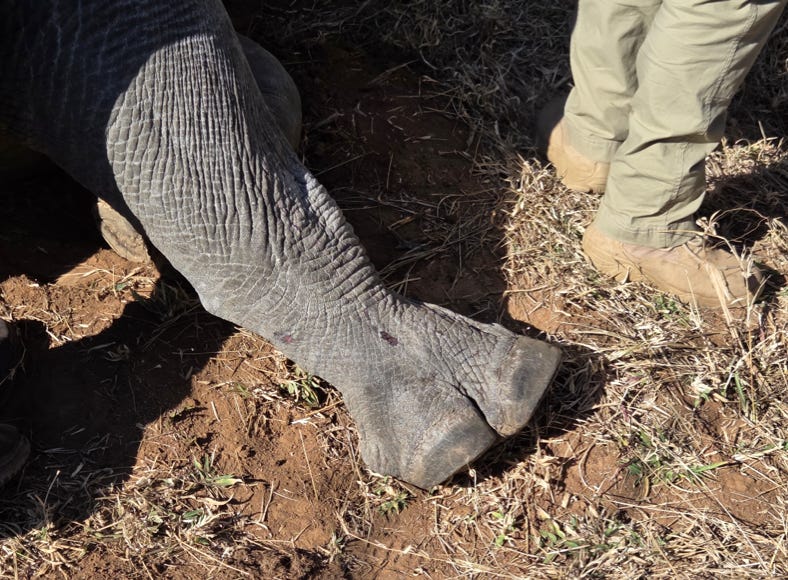
“There are wild elephants in the country, and numerous unicorns, which are nearly as big. They have hair like that of a buffalo, feet like those of an elephant, and a horn in the middle of the forehead which is black and very thick. They delight much to abide in mire and mud” ~ Marco Polo, 1280, in his account of the Sumatran Rhino, making the observation of the love of all rhino species to mud-wallow.
What a great story. We have to protect these amazing creatures. A South African safari is on my bucket
list. God bless those on the front lines protecting them from poachers…not an easy task.
Border collies are still the alpha-herders though. I once saw them round up an airfield full of stray, scattered helicopters, and push them all into the hangar.