

Audio:
The official story surrounding the Andes hantavirus cruise ship outbreak keeps shifting, but one detail should make any rational person stop and think.
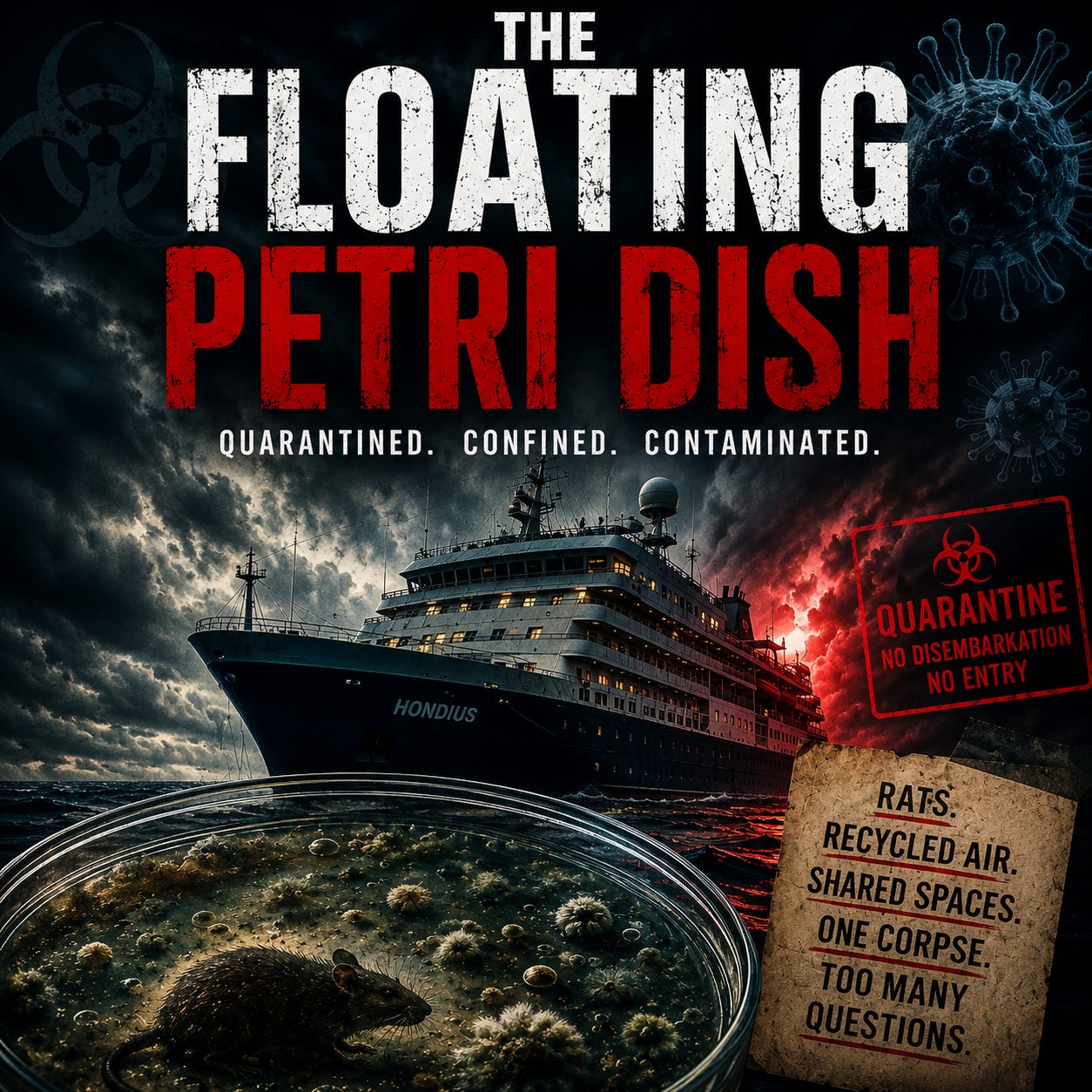
Authorities quarantined healthy passengers for weeks aboard a confined expedition vessel while, at the same time, at least one corpse remained on the ship for nearly two weeks.
Think about that for a moment.
If your actual goal is to minimize the possibility of human-to-human transmission inside a sealed maritime environment, keeping a dead infected body aboard while confining hundreds of people into shared airspace seems like an odd strategy.
The media, meanwhile, has focused almost entirely on the “rare human transmission” narrative while largely ignoring the far more obvious issue: ships are historically one of the most efficient rodent habitats ever created by man.
Rats and ships go together like barnacles and saltwater. Same for mice and ships.
For centuries, maritime law, naval engineering, and port sanitation protocols have revolved around one basic fact: rodents thrive aboard ships. Cargo vessels, cruise ships, food storage areas, bilges, rope lockers, waste systems, mechanical spaces, and dock loading zones create ideal rodent ecosystems. That is not a conspiracy theory. That is maritime history.
And hantaviruses are rodent-borne diseases.
Yet oddly, much of the reporting has downplayed the possibility of environmental contamination, food contamination, aerosolized rodent waste, or shipboard sanitation failures. Instead, the public is being pushed toward dramatic narratives emphasizing close-contact human spread.
Why?
Because “mysterious human transmission” generates headlines. Rodent control failures and contaminated food handling are much less cinematic.
But from a biological standpoint, contaminated environments matter enormously.
Hantaviruses can spread through aerosolized particles from rodent urine, feces, and saliva. In enclosed environments with shared ventilation systems, food preparation areas, tight cabins, recycled air, and limited deep-cleaning capacity during an active outbreak, those risks become difficult to dismiss.
Andes hantavirus is a single-stranded RNA virus, which means it mutates relatively quickly during replication. RNA viruses are inherently error-prone. Every new infection creates opportunities for small genetic changes.
Viruses evolve through replication and selective pressure from their environment.
The more transmission events occur, the greater the chance for variants better adapted to human spread to emerge. That is basic evolutionary biology.
A prolonged shipboard quarantine in tight quarters creates a uniquely compressed environment for this. Ships have historically served as amplifiers of infectious disease for exactly these reasons.
Importantly, Andes hantavirus already has a documented human-to-human transmission pattern, although it is inefficient and not previously associated with sustained human-to-human transmission. The evolutionary barrier has already been crossed at least partially.
That does not mean a “super strain” emerged aboard the Hondius. There is no evidence of that (yet).
But scientifically, it is entirely reasonable to ask whether prolonged confinement aboard a tightly enclosed vessel could favor continued transmission and create evolutionary pressure for adaptation. The WHO has indicated that it will not share viral sequences isolated from those infected with the United States in retaliation for the US exiting and withdrawing funding from the WHO. The United States has many of the world's top genomics and viral evolution analysts. That WHO policy position is short-sighted and petulant.
Cruise ships are basically floating HVAC experiments.
The Hondius polar expedition cruise ship was marketed specifically as an environmentally innovative vessel featuring advanced efficiency systems, centralized climate engineering, steam heating, humidity management, and tightly integrated power systems designed to minimize fuel consumption and environmental impact.
The company proudly advertised that the ship used “LED lighting, steam heating, bio-degradable paints and lubricants, and state-of-the-art power management systems that keep fuel consumption and CO2 levels minimal (1).”
That sounds wonderful from an eco-tourism perspective.
But from an infectious disease perspective, one immediately wonders how these tightly managed environmental systems interact with pathogen transmission within a compact, sealed vessel carrying roughly 250 people in total, including passengers and crew.
Humidity matters in infectious disease transmission. Air circulation matters. Ventilation patterns matter. Condensation matters. Shared airspace matters.
Especially aboard a 353-foot polar expedition ship where people spend extended periods indoors in common dining rooms, observation lounges, corridors, lecture halls, and cabins while crossing cold and rough seas.
This was not a giant open-air Caribbean party boat.
This was essentially a floating enclosed ecosystem.
Bring out your Dead.
Which brings the story back around to that dead person stored somewhere on this same closed system, for weeks on end. Enquiring minds want to know, just where was this corpse kept?
Shared air handling systems move air between cabins and common areas. Food is prepared centrally. Waste systems are centralized. Laundry systems are centralized. Sick passengers, healthy passengers, and crew often share recirculated indoor environments for days or weeks (1).
And during quarantine? Everyone spends even more time indoors.
Meanwhile, the press continues repeating phrases like “rare person-to-person transmission” as though that somehow excludes environmental spread. It does not.
Both routes can exist simultaneously.
But the environmental side of this story appears to have received remarkably little investigative attention compared to the far more sensationalized “human transmissible virus” angle.
That imbalance matters because fear thrives in informational vacuums.
The public hears “human transmissible hantavirus” and immediately imagines the next pandemic thriller. But asking hard questions about ship sanitation, rodent exposure, contaminated food handling, air circulation systems, humidity management, waste processing, quarantine logistics, and environmental contamination would require examining institutional failures that are far less politically useful than panic-inducing headlines.
And then there is the body itself.
Keeping an infected corpse aboard a quarantined vessel for extended periods may or may not have materially increased risk. We simply do not know. But common sense suggests that if authorities truly believed this was a highly dangerous human-transmissible outbreak, retaining human remains inside a sealed maritime environment while simultaneously isolating passengers raises legitimate operational questions.
At minimum, the optics are terrible.
Biased Media Coverage
Why has so much of the public messaging emphasized the “rare human-to-human transmission” angle while comparatively little attention has been devoted to environmental exposure, rodent ecology, ship sanitation, or aerosolized contamination risks aboard a confined vessel? Part of the answer may simply be media incentives. Human-to-human spread is dramatic. It generates clicks, ratings, social media engagement, and public anxiety in ways that “possible rodent contamination aboard ship” never will.
WHO Conflicts of Interest
But there is also a broader institutional context that cannot be ignored. Public health agencies and international organizations such as the World Health Organization have spent years warning about the inevitability of the next pandemic while simultaneously facing growing political skepticism, declining public trust, and significant funding pressures. In a contentious midterm election cycle, with public health bureaucracies under scrutiny and the WHO confronting ongoing financial instability after major donor pullbacks, there are strong institutional incentives to frame emerging outbreaks around narratives that reinforce the continuing need for centralized global surveillance, emergency authorities, and sustained funding.
A disease framed primarily as an environmental or sanitation problem aboard a ship does not carry the same political or psychological impact as one framed as a potentially expanding human-transmissible viral threat. This may explain why certain aspects of the story receive saturation coverage while others receive comparatively little attention.
At worst, it suggests the people making decisions may not have fully understood the transmission dynamics themselves.
Which is perhaps the most unsettling possibility of all.
JGM/RWM
References:
m/v Hondius: Hondius is the world’s first-registered Polar Class 6 vessel and was built from the ground up for expedition cruising.
https://chatgpt.com/c/6a086274-1324-83ea-b40a-9ef3d4204200
The quote “Rats leaving a sinking ship” wasn’t without real observation! My dad was a Longshoreman. Ropes were required to have rodent rings installed in port. Sharp observations as always Dr. 😊
It keeps coming down,to the need to develop better and broader spectrum anti-viral treatments rather than wasting time and money on vaccines that will be obsolete within wks due to viral mutagenesis.