

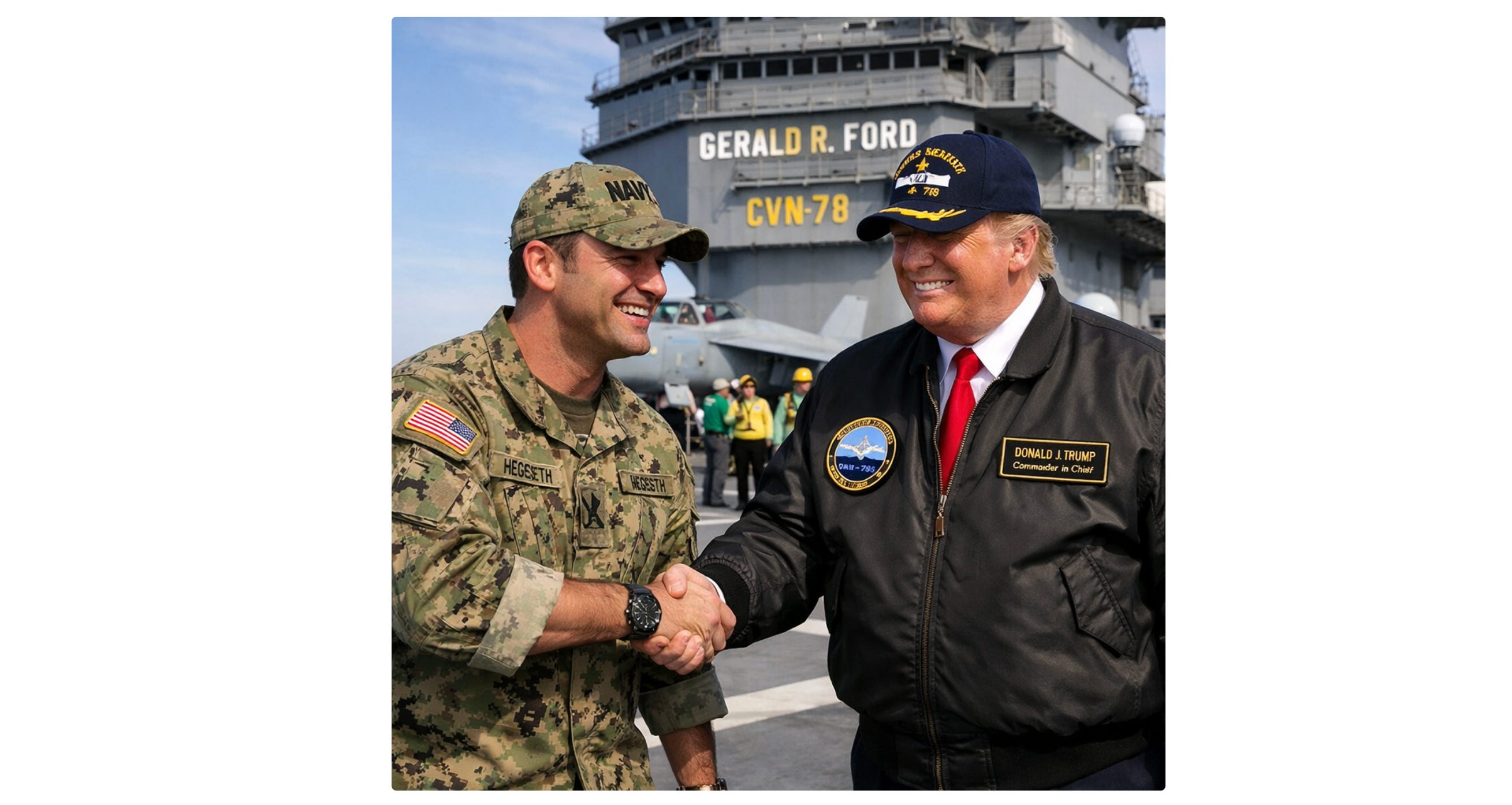
The U.S. Department of War has now published the 2026 National Defense Strategy
Sovereignty over globalism, peace through strength, while avoiding utopian, endless wars
“After years of neglect, the Department of War will restore American military dominance in the Western Hemisphere. We will use it to protect our Homeland and our access to key terrain throughout the region. We will also deny adversaries’ ability to position forces or other threatening capabilities in our hemisphere. This is the Trump Corollary to the Monroe Doctrine—a commonsense and potent restoration of American power and prerogatives in this hemisphere, consistent with Americans’ interests.”
National Security Strategic Guidance Documents:
The NSS (National Security Strategy - released Nov 2025) provides the “why” for the revitalized and renamed Department of War (DOW).
The NDS (National Defense Strategy - released Jan 2026) provides the “what” for the DOW.
The National Military Strategy (NMS) provides the “how” for the military, creating a nested framework for national security.
The 2026 NDS, released by the Department of War under Executive Order 14347, reflects a shift toward homeland defense, deterrence of China, burden-sharing with allies, and revitalizing the defense industrial base. It incorporates the Trump Corollary to the Monroe Doctrine, prioritizing security in the Western Hemisphere and repositioning U.S. forces accordingly. While the 2026 NMS has not yet been publicly released, its strategic framework is expected to align with this NDS and emphasize Golden Dome missile defense, counter-drone systems, and cyber resilience.
The Trump Doctrine refers to a policy shift introduced in the December 2025 U.S. National Security Strategy under President Donald Trump’s second term. It represents a reassertion of American dominance in the Western Hemisphere, framing regional stability as essential to U.S. national security. The Trump Doctrine is a direct corollary to the Monroe Doctrine.
The Trump Doctrine aims to restore American preeminence by preventing non-hemispheric powers, particularly China and Russia, from gaining military, economic, or political influence in the Americas. It explicitly seeks to block foreign ownership of strategically vital assets, such as ports, energy infrastructure, and supply chains.
The strategy authorizes targeted military deployments and lethal force against drug cartels designated as foreign terrorist organizations. It also emphasizes naval power and economic coercion, including sanctions enforcement, interdiction of oil shipments, and what Secretary of State Marco Rubio called an “oil quarantine” on Venezuela.
The January 3, 2026 capture of Nicolás Maduro was framed as a direct application of the Trump Doctrine. U.S. forces seized Maduro on narco-terrorism charges, citing the need to dismantle transnational criminal networks and prevent foreign influence. President Trump stated the U.S. would “run” Venezuela temporarily to ensure a transition aligned with American interests.
While the original Monroe Doctrine (1823) opposed European colonization in the Americas, and the Roosevelt Corollary (1904) justified intervention in unstable nations, the Trump Corollary expands this logic to include economic control, resource access, and migration management as national security priorities.
This approach, outlined in these two released documents, prioritizes threats based on their direct consequences for American interests, focuses on the military’s core warfighting role, and leverages American military power to create conditions for a lasting peace negotiated from a position of strength.
The shift to “hard-nosed realism” focuses on the core tenets of (1) America First; (2) Peace Through Strength; and (3) Common Sense, with a particular emphasis on the Trump Corollary to the Monroe Doctrine.
Note: There are classified portions of these documents that provide granular details not available to the public or available on unclassified networks and searches.
2025 National Security Strategy (NSS)
The November 2025 National Security Strategy of the United States of America marks a decisive evolution in American statecraft under President Trump’s second administration, rejecting the diffuse globalist doctrines of the post–Cold War era in favor of a focused America First reorientation. The document begins with a frank assessment of how U.S. strategy “went astray” after 1991: successive elites sought permanent global dominance, entangled the republic in costly foreign commitments, and undermined industrial and cultural strength through misguided globalism, deregulated trade, and dependence on transnational institutions.
“After the end of the Cold War, American foreign policy elites convinced themselves that permanent American domination of the entire world was in the best interests of our country.”
The new strategy’s core objective is the protection of America as a sovereign, independent republic whose government is focused on securing the natural rights and prosperity of its citizens. It emphasizes controlled borders, national resilience, self-sufficiency in energy and industry, technological leadership, cultural confidence, and renewal of traditional civic virtue and the family as pillars of strength.
Under this strategy, America is to remain the world’s most powerful military, economic, and scientific power, but will now wield that supremacy selectively and in service of clearly defined vital national interests rather than abstract ideological crusades, involving worldwide domination.
President Trump’s foreign policy is pragmatic but principled; firm, peace-oriented, non-interventionist except where American interests demand action. It celebrates Trump as the “President of Peace,” citing his unprecedented diplomatic achievements, including negotiated settlements across eight major global conflicts and historic normalization in the Middle East. The guiding principles include a tightly focused definition of the national interest, peace through strength, predisposition to non-interventionism, respect for sovereignty, balance of power, pro-American worker economics, fairness in alliances and trade, and the restoration of competence and meritocracy across national institutions. It explicitly condemns transnational ideologies, “DEI” bureaucracy, and climate “Net Zero” policies as erosions of American capability.
Major priorities include ending the era of mass migration, framed as an existential matter of national survival, protecting core constitutional rights from abuse by government agencies, demanding fair burden-sharing from allies (notably the Hague Commitment for NATO countries to spend 5% of GDP on defense), advancing peace diplomacy as a cost-effective strategic tool, and intertwining economic security with national defense through reindustrialization, energy dominance, financial preeminence, and technological innovation.
Economic strategy centers on balanced trade, re-shored supply chains, low-cost defense innovation, revitalized manufacturing, and the firm rejection of dependency on adversarial sources of minerals and components. The administration also envisions a “Golden Dome” homeland missile defense system and a renewed nuclear deterrent to safeguard the republic.
The regional strategy sections detail a recalibrated geopolitical order.
In the Western Hemisphere, Trump’s “Corollary to the Monroe Doctrine,” otherwise known as the Trump Doctrine, reasserts U.S. preeminence, pledging to block foreign powers (especially China) from acquiring strategic footholds, enlist regional allies against migration and cartels, and expand hemispheric prosperity through reciprocal trade and “commercial diplomacy” that rewards alignment with the United States.
In Asia, the focus is on winning the long-term economic future while deterring war, especially with China, by balancing trade, protecting supply chains, countering predatory Chinese economic expansion, and preserving maritime freedom, especially around Taiwan and the South China Sea. Economic cooperation through the “Quad” partnership with Japan, India, and Australia, and the harnessing of AI, quantum, and undersea superiority, underpin this approach, consolidating American and allied dominance.
In Europe, the strategy calls for revitalizing the continent’s self-confidence and halting its “civilizational decline” caused by bureaucratic overreach, uncontrolled migration, demographic implosion, and cultural loss. It seeks a stable, self-reliant Europe at peace with Russia and internally sovereign, ending perpetual NATO expansion and urging Europeans to assume primary defense responsibilities. Washington will also encourage nationalist political movements that restore pride and liberty, positioning the U.S. as Europe’s partner in a cultural and economic renaissance.
The Middle East section announces a structural downgrading of the region’s priority: energy independence, Israeli security, and anti-terror cooperation remain vital, but Trump’s recent ceasefire and anti-Iran operations (“Operation Midnight Hammer”) have, in the administration’s view, produced conditions for lasting peace. Policy henceforth emphasizes investment, partnerships in AI and defense industries, and respect for native governance traditions rather than ideological nation-building.
Finally, in Africa, the document prescribes a shift from aid to trade and investment, focusing on energy, minerals, and industrial projects that yield tangible returns for both sides. The U.S. will favor capable and open African states while helping to mediate conflicts and counter terrorist resurgence without open-ended commitments.
Overall, the 2025 National Security Strategy consolidates a bold American re-sovereigntization: ending globalist overreach, demanding fairness, renewing cultural unity, restoring economic self-sufficiency, and redefining world order around independent nation-states cooperating out of self-interest rather than ideology. America will lead by example: through power, competence, and peace, not through hegemony.
2026 National Defense Strategy (NDS)
The 2026 National Defense Strategy (NDS), issued by the Department of War (DOW), outlines a forceful realignment of U.S. defense policy grounded squarely in America First realism, a doctrine of peace through overwhelming strength, hemispheric sovereignty, and pragmatic global engagement.
The strategy opens by describing the perilous state of national security inherited in early 2025: porous borders, emboldened narco-terrorists, expanding Chinese and Russian assertiveness, and weakened allies accustomed to U.S. subsidy. It credits President Trump with reversing these trends by restoring military preparedness, revitalizing the defense industrial base, and reasserting U.S. sovereignty both at home and abroad.
The NDS establishes four key lines of effort (LOEs):
Defend the U.S. homeland
Deter China in the Indo-Pacific through strength but not confrontation
Increase allied burden-sharing
Supercharge the U.S. defense industrial base.
The document emphasizes that the overriding priority is Homeland defense: from securing borders and maritime approaches to constructing Trump’s proposed “Golden Dome for America”, a technological missile shield designed to protect against advanced and unmanned aerial threats. It explicitly integrates border control into the defense mission, treating mass illegal migration and narcotics trafficking as national security threats equivalent to military invasion.
The DOW vows to retain freedom of movement and control over key Western Hemisphere terrain; particularly the Panama Canal, Greenland, and the Gulf of America, and to uphold what it calls the “Trump Corollary to the Monroe Doctrine”, which forbids adversarial powers from gaining footholds anywhere in the Americas. Parallel initiatives include modernization of the nuclear deterrent, development of robust cyber and electromagnetic warfare defenses, and the continued neutralization of Islamic terrorist cells that threaten the U.S. homeland.
In the Indo-Pacific, the NDS defines China as the foremost long-term challenger, while adopting a firm but pragmatic approach: deterrence by denial rather than provocation. The strategy seeks peace with Beijing through military strength, explicitly rejecting regime change or domination in favor of a “decent peace” that secures a stable economic balance of power. The DOW is directed to erect a strong denial defense along the First Island Chain (FIC) and to empower regional allies, Japan, South Korea, India, and Australia, among them, to invest seriously in their own defense. This posture serves to preserve U.S. access to the world’s most important economic region while deterring aggression through combined readiness.
On allied burden-sharing, the NDS codifies Trump’s demand that partners assume primary responsibility for their regional defense. The 5% of GDP defense spending benchmark, agreed upon at the NATO Hague Summit (3.5% military, 1.5% security-related), is presented as a new global standard.
The document delineates a sharp division of labor: the U.S. focuses on homeland security and deterring China, while allies take the lead in Europe, the Middle East, Africa, and the Korean Peninsula with U.S. support calibrated to their performance. Europe is tasked with shouldering its own conventional defense and bringing an end to the war in Ukraine, while Middle East partners, especially Israel and the Gulf monarchies, are expected to counter Iran and its proxies with U.S. assistance limited to intelligence, arms sales, and strategic strikes like Operation MIDNIGHT HAMMER, which the NDS lauds for eliminating Iran’s nuclear infrastructure.
South Korea, already heavily armed and industrially advanced, is assigned growing responsibility for deterring the DPRK under reduced American involvement, while African states are supported mainly in anti-terror operations that prevent attacks on the U.S. homeland.
The fourth pillar, revitalization of the Defense Industrial Base (DIB), is described as a full-scale industrial mobilization to restore the nation’s capacity to produce weapons, ships, drones, and munitions at unprecedented speed and scale. The NDS portrays Trump’s partnership with Congress as igniting a “once-in-a-century industrial revival”, a deliberate echo of America’s mobilizations during the World Wars; designed to ensure the country remains the world’s “premier arsenal” for itself and allied democracies. It calls for stripping away outdated regulations, integrating artificial intelligence and automation, and fostering allied defense co-production to reduce redundancy and bolster global capacity consistent with burden-sharing objectives.
Internationally, the security environment section underscores a hierarchy of threats:
China as a systemic challenge;
Russia as a diminished but still nuclear-armed adversary;
Iran as a destabilizing theocracy just struck down militarily;
North Korea as a direct danger to Asia and potentially the U.S. homeland; and
Non-state actors such as narco-terrorists and jihadists as enduring low-level threats.
It identifies a “simultaneity problem,” namely the potential for concurrent regional aggressions by multiple adversaries, which necessitates distributing defense responsibilities to well-funded allies positioned around Eurasia. The United States, it argues, cannot and should not “prop up the entire world order like Atlas,” but will retain ultimate overmatch and rapid-strike capacity, able to project decisive force directly from the U.S. homeland.
In its conclusion, the strategy frames itself as the military embodiment of Trump’s broader national renewal: a rejection of utopian interventionism in favor of “flexible realism.”
“The purpose of the U.S. military is to win wars decisively when necessary, deter them always, and deliver peace through strength.”
This peace, it emphasizes, will not come from endless war but from sovereign respect and deterrent balance; a “noble and proud peace” compatible with the interests of other nations willing to recognize American strength.
Portraying the Department of War as “the nation’s sword and shield,” the 2026 NDS sets forth a defense doctrine of overwhelming readiness, industrial revival, and hard-headed diplomacy designed to secure a renewed Pax Americana grounded in sovereignty, deterrence, and self-reliance.
Conclusion
Together, the 2025 National Security Strategy and the 2026 National Defense Strategy represent a unified redefinition of American power in the twenty-first century, one that abandons the inertia of post–Cold War globalism for a disciplined, sovereign-centered realism. They project an America that leads not through ideology or perpetual war, but through strength, independence, and competence, cultivating a world order anchored in self-reliant, sovereign nations.
By reindustrializing the economy, rearming the military, securing borders, and redefining alliances based on fairness rather than dependency, these strategies aim to restore the balance between power and purpose that earlier generations squandered.
These two policy documents fuse hard power and statecraft under a single premise: that genuine peace arises only when America commands unsurpassed capability yet uses it judiciously, guided by the interests and prosperity of its own citizens. In essence, the two documents together articulate a new American grand strategy, one rooted in deterrence, economic self-sufficiency, cultural renewal, and moral confidence, seeking to forge not empire, but endurance: a Pax Americana of sovereign peace built on strength, merit, and national will.
National Defense Strategy Summary At a Glance:
Overview & Purpose
Issued by the Department of War (DOW) under President Donald J. Trump.
Forms the defense component of the broader America First national strategy.
Focuses on peace through strength, rejecting globalist interventionism and restoring sovereignty.
4 principal Lines of Effort (LOEs):
Defend the U.S. Homeland
Deter China in the Indo-Pacific through Strength, Not Confrontation
Increase Allied Burden-Sharing
Supercharge the U.S. Defense Industrial Base
Context & Strategic Rationale
Describes a “dangerous security environment” inherited in early 2025:
Open borders and narco-terrorism across the Western Hemisphere.
Degraded U.S. industrial base and overly dependent military alliances.
Rising Chinese power, persistent Russian aggression, and Iranian and DPRK threats.
Credits Trump’s leadership for halting decline, rebuilding deterrence, and restoring readiness.
Reframes U.S. defense priorities around practical, interests-based realism, not ideological crusades.
Line of Effort 1 – Defend the U.S. Homeland
Border security = national security.
Seal borders, deport illegal aliens, and coordinate with DHS.
Treat mass migration and narcotics trafficking as national security threats.
Counter narco-terrorism:
Operations (e.g., Operation ABSOLUTE RESOLVE) to hit cartel infrastructure.
Authorizes decisive unilateral U.S. military action across the hemisphere.
Hemisphere security and key terrain:
Control and guarantee U.S. access to Panama Canal, Greenland, and Gulf of America.
Enforce the “Trump Corollary to the Monroe Doctrine.”
Golden Dome for America:
Nationwide missile defense network to protect from missile and unmanned aerial threats.
Strengthen nuclear deterrent with modernization for escalation management.
Cyber & EM defense:
Reinforce cybersecurity and electromagnetic spectrum dominance to protect homeland systems.
Counter Islamic Terrorism: target only groups with both capability and intent to strike the U.S.
Line of Effort 2 – Deter China in the Indo-Pacific Through Strength, Not Confrontation
China identified as the most serious long-term strategic challenge.
Approach: “Flexible Realism” — peace through balance, not dominance or humiliation.
Goals:
Prevent China or any power from dominating the Indo-Pacific.
Preserve open and fair trade; ensure continued U.S. access to the global economic center.
Military posture:
Build a “denial defense” along the First Island Chain (FIC).
Maintain capability to strike globally, including from U.S. soil.
Diplomatic posture:
Support productive dialogue with the PLA for deconfliction and stability.
Emphasize deterrence by denial as the bedrock for credible peace negotiations.
Line of Effort 3 – Increase Allied Burden-Sharing
New global defense spending benchmark:
3.5% of GDP for military capability + 1.5% for security (total 5% of GDP).
U.S. focus: defend the homeland & deter China — allies take lead in other regions.
Regional guidelines:
Western Hemisphere:
Canada & Mexico to defend land, sea, and air approaches.
Regional allies to help dismantle cartels and secure key terrain.
Europe:
NATO allies must assume primary responsibility for conventional defense and Ukraine.
U.S. continues limited support; cooperation via defense industrial integration encouraged.
Middle East:
U.S. supports Israel and Gulf partners to counter Iran and its proxies.
Builds on Abraham Accords and peace deals following Operation MIDNIGHT HAMMER.
Africa:
Focus on preventing terrorist safe havens; local and regional partners lead.
Korean Peninsula:
South Korea capable and expected to lead its own deterrence posture.
U.S. maintains limited, strategic support for stability.
Line of Effort 4 – Supercharge the U.S. Defense Industrial Base (DIB)
Reindustrialization as a national mobilization effort:
Described as a “once-in-a-century revival” of America’s industrial strength.
Re-shore key industries to make the U.S. the “world’s premier arsenal.”
Goals:
Expand rapid munitions & platform production capacity.
Integrate AI and new technologies across manufacturing.
Eliminate bureaucratic and regulatory constraints hindering production.
Strengthen allied co-production: “shared strength, shared responsibility.”
Emphasizes defense self-sufficiency as foundation for deterrence and economic resurgence.
Security Environment: Threat Prioritization
Homeland & Hemisphere:
Illegal migration, narcotics trade, and external interference are existential threats.
Reaffirm U.S. dominance in the Western Hemisphere.
China:
Growing military, but deterrable via strength and balance-of-power.
Russia:
Persistent yet manageable; contained primarily by Europe’s expanded role.
Iran:
Severely weakened post–Operation MIDNIGHT HAMMER; still a destabilizing actor.
U.S. supports Israel as a “model ally” in ongoing containment.
DPRK (North Korea):
Direct threat to U.S. allies and potentially the homeland via nuclear missiles.
Simultaneity Problem:
Future coordination among adversaries (China/Russia/Iran/North Korea) requires allies to assume responsibility to avoid U.S. overstretch.
Conclusion & Core Philosophy
The U.S. will avoid utopian, endless wars but remain ready to fight decisively when necessary.
The objective is “peace through strength”, achieved via deterrence and responsible national power.
Peace, not dominance, is the ultimate goal—“a noble and proud peace” compatible with others’ sovereignty if they respect American interests.
America’s armed forces are reaffirmed as “the nation’s sword and shield.”
Trump’s leadership marks the start of a “new golden age” in which power, sovereignty, and industry once again align to safeguard the republic.
Key Themes & Takeaways
Sovereignty over globalism – defend borders, not police the world.
Selective engagement – focus on vital interests, not ideological wars.
Industrial power = military power – defense production is national defense.
Allied responsibility – move from dependency to partnership.
Peace through deterrence – power is the guarantor of peace, not compromise.
EXCELLENT. I read the entire article.. MAYBE YOU SHOULD BE ON THE CABINET.. :) actually I do get U.S Dept of State weekly bulletin: its free. I posted elsewhere I have been in bed for two days still on antibiotics, THAT IS AN AMAZINGLY WELL DONE ANALYSIS and SUMMATION OF TRUMP's geopolitical strategy. ! I agree 100 percent.. :) I also had some time to think this morning when I started to feel better about the "other stuff" going on.. and I am for sure going to just unsubscribe from the people who irritate me.. :) You so right. We, the US is the world's greatest superpower..and we are done picking up the tab.. for the rest of the world post WW2. The wanna be "players" at the WEF, Nato and EU are not even a shadow of the U.S in terms of the PRUDENCE AND PEACE THROUGH STRENGTH which the US consistently applies under Trump's team and leadership. Thanks for that EXCELLENTLY THOUGHT OUT AND THOROUGH ANALYSIS.
Our Europe friends are SO dependent on us for nearly all quality space and intel info. BUT they clearly don't appreciate what they get from us for nearly no $s, hard work, smarts, lessons learned, strategy, blood, sweat, tear,... Hard to work with someone who doesn't appreciate what we do for them. Sad.