

Audio Version:
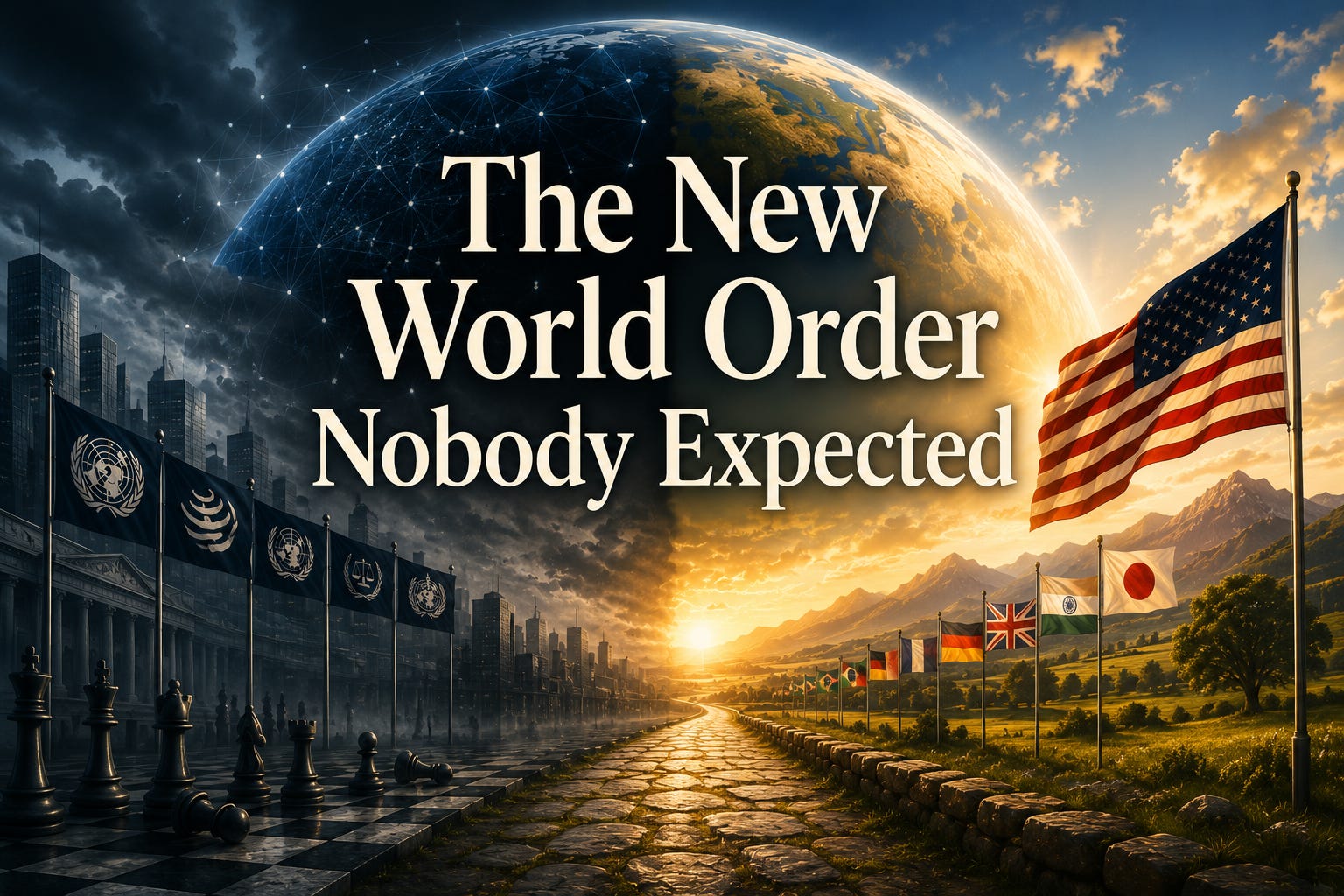
The New World Order Nobody Expected
For nearly three decades after the collapse of the Soviet Union, the world’s political and economic elites believed they knew where history was headed. The nation-state would gradually give way to international institutions. Markets would become global. Borders would matter less. International courts would become more influential. Decisions once made in national capitals would increasingly be made by multinational organizations, trade bodies, international courts, and public-private partnerships. Ironically, the new world order that is emerging bears little resemblance to the one so confidently predicted after the Cold War.
This was the great post-Cold War consensus, a post-war internationalist vision that holds that many of humanity's greatest challenges transcend national borders and therefore require international cooperation, shared institutions, and expert-informed policymaking.
Whether one called it globalization, global governance, the rules-based international order, stakeholder capitalism, or even the New World Order, the philosophy was remarkably consistent.
The underlying assumption was that nations would prosper by surrendering a measure of sovereignty to a growing network of international institutions designed to manage an increasingly interconnected world. They even gave this future a name. Heck, their leaders even wrote books about how the COVID-19 pandemic would rewrite world politics to reflect a one world government based on socialist principles. A new, more woke ethos would become the norm.
Stakeholder capitalism envisioned governments, multinational corporations, financial institutions, and international organizations working in increasingly close partnership to achieve common economic, environmental, and social objectives. This blurred the distinction between public authority and corporate power while diminishing democratic accountability. Stakeholder capitalism incorporated DEI positions favoring mass immigration of people from poorer countries into wealthier ones - to stop population decline, open borders, centralized vaccination campaigns, world trade agreements, etc.
What many people forget is that this represented a dramatic departure from the international system that had governed relations between nations for nearly four centuries. Beginning with the Peace of Westphalia in 1648, nation-states became the organizing principle of international affairs. The assumption was straightforward: governments exist first to govern their own people. Cooperation between nations was encouraged, but sovereignty remained paramount.
The post-Cold War consensus challenged that premise by arguing that many decisions could be better made above the level of the nation-state.
The European Union became its most ambitious political experiment.
The World Trade Organization would regulate international commerce.
The International Criminal Court would expand universal jurisdiction.
The World Health Organization would coordinate global public health.
The World Economic Forum became the annual gathering place where political leaders, multinational corporations, financial institutions, and international organizations discussed the future of global governance. In 2016, the WEF said the quiet part out loud, even declared in a video that soon people would “own nothing and be happy.” Yep, the Great Reset was a thing.
Many of us questioned this direction long before it became fashionable to do so. Not because international cooperation is undesirable. Nations will always cooperate where their interests align.
But cooperation is fundamentally different from governance.
The assumption underlying the post-Cold War consensus was that what benefits “the world” necessarily benefits individual nations. Experience has demonstrated that this is often not the case. The promise was that transnational governance would make everyone wealthier, in fact - the opposite is true.
Starting under President Clinton in the 1990s, U.S. trade policy increasingly prioritized global economic efficiency over the resilience of domestic manufacturing. The North American Free Trade Agreement (NAFTA), signed into law in 1993, accelerated the relocation of manufacturing to Mexico, where companies could take advantage of lower labor costs and a less burdensome regulatory environment. Estimates of the resulting job losses vary widely, from roughly 40,000 to more than 700,000 U.S. manufacturing jobs. But few dispute that entire manufacturing communities were hollowed out as factories closed or moved overseas.
The creation of the World Trade Organization in 1995, followed by China’s admission in 2001, accelerated those trends. International trade expanded, and consumers enjoyed lower prices on many imported goods. But those savings came at a cost. Millions of American manufacturing jobs left the United States over the following decades, supply chains migrated overseas, and many once-thriving industrial towns experienced long-term economic decline.
Prosperity depends on far more than what consumers pay at the checkout counter. It also depends on good-paying jobs, stable employment, affordable housing, accessible healthcare, educational opportunity, and the resilience of local communities. The post-1990 trade agreements improved the first while undermining the others.
The promise was that global supply chains would create unprecedented efficiency. Instead, Americans discovered during the COVID-19 pandemic that we no longer manufactured many of the medicines, medical supplies, semiconductors, and other strategic products upon which our lives depended. Efficiency had come at the expense of resilience.
The same philosophy reshaped our food system. We were told that feeding the world represented both humanitarian leadership and sound economic policy. In practice, those policies favored multinational agribusinesses capable of producing vast quantities of globally traded commodity crops while undermining traditional agriculture in developing nations, as well as domestically. Here at home, American farming became increasingly optimized for export markets, processed foods, and industrial efficiency rather than the nutritional quality, food security, and resilience of our own food supply. Shelf-stable, ultra-processed foods formulated with roughly 10,000 food additives and chemicals, many introduced through the GRAS process based largely on manufacturer-submitted evidence, became the norm because they could be produced cheaply, and shipped anywhere. Convenience and global commerce prevailed, at the expense of America’s health.
These developments unquestionably created winners.
Large multinational corporations benefited.
Global financial institutions benefited.
International consulting firms benefited.
Nations that the United States traded with benefited.
But the question every sovereign government should ask is not whether globalization created aggregate wealth. The question is whether it fulfilled its first responsibility to its own citizens.
That is the central idea behind America First, which the globalists frequently mock as isolationism. It is nothing of the sort.
Every nation has not only the right but the obligation to place the welfare of its own citizens at the center of public policy. In fact, many thriving nations do place their own citizens first. Japan, India, China, Israel, and increasingly many European nations all pursue policies they believe advance their own national interests. The United States should be no different. Virtually every successful nation pursues policies designed to advance its own strategic interests.
Trump Changed the Conversation
What is fascinating is that the institutions built upon the post-Cold War consensus now appear to recognize that the world has changed.
The World Trade Organization increasingly finds itself unable to enforce the rules that once governed international commerce. By blocking appointments to the WTO’s Appellate Body, the United States effectively disabled the organization’s final dispute-settlement mechanism, restoring greater freedom for sovereign nations to pursue their own trade policies rather than submit to supranational adjudication. President Trump’s embrace of tariffs, bilateral negotiations, and economic statecraft reflects a broader shift away from rules-based globalization and toward the primacy of national interests.
The International Criminal Court now faces an even more direct challenge. Secretary of State Marco Rubio has announced a diplomatic campaign to isolate and ultimately dismantle the Court, arguing that no international tribunal should claim authority over American citizens or officials. Together, these developments signal more than a change in policy. They represent a deliberate reassertion of national sovereignty over institutions that once appeared destined to govern an increasingly globalized world.
The World Economic Forum itself has begun speaking less about transnational governance as an inevitable destination and more about resilience, strategic competition, industrial policy, critical minerals, and supply-chain security. Davos now acknowledges that the world is entering what it calls an "Age of Competition."
The institution that once symbolized globalization now openly discusses fragmentation, economic security, and geopolitical rivalry as defining features of the emerging international order. At the same time, the Forum's ongoing leadership transition and governance reforms appear to reflect a growing emphasis on business leadership and organizational restructuring over the climate-centric agenda that dominated much of the previous decade.
These institutional changes represent an intellectual surrender of the assumptions that dominated international politics from roughly 1990 through 2024. The organizing principle is no longer transnational governance. It is sovereignty.
International cooperation, trade, and scientific collaboration remain valuable. None, however, should supersede the primary obligation of elected governments to serve and protect their own citizens.
The irony is unmistakable. For years, critics warned that a “new world order” would emerge in which international institutions gradually displaced national sovereignty. Instead, a very different new world order appears to be taking shape.
Not one governed from Brussels or coordinated from Davos or even adjudicated in The Hague. Instead, we are returning to something far older and, arguably, far more stable.
A world of independent nations cooperating where their interests align, competing where they do not, and accepting that no international institution can permanently substitute for the judgment and accountability of self-governing peoples.
The post-Cold War consensus may have reached its end. What appears to be returning is something much older: the Westphalian principle that sovereign governments exist first to serve their own people. In the case of the United States, establishing a constitutional republic and representative democracy has proven to be an extraordinary success. This is something to be cherished and it is time to return to those principles.
Ultimately, good governments derive their legitimacy not from international organizations, multinational corporations, or global summits. They derive it from the consent of the governed. That was the genius of the Westphalian tradition, and later of the American constitutional republic. Governments exist to serve their own citizens. International cooperation can be beneficial, but it must always remain subordinate to that first obligation, to serve and protect their own citizens.
The New World Order envisioned by its proponents never lived up to the hype that it was better for the world to harmonize as one, frictionless business venue. Instead, the world leaders and its citizens appear to be returning to a much older idea: each nation is accountable to their own people, cooperating where their interests align and competing where they do not.
President Trump’s presidency has accelerated this paradigm and given political voice to millions of Americans who believe their government had forgotten its first responsibility: serving its own people.
If you found this essay thought-provoking, I hope you’ll consider becoming a subscriber.
Independent voices survive only because readers choose to support them. We don’t have corporate sponsors, government grants, or billionaire backers shaping what we write. We rely on people like you who value independent analysis, historical perspective, and a willingness to question prevailing narratives.
Your subscription allows us to continue researching, writing, traveling, speaking, and tackling the difficult topics that too many others avoid.
If this work has informed, challenged, or encouraged you, please consider subscribing and sharing it with friends and colleagues. Every subscription helps ensure that independent journalism and thoughtful debate remain alive and well.
Thank you for reading, and for being part of this community.
JGM/RWM
The number one reason that the "New World Order" was always destined to fail is a very old problem...human nature!
Any time one group is artificially placed into a position of power and control over the lives of other people, with little to no accountability, things will go wrong, slowly at first and then, suddenly, all at once!
The people who gravitate towards those positions are usually the very worst people to be granted that type of power. They are both arrogant and ignorant, autocratic, and self serving.
Our founders understood this dynamic well. They held to the "tragic vision"* of mankind and wrote the Constitution as a safeguard against such people. Sadly, now, our government is full of people who instead hold to the "anointed vision"* and believe themselves better qualified than "regular" people to manage society, when, more often than not, they cannot even manage their own lives!
* Highly recommend the trilogy of books on this subject written by Dr. Thomas Sowell - A Conflict of Visions, The Vision of the Anointed, The Quest for Cosmic Justice.
Excellent article and I want to thank you