

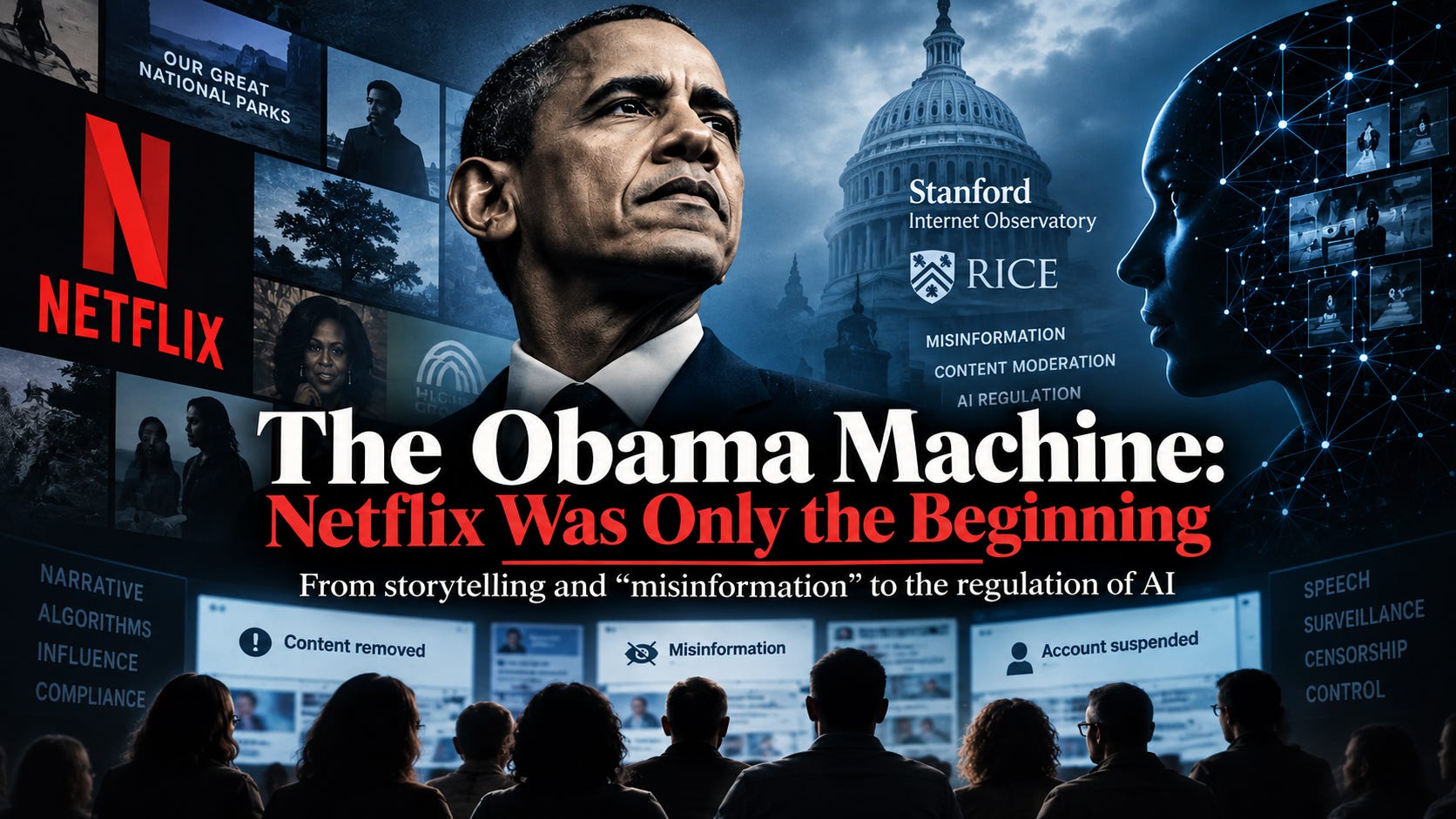
Audio Version:
The deeper story of Netflix is not simply that another American corporation drifted left, adopted DEI, and began producing programming that many Americans find politically tiresome. It is the story of how entertainment, politics, government, technology, and the management of information have gradually converged, with Barack Obama and the political network surrounding him appearing repeatedly at the intersections. Once those connections are placed on a timeline, Netflix begins to look less like the story itself and more like one piece of a much larger post-presidential Obama project involving culture, political organization, information management, and now artificial intelligence, all accompanied by an expanding argument for regulation and control of the systems through which Americans communicate and obtain information. The justification offered again and again is the protection of democracy. The uncomfortable question is what happens to democracy when protecting it increasingly requires someone to decide which information the public should be permitted to hear, and even how "democracy " is defined.
The story begins, strangely enough, with Netflix co-founder Marc Bernays Randolph. Randolph was Netflix’s first CEO and came from one of the most remarkable families in the history of modern persuasion. Sigmund Freud was a relative, but the more relevant connection was Edward Bernays, Freud’s nephew and Randolph’s great-uncle, commonly described as the father of modern public relations. Robert and I explored Bernays and the history of modern propaganda in considerable depth in our book PsyWar: Enforcing the New World Order. But the essential point here is that Bernays saw public relations as something far more powerful than simply selling soap or cigarettes.
His famous 1928 book was bluntly titled Propaganda, and his central insight was that human behavior could be influenced by manipulating desires, fears, symbols, and social expectations, often without the people being influenced recognizing what was happening. Randolph himself has acknowledged the peculiar family connection. His own professional career was built around direct marketing, branding, and consumer behavior, and he has remarked upon how closely his work resembled Bernays’s.
Randolph left the company in 2003, long before Netflix became the cultural colossus it is today, and pretending otherwise would turn an interesting historical connection into an unsupported conspiracy theory. But what Netflix subsequently became would probably have fascinated Uncle Edward. A company that began by mailing DVDs eventually built one of the most powerful storytelling and behavioral-data platforms in human history, capable of learning what hundreds of millions of people watch, recommending what they should watch next, and placing cultural narratives directly into their homes. The question is not whether Netflix possesses that power. Obviously it does. The question is what happened when the people running and influencing that institution began explicitly viewing storytelling as a mechanism for changing society.
Netflix formally incorporated “inclusion” into its corporate culture in 2017. This was not confined to the unobjectionable proposition that qualified people should receive equal opportunities to work there. Netflix explicitly connected representation inside the corporation with representation on the screen: who gets hired, who gets to tell stories, and who tells stories with which stories audiences ultimately see.
The company adopted an institutional philosophy that changing the composition and worldview of the people producing entertainment would change the entertainment itself, and influence culture worldwide. What critics later called “woke Netflix” was therefore not simply an accidental accumulation of unusually progressive writers and producers. Netflix itself described inclusion as part of the machinery through which content was created.
Then came 2018. On March 28, Netflix appointed Susan Rice to its board of directors. Rice was not a Hollywood producer or entertainment executive. She had been Barack Obama’s ambassador to the United Nations and his National Security Advisor, one of the most powerful foreign-policy officials in the Obama administration.
Less than two months later, on May 21, Netflix announced an extraordinary production partnership with Barack and Michelle Obama. The Obamas created Higher Ground Productions and entered a multi-year agreement under which Netflix would distribute their films, television programs, documentaries, and other productions to a service that already reached approximately 125 million member households in 190 countries.
This was not a former president retiring to write his memoirs. It was a former president entering the global entertainment business in order to exert cultural and political influence, and the Obamas were remarkably candid about why. Michelle Obama explained that storytelling could inspire people and make them think differently about the world around them. Barack Obama later explained that Higher Ground had been created to “harness the power of storytelling.” Its productions would address race, class, democracy, and civil rights, and would not merely entertain. They would “educate, connect, and inspire.” Netflix later described Higher Ground as producing stories that embodied the values the Obamas had championed throughout their lives. Those are not accusations made by conservative critics. Those are descriptions supplied by the Obamas and Netflix.
This is also why the endless argument about whether individual “woke” Netflix programs receive good ratings misses much of the point. Some have succeeded spectacularly. Others have failed spectacularly. Netflix itself remains enormously successful, and people continue watching thrillers, romances, crime dramas, children’s programming, Korean television, fantasy, documentaries, and action movies by the billions of hours. But cultural influence does not require an audience to deliberately select something called A Progressive Guide to Social Justice. In many ways, that would defeat the purpose.
The most powerful cultural assumptions are often the ones the audience is not consciously debating at all. Ideas about race, sex, gender, marriage, government, capitalism, social democracy, American history, and social justice can be incorporated into entertainment until they simply become part of the fictional world being consumed. The viewer never has to agree to attend the lecture because there appears to be no lecture. The action movie gets the viewer through the door. The cultural assumptions come with the subscription.
Susan Rice’s career provides an unusually clear illustration of how thoroughly the political and cultural worlds had begun to merge. Rice joined Netflix’s board in 2018 and remained there until January 2021, when she left the company and returned to government as President Biden’s Domestic Policy Advisor. There she became centrally involved in an administration that elevated “equity” into an organizing principle across the federal bureaucracy. Rice left the Biden White House in May 2023. Four months later, she was back on Netflix’s board. Obama administration to Netflix. Netflix to Biden administration. Biden administration back to Netflix.
Corporate directors operate at the level of governance, executive oversight, leadership, risk, and institutional strategy, and Susan Rice is no different. The more important point is what the revolving door reveals. Government, political networks, Silicon Valley, and entertainment increasingly draw from the same pool of people carrying many of the same assumptions about race, equity, democracy, information, and social change.
Barack Obama, meanwhile, never really left politics. He changed the mechanisms through which influence could be exercised. The Obama Foundation develops future civic and political leaders. The Obama Presidential Center is intended to carry his political philosophy and institutional legacy into another generation. Higher Ground operates in entertainment and culture. Obama himself has remained an influential Democratic adviser, fundraiser, and political figure. Kamala Harris had a longstanding relationship with Obama, and Obama supported Joe Biden’s selection of Harris as his vice-presidential running mate in 2020. Obama also supported Harris’ selection as Biden’s replacement.
What happened after Harris was installed without a Democrat primary is considerably more revealing. Once Harris became the presumptive nominee, a substantial portion of the Obama political machinery moved into her campaign. David Plouffe, Obama’s 2008 campaign manager and one of the architects of his political operation, became a senior Harris adviser. Stephanie Cutter, Obama’s former communications director and 2012 deputy campaign manager, joined the operation. Other Obama veterans followed, while Harris campaign chair Jen O’Malley Dillon was herself an Obama campaign veteran. Obama’s presidency had ended years earlier, but the network had not. Political power had become institutional power, capable of surviving the individual administration that created it.
Then came Stanford, and this is where the Netflix story becomes considerably more consequential. On April 21, 2022, Obama delivered a major address at an event co-hosted by the Stanford Cyber Policy Center and the Obama Foundation called Challenges to Democracy in the Digital Information Realm. The subject was not primarily foreign affairs, taxation, health care, or any of the conventional issues associated with a former president. It was the architecture of information itself. Obama discussed algorithms, social media, disinformation, platform responsibility, Section 230, and the effect of digital information systems on democracy. His conclusion included an extraordinarily important sentence: “Regulation has to be part of the answer.” The Obama Foundation described the larger project as finding a new “North Star for the internet.”
What does still nag at me, though, was my failure to fully appreciate at the time just how susceptible we had become to lies and conspiracy theories despite having spent years being a target of disinformation myself. Social media companies already make choices about what is or is not allowed on their platforms and how that content appears, both explicitly through content moderation and implicitly through algorithms. The problem is we often don’t know what principles govern those decisions in some cases, industry standards may replace or substitute for regulation, but regulation has to be part of the answer.
Barak Obama, Stanford, 2022
There is another fact about Obama's Stanford appearance that makes the speech considerably more significant. Stanford was not simply a prestigious university providing a convenient auditorium. The event was co-hosted by the Obama Foundation and Stanford's Cyber Policy Center, and housed within that same Cyber Policy Center was the Stanford Internet Observatory, one of the central academic participants in the emerging government-industry-academic machinery for monitoring what Americans said online. The Observatory helped lead the Election Integrity Partnership, which worked with social-media companies to identify and refer election-related content to the government for potential action.
A later Republican-led House Judiciary investigation produced internal correspondence stating that the Election Integrity Partnership had been created “at the request of DHS/CISA,” along with the underlying Jira ticket system used to track supposedly problematic speech. The Stanford operation subsequently participated in the Virality Project, which extended this machinery from election-related claims into COVID-19 and vaccine narratives. Robert himself appears in those records. His supposed offense was his June 2021 Tucker Carlson interview, in which he argued that the risks of COVID vaccination outweighed the benefits for teenagers and young adults. But the Jira record did not merely describe the claim being monitored. It also categorized Robert’s affiliations as “right wing” and labeled him “general anti-vaccination.” The House Judiciary Committee subsequently concluded that the EIP’s system disproportionately targeted conservative speakers.
This information-management machinery was not merely academic. The consequences for the people caught in it were real. Robert was permanently removed from Twitter on December 29, 2021, wiping out an audience of more than half a million followers at the height of the national debate over COVID vaccine policy. His professional LinkedIn presence was also ultimately permanently banned, while his reach on other major platforms was restricted or diminished. The documentary record shows that, during this same period, Robert was being tracked through the EIP/Virality Project's Jira system, where his political affiliation was explicitly categorized as “right wing” alongside the supposedly offending vaccine claims. The practical result is difficult to dismiss: a credentialed scientist publicly challenging government COVID policy was simultaneously being monitored within the government-linked misinformation apparatus and losing access to the dominant digital platforms through which he communicated with the public. Twitter eventually restored his account after the company changed ownership. LinkedIn did not. The audience, professional network, and reach destroyed by those decisions were not restored simply because one account was later returned.
That makes what happened at Stanford in April 2022 difficult to dismiss as an unrelated academic exercise. The very first panel at Obama’s event was titled “The Trust Problem” and asked, “What is the role of the U.S. government in facilitating consensus and reducing polarization at home?” Its moderator was Renée DiResta, then research manager at the Stanford Internet Observatory. Obama's keynote is worth reading in that institutional context.
At an event co-hosted by his own foundation and the Cyber Policy Center that housed the Stanford Internet Observatory, Obama argued that online disinformation threatened democracy, called for reconsideration of Section 230, and said explicitly that “regulation has to be part of the answer.” Even more revealingly, he described the internet and social media as tools that “we can remake,” adding that society must decide what it values and then use those tools to advance those values.
What this all establishes is a striking convergence: Obama was publicly calling for greater intervention in the digital information environment from within an institutional ecosystem already deeply involved in building mechanisms through which government, academia, and technology companies could identify, refer, moderate, suppress, or otherwise reduce the reach of information deemed false or harmful.
Obama’s language deserves considerably more scrutiny than it received. The former president who had entered the global storytelling business was now making the regulation of the information environment itself a major part of his post-presidential agenda. The argument was presented in the reassuring vocabulary that has become familiar throughout the Western political establishment: democracy, safety, truth, responsible platforms, healthier discourse, misinformation, and protection from manipulation.
But underneath every one of those abstractions sits a very old and very dangerous political question. Who decides what constitutes misinformation? Who decides which speech is dangerous? Who determines what gets amplified, suppressed, demonetized, labeled, or removed? And what happens when the government officials, foundations, academics, corporations, and technology companies answering those questions overwhelmingly share the same political and cultural worldview? What happens when that viewpoint is skewed by globalism, leftist propaganda, and woke ideologies?
Those questions became considerably less theoretical during the Biden administration. Subsequent litigation, later known as Murthy v. Missouri, exposed extensive communications between federal officials and social-media companies about COVID-19, vaccines, elections, and alleged misinformation. The Fifth Circuit reviewed that record and concluded that the White House and Surgeon General’s office likely violated the First Amendment, finding that officials coerced platforms and significantly encouraged their content-moderation decisions. The Supreme Court refused to rule that this conduct was constitutional. Instead, the six-justice majority explicitly said, “We begin—and end—with standing,” concluding that the plaintiffs had not established the standing necessary to obtain a forward-looking injunction and that the Court therefore lacked jurisdiction to reach the merits. In other words, the Supreme Court left the central First Amendment question unresolved.
But the underlying communications were not hypothetical, and they did not disappear because the Supreme Court disposed of the case on standing. White House officials flagged content to platforms, demanded explanations for material that remained online, pressed for faster and more aggressive enforcement, threatened social media companies if they didn’t comply with their censorship demands, and questioned the platforms' moderation policies. Facebook personnel discussed “Specific Asks from the White House.” Press Secretary Jen Psaki publicly acknowledged that the administration was flagging “problematic posts” for Facebook. The Supreme Court never resolved the legal question of when those interactions crossed the constitutional line, though the Fifth Circuit did. What remains is the documentary record itself: the federal government had inserted itself into the machinery controlling the flow of information, pressuring private platforms over which Americans would be heard, which opinions would be suppressed, and which version of events would be allowed to circulate.
That history changes the meaning of pleasant-sounding discussions about creating a healthier information environment. For Americans whose speech was restricted, labeled, suppressed, or algorithmically buried during the COVID era, the issue is not theoretical. The danger exists whenever government officials, politically aligned institutions, and enormously powerful information companies begin sharing assumptions about what constitutes dangerous information. No smoky room is required. No secret memorandum has to be signed. Institutional alignment can accomplish a remarkable amount when the people staffing government, foundations, universities, media companies, and technology platforms have already reached similar conclusions about what constitutes truth, misinformation, equity, democracy, social justice, and acceptable speech.
Seen this way, Obama’s post-presidential career resolves into three parallel channels of influence. The first is political power: the Obama Foundation, Democratic Party relationships, fundraising, advising, and a political network whose personnel continue appearing in presidential campaigns long after Obama left office. The second is information power: Stanford, disinformation, algorithms, Section 230, platform responsibility, and increasingly explicit arguments that government regulation should help manage the digital information environment. The third is cultural power: Higher Ground and Netflix, using what Obama himself calls the “power of storytelling” to address race, class, democracy, and civil rights while reaching an audience no political campaign could approach.
“Politics is downstream of culture”
Andrew Brietbart
“Politics is downstream from culture” is the most famous quote attributed to Andrew Breitbart, the American media publisher and conservative commentator who passed away in 2012.
The phrase, often referred to as the “Breitbart Doctrine,” posits that political outcomes are a result of prevailing cultural values, beliefs, and norms. Consequently, the doctrine argues that to effect meaningful political change, one must first shift the broader culture. An axiom of this is that scientism has replaced religion, and this is associated with a priesthood of anointed physicians and scientists. And, as any theology student will attest, religion is upstream of culture.
These channels do not have to be centrally coordinated to reinforce one another. Politics determines rules. Information systems determine which arguments people encounter. Culture shapes many of the assumptions through which people interpret those arguments. One operates through elections and government. Another operates through algorithms, search, moderation, and information distribution. The third operates through stories, heroes, villains, historical narratives, children’s programming, documentaries, and entertainment. Taken together, they represent a far more sophisticated mechanism of cultural influence than anything Edward Bernays could have imagined when he wrote Propaganda nearly a century ago.
And now the same argument has arrived at artificial intelligence. In September 2026, at a Democratic fundraiser, House Minority Leader Hakeem Jeffries asked Obama what Democrats should do about AI. Obama urged Democrats to make artificial intelligence a central part of their agenda and argued that, if Democrats regain control of the House after the midterm elections, they should establish a framework for a major public conversation about AI. He also urged future presidential candidates to develop clear AI agendas. Days later, Jeffries publicly identified AI as a high priority for House Democrats.
There are legitimate reasons to worry about artificial intelligence. Fraud, cybersecurity, autonomous weapons, labor displacement, deepfakes, privacy, and genuinely dangerous advanced systems deserve serious consideration. The existence of those problems does not establish that AI regulation is secretly a censorship program, and it would be foolish to make that assertion without evidence. But Obama’s history makes a different question unavoidable: what exactly will be regulated? Artificial intelligence is rapidly becoming the machinery through which Americans search for information, summarize history, compare arguments, evaluate evidence, write, create media, and increasingly understand the world. Regulation of AI therefore has implications extending far beyond whether a chatbot produces a dangerous recipe or a convincing deepfake. The rules governing AI can potentially influence the boundaries within which machines are permitted to answer questions at all. It will be and already is the next frontier in government censorship.
That is why Obama’s sudden emphasis on AI cannot reasonably be viewed in isolation from his broader post-presidential project. At Stanford he argued that the information environment itself required intervention and that government regulation had to be part of the answer. Through Higher Ground, he explicitly embraced storytelling as a means of educating and changing how people understand the world. Through his Foundation he has made democracy, information, and leadership development continuing institutional projects. Through the Democratic Party his political network has remained remarkably durable.
Now he is urging congressional Democratic leadership to make regulation of the most powerful information technology ever created a central agenda after the midterms. This provides ample reason to scrutinize any regulatory architecture that gives government, politically aligned institutions, or dominant technology companies greater authority over what artificial intelligence may say, particularly when the justification once again arrives wrapped in the language of protecting democracy from dangerous information.
The timing deserves scrutiny. An almost unknown 27-year-old Anthropic researcher resigned and warned that AI could kill humanity. He announced his departure internally on Anthropic’s Slack, and roughly thirty minutes later the Wall Street Journal had the story. Only afterward did he publish his public resignation statement on X, where a network of AI-safety advocates immediately amplified it. Within days, the CEOs of some of the world’s largest AI companies were publicly calling for a slowdown, government standards and outside control of frontier models. But the regulatory agenda had not suddenly appeared with Coxon’s resignation.
Anthropic’s Dario Amodei, OpenAI’s Sam Altman and Google DeepMind’s Demis Hassabis had already spent months converging on federal oversight of the technology they themselves dominate. Obama, meanwhile, had been talking privately with both Altman and Amodei about AI safety. Then, at a closed-door Democratic fundraiser, Hakeem Jeffries specifically raised Coxon’s resignation with Obama. Obama urged Jeffries to make AI a central Democratic agenda if his party retakes the House. Days later Jeffries was publicly demanding urgent action and invoking the CEOs’ call to slow development. This shows how quickly an industry-generated doomsday narrative traveled from a virtually unknown researcher, through the national media and America’s dominant AI companies, into a private conversation with a former president, and from there into the stated legislative agenda of the man who hopes to become the next Speaker of the House.
So who benefits from all of this regulation? The largest AI companies certainly can. OpenAI, Anthropic, Google and the other industry giants can afford armies of lawyers, compliance officers, safety researchers and government-relations specialists. A startup, university laboratory or independent developer cannot. Regulations requiring expensive testing, licensing and government approval can therefore protect the companies already dominating AI while making it far harder for new competitors to challenge them.
Government gains something too. An Obama political circle that has spent years arguing that the “information environment” must be managed and regulated now has an opportunity to help write the rules governing the technology that may soon become the world's primary gateway to information. The extraordinary concentration of corporate and government power produced by their proposed solutions should scare us all.
Nor is this confined to the United States. Europe has already moved much further toward regulating online speech and artificial intelligence through the Digital Services Act and AI Act. But the internet does not respect national borders. Global technology companies that want access to Europe's 450 million consumers must comply with European rules, and it can be easier to build those restrictions into their global platforms than maintain entirely separate systems. The result is the so-called “Brussels Effect”: European regulators can influence what Americans see, what platforms permit, and how AI behaves without Americans ever voting for a single one of them.
The Western world is deciding who will govern the information systems of the twenty-first century. Netflix initially looked like a story about an entertainment company that became political. It turns out to be a window into something much larger. Barack Obama’s post-presidential career has repeatedly converged on institutions that shape political leadership, popular culture, and the flow of information.
A government does not have to burn books to acquire enormous influence over political discourse. It can pressure platforms, define misinformation, regulate algorithms, establish rules for artificial intelligence, and encourage private institutions to police information according to standards government itself helped establish. At the same time, cultural institutions can normalize a political worldview through entertainment until ideas that were once controversial simply become the background assumptions of everyday life.
Each piece can be defended individually as reasonable. Netflix is only telling stories. Higher Ground is only making movies. Stanford is only studying disinformation. The Obama Foundation is only training leaders. Government officials are only protecting people from misinformation. Regulators are only making AI safe. The political network is only helping Democratic candidates win elections. Perhaps every individual involved sincerely believes exactly that. The problem appears when all of these pieces are placed beside one another and the direction of travel becomes visible. The danger is not necessarily a conspiracy. The danger is a system in which the same political assumptions increasingly dominate the institutions that produce culture, define misinformation, regulate information technology, train political leadership, and determine the permissible boundaries of digital speech.
That is why the question of whether Netflix has become “woke” now seems almost quaint. Netflix is only one piece of a much larger struggle over who gets to shape the stories Americans hear, which information Americans find, and increasingly which answers their machines are permitted to give them. Ronald Reagan famously warned that freedom is never more than one generation away from extinction. The modern threat to that freedom may not arrive wearing jackboots or carrying a list of banned books. It may arrive promising safety, inclusion, equity, responsible information, and the protection of democracy itself. Edward Bernays understood a century ago that the most effective propaganda does not feel like propaganda.
Perhaps the most dangerous form of censorship is the one people never recognize as censorship at all, because someone else has already decided which stories they will hear, which facts they will find, and which ideas they will never encounter.
By: JGM/RWM
If this essay made you uncomfortable, good. It made me uncomfortable to research it. Connecting these dots takes time, primary documents, court records, congressional reports, corporate filings, and a willingness to follow the evidence wherever it leads. Malone News is reader-supported precisely because independence matters when the subject is who controls the information Americans are allowed to see.
If you value investigations like this, please consider becoming a paid subscriber. The best defense against a managed information environment is an independent one.
References
Malone, Robert W., and Jill Glasspool Malone. PsyWar: Enforcing the New World Order. Skyhorse Publishing, 2024. See particularly the discussion of Edward Bernays, modern propaganda, the Election Integrity Partnership, Virality Project, Jira ticketing system, and censorship-industrial complex. The book documents the Jira entry concerning Robert Malone, including the descriptors “right wing” and “general anti-vaccination.”
Bernays, Edward L. Propaganda. Horace Liveright, 1928. Foundational statement of Bernays’s theories concerning public opinion, persuasion, and the organized manipulation of attitudes.
Netflix. “Ambassador Susan E. Rice Appointed to Netflix Board of Directors.” March 28, 2018. Rice, formerly Barack Obama’s National Security Advisor and U.N. Ambassador, joined Netflix’s board less than two months before the Obama production agreement was announced.
Netflix announcementNetflix. “Netflix Forming Storytelling Partnership With Barack and Michelle Obama.” May 21, 2018. Announces the multi-year Higher Ground agreement and states that its productions would be available to Netflix’s then-125 million member households in 190 countries.
Netflix-Higher Ground announcementHigher Ground Productions/Netflix. “Higher Ground Announces Upcoming Slate of Projects Exclusive to Netflix.” April 30, 2019. Particularly important for Obama’s statement that Higher Ground was created to “harness the power of storytelling” and that projects involving race, class, democracy and civil rights would educate as well as entertain.
Higher Ground project announcementNetflix. “Inclusion at Netflix.” Netflix Careers. Netflix explicitly connects its internal inclusion policies to what appears on screen, stating that “Better representation on-screen starts with representation in the office.”
Netflix inclusion policyNetflix. “Netflix Reappoints Ambassador Susan E. Rice to Its Board of Directors.” September 9, 2023. Documents Rice’s return after serving as Biden’s Domestic Policy Advisor.
Rice reappointment announcementNetflix, Inc. 2026 Proxy Statement. U.S. Securities and Exchange Commission. Confirms Rice’s continuing service on the Netflix board and Nominating and Governance Committee, and describes her government and public-policy expertise as relevant to Netflix.
Netflix 2026 proxy statementNetflix, Inc. Form 8-K, June 5, 2026. SEC filing confirming Rice and the other Netflix directors were reelected at the 2026 annual meeting.
Netflix June 2026 SEC filingStanford Freeman Spogli Institute/Cyber Policy Center. “Challenges to Democracy in the Digital Information Realm.” April 21, 2022. Official program for the Obama Foundation/Stanford Cyber Policy Center event. Particularly relevant is Panel I, moderated by Stanford Internet Observatory research manager Renée DiResta, asking: “What is the role of the U.S. government in facilitating consensus and reducing polarization at home?”
Stanford event program and Obama transcriptStanford University. “Disinformation is weakening democracy, Barack Obama said.” April 21, 2022. Stanford’s account of Obama’s keynote, including his statement that “regulation has to be part of the answer,” his discussion of Section 230, algorithms, AI/deepfakes and the information environment.
Stanford report on Obama’s speechObama Foundation. “President Obama Speaks at Stanford on Disinformation.” April 2022. The Foundation framed Obama’s project as establishing a new “North Star” for the internet and addressing the effects of the digital information environment on democracy.
U.S. House Committee on the Judiciary and Select Subcommittee on the Weaponization of the Federal Government. Interim reports and supporting documents concerning CISA, the Election Integrity Partnership, Stanford Internet Observatory and the Virality Project. These materials form an important basis for the essay’s discussion of government-academic-platform relationships.
U.S. Court of Appeals for the Fifth Circuit. Missouri v. Biden, No. 23-30445, September 8, 2023. The appellate court agreed that some federal officials had likely coerced or significantly encouraged social-media censorship in violation of the First Amendment and modified the district court’s injunction accordingly.
Fifth Circuit opinionSupreme Court of the United States. Murthy v. Missouri, 603 U.S. 43 (2024), decided June 26, 2024. The Court reversed on standing grounds rather than deciding whether the challenged government conduct violated the First Amendment.
Supreme Court opinionReuters. “How Obama boosted Harris and continues to shape the Democratic Party.” August 20, 2024. Documents Obama’s longstanding relationship with Kamala Harris, his advice to her after Biden’s withdrawal, and the movement of Obama veterans including David Plouffe and Stephanie Cutter into the Harris campaign.
Reuters report on Obama and HarrisThe Wall Street Journal. “The Anonymous Math Geek Who Quit Anthropic—and Became the Face of AI Safety.” September 17, 2026. Detailed reconstruction of Jacob Coxon’s resignation from Anthropic, his contacts with AI-safety advocates, the timing of the Journal’s reporting and his subsequent public announcement, and the rapid amplification of his warnings.
Wall Street Journal investigationThe Wall Street Journal. “Anthropic Researcher Quits Over ‘Out-of-Control’ AI Fears.” September 2026. Contemporary coverage of Coxon’s resignation and warnings concerning catastrophic AI risk.
The Wall Street Journal. “Biggest AI Rivals Agree They Need to Slow It Down.” September 2026. Documents the unusual convergence of Dario Amodei, Sam Altman, Elon Musk and other major AI figures around concerns about the pace and safety of frontier AI development.
The Wall Street Journal. “Congress Is Suddenly Waking Up to the AI Doomsday Threat.” September 2026. Contemporary account of congressional reaction to the AI-safety warnings and proposals for federal oversight.
Reuters. “Obama voices caution on AI, urges Democrats to tackle it, NYT says.” September 13, 2026. Reports Obama’s discussion with House Minority Leader Hakeem Jeffries at a private Democratic fundraiser and Obama’s recommendation that AI become a central Democratic agenda if the party regains the House.
Reuters report on Obama, Jeffries and AIOffice of Democratic Leader Hakeem Jeffries. September 2026 statements and interviews concerning artificial intelligence. Jeffries subsequently publicly agreed with Obama that action on AI was necessary and identified AI as a priority for House Democrats.
European Union. Regulation (EU) 2024/1689, the Artificial Intelligence Act. Especially Article 2, establishing that aspects of the Act apply to providers outside the EU when systems or general-purpose models are placed on the EU market, and in specified circumstances when AI output is used within the Union.
Official text of the EU AI ActEuropean Commission. Digital Services Act. Official materials concerning the EU regulatory framework governing online intermediaries and platforms, including services based outside the EU when offered within the European market.
Engler, Alex. “The EU AI Act will have global impact, but a limited Brussels Effect.” Brookings Institution, June 8, 2022. Useful background on the mechanism by which EU technology regulation can influence products and systems outside Europe even when EU law does not formally govern users in those jurisdictions.
Brookings analysis of the Brussels EffectReuters. “Carney says Canada seeks ‘unique alliance’ but not membership with the European Union.” September 13, 2026. Reports discussions of a new Canada-EU relationship and cooperation involving AI, energy, critical minerals and other strategic sectors.
Reuters. “Canada and EU should ally to protect democracies, Carney says, after ‘associate member’ proposal angers Trump.” September 17, 2026. Reports von der Leyen’s proposal for an unprecedented EU “associate member” relationship with Canada and Carney’s response.
Reuters on the Canada-EU proposalReuters. “Highlights from Canadian PM Mark Carney’s speech in Strasbourg.” September 17, 2026. Documents proposed Canada-EU cooperation involving AI, digital trade, defense, energy and strategic infrastructure.
Reuters. “HIGHLIGHTS – EU Commission chief ‘state of the union’ address.” September 16, 2026. Covers von der Leyen’s associate-member proposal for Canada and her parallel call for international cooperation and a slowdown in AI development.
Reagan Presidential Foundation & Institute. Ronald Reagan quotation archive and July 6, 1987 remarks containing the warning that “Freedom is never more than one generation away from extinction.” This is the source for the quotation used in the essay’s conclusion.
31. Randolph, Marc. That Will Never Work: The Birth of Netflix and the Amazing Life of an Idea. Little, Brown and Company, 2019. Randolph discusses growing up surrounded by Freud’s writings and portraits, explains that Freud was his father’s great-uncle, and identifies Edward Bernays as his grandmother’s brother. He describes Bernays as the father of modern public relations who applied psychology and psychoanalysis to marketing. The original hardcover was published September 17, 2019.
Publisher page for That Will Never Work32. Randolph, Marc. “That Will Never Work: The Birth of Netflix and the Amazing Life of an Idea with Marc Randolph.” Interview with Dr. Patty Ann Tublin, The Trust Doctor Podcast. This is the especially useful source for the essay because Randolph himself explicitly connects Bernays’s work to his own career. After discussing Freud, Randolph calls Edward Bernays the relative “more coincidentally aligned with what my career ended up becoming.” He explains that Bernays recognized that it was possible to change how people think without their necessarily recognizing that they were being changed, then observes that he himself spent his life fundamentally as a marketing person and jokes that the Freud/Bernays connection is almost too coincidental not to involve some “DNA connection.”
Full Marc Randolph interview and transcript33. Randolph, Marc. “Marc Randolph: Netflix Co-Founder, Entrepreneur, Mentor & Investor.” Right About Now: Legendary Business Advice. Randolph discusses his twelve years in direct marketing, calls marketing his “first love,” identifies Edward Bernays as his great-uncle and “father of public relations,” and explains how central marketing was to Netflix’s early development.
I noticed the Obama-Rice-Netflix early on. It's the reason I have avoided subscribing, and I continue to encourage others to get rid of it.
AI is scary, but AI under government-controlled-fascist monopoly is scarier.
Decentralized AI with many sources is better natural selection and a safer alternative.
Thank God for Substack. Though they attempted a suppression shenanigan through Stripe, it was unsuccessful. How grateful I am that I can read your posts and have all the dots connected for me. The work you do to inform us is stellar. Thank you so much.