

MALONE.NEWS · BOOK REVIEW
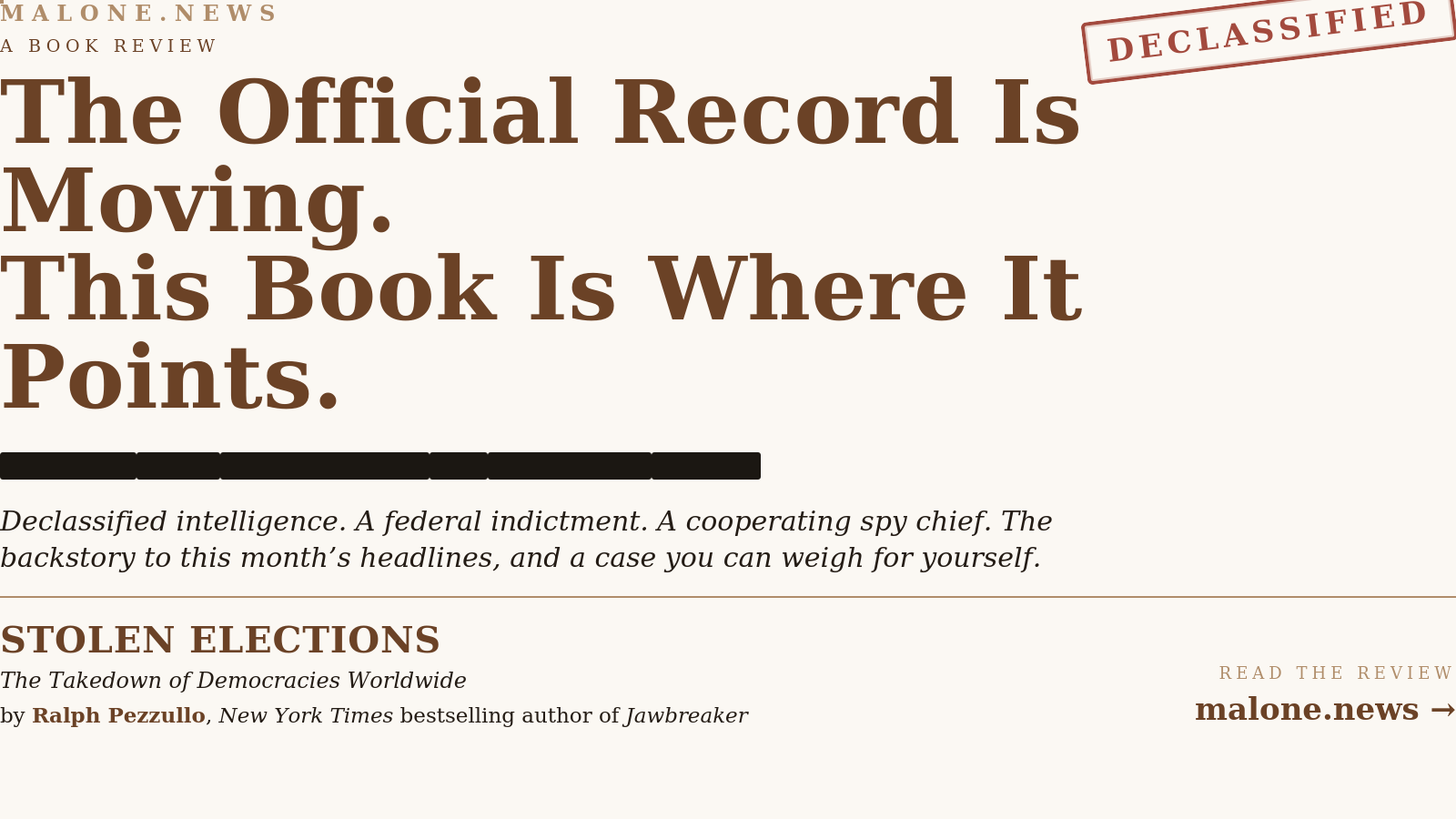
The Official Record Is Moving. This Book Is Where It Points.
The White House has declassified intelligence on voting-system vulnerabilities. A captured Venezuelan spy chief is writing letters to the President. Ralph Pezzullo’s Stolen Elections is the fullest account yet of the story those developments only begin to tell. Read it, and decide for yourself.
Review by Robert W. Malone, MD
On the night of July 16, 2026, President Trump stood in the East Room and declassified a body of intelligence on the security of American elections, then laid it before the country in a primetime address. Alongside the speech, the White House released four sets of documents. They covered vulnerabilities in electronic voting and ballot-counting systems, China’s acquisition of American voter data, a Michigan voter-registration investigation, and noncitizens on state rolls (Fox News 2026).
The centerpiece was a declassified CIA memo dated June 29, 2026. It records that the intelligence community rated Smartmatic’s purchase of the American firm Sequoia Voting Systems a moderate threat to national security in 2006, and that the concern was serious enough to force a divestiture through a federal review in 2007 (Military.com 2026). It summarizes reporting that Venezuela built the capacity to alter its own elections. It also draws one clear line. Neither Smartmatic nor the Venezuelan government, the memo concludes, held the access required to change an election result outside Venezuela (CNN 2026).
That conclusion is the seam between the official record and this book. The record stops at the exact point the book keeps going.
The declassification is one piece of a wider push. The recently resigned Director of National Intelligence, Tulsi Gabbard, had taken an unusual and expanding role in election security prior to her departure. Her office obtained voting machines from Puerto Rico and tested them for vulnerabilities, and she was present as FBI agents executed a 2020-related search warrant in Fulton County, Georgia (CNN 2026). The administration has moved on the policy front as well. A March 2026 executive order on citizenship verification and mail ballots was partly blocked in the courts, then partly revived when a federal appeals court let the Postal Service continue its ballot-mail rulemaking on July 17 (NPR 2026; New York Post 2026). The President has said he intends to end mail-in ballots and the machines themselves before the midterms (The Hill 2025).
And in a jail in Brooklyn sits Nicolás Maduro, captured and brought to New York to face narcoterrorism charges. His former military intelligence chief, Hugo Carvajal, pleaded guilty in 2025, wrote a letter to President Trump in December, and had his sentencing postponed with no new date, which legal observers read as a possible sign of cooperation (CNN 2026). Carvajal’s letter names Smartmatic.
Whatever you conclude about any single item, the larger fact is settled. Three years ago, raising these questions got people banned from platforms. Today the same questions drive presidential declassification, federal prosecution, and executive orders. The topic that was forbidden is now the top of the front page.
Into this moment, a book
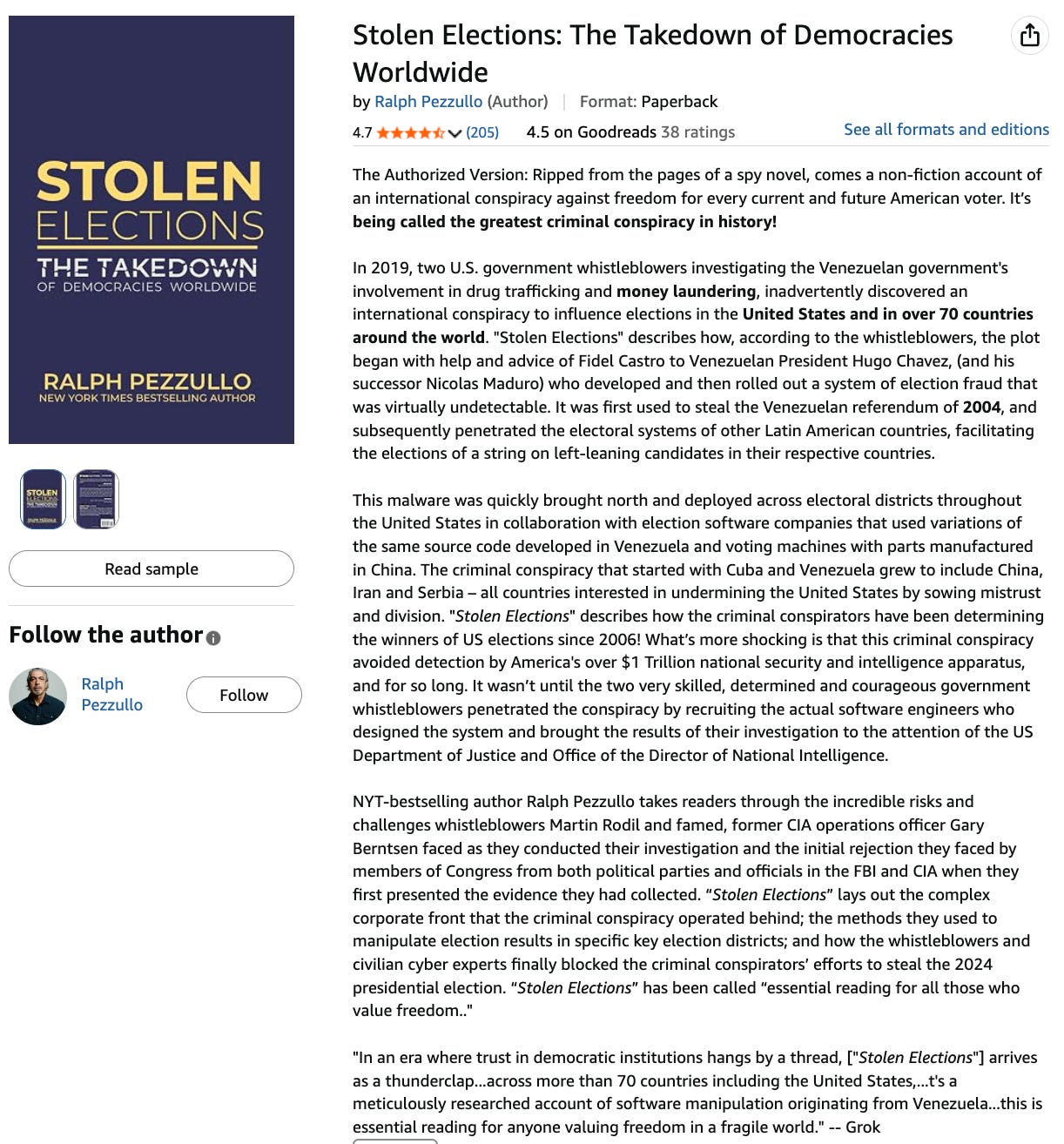
Ralph Pezzullo did not write Stolen Elections to catch a news cycle. He is a New York Times bestselling author who has spent a career co-writing with intelligence and special-operations figures, including the former CIA officer Gary Berntsen, with whom he wrote Jawbreaker. That matters, because Berntsen is one of the two men at the center of this book. The other is Martin Rodil, a Venezuelan-American financial investigator who worked cases for the DEA. Together, the book tells us, they spent four years running a private criminal investigation into election fraud, at real risk to themselves, with no help from the agencies whose job this was, and in some instances against their active resistance. The book’s path to print carried the same friction. Pezzullo says a major trade publisher signed the book and paid an advance, then declined to release it, and he brought it out himself.
I am not going to walk you through what they found. Spoiling it would rob the book of its reason to exist. But the method is worth describing, because the method is what holds you.
Pezzullo writes like the professional storyteller he is. The investigation reads like the field reporting it was, source by recruited source, and the men doing the recruiting are the genuine article rather than podcast personalities. The book does not ask you to take its word. Its appendices carry the documents: the federal indictment of Smartmatic co-founder Roger Piñate, the record of USAID grants that pushed this software abroad, Treasury sanctions, the account of a Serbian engineer at the center of the system, and Carvajal’s letter to the President reproduced in full. When Pezzullo makes a claim you can check, he shows you where to check it. That discipline is rare in this genre, and it is why the book earns a serious reading.
The scope is enormous. Pezzullo argues that the manipulation reaches across seventy-two countries and back through more than a decade of American elections. He traces Smartmatic from a 2004 Venezuelan referendum to the largest county in the United States. He names the people he believes built the system and the people he believes protected it. If even a fraction survives scrutiny, the story is a large one. He believes all of it survives, and he argues it with more specificity than anyone before him.
Where the book goes past the record, and why that is the reason to read it
The memo’s conclusion is where the disagreement starts. The government’s own declassified assessment says the access needed to alter an American election from Venezuela did not exist. Pezzullo argues that it did exist and was used. That is not a small gap. It is the central question, and the administration’s own document lands on the opposite side of it from the book.
I am not going to paper over that, and you should be suspicious of any reviewer who does. Parts of this book rest on anonymous sources whose claims cannot be independently verified. The most sweeping assertions, that specific past presidential outcomes were determined from abroad, go well beyond what any court, any audit, or any declassified memo has established. The Carvajal material is a live development, and reading a former spy chief describe the system from the inside is arresting. It is also a set of allegations from a man who pleaded guilty to narcoterrorism and has every reason to tell this administration what it wants to hear, and no court has tested a word of it. A related document circulating online, a list purporting to name dozens of bribed American senators, appears to be fabricated even by the account of sympathetic writers (Houk 2026). The information environment around this story is treacherous, and a careful reader has to keep his footing.
None of that is a reason to skip the book. It is the reason to read it.
You are going to form a view on this. The President is declassifying documents about it. Federal prosecutors have indicted a voting-machine company and its parent, though on financial crimes rather than vote-rigging, and have traced money from the Los Angeles contract into the same structure used to bribe an election official abroad (Willkie Compliance Concourse 2025; The Guardian 2025). A cooperating witness may be about to talk. You can form your view from headlines and hostile summaries, or from the fullest primary argument anyone has assembled. Stolen Elections is that argument. Reading it does not commit you to believing it. It commits you to understanding, in detail and from the source, what the official record is now circling. A serious citizen reads a serious claim and weighs it for himself.
This is the ground Malone.News intends to hold, and it is nearly empty. Most of the press will not touch the book except to sneer. Much of the alternative media will cheer it without reading past the jacket. Almost no one stands in between, crediting what is documented and marking plainly what is not. An honest center-right reader deserves that middle ground, and few are offering it.
Read it before you decide
The declassified memo, the captured regime, the cooperating spy chief, the indicted vendor, the executive orders working through the courts. None of it is a forecast. It is this month’s news. Ralph Pezzullo wrote the backstory to all of it before most of it broke, and he wrote it as a narrative you will not put down and a dossier you can argue with.
You will not agree with every page. I did not. That is not the standard for whether a book is worth your time. The standard is whether it sharpens how you see the question and equips you to judge it for yourself, and by that standard Stolen Elections earns its place on the shelf beside the declassified documents it anticipates.
Buy it. Read it. Then hand it to the person in your life who still believes this question was settled, and ask them to do the same.
The record is moving. Get ahead of it.
About the author
Ralph Pezzullo is a New York Times and international bestselling author whose books have sold more than six million copies. He has written more than thirty of them, most by the same method: working with CIA officers, Special Forces soldiers, and federal agents to turn their firsthand accounts into print. The best known is Jawbreaker, his inside history of the CIA’s pursuit of Osama bin Laden, written with the former CIA officer Gary Berntsen, who is one of the two investigators at the center of Stolen Elections. Paramount Pictures bought the film rights to Jawbreaker, with Oliver Stone attached to direct. His other books include Zero Footprint, Left of Boom, Ghost, and the SEAL Team Six series. He covered Latin America as an Associated Press correspondent, and he grew up inside American diplomacy as the son of Ambassador Lawrence Pezzullo, who helped negotiate the 1979 departure of Nicaraguan dictator Anastasio Somoza. He hosts the documentary podcast Heroes Behind Headlines. He has reported this world for decades, and that record is why the book deserves a hearing.
Ralph Pezzullo, Stolen Elections: The Takedown of Democracies Worldwide. HBH Books, hardback September 2025, paperback January 2026. Hardback ISBN 979-8-9997530-0-7; paperback ISBN 979-8-9997530-1-4. Available on Amazon. More at stolenelections.us .
Robert W. Malone, MD, MS, is a physician-scientist, an inventor of the foundational mRNA vaccine technology, and a co-author, with Jill Glasspool Malone, PhD, of Lies My Gov’t Told Me and the forthcoming Homesteading for Health. He writes at malone.news.
REFERENCES
Central Intelligence Agency. 2026. “Summary of Select Intelligence Reporting From 2004 to 2020 on Venezuela’s Electronic Voting Manipulation Capabilities.” Declassified memo dated June 29, 2026.
CNN Politics. 2026. “Key moments from Trump’s speech claiming declassified documents show US election vulnerabilities.” July 17, 2026.
CNN. 2026. “Could Hugo Carvajal Barrios be a witness in Maduro trial?” April 26, 2026.
CNN Politics. 2026. “Intelligence director Tulsi Gabbard’s office obtained and tested voting machines in Puerto Rico.” February 4, 2026.
Fox News. 2026. “Trump White House releases election integrity files after primetime address.” July 2026.
The Guardian (Zetter, Kim). 2025. “New Allegations Against Smartmatic Executive in Company’s Voting Machine Contract with LA County.”
Houk, John R. 2026. “Looking at the ‘Venezuela List’ Attributed to Hugo Carvajal.” January 6, 2026.
The Hill. 2025. “Trump takes aim at mail-in ballots, ‘controversial’ voting machines.” August 2025.
Military.com. 2026. “Trump Declassifies CIA Intelligence on Alleged Maduro Election-Rigging Efforts.” July 2026.
NPR. 2026. “Trump signs a new executive order on voting. Experts say he lacks the authority.” March 31, 2026.
Pezzullo, Ralph. 2025. Stolen Elections: The Takedown of Democracies Worldwide. HBH Books.
New York Post. 2026. “USPS to move forward with major mail-in voting change: ‘A win for election integrity.’” July 18, 2026.
Willkie Compliance Concourse. 2025. “Smartmatic Charged in the Southern District of Florida for Allegedly Bribing a Philippine Official.” October 27, 2025.
I purchased 10 copies of this book to distribute to folks when it first came out. I've been promoting this book at every opportunity within the EI circles I travel. Patrick Byrne fundamentally underwrote the investigative effort, and that was a costly and heroic effort.
Unfortunately, the book is poorly edited and near the end appears thrown together, which detracts.
Nonetheless, the basic narrative of the book cannot be underappreciated. A digital election infrastructure is a recipe for catastrophe. What we find is that the vulnerabilities of these systems are not bugs - they are features. No software patches will fix. All machines must be retired.
Thanks Dr. Malone for diving into the deep end of the pool.
Anyone who doubts the fraud in the '20 presidential election is ignorant as a post and/or certifiably brain dead. That said, it is pretty much a big so what until actual steps are taken to prevent its recurring. Not convinced that is happening.