

One of the more revealing thought experiments I envisioned recently began with a very simple question:
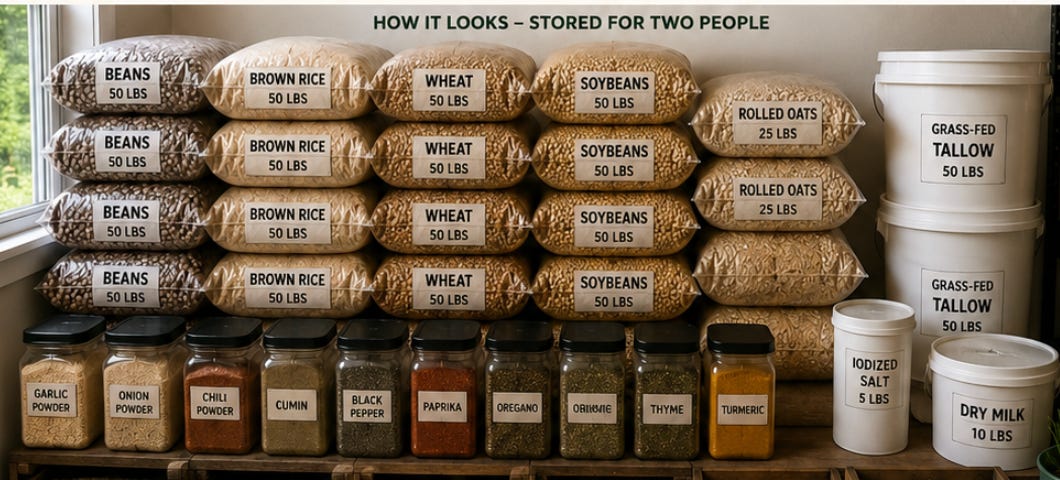
What would happen if a household had a pantry containing:
50 pounds of beans
50 pounds of brown rice
50 pounds of wheat
50 pounds of soybeans
50 pounds of rolled oats
50 pounds of grass-fed tallow
Along with:
iodized salt
dry milk
spices
greens from gardening, foraging, or sprouting
and two eggs a day per person
Could a person or two people actually live on that?
The answer is yes. Not only survive, but likely remain healthier than many Americans currently eating what passes for the modern “standard diet.”
When the calories are added up, this pantry contains roughly 630,000 to 700,000 calories, depending on the exact composition of the oats, soybeans, and tallow. Supplemented with eggs, greens, dry milk, and sprouted foods, this reserve would sustain two adults for approximately 10 to 12 months at about 1,800 calories per person per day.
What appears visually to be a relatively modest stack of bulk dry goods in a spare room or basement corner can quietly represent nearly a full year of food security for a couple.
Now, meat is excluded from this particular exercise, as this is a basic survival plan for the existential emergency. Some of us may have access to butchered animals, but not all. If you do, consider yourselves lucky. And most likely, you probably live in the country.
That said, add in meat - and this is the diet of past generations. And it isn’t all that hard to live on, as long as one has the cooking and preparation skills necessary. And both are easily learned.
The cost?
Depending on whether one buys conventional or organic staples, somewhere around three to six dollars per person per day.
That figure alone should force some uncomfortable reflection.
Modern Americans routinely spend ten times that amount on food. Often more. Yet despite the extraordinary expense, the United States now suffers epidemic levels of obesity, diabetes, fatty liver disease, inflammatory bowel disorders, cardiovascular disease, and metabolic dysfunction.
We are simultaneously overfed and undernourished. Yet this simple diet provides the calories, protein, carbohydrates, and nutrients a human body needs.
The modern food economy is built less around nourishment than around convenience, novelty, branding, emotional gratification, and engineered hyper-palatability. Entire industries now exist to transform cheap commodity crops into brightly packaged edible entertainment products designed to override satiety mechanisms and maximize repeat consumption.
This is not an accident. It is a business model.
At 6 bucks a day, this organic diet costs $180 a month.
or about $2,150 per person per year.
Meanwhile, the humble pantry staples that nourished civilizations for centuries are treated as symbols of deprivation or eccentricity.
Beans. Rice. Wheat. Oats. Eggs.
Milk. Greens. Animal fat.
These are now viewed by many Americans almost as “poverty foods,” despite the fact that they formed the backbone of countless traditional diets associated with physical resilience, lower obesity rates, stable family economies, and long-term food security.
The truth is that staples feed people.
Brands sell lifestyles.
Rolled oats are a particularly interesting addition to this thought experiment because they solve multiple problems at once.
They are inexpensive. They store well. They are calorie-dense. They provide soluble fiber beneficial for metabolic health and gut function. They are versatile. Oatmeal can be breakfast, bread extender, soup thickener, porridge, granola, or added to baked goods. Combined with dry milk, spices, and eggs, oats become an extraordinarily nutritious and comforting staple food.
A pantry with oats also feels psychologically more complete. Humans do not simply require calories. They require rhythm, familiarity, and comfort. A warm bowl of oats on a cold morning matters more than nutrition spreadsheets acknowledge.
Now, to be clear, this hypothetical pantry is not glamorous. Nobody is claiming that living indefinitely on bulk grains, legumes, oats, tallow, powdered milk, and eggs represents culinary nirvana. Humans crave variety. Appetite fatigue is real. Morale matters.
That is where the garden, the herb patch, the sprouting jars, and the spice shelf enter the picture.
Historically, cultures that survive on staple foods have learned to make simple ingredients endlessly adaptable. Garlic. Onion. Vinegar. Rosemary. Thyme. Chili powder. Curry. Mustard. Fermentation. Pickling. Sprouting. Bone broths. Fresh greens.
The difference between deprivation and abundance often lies less in luxury than in skill.
A pot of beans becomes chili. Lentil stew. Curry. Soup. Mash. Flatbread filling. Fermented paste. Rice changes character entirely depending on seasoning and preparation. Wheat becomes porridge, bread, pancakes, noodles, dumplings, or sprouted grain. Oats become breakfast, cookies, savory porridge, oatcakes, or a thickening for stews.
Traditional households understood this intuitively because they had no choice. Modern consumers increasingly do not because food preparation itself has been outsourced.
And this is where the prepper angle intersects with something deeper than disaster planning.
Preparedness is not paranoia.
Preparedness used to be called housekeeping or, even better, the domestic arts.
For most of human history, resilient households maintained stores of staple foods, preserved fats, seeds, root vegetables, grains, dried beans, oats, and salt. They kept chickens. They gardened. They preserved surplus harvests. They knew how to cook from raw ingredients because daily survival required it.
What many now call “prepping” was once simply normal adult competence.
A household possessing:
bulk staples
rolled oats
stored fats
laying hens
a productive garden
preserved foods
clean water
and basic cooking knowledge
is extraordinarily resilient compared to a household dependent on:
daily grocery deliveries
takeout apps
frozen dinners
ultra-processed snacks
and fragile just-in-time supply chains.
The COVID period briefly exposed how thin the illusion of abundance really was. Grocery shelves emptied rapidly. Supply chains faltered. Prices surged.
Suddenly, millions of Americans discovered that they possessed only a few days’ worth of food at home and little practical knowledge of how to improvise when systems became unstable.
The irony is that the solutions are neither exotic nor expensive.
The old ways still work.
Beans still store well. Rice still feeds billions. Oats still nourish. Eggs remain nutritional powerhouses. Animal fats remain dense, stable calorie sources. Gardens still produce food. Sprouting still converts dry seeds into fresh nutrition during winter months. Dry milk still provides calcium and protein cheaply. Salt still matters.
There is also a psychological component that deserves attention.
Consumer culture trains people to associate security with endless purchasing. But genuine resilience often comes from reducing dependency, not increasing consumption.
A person who knows how to turn simple staples into nourishing meals is harder to manipulate through fear, scarcity, inflation, or supply disruptions.
Self-reliance has always carried political implications.
The modern economy depends heavily on perpetual consumption, dependence on convenience, and learned helplessness. Citizens who lose the ability to feed themselves from basic ingredients become permanently dependent on industrial systems they neither understand nor control.
That dependence creates vulnerability.
The prepper pantry thought experiment strips away the illusion and asks a simple question:
How much food does a human being actually require to remain healthy?
The answer is: far less money, far fewer processed products, and far more practical knowledge than modern society would have us believe.
Our grandparents understood this. Many homesteaders still do.
The pantry, the garden, the hens, the root cellar, the oats, the spice rack, the soup pot, and the mason jar are not relics of a backward past.
They are technologies of resilience.
JGM/RWM
Homesteading for Health
This, along with meat and fish, should be the only thing eligible for the SNAP cards that our government forces us to fund with our tax dollars. Using government funds to buy soda, cake, cookies and candy, that only make the indigent fatter, lazier and sicker is madness. Vote out the Congressional parasites that force this insanity on hardworking American taxpayers.
You forgot chocolate. As you said in a previous post, dinosaurs didn’t have chocolate and look what happened to them.